
2014年PEP新版五年级英语上册Unit5教案
五年级上册英语教案Unit 5 There is a big bed教学目标1. 掌握A、B部分“Let’s learn”,“Let’s talk”中的词汇和句子。
2. 能理解There be句型的含义并灵活运用There be句型进行问答练习。
3. 能用适当的介词描述物体的方位。
4. 掌握双元音/ei/在单词中的发音。
5. 能读懂“Story time”部分的趣味故事。
6. 能听懂、会唱歌曲“A photo of me”。
7. 鼓励学生多参加课堂活动,提高学生学好英语的自信心。
教学重点1. 掌握A、B部分“Let’s learn”,“Let’s talk”中的词汇和句子。
2. 能理解There be句型的含义并灵活运用There be句型进行问答练习。
教学难点1. 能用适当的介词描述物体的方位。
2. 掌握双元音/ei/在单词中的发音。
教学安排第一课时:A. Let’s learn A. Let’s play第二课时:A. Let’s try A. Let’s talk第三课时:B. Let’s learn B. Find and say第四课时:B. Let’s try B. Let’s talk第五课时:A. Let’s spell B. Let’s wrap it up第六课时:B. Read and write B. Let’s check C. Story time第一课时课时目标1. 能听、说、读、写单词“clock”,“plant”,“bike”,“water bottle”和“photo”,并能用句型“There is …”表达某处有某物。
2. 能做“Let’s play”部分的游戏。
3. 培养学生积极与他人合作的优良品质。
4. 教育学生要热爱自己的家。
教学重点1. 能听、说、读、写单词“clock”,“plant”,“bike”,“water bottle”和“photo”,并能用句型“There is …”表达某处有某物。
2. 能做“Let’s play”部分的游戏。
教学难点There be句型的简单运用。
教学准备1. 教师准备多媒体课件、录音机和录音带、图片、衣服实物。
2. 学生准备画笔和画纸。
教学过程一、课前热身(Warm-up)1. Free talkT: Good morning, everyone. How are you today?Ss: Fine, thank you. And you?T: I’m fine, too.2. 教师播放歌曲“What can you do?”的录音,全班学生跟着录音大声唱歌曲,创设学习英语的氛围。
二、课前预习(Preview)1. T: You can do so many things. You’re helpful. Look! The room is clean and beautiful. (课件出示一间干净、整齐的房间)T: What can you see in this picture?S: I can see a bed, a desk and a …2. 教师依次指着图片中的bed, window, desk, picture, chair问:“What’s this?”,学生回答:“It’sa / an …”并快速拼读。
T: This is a nice room. I want to make this room nicer. So I need to put more things in this room.三、新课呈现(Presentation)1. A. Let’s learn(1) 教学新单词T: First, let’s put a clock in the room. (教师边说边点击课件,房间的墙上出现一个钟表) Now there is a clock in the room. Follow me, pleas. Clock, c-l-o-c-k, clock, there is a clock.教师用同样的方法引出词语:plant, water bottle, bike, photo(2) 教师用“唱反调”的方式带领学生读几遍新词汇。
(3) 教师介绍张鹏的房间。
T: Do you know what Zhang Peng’s room like? Let’s go and see.(4) 第一次播放教学录音,全班学生跟着录音读,了解对话的大致内容。
(5) 学生同桌合作,用句型“There is ...”介绍自己班级的物体。
2. A. Let’s play(1) 教师请三位学生上讲台,表演本部分的“句子接龙”游戏。
(2) 学生三人一组,模仿示例表演“句子接龙”游戏,然后教师请两三组学生上讲台表演。
四、巩固延伸(Consolidation & Extension)1. 画一画教师说:“There is a clock, a chair, a bed … in my room.”,学生根据教师的描述画图。
2. 情感教育:Everybody has his own house. The house is a loving bay. The house is a lasting marriage. I love my house.3. 课堂练习——填入所缺字母,完成单词:①瓶子bot __ __ e ②时钟clo __ __ ③自行车 b __ __ e④水w __ t __ r ⑤照片pho __ __ ⑥植物pl __ __ t4. Check the answer① tl, ② ck, ③ ik, ④ ae, ⑤ to, ⑥an五、课堂小结(Summary)师生一起总结本节课学习的词汇和句型,学生说说自己还有哪些不懂的地方。
六、布置作业(Homework)1. 将本节课学习的新单词在四线三格内抄写六遍。
2. 跟着录音朗读本节课所学习的内容。
板书设计Unit 5 There is a big bedA. Let’s learn A. Let’s playThis is my room. There is a clock, a …第二课时课时目标1. 能听、说、认读单词“there”。
2. 能灵活运用There be句型介绍房间内有什么,并用适当的形容词描述房间内的物体。
3. 能完成“Let’s try”部分的听力任务。
4. 激发学生与他人进行合作、交流的欲望,加强学生对彼此的了解。
教学重点1. 能听、说、认读单词“there”。
2. 能灵活运用There be句型介绍房间内有什么,并用适当的形容词描述房间内的物体。
教学难点1. There be句型的用法。
2. 激发学生与他人进行合作、交流的欲望。
教学准备1. 教师准备多媒体课件、录音机和录音带、图片。
2. 学生准备画笔和画纸、人物头饰。
教学过程一、课前热身(Warm-up)1. Free talkT: Hello, boys and girls.Ss: Hello, teacher.T: How are you today?Ss: Fine, thank you. And you?T: I’m fine, too.2. 教师出示图片,学生说出相应的单词,复习上节课学习的新词汇。
二、课前预习(Preview)活动:猜一猜教师出示六幅卧室图,与学生进行对话,如:T: I have six photos of bedroom. Do you know which one is my bedroom? You can ask me: What’s in your bedroom? Who want to have a try?S1: What’s in your bedroom?T: There is …S2: Oh, the second photo is your bedroom.T: Yes, the second photo is my bedroom. You’re right.三、新课呈现(Presentation)A. Let’s talk1. 教师再次出示自己的卧室图片,让学生同桌用There be句型说一说卧室里面有什么,并对卧室里的物体进行评价,如:S1: There is a water bottle in the bedroom.S2: Oh, it’s nice.S1: There is a photo on the wall.S2: I like the photo. X…2. 介绍对话情景T: There is a photo of Zhang Peng’s room. Sarah and Zhang Peng are talking about the room. Let’s listen to the tape and know something about their talking.3. 第一次播放教学录音,全班学生跟着录音读。
第二次播放教学录音,学生听完录音后回答下面问题:① Is Zhang Peng’s room nice?② Is the bed big or small?③ Where is the computer?Answer:① Yes, it is.② It’s big.③ It’s on the desk.第三次播放教学录音,全班学生跟着录音读,提醒学生在跟读的过程中药注意模仿录音中的语音、语调。
4. 学生拿出人物头饰,同桌合作练习表演对话,然后教师请几对学生上讲台表演,评选出“最佳表演者”,并给予小礼物作为奖励。
5. Describe the picture教师出示情景图,学生用There be句型描述房间里有些什么物体。
四、巩固延伸(Consolidation & Extension)1. A. Let’s try(1) 明确听力任务T: Sarah and Mike are in Zhang Peng’s bedroom. What’s in the room? I’ll play the tape and you should tick the right picture.(2) 先让学生观察图片,然后播放教学录音。
播放第一遍录音,学生选出正确的图片;播放第二次录音时,师生一起核对答案。
2. Talk and draw学生结对合作,一名学生用自己学习过的句型(如:I have … / There is / are …)描述自己的房间,另一名学生根据描述在空房间内画出相应的物品,然后交换角色练习。
比一比谁画得更像、更好。
2014PEP五年级上册第五单元UNIT 5 备课
Steps 1:Warm up exercises:
1. Sing an English song《What can you see?》
2. Make a free talk T~S.
A: this is my room ?
B: there is a /an…
3.Review the dialogue last class with the video.
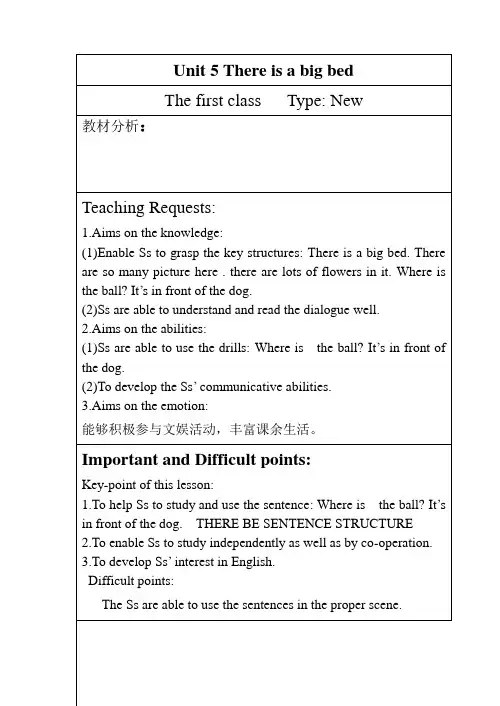
(2)To develop the Ss’ communicative abilities.
3.Aims on the emotion:
能够积极参与文娱活动,丰富课余生活。
Important and Difficult points:
Key-point of this lesson:
1.To help Ss to study and use the sentence:Where is the ball? It’s in front of the dog.THERE BE SENTENCE STRUCTURE
2. Say the new dialogue to their parents.
(Purpose:课后延伸练习,模范语音语调,规范学生发音。通过向父母展示增加其成就感)
Bb writing design:
Unit 5 There is a big bed
what is in the room?
There is a big bed .
Step 4:Sum up
What have we learned today?
what is in the room ?
There is a desk.
PEP 小学英语五年级上册 Unit 5 My new room教案
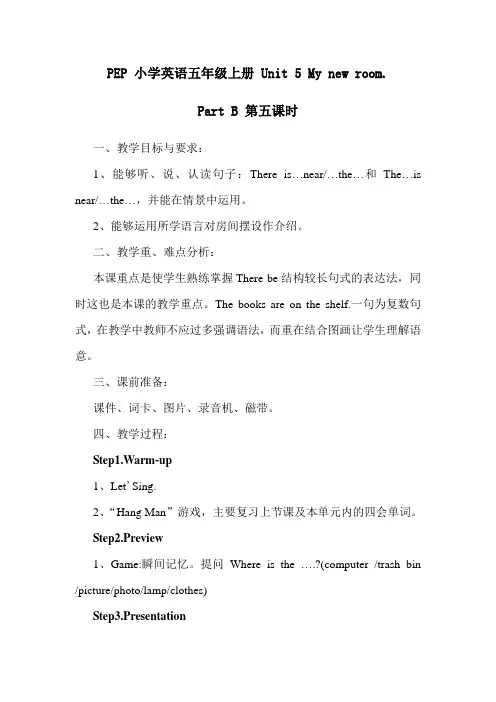
PEP 小学英语五年级上册 Unit 5 My new room.Part B 第五课时一、教学目标与要求:1、能够听、说、认读句子:There is…near/…the…和The…is near/…the…,并能在情景中运用。
2、能够运用所学语言对房间摆设作介绍。
二、教学重、难点分析:本课重点是使学生熟练掌握There be结构较长句式的表达法,同时这也是本课的教学重点。
The books are on the shelf.一句为复数句式,在教学中教师不应过多强调语法,而重在结合图画让学生理解语意。
三、课前准备:课件、词卡、图片、录音机、磁带。
四、教学过程:Step1.Warm-up1、Let’ Sing.2、“Hang Man”游戏,主要复习上节课及本单元内的四会单词。
Step2.Preview1、Game:瞬间记忆。
提问Where is the ….?(computer /trash bin /picture/photo/lamp/clothes)Step3.Presentation1、出示Let’s talk 录音动画.2、操练There are… There is 句型3、让学生介绍自己的房间.拿出事先完成的设计图及句子.让学生上台仿照Let’s talk 介绍自己的房间.并可以用Where is/are the…? 操练方位单词.4、拓展Design the living room.5、轻松一刻.Let’s sing.6、B Let’s talk部分活动手册配套练习。
Step4. extension1、课外阅读理解.Step5.HomeworkTalk about your room with your classmate.。
PEP新版五年级英语上册Unit5教案
PEP新版五年级英语上册Unit5教案课时安排- 第一课时:Greeting and Weather(约25分钟)- 第二课时:Days and Dates(约25分钟)- 第三课时:Daily Routines(约25分钟)- 第四课时:Classroom Objects(约25分钟)- 第五课时:Revision and Assessment(约35分钟)教学目标1. 研究和掌握与问候和天气相关的词汇和句型。
2. 研究和掌握有关日期和星期的表达方式。
3. 研究和掌握日常活动的词汇和句型。
4. 研究和掌握教室里的物品名称。
5. 复并进行知识评估。
教学内容第一课时:Greeting and Weather- 视频播放:介绍问候和天气的常用词汇和句型。
- 听力练:听录音,选择正确的答案。
- 口语练:与同伴进行问候和谈论天气的对话练。
第二课时:Days and Dates- 视频播放:介绍表达日期和星期的常用词汇和句型。
- 听力练:听录音,填写正确的日期和星期。
- 口语练:与同伴进行日期和星期的对话练。
第三课时:Daily Routines- 视频播放:介绍表达日常活动的常用词汇和句型。
- 听力练:听录音,选择正确的描述图片的句子。
- 口语练:与同伴进行日常活动的对话练。
第四课时:Classroom Objects- 视频播放:介绍教室里常见的物品名称。
- 听力练:听录音,选择正确的物品名称。
- 口语练:与同伴进行物品名称的对话练。
第五课时:Revision and Assessment- 复前四课的内容。
- 进行知识评估:听力和口语练。
教学过程1. 播放视频,让学生熟悉相关词汇和句型。
2. 听力练和口语练,以巩固学生的掌握程度。
3. 引导学生进行对话练,鼓励他们积极参与。
4. 复前几课的内容,并进行评估。
教学资源- 视频资源:问候和天气、日期和星期、日常活动、教室物品。
- 听力材料和练题。
课堂评估- 听力练的成绩。
人教PEP版五年级英语上册《Unit5》精品教案教学设计小学优秀公开课3

教学内容
Part A Let’s try Let’s talk
第 1 课时
总课时数:
知识目标:能用句型 There is a …on/in…表达某地有某物。
教学目标 能力目标:听懂本课对话并能在情景中灵活运用。
音内容圈出正确的选项。
(3) 再次播放教学录音,师生一起核对答
案。
2. Look, listen and write
(1) 先让学生观察本部分的图片,然后教
师播放教学录音,全班学生根据录音内容
填空。
(2) 再次播放教学录音,师生一起核对答
案。
(3) 让学生选择自己喜欢的一句话,并把
其在四线三格中抄写两遍。
教学重点
能够听说读写四会单词 clock,photo,plant,bike,water bottle,并能熟练掌握 句子 This is my room.There is a clock,a…
教学难点 再次巩固同时熟练掌握并灵活运用本课四会单词和 There be 句型。
教学方法 情景教学法 任务教学法
呈现任务,让学生 在任务驱动下进入
布置任务
学习状态。
A.let’s spell
(1) 呈现例词
教师用多媒体依次呈现本部分的图片,引
出例词,并把例词写在黑板上。
rainy/rainbow/paint/wait/say/way/bi 回忆旧知,以旧带
rthday/Monday
新。
3.Presentati (2) 播放本部分的教学录音,全班跟着录 运用 phonics 教学
知识目标:能够听说读写四会单词 clock,photo,plant,bike,water bottle,并
完整word版-PEP新版五年级英语上册Unit5教案
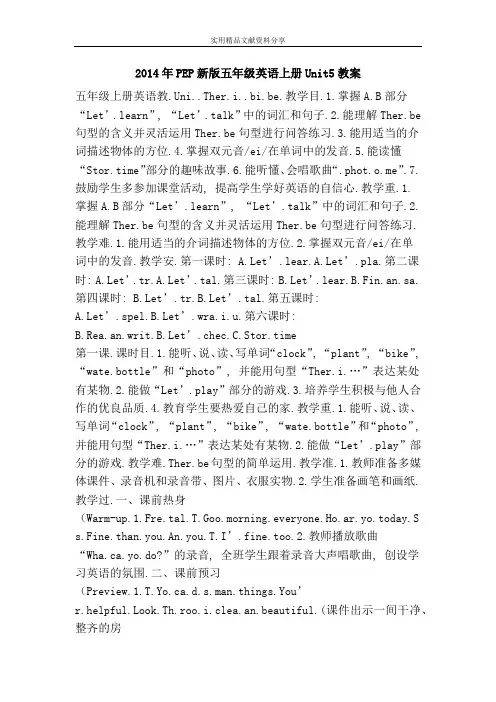
2014年PEP新版五年级英语上册Unit5教案五年级上册英语教.Uni..Ther.i..bi.be.教学目.1.掌握A.B部分“Let’.learn”, “Let’.talk”中的词汇和句子.2.能理解Ther.be 句型的含义并灵活运用Ther.be句型进行问答练习.3.能用适当的介词描述物体的方位.4.掌握双元音/ei/在单词中的发音.5.能读懂“Stor.time”部分的趣味故事.6.能听懂、会唱歌曲“.phot.o.me”.7.鼓励学生多参加课堂活动, 提高学生学好英语的自信心.教学重.1.掌握A.B部分“Let’.learn”, “Let’.talk”中的词汇和句子.2.能理解Ther.be句型的含义并灵活运用Ther.be句型进行问答练习.教学难.1.能用适当的介词描述物体的方位.2.掌握双元音/ei/在单词中的发音.教学安.第一课时: A.Let’.lear.A.Let’.pla.第二课时: A.Let’.tr.A.Let’.tal.第三课时: B.Let’.lear.B.Fin.an.sa.第四课时: B.Let’.tr.B.Let’.tal.第五课时:A.Let’.spel.B.Let’.wra.i.u.第六课时:B.Rea.an.writ.B.Let’.chec.C.Stor.time第一课.课时目.1.能听、说、读、写单词“clock”, “plant”, “bike”, “wate.bottle”和“photo”, 并能用句型“Ther.i.…”表达某处有某物.2.能做“Let’.play”部分的游戏.3.培养学生积极与他人合作的优良品质.4.教育学生要热爱自己的家.教学重.1.能听、说、读、写单词“clock”, “plant”, “bike”, “wate.bottle”和“photo”, 并能用句型“Ther.i.…”表达某处有某物.2.能做“Let’.play”部分的游戏.教学难.Ther.be句型的简单运用.教学准.1.教师准备多媒体课件、录音机和录音带、图片、衣服实物.2.学生准备画笔和画纸.教学过.一、课前热身(Warm-up.1.Fre.tal.T.Goo.morning.everyone.Ho.ar.yo.today.S s.Fine.than.you.An.you.T.I’.fine.too.2.教师播放歌曲“Wha.ca.yo.do?”的录音, 全班学生跟着录音大声唱歌曲, 创设学习英语的氛围.二、课前预习(Preview.1.T.Yo.ca.d.s.man.things.You’r.helpful.Look.Th.roo.i.clea.an.beautiful.(课件出示一间干净、整齐的房间.T.Wha.ca.yo.se.i.thi.picture.S..ca.se..bed..des.an...2.教师依次指着图片中的bed.window.desk.picture.chair问: “What’.this?”, 学生回答: “It’...a.…”并快速拼读.T.Thi.i..nic.room..wan.t.mak.thi.roo.nicer.S..nee.t.pu.m or.thing.i.thi.room.三、新课呈现(Presentation.1.A.Let’.lear.(1.教学新单.T.First.let’.pu..cloc.i.th.room.(教师边说边点击课件, 房间的墙上出现一个钟表.No.ther.i..cloc.i.th.room.Follo.me.pleas.Clock.c-l-o-c-k .clock.ther.i..clock.教师用同样的方法引出词语:plant.wate.bottle.bike.phot.(2.教师用“唱反调”的方式带领学生读几遍新词汇.(3.教师介绍张鹏的房间.T.D.yo.kno.wha.Zhan.Peng’.roo.like.Let’.g.an.see.(4.第一次播放教学录音, 全班学生跟着录音读, 了解对话的大致内容.(5.学生同桌合作, 用句型“Ther.i....”介绍自己班级的物体.2.A.Let’.pla.(1.教师请三位学生上讲台, 表演本部分的“句子接龙”游戏.(2.学生三人一组, 模仿示例表演“句子接龙”游戏, 然后教师请两三组学生上讲台表演.四、巩固延伸(Consolidatio..Extension.1.画一.教师说:“Ther.i..clock..chair..be..i.m.room.”, 学生根据教师的描述画图.2.情感教育:s tin.marriage..lov.m.house.3.课堂练习――填入所缺字母, 完成单词..瓶.bo._._...时.cl._._..自行.._._....._.._...照.ph._._..植.p._._..4.Chec.th.answe..tl..ck..ik..ae..to..a.五、课堂小结(Summary.师生一起总结本节课学习的词汇和句型, 学生说说自己还有哪些不懂的地方.六、布置作业(Homework.1.将本节课学习的新单词在四线三格内抄写六遍.2.跟着录音朗读本节课所学习的内容.板书设.Uni..Ther.i..bi.be.A.Let’.lear.A.Let’.pla.cloc.plan.bo ttl.wate.bottl.bik.phot.Thi.i.m.room.Ther.i..clock..…第二课.课时目.1.能听、说、认读单词“there”.2.能灵活运用Ther.be 句型介绍房间内有什么, 并用适当的形容词描述房间内的物体.3.能完成“Let’.try”部分的听力任务.4.激发学生与他人进行合作、交流的欲望, 加强学生对彼此的了解.教学重.1.能听、说、认读单词“there”.2.能灵活运用Ther.be句型介绍房间内有什么, 并用适当的形容词描述房间内的物体.教学难.1.Ther.be句型的用法.2.激发学生与他人进行合作、交流的欲望.教学准.1.教师准备多媒体课件、录音机和录音带、图片.2.学生准备画笔和画纸、人物头饰.教学过.一、课前热身(Warm-up.1.Fre.tal.T.Hello.boy.an.girls.Ss.Hello.teacher.T .Ho.ar.yo.today.Ss.Fine.than.you.An.you.T.I’.fine.too.2.教师出示图片, 学生说出相应的单词, 复习上节课学习的新词汇.二、课前预习(Preview.活动: 猜一.教师出示六幅卧室图, 与学生进行对话,如.T..hav.si.photo.o.bedroom.D.yo.kno.whic.on.i.m.bedroom.Y o.ca.as.me.What’.i.you.bedroom.Wh.wan.t.hav..try.S1.What’.i.you.bedroom.T.Ther.i..S2.Oh.th.secon.phot.i.you.bedroom. T.Yes.th.secon.phot.i.m.bedroom.You’r.right.三、新课呈现(Presentation.A.Let’.tal.1.教师再次出示自己的卧室图片, 让学生同桌用Ther.be句型说一说卧室里面有什么, 并对卧室里的物体进行评价,如.S1.Ther.i..wate.bottl.i.th.bedroom.S2.Oh.it’.nice.S1.Th er.i..phot.o.th.wall.S2..lik.th.photo..2.介绍对话情.T.Ther.i..phot.o.Zhan.Peng’.room.Sara.an.Zhan.Pen.ar.ta lkin.abou.th.room.Let’.liste.t.th.tap.an.kno.somethin.abou .thei.talking.3.第一次播放教学录音, 全班学生跟着录音读.第二次播放教学录音, 学生听完录音后回答下面问题..I.Zhan.Peng’.roo.nice..I.th.be.bi.o.small..Wher.i.th.c omputer.Answer..Yes.i.is..It’.big..It’.o.th.desk.第三次播放教学录音, 全班学生跟着录音读, 提醒学生在跟读的过程中药注意模仿录音中的语音、语调.4.学生拿出人物头饰, 同桌合作练习表演对话, 然后教师请几对学生上讲台表演, 评选出“最佳表演者”, 并给予小礼物作为奖励.5.Describ.th.pictur.教师出示情景图, 学生用Ther.be句型描述房间里有些什么物体.四、巩固延伸(Consolidatio..Extension.1.A.Let’.tr.(1.明确听力任.T.Sara.an.Mik.ar.i.Zhan.Peng’.bedroom.What’.i.th.room.I’l.pla.th.tap.an.yo.shoul.tic.th.righ.picture.(2.先让学生观察图片, 然后播放教学录音.播放第一遍录音, 学生选出正确的图片;播放第二次录音时, 师生一起核对答案.2.Tal.an.dra.学生结对合作, 一名学生用自己学习过的句型(如: .hav...Ther.i..ar.…)描述自己的房间, 另一名学生根据描述在空房间内画出相应的物品,然后交换角色练习。
PEP五年级上册unit5教案

…
导入:
由一个box引出猜想:盒子里有什么?从中引出closet的教学
Closet记忆法
Closet=clo(衣服)+set(放置)
衣柜就是放衣服的地方
由谜语,图片,实物出示等方式教学其他单词
What’s missing?
Repair the furniture(修理家具)
Wanyu says:
I have my own(自己的)house.
I have my own room.
I have my own car.
Xiaoxian says:
2.T:Do you know whereisthe furniture from?It isfromLove Apartment.Do you love it? Let’s go andhave a look, Ok?
3.出示爱情公寓主角图片,问学生一些问题:Who’s he/she? What’s he/she like?
2. T: Now, let’s have a chant together,ready? let’s go!
The end tables are big, big, big, big.
The curtains are blue, blue, blue, blue.
The garbage is empty, empty, empty, empty.
3、能够听懂、会唱歌曲“My Small Bedroom”。
教学重点难点
教学重点
1、正确认读出本课出现的单词:curtain, closet, mirror, end table, trash bin, air-conditioner,并知其意;
2014PEP新版五级英语上册Unit5教案
五年级上册英语教案Unit 5 There is a big bed教案目标1. 掌握A、B部分“Let’s learn”,“Let’s talk”中的词汇和句子。
2. 能理解There be句型的含义并灵活运用There be句型进行问答练习。
3. 能用适当的介词描述物体的方位。
4. 掌握双元音/ei/在单词中的发音。
5. 能读懂“Story time”部分的趣味故事。
6. 能听懂、会唱歌曲“A photo of me”。
7. 鼓励学生多参加课堂活动,提高学生学好英语的自信心。
教案重点1. 掌握A、B部分“Let’s learn”,“Let’s talk”中的词汇和句子。
2. 能理解There be句型的含义并灵活运用There be句型进行问答练习。
教案难点1. 能用适当的介词描述物体的方位。
2. 掌握双元音/ei/在单词中的发音。
教案安排第一课时:A. Let’s learn A. Let’s play第二课时:A. Let’s try A. Let’s talk第三课时:B. Let’s learn B. Find and say第四课时:B. Let’s try B. Let’s talk第五课时:A. Let’s spell B. Let’s wrap it up第六课时:B. Read and write B. Let’s check C. Story time第一课时课时目标1. 能听、说、读、写单词“clock”,“plant”,“bike”,“water bottle”和“photo”,并能用句型“There is …”表达某处有某物。
2. 能做“Let’s play”部分的游戏。
3. 培养学生积极与他人合作的优良品质。
4. 教育学生要热爱自己的家。
教案重点1. 能听、说、读、写单词“clock”,“plant”,“bike”,“water bottle”和“photo”,并能用句型“There is …”表达某处有某物。
(PEP)五年级英语上册教案 Unit 5 Part A Let’s learn
Part A Let’s learn & Let’s play教学内容与目标学生能够听、说、读、写单词和词组“clock, photo, bike, plant, water bottle”。
学生能够熟练地运用上述单词和词组介绍房间内物品。
学生能够在“滚雪球”游戏中正确运用核心词汇和句型。
教学重点学生能够听、说、读、写并熟练运用核心词汇及句型。
教学难点学生能够在语境中灵活运用所学词汇及核心句型。
教学准备PPT课件、课文录音等。
教学过程Step 1: Warm-up & Revision & Lead-in1. Greetings.2. I do and you say.The teacher does some actions (It can be done with the help of the PPT.) and students say sentences with “There is…” like this: The teacher puts an apple on the plate. Students say “There is an apple on the plate.” These words can be used: pen/desk/book/bag…3. Retell the dialogue.Show the picture of “Let’s talk” on page 48. (出示课件) Let students look at the picture and retell the dialogue.Step 2: Presentation1. Learn the new words and phrase of “Let’s learn”.(1)Learn the new word “photo”.T: This is Zhang Peng’s room. (Point to the photo.) So what’s this on the wall?Ss: …T: Yes, it’s Zhang Peng’s photo. It’s a nice photo.Teach the word “photo”. Lead students to practice the word in a high and low voice. Show some students’ photos on the PPT and say with students like these: S1’s photo, S2’s photo…Write down the word “photo” on the blackboard. Ask students to pay attention to the sound of the letter “o”. Ask students to fill in the blanks: _ _ oto, ph_t_, pho_o.Lead students to practice the sentence patterns “There is a nice/beautiful/funny/cool/…photo in/on…” in groups.Show a picture and a photo to students. (出示课件)T: Look! This is a picture. I can draw a picture. (with the action of“drawing”). This is a photo. It’s Zhang Peng’s photo.Explain the difference between the two words. Lead students to practice with “There is a picture/photo in/on…”(2)Learn the new word “clock”.T: Zhang Peng is a student. He is never late for school, because the clock helps him a lot. (课件出示:先出现张鹏房间图片,后聚焦在clock上面) T: Look! This is Zhang Peng’s clock.Teach the word “clock”. Lead students to practice the word in a high and low voice. Write it down on the blackboard. Ask students to pay attention to the sound of the letter “o”. Ask students to fill in the blanks: cl_ck, clo_ _ , c_o_ _ .Show various clocks. (出示课件) Let students practice the sentence patterns “There is a funny/yellow…clock in Zhang Peng’s room.”(3)Learn the new word “bike”.T: Zhang Peng goes to school by bike. (Point to the bike.) Look, this is his bike. It’s near the door.Teach the word “bike” like this: i-/aɪ/, bike. Show the word “like” to help students read and remember the word “bike”. Lead students to practice it in a high and low voice.Write it down on the blackboard. Ask students to fill in the blanks: b_k_, _i_e.Show several bikes in different colours (red bike, blue bike…) on the PPT. (出示课件)Lead students to practice the sentence pattern “There is a red/…bike near/behind…”(4)Learn the new word “plant”.Show a picture on the PPT. (课件出示:一个男孩骑车上学,路边有一些植物)T: Look! The boy is riding a bike. (Point to a plant along the road.) What’s this?Help students answer: Plant.Teach the word “plant”. Lead students to practice the word in a high and low voice. Write it down on the blackboard. Ask students to pay attention to the sound of the letter “a”. Ask students to fill in the blanks: pl_nt, p_ant, pla_t.Lead students to practice the sentences “There is a plant./There are some plants.” one by one with some different pictures. (出示课件)At last the teacher asks: Does Zhang Peng like plants? Guess! After students guess, the teacher says: Yes. Zhang Peng likes plants. Look, there is a plant near the window in his room. And many plants can make the air fresh for us.(5)Learn the new phrase “water bottle”.T: Zhang Peng rides a bike to school every day. He’s often thirsty. So he always takes a water bottle in his bag.Teach the word “bottle”. Give the words “little, apple” to help students read and remember the word. Lead students to practice it in a high and low voice. Write down the phrase “water bottle” on the blackboard. Ask students to fill in the blanks: b_tt_e, bot_le, bo_ _le.Show some pictures and lead students to practice the phrase “water bottle, milk bo ttle” and the sentence “There is a water bottle in his bag.” (出示课件)2. Read and act.The teacher plays the recording. (出示课件) Students read after it one by one. After practicing in different ways, students try to say sentences in class like these: This is m y room. There is a clock, a… Ask students to pay attention to the position of the word “and”.Step 3: Practice1. Say in different voices.The teacher says a word in a low voice, and students say it in a high voice. The teacher says a word in a high voice, and students say it in a low voice. Practice the new words and the phrase.2. Listen and choose.The teacher says a word. Students choose the corresponding picture from the three pictures that appear at random on the PPT. (出示课件)3. What’s missing?Divide the new words and phrase into five groups. There are three words in every group. Show the groups of words on the PPT. Let students say what’s missing quickly. (出示课件)Step 4: Consolidation & Extension1. Let’s play.Show the picture and the sentences of “Let’s play” on page 49 on the PPT.(出示课件) Let students find the difference among the three sentences. Students imitate and work in groups. The teacher shows some sentences on the PPT to help students. Choose some students to show in class like these: There is a bike in my room. There is a bike and a computer in my room. There is a bike, a computer and a photo in my room.2. Listen, draw and say.Tell students what’s in the room and students draw the corresponding room. Then some students introduce the room with the sentence patterns “There is a…in the room. There is a…and a…in the room.” The others check the answers with the teacher.3. Write and say.Show a picture of a room and a passage with some blanks on the PPT. (出示课件) Ask students to finish the passage according to the information. Then let several students stand up and read their passages. The following passage can be used:This is my room. There is a ________ in my room. There is a ________. There is a ________ and a ________, too. I like my room very much. It’s clean and nice.Encourage students to introduce their own rooms. These words and phrases can be used: end table, closet, mirror, curtain, trash bin, air-conditioner, heating system…板书作业1. Listen to the recording of “Let’s learn” and rea d after it.2. Introduce your room to your parents.教学反思采用对比、自然拼读等多种方法教授单词;以学生为本,设计了丰富多样的操练活动,从音、义、形几个方面由浅入深地进行操练;学生在学中玩、玩中学,活跃了课堂气氛;注重学习方法和学习策略的培养,从根本上指导学生听、说、读、写单词。
人教PEP版五年级英语上册《Unit5》精品教案教学设计小学优秀公开课
中已经出现过。并且第一课时中已经设计了“There is…”句型,
本单元的教学内容与学生日常生活联系密切,在课堂中应鼓励学生
每天善于观察,并学习用英语表达。
学情分析
五年级的学生通过前两年的学习,对英语单词、句子的掌握有 一定的基础。本节课我会着重加强学生的口语交流,做到关注到每 一位学生,不放过每一个学生。
Peng’s room nice? Q2: Is the bed the answer to
big or small?Q3: Where is the the question
computer?
3、听录音,跟读对话,划出你不理解、
有疑惑的词语或句子。二、合作探究 :
1、在组内提出不懂的问题,相互解决。
两幅图,找出不同
提高学生兴
Compare the two pictures ,and find 之处,并用 There
趣,同时将本
the difference ,use “There is …句型进行回
课 There
is …”
答,采取小组内抢
is …句型,
答的的形式,共 5
练习巩固。
组图片。
人教 PEP 版五年级英语上册
生随教师一起做 韵律
句子轻松 引出,使学 生在愉悦
bike , there is a bike.
的氛围中
Water bottle , water bottle ,
进入本课
there is a water bottle.
堂。
人教 PEP 版五年级英语上册
1、展示 Zhang Peng’s bedroom 图片,
Presentation 部分的练习。
PEP5 五年级上册Unit5第五单元 B read and write教案
PEP英语五年级上册Unit5 There is a big bedB Read and write教学设计教学目标:知识目标:1.学生能够读懂邮件,了解邮件大意。
2.学生能够在语境中理解新单词和新词组dirty,nature park,hurry等。
3. 学生能够能够用正确的语音、语调、意群朗读邮件。
能力目标:1.学生能够在教师的帮助和图片的提示下,选出正确的房间图片,并找出依据。
2. 学生能运用核心句型,描述自己房间的物品。
3.学生能够仿写电子邮件。
情感目标:1.学生学会合理布置自己的房间,养成讲卫生的好习惯。
教学重点:1.学生能读懂邮件,并正确朗读。
2.掌握There is和There are句型的用法区别。
教学难点:1.能够用正确的格式写电子邮件。
2.运用核心句型写出句子There is和There are,描述房间的物品。
一.Warming up & revision1.Let’s singA photo of me2.Look and sayPPT: What’s in Zhang Peng’s room?There is a.../There are...T: So how is Zhang Peng’s room?PPT:The room is _______. (nice, clean, big, beautiful...)3.Show another picture of a roomT:Zhang Peng’s room is nice! But how is this room? (show the mouse)Oh, no! There is a mouse!PPT: The room is ______. (show and learn ‘dirty’)二.Presentation1.LeadT: Do you like this room?( No.)Mr jones doesn’t like the mouse. He wants a clean and nice room. And he just moved into an old house.(Show the old house and Mr Jones’s luggage, stick the pictures on the blackboard)1)Listen: I just moved into an old house.2)read:moved, into2.Read quicklyT: How is the room like? Is it clean? Read quickly and underline.(PPT shows the reading tips, then write down ‘How’ on the blackboard for the old house)1)Is the room clean?2)What’s the text about? email/diary3) check the answers(show the passage and the sentence ‘The rooms are dirty.’)(An email to Robin, To...From...,get to know the format about an email.)3.Read againT:What’s in Mr Jones’ room? Read again and circle (give reading tips, write down ‘’What’ on the blackboard)1)Students read again and circle2)Check the things. Circle them on the screen. Write down them on the blackboard.4.Read carefully and tickQ: Where are the things? (write ‘Where’ for the old house)1)Read and find the location of the things2)Tick the right picture of Mr Jones’s room3)Let’s act: Oh, no! I see a mouse behind my computer! (stick a picture of a mouse on the Bb)5.Let’s think1)Why there is a mouse in the room?S1:The rooms are dirty.T:Yes, and let’s see. Where does Mr Jones live?S2: I live near the nature park.T: Yes. He lives near the nature park.(Show the picture and sound, read ) There are so many trees and animals in the park. So we can see a mouse in his room. So he says, please help me! Please hurry!3)Listen and imitate:Please help me! Please hurry!6.Read better1)Listen and imitatePay attention to the intonation2)Read better7.Let’s retell1)Teacher and the students retell the email together, using the blackboard drawing2)Students try to retell with the Bb drawing by themselves四.Practice1.Robin’s workT: Robin reads the email and come to help. He cleans the room. He is so helpful. One day later. What’s the room like now?( show the room after cleaning)S: Look! There is... There are...(describe the room now)五.Extension1.Share Mz Zhu’s dream roomT:Oh, the room is clean and nice now! Mr Jones is so happy! (Show Mr Jones:Thank you robin! This is my dream room!) and this is his dream room. And , I have my dream room, too. Look at my room. There is.../There are...2.Design your dream room1)Students design their dream room on the sheet,and finish writhing the email to introduce their room to Mr Jones.2)Students share their pictures and emails. Check the writings together. 六.Homework.1. Read the email for five times2. Complete your design. Write an email to your friend.板书Blackboard WritingUnit5B Read and writeAn email My roomTo: robin@ There is a bed in the room.From:jones@ There are pictures on the wall.Dec. 21st Array Dear______There is a_____________.There are _____________....。