
八年级英语上册unit1where did you go on vacation导学案
Unit 1 Where did you go on vacation?Section A 1a—2d(1课时)All roads lead to Rome .条条大路通罗马。
【学习目标】1、学会谈论过去发生的事件—学习一般过去时的用法2、掌握规则动词的变换规则3、熟记一些常用的不规则动词【学习重难点】一般过去时的用法利用情景思维在理解句意的基础上理解词汇的用法记忆重点词汇句型和语法内容。
【学习过程】一、知识衔接1.带有确定的过去时间状语时要用过去时。
如:two days ago…、last year 、just now、when I was 8 years old 、yesterday ···eg: Did you have a party yesterday.2 表示过去连续发生的动作时要用过去时. 这种情况下,往往没有表示过去的时间状语,而通过上下文来表示。
The boy opened his eyes for a moment,looked at the captain and then died. 那男孩把眼睛张开了一会儿看看船长然后就去世了。
3 表示过去一段时间内经常或反复的动作常与always、never 等连用。
Mrs. Peter always carried an umbrella. 彼得太太过去老是带着一把伞。
只是说明她过去的动作不表明她现在是否常带着伞。
二、自主学习学生自学P1-2.用红笔标注不理解的内容。
然后,完成下面各题:1、翻译下列短语①待在家②去海滩③去夏令营④去山区⑤去度假⑥人和特殊的东西⑦人和有趣的人⑧人和有趣的地方2.你会把下列动词进行过去式的变化吗①look__________②play___________③live____________ ④hope__________⑤get __________⑥shop__________ ⑦study _________ ⑧am_________⑨is ⑩are________ ⑪take ⑫do三、小组合作Task 1、学生两人一组展示活动,轮流介绍自己去过的一个地方,如:I went to Beijing/ the Great wall /went to the park etc.Task 2、学生两人一组编对话讨论假期活动A:Where did you go on vacation?B:I went to the mountains.Task 3 、完成课本1a要求图文搭配。
Task 4 、听录音完成1b ,2a,2b.四.班级展示1.表演所编对话.2.说出听力部分的答案.3.表演对话2d.五.质疑探究预设: 1.不定代词用法特点 2.most作形容词与作代词的不同用法六.自悟自得达标反馈A、单项选择1.---What did you do on vacation?----I____ to New York City.A. goB. goingC. wentD. goes2. They helped me_______my books.A. findedB. findC. foundD. finding3. What____ you ___ last night?A. did. DoB. do, doC. did , doingD. are, do4. ----Where did she go on vacation?----She ___ to the beach.A. goB. goesC. wentD. going5. Did he go to Central Park?Yes, he_____.A. didB. didn’tC. doD. doesB、用动词的适当形式填空1. Tom and Mary ___________ (come) to China last month.2.Mike ________(not go) to bed until 12 o’clock last night. So I _______(get ) up late.3.Mary __________ (read) English yesterday morning.4.There _________ (be) no one here a moment ago.5.I ___________ (call) Mike this morning.6.I listened but ___________ (hear) nothing.7.Tom ___________ (begin) to learn Chinese last year.st week we _________ (pick) many apples on the farm.9.My mother ________________ (not do) housework yesterday.10. She watches TV every evening. But she (not watch) TV last night.C、用括号内动词的正确形式填空Last year Mr. Smith _____ (go ) to China and Japan. He _____ (have) a wonderful time. He _____ (do) a lot of different things and _____ (talk) to a great number of different people. He _____ (eat) Chinese and Japanese food and _____ (visit) a lot of interesting places. When he _____ (go) back to England, he _____ (be) very tired. 【课后反思】Unit 1 Where did you go on vacation?Section A 3a-3c (2课时)He who does not advance loses ground.逆水行舟,不进则退。
【学习目标】1、一般过去时的一般疑问句和答语。
2、Was\were 结构。
3、How 引导的特殊疑问句【学习重难点】1、正确运用一般过去时谈论过去发生的事,并写出简单文章。
2、能谈论自己的旅游经历,享受生活的乐趣。
【学习过程】一、知识衔接复合不定代词由some,any,no,every加上-body,-one,-thing构成的不定代词,叫做复合不定代词。
1)复合不定代词有a) somebody 某人someone某人something某物,某事b) anybody 任何人anyone 任何人anything任何事物c) nobody 无一人no one无一人nothing无一物d)everybody,everyone每人,大家,人人everything每一个事物,一切2)复合不定代词的用法a)复合不定代词只相当于名词,在句中用作主语、宾语和表语。
如:Everything is made of elements.任何东西都是元素构成的。
(作主语)I have got nothing to say.我没有什么话要说。
(作宾语)something和anything的区别与some和any的区别一样,前者一般用于肯定句、疑问句或条件状语从句中。
b)复合不定代词被形容词所修饰时,形容词须放在它们的后面。
如:There is nothing wrong with the lathe.这个车床没有毛病。
Is there anything important in today's newspaper?今天报纸上有什么重要消息吗?I need somebody strong to help me.我需要一个体格强壮的人帮助我。
二、自主学习1. 预习3页单词及3a,3b.2. 翻译短语玩的愉快买特殊的东西遇见有趣的人备考和某人外出给…买某物有趣的地方似乎很烦三、小组合作Task 1、两人一组,根据Grammar Focus讨论一般过去时的含义及用法。
Task 2、小组练习,完成3a对话。
Task 3、阅读3b, 填空。
划出难点,小组讨论。
四、班级展示1.说出行为动词和be动词的一般过去时的基本形式。
肯定式:否定式:一般疑问式:特殊疑问式:2.说出3a,3b部分答案。
五、质疑探究预设:no one与none有何区别?六、达标反馈A、单项选择()1.—How was your vacation? —It pretty good.A. isB. areC. wasD. were() 2.—How the beaches? —They were fantastic.A. isB. areC. wasD. were()3.—How the weather? —It is hot.A. isB. areC. wasD. were()4.—Did you go to Central Park? — .A. Yes, I didn’tB. Yes, I didC. No, I did()5.—What are you , Tina? —I’m homework.A. do; doing B .doing; did C. doing; doing D. did; doingB、完成对话A: Hi, Ann! How your weekend?B: It was .A: Where did you ?B: I to Tokyo with my family.A: Really? Wow! What you do there?B: Well, we went to a lot of museums.A: Oh , how were they?B: They interesting. you? Did you have a great weekend? A: No, I , I at home. It wasn’t very good.【课后反思】Unit 1 Where did you go on vacation?Section A 1a-1e(3课时)Where there is a will , there is a way. 有志者,事竟成【学习目标】1、能熟练运用一般过去式。
2、能运用be+形容词来评价事物,如:The people were friendly.【学习重难点】形容词的正确运用,根据听力材料完成练习【学习过程】一、知识衔接符合不定代词A、单数形式1、复合不定代词都具有单数的含义,因此通常被看成是单数第三人称。
八年级上册英语:Unit-1-Where-did-you-go-on-vacation试题及答案
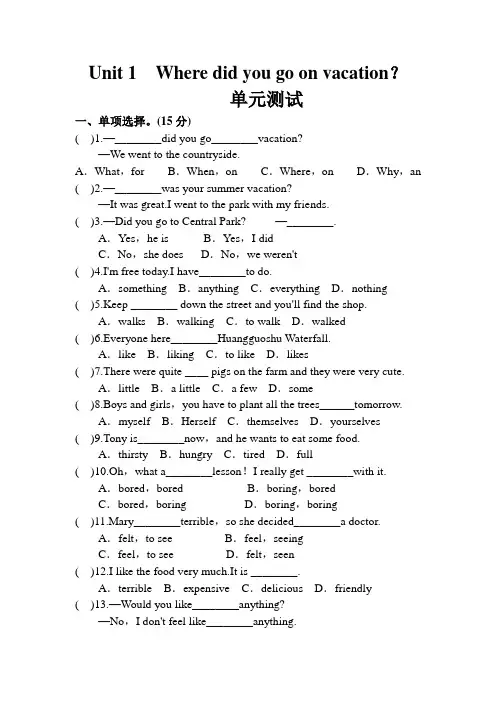
Unit 1 Where did you go on vacation?单元测试一、单项选择。
(15分)()1.—________did you go________vacation?—We went to the countryside.A.What,for B.When,on C.Where,on D.Why,an ()2.—________was your summer vacation?—It was great.I went to the park with my friends.()3.—Did you go to Central Park? —________.A.Yes,he is B.Yes,I didC.No,she does D.No,we weren't()4.I'm free today.I have________to do.A.something B.anything C.everything D.nothing()5.Keep ________ down the street and you'll find the shop.A.walks B.walking C.to walk D.walked()6.Everyone here________Huangguoshu Waterfall.A.like B.liking C.to like D.likes()7.There were quite ____ pigs on the farm and they were very cute.A.little B.a little C.a few D.some()8.Boys and girls,you have to plant all the trees______tomorrow.A.myself B.Herself C.themselves D.yourselves()9.Tony is________now,and he wants to eat some food.A.thirsty B.hungry C.tired D.full()10.Oh,what a________lesson!I really get ________with it.A.bored,bored B.boring,boredC.bored,boring D.boring,boring()11.Mary________terrible,so she decided________a doctor.A.felt,to see B.feel,seeingC.feel,to see D.felt,seen()12.I like the food very much.It is ________.A.terrible B.expensive C.delicious D.friendly()13.—Would you like________anything?—No,I don't feel like________anything.A.eating,eating B.eating,to eatC.to eat,eating D.to eat,to eat()14.—Do you like football? —______.I play it every afternoon.A.Of course B.Sorry C.That's OK D.Thanks a lot ()15.—Long time no see!—Oh!it________like years since(自从) I saw you last time.A.looks B.seems C.sounds D.tastes二、阅读理解。
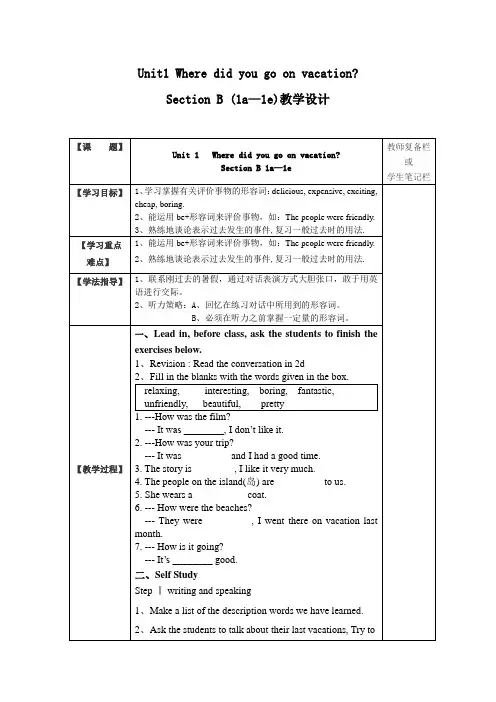
人教版八年级英语上册《Unit-1-Where-did-you-go-on-vacation》教学设计
1、First read the questions in 1c and 1d to make clear their meaning.
(Beforelistening, it is necessary to make students know what the task is and what information they should catch from the listening. Also, some writing strategies should be stressed.)
1、Revision : Read the conversation in 2d
2、Fill in the blanks with the words given in the box.
relaxing, interesting, boring, fantastic,
unfriendly, beautiful, pretty
4、Read the listening material following the tape.
三、Group work
Fill in the blanks with interrogatives.
1、A:was the weather?
B:It was sunny.
2、A:did you go on vacation?
A:39
B: They were great, and not expensive.
A: Did you enjoy the food there?
B: Yes, They were great, delicious and cheap.
B
A: What did you do on vacation?
人教版英语八年级上册 Unit 1 Where did you go on vacati

go out 出去
last month 上个月
take photos 拍照
quite a few 相当多;不少
have a good time 玩得开心 go shopping 去购物
of course 当然;自然
seem to do sth. 似乎做某事;好像做某事
keep a diary 写日记
Unit 1 Where did you go on vacation?
单元知识盘点
常用短语
on vacation 度假
go to the mountains 去爬山
stay at home 待在家里 go to the beach 去海滩
summer camp 夏令营
play volleyball 打排球
经典句型
1. ...I bought something for my father. ……我给我爸爸买了一些 东西。
2. Everything tasted really good! 所有的食物尝起来都很美味! 3. How did you like it? 你认为它(三亚)怎么样? 4. It was sunny and hot, so we decided to go to the beach near our
5. |烟台中考|—Look at my new smartphone.
—Wow, it’s so cool. When and where C you
it?
A. do; buy
B. have; bought
C. did; buy
D. have; had
6. —I have seen The Adventures of Alice in Wonderland. What
人教八年级上册Unit 1 Where did you go on vacation?(必备单词、短语及语法练习)习题 答案
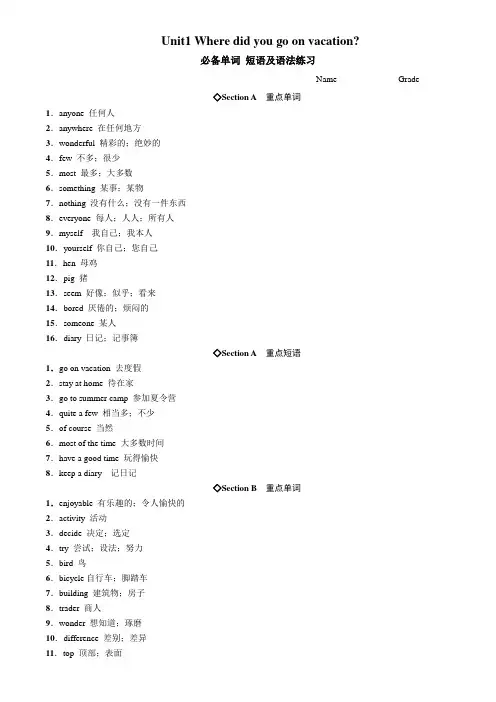
Unit1 Where did you go on vacation?必备单词短语及语法练习Name___________ Grade___________◇Section A重点单词1.anyone 任何人2.anywhere 在任何地方3.wonderful 精彩的;绝妙的4.few 不多;很少5.most 最多;大多数6.something 某事;某物7.nothing 没有什么;没有一件东西8.everyone 每人;人人;所有人9.myself 我自己;我本人10.yourself 你自己;您自己11.hen 母鸡12.pig 猪13.seem 好像;似乎;看来14.bored 厌倦的;烦闷的15.someone 某人16.diary 日记;记事簿◇Section A重点短语1.go on vacation 去度假2.stay at home 待在家3.go to summer camp 参加夏令营4.quite a few 相当多;不少5.of course 当然6.most of the time 大多数时间7.have a good time 玩得愉快8.keep a diary 记日记◇Section B重点单词1.enjoyable 有乐趣的;令人愉快的2.activity 活动3.decide 决定;选定4.try 尝试;设法;努力5.bird 鸟6.bicycle自行车;脚踏车7.building 建筑物;房子8.trader 商人9.wonder 想知道;琢磨10.difference 差别;差异11.top 顶部;表面12.wait 等待;等候13.umbrella 伞;雨伞14.wet 湿的;潮湿的;下雨的15.below 在……下面;到……下面16.enough 足够的(地);充足的(地);充分的(地)17.hungry 饥饿的18.as 像……一样;如同;当……时19.hill 小山;山丘20.duck 鸭21.dislike 不喜爱(的事物);厌恶(的事物)◇Section B重点短语1.feel like 给……的感觉;感受到2.because of 因为3.in the past 在过去4.take the train 乘火车5.get to 到达◇词形变换1.wonderful→(动词)wonder2.activity→(形容词)active3.decide→(名词)decision4.building→(动词)build5.difference→(形容词)different6.wait→(名词)waiter7.you→(反身代词)yourself/yourselves◇重点句型1.Still no one seemed to be bored.似乎仍然没有人觉得无聊。
人教版英语八年级上第一单元Unit1Wheredidyougoonvacation知识点梳理

人教版英语八年级上第一单元Unit1Wheredidyougoonvacation知识点梳理Unit 1 Where did you go on vacation?知识梳理一、词型转换Section A1.wonder →(adj.) wonderful2.I →(反身代词) myself3.you →(反身代词) yourself4.yourself →(pl.) yourselves5.seem →(pt.) seemedSection B1.activity →(pl.) activities2.decide →(n.) decision3.try →(pt.) tried4.bike →(同义词) bicycle5.build →(n.) building6.difference →(adj.) different7.like →(反义词) dislike8.below →(反义词) above二、短语归纳Section A1.go to Central Park 去中央公园2.on vacation 在度假3.buy something special 买特别的东西4.meet someone interesing 遇见有趣的人5.go out with someone 和某人一起出去6.take quite a few photos 拍相当多的照片7.most of the time 大多数时间8.go shopping 去购物9.keep a diary 记日记10.of course 当然;自然Section B1.have a good time 玩得高兴;过得愉快2.go to the beach 去海滩3.feel like 感觉像4.the houses of the Chinese traders 中国商人的房子5. a lot of new buildings 许多新的建筑物6.in the past 在过去7.over an hour 一个多小时8.too many people 太多的人9.get to the top 到达顶部10.because of the bad weather 因为不好的天气11.one bowl of fish 一碗鱼肉12.another two hours 另外两个小时13.the top of the hill 山顶14.learn something important 学习重要的东西Self Check1.go to the countryside 去乡下2.in the shopping center 在购物中心3.have a fun time 玩得高兴;过得愉快4.after three hours 三个小时以后5.keep going 一直走6.twenty minutes later 20分钟后重点句子1.Where did you go on vacation?你去哪儿度假的?2.Long time no see.好久不见。
人教版英语八年级上册UNIT1:Where-did-you-go-on-vacation教学设计

Where did you go on vacation?教学设计(Period1)一、教学目标在本节课结束时,学生将能够:学习本单元的重点短语;用一般过去时就假期活动进行问答;能够口头介绍自己假期的旅游经历等。
知识与能力:通过本课学习,学会使用目标语言进行询问并描述假期活动。
同时在描述自己国内假期活动中学会爱国。
过程与方法:采用二人对话、头脑风暴、小组活动、听力活动和预测听力内容的学习策略,PPT、图片或制作课件等来展开课堂教学、二人对话、小组活动、口头作文等进行谈论假期的经历” 的课堂教学和练习。
利用视频、“询问和本单元的教学法建议:短语教学采取情景引入展开启发式的教学方式,让学生在思考中输出自己的语言,并在句型中学会运用;语音教学让学生进行听对话并跟读听力内容,并在模仿中内化语言,输出语言;口语教学采取pair work 、 report 和口头作文对学生进行教学;听力教学采取听音填表和听音打钩等的方式进行教学,训练学生的听力能力;口头作文教学通过图片启发学生就自己的假期经历进行简单输出;语法教学让学生模仿给出的过去时句子进行模仿,并教师及时纠正。
情感态度与价值观:通过参与课题教学活动,增进同学之间的了解和友情并学会在英语交流中注意他人的情感,同时通过谈论祖国的风景名胜而增强爱国情感。
二、教学重难点教学重点:学生学习并掌握一般过去时的疑问句及答语。
教学难点:帮助学生建立使用助动词did 提问的意识及对谓语动词原形的使用。
三、教学策略语音教学让学生跟读听力材料进行模仿式操练;短语教学采取视频引入话题然后进行启发式教学,并在对话中运用;口语教学采取 pair work 问答式的口语交际活动或小组活动互相操练;听力教学采取听音填表和听音打钩等方式;口头作文教学以对话活动,小组汇报,口头作文等进行口头作文练习;语法教学通过模仿听力材料进行对话练习,在教师的纠正中培养正确的一般过去时语法意识。
四、教学过程Step 1: Lead in通过播放视频引出本节课话题“假期经历”,复习有关假期活动的短语。
初二英语上册(人教新目标)Unit1Wheredidyougoonvacation_知识点总结
初二英语上册〔人教新目标〕Unit 1 Where did you go on vacation?知识点总结一、重点词汇anyone·原文再现Did you go with anyone?有人和你一起去吗?·根本用法pron. anyone 任何人,相当于 anybody,通常用在否认句、疑问句或条件从句中。
如:I won ’ t tell anyone I saw you here.我不会告诉任何人我在这儿见过你。
Why would anyone want that job?为什么会有人想要那份工作呢?·知识拓展 ---同类词some-any-no-every-指人someone 有人anyone 任何人no one 没有人everyone 人人somebody anybody nobody everybody指物something 某物anything 任何事nothing 没有事everything 一切事指地点 somewhere某地anywhere 任何地方nowhere 无处,没有地方 everywhere 到处注意:(1)由 some-, any-, no-, every-构成的符合不定代词作主语时,都作单数看待,其谓语动词用第三人称单数形式。
(2)不定代词假设有定语修饰,该定语要置于其后,作后置定语。
如:I ’ d like something to drink.我想要些喝的。
Is there anything interesting in the book?这本书中有有趣的东西吗?anywhere·原文再现Oh,did you go anywhere interesting?哦,你去过某个有趣的地方吗?·根本用法adv./pron. anywhere 什么地方,任何地方,常用在否认句或疑问句中。
肯定句中常用 somewhere,其修饰词也常常放在其后面。
人教版英语八年级上册Unit1Wheredidyougoonvacation教案
Unit 1 Wheredid you go on vacati on?一.必记单词1. anyone pron.(不定代词)任何人nothin g pron. (不定代词)没有什么,没有一件东西someth ing pron.(不定代词)某事;某物everyon e pron. (不定代词)每人;人人;所有人someon e pron.(不定代词)某人anywhe re adv. (不定副词)在任何地方2. wonderful adj. 精彩的;绝妙的3. few adj. & pron. 不多;很少quite a few 相当多;不少Notice:few, a few, little,a little用法a few + 可数名词肯定句a little + 不可数名词肯定句few + 可数名词否定句little + 不可数名词否定句4. most adj., adv. & pron. 最多;大多数5. myself pron.我自己;我本人yourse lf pron.你自己;您自己yourse lvespl. 你们自己Notice:反身代词第一、二人称的反身代词由物主代词加-self构成。
第三人称的反身代词由代词宾格加-self构成。
Oursel ves 我们自己himsel f 他自己hersel f 她自己itself它自己Themsel ves他们自己6. hen n. 母鸡pig n. 猪bird n. 鸟duck n. 鸭7. seem v. 好像;似乎;看来8. boredadj. 厌倦的;烦闷的9. diaryn. 日记;记事簿10. activi ty n. 活动11. decide v. 决定;选定decide to do sth. 决定去做某事12. try v.& n. 尝试;设法;努力Notice: try to do sth.与try doingsth.辨析try to do sth.(尽力、设法去做某事)表示想尽一切办法要把某事办成,强调付出一定的努力设法去完成try doingsth.(尝试着做某事)表示一种尝试、做做看的想法,不一定付出很多努力Eg.: I tried calli n g him, but no one answe red. I ’m tryin g to learn Engli s h well. 13. bicyc l e n. 自行车;脚踏车 14. build i ng n. 建筑物;房子 Notic e: build (建造,建筑)+ ing ==== build i ng(建筑物) build (建造,建筑)+ er ==== build e r(建设者,建筑者) 15. trade r n. 商人 16. wonde r v . 想知道;琢磨 17. diffe r ence n. 差别;差异 ( diffe rent adj. 不同的,有差异的) 18. top n. 顶部;表面19. wait v . 等待;等候 (wait for sb./sth. 等待某人/某物) 20. umbre lla n. 伞;雨伞21. wet adj. 湿的;潮湿的;下雨的 22. below prep.& adv . 在···下面;到···下面 反义词 above 超过;在···之上 23. enoug h adj. & adv . 足够的(地);充足的(地);充分的(地) 巧记eno u gh 在句中的位置:修饰名词很自由,可以前来也可后, 若是修饰形或副,一定后置要记住。
人教新目标版英语八上Unit1《Wheredidyougoonvacation》精美说课稿
人教新目标版英语八上Unit 1《Where did you go on vacation》精美说课稿一. 教材分析《Where did you go on vacation》是人教新目标版英语八上Unit 1的内容。
本节课主要讨论过去发生的事情,通过询问对方度假的地点来展开对话。
教材内容丰富,插图生动,激发学生的学习兴趣。
本节课的主要目的是让学生掌握一般过去时的疑问句和回答,并能够运用所学知识进行实际对话。
二. 学情分析八年级的学生已经掌握了基本的英语语法知识,对于一般过去时有一定的了解。
但在实际运用中,部分学生可能会出现语法错误。
此外,学生的词汇量有限,可能会影响他们对文本的理解。
因此,在教学过程中,需要关注学生的个体差异,因材施教,帮助学生更好地掌握知识。
三. 说教学目标1.知识目标:学生能够掌握一般过去时的疑问句和回答,正确运用动词过去式进行对话。
2.能力目标:学生能够听懂、说出一般过去时的疑问句和回答,提高英语口语表达能力。
3.情感目标:通过讨论度假经历,培养学生热爱生活、分享快乐的感情。
四. 说教学重难点1.重点:学生能够掌握一般过去时的疑问句和回答。
2.难点:学生能够正确运用动词过去式进行实际对话。
五. 说教学方法与手段1.情景教学法:通过设置度假场景,让学生在真实情境中学习一般过去时的疑问句和回答。
2.任务型教学法:学生分组进行角色扮演,完成对话任务,提高口语表达能力。
3.信息技术辅助教学:利用多媒体课件、网络资源等,丰富教学手段,提高学生的学习兴趣。
六. 说教学过程1.导入:教师通过提问“Where did you go on vacation?”引导学生思考并回答,激发学生的学习兴趣。
2.新课呈现:教师展示教材插图,介绍一般过去时的疑问句和回答。
3.课堂活动:学生分组进行角色扮演,完成对话任务,教师巡回指导。
4.巩固练习:学生进行小组竞赛,看哪个小组能够在最短时间内完成一般过去时的疑问句和回答。
人教版八年级上册英语Unit1 Where did you go on vacation知识点
Unit 1 Where did you go on vacation ? Section A1. Where did you go on vacation ? 你去哪儿度假了?2. vacation= holiday go on vacation去度假on vacation 在度假take a vacation 休假winter vacation 寒假summer vacation 暑假3.go to the mountains去爬山4.stay at home 待在家里5.go to the beach去海滩6.visit sb. /sp. 拜访某人/参观某地visit my uncle/ museums拜访我的叔叔/参观博物馆7.go to summer camp去夏令营8.go to New York City去纽约城9.buy sth for ab./ buy sb. sth 为某人买某物10.something special 一些特别的东西(形容词放在不定代词之后)11. Kevin meet anyone interesting? 凯文遇到有趣的人了吗?【注】不定代词作主语,谓语动词用单数Is everyone here ?12. I have something important to tell you.我有重要的事告诉你。
13.study for tests 为考试而学习14.Did you go with anyone?你和别人一起去的吗?15.Long time no see.好久不见16. quite a few 相当的;不少(修饰可数名词复数)17.take photos 拍照18.take quite a few photos 拍相当多的照片19. Did you go anywhere interesting?你去什么有趣的地方了吗?20.go out 出去21.most of the time大部分的时间22.taste + adj. 尝起来……taste good 尝起来很好23.enjoy oneself=have fun =have a good time玩得高兴反身代词的常见搭配:teach oneself=learn …by oneself 自学by oneself =on ones own=alone 独自help oneself to 随便吃introduce oneself to 自我介绍24. How did you like it ? 你认为它怎么样?How do you like sth?= What do you think of sth? 你认为......怎么样?25.go shopping去购物26.in the countryside 在乡村27.The only problem was that there was nothing much to do in the evening but read.唯一的问题是晚上除了读书没什么事可做。