
PEP四英语上册Unit4C Story time
Part C
Story time
一课一案 创新导学
学习目标
1.能听、说、认读单词:chang改变;交换,
those那(that的复数)。 2.能理解并能朗读和表演故事。 3.复习本单元的主要知识。
一课一案 创新导学
Story time
学习重点
1.理解Story time的故事情节。
The glasses are on the bed.
一课一案 创新导学
合作探究
1.听Story time中的录音,小组讨论并 回答下列问题。 (1)Where are Grandpa Bear's glasses? His glasses are on the table. ______________________ (2)Where are Uncle Bear's glasses? ____________________ On the bed.
一课一案 创新导学
Story time
Grandpa Bear
他们正在寻找什么?
一课一案 创新导学
Uncle Bear
What are they looking for?
问题导引
熊爷爷和熊伯伯都戴着同样的眼镜。 有一天,他们的眼镜互换了,结果出现了 什么状况呢?看视频。并想一想以下的 问题。
一课一案 创新导学
2.复习本单元的主要知识。
一课一案 创新导学
温故知新 一、我能找出不同类的单词。
( C )1.A.desk ( C )2.A.shoes ( C )3.A.table ( A )4.A.sofa B.chair B.glasses B.bed B.kitchen C.fridge C.bedroom C.study C.bathroom
5.请优秀小组上台展示。
一课一案 创新导学
归纳总结
1.这节课你掌握了哪些新知识? .Those are not my glasses. 那不是我的眼镜。 .Let's change our glasses. 让我们交换一下眼镜。
2.这节课你给自己几颗星?请选择并涂上
你喜欢的颜色吧。 ☆☆☆☆☆
一课一案 创新导学
连词成句
1. is bed the in the living room(.) .The bed is in the living room. 2.the chairs in study the are(.) The chairs are in the study. 3.they on table aபைடு நூலகம்e the (?) Are they on the table?
1、里面出现了哪些房间,说 一说。 2、Where are the glasses in the picture2/3/4?
一课一案 创新导学
一课一案 创新导学
一课一案 创新导学
The glasses are on the fridge.
The glasses are on the table.
一课一案 创新导学
Let's try to read better让我们读的更好
一课一案 创新导学
1.在组内自主阅读课文,并在课文中 划出不理解的生词和句子。 2.与小组成员共同讨论不理解的生词 和句子,解决不了的再请教老师
一课一案 创新导学
1.听录音两遍并跟读。 2.小组成员在组内分角色朗读故事(注意语音、语调)。 3.请优秀小组上台展示。 4.小组成员在组内分角色表演故事(注意动作、表情、感 情) 。
一课一案 创新导学
二、我能选出正确的答案。 ( C )1.Are in the fridge?
A.your
B.them
C.they
my keys? C.is it
( B )2.Where A.is B.are
( B )3.Mike
A.have B.has
a blue bed.
C.there
一课一案 创新导学
人教版四年级上册小学英语PEP教案Unit4单元教案完整内容

Unit 4 My home第一课时一、学习内容Part A Let’s talk & Let’s play二、学习目标1. 掌握单词和短语living room, study, kitchen的认读和书写。
2. 能用Is it/she in … ?询问物品或某人所在的位置。
能在实际生活中运用本课时的对话,能听懂会说Is she in the living room? No, she isn’t. Is it …? Yes, it is/No, it isn’t.4、了解知识点: 一般疑问句中Is she in the study? am, is, are前置,该问句的肯定、否定回答等。
三、教学重难点1. 掌握一般疑问句Is she in/on/under/…?的正确使用和回答。
2. 缩写形式isn’t的读法和书写。
四、教学准备录音机、磁带、教学课件五、教学过程Step 1 Warming-up1. 游戏:单词风暴。
大屏幕快速闪现上节课单词,让学生快速说,达到复习单词的目的。
2. 出示课件,展示一个房子内部结构的图片。
T: Hello, everyone. This is Amy’s home.Welcome to her home. Oh, where is Amy’s cat? Let’s go and have a look.3. 分小组把学生分为喜羊羊之家和灰太狼之家,如果做的好,教师可以为奖励一个房间,比一比谁的home 又大又好。
Step 2 Presentation1. 学习Let’s talk(1)教师请学生观看对话视频或者仔细观察教材第38页的对话图片,引导学生介绍对话情景(用中文或英文):Amy邀请Sarah 来家里玩,向她介绍自己有一只宠物猫,两人在家里找宠物猫。
(2)教师呈现核心句型:Is she in the living room/study? 请学生根据图片或视频材料说出答句:No, she isn’t.教师进一步追问:Is she in the kitchen? 引导学生根据课本图片或课件说出:Yes, she is. She is in the kitchen.(3)教师播放录音,学生静听。
译林版四年级英语上册unit4第1课(Storytime)教案

译林版四年级英语上册unit4第1课(Storytime)教案四年级上册第四单元第1课时教案Teaching contents 教学内容Story timeTeaching aims and learning objectives 教学⽬标1. 学⽣能够阅读理解故事内容。
2. 学⽣能够在理解的基础上表演故事。
3. 学⽣能够在表演的基础上,适当拓展改编故事为⼩短剧并进⾏表演。
Focus of the lesson and predicted area of difficulty 教学重点和难点教学重点:1. 从整体上阅读故事并理解。
2. 语⾳语调正确地朗读对话,表演故事。
教学难点:学⽣能够阅读理解故事内容。
Teaching procedures 教学过程Step 1 Greeting &Warm up1. GreetingT: Hello, boys and girls.S: Hello …T: Nice to meet you.S: Nice to meet you, tooT: Good. Today I’m very happy. Are you happy too?S: Yes.T: Great!2. Play a game (Get to know each other)T: First, let’s play a game—Listen, read and judge. Look at the rules. Please say “Yeah, Yeah, Yeah” if you think it is true. Say “No, No, No” if you think it is false. Got it?S: Yes.T: Good. Here we go. It’s a bout me. Ready? Go.I can run. I can sing. I can swim. I can dance. I can fly.I can speak English. I can play basketball.(⽼师带着学⽣边说边做动作:run, sing, swim, dance, fly等。
PEP《小学英语》四上Unit 2 C Story time
PEP《小学英语》4A Unit 2 C Story time教学设计龙狮中心小学江琼一、教学目标:本课选自人教版PEP教材四年级上册第二单元C Story time。
本单元学习的主题是描述书包里的教材及其他物品。
在认真分析教材的基础上,针对学生实际,将本课时的教学目标确定如下:1.语言知识目标:(1) 认读本单元重点词汇:English book, Chinese book, math book, schoolbag,熟练运用句型:What’s in your schoolbag?.(2) 借助图片及结合上下文理解词汇:put away 、take out,句型:Is everything in your schoolbag?(3) 感知故事中疑问句,陈述句,感叹句等在不同语境中的语气。
2.语言技能目标:(1) 能借助图片、动画听懂并理解故事内容;(2) 能惟妙惟肖的模仿录音,绘声绘色的朗读故事;(3) 能表演并简单复述故事内容;(4) 能在实际情景中恰当运用故事中的语言,完成故事拓展;3.情感态度目标:(1) 爱护学习用品,并且养成自己收拾东西的好习惯;(2) 培养规律的作息习惯。
4.学习策略目标:(1)积极运用所学语言进行表述和交流;(2)积极与他人合作,共同完成学习任务。
5.文化意识目标:通过体验感知英语中不同时段简单的问候用语。
二、教学重点、难点:1.教学重点:(1)巩固和复习本单元重点词汇和句型。
(2)在图片的辅助下理解故事并朗读表演对话。
2.教学难点:(1)简单复述故事。
(2)在具体情境中使用故事中的语言,进行故事拓展。
三、教学准备:PPT,书包等实物,单词卡片四、教学过程五、板书设计:Unit 2 My SchoolbagC. Story timeheavy everything Chinese book put away some more English book take out maths book 六、教学反思:本节课选自PEP 教材四年级上册第二单元中的故事部分。
四年级上册英语教案Unit4 I can play basketball Story time全英版 译林版(三起)

小学英语四上unit4 I can play basketball (Story Time) Teaching material:Story Time of unit4 in grade fourTeaching aims:By the end of this lesson, students can:1.know the words basketball in listening, speaking, reading and writing.2.know the phrase play basketball, very well, have a try in listening,speaking, and reading.3.know the sentence pattern: I can ..., Can you...? Yes, I can./ No, I don’t.in listening, speaking and reading.4.grasp the main idea of the text.5.encourage others in need and taste the happiness in success. Teaching focuses:1. Know the words basketball and the phrases play basketball, very well, have a try in listening, speaking and reading.2. Know the sentence pattern: I can ..., Can you...? Yes, I can./ No, I don’t. in listening, speaking and reading.3. Grasp the main idea of the text.Teaching difficulties:1. The pronunciation of the word basketball and the phrase very well.2. Know the sentence pattern: I can ..., Can you...? Yes, I can./ No, I don’t. in listening, speaking and reading.3.Encourage others in need and taste the happiness in success. Teaching aids:Cards, CAI, basketball and basketball standsTeaching procedures:Step1. Warm up and lead-in1.Sing a song: 《I can sing》The students will sing the song 《I can sing》to touch the sentence pattern I can....This activity can help increase the students’ initiative.2.Sing the action you can do.Students sing the action they can do, for example, “talk-talk-talk-I can talk-I can talk” to practice the sentence pattern I can...3.Let’s learnUse the picture of a boy playing basketball to teach the word basketball and the phrase play basketball. Then ask a question: Can you play basketball? Let students answer and act: Yes, I can./ No, I can’t.By acting, students’ interest in learning can largely increase. They can touch the sentence pattern: Can you...? Yes, I can./ No, I don’t.4.Ask and answer in pairsStudents guess what I can do, then ask and answer, using the sentence pattern I can ..., Can you...? Yes, I can./ No, I don’t.The sentence patterns can be practiced again.5.Let’s singSing the song adapted together. Learn the word football.Step2. Presentation1.Watch and sayWatch the cartoon and say who they are, where they are and what they are talking about.Students can be familiar with the text as a whole.2.Listen and answer: Can Wang Bing play basketball?Listen to the tape of picture1, and answer the question.The content of picture1 is easy for students to grasp, so their listening ability can be practiced in this process.3.Read and circle: Can Mike play basketball?Read the dialogue of picture2 and circle out the answer. Then imitate the sentences Yes, he can. He can play basketball very well.4.Read and underline: Can Liu Tao play basketball?Read the dialogue of picture2 and 3, and underline the answer. taste the change of tone by imitation, and know the transform of Liu Tao’s mood.Let students experience the happiness of success.Step3. Practice1.Read after the record sentence by sentence2.Choose a way and read in groups of three. They can read in roles, readtogether or another way.Step4. Production1.Role playing in groups of three.2.Show timeWang Bing can play basketball now. Su Hai and Yang Ling comes to the playground. Can they play basketball? Design a dialogue in groups of three.Students can use what they learned to integrate and produce. They can collaborate and improve their thinking ability.3.Some words for students.Let students know everyone can be in need at a time. We need to encourage him.Emotion education.Step5. Homework1.Read the text after the tape 3times2.Find other words about sports.3.Do some sports.Step6.Blackboard designUnit4 I can play basketballStory timeNov.24。
PEP小学四年级上册英语课文
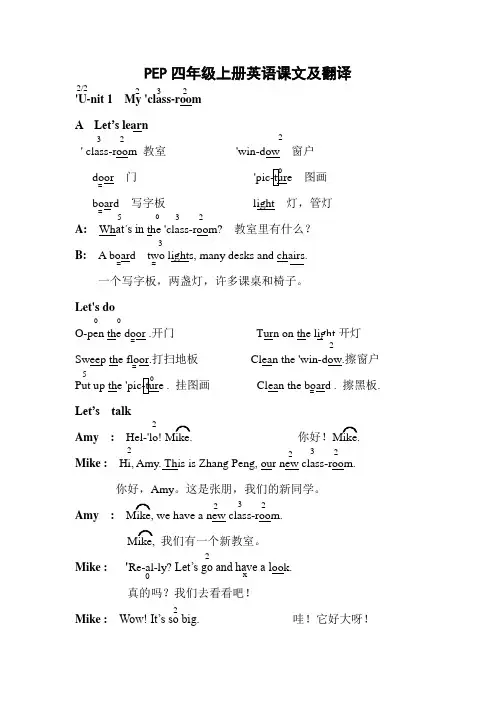
3 2 00 2x3 2 2 2 235⌒ ⌒ 22⌒ ⌒ 2PEP 四年级上册英语课文及翻译'U-nit 1 My 'class-room A Let’s l earn' class-room 教室 'win-dow 窗户door 门 'pic-ture 图画 board 写字板 light 灯,管灯A: Wh at’s in the 'class-room? 教室里有什么?B: A board two lights, many desks and chairs. 一个写字板,两盏灯,许多课桌和椅子。
Let's doO-pen the door .开门 Turn on the light.开灯Sweep the floor.打扫地板 Clean the 'win-dow.擦窗户Put up the 'pic-ture . 挂图画 Clean the board . 擦黑板. Let’s talkAmy : Hel-'lo! Mike.你好!Mike. Mike : Hi, Amy. This is Zhang Peng, our new class-room. 你好,Amy 。
这是张朋,我们的新同学。
Amy : Mike, we have a new class-room.Mike,我们有一个新教室。
Mike : 'Re-al-ly? Let’s go and have a l ook.真的吗?我们去看看吧!Mike : Wow! It’s so big. 哇!它好大呀!322==53 2==3==2=2×2/20 2⌒ Zhang : We have 6 new lights. 我们有六个新电灯。
Amy : Look, this is my new desk. 看,这是我的新课桌。
Zhang: Where is my seat? 我的座位在哪儿? Mike : It’s n ear the door. 在门的附近。
人教PEP四年级英语上册Unit4_C_Story_time优秀课件

Grandpa: But where are my glasses?
Uncle Bear: Look! Your glasses are on the bed!
Grandpa: Thank you.
Grandpa: Oh, my …
Uncle Bear: Let’s change our glasses.
Grandpa: I can see now.
Uncle Bear: Me too.
点击小喇叭或文本框都可以播放音频
Role play 两人一组,练习并表演故事,其他同学评价。
C
流利地朗读。
B
流利地表演。
AHale Waihona Puke 有感情地表演。1. 登录“优教信使”,在“智学助手” 下,完成听读作业,进行口语测评。 2. 和朋友一起,表演故事。
Let’s sing
Review
Where is the TV in the song? It’s in the bedroom.
Where is the sofa in the song? It’s in the living room.
These are my glasses.
Guess: Where are my glasses in my home?
Look and answer
Where are the glasses in Picture 2/3/4?
They’re on the fridge. They’re on the table. They’re on the bed.
Watch and answer
Where are Uncle Bear’s glasses? They’re on the table. Where are Grandpa’s glasses? They’re on the bed.
人教PEP四年级英语上册Unit3_C_Story_time 公开课教案
Unit3 C Story time公开课教案一、教学目标知识与能力:1. 能够听懂、会说故事中出现的重点短语。
2. 学生能理解故事内容;能基本朗读故事;基础较好的学生能够表演故事。
情感态度价值观:结合我校英语组善“SHOW”的课堂理念,通过感知、理解、表演拔萝卜的故事,培养学生互帮互助、团结合作的精神,使其明白“团结就是力量”的道理。
二、学情分析鉴于我校一年级开设英语课,四年级阶段的学生有一定的英语基础,能够借助旧词自然拼读新单词,因此授课中重点关注学生对故事内容的整体理解及人文素养培养。
三、重点难点重点:1. 理解并掌握重点句型:I can’t pull it up. Come on, friends, please help me. Let’s work together.2. 理解故事大意并朗读故事。
难点:表演故事、感受团结就是力量。
四、教学过程活动1【导入】Lead inGreet Ss with daily expressions.活动2【讲授】Pre-reading(1) Play a guessing game.T: Before the class, let’s play a guessing game! Who can read it?S1: She is my friend. She has ...Ss: It’s you. Yuki.T: You are so clever. It’s me. Look, I have a ... Now, could you please talk about your friend? (Tips about vocabulary for Ss)S1: …S2: ...T: Today, I’ll introduce an animal friend. It has a small nose, a small mouth, 2 big eyes, and 2 long ears. Guess, who’s she?S1: Rabbit.T: Yes! But do you know what does a rabbit like to eat? Guess?Ss: cabbages / apples / bananas / vegetables…T: They also like to eat turnip.(拿出实物萝卜)引导学生运用自然拼读法拼读该单词。
人教PEP版四年级英语上册Unit 4 My home 单元概述与课时安排
Unit Four My home单元整体分析本单元是义务教育灵通版(pep)小学英语教科书四年级上册第四单元。
单元主题为My home(我的家)。
主情景图展示了几个学生以及Zoom和Zip的家居生活,从而揭示本单元的主题:描述家里的居室及物品设施。
A部分共三页,分三课时。
第一课时为情景对话和练习部分。
Let’s talk部分Amy向Sarah介绍自己的小猫,然后两个人在家里的房间找来找去,终于找到了它。
以此介绍了询问物品或人物位置的句子:Is she in the ...? 以及表示房间名称的词汇:living room, study, kitchen。
之后的Let’s play是个猜东西位置的游戏。
以此来练习重点句式。
第二课时为词汇学习课时,Let’s learn中介绍了房间名称词汇:bedroom, study, living room, kitchen, bathroom以及询问物品或人物位置的句子:Where is ...? Is she in the ...?之后的Let’s do通过指令活动来练习房间名称以及在这个房间里能做的活动。
第三课时为语音与字母学习课时,通过读一读,听一听,唱一唱;听一听、圈一圈;听一听,圈一圈,写一写三个活动,让学生学习元音字母u在开音节中的发音/ju:/。
B部分共四页,分两课时。
第一课时仍然呈现情景对话和练习。
Let’s talk中John和妈妈到处找门钥匙,最后发现它在门上。
以此来引出询问物品和人物位置的句子Where are...? Are they ...? 以及词汇:table, phone。
之后的Ask, answer and write活动来练习重点句式与单词。
第二课时以John和Mike的对话来学习新的词汇:sofa, phone, table, fridge之后通过一个活动Let’s play来练习句子。
进一步熟悉新授词汇。
之后的读写练习、听音判断、看一看并判断的练习以及歌曲都用来巩固练习本课的重点词汇及句型,与C部分合为一个课时。
人教(PEP)版三年级起点四年级上册英语《Unit 4 My home C》(一等奖课件) (26)
Where is Zhu zhuxia?
He's under the desk.
Look at those cakes. Are they on that table?
Yes.Those cakes are on that table.那些
that那个--those那些(复数)
Find the different.( 找不同) glasses 眼镜
人教版(PEP)小学英语四年级上册
Part C Story time
安阳市文峰区宝莲寺镇黎元小学 刘小如
人教版(PEP)小学英语四年级上册
Part C Story time
安阳市文峰区宝莲寺镇黎元小学 刘小如
Boys
? aAnrde ygoiruls ready
READ IT!!
Where is the book?
Which one do you like?你们喜欢哪一个?
Homework
1. Listen to the tape ,read after it and try to imitate.(听磁带,跟读课文, 并且模仿发音。) 2. Try to introduce where is your thing.(介绍一下你的东西在哪里?)
Thank you.
Oh, my...
交换
Let's change our glasses.
I can see now.
Me too.
Role paly
Daddy
Grandpa
Let's write!
1. The cat is on ____________. 2.The phone is on _________. 3.The chairs are near _______. 4.The plates are ___________. 5._______________________.
人教PEP版四年级上册英语 Unit 4 Part C Story time 教案
Unit 4 《My home》教案第七课时(Part C Story time)教学目标1. 能听、说、读、写单词those, glasses, change.2. 能听懂、说、认读句型Do you see my glasses? Those are not my glasses. Let’s change our glasses.教学重点将陈述句变为一般疑问句和否定句。
教学难点给合所学的句型来描述自己的房间。
教学工具ppt教学过程一、Let’s singT播放音频动画,听歌曲,让学生跟唱。
[设计意图]通过听歌曲,提高学生学习英语的兴趣,活跃课堂气氛。
二、Revision学生两人一组进行句型练习:1. A: Where are the keys?B: They’re on the fridge.2. A: Are they on the fridge?B: Yes, they are. / No, they aren’t.[设计意图]通过此种方式可调动学生的学习积极性,复习巩固所学的单词与句型。
三、Story time(一)、1. Do you know who they are? 先认识一下故事的主人公吧。
2. 教师出示Story time图片,引导学生看图。
3. 学生听录音跟读,提醒学生注意模仿语音、语调。
4. 播放录音,要注意读出故事中人物的心情哦!5. 学生分小组分角色朗读。
6. 学生小组上台表演对话。
7. 看Story time视频,学生跟读。
8. 根据图片内容两人进行对话表演。
(二)、Questions1. What are they looking for?2. Where are Grandpa’s glasses?3. Where are Father bear’s glasses?四、Let’s learn1. Do you see my glasses?此句是一般疑问句。