
2020-2021学年牛津译林版八年级英语上册阅读理解专项强化训练(十)(含答案)
Day 1Kids are getting too fatMore children in China are putting on weight. In 2018, 16 percent of Chinese children and teenagers were overweight or obese (肥胖的), according to the National Health Commission.Being too fat is bad for children’s health. According to the World Health Organization (WHO), overweight and obese children are more likely to develop diseases like diabetes (糖尿病) at a younger age. This can lead to a higher chance of premature (过早的) death.On Oct 23, the National Health Commission, together with five other national departments (部门), worked out a plan to prevent and control obesity. The plan aims to cut the average annual (每年的) growth rate of obesity among children aged 0-18 years by 70 percent from 2020 to 2030, Xinhua reported.Kids are putting on weight because of changes in their diet and lifestyle, according to experts. Too much schoolwork and greater use of electronic devices (电子产品) could also be a cause.According to the plan, teachers should not allow their classes to run too late or too early. They should make sure that students have breaks and enough physical activity. Primary and secondary school students should have at least three hours of vigorous (剧烈的) physical activity each week.Parents should reduce their children’s use of electronic devices andstop their children from eating foods that are high in sugar, fat and salt.1. Paragraph 2 is about _____.A. a recent WHO reportB. the causes of childhood obesityC. Chinese children’s obesity rateD. the effects of being too fat2. The NHC worked out the plan to _____.A. improve students’ PE scoresB. stop children from getting sickC. stop children from getting fatD. encourage children to live happily3. The plan suggests that schools should _____.A. give children more time to exerciseB. stop children from using electronic devicesC. stop children from eating junk foodD. force obese children to lose weight4. What is the story mainly about?A. Chinese people’s health conditions.B. Why Chinese children love junk food.C. What Chinese students do during their breaks.D. Action that China is taking to reduce childhood obesity.Day 2Victoria opens upOct 26 was a big day for people in Victoria, the second most populated state in Australia. Following a drop in new COVID-19 cases, the premier (州长) of Victoria lifted (撤销) one of the longest lockdowns in the world – nearly five months. Starting from Oct 28, we were allowed to leave our homes and go back to normal. The premier even shared a happy face with a doughnut (甜甜圈) on Facebook.Restaurants and bars were quickly filled. Stores were crowded with shoppers. And we were no longer stuck in our homes. The funniest part was that there was a long line in front of every barbershop. All of the men whose hair had been growing wildly for months were finally able to get a haircut. They could say goodbye to their sloppy selves (邋遢的自己).Last weekend, I went out to meet up with my friend. As we held handsand walked past each familiar (熟悉的) store, I felt like the past months had been a dream. But something did change. We put on weight, menus were changed and hand sanitizer (洗手液) was everywhere. They reminded us that the world had been turned upside-down (天翻地覆) in 2020.We deserve to celebrate a bit, but we still need to be careful, as the virus is still spreading. All we can do is to recover (恢复) from it and live with it.1. Why was Oct 26 a big day for people in Victoria?______________________________________2. How long did Victoria’s lockdown last?_______________________________________3. What did people in Victoria do after the lockdown was lifted?_______________________________________4. Why were there long lines in front of barber shops?_______________________________________5. How did the writer feel after going out with her friend?_______________________________________6. What does the writer remind us about at the end of her story?_______________________________________Day 3Recess and lunch are our big breaksAs a Chinese student, you probably have morning exercises at school each day. We don’t have this in US schools. I found out about this cultural difference the first day I was in China. My first apartment (公寓) was right next to an elementary school (小学) and I saw the students doing their morning exercises.In the US, however, only elementary (from kindergarten to 4th grade) and middle school (5th – 6th grade) students have exercise time like this. We call it “recess (课间休息)”. It’s a short daily play period (30 to 45 minutes) where we can play on the playground. My friends and I would play kickball (美式足垒球) and build forts (堡垒) out of big tree branches (树枝) that we found in the woods next to our playground. And in winter, we would sled down (乘雪橇滑下) a big icy hill behind our school.In junior high (7th – 8th grade) and high school (9th – 12th grade), things are different. We have to move between many different classrooms, as each subject has a different teacher and a different classroom. We have a few minutes between each class to get our books and chat a bit – but only a few minutes. We’re in class almost the entire (全部的) time we’re at school.Except for (除了) our one big break – lunch. Junior high and high school students get as much as an hour, sometimes even a little more, to eat and hang out. In my school, older students (grades 11 and 12) were even allowed to go off-campus (离开学校) for meals. Those who had driver’slicenses and cars could drive around our town, listening to music and eating fast food. It was a fun break in the middle of those long school days.1. What did the writer learn just after moving to China?A. Students do morning exercises at school.B. Students have long breaks between classes.C. Chinese kids are good at sports.D. Chinese kids like to do morning exercises.2. Paragraph 2 is mainly about _____.A. why the writer liked recess as a childB. what recess in the US is likeC. how US students do their morning exercisesD. what the writer’s favorite exercise is3. In the US, students in grades 7 to 12 don’t have recess because _____.A. they have little time between classesB. they are no more interested in exercisingC. they have to do homework during their breaksD. they can exercise during PE class instead4. From the last paragraph, we know that _____.A. US students have their lunch at schoolB. US students don’t eat much during lunchC. the older students get, the busier they areD. high school students get a long lunch breakDay 4Is anybody out there?When you look into the night sky, you might not think that there’s someone out there looking right back at you. But a new study says that there are more than 1,000 stars (恒星) in direct (直接的) line of sight to Earth that might have life. That is to say, life on the planets that orbit (绕轨道运行) these stars would also be able to see our planet. There might be aliens watching us!Lisa Kaltenegger, the lead author (主要作者) of the study, said we can see some of these stars from right here on Earth without telescopes (望远镜). Kaltenegger found that there are about 1,000 stars that are not only close enough for us to see, but also have some of the same qualities (特质) as our own sun.For now, we have no idea if there really is life on the planets that orbit these stars. However, researchers will be able to start scanning (扫描) the atmospheres (大气) of these planets with the help of NASA’s James Webb Space Telescope next year. The scans could turn up signs (迹象) of life on these planets.“If we’re looking for intelligent life (智慧生物) in the universe that could find us and might want to get in touch, we’ve just created the star map of where we should look first,” Kaltenegger said.1. Which of the following is TRUE?A. There are aliens in outer space.B.There are over 1,000 stars that directly face Earth.C.We cannot see any stars without telescopes.D. There is life on the planets that orbit some stars.2.Life might exist on planets near some of the stars because _____.A. the stars are similar to our sunB. the stars are close to EarthC. we can see the stars without telescopesD. the stars have similar atmospheres to Earth3. To see if there is life on other planets, scientists _____.A. will send spacecraft to find signs of lifeB. will use a telescope to scan for signs of lifeC. will scan the atmospheres of the stars。
牛津译林版八年级英语上册阅读理解专项强化训练(二)
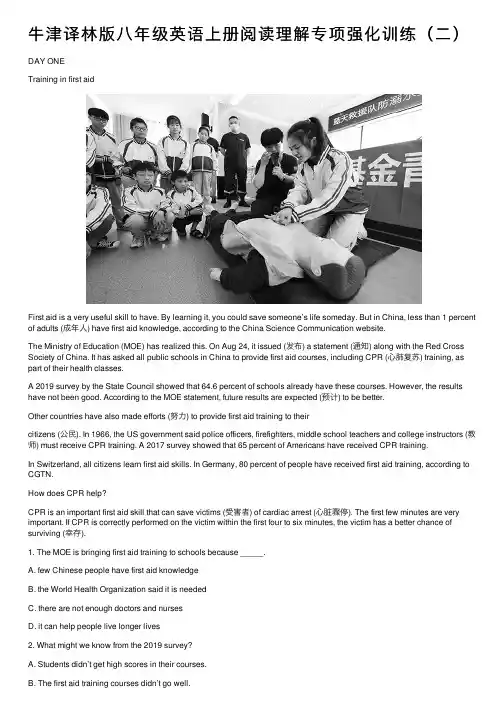
⽜津译林版⼋年级英语上册阅读理解专项强化训练(⼆)DAY ONETraining in first aidFirst aid is a very useful skill to have. By learning it, you could save someone’s life someday. But in China, less than 1 percent of adults (成年⼈) have first aid knowledge, according to the China Science Communication website.The Ministry of Education (MOE) has realized this. On Aug 24, it issued (发布) a statement (通知) along with the Red Cross Society of China. It has asked all public schools in China to provide first aid courses, including CPR (⼼肺复苏) training, as part of their health classes.A 2019 survey by the State Council showed that 64.6 percent of schools already have these courses. However, the results have not been good. According to the MOE statement, future results are expected (预计) to be better.Other countries have also made efforts (努⼒) to provide first aid training to theircitizens (公民). In 1966, the US government said police officers, firefighters, middle school teachers and college instructors (教师) must receive CPR training. A 2017 survey showed that 65 percent of Americans have received CPR training.In Switzerland, all citizens learn first aid skills. In Germany, 80 percent of people have received first aid training, according to CGTN.How does CPR help?CPR is an important first aid skill that can save victims (受害者) of cardiac arrest (⼼脏骤停). The first few minutes are very important. If CPR is correctly performed on the victim within the first four to six minutes, the victim has a better chance of surviving (幸存).1. The MOE is bringing first aid training to schools because _____.A. few Chinese people have first aid knowledgeB. the World Health Organization said it is neededC. there are not enough doctors and nursesD. it can help people live longer lives2. What might we know from the 2019 survey?A. Students didn’t get high scores in their courses.B. The first aid training courses didn’t go well.C. The first aid training went better than expected.D. Students were interested in learning first aid.3. The last two paragraphs are written to show _____.A. first aid training is common in Asian countriesB. teaching first aid is not easyC. people in some fields should learn first aid knowledgeD. other countries have provided first aid training to their citizens4. What is the story mainly about?A. We can save others with first aid knowledge.B. More people will need first aid in the future.C. We need more time to train people in first aid.D. China is making first aid training part of its school courses.DAY TWOLearn to skate againIn 2018, I saw Canadian ice skater Tessa Virtue and her partner Scott Moir performMoulin Rouge at the PyeongChang Winter Olympic Games. It encouraged me to realize my dream of skating. When I was just a little girl, I practiced skating for three years, but had to give it up and focus on (专注) school.Relearning figure skating (花样滑冰) at an older age is not easy. While standing on the thin steel blades (冰鞋⼑) for the first time in years, I felt both excited and scared.I couldn’t remember any jumps or spins (旋转). Younger skaters learn difficult rotation jumps (旋转跳跃). Could I still do that?“You have as much right to be here as anyone else,” my coach said to me. I felt better and decided to work harder. I fell many times while learning new jumps, spins and dance movements (舞蹈动作). Each fall only hurts more because you are already bruised (淤青的). But I still practice for hours each day.I’ve doubted (怀疑) myself and the pain is hard. But the feeling of joy is amazing. Fall down seven times, get up eight!1. After watching the two famous skaters perform, the writer _____.A. gave up her dreamB. decided to focus on schoolC. decided to relearn figure skatingD. wanted to learn something else2. When the writer got ready to start skating, _____.A. she was too excited to moveB. she found it difficult to put on her skatesC. she thought it might be too late to learnD. she felt both excited and scared3. What do we know from Paragraph 3?A. The coach didn’t think much of the writer.B. The writer couldn’t work hard.C.The writer’s early experience helped her.D. The writer wasn’t scared of pain4. From the story, we know that the writer _____.A. wants to compete in the Olympic GamesB. will stick to figure skatingC. will give up figure skatingD. is 100-percent sure she will succeedDAY THREEHelp scientists make progressIf you think doing scientific research (研究) is only for great scientists like Newton or Einstein, you might be wrong.In fact, if you like to play with insects or take pictures of wild animals, you might be able to help scientists do research yourself!The Shanghai Natural History Museum recently made an app called “Find Nature (听见万物)”. The app’s users can upload (上传) photos, sounds and locations (位置) of frogs, birds and other animals they see around them. These data (数据) can be used by scientists to study biodiversity (⽣物多样性) and better protect animals that live in cities.The concept of having people take part in scientific research, no matter what their background is, is called “citizen science”. The tasks are often easy and fun, but at the same time, you can become a big part of scientific studies.Of course, citizen science is not only about frogs or birds. There are also projects (项⽬) about watching stars and clouds, counting (数) penguins, or listening to laughs (笑声). Citizen science shows us that science can be fun and is for everyone!What citizen scientists have doneDataGalaxy Zoo invites people to help classify (分类) large numbers of galaxies. It has received 50 million classifications from more than 150,000 people!PapersWith the help of Cornell Lab citizen science data, more than 60 scientific papers have been written. The data used to write them has been collected by birdwatchers since 1997.DiscoveriesFoldit is an online puzzle game (智⼒游戏) about protein-folding (蛋⽩质折叠). Its players helped find the structure of an enzyme (酶) from an AIDS-like virus (病毒) in just three weeks.Where can I find my own projects?There are many websites (⽹站) where you can look for cool citizen science projects. They include Zooniverse, SciStarter, iNaturalist, and others. Just type (输⼊) in keywords that you’re interested in and you’ll see many projects. Here are some examples.Whale Song ProjectHave you ever heard whales singing beautiful songs? Do you want to know what they are singing? The Whale Song Project invites you to listen to whale calls and help scientists study how whales communicate with each other.When you visit the site, you’ll see an image (图像) that stands for a whale sound. Click on it and you’ll hear the sound. Under the image, there are several smaller images. Listen to each one and see if any of them matches the first one you heard.Age GuessAge Guess is an online game where you guess the ages of other people by looking at their pictures. You can also post your own photos and have other people guess yourage. In just a few minutes, you can help create (创造) research data for the study of human aging. The project studies the differences between how old you look to others and your real age.Answer the questions:1. How do people help scientists do research through Find Nature?_______________________________________2.What does the term “citizen science” mean?_______________________________________3. What does citizen science show us?_______________________________________4. What does the Whale Song Project study?_______________________________________5. How do people collect data for the project Age Guess?_______________________________________DAY FOURBack when our world was coldThese days, we often talk about global warming. In fact, the Earth was once the opposite (相反的事情) – it was cooling down instead of warming up. Scientists call this period the Ice Age (冰河时代). So far, Earth has gone through five Ice Ages. But how cold was this period? Was everything covered in ice and snow?According to a study by scientists at the University of Arizona, US, the average global temperature (全球温度) during the most recent Ice Age, which was about 20,000 years ago, was 7.8 C. This is about 6 degrees colder than today’s average temperature.You might just take off your T-shirt and put on a sweatshirt (运动衫) if the temperature drops by 6 degrees. However, on a global scale (范围), this is a hugechange.At the time, glaciers (冰川) covered about half of the Americas and Europe as well as many parts of Asia, according to Jessica Tierney, lead scientist of the study. The greatest cooling happened at higher latitudes (纬度). The Arctic (北极), for example, was about 14 degrees colder than today.Tierney said that past temperatures show us what really happens when the Earth cools or warms to a large degree (程度). It can help us know what to expect in the future.How did scientists find the average temperature?Scientists used ocean animal fossils (化⽯) and climate models (⽓候模型). The structures of fats from the fossils show changes in water temperature. Then they put this information into the models to get the global average temperature.1. The average global temperature today is about _____.A. 1.8 ℃B. 6 ℃C. 7.8 ℃D. 13.8 ℃2. When the average global temperature goes down, _____A. the temperature will drop by the same amount everywhereB. we won’t notice much of a change in temperatureC. all land will be covered with glaciersD. higher latitudes will experience greater changes3. Tierney thinks that _____.A. we can learn from past temperature changesB. we are about to go through a new Ice AgeC. we can do nothing to change global weatherD. we don’t have to worry about global warming4. What is the point of the story?A. Earth will cool down again in the future.B. Global warming isn’t a big problem.C. Earth has experienced cold periods before.D. The Ice Age is not over yet.DAY FIVEOnce upon a time, there lived a king named Minos. He ruled the island of Crete. He had a 1 monster called the Minotaur. The Minotaur lived in a maze (迷宫). He had the body of a man, but the head of a bull (公⽜).Minos was a cruel (残忍的) king. 2 he was bored, he would fight the people of a nearby island called Athens. To 3 him, they made a deal. They would give seven boys and seven girls to the Minotaur each year as a sacrifice (献祭). Minos agreed.The prince of Athens, Theseus, was mad about this. He told his father to 4 him to Crete as the seventh boy, for he wanted to kill the Minotaur.When Minos’ daughter, Adriadne, saw Theseus arriving to be sacrificed, s he wanted to 5 him. That morning, she 6 went to Theseus and gave him a sword (剑) and a ball of string (细绳).No one knew how to 7 the Minotaur’s maze. Minos threw the seven boys and seven girls in and laughed. Theseus, though, had a 8 . He left a line of string behind him. After a long fight, he killed the monster. Then, he 9 the string and found hisway out of the maze. Adriadne was 10 him there. They ran away together before Minos could stop them.1. A. traditional B. horrible C. cute D. lovely2. A. Whenever B. Wherever C. Whatever D. However3. A. refuse B. push C. stop D. leave4. A. bring B. send C. catch D. lend5. A. help B. leave C. catch D. kill6. A. carefully B. similarly C. clearly D. secretly7. A. get out of B. make up with C. come up with D. get along with8. A. tool B. view C. problem D. plan9. A. lost B. threw C. opened D. followed10. A. pulling up B. waiting for C. hearing from D. depending onDAY SIX应⽤⽂实战演练:为新⾐发愁Dear Murray,Autumn has come and my blouses (⼥式衬衫) are all too small. However, my mother wants to save money and refuses to buy new clothes for me. What can I do?Jelly Dear Jelly,If your blouses are so small that you can’t wear them, I suggest that you ask your mother to find some new blouses that are within her budget (预算). There are lots of ways to get cheap clothing, such as by buying second-hand clothes. It’s important to have a healthy lifestyle, too. If you are trying to lose weight so you can fit in your blouses, do it in a healthy way.Murray1. Jelly’s mother refuses to buy Jelly new clothes because _____.A. Jelly wants expensive clothesB. Jelly has enough clothesC. she thinks Jelly is growing too fastD. she wants to save money2. What is Murray’s first suggestion?A. Jelly shouldn’t ask for new clothes.B. Jelly can wear her mother’s clothes.C. Jelly can find cheaper clothes.D. Jelly should make a budget.3. According to Murray, Jelly _____.A. can exchange clothes with friendsB. can fit in her clothes by losing weightC. doesn’t stay fit in a healthy wayD. can earn money on her own4. What do we know from the text?A. Jelly’s family might not have much money.B. Jelly is often laughed at because of her clothes.C. Jelly often argues with her mother.D. Jelly is not in good health.参考答案:Day 1: ABDDDay 2: CDDBDay 3:1. They upload photos, sounds and locations of animals around them.2. It means common people can take part in scientific research, no matter what their background is.3. Science can be fun and it is for everyone.4. It studies how whales communicate with each other.5.They can guess others’ ages or post their own pictures and let others guess.Day 4: DDACDay 5: 1-5 BACBA 6-10 DADDBDay 6:应⽤⽂实战演练:DCBA。
江苏省牛津译林版2020-2021学年第一学期八年级期末复习(首字母填空)专项练习(含答案)

2020-2021学年第一学期八年级期末复习(首字母填空)专项练习专项练习一根据短文内容及首字母提示,填写所缺单词,使短文意思完整。
Summer is coming. The w 1________ becomes hotter and hotter. A lot of people like swimming in the swimming pool or in the sea. They think water makes them f 2________ cool. But some people are not careful enough. They often think they can swim better than others and they don't have to worry about anything. So these years, many accidents happened and some people 1 3________ their lives. Most of them were students. As we all know, safety is the most important. Do you know how to protect yourself? To protect yourself, you must be careful. Remember not to swim in a d 4________ place. Don't swim alone,and when you see a"No Swimming" sign, don't swim, either. Of course, you can swim w 5________ someone who can keep you safe. If you remember these, swimming will be safer.1.________2.________3.________4.________5.________参考答案:1.weather 2.feel 3.lost 4.dangerous 5.with专项练习二根据短文内容及首字母提示,填写所缺单词,使短文意思完整。
2020-2021年 英语八年级英语上册阅读理解20(附带答案解析)

2020-2021年英语八年级英语上册阅读理解20(附带答案解析)一、八年级英语上册阅读理解专项练习(含答案解析)1.阅读理解Bike-sharing is a new and great idea for short trips in the city. It can also help to keep the city clean and green.A new report finds that shared bikes in China make people interested in riding bikes again. Now more and more Chinese people would like to choose shared bikes to take short trips. On the one hand, it is easy to find them on the streets and the heavy traffic won't influence(影响) the riders too much. On the other hand, riding a bike is also a kind of exercise, so it is good for the rider's health.The report says that as soon as they appear, fewer and fewer people take short trips by car. Now not only young people who were born in the 1980s and 1990s love shared bikes, but also people over sixty do!At weekends, the number of the riders in Shenzhen reaches the top of all cities in China. On weekdays, the number of people who use shared bikes to travel to work is going up in Shanghai.Someone thinks that bike sharing will help to improve the cities' environment. It helps to solvethe traffic problems. Also, it will help to make better use of space in cities. The most important thing is that it can make the city get less pollution.So would you like to try to ride a shared bike to travel, too?(1)What's the main idea of the second paragraph(段落)?A. Where people like to take short trips.B. How people take short trips in China.C. When people take short trips by bike in cities.D. Why people choose shared bikes to take short trips.(2)What does the underlined word "them" refer to?A. Buses.B. TaxisC. Shared bikes.D. Cars.(3)Which of the following is NOT bike sharing's advantage(优点) according to the passage?A. It is good for the environment.B. It helps solve the traffic problems.C. It helps make good use of space in cities.D. It helps people save more money.【答案】(1)D(2)C(3)D【解析】【分析】主要讲了人们短途旅行选择共享单车的原因及好处。
2020-2021年 八年级英语上册阅读理解练习题基础、提高、难题_汇总(含答案)
2020-2021年八年级英语上册阅读理解练习题基础、提高、难题_汇总(含答案)一、八年级英语上册阅读理解专项练习(含答案解析)1.阅读理解We are already familiar with computers-computers work for us at home, in offices and in factories. But it is also true that many children today are using computers at school before they can write. What does this mean for the future? Are these children lucky or not?Many people who do not know about computers think of them as machines that children play with. They worry that children do not learn from experience but just from pressing a button. They think that children are growing not knowing about the real world.But people who understand more about computers say that computers can be very good for children. A computer can help them to learn about the real world more quickly, to learn what they want to learn and think for themselves. And in the future, don't we need people who can think clearly, who know how to get information quickly and use it well? What do you think?(1)"To be familiar with" means to __________.A. know nothingB. know aboutC. dislikeD. like(2)Does everyone think computers are good for children?A. Yes, they do.B. No, not everyone thinks so.C. We don't know.D. They are not sure.(3)What can computers help children to do?A. To think clearly, to do homework and to write.B. To play games, to do Maths problems and to copy.C. To think clearly, to get information and use it well.D. To count, to clean the house and to get information.(4)Does the writer think the computer is a good thing?A. It isn't mentioned.B. No, he doesn't.C. He doesn't know.D. Yes, he does.【答案】(1)B(2)B(3)C(4)D【解析】【分析】文章大意:电脑对我们的影响越来越大。
2020~2021学年度牛津译林版第一学期八年级英语期末模拟试卷(含答案)
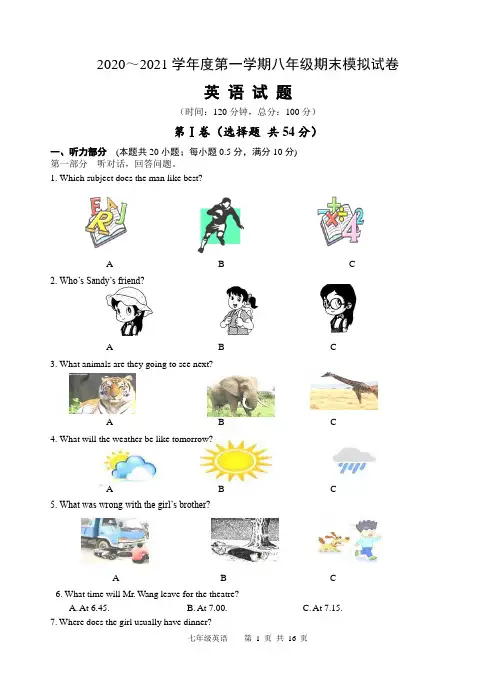
2020~2021学年度第一学期八年级期末模拟试卷英语试题(时间:120分钟,总分:100分)第Ⅰ卷(选择题共54分)一、听力部分(本题共20小题;每小题0.5分,满分10分)第一部分听对话,回答问题。
1. Which subject does the man like best?A B C2. Who’s Sandy’s friend?A B C3. What animals are they going to see next?A B C4. What will the weather be like tomorrow?A B C5. What was wrong with the girl’s brother?A B C6. What time will Mr. W ang leave for the theatre?A. At 6.45.B. At 7.00.C. At 7.15.7. Where does the girl usually have dinner?A. In a restaurant.B. At home.C. At school.8. Whose books are these?A. Mike’s.B. Kitty’s.C. Bruce’s.9. Why does the girl feel worried?A. Because she is not as clever as her friends.B. Because she is not as pretty as her friends.C. Because she is not as slim as her friends.10. How much should the woman pay for the three tickets?A. 60 yuan.B. 40 yuan.C. 30 yuan.第二部分听对话或短文,回答问题。
2020-2021年 英语八年级英语上册阅读理解20(附带答案解析)经典1
2020-2021年英语八年级英语上册阅读理解20(附带答案解析)经典1一、八年级英语上册阅读理解专项练习(含答案解析)1.阅读理解When I was a teenager(青少年), I was always unhappy. I often became unhappy with my parents by shouting at them and not talking with them.Later on, when I thought about it, I understood it was wrong to do that. I decided to try my best to calm myself down and be good with others.Now I start to act more politely to people around me. When I laugh, I show at least eight teeth. That's how happy I am feeling.In the past, I had another teenage problem. I cared about my looks very much. I spent lots of time in front of the mirror every day deciding what my hair should look like, while all my dirty clothes were on my bedroom floor.As life went on, I learned that sometimes looks isn't that important. True beauty(美丽)should be inside our hearts, but not on our faces. I should spend more time studying and reading.I believe all teenagers have problems, but I also believe if you can solve(解决)them healthily, they will help you become a better person. You can expect to learn a lot from your problems.(1)As a teenager, when I felt unhappy, I usually .A. shouted at my parentsB. talked with my parentsC. thought about my parentsD. told my teacher(2)The underlined part "calm myself down" means " ".A. 让自己争吵B. 使自己冷静C. 给自己热情D. 与自己相处(3)"I show at least eight teeth" means I am very .A. sorryB. happyC. luckyD. scary(4)From the passage, we mainly(主要地)know .A. teenagers always talk with their parentsB. teenagers care about their looks very muchC. we should solve our problems healthilyD. teenagers often get angry with their parents【答案】(1)A(2)B(3)B(4)C【解析】【分析】主要讲了青少年应该和父母健康地解决问题。
[全]牛津译林版-八年级英语上册阅读理解专项强化训练题含答案
牛津译林版八年级英语上册阅读理解专项强化训练题含答案Most people think that they don't have the power to change the world. Do we have the power to impact (影响) other people in our lives? The 1946 US film It's A Wonderful Life tells us the answer. In the film, everyone has his or her own guardian (守护) angel. It starts with George Bailey, a man who has given up on his dream and wants to kill himself on Christmas Eve because of financial (财务的) difficulties. This draws the attention of his guardian angel, Clarence Odbody. The angel shows Bailey how different life would be for his family and his community if he wasn't around. When Bailey was 12, for example, his brother Harry fell through ice and Bailey jumped into the freezing (冰冻的) water to save him. If Bailey had not been there, Harry would have died and would never have become a war hero. This movie teaches people a lesson about the power of kindness. Bailey sacrifices (牺牲) a lot of things for the welfare (福利) of the town. He also tries to help people living in the townachieve (实现) their goal of having their own houses. Bailey's kindness is repaid in the end when almost everyone in the town comes and helps him through his troubles.1. Which film is the story about?______________________________________3. What did Clarence Odbody do to saveBailey?______________________________________4. What is Paragraph 3 mainly6. What can we learn from the film?______________________________________Huge squares, great buildings and countless treasures (珍宝) –the Forbidden City never fails to take its visitors' breath away. This year, theworld's largest wooden palace is 600 years old! Have you ever wondered who made this marvel (奇迹)? In 1406, when the Ming Emperor Yongle decided to move the country's capital from Nanjing to Beijing, he started to build a palace at the heart of Beijing. His vision 愿(景) was big. It took a million workers 14 years to finish it. Materials were sent from all over China to Beijing. Nanmu, the rarest of all Chinese woods, was used to make huge wooden pillars (柱子). It can only be found deep in forests over 1,800 km away from Beijing. Workers had to float (漂浮) the wood on rivers all the way north to Beijing. Stones were also transported to the palace. The heaviest stone in the Forbidden City weighs 250 tons. It was found 80 km west of Beijing. It was so heavy that people could only move it during winter. They poured water onto the road to create ice. Then thousands of workers pulled the stone on the ice to the palace. The project even changed the local landscape (地貌). While building a moat (护城河) around the palace, workers dug up soil and piled it on a hill north of the Forbidden City. That's where Jingshan (景山) came from.1. What can't we learn from Paragraph 3?A. How long it took to build the Forbidden City.B. Who decided to build the Forbidden City.C. Where the Forbidden City was built.D. How the Forbidden City got its name.2. Paragraph 4 mainly shows that _____.A. North China had few treesB. some building materials came from far awayC. Chinese people were hard-working in the pastD. river transportation started in ancient times3. Workers transported stones in winter because _____.A. the icy rivers helped them transport stonesB. winter is the best season to make carvingsC. stones are lighter when they're frozenD. they had to use ice to move the stones4. What do we know about Jingshan?A. It was built with soil from the palace.B. It was part of the Forbidden City.C. It was moved in order to build a moat.D. It was there before the Forbidden City.5. The process of building the Forbidden City was _____.A. simpleB. difficultC. smoothD. dangerousBurger pizza? Korean tacos (墨西哥卷饼)? These might sound a bit strange to you, but they're just some examples of what we call "fusion food" (无国界料理). Fusion foods are dishes that combine (结合) two or more different kinds of food into one dish. For example, the burger pizzahas a normal pizza crust (面饼), but instead of putting pepperoni (意大利香肠) and vegetables on top of the cheese, you add ground beef (like you would use to make a burger), ketchup, lettuce and tomato. Fusion restaurants are popular in a lot of big US cities. In fact, they are often seen as trendy (流行的), since they try to be creative when combining different foods. Fusion food usually combines dishes that are from different parts of the world. For example, Korean tacos are tortillas (墨西哥薄饼) that are filled with kimchi (韩国泡菜). There aren't many fusion restaurants in China yet. A person from Dongbei could probably never imagine combining their food with Sichuan dishes. However, I have tried kaoya pizza in Beijing. I have to say, it wasn't too bad!1. What is fusion food?A. A type of foreign food.B. A strangely-named food.C. A kind of smelly food.D. It is a combination of cuisines.2. Paragraph 2 shows an example of _____A. how to make a kaoya pizzaB. the writer's favorite fusion foodC. how fusion food is madeD. the most delicious fusion food3. What do we know about fusion food?A. Fusion restaurants are common in Mexico.B. Chinese people don't like to eat fusion food.C. It usually combines foods from different countries.D. People like fusion food because it is easy to cook.4. What might the writer think of fusion food?A. It is terrible.B. It is not too bad.C. It is not worth trying.D. It is tasty.In 1969, the US became the first country to put a man on the moon. Fifty-five years later, it is expecting to become the first to put a woman there as well. NASA recently said that its Artemis program (阿耳特弥斯计划) will send a woman to the moon in 2024. It will be a great achievement to send a woman to the moon for the first time. But what happens when women go into space? Can they handle it as well as -or maybe even better -than men? The answer is a little bit of both, according to Varsha Jain, who works closely with NASA. On one hand, women are more likely to feel sick when going into space -however, men are more likely to feel sick when returning Earth. Women tend to (倾向于) have blood pressure (血压) problems when they return to Earth, while men tend to have vision (视力) and hearing problems instead. These differences may come from their different hormonal balances (荷尔蒙平衡) or body changes. However, a specific (具体的) cause is still unknown. Women also have some advantages in space. For one thing, they tend to be smaller, which means they use less oxygen (氧气) and take up less space in small spacecraft. Also, women often have better communicationskills than men, which makes them better-suited (更适应) for long spaceflights.1. What do we know about the Artemis program?A. It put a human on the moon in 1969.B. It will send a woman to the moon.C. It will be the second time for us to visit the moon.D. It will take place 55 years from now.2. After returning from space, female astronauts _____.A. might feel sicker than menB. might have blood pressure problemsC. might have hearing problemsD. might have vision problems3.The advantages of sending women into space include _____.a. they use less oxygenb. they take up less spacec. they have better communication skillsd. they have higher hormone levels than menA. abc B. abd C. acd D. bcd4. From the story, we can learn that _____.A. women act similarly to men in spaceB. men are not suited to live on the moon C. women have some advantages when traveling in spaceD. women are better astronauts than menDay 5One day, a teacher entered his classroom, handed out test papers and asked his students to 1 . To everyone's surprise, there were no 2 −just ablack dot (点) in the center of the page. The teacher said, "I want you to write about 3 you see there." The confused (困惑的) students got started on this task (任务). At the end of the class, the teacher took all the answer papers and started 4 each of them. All of students 5 the black dot and tried to explain (解释) where it was on the paper. After all papers had been read, the teacher explained, "I just wanted to give you something to think about. 6 one wrote about the white part of the paper. Everyone wrote about the black dot. The same thing 7 in our lives. We have a white paper to 8 , but we always focus on (关注) the dark spots." "Our life is a gift filled with love and care. However, we keep focusing only onthe 9 spots. They are troublesome, but they are very 10 . Take your eyes away from the black spots in your life. Enjoy life and be happy!"1. A. begin B. stop C. keep D. stay2. A. numbers B. questions C. answers D. keys3. A. what B. why C. where D. when4. A. breaking B. writing C. hearing D. reading5. A. described B. visited C. improved D. shared6. A. Any B. Some C. Every D. No7. A. arrives B. chooses C. happens D. includes8. A. waste B. catch C. enjoy D. move9. A. bright B. dark C. colorful D. huge10. A. different B. strange C. short D. smallDay 1: 1. It's A Wonderful Life.2. Because he had financial difficulties.3. He showed him how he affected the lives of others. 4. Bailey saved hisbrother's life. 5. Many people came to help him.6. We should be kind.Day 2: DBDABDay 3: DCCBDay 4: BBACDay 5: 1-5 ABADA 6-10 DCCBDblack dot (点) in the center of the page. The teacher said, "I want you to write about 3 you see there." The confused (困惑的) students got started on this task (任务). At the end of the class, the teacher took all the answer papers and started 4 each of them. All of students 5 the black dot and tried to explain (解释) where it was on the paper. After all papers had been read, the teacher explained, "I just wanted to give you something to think about. 6 one wrote about the white part of the paper. Everyone wrote about the black dot. The same thing 7 in our lives. We have a white paper to 8 , but we always focus on (关注) the dark spots." "Our life is a gift filled with love and care. However, we keep focusing only onthe 9 spots. They are troublesome, but they are very 10 . Take your eyes away from the black spots in your life. Enjoy life and be happy!"1. A. begin B. stop C. keep D. stay2. A. numbers B. questions C. answers D. keys3. A. what B. why C. where D. when4. A. breaking B. writing C. hearing D. reading5. A. described B. visited C. improved D. shared6. A. Any B. Some C. Every D. No7. A. arrives B. chooses C. happens D. includes8. A. waste B. catch C. enjoy D. move9. A. bright B. dark C. colorful D. huge10. A. different B. strange C. short D. smallDay 1: 1. It's A Wonderful Life.2. Because he had financial difficulties.3. He showed him how he affected the lives of others. 4. Bailey saved hisbrother's life. 5. Many people came to help him.6. We should be kind.Day 2: DBDABDay 3: DCCBDay 4: BBACDay 5: 1-5 ABADA 6-10 DCCBD。
2020-2021学年牛津译林版八年级英语上册阅读理解专项强化训练(三)(含答案)
Day OneSong without sightIn 1798, German composer Ludwig van Beethoven marked the first passage of his newest composition (作曲) with the Italian term “grave”, meaning slow and solemn (肃穆的). He was troubled to learn that he was losing his hearing. But his Sonata Pathétique (《悲怆奏鸣曲》) sounded exciting and optimistic (积极的). It has inspired (激励) many people over the years.On Aug 29, 18-year-old Xiong Linghao from Chengdu Special Education School played the sonata at the 13th Shanghai International Youth Piano Competition. A video of her performance has gotten 7 million views online.It’s been a long and hard journey for Xiong. She lost her eyesight due to a medical accident when she was still a baby. Her mother later found that Xiong had a talent for music. At age 3, she could play children’s songs on a small electric (电子的) piano. At age 6, she started learning the piano for real.Unlike people who can see the keyboard (键盘), she must remember where each note is. Practice is key because she needs to form muscle memory (肌肉记忆) so she can find the right keys. She practices six to eight hours every day. “I listen to the melody (旋律) again and again and then send what I hear to my fingers. I used to practice with each hand separately before I could play with both hands together,” Xiong said.Xiong won the Special Jury Prize (评审团特别奖) at the competition. “The piano has accompanied (陪伴) me through my ups and downs in its own way,” she said. “It empowers me and brings so much pleasure (乐趣) into my life.”1. Xiong Linghao got attention online for _____.A. being a blind piano playerB. being a young piano playerC. her outstanding memoryD. her sad experience2. Paragraph 3 is written to show _____.A. how Xiong lost her eyesightB. how Xiong started to learn the pianoC. how Xiong practiced pianoD. how Xiong recovered from an accident3. From what Xiong said, we know that _____.A. she easily remembers where each key isB. she spends a lot of time practicing the pianoC. she gets bored with practicing only one melodyD. she can play any melody after listening to it4. Xiong’s exp erience is _____.A. dangerousB. excitingC. encouragingD. commonDay TwoTaking care of our outdoor workWhat kinds of chores do you usually do around the house? Maybe you clean your room, wash the dishes, sweep or mop (拖) the floor. All of these are “indoor” chores.But in many places – especially in rural (农村的) areas and suburbs (郊区) in the US – kids hav e different “outdoor” chores during differentseasons.In the fall, the most common outdoor chore is raking (清扫) leaves. As trees lose their leaves in fall, the leaves will pile up (堆积) in people’s yards. It is up to each family to rake up the leaves and put them in big trash bags.After a heavy snowfall in winter, children help shovel (铲) snow in their front yard. Otherwise (否则), it might be hard for families to leave their homes.Spring and summer bring lots of rain and sun, which make the grass in people’s yards grow tall. It is common for kids to mow (割草) their yards to keep them fresh and neat (整洁的).Doing all of these chores might sound like a lot of work. Fortunately (幸运的是), most families give their kids a little bit of money for doing them. People who don’t have children might even pay neighborhood kids to take care of chores for them. Either way, it’s a good way to make some money if you aren’t old enough to have a real job yet.1. In the US, the most common outdoor chore in fall is _____.A. mopping the floorB. walking dogsC. raking leavesD. mowing yards2. In winter, people shovel snow in their front yard because _____.A. they like to keep their yard clean and neatB. gr ass won’t grow if snow is on itC. it is a traditional winter outdoor activityD. the snow might block their way out3. What can we learn from the last paragraph?A. Doing outdoor chores is difficult.B. Kids can earn money by doing outdoor chores.C. People without kids find it hard to do chores.D. US parent s don’t want to do outdoor chores.4. The story is mainly about _____.A. ways of making money in the USB. different outdoor chores in the USC. differences between outdoor chores in China and the USD. why people in the US have yardsDay ThreeBe honest alwaysDuring the Eastern Han Dynasty (25-220), there was a government official (政府官员) named Yang Zhen.One day, Yang ran into his old coworker (同事) Wang Mi during a trip. In the past, Yang noticed Wang’s talent and promoted (提拔) him. Wang never forgot Yang’s help and invited Yang to stay over for the night.It was near midnight when Wang knocked on the door of Yang’s bedroom. He handed Yang a bag and said, “This is to thank you for teaching me and helping me become who I am today.” Yang looke d in the bag. It was full of gold ingots (金锭).“Do I look like a person who accepts (接受) bribes (贿赂)? I thought you knew me well!” Yang said angrily.“It’s late at night. No one will know if we keep it a secret,” said Wang.“What do you mean no one would know? Heaven (天) knows, Earth (地) knows, you know and I know,” Yang said.Wang left the room in shame (羞愧).1. Yang Zhen promoted Wang Mi because _____.A. he knew Wang was talentedB. he wanted to thank Wang for his helpC. Wang was his old coworkerD. Wang lived a poor life2. To thank Yang, Wang _____.A. treated Yang as his brotherB. went to bribe Yang secretlyC. gave Yang a new bagD. helped Yang keep secrets3. Why was Yang angry with Wang?A. Because Wang gave his secrets away.B. Because he found Wang wasn’t talented.C. Because he found Wang accepted bribes.D. Because Wang tried to bribe him.4. We might describe Yang as being _____.A. two-facedB. shamelessC. sillyD. justDay FourRobots in serviceA big fair just ended in Beijing. The China International Fair for Trade in Services (CIFTIS) took place from Sept 4 to 9. It is a major (主要的) service trade event. Visitors saw how new technologies, such as artificial intelligence and 5G, are used in different areas. One highlight (亮点) this year was service robots. Let’s look at three of them.Robot dogUnitree, a company in Hangzhou, Zhejiang, has made a robot dog.With an AI-powered smart camera, it can record everything it sees in real time. It can move up to 3.3 meters per second. It can also carry objects weighing up to 5 kg, about as heavy as 10 bottles of water.The robot dog can give people a hand in many ways. For example, it can move (搬运) goods or search for people who go missing during disasters (灾难).Garbage-sorting robotGarbage sorting is new to many people. Swiss company ABB has designed (设计) a robot to help us do it. It uses two arms to pick different kinds of garbage that come down a conveyor belt (传送带). It then throws the garbage into the right bin. A screen (屏幕) can show how many pieces of garbage it has sorted.Ping-pong serving robotCan you hit back a ball that is served (发) by a robot? Find out by playing against a ping-pong serving robot made by Chinese company Siasun. The robot can serve balls one by one automatically (自动地). It can change the speed, angle (角度), and landing area (落点) of the ball as well. It can record your performance with a camera so you can review it later. It will help ping-pong players train (训练) and improve.Fill in the blanks:A quick look of CIFTIS• It took place from 1. _____ to ______.• Visitors can see how 2. _____ are used in different service areas. Robot dogCompany: UnitreeUsage: helping people do tasksAbility:• record in real time• run fast• car ry 3. _____• 4. _____ during disastersPing-pong serving robotCompany: SiasunUsage: 5. _____ ping-pong playersAbility:• 6. _____ one by one automatically• change the speed, angle, and landing area of the ball• record players’ 7. _____Garbage-sorting robotCompany: ABBUsage: 8. _____Ability:• 9. _____ from a conveyor belt• 10. _____ into the right bin• count how many pieces of garbage are sortedDay Five根据首字母提示补全短文。
[全]牛津译林版八年级英语上册阅读理解专项强化训练题-含答案
牛津译林版八年级英语上册阅读理解专项强化训练题含答案Day 1Will we lose jobs?In science fiction films, we often see machines doing jobs that humans usually do. This is gradually coming true. By 2025, machines will do more work than humans, according to a new report. The World Economic Forum (WEF) report came out on Oct 21. It said that in the next five years, machines will take over about 85 million jobs. This means that machines will handle about half of all work tasks, almost twice as many as now, Quartz reported. Most of the jobs are either routine (程序性的) or manual (体力的) jobs in administration (行政) for white- and blue-collar (白领和蓝领) workers, WEF said. These include factory workers, accountants and mechanics (机修工). But there's not much reason to be worried. The report also shows that at the same time, 97 million new jobs will be created. New industries will be created as society changes and develops. Countries around the world are focusing on (专注于) areas like environmental protection, AI development and elderly care. This means there will be many new jobs for caretakers, big data specialists (专家), and cloud computing experts, the BBC reported. These jobs need humanskills such as advising, decision-making (决策), reasoning (推理) and communicating. "People need to learn new skills to deal with the change [in society]," the WEF pointed out.1. How many jobs do machines do now?A. 21.25 million jobs.B. 42.5 million jobs.C. 85 million jobs.D. 170 million jobs.2. Which job is most likely to be taken by machines in the future?A. Factory worker.B. Pianist. C. Scientist.D. Designer.3. According to the report, _____.A. people won't need to work in the futureB. there will be new jobs for humans in the futureC. people will compete with machines for the same jobsD. machines can work faster than humans4. The writer probably agrees that _____.A. there will not be enough jobs in the futureB. machines can still be improvedC. people should make careful use of machinesD. people should learn more new skillsDay 2Finding hope in dark times lifts us upWho stands for human civilization (文明) better than pianists? Wladyslaw Szpilman is a good example. The music he plays is beautiful, but his life isin danger. That's the story of Polish director Roman Polanski's 2002 film The Pianist. Based on an autobiographical (自传的) novel, it's the story of Jewish pianist Szpilman. He hears about the Nazi invasion (侵略) on the radio. He is eventually caught and sent to a death camp, but manages to escape (成功逃脱) and lives in the ruins (废墟) of Warsaw. When the city is bombed (被……轰炸), he is no longer able to find food. But one night, he finds a piano and plays it. German officer Wilm Hosenfeld hears him and is surprised at his talent. The pianist survives with the protection and help of the officer, who understands the beauty of music and the importance of saving it. Hosenfeld not only helps Jewish people get fake identities (身份) and places to live, he also writes diary entries and letters that criticize the brutality (暴行) of the Nazis. It's people like Hosenfeld who can bring others hope in dark times. He shows that although evil exists (存在) in the human heart, so does love.1. What do we know about The Pianist?A. The story in the film took place in 2002.B. It's about a Jewish pianist.C. It made lots of money.D. It is a well-known musical.2. Paragraph 2 is mainly about _____.A. how Szpilman suffered and was savedB. what the movie's historical background was C. how Szpilman escaped from the death campD. why people enjoy Szpilman's story3. Hosenfeld saved Szpilman because _____. A. he knew that Jewish people are harmlessB. he had the same experience as SzpilmanC. he was touched by Szpilman's musicD. he was an old friend of Szpilman4. From the story, we know that Hosenfeld _____A. thought that all people are equal B. saved Jewish people who had certain talentsC. helped Jewish people fight backD. helped many Jewish people in secretDay 3Arctic ice is at riskA weak, skinny polar bear is standing on a small piece of ice, drifting (漂流) in the sea. He is losing the solid (坚固的) ice that used to be his home and hunting ground. There has been a lot of bad news in recent years about how climate (气候) change has affected the Arctic (北极). This October, a group of scientists returned from a year-long Arctic expedition (远征). They had more bad news: all Arctic ice may disappear during the summer in just a few decades (十年). "This world is threatened. We really saw how the ice is disappearing," said Markus Rex, leader of the expedition. The temperature (温度) in the Arctic is 18 degrees higher than it was 125 years ago. Even at the North Pole, the coldest point in the Arctic, scientists found badly melted (融化的), thin ice. Polar bears are notthe only animals that are suffering. Animals like walruses (海象) and seals also depend on the ice to rest, give birth and raise babies. The loss of ice means the loss of their habitat (栖息地). Since there's now more rain, moss (苔藓) and grass are locked in ice instead of snow. Many reindeer (驯鹿) starve (挨饿) to death because they can't get to their food under the hard ice. According to the World Wildlife Fund (WWF), the number of reindeer has dropped by 56 percent in the last 20 years. Melting sea ice is also opening the door for more human activity, such as shipping, traveling and fishing. This will disturb (扰乱) the area's environment and the Arctic would never be the same again.1. How is climate change affecting theArctic?______________________________________2. How has the temperature in the Arctic changed over theyears?______________________________________3. How is melting ice affectinganimals?______________________________________4. Why are reindeer dying in theArctic?______________________________________5. What will happen in the Arctic if human activityincreases?______________________________________Day 4Racing to find a COVID cureScientists around the world have been racing to find a vaccine (疫苗) for the novel coronavirus as the COVID-19 pandemic continues. Some countries have started testing their vaccines, including China. The country now has 13 vaccine candidates (候选) in clinical trials (临床试验), according to China Daily. You might be wondering –how exactly do vaccines work? The answer is actually very simple. The first vaccine was found in 1796, when English doctor Edward Jenner exposed (暴露) a13-year-old boy to a small amount of the cowpox virus (牛痘病毒). Cowpox is a cousin of the deadlier disease smallpox (天花). Amazingly, the boy developed immunity (免疫力) to smallpox -and in 1798, the first smallpox vaccine was created. You see, when our bodies are exposed to small amounts of dead or weakened (削弱的) viruses, we create special cells called antibodies (抗体). If we're exposed to the same viruses later, our antibodies can kill them off, even if they're stronger. Since Jenner's discovery, we've come up with many vaccines, including those for chicken pox (水痘) and the flu (流感). However, developing a safe and useful vaccine takes time. Some vaccines simply don't work, while others have uncomfortable or even dangerous side effects (副作用).About 60,000 people in China have received COVID-19 trial vaccinations so far, according to CGTN. They have not reported any serious side effects. However, clinical trials must be finished before the vaccine is ready for more people.1. Paragraph 2 explains _____.A. how vaccines workB. what vaccines are made ofC. how the first vaccine was discoveredD. what kinds of vaccines we have today2. How do vaccines work?①The patient is exposed to small amounts of dead or weakened viruses.②The patient is exposed to the same virus later.③The patient's antibodies kill the virus off.④The patient's body creates antibodies.A. ①②③④B. ②①④③C. ②④①③D. ①④②③3. The COVID-19 vaccine is not ready for the public because _____.A. its clinical trials are not finishedB. it is said to have side effects C. mass production has not started yetD. it has been found to be ineffective4. From the story, we know that _____.A. every virus has a vaccineB. vaccine testing is easyC. the pandemic will be over soonD. vaccines are difficult to createDay 5The castle (城堡) of Prince Llywelyn stood in the Welsh (威尔士) mountains, next to a dark forest full of wild animals. Llywelyn led a happylife. There were 1 things that he loved most in the world: his wife, his baby son and his dog, Gelert. Gelert was a strong, brave(勇敢的) dog. Gelert loved the baby and slept under his bed to 2 him every night. One day, Llywelyn and his wife had to 3 the castle early in the morning. Llywelyn told the dog to 4 the baby while he was away. At the end of the day, Llywelyn and his wife returned to the castle. As Llywelyn walked into the baby's bedroom, he could not see the baby anywhere. What had 5 ? Gelert was covered in blood (血). Llywelyn's first thought was that his dog had 6 the baby. Terribly angry, he immediately (立刻) took out his knife and killed the dog he had loved so much. It was then that he saw his baby 7 and well, sleeping under a blanket (毯子). The dead body of a huge wild dog lay next to him. Gelert had not killed the baby, 8 had killed the wild dog, which had tried to eat the baby. Llywelyn realized what a terrible mistake he had 9 . The prince buried (埋葬) Gelert under the castle wall so people would always 10 how brave Gelert had been. His story is still told today.1. A. one B. two C. three D. four2. A. protect B. watch C. perform D. feed3. A. find B. enter C. clean D. leave4. A. look after B. pay for C. put up D. spend on5. A. started B. closed C. missed D. happened6. A. hid B. killed C. left D. hit7. A. awake B. alive C. lively D. hurt8. A. and B. so C. but D. or9. A. made B. tried C. taken D. turned10. A. forget B. remember C. mind D. find参考答案:Day 1: BABDDay 2: BACDDay 3: 1. Arctic ice is melting and may disappear in just a few decades.2. It's 18 degrees warmer than it was 125 years ago.3. They are losing their habitat and food.4. Because more rainfall has caused their food to freeze under the ice.5. The area's environment will be disturbed.Day 4: CDADDay 5: 1-5 CADAD 6-10 BBCAB。
[全]牛津译林版八年级英语上册阅读理解专项强化训练题含答案
牛津译林版八年级英语上册阅读理解专项强化训练题含答案Day 1Kids are getting too fatMore children in China are putting on weight. In 2018, 16 percent of Chinese children and teenagers were overweight or obese (肥胖的), according to the National Health Commission. Being too fat is bad for children's health. According to the World Health Organization (WHO), overweight and obese children are more likely to develop diseases like diabetes (糖尿病) at a younger age. This can lead to a higher chance of premature (过早的) death. On Oct 23, the National Health Commission, together with five other national departments (部门), worked out a plan to prevent and control obesity. The plan aims to cut the average annual (每年的) growth rate of obesity among children aged 0-18 years by 70 percent from 2020 to 2030, Xinhua reported. Kids are putting on weight because of changes in their diet and lifestyle, according to experts. Too much schoolwork and greater use of electronic devices (电子产品) could also be a cause. According to the plan, teachers should not allow their classes to run too late or too early. They should make sure that students have breaks and enough physical activity. Primary and secondary schoolstudents should have at least three hours of vigorous (剧烈的) physical activity each week. Parents should reduce their children's use of electronic devices and stop their children from eating foods that are high in sugar, fat and salt.1. Paragraph 2 is about _____.A. a recent WHO reportB. the causes of childhood obesityC. Chinese children's obesity rateD. the effects of being too fat2. The NHC worked out the plan to _____.A. improve students' PE scoresB. stop children from getting sickC. stop children from getting fatD. encourage children to live happily3. The plan suggests that schools should _____.A. give children more time to exerciseB. stop children from using electronic devicesC. stop children from eating junk foodD. force obese children to lose weight4. What is the story mainly about?A. Chinese people's health conditions.B. Why Chinese children love junk food.C. What Chinese students do during their breaks.D. Action that China is taking to reduce childhood obesity.Day 2Victoria opens upOct 26 was a big day for people in Victoria, the second most populated state in Australia. Following a drop in new COVID-19 cases, the premier (州长) of Victoria lifted (撤销) one of the longest lockdowns in the world –nearly five months. Starting from Oct 28, we were allowed to leave our homes and go back to normal. The premier even shared a happy face with a doughnut (甜甜圈) on Facebook. Restaurants and bars were quickly filled. Stores were crowded with shoppers. And we were no longer stuck in our homes. The funniest part was that there was a long line in front of every barbershop. All of the men whose hair had been growing wildly for months were finally able to get a haircut. They could say goodbye to their sloppy selves (邋遢的自己). Last weekend, I went out to meet up with my friend. As we held hands and walked past eachfamiliar (熟悉的) store, I felt like the past months had been a dream. But something did change. We put on weight, menus were changed and hand sanitizer (洗手液) was everywhere. They reminded us that the world had been turned upside-down (天翻地覆) in 2020. We deserve to celebrate a bit, but we still need to be careful, as the virus is still spreading. All we can do is to recover (恢复) from it and live with it.1. Why was Oct 26 a big day for people inVictoria?______________________________________2. How long did Victoria's lockdown last?_______________________________________3. What did people in Victoria do after the lockdown waslifted?_______________________________________4. Why were there long lines in front of barbershops?_______________________________________5. How did the writer feel after going out with herfriend?_______________________________________6. What does the writer remind us about at the end of herstory?_______________________________________Day 3Recess and lunch are our big breaksAs a Chinese student, you probably have morning exercises at school each day. We don't have this in US schools. I found out about this cultural difference the first day I was in China. My first apartment (公寓) was right next to an elementary school (小学) and I saw the students doing their morning exercises. In the US, however, only elementary (from kindergarten to 4th grade) and middle school (5th –6th grade) students have exercise time like this. We call it "recess (课间休息)". It's a short daily play period (30 to 45 minutes) where we can play on the playground. My friends and I would play kickball (美式足垒球) and build forts (堡垒) out of big tree branches (树枝) that we found in the woods next to our playground. And in winter, we would sled down (乘雪橇滑下) a big icy hill behind our school. In junior high (7th –8th grade) and high school (9th –12th grade), things are different. We have to move between many different classrooms, as each subject has a different teacher and a different classroom. We have a few minutes between each class to get our books and chat a bit –but only a few minutes. We're in class almost the entire (全部的) time we're at school. Except for (除了) our one big break –lunch. Junior high and high school students get as much as an hour, sometimes even a little more, to eat and hang out. In my school, older students (grades 11 and 12) were even allowed to go off-campus (离开学校) for meals. Those who had driver's licenses and cars could drivearound our town, listening to music and eating fast food. It was a fun break in the middle of those long school days.1. What did the writer learn just after moving to China? A. Students do morning exercises at school.B. Students have long breaks between classes.C. Chinese kids are good at sports.D. Chinese kids like to do morning exercises.2. Paragraph 2 is mainly about _____.A. why the writer liked recess as a childB. what recess in the US is likeC. how US students do their morning exercisesD. what the writer's favorite exercise is3. In the US, students in grades 7 to 12 don't have recess because _____.A. they have little time between classesB. they are no more interested in exercisingC. they have to do homework during their breaksD. they can exercise during PE class instead4. From the last paragraph, we know that _____.A. US students have their lunch at schoolB. US students don't eat much during lunchC. the older students get, the busier they areD. high school students get a long lunch breakDay 4Is anybody out there?When you look into the night sky, you might not think that there's someone out there looking right back at you. But a new study says that there are more than 1,000 stars (恒星) in direct (直接的) line of sight to Earth that might have life. That is to say, life on the planets that orbit (绕轨道运行) these stars would also be able to see our planet. There might be aliens watching us! Lisa Kaltenegger, the lead author (主要作者) of the study, said we can see some of these stars from right here on Earth without telescopes (望远镜). Kaltenegger found that there are about 1,000 stars that are not only close enough for us to see, but also have some of the same qualities (特质) as our own sun. For now, we have no idea if there really is life on the planets that orbit these stars. However,researchers will be able to start scanning (扫描) the atmospheres (大气) of these planets with the help of NASA's James Webb Space Telescope next year. The scans could turn up signs (迹象) of life on these planets. "Ifwe're looking for intelligent life (智慧生物) in the universe that could find us and might want to get in touch, we've just created the star map of where we should look first," Kaltenegger said.1. Which of the following is TRUE?A. There are aliens in outer space.B. There are over 1,000 stars that directly face Earth.C. We cannot see any stars without telescopes.D. There is life on the planets that orbit some stars.2. Life might exist on planets near some of the stars because _____.A. the stars are similar to our sunB. the stars are close to EarthC. we can see the stars without telescopesD. the stars have similar atmospheres to Earth3. To see if there is life on other planets, scientists _____.A. will send spacecraft to find signs of lifeB. will use a telescope to scan for signs of lifeC. will scan the atmospheres of the starsD. will help NASA invent new telescopes4. What do we know from the last paragraph?A. It's important to look for life in space.B. We need to create a star map for the whole universe.C. There must be intelligent life in the universe.D. The stars we've discovered might help us find life in space.Day 5More than 700 years ago, Scotland was fighting with England. The King of England wanted to control Scotland. He had a strong army (军队), so it was 1 for the Scots to fight back. Scotland lost many battles. Eventually, King Robert of Scotland had to 2 from the English army. One rainy day, King Robert 3 in a cave (洞穴). He thought that he was not good enough to be the king. He was so 4 that he didn't even see the spider near him. He looked up when he saw the spider climbing. It was trying to climb up to its web (蛛网) at the top of the cave, but it 5 . "How sad!" thought King Robert. "The spider is like me. It's not strong enough." He watched while the spider 6 again. It fell down a second time. "Be careful, little spider," he said. "Life is so hard. You'll 7 get back to your web." But the spider tried again and again. King Robert watched while it slowly climbed back to its web. After an hour, the spider 8 the web. "You are really great," the king said. "If you can keep trying, I can too. I must carry on fighting."Then the king's army grew stronger and successfully 9 the English army. Nobody knows if this is a true story. Many parents tell it to their children because they want their children to learn how to 10 challenges and setbacks (挫折).1. A. difficult B. important C. interesting D. traditional2. A. jump B. keep C. arrive D. run3. A. built B. hid C. dug D. flew4. A. worried B. excited C. shortD. tall5. A. turned up B. fell down C. took off D. showed up6. A. cried B. died C. tried D. lied7. A. sometimes B. always C. never D. often8. A. left B. reached C. broke D. spread9. A. forgot B. caught C. joined D. stopped10.A. deal withB. spend onC. stand upD. look for参考答案:Day 1: DCADDay 2: 1. Because the state's lockdown was lifted.2. Nearly five months.3. They went out to eat, went shopping and enjoyed being outside.4. Because people couldn't get their hair cut during the lockdown.5. The world has changed a lot.6. The virus is still spreading and we need to be careful.Day 3: ABADDay 4: BABDDay 5: 1-5 ADBAB 6-10 CCBDA。