
2017年11月浙江英语高考完整真题及答案
2017年11月普通高等学校招生全国统一考试英语科(浙江)选择题部分第一部分:听力(共两节,满分30分)第一节(共5小题;每小题1.5分,满分7.5分)听下面5段对话。
每段对话后有一个小题,从题中所给的A、B、C三个选项中选出最佳选项,并标在试卷的相应位置。
听完每段对话后,你都有10秒钟的时间来回答有关小题和阅读下一小题。
每段对话仅读一遍。
1. What is the man looking for?A. His pen.B. His book.C. His phone.2. What does Carol’s father ask her to do?A. Talk with her friends.B. Go out with him.C. Put on warm clothes.3. How many members are there in Alice’s group now?A. Two.B. Four.C. Six.4. What are the speakers talking about?A. Ways of cooking.B. Healthy food for kids.C. Kids helping in the kitchen.5. What is the woman?A. She’s a shop assistant.B. She’s a receptionist.C. She’s a secretary. 第二节(共15小题;每小题1.5分,满分22.5分)听下面5段对话或独白。
每段对话或独白后有几个小题,从题中所给的A、B、C 三个选项中选出最佳选项,并标在试卷的相应位罝。
听每段对话或独白前,你将有时间阅读各个小题,每小题5秒钟;听完后,各小题将给出5秒钟的作答时间。
每段对话或独白读两遍。
听第6段材料,回答第6、7题。
6. Why does the man sound surprised?A. Lily rejected a job offer.B. Lily was absent from school.C. Lily turned downa scholarship.7. What has Lily decided to do?A. Travel to Dubai.B. Stay with her mom.C. Start a business.听第7段材料,回答第8至10题。
8. What is the probable relationship between the speakers?A. Colleagues.B. Relatives.C. Classmates.9. What is Sabrina’s sister doing?A. Touring in Africa.B. Teaching in a village.C. Working in a company.10. How can Sabrina reach her sister now?A. By phone.B. By email.C. By letter.听第8段材料,回答第11至13题。
11. What does Maria think of the soup?A. Tasteless.B. Just fine.C. Thick.12. What does Karl say can be added to the soup?A. Salt.B. Onions.C. Pepper.13. Where are the speakers?A. At home.B. At a restaurant.C. At a friend’s house.听第9段材料,回答第14至16题。
14. When will someone come to check the hot water?A. This afternoon.B. Tomorrow.C. At the weekend.15. How did the students know about the flat?A. From a friend.B. From a newspaper.C. From a house agency.16. What will the woman do to settle the problem about the fridge?A. Pay the students for the new one.B. Get someone to fix the old one.C. Order one on the Internet.听第10段材料,回答第17至20题。
17. Who is the speaker?A. An invited guest.B. A news reporter.C. A radio host.18. In what way has the speaker changed?A. He speaks faster.B. He becomes heavier.C. He cooks more often.19. What is difficult for the speaker to get used to?A. The food.B. The weather.C. The language.20. What does the speaker think of the French people?A. A bit cold.B. Generous.C. Easy-going.第二部分:阅读理解(共两节,满分35分)第一节(共10个小题;每小题2.5分,满分25分)阅读下列短文,从每题所给的A、B、C和D四个选项中,选出最佳选项,并在答题纸上将该项涂黑。
AWhen I was in fourth grade, I worked part-time as a paperboy. Mrs. Stanley was one of my customers. She'd watch me coming down her street, and by the time I'd biked up to her doorstep, there'd be a cold drink waiting. I'd sit and drink while she talked.Mrs. Stanley talked mostly about her dead husband, "Mr. Stanley and I went shopping this morning." she'd say. The first time she said that, soda(汽水) went up my nose.I told my father how Mrs. Stanley talked as if Mr. Stanley were still alive. Dad said she was probably lonely, and that I ought to sit and listen and nod my head and smile, and maybe she'd work it out of her system. So that's what I did, and it turned out Dad was right. After a while she seemed content to leave her husband over at the cemetery(墓地).I finally quit delivering newspapers and didn't see Mrs. Stanley for several years. Then we crossed paths at a church fund-raiser(募捐活动). She was spooning mashed potatoes and looking happy. Four years before, she'd had to offer her paperboy a drink to have someone to talk with. Now she had friends. Her husband was gone, but life went on.I live in the city now, and my paperboy is a lady named Edna with three kids. She asks me how I'm doing. When I don't say "fine", she sticks around to hear my problems. She's lived in the city most of her life, but she knows about community. Community isn't so much a place as it is a state of mind. You find it whenever people ask how you're doing because they care, and not because they're getting paid to do so. Sometimes it's good to just smile, nod your head and listen.21. Why did soda go up the author's nose one time?A. He was talking fast.B. He was shocked.C. He was in a hurry.D. He was absent-minded.22. Why did the author sit and listen to Mrs. Stanley according to Paragraph 3?A. He enjoyed the drink.B. He wanted to be helpful.C. He took the chance to rest.D. He tried to please his dad.23. Which of the following can replace the underlined phrase "work it our of her system"?A. recover from her sadnessB. move out of the neighborhoodC. turn to her old friendsD. speak out about her past24. What does the author think people in a community should do?A. Open up to others.B. Depend on each other.C. Pay for other's helpD. Care about one another.BIt's surprising how much simple movement of the body can affect the way we think. Using expansive gestures with open arms makes us feel more powerful, crossing your arms makes you more determined and lying down can bring more insights(领悟).So if moving the body can have these effects, what about the clothes we wear? We're all well aware of how dressing up in different ways can make us feel more attractive, sporty or professional, depending on the clothes we wear, but can the clothes actually change cognitive(认知) performance or is it just a feeling?Adam and Galinsky tested the effect of simply wearing a white lab coat on people's powers of attention. The idea is that white coats are associated with scientists, who are in turn thought to have close attention to detail.What they found was that people wearing white coats performed better than those who weren't. Indeed, they made only half as many errors as those wearing their own clothes on the Stroop Test(one way of measuring attention). The researchers call the effect "enclothed cognition," suggesting that all manner of different clothes probably affect our cognition in many different ways.This opens the way for all sorts of clothes-based experiments. Is the writer who wears a fedora more creative? Is the psychologist wearing little round glasses and smoking a cigar more insightful? Does a chef's hat make the restaurant food taste better?From now on I will only be editing articles for PsyBlog while wearing a white coat to help keep the typing error count low. Hopefully you will be doing your part by reading PsyBlog in a cap and gown(学位服).25. What is the main idea of the text?A. Body movements change the way people think.B. How people dress has an influence on their feelings.C. What people wear can affect their cognitive performance.D. People doing different jobs should wear different clothes.26. Adam and Galinsky's experiment tested the effect of clothes on their wearers'______.A. insightsB. movementsC. attentionD. appearance27. How does the author sound in the last paragraph?A. Academic.B. Humorous.C. Formal.D. Hopeful.CThere are energy savings to be made from all recyclable materials, sometimes huge savings. Recycling plastics and aluminum, for instance, uses only 5% to 10% as much energy as producing new plastic or smelting(提炼)aluminum.Long before most of us even noticed what we now call "the environment," Buckminster Fuller said, "Pollution is nothing but the resources(资源)we are not harvesting. We allow them to be left around because we've been ignorant of their value." To take one example, let's compare the throwaway economy(经济)with a recycling economy as we feed a cat for life.Say your cat weighs 5kg and eats one can of food each day. Each empty can of its food weights 40g. In a throwaway economy, you would throw away 5,475 cans over the cat's 15-year lifetime. That's 219kg of steel-more than a fifth of a ton and more than 40 times the cat's weight.In a recycling economy, we would make one set of 100 cans to start with, then replace them over and over again with recycled cans. Since almost 3% of the metal is lost during reprocessing, we'd have to make an extra 10 cans each year. But in all, only 150 cans will be used up over the cat's lifetime-and we'll still have 100 left over for the next cat.Instead of using up 219kg of steel, we've used only 6kg. And because the process of recycling steel is less polluting than making new steel, we've also achieved the following significant savings: in energy use-47% to 74%; in air pollution-85%; in water pollution-35%; in water use-40%.28. What does Buckminster Fuller say about pollution?A. It is becoming more serious.B. It destroys the environment.C. It benefits the economy.D. It is the resources yet to be used.29. How many cans will be used up in a cat's 15-year lifetime in a recycling economy?A. 50B. 100C. 150D. 25030. What is the author's purpose in writing the text?A. To promote the idea of recycling.B. To introduce an environmentalist.C. To discuss the causes of pollution.D. To defend the throwaway economy.第二节(共5小题;每小题2分,满分10分)根据短文内容,从短文后的选项中选出能填入空白处的最佳选项。
2017年度11月浙江高考英语试题标准答案与解析
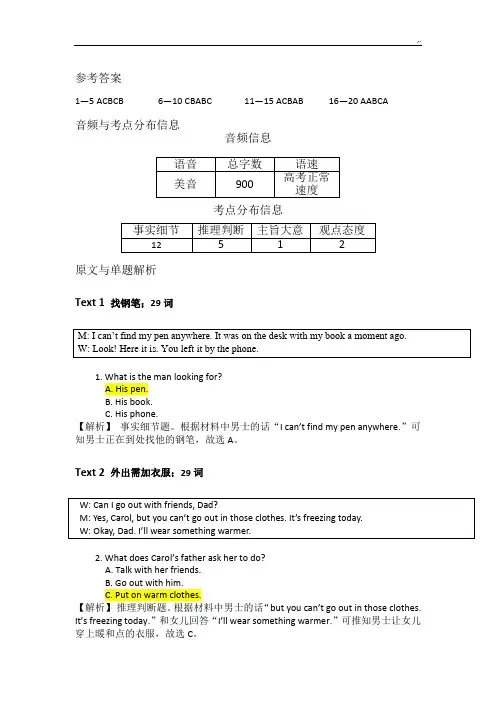
参考答案1—5 ACBCB 6—10 CBABC 11—15 ACBAB 16—20 AABCA音频与考点分布信息音频信息考点分布信息原文与单题解析Text 1 找钢笔;29词1. What is the man looking for?A. His pen.B. His book.C. His phone.【解析】事实细节题。
根据材料中男士的话“I can’t find my pen anywhere.”可知男士正在到处找他的钢笔,故选A。
Text 2 外出需加衣服;29词2. What does Carol’s father ask her to do?A. Talk with her friends.B. Go out with him.C. Put on warm clothes.【解析】推理判断题。
根据材料中男士的话“but you can’t go out in those clothes. It’s freezing today.”和女儿回答“I’ll wear something warmer.”可推知男士让女儿穿上暖和点的衣服,故选C。
Text 3 研究小组的人数;22词3. How many members are there in Alice’s group now?A. Two.B. Four.C. Six.【解析】事实细节题。
根据材料中女士的话“there were six of us to begin with. Then two people left.”可以简单地计算出女士的小组现在有4名成员,故选B。
Text 4 让孩子在厨房帮忙;40词4. What are the speakers talking about?A. Ways of cooking.B. Healthy food for kids.C. Kids helping in the kitchen.【解析】主旨大意题。
2017年11月浙江高考英语试题答案与解析
参考答案20 AABCA——15 ACBAB 16—1—5 ACBCB610 CBABC 11音频与考点分布信息音频信息总字数语速语音高考正常900美音速度考点分布信息观点态度推理判断事实细节主旨大意25 1 12原文与单题解析Text 1 29词找钢笔;1. What is the man looking for?A. His pen.B. His book.C. His phone.【解析】事实细节题。
根据材料中男士的话“I can't find my pen anywhere.”可知男士正在到处找他的钢笔,故选A。
Text 2 词29外出需加衣服;2. What does Carol's father ask her to do?A. Talk with her friends.B. Go out with him.C. Put on warm clothes.【解析】推理判断题。
根据材料中男士的话“but you can't go out in those clothes. It's freezing today.”和女儿回答“I'll wear something warmer.”可推知男士让女儿。
C穿上暖和点的衣服,故选.Text 3 词22研究小组的人数;s group now? 3. How many members are there in Alice'A. Two.B. Four.C. Six.there were six of us to begin with. 事实细节题。
根据材料中女士的话“【解析】。
BThen two people left.”可以简单地计算出女士的小组现在有4名成员,故选Text 4 词让孩子在厨房帮忙;404. What are the speakers talking about?A. Ways of cooking.B. Healthy food for kids.C. Kids helping in the kitchen.主旨大意题。
浙江省2017年11月英语高考(项老师)试题(含答案-word版)

浙江省2017年11月英语高考(项老师)试题(含答案-word版)绝密★考试结束前(2017.11.4)2017年11月浙江省普通高校招生选考科目考试英语试题参考答案第一部分听力(共20小题;每小题1.5分,满分30分)1.A2.C3.B4.C5.B6. C7.B8. A9. B10. C11. A 12. C 13. B 14. A 15. B 16. A 17.A 18.B 19.C 20. A第二部分阅读理解第一节(共10小题;每小题2.5分,满分25分)21.B 22. B 23. A 24. D 25. C 26. C 27.B 28. D 29.C 30. A第二节(共5小题;每小题2分,满分10分)31.D 32. A 33. F 34. G 35. B第三部分语言运用第一节(共20小题;每小题1.5分,满分30分)36. A 37. B 38. D 39. C 40. D 41. C 42.A 43.B 44.C 45. D46. D 47. C 48. B 49. B 50. C 51. A 52.A 53.B 54. A 55. D第二节(共10小题;每小题1.5分,满分15分)56. an 57. which 58. months 59. for 60. effective61. really 62. sounds 63. reading 64. their 65. learned/learnt第四部分写作第一节(满分15分)One Possible VersionDear Mr. Hall,I’m writing to invite you to come to my home to celebrate the Spring Festival on January 19. It’s traditionally a time for family reunion, so my parents and my brother will all be there. We’ll make dumplings together and have a big dinner.B. Healthy food for kids.C. Kids helping in the kitchen.5. What is the woman?A. She’s a shop assistant.B. She’s a receptionist.C. She’s a secretary.第二节(共15小题;每小题1.5分,满分22.5分)听下面5段对话或独白。
2017年11月份高考英语试题(浙江卷含答案)
2017年11月普通高等学校招生全国统一考试(浙江卷)英语选择题部分第一部分听力(共两节,满分30分)第一节(共5小题;每小题1.5分,满分7.5分)听下面5段对话。
每段对话后有一个小题,从题中所给的A、B、C三个选项中选出最佳选项。
听完每段对话后,你都有10秒钟的时间来回答有关小题和阅读下一小题。
每段对话仅读一遍。
1.What is the man looking for?A.His pen.B.His book.C.His phone.2.What does Carol's father ask her to do?A.Talk with her friends.B.Go out with him.C.Put on warm clothes.3.How many members are there in Alice's group now?A.Two.B.Four.C.Six.4.What are the speakers talking about?A.Ways of cooking.B.Healthy food for kids.C.Kids helping in the kitchen.5.What is the woman?A.She's a shop assistant.B.She's a receptionist.C.She's a secretary.第二节(共15小题;每小题1.5分,满分22.5分)听下面5段对话或独白。
每段对话或独白后有几个小题,从题中所给的A、B、C三个选项中选出最佳选项。
听每段对话或独白前,你将有时间阅读各个小题,每小题5秒钟;听完后,各小题将给出5秒钟的作答时间。
每段对话或独白读两遍。
听第6段材料,回答第6、7题。
6.Why does the man sound surprised?A.Lily rejected a job offer.B.Lily was absent from school.C.Lily turned down a scholarship.7.What has Lily decided to do?A.Travel to Dubai.B.Stay with her mom.C.Start a business.听第7段材料,回答第8至10题。
(完整word版)2017浙江高考英语试题及答案,推荐文档

2017年普通高等学校招生全国统一考试英语选择题部分第一部分听力(共两节,满分30分)做题时,先将答案标在试卷上。
录音内容结束后,你将有两分钟的时间将试卷上的答案转涂到答题纸上。
第一节(共5小题;每小题1.5分,满分7.5分)听下面5段对话。
每段对话后有一个小题,从题中所给的A、B、C三个选项中选出最佳选项,并标在试卷的相应位置。
听完每段对话后,你都有10秒钟的时间来回答有关小题和阅读下一小题。
每段对话仅读一遍。
例:How much is the shirt?A. £19.15B. £9.18C. £9.15答案是C.1. What does the woman think of the movie?A. It's amusing.B. It's exciting.C. It's disappointing.2. How will Susan spend most of her time in France?A. Traveling aroundB. Studying at a school.C. Looking after aunt.3. What are the speakers talking about?A. Going out.B. Ordering drinks.C. Preparing for a party.4. Where are the speakers?A. In a classroomB. In a libraryC. In a bookstore5. What is the man going to do?A. Go on the Internet.B. Make a phone call.C. Take a train trip.第二节(共15小题;每小题1.5分,满分22.5分)听下面5段对话或独白。
每段对话或独白后有几个小题,从题中所给的A、B、C三个选项中选出最佳选项,并标在试卷的相应位置。
浙江省2017年11月新高考英语试题有答案
浙江省2017年11月新高考英语]有答案[试题.绝密★考试结束前2017年11月浙江省普通高校招生选考科目考试英语试题浙江省2017年11月新高考英语试题第一部分听力(共两节,满分30分)做题时,先将答案标在试卷上。
录音内容结束后,你将有两分钟的时间将试卷上的答案转涂到答题卡上。
第一节(共5小题;每小题1.5分,满分7.5分)听下面5段对话。
每段对话后有一个小题,从题中所给的A、B、C三个选项中选出最佳选项,并标在试卷的相应位置。
听完每段对话后,你都有10秒钟的时间来回答有关小题和阅读下一小题。
每段对话仅读一遍。
例:How much is the shirt?A. £19.15B. £9.18C. £9.15答案是C1. What is the man looking for?A. His penB. His bookC. His phone2. What does Carol's father askher to do?A. Talk with her friendsB.Go out with himC. Put on warm clothes3. How many members are there in Alice's group now?.A. TwoB. FourC. Six4. What are the speakers talking about?A. Ways of cookingB. Healthy food forkids C. Kids helping in the kitchen5. What is the woman?A. She's a shop assistantB. She's areceptionist C. She's a secretary第二节(共15小题;每小题1.5分,满分22.5分)听下面5段对话或独白。
每段对话或独白后有几个小题,从题中所给的A、B、C三个选项中选出最佳选项,并标在试卷的相应位置。
(完整word版)2017浙江高考英语试题及答案.doc
2017 年普通高等学校招生全国统一考试英语选择题部分第一部分听力(共两节,满分30 分)做题时,先将答案标在试卷上。
录音内容结束后,你将有两分钟的时间将试卷上的答案转涂到答题纸上。
第一节(共 5 小题;每小题 1.5 分,满分7.5 分)听下面 5 段对话。
每段对话后有一个小题,从题中所给的A、 B、 C 三个选项中选出最佳选项,并标在试卷的相应位置。
听完每段对话后,你都有10 秒钟的时间来回答有关小题和阅读下一小题。
每段对话仅读一遍。
例: How much is the shirt?A. £19.15B. £9.18C. £9.15答案是 C.1. What does the woman think of the movie?A. It's amusing.B. It's exciting.C. It's disappointing.2. How will Susan spend most of her time in France?A. Traveling aroundB. Studying at a school.C. Looking after aunt.3. What are the speakers talking about?A. Going out.B. Ordering drinks.C. Preparing for a party.4. Where are the speakers?A. In a classroomB. In a libraryC. In a bookstore5. What is the man going to do?A. Go on the Internet.B. Make a phone call.C. Take a train trip.第二节(共 15 小题;每小题 1.5 分,满分22.5 分)听下面 5 段对话或独白。
2017年11月普通高等学校招生全国统一考试(浙江卷)英语试题附详解
2017年11月普通高等学校招生全国统一考试英语选择题部分第一部分听力(共两节,满分30分)第一节(共5小题;每小题1.5分,满分7.5分)听下面5段对话。
每段对话后有一个小题,从题中所给的A、B、C三个选项中选出最佳选项,并标在试卷的相应位置。
听完每段对话后,你都有10秒钟的时间来回答有关小题和阅读下一小题。
每段对话仅读一遍。
例:How much is the shirt?A. £19.15B. £9.18C. £9.15答案是C.1. What is the man looking for?A. His pen.B. His book.C. His phone.2. What does Carol’s father ask her to do?A. Talk with her friends.B. Go out with him.C. Put on warm clothes.3. How many members are there in Alice’s group now?A. Two.B. Four.C. Six.4. What are the speakers talking about?A. Ways of cooking.B. Healthy food for kids.C. Kids helping in the kitchen.5. What is the woman?A. She’s a shop assistant.B. She’s a receptionist.C. She’s a secretary.第二节(共15小题;每小题1.5分,满分22.5分)听下面5段对话或独白。
每段对话或独白后有几个小题,从题中所给的A、B、C 三个选项中选出最佳选项,并标在试卷的相应位罝。
听每段对话或独白前,你将有时间阅读各个小题,每小题5秒钟;听完后,各小题将给出5秒钟的作答时间。
2017年11月高考真题浙江卷英语试卷-学生用卷
2017年11月高考真题浙江卷英语试卷-学生用卷一、阅读理解(共10小题,每小题2.5分,共25分)1、【来源】 2017年11月高考真题浙江卷(A篇)第21~24题10分When I was in fourth grade, I worked part-time as a paperboy. Mrs. Stanley was one of my customers. She'd watch me coming down her street, and by the time I'd biked up to her doorstep, there'd be a cold drink waiting. I'd sit and drink while she talked.Mrs. Stanley talked mostly about her dead husband, "Mr. Stanley and I went shopping this morning." she'd say. The first time she said that, soda (汽水) went up my nose.I told my father how Mrs. Stanley talked as if Mr. Stanley were still alive. Dad said she was probably lonely, and that I ought to sit and listen and nod my head and smile, and maybe she'd TAL#NBSP work it out of her system. So that's what I did, and it turned out Dad was right. After a while she seemed content to leave her husband over at the cemetery (墓地) .I finally quit delivering newspapers and didn't see Mrs. Stanley for several years. Then we crossed paths at a church fund-raiser (募捐活动) . She was spooning mashed potatoes and looking happy. Four years before, she'd had to offer her paperboy a drink to have someone to talk with. Now she had friends. Her husband was gone, but life went on.I live in the city now, and my paperboy is a lady named Edna with three kids. She asks me how I'm doing. When I don't say "fine, " she sticks around to hear my problems. She's lived in the city most of her life, but she knows about community. Community isn't so much a place as it is a state of mind. You find it whenever people ask how you're doing because they care, and not because they're getting paid to do so. Sometimes it's good to just smile, nod your head and listen.(1) Why did soda go up the author's nose one time?A. He was talking fast.B. He was shocked.C. He was in a hurry.D. He was absent-minded.(2) Why did the author sit and listen to Mrs. Stanley according to Paragraph 3?A. He enjoyed the drink.B. He wanted to be helpful.C. He took the chance to rest.D. He tried to please his dad.(3) Which of the following can replace the underlined phrase "work it out of her system"?A. recover from her sadnessB. move out of the neighborhoodC. turn to her old friendsD. speak out about her past(4) What does the author think people in a community should do?A. Open up to others.B. Depend on each other.C. Pay for others' help.D. Care about one another.2、【来源】 2017年11月高考真题浙江卷(B篇)第25~27题7.5分It's surprising how much simple movements of the body can affect the way we think. Using expansive gestures with open arms makes us feel more powerful, crossing your arms makes you more determined and lying down can bring more insights(领悟).So if moving the body can have these effects, what about the clothes we wear? We're all well aware of how dressing up in different ways can make us feel more attractive, sporty or professional, depending on the clothes we wear, but can the clothes actually change cognitive (认知的) performance or is it just a feeling?Adam and Galinsky tested the effect of simply wearing a white lab coat on people's powers of attention. The idea is that white coats are associated with scientists, who are in turn thought to have close attention to detail.What they found was that people wearing white coats performed better than those who weren't. Indeed, they made only half as many errors as those wearing their own clothes on the Stroop Test(one way of measuring attention). The researchers call the effect "enclothed cognition" suggesting that all manner of different clothes probably affect our cognition in many different ways.This opens the way for all sorts of clothes-based experiments. Is the writer who wears a fedora more creative? Is the psychologist wearing little round glasses and smoking a cigar more insightful? Does a chef's hat make the resultant food taste better?From now on I will only be editing articles for PsyBlog while wearing a white coat to help keep the typing error count low. Hopefully you will be doing your part by reading PsyBlog in a cap and gown(学位服).(1) What is the main idea of the text?A. Body movements change the way people think.B. How people dress has an influence on their feelings.C. What people wear can affect their cognitive performance.D. People doing different jobs should wear different clothes.(2) Adam and Galinsky's experiment tested the effect of clothes on theirwearers'.A. insightsB. movementsC. attentionD. appearance(3) How does the author sound in the last paragraph?A. AcademicB. HumorousC. FormalD. Hopeful3、【来源】 2017年11月高考真题浙江卷(C篇)第28~30题7.5分There are energy savings to be made from all recyclable materials, sometimes huge savings. Recycling plastics and aluminum, for instance, uses only 5% to 10% as much energy as producing new plastic or smelting (提炼)aluminum.Long before most of us even noticed what we now call "the environment, " Buckminster Fuller said, "Pollution is nothing but the resources(资源)we are not harvesting. We allow them to be left around because we've been ignorant of their value." To take one example, let's compare the throwaway economy (经济)with a recycling economy as we feed a cat for life.Say your cat weighs 5kg and eats one can of food each day. Each empty can of its food weighs 40g. In a throwaway economy, you would throw away 5, 475 cans over the cat's 15-year lifetime. That's 219kg of steel—more than a fifth of a ton and more than 40 times the cat's weight.In a recycling economy, we would make one set of 100 cans to start with, then replace them over and over again with recycled cans. Since almost 3% of the metal is lost during reprocessing, we'd have to make an extra 10 cans each year. But in all, only 150 cans will be used up over the cat's lifetime—and we'll still have 100 left over for the next cat.Instead of using up 219kg of steel, we've used only 6kg. And because the process of recycling steel is less polluting than making new steel, we've also achieved the following significant savings: in energy use—47% to 74%; in air pollution—85%; in water pollution—35%; in water use—40%.(1) What does Buckminster Fuller say about pollution?A. It is becoming more seriousB. It destroys the environmentC. It benefits the economyD. It is the resources yet to be used(2) How many cans will be used up in a cat's 15-year lifetime in a recycling economy?A. 50.B. 100.C. 150.D. 250.(3) What is the author's purpose in writing the text?A. To promote the idea of recycling.B. To introduce an environmentalist.C. To discuss the causes of pollution.D. To defend the throwaway economy.二、七选五(共5小题,每小题2分,共10分)4、【来源】 2017年11月高考真题浙江卷第31~35题10分(每题2分)2017~2018学年12月湖北荆州公安县车胤中学高三上学期月考第36~40题10分(每题2分)How to Remember What You Read Reading is important. But the next step is making sure that you remember what you'veread!1You may have just read the text, but the ideas concepts and images (形象) may fly right out of your head. Here are a few tricks for remembering what you read.2If the plot, characters, or word usage is confusing for you, you likely won't be able to remember what you read. It's a bit like reading a foreign language. If you don't understand what you're reading, how would you remember it? But there are a few things you can do… Use a dictionary: look up the difficult words.●Are you connected?Does a character remind you of friend? Doesn't the setting make you want to visit the place? Does the book inspire you, and make you want to read more? With some books, you may feel a connection right away.3How willing are you to make the connections happen?●Read it; hear it; be it!Read the lines. Then, speak them out loud. And, put some character into words. When he was writing his novels, Charles Dickens would act out the parts of the characters. He'd make faces in the mirror, and change his voice for each character.4●How often do you read?If you read frequently, you'll likely have an easier time with remembering what you're reading (and what you've read).5As you make reading a regular part of your life, you'll make more connections, stay more focused and understand the text better. You'll learn to enjoy literature—as you remember what you read!A. Are you confused?B. Practice makes perfect.C. What's your motivation?D. Memory is sometimes a tricky thing.E. Marking helps you remember what you read.F. But other books require a bit more work on your part.G. You can do the same thing when you are reading the text!三、完形填空(共20小题,每小题1.5分,共30分)5、【来源】 2017年11月高考真题浙江卷第36~55题30分2020~2021学年10月浙江嘉兴海宁市上海外国语大学附属浙江宏达学校高二上学期月考第36~55题30分2018~2019学年山东淄博张店区淄博实验中学高一上学期期中第41~60题30分2017~2018学年四川成都郫都区郫都区成都外国语学校高一下学期期末第21~40题30分A young English teacher saved the lives of 30 students when he took1of a bus after its driver suffered a serious heart attack. Guy Harvold, 24,had2the students and three course leaders from Gatwick airport, and they were travelling to Bournemouth to3their host families. They were goingto4 a course at the ABC Language School in Bournemouth where Harvold works as a5.Harvold, who has not6his driving test, said, "I realized the bus was out of control when I was7the students." The bus ran into trees at the side of the road and he8the driver was slumped(倒伏) over the wheel. The driver didn't9. He was unconscious. The bus10 a lamp post and it broke the glass on the front door before Harvold11to bring the bus to a stop. Police12the young teacher's quick thinking. If hehadn't13quickly, there could have been aterrible14.The bus driver never regained consciousness and died at Easy Surrey Hospital. He had worked regularly with the15and was very well regarded by the teachers and students. Harvold said, I was16that no one else was hurt, but I hoped that the driver would17.The head of the language school told the local newspaper that the school is going to send Harvold on a weekend18to Dublin with a friend, thanking him forhis19. A local driving school has also offered himsix20driving lessons.A. controlB. careC. advantageD. noteA. taken inB. picked upC. tracked downD. helped outA. greetB. thankC. inviteD. meetA. presentB. introduceC. takeD. organizeA. driverB. doctorC. librarianD. teacherA. givenB. markedC. passedD. conductedA. speaking toB. waiting forC. returning toD. looking forA. learnedB. noticedC. mentionedD. doubtedA. sleepB. cryC. moveD. recoverA. ran overB. went byC. carriedD. hitA. rememberedB. continuedC. preparedD. managedA. witnessedB. recordedC. praisedD. understoodA. appearedB. reactedC. escapedD. interruptedA. delayB. accidentC. mistakeD. experienceA. airportB. hospitalC. schoolD. policeA. happyB. fortunateC. touchedD. sorryA. surviveB. retireC. relaxD. succeedA. projectB. tripC. dinnerD. dutyA. braveryB. skillC. qualityD. knowledgeA. necessaryB. easyC. differentD. free四、语法填空(共10小题,每小题1.5分,共15分)6、【来源】 2017年11月高考真题浙江卷第56~65题15分2020~2021学年广东广州荔湾区广东实验中学高一上学期期末第66~75题15分(每题1.5分) 2017~2018学年广东广州越秀区高一上学期期末广大附、铁一等三校联考第66~75题15分2018~2019学年4月湖南长沙开福区长沙市第一中学高三下学期月考第61~70题15分2020~2021学年广东广州荔湾区广东实验中学高一上学期期末第66~75题15分(每题1.5分)阅读下面短文,按照句子结构的语法性和上下文连贯的要求,在空格处填入一个适当的词或使用括号中词语的正确形式填空。
2017年11月浙江省高考英语参考答案.doc
首先是稳定心态,保持镇静,并注意调节自己的呼吸率。先慢吸气,当对自己说放松时缓慢呼气,再考虑你正在努力回忆的问题,如果你仍不能回想起来,就暂时搁下这道题,开始选做其他会的试题,过段时间再回过头来做这道题。
作文
略
赠送以下资料
考试知识点技巧大全
一、考试中途应饮葡萄糖水
大脑是记忆的场所,脑中有数亿个神经细胞在不停地进行着繁重的活动,大脑细胞活动需要大量能量。科学研究证实,虽然大脑的重量只占人体重量的2%-3%,但大脑消耗的能量却占食物所产生的总能量的20%,它的能量来源靠葡萄糖氧化过程产生。
据医学文献记载,一个健康的青少年学生30分钟用脑,血糖浓度在120毫克/100毫升,大脑反应快,记忆力强;90分钟用脑,血糖浓度降至80毫克/100毫升,大脑功能尚正常;连续120分钟用脑,血糖浓度降至60毫克/100毫升,大脑反应迟钝,思维能力较差。
据医学文献记载,一个健康的青少年学生30分钟用脑,血糖浓度在120毫克/100毫升,大脑反应快,记忆力强;90分钟用脑,血糖浓度降至80毫克/100毫升,大脑功能尚正常;连续120分钟用脑,血糖浓度降至60毫克/100毫升,大脑反应迟钝,思维能力较差。
我们中考、高考每一科考试时间都在2小时或2小时以上且用脑强度大,这样可引起低血糖并造成大脑疲劳,从而影响大脑的正常发挥,对考试成绩产生重大影响。因此建议考生,在用脑60分钟时,开始补饮25%浓度的葡萄糖水100毫升左右,为一个高效果的考试加油。
2017年11月普通高等学校招生全国统一考试英语科
参考答案
听力部分:
ACBCB/ CBABC / ACBAB / AABCA