
美国作家斯坦贝克的《菊花》全英文分析
for creative expression are limited
Her outlets are her ―hard-swept‖
house and her garden She senses that an important part of her is lying dormant and that the future will be predictable and rather mundane
in the eyes of teamsters and of sailors"
Represents freedom, connection with
others that Elisa longs for but cannot have
The Tinker
He is a skilled salesman, extremely
beauty
Elisa asks his permission (―Can
we…?‖)
Henry
Polite but not intimate Blundering; does not know how to
compliment Elisa
Elisa hopes Henry will see how pretty
The film had 7 Academy
Henry Fonda (center) in The Grapes of Wrath.
Award nominations, 2 wins: Best Supporting Actress (Jane Darwell) Best Director (John Ford).
Hபைடு நூலகம்nry
Concentration on his own role as provider,
organizer, and decision-maker has blinded him to the fact that Elisa needs something more
in her life than a neat house and a good garden
John Steinbeck
Married 3 times, had 2 children with 2nd
wife
Steinbeck was a private person who
shunned publicity.
Later works include: Cannery Row
(1945), The Pearl (1947), East of Eden (1952), Travels with Charley (1962).
A displaced family migrates from Oklahoma to
California
Themes: problems of migrant farm laborers,
social protest, + survival through adversity
Steinbeck won a Pulitzer Prize, a
The Tinker
Like Henry, he values what is practical.
He has saved the flowerpot, but tossed the flowers into the road Is the tinker satisfied with his nomadic life? Or is he trapped in his wandering just as Elisa is trapped in her domestication?
Plot
Climax: Elisa sees the chrysanthemums
and dirt discarded on the road:
• ―Far ahead on the road Elisa saw a dark speck. She knew.”
Resolution: Elisa realizes she is not so strong,
clothes Has no children Has ''a gift'' for growing things Isolated
Elisa
Described as ―having terrier fingers‖
The tinker makes Elisa think about how
Elisa feels connected to a larger world beyond
her isolated farm life.
Elisa
She is devastated by the rejection of her flowers and realizes
her future will be mundane and unremarkable.
Satisfaction with predetermined gender roles?
Setting
―The Chrysanthemums‖
Setting
“The high grey-flannel fog of winter closed off the
Salinas Valley from the sky and from the rest of the world”
Steinbeck died in New York City of
heart disease,1968.
Plot
―The Chrysanthemums‖
Plot
Explication: Story opens with
Elisa and Henry both hard at work on their farm in the valley; interaction between husband & wife
Elisa
When the tinker mentions taking some
chrysanthemums to a woman down the road, Elisa feels energized and encouraged that her work and talent will be appreciated.
and she breaks down in weak tears ''like an old woman.''
Characters
―The Chrysanthemums‖
Elisa
Elisa
Protagonist 35 years old Lean and strong
Wears shapeless, functional
“The Chrysanthemums”
Notes on the story
John Steinbeck
Born on February 27, 1902, in
Salinas, California
Wrote about American working class
poor, often agricultural laborers
limited her life is She feels attracted to and aroused by the tinker She ―‗crouched low like a fawning dog‘‘
Elisa
Realizes that her opportunities
skillful at exploiting potential customers
immediately discerns Elisa's vulnerabilities captures her sympathies by describing her
flowers as looking "like a quick puff of colored smoke."
Here drought and poverty combined to deprive
many farmers of their land.
This is the story of one farmer's family, driven from
their fields by natural disasters and economic changes beyond anyone's control and their great journey in search of peace, security, and another home.
she is, but he does not.
His compliment falls short of what
Elisa needs:
You look strong enough to break a calf
over your knee, happy enough to eat it like a watermelon."
She cries like an old woman - she sees herself growing old
in the same isolated, stifling environment. (or is she already ―old‖ in her own mind?)
Old woman: wise but non-sexual; weak; not useful on a farm
间接言语行为理论在英语阅读教学中的运用——以《菊花》为例
as s d t n l z p e h a t n d s o re f rp o t g s d n s b l y t n e tn ,c mme t n p r cae a d lo u e o a a y e s e c cs i i u s o r moi t e t ’a i t o u d r a d o c n u i s n ,a d a p e it n as o d n n erh ma it n wld e l frwie i g t i u n si k o e g . o h c Ke r s I d r c p e h a t e r ; i o re; n e tn y wo d :n i ts e c c o e h t y ds u c s u d r a d; p r ca e s a p e it
— —
以《 菊花》 为例
高 翼
( 遵义师范学 院 大外部, 贵州 遵义 5 3 0 ) 6 0 2 摘 要 : 文试 图通过 间接 言语行 为理论 , 阅读 中的语篇 言语行 为进行 分析 , 学 生在 阅读 过程 中深刻 理解、 本 对 使 评
价、 赏作品 , 而提升 学生的理解 力和人 文知识 。 欣 从
间接地使用语言是人类 交际 中的一个 普遍现 象。 在语言实践中, 人们并非总是在句法或词汇上直 截了当地表明说话者的意图 ,而是让听话者去意会 其深层的寓意即“ 言外之意”ipi t e 。 ( l a r)语言使用 m cu 中的这种现象就是语 言的间接现象 ( d et s) i i c es。 nr n 这种情况的发生在于 ,人们有时出于一定 的社会规 约限制 , 说话人不能用直接的语言表达思想 , 有时是 说 话人 为 了换取 特定 的交 际效 果 ,出现 了话语 与实 际意义所承载或传递 的信息之间的差异问题。本文 将 以斯坦贝克短篇小说《 菊花》 为例 , 间接言语行 对 为理论 在阅读理 解 中 的作 用进 行 探讨 。
《山菊花》仁爱精神作文

《山菊花》仁爱精神作文英文回答:The story "The Chrysanthemums" by John Steinbeck depicts the life of Elisa Allen, a woman trapped in an unfulfilling marriage and yearning for a more meaningful existence. Elisa's passion for cultivating chrysanthemums symbolizes her unfulfilled potential and her longing for beauty and fulfillment. Through the character of Elisa, Steinbeck explores the theme of stifled creativity and the human desire for connection and purpose.Elisa's husband, Henry, is a practical man who does not share her passion for flowers. He sees them as mere decorations, while Elisa views them as an expression of her inner world. This difference in perspective highlights the emotional distance between them. Elisa's desire for connection and understanding is further emphasized when she encounters a traveling tinker, who represents the potential for a different kind of life.The tinker's arrival disrupts Elisa's mundane existence. His tales of distant lands and his appreciation for her chrysanthemums spark a longing in Elisa's heart. She is drawn to his free spirit and his ability to appreciate the beauty she creates. However, societal expectations and her responsibilities as a wife ultimately prevent her from pursuing a life beyond her marriage.In the end, Elisa is left with the painful realization that her dreams will remain unfulfilled. She buries hermost prized chrysanthemums, symbolizing the loss of her hopes and aspirations. The story concludes with a sense of resignation and regret, underscoring the tragedy of wasted potential and the constraints imposed upon women in a patriarchal society.中文回答:《菊花》是约翰·斯坦贝克创作的一个故事,描述了艾丽莎·艾伦的生活,她是一个被困在一段毫无意义的婚姻中,渴望更有意义的生活的女人。
the chrysanthemum+菊花中英对译

Elisa is a young married lady working on an isolated farm and proud of her skills in growing flowers. One day, she suddenly feels a desire to communicate with the outside world. What happens to her? Please read the following story.
飘荡在半空中的冬雾呈现出灰法兰绒色,将萨利纳斯山谷严实地罩了起来;同时也把它与外界分隔开。雾气锁着山头,四面象顶盖子,而山谷则成了一口盖得严严实实的 深锅。农民在宽阔平坦的土地上深耕,犁铧过处,黑色的土地闪着金属的光泽。在横卧萨利纳斯河的丘陵地上,农场里的茬地泛着黄色,象是沐浴在冷冷的苍白日光下;不过,现在时至腊月,山谷里没什么阳光。河边上密密麻麻的柳丛上的黄叶颜色鲜浓,象着了火似的。
伊利莎看了他们一会儿,又继续忙自己的活儿。她今年三十五岁,脸庞瘦俏并透着坚毅,一双眼睛清澈如水。由于穿着园艺工作服,她显得鼓囊囊 的、有点儿笨拙。她头上戴着一顶男式的黑帽子,拉得很低,直到她的眼睛。脚上是一双粗笨的鞋子。下面穿的印花裙子几乎全给那个大号的灯心绒围裙遮盖了起来。围裙上有四个大口袋,用来放她干活时用的剪刀、泥铲、刮管器、种子和刀。干活时她戴着厚厚的皮手套,免得弄伤手。
河对岸亨利?埃伦家位于丘陵上的农场里已经没什么活计了:干草都收割过并存放了起来,果园业已深翻过,好等到有雨的时候浇个透底墒。高处山坡上的牛变得毛皮杂乱粗糙。
Elisa Allen, working in her flower garden, looked down across the yard and saw Henry, her husband, talking to two men in business suits. The three of them stood by the tractor shed, each man with one foot on the side of the little Fordson. They smoked cigarettes and studied the machine as they talked.
The Chrysanthemums 菊花
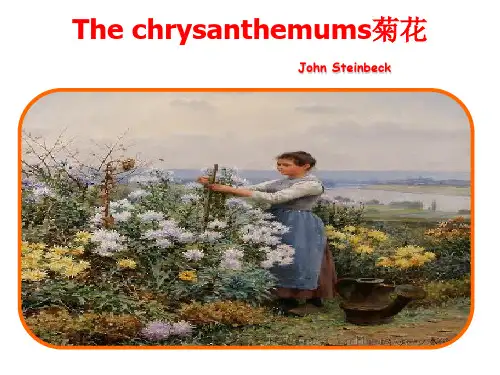
约翰·斯坦贝克(John Steinbeck, 1902-1968)美国作家。生于加利福尼 亚州的一个中产阶级家庭。小时候生 活在小镇、乡村和牧场,热爱乡野的 自然风光。受其母亲的熏陶,很早就 接触欧洲古典文学作品,深爱《圣经》 亚瑟王传奇故事的影响。1919年,进 入斯坦福大学攻读大学。他熟悉并屿 社会底层的人们,他的许多作品都以 他们为主人公,表现了底层人的善良、 质朴的品格,创造了“斯坦贝克式的英 雄”形象。30年代末,蓬勃发展的工人运 动使斯坦贝克受到很大的影响。贝克受到 很大的影响。1937年和1947年,斯坦 贝克两次访问北欧和苏联
Symbols————the Salinas Valley 原文: 原文: “The high grey-flannel fog of winter closed off the Salinas Valley from the sky and from all the rest of the world. On every side it sat like a lid on the mountains and made of the great valley a closed pot.” The Salinas Valley symbolizes Elisa’s emotional life. The story opens with a lengthy description of the valley, which Steinbeck likens to a pot topped with a lid made of fog. The metaphor of the valley as a “closed pot” suggests that Elisa is trapped inside an airless world and that her existence has reached a boiling point.
从文体学的视角赏析斯坦贝克的《菊》
从文体学的视角赏析斯坦贝克的《菊》摘要斯坦贝克的小说《菊》描述了女主人公艾丽莎艾伦从女性的觉醒到幻灭的过程,小说的写作风格独特而又艺术魅力,彰显了诺贝尔得住斯坦贝克的大师风范。
关键词第三人称视角直接引语讽喻1. 引言短片小说《菊》(The Chrysanthemum)是二十世纪上半叶美国著名小说家约翰.斯坦贝克所著,他以《愤怒的葡萄》赢得1962年诺贝尔文学奖。
小说故事情节简明清晰,故事背景发生在作者的家乡—南加利福尼亚州州的萨利纳斯峡谷。
女主人公艾丽莎艾伦与丈夫亨利生活在农场,家门口的菊花圃是艾丽莎展示平日浪漫情怀以及宣泄郁结情感的场所。
某天,她正在花圃里侍弄心爱的菊花时,一个高大不羁的补锅匠意外出现,使她平静的生活泛起阵阵涟漪。
艾丽莎在莫名情愫的驱使下将一盆心爱的菊花苗送给了补锅匠。
而后却在与丈夫外出时发现了被丢弃在路边的菊花苗。
小说结尾时,艾丽莎像苍老的女人一样悲哀哭泣,给读者留下了难以磨灭的形象。
小说之所以如此打动读者,是因为作者高潮的写作技巧。
2. 第三人称视角的读者行文本斯坦贝克采纳不同的叙事方式刻画了一位男性统治社会下的悲剧女性。
为了有效地展开故事情节,他利用了多种文体特征和修辞手法。
通览全文,故事是一篇读者性文本。
Barhes, Roland 认为现代小说可以分为读者性文本和作者性文本。
所谓读者性文本就是允许读者成为文本所呈现的意义、叙述和人物的消费者(175:4)。
简而言之,也就是文本的结构流畅、叙事自然、语言简洁,读者通过阅读可以深刻理解文本的含义和内容。
作者运用第三人称的客观视角展开了小说的叙事。
这种看似传统的叙事角度却对主题揭示有着重要意义。
首先,它显现了一种被束缚压制的叙事张力,对应着小说意图展现了一个事实:在男权统治的世界,女性的诉求是徒劳的。
小说中,无论是她的丈夫还是补锅匠都没有真正试图去了解艾丽莎的内心感受。
其次,这种叙事方式增添了小说主题的多重性和复杂性,为读者解读主人公的心路历程留下了一定的空白,给读者留下了期待视野。
我们看菊花去读后感

我们看菊花去读后感(中英文版)Task Title: Reflection on Reading "We Visit the Chrysanthemums"The short story "We Visit the Chrysanthemums" by John Steinbeck has left an indelible mark on my heart.It tells the tale of a farmer"s wife, Elisa Allen, who dreams of running a farm on her own terms but is constrained by societal expectations and her gender roles.这部短篇小说《我们去看菊花》深深地打动了我。
它讲述了一个农场主的妻子伊丽莎·艾伦的故事,她梦想着经营自己的农场,却受到社会期望和性别角色的限制。
In the story, Steinbeck masterfully portrays the struggles of a woman trying to find her voice in a world that expects her to conform.The chrysanthemums symbolize Elisa"s own ambitions and desires, which are ultimately left unfulfilled.在这个故事中,斯坦贝克精湛地描绘了一个在一个期望她服从的世界里寻找自己声音的女性的挣扎。
菊花象征着伊丽莎自己的雄心和欲望,最终却未能实现。
The narrative style of "We Visit the Chrysanthemums" is captivating, moving from a third-person perspective to a first-person point of view.This shift adds depth to the story, allowing readers to experience Elisa"s emotions and thoughts more intimately.《我们去看菊花》的叙述方式非常吸引人,从第三人称视角转到第一人称视角。
美国作家斯坦贝克的《菊花》全英文分析PPT课件
Plot
Climax: ➢Elisa sees the chrysanthemums and dirt discarded on the road:
• “Far ahead on the road Elisa saw a dark speck. She knew.”
Resolution: ➢Elisa realizes she is not so strong, and she breaks down in weak tears ''like an old woman.''
6
John Steinbeck
Married 3 times, had 2 children with 2nd wife
Steinbeck was a private person who shunned publicity.
Later works include: Cannery Row (1945), The Pearl (1947), East of Eden (1952), Travels with Charley (1962).
Steinbeck won a Pulitzer Prize, a
National Book Award and the Nobel
Prizs
of Wrath.
4
The Grapes of Wrath
In 1940, director John Ford's released his adaptation of The Grapes of Wrath.
3
John Steinbeck
Most significant work: The Grapes of Wrath (novel) 1939
约翰·斯坦贝克《菊花》的及物性分析
但在不 同的语类(er) 它们的分布则不尽相同。在特定的情景语境 中, gne中, 言语者从及物性( asit) t nivy系统作 r ti
连续的选择 以表达内部心理世界和外部经历时 , 某些及物性结构的选择频率会偏高。例如 , 由于物质过程和言
语过程是表达事件发生与进展 以及组织语篇对话 的两大资源 ,所以它们在叙述类及新闻报道等语类 中出现频
性 系统 的相关文体特征 , 有助于揭示 文本 的深层主题意义 : 在当时社会背景下 , 女主人公所代表的女性世界被禁锢于家务和园艺 中, 在其他社会活动中只是被影响的对象 , 现被动 胜; 体 男性世界则专注于物质活动 , 极少用 “ ” 心 去感知世界 , 缺少感性思维活动; 具有 主 观能动 『 生的人也失去了 自我 , 变成了受客观环境支配 的对象。
收稿 日期 :0 0 0 — 5 2 1 — 5 2 作者简 介: 陈 英 (9 6 , , 1 8 一)女 西南大学硕士研究生 , 从事功能语言学研究。
・
14・ 2
沈 阳农 业 大 学 学报 ( 会 科 学版 ) 社
第1 3卷
以爱丽莎作为直接参与者的及物性过程的统计分析表明 , 文本 中物质过程和言语过程分别 占 4 . 共 9 句 ) 7 %( 3 9
就体现男性所从事活动的各类过程而言与女性角色相比物质过程的频率最高而心理过程与行为过程则明显减少表明男性专注于物质活动极少用心去感知世界缺少感性思维活动此外大多数物质活动均只有一个动作者缺乏影响对象说明了当时社会现实下人的主观能动性的丧失
沈 阳农 业 大学 学报 ( 会科 学版 )2 1— 1 1()13 15 社 ,0 lO ,31:2 —2
和 2 .%( 5 99 共 8句 ) 由此 , 以发 现女 主人 公实 际上 主要 涉 及两 类 活动 : 质 活动 和言 语 活动 , 文 中分 别体 。 可 物 在 现 为 : 剪 菊花 和 与人交 谈 ( 修 交谈 对象 包括 丈 夫 和补锅 匠 ) 。这 两类 过程 共 同推 动着 故事 情节 的发 展 。其 中 , 一
菊花
The Chrysanthemums 菊花(by John Steinbeck 约翰•斯坦贝克)约翰·斯坦贝克( John . Steinbeck, 1902 ~1968)是美国20世纪上半叶著名的小说家,他曾写过不少短篇小说,《菊花》( the chrysanthemums) [ 1 ]便是其中的一篇杰作。
《菊花》的故事情节并不复杂,故事发生在斯坦贝克的故乡———南加州的萨利纳斯峡谷。
女主人公爱丽莎·艾伦是一位能干的35岁的家庭主妇,她十分擅长种菊花,和丈夫亨利一起过着一种平淡如水的生活。
但平淡的生活压制不了爱丽莎内心充满的勇气和渴望,她向往外面的世界,渴望走出峡谷去领略生活的风光。
她的这种渴望在碰到一位四处流浪,过着自由生活的补锅匠后变得更加强烈。
但故事的结局却是悲剧性的。
爱丽莎送给补锅匠的菊花被弃之路旁,她对男性世界彻底绝望,她的梦想也随之破灭。
小说开篇渲染的环境气氛,标题《菊花》的象征意义以及斯坦贝克着力塑造的爱丽莎的人物形象,都蕴涵着女性主义思想。
正是这三方面的共同作用,才推动了爱丽莎心理活动的发展,使其女性身份由被界定到自我发现的完成。
1氛围的暗示斯坦贝克把故事的发生地定在萨利纳斯峡谷,然而,他呈现给读者的并不是峡谷的旖旎风光,而是一副沉闷的备受压抑的画面。
“厚重的,灰蒙蒙的法兰绒般的冬雾紧紧笼罩着萨利纳斯峡谷,仿佛要与天空,与外部的整个世界隔绝开一样”,而“这冬雾像扣在山峰上的铁锅,使得整个峡谷看起来像一个紧密扣实的锅盖”。
“紧紧笼罩”,“锅盖”,“紧密扣实的铁锅”,以及紧接着的“苍白的冷冷的阳光”,“焦黄的柳树叶子”等意象词无不暗示着爱丽莎生活的地方是多么的萧条衰败而毫无生机。
它衬托出当时的社会环境或者说当时社会的大气候给人的一种压抑,无形中摧残着女性内心的渴望,使她们像爱丽莎一样迷失了本该属于自己的女性身份。
在男权统治的社会里,她们不得不安于“家庭中的天使”一般的角色。
斯坦贝克的《菊》
The Chrysanthemums二元性别对立下的僭越悲剧——由斯坦贝克的《菊》想到的短篇小说《菊》(The Chrysanthemums)的作者是美国二十世纪上半叶的著名小说家,以《愤怒的葡萄》等作品获得1962年诺贝尔文学奖的约翰·斯坦贝克(John Steinbeck)。
《菊》是斯坦贝克创作中期的作品,他曾在给朋友的信中提到当时他刚刚完稿的《菊》:“它完全不同(于其他作品),将在不知不觉中打动读者。
”而事实正如斯坦贝克预料的那样,拜读过《菊》的读者及评论者无不感到了“内心被某种难以言说的东西所深深震撼了。
”《菊》的故事情节简明而清晰。
故事展开的地点是斯坦贝克的故乡,南加里福尼亚洲的萨利纳斯峡谷。
女主人公艾丽莎·爱伦与丈夫亨利住在那里的一个农场上,家门口的菊花圃是艾丽莎展示平日浪漫情怀以及宣泄郁结的感觉的场所。
这一天,当艾丽莎在花圃里打理心爱的菊花时,一个高大不羁的补锅匠的意外出现,在她平静的心中泛起了不小的涟漪。
艾丽莎在莫名的感情驱使下将一盆心爱的菊花苗送给了补锅匠。
而后却在与丈夫外出时发现了被丢弃在路边的菊花苗。
小说结尾,艾丽莎像苍老的女人一样哀哀哭泣。
很显然,通常人们习惯性地将《菊》解读为一个已婚女人历经失意和遭受挫败的故事。
但对于女主人公为何感到失意,因何遭到挫败却有不同的理解。
一些评论者把主人公艾丽莎的不满和孤独与她年近中年却没有子女,潜在的母性无法发展联系在一起;一种说法是察觉到艾丽莎与丈夫亨利的夫妻关系缺乏激情和深层理解,提出性压抑或许是她感觉烦闷的潜在原因;还有一种则是把《菊》解读为描写厌倦烦琐生活的家庭主妇的典型例子,认为艾丽莎的不满来源于对一成不变的现实生活感到疲乏及对于虚幻的浪漫未来的向往。
毫无疑问,这些观点从不同角度对文本进行了探索和分析,各有其立论依据。
然而,它们在很大程度上并没能细致的发掘《菊》的主题内涵。
如果我们能对这篇小说进行深层的检索,充分留意其中被巧妙地编织进故事的意象与特征,或许可以得到另一种解释,即《菊》是一篇深刻的关于“性别”的故事,它讲述的是一个试图僭越二元性别对立下的女人无法避免的悲剧。