
八大时态构成
八大时态构成
一、一般现在时:
1.概念:经常、反复发生的动作或行为及现在的某种状况。
2.时间状语:always, usually, often, sometimes, every week (day, year, month...), once a week, on Sundays,
3.基本结构:动词原形(如主语为第三人称单数,动词上要加(e)S
4.否定形式:am/is/are+not;此时态的谓语动词若为行为动词,则在其前加don't,如主语为第三人称单数,则用doesn't,通常还原行为动词。
5.一般疑问句:把be动词放于句首;用助动词do提问,如主语为第三人称单数,则用does,同时,还原行为动词。
6.例句:It seldom snows here.
He is always ready to help others.
Action speaks louder than words.
二、一般过去时:
1.概念:过去某个时间里发生的动作或状态;过去习惯性、经常性的动作、行为。
2.时间状语:ago, yesterday, the day before yesterday, last week(year, night, month…), in 1989, just now, at the age of 5, one day, long long ago, once upon a time, etc.
3.基本结构:be动词;行为动词
4.否定形式:was/were+not;在行为动词前加didn't,同时还原行为动词。
5.一般疑问句:was或were放于句首;用助动词do的过去式did 提问,同时还原行为动词。
6.例句:She often came to help us in those days.
I didn't know you were so busy.
三、现在进行时:
1.概念:表示现阶段或说话时正在进行的动作及行为。
2.时间状语:now, at this time, these days, etc.
3.基本结构:am/is/are+doing
4.否定形式:am/is/are+not+doing.
5.一般疑问句:把be动词放于句首。
6.例句:How are you feeling today?
He is doing well in his lessons.
四、过去进行时:
1.概念:表示过去某段时间或某一时刻正在发生或进行的行为或动作。
2.时间状语:at this time yesterday, at that time或以when 引导的谓语动词是一般过去时的时间状语等。
3.基本结构:was/were+doing
4.否定形式:was/were + not + doing.
5.一般疑问句:把was或were放于句首。
6.例句:At that time she was working in a PLA unit.
When he came in, I was reading a newspaper.
五、现在完成时:
1.概念:过去发生或已经完成的动作对现在造成的影响或结果,或从过去已经开始,持续到现在的动作或状态。
2.时间状语:recently, lately, since…for…,in the past few years, etc.
3.基本结构:have/has + done
4.否定形式:have/has + not +done.
5.一般疑问句:have或has提前
6.例句:I've written an article.
It has been raining these days.
六、过去完成时:
1.概念:以过去某个时间为标准,在此以前发生的动作或行为,或在过去某动作之前完成的行为,即“过去的过去”。
2.时间状语:before, by the end of last year(term, month…),etc.
3.基本结构:had + done.
4.否定形式:had + not + done.
5.一般疑问句:had放于句首。
6.例句:As soon as we got to the station, the train had left.
By the end of last month. We had reviewed four books
七、一般将来时:
1.概念:表示将要发生的动作或存在的状态及打算、计划或准备做某事。
2.时间状语:tomorrow, next day(week, month, year…),soon, in a few minutes, by…,the day after tomorrow, etc.
3.基本结构:am/is/are/going to + do;will/shall + do.
4.否定形式:was/were + not; 在行为动词前加won't,同时还原行为动词。
5.一般疑问句:be放于句首;will/shall提到句首。
6.例句:They are going to have a competition with us in studies.
It is going to rain.
八、过去将来时:
1.概念:立足于过去某一时刻,从过去看将来,常用于宾语从句中。
2.时间状语:the next day(morning, year…),the following month(week…),etc.
3.基本结构:was/were/going to do;would/should + do.
4.否定形式:was/were/not + going to + do;would/should + not + do.
5.一般疑问句:was或were放于句首;would/should 提到句首。
6.例句:He said he would go to Beijing the next day.
I asked who was going there。
英语八大时态结构_含例句
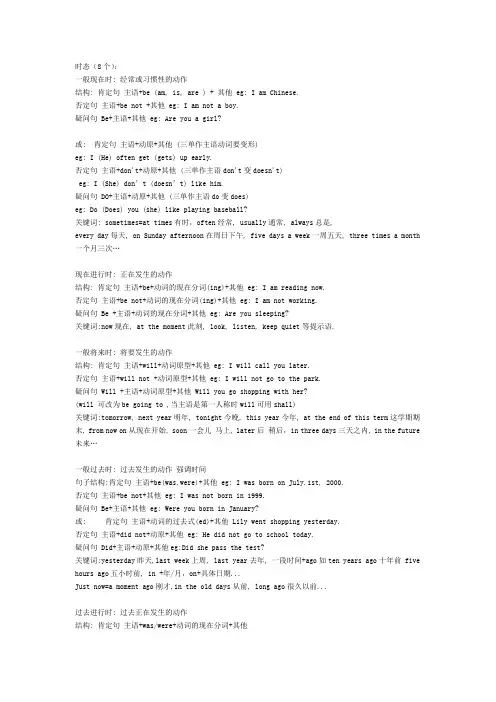
时态(8个):一般现在时: 经常或习惯性的动作结构: 肯定句主语+be (am, is, are ) + 其他 eg: I am Chinese.否定句主语+be not +其他 eg: I am not a boy.疑问句 Be+主语+其他 eg: Are you a girl?或: 肯定句主语+动原+其他 (三单作主语动词要变形)eg: I (He) often get (gets) up early.否定句主语+don't+动原+其他 (三单作主语don't变doesn't)eg: I (She) don’t (doesn’t) like him.疑问句 DO+主语+动原+其他 (三单作主语do变does)eg: Do (Does) you (she) like playing baseball?关键词: sometimes=at times有时,often经常, usually通常, always总是,every day每天, on Sunday afternoon在周日下午, five days a week一周五天, three times a month 一个月三次…现在进行时: 正在发生的动作结构: 肯定句主语+be+动词的现在分词(ing)+其他 eg: I am reading now.否定句主语+be not+动词的现在分词(ing)+其他 eg: I am not working.疑问句 Be +主语+动词的现在分词+其他 eg: Are you sleeping?关键词:now现在, at the moment此刻, look, listen, keep quiet等提示语.一般将来时: 将要发生的动作结构: 肯定句主语+will+动词原型+其他 eg: I will call you later.否定句主语+will not +动词原型+其他 eg: I will not go to the park.疑问句 Will +主语+动词原型+其他 Will you go shopping with her?(will 可改为be going to ,当主语是第一人称时will可用shall)关键词:tomorrow, next year明年, tonight今晚, this year今年, at the end of this term这学期期末, from now on从现在开始, soon一会儿马上, later后稍后,in three days三天之内, in the future 未来…一般过去时: 过去发生的动作强调时间句子结构:肯定句主语+be(was,were)+其他 eg: I was born on July.1st, 2000.否定句主语+be not+其他 eg: I was not born in 1999.疑问句 Be+主语+其他 eg: Were you born in January?或: 肯定句主语+动词的过去式(ed)+其他 Lily went shopping yesterday.否定句主语+did not+动原+其他 eg: He did not go to school today.疑问句 Did+主语+动原+其他eg:Did she pass the test?关键词:yesterday昨天,last week上周, last year去年, 一段时间+ago如ten years ago十年前 five hours ago五小时前, in +年/月,on+具体日期...Just now=a moment ago刚才,in the old days从前, long ago很久以前...过去进行时: 过去正在发生的动作结构: 肯定句主语+was/were+动词的现在分词+其他eg: I was doing my homework at 8 o’clock yesterday evening.否定句主语+was/were not +动词的现在分词+其他They were not staying at home at this moment last Sunday.疑问句 Was/Were + 主语+ 动词的现在分词+其他Were you sleeping when I called you last night?关键词:具体时间如:at ten o'clock yesterday morning, at this moment last Sunday上周日的这个时候...现在完成时: 过去发生的动作对现在造成的影响强调动作或其产生的结果结构:肯定句主语+have/has+动词的过去分词+其他(三单变成has)eg: This year alone, we've already planted ten thousand trees否定句主语+have/has not+动词的过去分词+其他eg: He has not arrived at home yet.疑问句 Have/Has +主语+动词的过去分词+其他eg: Have you been to China?关键词:already已经, yet还, just刚刚, ever曾经, never从不,so far目前, for +一段时间,since+过去的具体时间,this year alone今年以来,these five years alone这五年以来",in the last ten years 在过去的十年中…过去将来时:结构: 肯定句主语+ would+动原+其他 eg: I didn't know if he would come.否定句主语+ would not +动原+其他eg: They were not going to go hiking unless they finished their homework.疑问句 Would+主语+动词原型+其他 (would you like是词组一个固定搭配一般用表示礼貌的问)eg: Would you like to have a dinner with me?(would可改为was/were going to ,主语第一人称时would也可以用should)过去完成时:结构: 肯定句主语+had +动词的过去分词+其他eg: Mr. Smith died yesterday. He had been a good friend of mine.否定句主语+had not +动词的过去分词+其他eg: He said he has not been to America.疑问句 Had+主语+动词的过去分词+其他eg: Had he completed his homework by the time you got there.关键词: 句子中的两个动作都发生在过去一、一般现在时:概念:经常、反复发生的动作或行为及现在的某种状况。
英语八种时态的结构
英语八种时态的结构
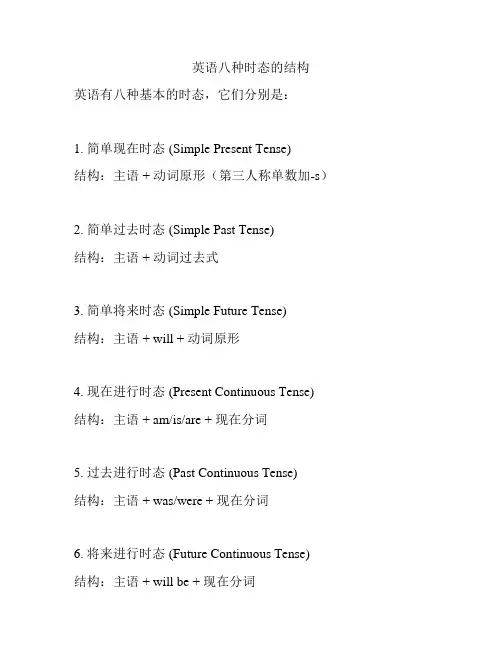
英语有八种基本的时态,它们分别是:
1. 简单现在时态 (Simple Present Tense)
结构:主语 + 动词原形(第三人称单数加-s)
2. 简单过去时态 (Simple Past Tense)
结构:主语 + 动词过去式
3. 简单将来时态 (Simple Future Tense)
结构:主语 + will + 动词原形
4. 现在进行时态 (Present Continuous Tense)
结构:主语 + am/is/are + 现在分词
5. 过去进行时态 (Past Continuous Tense)
结构:主语 + was/were + 现在分词
6. 将来进行时态 (Future Continuous Tense)
结构:主语 + will be + 现在分词
7. 现在完成时态 (Present Perfect Tense)
结构:主语 + have/has + 过去分词
8. 过去完成时态 (Past Perfect Tense)
结构:主语 + had + 过去分词
除了这些基本时态,还有一些其他时态的变体,如进行完成时态 (Present Perfect Continuous Tense) 和将来完成时态 (Future Perfect Tense)。
八大时态的基本结构

八大时态的基本结构八大时态是指英语中的基本时态,包括简单现在时、一般过去时、一般将来时、现在进行时、过去进行时、现在完成时、过去完成时和将来完成时。
下面将对每个时态的基本结构进行详细说明。
1.简单现在时简单现在时主要用来描述经常发生的动作、事实、常规情况以及普遍真理。
它的基本结构为:主语 + 动词原形(第三人称单数需在动词末尾加-s/-es)+ 其他成分For example:- I play basketball every day.- He watches TV every night.- They speak English fluently.2.一般过去时一般过去时用来表示已经结束的动作或状态。
它的基本结构为:主语+动词过去式+其他成分For example:- I played basketball yesterday.- He watched a movie last night.- They spoke to their teacher this morning.3.一般将来时一般将来时用来表示将来发生的动作或情况。
它的基本结构为:主语 + will + 动词原形 + 其他成分For example:- I will play basketball tomorrow.- He will watch a movie later.- They will speak to their teacher next week.4.现在进行时现在进行时用来表示正在进行的动作。
它的基本结构为:主语 + am/is/are + 动词-ing形式 + 其他成分For example:- I am playing basketball right now.- He is watching a movie at the moment.- They are speaking to their teacher currently.5.过去进行时过去进行时用来表示在过去其中一时刻正在进行的动作。
八大时态讲解(共26张PPT)
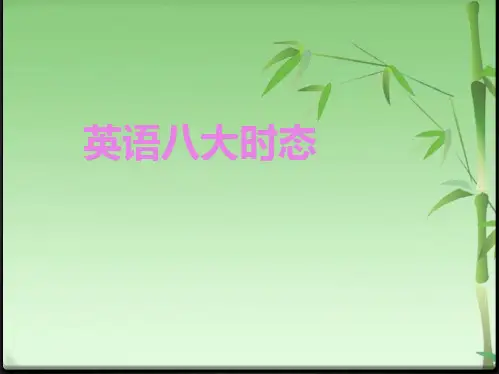
0 一般过去将来时:
He was sixty-eight. In two years he would be seventy.
I knew you would agree.
0 现在英进行语时的: 动词时态(进行) What are you doing?
算;
如:I am going to listen to music. (我打算听音乐) will /shall 表示未事先思考或为计划过的意图
如:It will be Christmas soon .(很快就圣诞节了)
4. 现在进行时态( The Present Continuous Tense )
5、我们离开广州六年了。
We have left Guangzhou for 6 years . ×
We have been away from Guangzhou for 6
years .
3.常见句型
1) 主句(现在完成时)+since 从句(一般过去时).
2) It is +一段时间+ since 从句(一般过去时).
has gone to
He said had seen this morning, …ago, etc
that he _________the film many 如果明天不下雨,我们将去野营。
He has borrowed the pen for three days .
times. 现在进行时态( The Present Continuous Tense )
was /were going to +动词原形
英语语法的八大时态
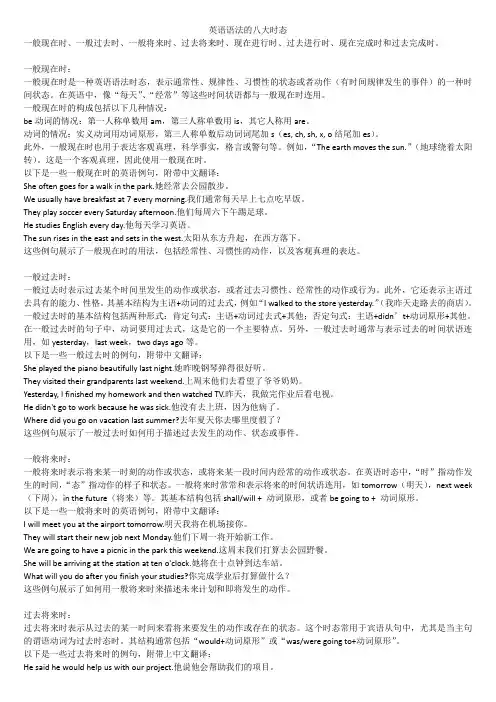
英语语法的八大时态一般现在时、一般过去时、一般将来时、过去将来时、现在进行时、过去进行时、现在完成时和过去完成时。
一般现在时:一般现在时是一种英语语法时态,表示通常性、规律性、习惯性的状态或者动作(有时间规律发生的事件)的一种时间状态。
在英语中,像“每天”、“经常”等这些时间状语都与一般现在时连用。
一般现在时的构成包括以下几种情况:be动词的情况:第一人称单数用am,第三人称单数用is,其它人称用are。
动词的情况:实义动词用动词原形,第三人称单数后动词词尾加s(es, ch, sh, x, o结尾加es)。
此外,一般现在时也用于表达客观真理,科学事实,格言或警句等。
例如,“The earth moves the sun.”(地球绕着太阳转)。
这是一个客观真理,因此使用一般现在时。
以下是一些一般现在时的英语例句,附带中文翻译:She often goes for a walk in the park.她经常去公园散步。
We usually have breakfast at 7 every morning.我们通常每天早上七点吃早饭。
They play soccer every Saturday afternoon.他们每周六下午踢足球。
He studies English every day.他每天学习英语。
The sun rises in the east and sets in the west.太阳从东方升起,在西方落下。
这些例句展示了一般现在时的用法,包括经常性、习惯性的动作,以及客观真理的表达。
一般过去时:一般过去时表示过去某个时间里发生的动作或状态,或者过去习惯性、经常性的动作或行为。
此外,它还表示主语过去具有的能力、性格。
其基本结构为主语+动词的过去式,例如“I walked to the store yesterday.”(我昨天走路去的商店)。
一般过去时的基本结构包括两种形式:肯定句式:主语+动词过去式+其他;否定句式:主语+didn’t+动词原形+其他。
英语八大时态标志词及结构表
英语八大时态标志词及结构表篇一:英语八大时态标志词及结构表1. 一般现在时 (Simple Present Tense):- 常用标志词: always, usually, often, sometimes, never, every day/week/month/year, on Mondays, etc.- 结构: 主语 + 动词原形/第三人称单数形式2. 现在进行时 (Present Continuous Tense):- 常用标志词: now, at the moment, currently, right now, etc. - 结构: 主语 + am/is/are + 现在分词3. 一般过去时 (Simple Past Tense):- 常用标志词: yesterday, last week/month/year, in 1985, etc. - 结构: 主语 + 动词过去式4. 过去进行时 (Past Continuous Tense):- 常用标志词: at 6 pm yesterday, while, when, etc.- 结构: 主语 + was/were + 现在分词5. 一般将来时 (Simple Future Tense):- 常用标志词: tomorrow, next week/month/year, in the future, etc.- 结构: 主语 + will + 动词原形6. 将来进行时 (Future Continuous Tense):- 常用标志词: this time next week/month/year, at 8 pm tomorrow, etc.- 结构: 主语 + will be + 现在分词7. 现在完成时 (Present Perfect Tense):- 常用标志词: already, yet, just, ever, never, so far, etc. - 结构: 主语 + have/has + 过去分词8. 过去完成时 (Past Perfect Tense):- 常用标志词: by the time, before, after, etc.- 结构: 主语 + had + 过去分词以上是英语八大时态标志词及其对应结构表。
英语八大时态详细讲解
5.不规则变化
六、过去进行时
1.构成:①肯定结构:主语+was/were + doing+ (宾语)
②否定结构:主语+was/were not + doing+ (宾语)
④不能用于进行时的动词:A.表示感觉的(feel, smell, sound, taste)
Eg. The plan sounds good.
B.表示感情、拥有关系、状态或思想的动词:agree, believe, belong, contain, hate, hear, like, love, mind, possess, seem, understand, want等
Eg. I wasgoingto leave when it began to rain.
He looked as if he was about to burst into tears.
③was/were to do和was/were doing:
Eg. I was seeing off my sister at the station the next day.
4)重读闭音节,双写词尾辅音字母加ed.如: preferred(重读在fer前); admittedstopped
三、一般将来时
1.结构:①肯定结构:主语+be going to + do或者will/shall + do+宾语
②否定结构:主语+be not going to + do或者will/shall not + do+宾语
He is not going to play basketball this weekend.
英语的八种时态的结构
英语的八种基本时态包括:一般现在时、一般过去时、一般将来时、过去将来时、现在进行时、过去进行时、现在完成时和过去完成时。
以下是这八种时态的基本结构和用法:1.一般现在时:1.结构:主语+ 动词原形/第三人称单数形式(动词+s/es)+ 其他。
2.用法:描述经常发生的动作或状态,表达普遍真理或习惯性行为。
2.一般过去时:1.结构:主语+ 动词过去式+ 其他。
2.用法:描述过去某个时间发生的动作或状态。
3.一般将来时:1.结构:主语+ will/shall + 动词原形+ 其他;主语+ be going to +动词原形+ 其他;主语+ be to + 动词原形+ 其他;主语+ be about to + 动词原形+ 其他;主语+ be due to + 动词原形+ 其他;主语+ be on the point of + 动名词形式+ 其他。
2.用法:描述将来某个时间将要发生的动作或状态。
4.过去将来时:1.结构:主语+ would/should + 动词原形+ 其他。
2.用法:描述过去某个时间将来要发生的动作或状态。
5.现在进行时:1.结构:主语+ be 动词(am/is/are)+ 现在分词(动词+ing)+ 其他。
2.用法:描述正在进行的动作或状态。
6.过去进行时:1.结构:主语+ be 动词的过去式(was/were)+ 现在分词(动词+ing)+ 其他。
2.用法:描述过去某个时间点正在进行的动作或状态。
7.现在完成时:1.结构:主语+ have/has + 过去分词(动词+ed)+ 其他。
2.用法:描述过去发生的动作对现在造成的影响或结果,或者表示从过去某一时间开始一直持续到现在的情况。
8.过去完成时:1.结构:主语+ had + 过去分词(动词+ed)+ 其他。
2.用法:描述过去某个时间点之前已经完成的动作或状态,或者表示一个过去的动作在另一个过去的动作之前发生。
请注意,以上列出的时态结构和用法是基本的概述,实际使用中可能因语境和习惯而有所不同。
学习笔记——英语语法的八大时态
英语语法的八大时态学习笔记一般现在时一般现在时是英语语法中的一个重要部分,它用来描述经常发生的动作、习惯、事实等。
需要掌握一般现在时的用法和构成规则,以便能够正确地运用这一时态。
一、一般现在时的构成一般现在时的构成非常简单,只需要在动词原形后面加上-s或-es。
对于大多数动词来说,加-s就可以了。
例如:work →worksplay →playswatch →watches但是还有一些特殊变化的动词,需要按照它们的规则来变化。
这些变化包括:以s, x, ch, sh结尾的动词加-es。
例如:pass →passesfix →fixeswash →washesbrush →brushes以辅音字母+y结尾的动词,变y为i再加-es。
例如:study →studiescarry →carriesfly →flies有些动词是不规则变化的,需要记忆它们的变化形式。
例如:have →hasdo →doesgo →goes二、一般现在时的用法一般现在时用来描述经常发生的动作、习惯、事实等。
具体来说,它可以表示以下几种情况:经常性动作或状态。
例如:I usually get up at six o'clock.(我通常六点起床。
)She always eats breakfast before she goes to work.(她上班前总是吃早餐。
)They never go to bed late on weekdays.(工作日他们从不晚睡。
)习惯性动作。
例如:He smokes a lot.(他抽烟很凶。
)She drinks coffee every morning.(她每天早上喝咖啡。
)They often take a walk after dinner.(他们经常晚饭后散步。
)客观事实或普遍真理。
例如:The earth revolves around the sun.(地球绕着太阳转。
初中英语语法八大时态总结(完整版)
初中英语语法八大时态一.一般现在时1.结构肯定句式:主语+动词原形/动词的第三人称单数+其他否定句式:主语+(助动词)don't/doesn't+动词原形+其他一般疑问句式:Do/Does+主语+动词原形+其他简略回答:(肯)Yes,主语+do/does(否)No,主语+do/does not缩写形式:don't=do not doesn't=does not例句:He often goes swimming in summer.I usually leave home for school at7every morning.2.用法1)表示经常的、习惯性的动作或存在的状态,常与表示频度的副词连用。
常用的频度副词有:always、often、usually、seldom、never、sometimes,every week(day,year, month…),once a week,on Sundays.频度副词在句中通常放在行为动词之前,系动词、助动词之后。
例如:He often goes swimming in summer.I usually leave home for school at7every morning.2)表示主语具备的性格、特征和能力等。
例如:All my family love football.My sister is always ready to help others.Ann writes good English but does not speak well.3)表示客观真理、客观存在、自然现象。
例如:The earth moves around the sun.Shanghai lies in the east of China.4)表示按计划或安排好的,或将要发生的动作,可用一般现在时表将来。
但只限于start,begin,leave,go,come,arrive,return,take place等。