
七年级英语新版(上)Unit6 Do you like bananas Section A 1 课件
3. Let’s have … 是一个祈使句,表示“让 我们吃/喝„„吧。” Let’s have some ice-cream. 让我们吃些冰激凌吧。 [归纳] have是多义词,归纳如下: (1) 有,拥有;如: I have a new watch. 我有块新手表。
(2) 吃,喝;如: Let’s have some milk and some bread. 让我们喝些牛奶,吃些面包。 (3) 构成固定短语: have a look 看一看
Yes, I do.
Do you like …?
Yes, I do. / No, I don’t.
2a
hamburgers
oranges
Listen and circle the food you hear. tomatoes
salad
pears
strawberries
bananas
ice-cream
Listen again. Fill in 2b the blanks. — I like hamburgers. Do you like hamburgers? —Yes, I do. — Do you like tomatoes __________? — No, I don’t like ___________. tomatoes — Let’s have ice-cream _________. — Oh, no. — No? — I don’t like __________. ice-cream
2. How about …? 相当于 What about …? 意 为“„„怎么样?”是一个用来征询别人 的意见、向别人提建议的交际用语。about是 介词,后跟名词、代词或动词-ing形式。 How about nine o’clock? 9点钟怎么样? I like strawberries. How about you? 我喜欢草莓。你呢? What about having hamburgers? 吃汉堡包怎么样?
4. sure adv. (用作副词)当然;肯定;一定 常用来回答一般疑问句,意为“当然; 的确”,相当于yes或certainly。只是 sure 在英国英语中较为常用,而在美国 英语中常用certainly。
— Are you going with us? 你和我们一起去吗? — Sure. 当然啦。
2d
Jack: Hey, John’s birthday dinner is next week. Let’s think about the food. Tom: Sure. How about burgers, vegetable salad, and some fruit? Bill: Sounds good. John likes hamburgers. Jack: Oh, I don’t like salad.
2c
Practice the conversations above. Give answers that are true for you.
I like hamburgers. Do you like hamburgers?
Yes, I do.
Do you like____? Yes, …/ No, …
last week 上礼拜 this week 本周 next week 下周
7. think about 思考,思索
(一般是短时间的较仔细的考虑) What do you think about that? 你认为怎么样? I’ll have to think about it. 我得想一想。
think of 想到;想象;设想 多用来指“想起,认为”。
Bill: But John likes salad, and it’s his birthday. Jack: Yes, you’re right. What about the fruit? Tom: I think John likes strawberries and apples. Bill: OK. Let’s have strawberries and apples then.
5. dinner n. (中午或晚上吃的)正餐 dinner 指一日中的主餐,可中午吃,也 可晚间吃。但多用于指宴请客人的正式 的一餐。 It’s time for dinner. 该吃晚饭了。 dinner party 宴会 dinner table 餐桌 dinner time 吃饭时间
6. week n. 周;星期 Sunday is the first day of the week. 星期日是一周的第一天。
Let’s have ____.
Sounds good. / No, I don’t like it.
Read the dialogue in 2d. Then choose the right answers. 1. It’s ____ birthday. C A. Jack’s B. Bill’s C. John’s 2. ____ doesn’t like salad. B A. Tom B. Jack C. John 3. John likes burgers, salad, apples and ____. A A. strawberries B. pears C. banana
tomatoes
oranges
strawberries
pears
bananas
Food: bread hamburgers salad
It’s his birthday.
birthday dinner
I like hamburgers. Do you like hamburgers?
Yes, I do.
1b Listen and number the
conversations [1-3].
2 A: Do you like salad?
B: No, I don’t.
1 A: Do you like bananas?
B: Yes, I do.
3 A: Do you like oranges?
B: Yes, I do.
1c
Do you like bananas? Do you like salad? Do you like oranges?
Practice the conversation above. Then make your own conversations.
Yes, I do. No, I don’t.
1. tomatoes 西红柿 tomatoes是tomato的复数形式。 My sister likes tomatoes very much. 我姐姐喜欢吃西红柿。
以字母o结尾的有生命词,其 复数形式在词尾加-es。如图:
negroes (黑人)
heroes
toma和马铃薯。
I couldn’t think of the name of that man
anyhow.
我怎么也想不出那人的名字来了。
Let’s think of some questions about life.
让我们对生活设想一些问题吧。
1. 记忆本课所学的生词。 2. 完成本课的同步练习
— What’s that? — It’s _____. milk
bread
salad
an ice-cream
— What are those? — They are _________. bananas
tomatoes
oranges
strawberries
pears
hamburgers
Fruit:
Let’s have tomatoes?
Oh, no. I don’t like tomatoes.
What about an ice-cream?
Sounds good.
1a
Match the words with the things in the picture.
1. hamburgers d 2. tomatoes i 3. oranges f 4. ice-cream h 5. salad b 6. bananas g 7. strawberries c 8. pears j 9. milk e 10. bread a
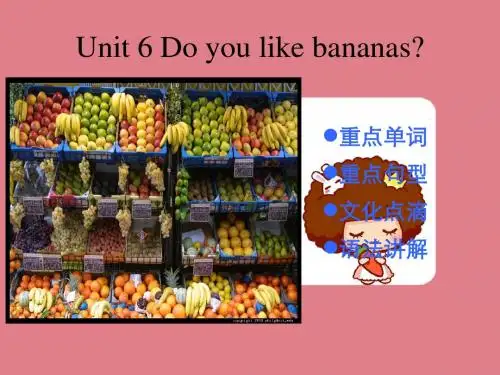
新版七年级初一上册第六课英语Unit 6 Do you like bananas
He/ She/ It likes… He / She/ It doesn’t like…
PPT模板下载:/moban/ 节日PPT模板:/jieri/ PPT背景图片:/beijing/ 优秀PPT下载:/xiazai/ Word教程: /word/ 资料下载:/ziliao/ 范文下载:/fanwen/ 教案下载:/jiaoan/
1.---Does Tom like bananas? ---_____, No ____ he _______. doesn’t But Rose does.
likes 2.My mother ______salad. But I don’t like.(like 3.Do you like apples ___________? (apple) doesn’t 4.She _______ like ice cream. 5.They like hamburgers.(一般疑问句) Do they like hamburgers?
lunch Tom’s
Tom’dinner s
Sandra has/likes eggs, apples and bananas for breakfast. Tom has/likes … for lunch.
返回
He has … He doesn’t have… He likes … He doesn’t like…
2. salad是西餐中一道经典的凉拌菜。传统的沙拉是将洗 净、切成块状或片状的生蔬菜(通常包括生菜、黄瓜 和西红柿等)与沙拉酱混合,均匀搅拌即可。沙拉也 有水果沙拉(fruit salad)、土豆沙拉(potato salad)、海鲜沙拉(seafood salad)等各个品种。
Exercises
七年级英语上册Unit6Doyoulikebananas

My father likes __b__lu, ebut he doesn’t like ___.red
My mother likes _b_l_a_ck_, but she doesn’t like _y_e_ll_o_w__.
第二十六页,共三十六页。
1. What food / sports / colors do you like and dislike?
Do you like … for lunch?
Do you like … for dinner?
No, I don’t. I like oranges.
Yes, … /
No, …
Yes, … /
No, …
第十二页,共三十六页。
Fill in the chart.
Breakfast
Lunch
Dinner
_I_d_o_n_’_t_li_k_e_t_o_m__a_to_e_s_. And for dinner, __I_l_ik_e _ch__ic_k_e_n__a_n_d__r_ic_e_,_b__u_t_I_d_o__n_’t__li_k_e_a__p_p_le. sFor
breakfast, __M__ik_e_ likes ___e_g_g_s_a_n_d__m_i_l_k_, _b_u_t _h_e__d_o_e_s_n_’_t__h_e_likes _h_a_m__b_u_r_g_e_r_s_a_n_d__s_a_l_a_d_,_b_u_t__h_e_d_o_e_s_n_’_t_l_ik_e
第九页,共三十六页。
What do you have for your supper every day?
第十页,共三十六页。
人教版七年级上册英语Unit6Doyoulikebananas
人教版七年级上册英语Unit6 Do you like bananas一. 教材分析人教版七年级上册英语Unit6 Do you like bananas主要讲述了关于喜好和食物的话题。
本节课的主要内容是让学生能够用英语询问和描述他们对不同食物的喜好。
教材通过简单的对话和词汇,帮助学生掌握基本的交际用语,并能够运用这些句子进行日常交流。
此外,本单元还引入了一般现在时态的用法,让学生能够用英语描述他们的日常喜好和习惯。
二. 学情分析在进入七年级上册时,学生们已经掌握了基本的英语语法和词汇知识,具备一定的听、说、读、写的能力。
然而,对于一般现在时态的用法和复杂的句子结构,他们可能还较为陌生。
因此,在教学过程中,需要注重引导学生理解和运用一般现在时态,并通过大量的练习和实际操作,让他们能够熟练运用该时态进行描述和交流。
三. 说教学目标1.知识目标:学生能够掌握一般现在时态的用法,并能够用英语询问和描述他们对不同食物的喜好。
2.能力目标:学生能够听懂、说出一般现在时态的句子,并能够运用该时态进行日常交流。
3.情感目标:通过小组合作和互动交流,学生能够增强自信心,提高团队合作意识。
四. 说教学重难点1.教学重点:一般现在时态的用法和食物词汇的掌握。
2.教学难点:一般现在时态的运用和食物词汇的灵活运用。
五. 说教学方法与手段1.教学方法:采用任务型教学法,通过小组合作、互动交流和实际操作,引导学生主动参与学习过程。
2.教学手段:利用多媒体教学资源,如图片、音频和视频,增加学生的学习兴趣和参与度。
六. 说教学过程1.导入:通过展示一些常见食物图片,引导学生谈论他们对食物的喜好。
2.新课呈现:引入一般现在时态的概念,并通过示例句子让学生理解一般现在时态的用法。
3.对话练习:让学生听录音或观看视频,模仿对话中的句子,并进行角色扮演。
4.小组活动:学生分组进行讨论,用英语询问和描述他们对食物的喜好。
5.巩固练习:通过完成练习题和互动游戏,让学生进一步巩固一般现在时态的用法。
英语七年级上册Unit6Doyoulikebananas人教版七年级上unit6课件

I couldn’t think of the name of that man. 我想不出那人的名字来了。
Let’s think of some questions about life. 让我们对生活设想一些问题吧。
4. sure adv. (副词)当然;肯定;一定 常用来回答一般疑问句,意为“当然; 的确”,相当于yes或certainly。只是 sure 在英国英语中较为常用,而在美国 英语中常用certainly。
Jack: Hey, John’s birthday dinner is next week.
Let’s think about the food.
Tom: Sure. How about burgers, vegetable salad,
and some fruit?
2d
Bill: Sounds good. John likes hamburgers.
last week 上礼拜
this week 本周
next week 下周
3. think about 思考,思索
(一般是短时间的较仔细的考虑) What do you think about that? 你认为怎么样? I’ll have to think about it. 我得想一想。
think of 想到;想象;设想 多用来指“想起,认为”。
Countable nouns Uncount- Countable and
able uncountable
nouns nouns
hamburgers, e_g_g_s milk _o_r_a_n_g_e_s__a_p__p_le_s_ bread _b_a_n_a_n__a_s__p_e_a_r_s_ rice _ca_r_r_o_t_s__t_o_m_a__to_e_s _v_e_g_e_t_a_b_le_s______
七年级上Unit 6Do you like bananas 知识点总结

七年级上Unit 6Do you like bananas 知识点总结谈论对事物的喜好a.一般情况下,加-s; eg:like---likesb.以ch,sh等结尾的动-es,eg:watch--watchesc.以辅音字母+y结尾的动词,直接加规则动词 d. 以元音字母+y结尾的动词,变y为i加e.以字母o结尾,一般加-s动词第三人称单数形式变化规律不规则动词:have----hasfor + breabfast / lunch / dinnerfor breakfast? 你早餐喜欢吃什么?I like chicken for breakfast. 我早餐喜欢吃鸡肉。
举一反三:1.What do you like like for + breabfast / lunch / dinner?你早餐/午餐/ 晚餐喜欢吃什么?I like sth for breakfast/ lunch / dinner.我早餐喜欢吃鸡肉。
2.What do they like like for + breabfast / lunch / dinner?他们早餐/午餐/ 晚餐喜欢吃什么?They like sth for breakfast/ lunch / dinner.他们早餐喜欢吃鸡肉。
3.What does he/she like like for + breabfast / lunch / dinner?他/她早餐/午餐/ 晚餐喜欢吃什么?He/She likes sth for breakfast/ lunch / dinner.他/她早餐喜欢吃鸡肉1)可数名词、不可数名词、即可数又不可数名词2)可数名词单数变复数的规则1.一般情况下直接加-s, girls, books,2. 以s, x, ch, sh 结尾的加-es , classes, boxes, brushes,3.以辅音字母加y 结尾, 4, 以元音字母加y 结尾, 或fe 结尾, Phrases 1. birth 出生 day 日;天 birthday 生日 birthday dinner 生日聚餐 2. right 正确的;适当的 你是对的。
七年级英语上册Unit6Doyoulikebananas课文注释素材(新版)人教新目标版

七年级英语上册Unit6Doyoulikebananas课文注释素材(新版)人教新目标版Unit6 Do you like bananas?1.Let's think about the food.答案让我考虑考虑(这件事)。
2.So what fruit do you like?答案那你喜欢哪种水果?此处疑问词what和名词fruit合成一个独立的疑问结构,表示“什么水果;哪种水果”。
3.what还可以和其他名词搭配,组成“合成疑问词”。
例如:What color do you like?答案你喜欢什么颜色?4. I don't want to be fat.答案我可不想变胖。
want to be…表示“想要成为……;想要变得……”,动词be之后接形容词或名词。
5.Do you want to be a teacher?答案你想成为一名老师吗?6.I don't want to be old!答案我可不想变老!7. I don't want to be overweight.答案我不想超重。
fat有“肥胖”之意,表达较为直接。
在英语中,人们比较忌讳使用这个词,而是委婉地改用其他说法。
8.For breakfast/lunch/dinner,I like…答案早饭/午饭/晚饭我喜欢(吃)…9.What do you have for breakfast?答案早饭你吃什么?10.We often eat rice for lunch. (=For lunch, we often eat rice.)答案我们午饭常吃米饭。
介词for与一日三餐名称搭配使用时,表示各餐所吃的食物。
Unit6Doyoulikebananas_重点语法归纳总结人教版七年级英语上册
Unit 6 Do you like bananas?一、【重点短语过关】birthday dinner 生日餐think about 考虑what/how about ……怎么样vegetable salad 蔬菜沙拉eating habits 饮食习惯after dinner 饭后want to 想要eat well 吃得好have breakfast 吃早餐have lunch 吃午餐have supper 吃晚餐have sth. for…哪顿饭吃某物二、【重点句型过关】Do you like hamburgers? Yes, I do. /No, I don’t.Does he/she like a salad? Yes ,he/she does. No ,he/she doesn’t.She doesn’t like vegetables.We don’t like bananas.What do you like/ have for lunch? I like/ have hamburgers for lunch.Do you like eggs for breakfast? Yes. I do./ No, I don’t.三、【重点语法解析】可数名词和不可数名词名词按其所表示的事物的性质分为可数名词和不可数名词。
(1)可数名词:可以用数量计数的名词。
它又可以分为单数和复数两种形式。
可数名词作主语时,谓语动词与主语单复数保持一致;(2)不可数名词:不可以用数字一个一个数出来的名词。
如:water information paper news bread 特点:a.通常没有复数形式。
b.作主语时,谓语动词要用单数形式。
c.不能直接用a/an和指示代词this,that,these,those修饰。
d.不能用基数词修饰。
e.可用some,any,a little,a lot of,lots of,much等形容词修饰。
人教版七年级上册英语Unit6Doyoulikebananas知识点总结
人教版七年级上册英语Unit6Doyoulikebananas知识点总结人教版七年级上册英语Unit 6 Do you like bananas? 知识点总结1. A: Do you like tomatoes? 你喜欢西红柿吗?B: Yes, I do./No, I don't. I don't like tomatoes 是的,我喜欢。
不,我不喜欢。
我不喜欢西红柿。
2.-Does your father like carrots? 你的爸爸喜欢胡萝卜吗?- Yes, he does./ No, he doesn't. He doesn’t like carrots. 是的,他喜欢。
/不,他不喜欢。
他不喜欢胡萝卜。
3. sb’s birthday dinner 某人的生日晚宴4. next week 下周5. think about 考虑6. some fruit/food 一些水果 /食物7. Let’s h ave ice-cream. 让我们吃冰激凌吧。
8. eat well 吃得好9. ask…about …向某人询问某物10. eating habits 饮食习惯11. What fruit do you like? 你喜欢什么水果?12. for breakfast/lunch/dinner 就早 /午/晚餐而言13. It’s healthy. 它是健康的。
14. I really like it. 我真的喜欢它。
15. I like chicken for dinner. 晚餐我喜欢吃鸡肉。
16. one last question 最后一个问题17. after dinner 晚饭后18. I don’t want to be fat. 我不想变胖。
1、Do you like hamburgers? 你喜欢汉堡包吗?Yes, I do. No, I don’t是的,我喜欢。
人教版七年级英语上册unit6 do you like bananas单词短语归纳
Unit 6 Do you like bananas 【单词总结】banana/bə'na:nə/n.香蕉hamburger/'hæmbə:gə/n.汉堡包tomato/tə'ma:təu/n.西红柿ice-cream/ais'kri:m/n.冰激凌salad/'sæləd/n.沙拉strawberry/'strɔ:bəri/n.草莓pear/peə/n.梨milk/milk/n.牛奶bread/bred/n.面包birthday/'bə:θdai/n.生日dinner/'dinə/n.(中午或晚上吃的)正餐week/wi:k/n.周;星期think about思考;思索food/fu:d/n.食物sure/ʃuə/adv.当然;肯定;一定How about...?(提出建议)......怎么样?burger/'bə:gə/n.(=hamburger)汉堡包vegetable/'vedʒtəbl/n.蔬菜fruit/fru:t/n.水果right/rait/adj.正确的;适当的apple/'æpl/n.苹果then/ðen/adv.那么egg/eg/n.蛋;鸡蛋c arrot/'kærət/n.胡萝卜rice/rais/n.大米;米饭chicken/'tʃikin/n.鸡肉so/səu/conj.(引出评论或问题)那么breakfast/'brekfəst/n.早餐;早饭lunch/lʌntʃ/n.午餐star/sta:/n.明星;星星eat/i:t/v.吃well/wel/adv.好;令人满意地habit/'hæbit/n.习惯healthy/'helθi/adj.健康的really/'ri:əli/adv.真正地question/'kwestʃən/n.问题want/wɔnt/v.需要;想要be/bi:/v.变成fat/fæt/adj.肥的;肥胖的【短语归纳】1.John’s birthday dinner约翰的生日宴会2.vegetable salad蔬菜沙拉3.two tomatoes两个西红柿4.eat well吃得营养5.think about考虑6.eat/have breakfast/lunch/dinner吃早/午/晚饭7.sports stars体育明星8.the volleyball star排球明星9.ask sb.about sth.问某人某事10.like hamburgers/ice-cream喜欢汉堡包/冰淇淋11.like eating eggs喜欢吃鸡蛋12.her eating habits她的饮食习惯13.be(not)healthy(不)健康14.one last question最后一个问题15.healthy food健康食物16.after breakfast/lunch/dinner早/午/晚饭后。
2023七年级英语上册Unit6Doyoulikebananas第4课时教案(新版)人教新目标版
2.请用一般现在时描述你家人的日常生活,并尝试使用情态动词do进行提问和回答。
例:My mother cooks dinner at 6 o'clock every evening. Yes, she does. Does your mother?
3.请用一般现在时描述你的朋友或同学的日常生活,并尝试使用情态动词do进行提问和回答。
例:My friend goes to school by bus every day.在时描述你的宠物的日常生活,并尝试使用情态动词do进行提问和回答。
例:My cat sleeps on the sofa every afternoon. Yes, it does. Does your cat?
核心素养目标分析
本节课旨在培养学生的语言能力、文化意识、思维品质和学习能力,全面提高学生的英语核心素养。在语言能力方面,通过本节课的学习,学生能够准确运用一般现在时表达自己的喜好和习惯,并能用情态动词do进行恰当的提问和回答。在文化意识方面,学生能够了解和理解不同文化背景下人们对食物喜好的差异,培养尊重和理解他人的文化习惯。在思维品质方面,学生能够通过分析、推理和判断等思维活动,提高思维的逻辑性和准确性。在学习能力方面,学生能够运用自主学习、合作学习和探究学习等策略,提高学习的效果和效率。通过本节课的学习,学生将能够更好地运用英语进行实际交际,提高自身的英语核心素养。