
仁爱版英语七年级下册知识点
仁爱版)英语七年级下册知识点归纳2018-09-03(仁爱版)英语七年级下册知识点归纳Unit 5 Topic1重点语法一般现在时(常与频度副词never, seldom, sometimes, often ,usually, always等连用)重点句型—How do you usually come to school?—I usually come to school by subway.—How often do you go to the library?—Once/Twice/Three times a week/Very often/Every day/Seldom重点详解1I always come to school by bus.by+交通工具名称,表示使用某种交通方式,中间不加限定词,如果交通工具前有a, the, my 等限定词,就不能用by,而是用in或是on.on the train=by train on his bike=by bike in my car=by car.巧辩异同on foot 与walk on foot “走路”,是介词短语,不能作谓语,只作方式状语,位于句末。
walk “走路”,是动词,可以作谓语。
go to…on foot= walk toI often go to school on foot. =I often walk to school.同样,go to….by bike = ride a bike togo to…. by car = drive a car togo to … by plane = fly togo to… by bus = take a bus to2 Come on! It’s time for class. come on “快点,加油,来吧”。
It’s time for sth. “该做某事了”,与 It’s time to do sth.意思一样。
3 look的短语 look the same看起来一样look like看起来像……look for寻找look after 照顾4 do my homework at school 在学校做作业do one’s homework 做家庭作业(注意:one’s要随主语的变化而变化,常用形容词性物主代词my, your, their, our, his, her等)。
5 we want to know about the school life of American students. 我们想了解一下美国学生的学校生活。
know about “了解,知道关于…”。
6 巧辩异同 a few与few a few “一些”,few“很少,几乎没有”,修饰可数名词。
a little与little a little“一些”,little“很少,几乎没有”,修饰不可数名词。
7 They often play basketball or coccer, go swimming and so on.go swimming 去游泳and so on “等等”,表示还有很多。
拓展 go+v.-ing 表示去做某事,类似的有:go fishing 去钓鱼go shopping 去买东西go boating 去划船go skating 去滑冰8 How often do you go to the library?你多久去一次图书馆?how often“多久一次”,问频率。
答语常用频度副词never, always, often等或单位时间内的次数once a week一周一次twice a month每月两次three times a year每年三次语法讲解一般现在时一般现在时表示:(1)现在所处的状态。
Jane is at school.(2)经常或习惯性的动作。
I often go to school by bus.(3)主语具备的性格和能力。
He likes playing football.(4)客观真理。
The earth goes round the sun.常用的时间状语:often, always, usually, sometimes, every day等等。
行为动词的一般现在时,助动词是do/don’t和does/doesn’t.当主语是第一、二人称和所有复数形式时,行为动词用原形。
肯定式:I go to school on foot.否定式:I don’t go to school on foot.疑问式:Do you go to school on foot? —Yes, I do. —No, I don’t.当主语是第三人称单数时,动词用第三人称单数形式,在词尾加-s或-es。
肯定式:He goes to work by bus. 否定式:He doesn’t go to work by bus.疑问式:Does he go to work by bus? —Yes, he does. —No, he doesn’t.Topic2重点语法现在进行时态。
重点句型What are you doing? He is cleaning the dormitory.Are you doing your homework? Yes, I am./No, I am not.How long can I keep them? Two weeks.重点详解1 at the moment“此刻,现在”,相当于now.2 巧辩异同go to sleep与go to bed① go to bed“上床”“就寝”I often go to bed at ten.② go to sleep“入睡”“睡着”Last night I went to sleep at two o’clock.3 巧辩异同some, a few 与a little“一些,有些”三者都修饰名词。
some既可以修饰可数名词又可以修饰不可数名词。
We want some apples and some water.a few用在可数名词复数之前,a little用在不可数名词之前。
There are a few books and a little waterin the classroom.4 与how相关的短语how often多常how many多少how much多少钱how old多大5 And you must return them on time.你必须按时归还它们。
Return意为“归还,回归”① return sth. to sb.把某物归还某人=give back sth. to sb.② return to“回到…”,相当于come back to…6 Maria and a girl are talking at the lost and found.talk“交谈”,常用的短语talk to/with sb.“与某人交谈”巧辩异同talk, say, speak与tell(1) talk“交谈”,表示通过谈话方式交换意见、消息等。
(2) speak“说话”,强调开口发声,后常接某种语言。
(3) say “说”,强调所说的话的内容。
(4) tell“告诉”,有时兼含“嘱咐”“命令”等。
tell a truth说真话,tell a lie说谎, tell a story 讲故事等固定搭配。
7I can’t find my purse and I am looking for it. look for“寻找”,强调寻找的过程;find“找到”强调找的结果。
8 look(at), see与read look(at)指看的动作,see指看的结果,read常指看书、看报纸等。
9 Here are some photos of his.这有他的一些照片。
photos of his是双重所有格。
his是名词性物主代词,后还可以接名词所有格。
a friend of mine我的一个朋友a classmate of my brother’s我弟弟的一个同学10 I also want to go there one day.我也希望有一天到那儿。
also意为“也”,常用于be动词和情态动词后面,实义动词的前面。
巧辩异同 also与too also放在句中,too用于句末。
语法讲解现在进行时1.现在进行时表示:现在正在进行或发生的动作。
2.常用的时间状语:now, at the moment, look, listen等。
3.谓语动词构成:be(am/is/are)+v.-ing形式。
4.现在进行时态的肯定、否定和疑问式。
(1)肯定式:I am running. You are running. He/She is running.(2)否定式:I’m not running. You aren’t running. He/She isn’t running.(3)一般疑问句及回答:—Are you running? —Yes, I am./—No, I am not.—Is he/she running? —Yes, he/she is./ —No. he/she isn’t.Topic3重点语法一般现在时和现在进行时的使用和异同。
重点句型 What day is ti today? It’s Wednesday.Why do you like it? it’s easy and interesting.What class are they having? They are having a music class.重点详解1 询问星期几用What day…?回答:It’s Wednesday/Sunday…。
与特殊疑问句词what有关的短语:what class什么班what color什么颜色what time几点what date几号(日期)2 How many lessons does he have every weekday?How many+可数名词的复数形式;How much+不可数名词。
3 一个星期的第一天是Sunday, 在星期几前用介词on,在具体点钟前用at.4 learning about the past了解过去learn about了解拓展learn from向……学习learn by oneself自学5 What do you think of …? = How do you like…?你认为……怎么样?6 —Why? —Because it’s interesting. 用why提问必须用because回答。
(完整版)仁爱版英语七年级下全部知识点总结.doc

七年级下英语知识点总结Unit 5 Topic1㈠短语总结1.在学校大门口 at the school gate2.来学校come to school3. 去学校go to school4. 上课have class / have classes5. 步行on foot6.骑自行车ride a bike/ ride bikes/ by bike / on a bike7.坐公交by bus / take a bus8.坐地铁by subway / take the subway / on the subway9.坐飞机by plane/ take the plane / on the plane10.坐小汽车by car / in a car/ take a car/ drive a car11. 坐轮船by ship12. 坐小船by boat13. 坐火车by train / on the train14. 在我们组in our group15.一群学生a group of students16.我们中的三个人 three of us17.在平日 on weekdays18.在周末 on the weekends / at weekends19.起床 get up20.睡觉 go to bed21.早起 get up early22.回家 go home23.到家 get home24.去动物园 go to the zoo25.去公园 go to the park26.看电影 see a movie / film27.看电视 watch TV28.在晚上 in the evening / at night29.帮助父母 help parents30.做某人的家庭作业 do one’s ( my/ her/ his/ your/ their)homework31.在学校 at school32.知道 ,了解 know about / learn about33.校园生活 school life34.一个美国学生 an American student35.在美国 in America / in the U.S.A.36.许多学生 many students/ a lot of students/ lots of students37.很少 very few38.吃午饭 have lunch39.出去吃饭 eat out40.在校期 on school days41.休息一会 have a short rest/ break42.午后 after lunch43.在某人的余 in one’s ( my/ his/ her/ their⋯)free/ spare time44.打球 play basketball45.踢足球 play soccer / football46.琴 play the piano47.吉他 play the guitar48.拉二胡 play erhu49.去游泳 go swimming / go for a swim50.去划船 go boating51.球 a ball game / ball games52.一年四次 four times a year53.听音 listen to music54.read books55.看 read newspapers56.看医生 see a doctor57.去 go to the library58.一周两次 twice a week59.朋友 meet friends60.每天 every day61.在七点半 at half past seven62.一小会 for a little while / for a short time63.晚后 after supper64.吃 have dinner65.吃早 have breakfast㈡重要句型1.I usually come to school by subway.同句 : I usually take the subway to school.划部分提 : How do you usually come to school?似的有:go to school by bike=go to schoolon a bike= ride a bike to school=ride to schoolgo home by bus=go home on a bus=take a bus home2.How do you usually/ often⋯?你通常 /常怎⋯?3.It ’stime for class.=It’s time to have class. =It’s time for having class.4.What about you? =How about you?5.How often ⋯? 率,回答可以用率副: always, usually, often,sometimes, seldom, never, every day ,every +其他名或表示率的短回答表示率的短:次数 +位e.g. : once a day / twice a week / three times a month6.The early bird catches the work. ( ) 笨先7.Work / Study must come first. 工作 / 学必放在第一位!8. Classes begin at eight. =Class begins at eight.提问:What time does the class begin? / What time do the classes begin?㈢重要单词的用法1.look (感官动词 ) 看起来,后面加形容词His mother looks very young.They look very cute.Her dress looks very nice.You look very cool in this coat.2. by 介词by 后面直接加表示交通工具的名词,中间不用任何词修饰,如: by bike by +动词 ing 形式,表示通过某种方式People show love to their mothers by giving cards.You can be a good student by working hard.3.over (形容词 ) School/ Class is over.4.begin现在分词 : beginning 过去式 : beganbegin to do sth , begin doing sthHe begins to write a letter. =He begins writing a letter.如果 begin 本身为分词,只能用begin to do sthHe is beginning to run.5.listen to 听(动作), hear 听见 (结果 )6.always 反义词 never7.本话题涉及的时态为一般现在时,句中常有频率副词或表示频率的短语,如果主语为三单,动词一定要用三单!(四)易错题1.You new watch ______ (look) very nice!2.Here ______(be) some news.3.Oh, come on! It’s time_____ going to school.4.They usually go to school on ________(feet).5.In my class, forty of _______(we) go to school by bike.6.The early bird ______ (catch) the worm.7.Kangkang often _____ (ride) a bike to the park.8.What time _____ (be)school over?9.Work must come ______(once).10.It ’stime ____you to get up.11.We often _____ books in the morning.12.Jill ’s friend like ______(study) in our school.13.Mr. Wang teaches ______(we) English. _____ of us like him.14.How about ______(go) out with me?15.Most students go to school _____ the school bus.16._______ do you go shopping with your mother?A. How soonB. How farC. How oftenD. How much17. What time do you usually get up _____ weekdays?18. He ______ busy, so he has no time to play with us.A. is alwaysB. seldom isC. always isD. often is19.The last class______(finish) at twelve o’clock.20.Let’s go______(boat).21.It’stime to have breakfast. 同(义句 )______________________________________________________.22.Michael often rides a bike to school. 同(义句 )______________________________________________________.23.I always go to work on foot. (对划线部分提问 )______________________________________________________.24.My mother goes shopping twice a week. 对(划线部分提问 )______________________________________________________.25.Mary always reads books in the library. 反(义句 )______________________________________________________.26.He usually does his homework at school.否(定句 )______________________________________________________.27.They often go to school by bus in the morning. 对(划线部分提问 ) ______________________________________________________.28.Jane seldom watches TV on weekdays改.(为一般疑问句 )______________________________________________________.29.He usually has lunch at home. 对(划线部分提问 )______________________________________________________.30.Li Ping often goes to work on foot. (同义句 )______________________________________________________.31.几乎没有学生乘地铁去学校。
仁爱英语七年级下册unit7知识点

Unit 7 Topic 3 知识点总结一、语法:一般过去式1、概念:表示过去发生的动作、事件、情况,而现在已结束,也可以表示过去时间里经常性或习惯性的动作,或主语过去的性格和能力。
2、常见的时间状语①yesterday ,yesterday morning/afternoon/evening②just now刚才in the past过去the day before yesterday前天③ago短语:a moment ago, an hour ago, three weeks ago, two months ago, four years ago等④in+时间点:in 2000,in 1995,in 1880⑤last短语:last week上周/last year去年/last month上个月/last night昨天晚上二、是三、1、at the party在聚会上2、recite a Chinese poem背汉语诗3、perform magic tricks表演魔术4、enjoy oneself=have a good time玩的愉快5、miss the chair 坐空椅子6、fall down摔倒7、hurt yourself伤了你自己8、at once立刻9、sth happened to sb某事发生在某人身上10、at that time在那时11、come back home回家12、lie to sb向某人撒谎13、tell sb the truth告诉某人真相14、go to the party with sb和某人一起去参加party15、last night昨天晚上16、tell a lie to sb向某人说谎17、make sb angry使某人生气18、lose the game输了比赛19、buy lots of food and drinks for sb为某人买许多食物与饮料20、each of us我们每一个人21、make the card by hand亲手制作卡片22、a big birthday cake with 13 candles带13根蜡烛的大生日蛋糕23、make a silent wish默默地许愿24、blow the candles out in one breath一口气吹灭蜡烛25、it’s your turn轮到你了26、it’s one’s turn to do sth轮到某人做某事27、enjoy doing sth=like doing sth喜欢做某事四、重要句型1、How was Kangkang’s birthday party? It was very nice.康康的生日party怎么样?它很不错。
(完整版)仁爱版七年级英语下册知识点总结
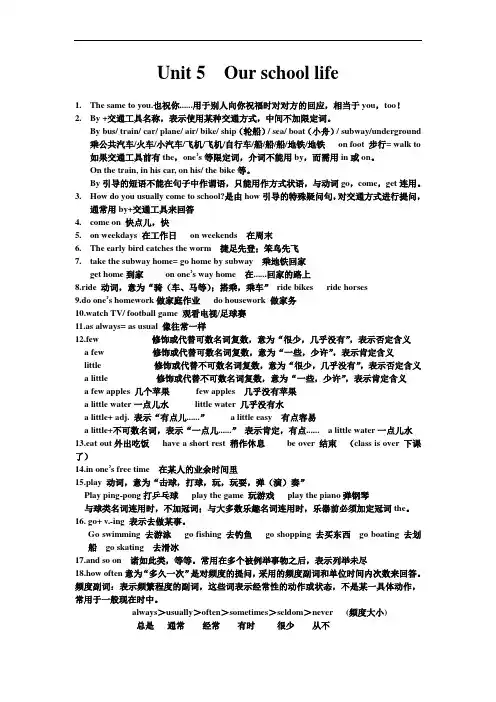
Unit 5 Our school life1.The same to you.也祝你......用于别人向你祝福时对对方的回应,相当于you,too!2.By +交通工具名称,表示使用某种交通方式,中间不加限定词。
By bus/ train/ car/ plane/ air/ bike/ ship(轮船)/ sea/ boat(小舟)/ subway/underground 乘公共汽车/火车/小汽车/飞机/飞机/自行车/船/船/船/地铁/地铁on foot 步行= walk to 如果交通工具前有the,one’s等限定词,介词不能用by,而需用in或on。
On the train, in his car, on his/ the bike等。
By引导的短语不能在句子中作谓语,只能用作方式状语,与动词go,come,get连用。
3.How do you usually come to school?是由how引导的特殊疑问句,对交通方式进行提问,通常用by+交通工具来回答e on 快点儿,快5.on weekdays 在工作日on weekends 在周末6.The early bird catches the worm 捷足先登;笨鸟先飞7.take the subway home= go home by subway 乘地铁回家get home到家on one’s way home 在......回家的路上8.ride 动词,意为“骑(车、马等);搭乘,乘车”ride bikes ride horses9.do one’s homework做家庭作业do housework 做家务10.watch TV/ football game 观看电视/足球赛11.as always= as usual 像往常一样12.few 修饰或代替可数名词复数,意为“很少,几乎没有”,表示否定含义a few 修饰或代替可数名词复数,意为“一些,少许”,表示肯定含义little 修饰或代替不可数名词复数,意为“很少,几乎没有”,表示否定含义a little 修饰或代替不可数名词复数,意为“一些,少许”,表示肯定含义a few apples 几个苹果few apples 几乎没有苹果a little water一点儿水little water 几乎没有水a little+ adj. 表示“有点儿......” a little easy 有点容易a little+不可数名词,表示“一点儿......”表示肯定,有点...... a little water一点儿水13.eat out外出吃饭have a short rest 稍作休息be over 结束(class is over 下课了)14.in one’s free time 在某人的业余时间里15.play 动词,意为“击球,打球,玩,玩耍,弹(演)奏”Play ping-pong打乒乓球play the game 玩游戏play the piano弹钢琴与球类名词连用时,不加冠词;与大多数乐趣名词连用时,乐器前必须加定冠词the。
仁爱英语七年级下册unit8知识点

仁爱英语七年级下册unit8知识点仁爱英语七年级下册unit8主要包括了四个知识点:爱好、频度副词、现在进行时和以be动词为主语的句子。
一、爱好关于爱好,我们可以用动词+ing形式的结构来描述,例如:- I like playing basketball.- She enjoys listening to music.- He hates watching horror movies.二、频度副词频度副词是用来描述某个动作发生的次数的。
常见的频度副词有:always、usually、often、sometimes、rarely和never。
我们可以将频度副词放在句首或者句末,例如:- He always brushes his teeth before going to bed.- I usually eat breakfast at 7 o'clock in the morning.- They sometimes go to the park on weekends.- She rarely drinks coffee because it makes her nervous.- We never miss our English class.三、现在进行时现在进行时用来描述正在进行的动作,其结构为:be动词+现在分词。
例如:- He is playing basketball with his friends now.- They are watching TV in the living room.- She is studying English at the library.- We are listening to music in the classroom.需要注意的是,某些动词不宜用于现在进行时,例如感官动词(see、hear、smell、notice、feel、taste)和状态动词(be、seem、appear、look、feel、sound、taste)。
仁爱版七年级英语下册知识点总结(全册)

仁爱版七年级英语下册知识点总结(全册)仁爱版七年级英语下册知识点总结(全册)Unit 5 Topic1 重点短语1.on foot go …on foot = walk ( to )…2.at the school gate在学校大门口3.on weekdays在平日 ,在工作日4. on weekends=on the weekend在周末5.after school 放学后6.after class 下课后7.after breakfast / lunch / supper早餐/ 午餐/ 晚餐后8.in ones free time在某人空闲时间9.have a rest 休息一下10.read books 读书11.go swimming 去游泳12.listen to music 听音乐13.watch TV 看电视14.do(one’s)homework 做作业15.go to the zoo / park 去动物园/ 公园16.once a week 一周一次17.every day 每天18.have classes 上课19.for a little while 一会儿20.go to bed 上床睡觉/doc/3c4073325.htmle on 快点,加油,来吧22.get up 起床23.talk with / to sb.与某人谈话24.at school 在学校、在上课25.go to school 去上学26.and so on ……等等重点句型1.Happy New Year! The same to you.2.Your new bike looks very nice. Thank you.2.How do you usually come to school? —I usually come to school by subway.3.How often do you go to the library? —Once/Twice/Three times a week/Very often/Every day/Sedom4.The early bird catches the work. (谚语) 笨鸟先飞5.Classes begin at eight. =Class begins at eight. What time does the class begin? / What time do theclasses begin?6.We have no more time. 我们没有更多的时间了。
七年级下册英语仁爱版知识点总结

七年级下册英语仁爱版知识点总结一、Unit 1 School Life在第一个单元中,我们主要学习了关于学校生活的词汇和短语,例如school subjects, classroom objects, daily activities等。
除了词汇和短语的学习,我们还学习了一些与学校生活相关的句型和语法知识,比如动词的进行时态和一般现在时的用法等。
值得一提的是,我们还学习了如何用英语向他人介绍自己和他人。
这对我们提高英语口语表达能力有着很大的帮助。
二、Unit 2 My Day在第二个单元,我们学习了描述日常生活的词汇和句型。
我们能够清楚地表达一天中的不同活动,并且学会了询问别人的日常活动。
我们还学习了一些常用的时间状语从句和表示频率的副词,以及动词的一般过去时态。
三、Unit 3 Our Hobbies第三个单元主要是关于我们的爱好和业余活动。
在这一单元里,我们学习了描述爱好的词汇和短语,以及询问他人的爱好。
我们还学习了如何用英语表达我们对某些活动感到喜欢或不喜欢,以及介绍他人的爱好等。
通过学习这一单元的内容,我们可以更好地与他人交流,增进彼此的了解。
四、Unit 4 Celebrations第四个单元主要是关于庆祝活动。
我们学习了描述不同庆祝活动的词汇和短语,以及询问别人关于庆祝活动的相关问题。
我们还学习了一些关于时间的表达方式,比如日期、星期、月份等。
我们还学习了一些关于情感的形容词,以及表示祝福的句型和短语。
五、Unit 5 The World Around Us在第五个单元中,我们学习了描述环境和自然现象的词汇和短语,以及相关的句型和语法知识。
我们可以用英语描述不同的自然现象,比如天气、季节等,也能够表达对自然环境的关心和热爱。
除了这些,我们还学习了一些关于地点和方位的词汇,以及表示允许和禁止的句型和短语。
六、Unit 6 Amazing Stories在第六个单元中,我们学习了一些关于神话故事和传奇人物的词汇和短语。
七年级英语下册重要知识点和语法点归纳仁爱版
七年级英语下册重要知识点和语法点归纳仁爱版--------------------------------------------------------------------------作者: _____________ --------------------------------------------------------------------------日期: _____________Unit 5 Our School Lifetopic1 How do you go to school?一、重点词语:1. wake up 醒来,唤醒get up 起床2. go to school 去上学go home 回家3. go dancing / shopping / skating / swimming 去跳舞;购物、滑冰;游泳go doing something 可用于表达去进行某种娱乐休闲活动。
4. 表示交通方式:on foot 步行 by boat 坐船by ship 坐船by air 乘飞机by plane 乘飞机by train 坐火车by subway 搭乘地铁by car 坐小汽车by bus 坐公共汽车by bike 骑自行车5. take the subway / bus / car 搭乘地铁;公共汽车;小汽车6. drive a car to work = go to work by car 驾车去上班take a bus to work = go to work by bus 乘公共汽车去上班go to school on foot = walk to school 步行去上学7. ride a bike / horse 骑自行车;骑马8. after school / class 放学以后;下课以后9. play the piano / guitar / violin 弹钢琴;吉他;小提琴play basketball / soccer / football 打篮球;踢足球;打橄榄球play computer games 玩电脑游戏 play with a computer 玩电脑play sports 做运动10. next to 紧挨着,在…旁边11. a plan of my school 一幅我们学校的平面图12. on weekdays 在工作日at weekends 在周末13. have breakfast / lunch / supper / dinner / meals吃早餐;中餐;晚餐;正餐;一日三餐have classes / lessons / a meeting 上课;上课;开会14. watch TV / movies / games / the animals 看电视;电影;比赛;动物read novels / newspapers / books 看小说;报纸;书15. wash one’s face / clothes 洗脸;衣服16. 反义词:up – down, early – late 近义词:quickly – fastget up early 早起 be late for 迟到17. the first / second / third / fourth day 第一;二;三;四天18. clean the house 打扫房子19. 表示建筑物(尤其学校建筑物):on the playground 在操场at school / home / table 在学校;家里;桌旁in a computer room / tea chers’ office / classroom building / gym / library / lab / canteen在电脑室;教师办公室;教学楼;体操馆;图书馆;实验室;食堂20. around six o’clock = at about six o’clock大约在六点21. 频率副词:never, seldom, sometimes, often, usually, always二、重点句型:1. It’s time to get up.该起床的时候了。
仁爱版七年级下册英语复习知识点
仁爱版七年级下册英语复习知识点仁爱版七年级下册英语复习知识1重点语法Therebe句型Wh-questions重点句型What’syourhomelike?What’sthematter?Sorry,Ican’thearyou.I’llgetsomeonetocheckitrightnow.Thereissomethingwrongwithmykitchenfan.重点讲解housewiththreebedrooms.有三间卧室的房子。
with“有,带有”。
with还可以意为“和(某人/某物)在一起”apartmentforafamilyoftwo.适合两口之家的公寓。
(1)for表示“给……”表示目的或功能。
后接物主代词或名词,但通常带’s.或者后接表示无生命物体的名词。
Hereisaletterforyou.(2)of的含义为“属于某人/某事物”。
SheisafriendofLily’s.=SheisLily’sfriend.3What’sthematter?怎么了?该句常用来询问某或某物出了什么什么问题或毛病;询问具体某人或某物出了什么问题时,还可以表达为:What’sthematterwithsb./sth.某人或某物出了什么毛病。
What’sthematter?=What’swrong?Ihearyouplayingthepiano.我听见你在弹钢琴。
hear…doingsth.“听见……在做某事”,强调正在进行的动作。
hear…dosth.“听见……做了某事”,强调全过程。
hearaboutsth.听到关于某事物的消息hearfromsb.接到某人的来信、电话等hearofsb./sth.听到或知道某人或某事物的情况alotof=lotsof许多后接可数名词,相当于many;后接不可数名词,相当于much,用于肯定句中;但是注意:如果是否定句,则常用many或much.befarfrom…离……远(抽象距离)be…awayfrom…离……远(具体距离)Myschoolisnotfarfromthebookstore.Theseais2milesawayfromthehotel.7Thereissomethi ngwrongwithsb./sth.某人或某物出问题/有毛病了。
仁爱英语七年级下册unit8 知识点
仁爱英语七年级下册unit8 知识点在仁爱英语七年级下册的unit8中,主要学习有关聚会、过生日和购物等话题的词汇和句型。
本文将对其中的知识点进行详细讲解,帮助同学们更好地掌握这些内容。
一、聚会1. invite sb. to sth. 邀请某人参加某事。
例如:I invite you to my party. 我邀请你参加我的聚会。
2. bring sth. to the party. 带某物到聚会。
例如:Don't forget to bring some snacks to the party. 别忘了带一些小吃到聚会上。
3. decorate the room. 装饰房间。
例如:We need to decorate the room before the party. 我们需要在聚会前装饰房间。
二、过生日1. Happy birthday! 生日快乐!2. blow out the candles. 吹灭蜡烛。
例如:Make a wish and blow out the candles. 许个愿望,然后吹灭蜡烛。
3. cut the cake. 切蛋糕。
例如:Let's sing "Happy birthday" and cut the cake. 让我们唱“生日快乐歌”然后切蛋糕。
三、购物1. How much is it? 多少钱?例如:How much is this T-shirt? 这件T恤多少钱?2. Can I try it on? 可以试穿一下吗?例如:Excuse me, can I try on these shoes? 不好意思,我能试穿这双鞋吗?3. I'll take it. 我要买了。
例如:This bag is perfect, I'll take it. 这个包非常完美,我要买了。
以上便是仁爱英语七年级下册unit8的主要知识点,同学们可以通过这些词汇和句型,更好地应对有关聚会、过生日和购物等话题的会话。
仁爱版英语七年级下册知识点归纳(完整版)
仁爱版英语七年级下册知识点归纳(完整版)-CAL-FENGHAI-(2020YEAR-YICAI)_JINGBIAN仁爱版英语七年级下册知识点归纳?英语七年级下册知识点归纳Unit?5?Topic1?重点语法一般现在时(常与频度副词never,?seldom,?sometimes,?often ,usually,?always等连用)重点句型?—How?do?you?usually?come?to?school???—I?usually?come?to?school?by?subway.????????????—How?often?do?you?go?to?the?library????—Once/Twice/Three?times?a?week/Very?often/Every?day/Seldom重点详解1I?always?come?to?school?by?bus.???by+交通工具名称,表示使用某种交通方式,中间不加限定词,如果交通工具前有a,?the,?my?等限定词,就不能用by,而是用in或是on.???on?the?train=by?train???on?his?bike=by?bike???in?my?car=by?car.???巧辩异同on?foot?与?walk????on?foot?“走路”,是介词短语,不能作谓语,只作方式状语,位于句末。
??walk?“走路”,是动词,可以作谓语。
? ? ??go?to…on?foot=?walk?to? ? ???I?often?go?to?school?on?foot.?=I?often?walk?to?school.?????同样,go?to….by?bike?=?ride?a?bike?to?????? ? ? ? ? go?to….?by?car?=?drive?a?car?to????????? ??go?to?…?by?plane?=?fly?to????????? ? ? ? ? go?to…?by?bus?=?take?a?bus?to2???Come?on!?It’s?time?for?class.???????come?on?“快点,加油,来吧”。