
新人教必修2 unit3reading
common 指“共有的,公共的;共同的;常见的”。 反义词rare. The problems are common to all societies.这些问 题是所有社会的通病 common作“普通的”讲可与ordinary换用。如“普 通人”也可说成common people。 ordinary 意为“普通的,平淡无奇的”,指没有什 么特别的地方 He is in ordinary clothes.他穿着平常的衣服。 usual 意思是“平常的,通常的,一向的”,惯例。 We met every day at the usual place. 我们每天在 往常那个地方见面
have/gain/win an advantage over/of sb. 胜过
give sb. an advantage over 使某人处于更有利的地位
考点三
go by 【基础过关】(时间)过去,流逝;经过,走过(某处) Several years went by before we met again. 过去了好几年 我们才再度见面。 【拓展延伸】go after 追求 go against 反对 go ahead 先 行一步;进展 go over 复习 go out 熄灭 go though 经历;仔细检查 go on with 继续 go in for 爱好;从事go off 悄悄离开;食物变 坏 go on进展,进行 pass by sb从某人旁边经过 【典型例题】 I don’t ________ rock ‘n’ roll. It’s much too noisy for my taste. A. go after B. go away with C. go into D. go in for 【答案】D 考查动词短语 【点拨】 按照句意此处为“喜欢”之意。go after 追求;go away with与某人一块离开;go into 进入;go in for 爱好,从事
Important expressions:
common;辨析common, ordinary,usual take an advantage of;disagree; so…that… in a way ;make up;go by ;deal with
Grammar (have/has +been +done ) The Present Perfect Passive Voice(现 在完成时的被动语态)
Scanning
Timeline
1642:_______________________________________________ The computer began as a calculating machine 1822:The Analytical Machine was made by Charles Babbage. 1936:_____________________________________________ The computer grew rapidly both in size
考点二 advantage 【基础过关】[u] & [C] 优势,优点 It is an advantage if you know how to speak English. 如果你会说英语,将对你有利。 He had the advantage of me. 他比我占优势。
【拓展延伸】take an advantage of=make full use of 趁机利用;占---便宜
True or False
1. Alan Turing built an Analytical Machine to solve any mathematical problems. F 2. People began to realize that the computer got T cleverer and quicker with time passing. 3. The computer began to serve the human race since it was brought into people’s homes. F 4. Since the 1970s, the computer was used by T people around the world through the Internet. 5. The larger the computer is, the more memory F it has.
world together. __________________________________________
Paragraph 2 (group work)
Underline the expressions, sentences & grammar that you think are important.
and in brainpower. _________________________________________
The computer had grown as large as a room. 1940s:_________________________________________ 1960s The first family of computers was connected to _____:
each other.
mes. 1970s:_________________________________________
Now:__________________________________________ Computers connect people all over the
考点一
common 【基础过关】adj. 共同的,普遍的;常见的 Phrases: in common 共有,公用,在句中多作状 语) have nothing/little/a lot/something in common (with) sb. 与----没有/许多/有些共同之处 in common with 和……一样 common sense 常识 Jane and I have nothing in common(=I have nothing in common with Jane). 我与简毫无共同之处 【点拨】辨析common, ordinary,usual
Charles Babbage
3. Who was the next important person to design computers? Alan Turing
The history/development of computers
Internet
The development of computers
Reading:
Who am I ?
Paragraph 1:
Skimming: Read and answer these questions:
1.Who am I? A computer. 2.Who was the first person to invent the earliest computer?
unit3 section ⅰ warming up & reading课件 新人教版必修2
运用 完成句子 solve his problems ①He went there hoping to ______________________ ( 解决 他的问题). the solution to ②We still haven't found ____________________ (解决方法) our argument.
了怎样使我成为一台 “通用机器”来解决任何数学难题。 3.solve vt.解决;解答
典例 I solved the word puzzle in three minutes.
我用三分钟解出了那个字谜。 拓展 solve 的名词形式为 solution,后面常接“介词 to+ 名词/代词”,意为“„„的解决方法”。如: The only solution to the trouble is to sit and talk peacefully. 解决这件事的唯一方法是平静地坐下来谈谈。
典例 What do these writers have in common? 这些作家有哪些共同之处?
拓展 common knowledge/sense 常识
in common with...和„„一样
have something/much/little/nothing in common with... 与„„ 有一些/很多/很少/没有共同之处 运用 完成句子 ①______________________ (和„„一样) many Americans, In common with he enjoys basketball very much.
2.sum n.总数;算术题;金额
典例 Little Lucy is good at sums and she can tell us the sum
新人教高中英语必修二Unit3The Internet-Readingforwriting公开课学案
2019新人教高中英语必修二Unit 3 The Internet--Reading for writing公开课学案学习目标:1.To acquire some features about a blog post by reading the text.2.To write a summary about a blog post properly using some newly acquired writing skills in this period.3.To absorb some language points concerning the topic.重点难点:1. To study the organization and language features of a blog post.2. To use what has been learned to write a blog post about online safety.3. To exchange drafts with a partner. Use the checklist to help your partner revise his/her draft.学习过程:Cultural Note“Blog” is a shortening of “web-log”.The old word “log” was an official record of events during a particular period of time,often used in the context of ships and journeys.There are many kinds of blogs covering different topics and used for different things.One common example is a “live blog”,where an event will be written about online as it happens,often on a news-based website.Part Ⅰ Reading for the main ideaRead the blog post quickly and answer the questions.1.What’s the main purpose of the blog post?____________________________________________2.What’s Paragraph 2 mainly about?____________________________________________3.Can you write a title for it?____________________________________________Part Ⅰ Reading for detailsRead the blog post again and answer the questions.1.What guidelines does the author provide for staying safe online?______________________________________________________2.Who are the online troublemakers the blog post mentions?______________________________________________________3.What does “a troll” mean?What does “a cyberbully” mean?______________________________________________________4.Do you have any more tips on how to surf the Internet safely?Share your ideas with a partner.______________________________________________________Part Ⅰ Reading for organization and language featuresRead the text again and study the organization and language features.1.Tick what the writer tells the reader in Paragraph 1.□definition of online safety□the writer’s knowledge□background information□the topic of the post2.What words and phrases does the writer use to organize the information in Paragraph 2?_______________________________________________________3.How does the writer end the post?_______________________________________________________4.Draw a mind map to show the structure of the post._______________________________________________________Part Ⅰ Writing a blog post about online safety1.Read through the three topics below.Brainstorm more expressions to make suggestions.Expressions to make suggestions:2.Choose one topic to write anize your draft according to the outline below.【写作指导】【文体剖析】网络博客文体是包含了网友评论、相关新闻链接在内的一种新兴的新闻文体。
高中英语人教版(9)必修第二册Unit 3 Reading and thinking 教案
新人教必修2 Unit 3 THE INTERNETReading and Thinking: Stronger Together: How We Have BeenChanged by the Internet文本简析本单元阅读文本的话题是互联网对人们的积极影响:互联网不但给人们的生活带来便利,而且能促进人与人之间的相互帮助,使人们变得更加强大。
该文本是叙事性文本,讲述了英国一位名叫简的英语教师辞职后,借助互联网得到了帮助,并主动帮助他人的事例。
从表层意义讲,文本讲述了互联网是如何改变人们的生活方式的;从深层意义来看,本文进一步表达互联网带给人与人之间的“连锁反应”:互联网作为媒介,连接着人与人之间的互助,激发着人们积极向上的正能量,传递着人们之间的互相关爱。
全文共五段,文本结构清晰。
第一段阐明了互联网带给人们的积极影响;第二、三、四段讲述了简失业在家及接触互联网后心理和行为上的变化;第五段通过简自己的话语,解释了她愿意帮助别人的原因,体现了相互帮助带来的积极效应。
本文可以围绕标题中的关键词“change, stronger, together”展开教学,主要通过静默阅读提取文本信息、提问处理相关语言、人物鉴赏学习优秀品质、写作迁移训练语言能力等几个教学策略达到本文的阅读课教学目标。
第1课时一、教学内容提取标题中“stronger, together, change”和“Internet”四个关键词。
梳理关于互联网、人物和描述变化的语言。
抓住“变化”主线,梳理文本,系统化地处理信息。
二、课时目标1. 通过分析标题关键词,理清标题与文本的内在联系,掌握文本主要内容。
2. 理解表示变化、互联网等的话题语言,能够在关键词的帮助下,复述主人公简的故事。
3. 通过记者与简之间角色扮演,进一步梳理简的故事,训练语言的综合运用能力。
三、教学过程Activity 1 Finding out the key words of the title本活动为实现课时目标1而设计。
Unit3Reading教案 高中英语人教版必修第二册

高中英语人教版新版教材Unit 3-reading 教案以及知识点Step1-Warming up:Before reading: look at the title and discuss these questions in pairs.Q1: What do you think the text will say ?Probably answer: It might talk about the Internet or the change brought by the Internet in our daily life.Q2:How do you think the writer feels about the topic ?Probably answer: The writer might feel excited because it is the Internet that has greatly improved her life.Step-2: While readings:-lead students to understand the main idea of this article and then translate the article with students together.-answer the questions of the article:Q1: Why did Jane quit her job ?Q2:How did the people in the online community help her ?She and her friends now organize events and collect money to pay for private teachers.Q3: Why did she start th e IT club ?Because she was so inspired by the people she met onlineQ4:What is the digital divide ?Not everyone has access to the Internet and knows how to use new technologyQ5:What is Jan’s next goal ?Her next goal is to start a charity website to raise money for children in poor countries.Q6: What can we learn from her experience ?We can know she is a grateful woman who is always inspired by other people’s situation and she is considerable.3.examples: students can take part in on-line classes during the outbreak of COVID-19 epidemic.4.Answers:1.benefit2.convenient3.surf4. download5.distance6.cash7.updated8.inspirework 10. accessWords and expression:1.convenient adj. 方便的;近便的(1) It is convenient (for sb.) to do sth. 做某事(对某人来说)是方便的(2) conveniently adv. 方便地;近便地(3) convenience n. 方便;便利;适宜at one's convenience 在某人方便的时候(4)inconvenient adj. 不方便的;不近便的【练透考点】单句语法填空①______ your convenience,I'd like to invite you and your family to visit China.②If_____is convenient for you,can you pick me up at the airport at 11:30 am?③This apartment is very convenient for the bus station and it has a lot of_______________.(convenience)1.at2.it3.convenience.2. benefit n.益处vt.使受益vi.得益于(1)be of(great) benefit to 有益于;对……(很)有益for the benefit of sb=for one’s benefit为了某人的利益(2)benefit sb/sth使某人/某物受益benefit from/by...从……中获益(3)benefi cial adj.有益的;有利的be beneficial to...对……有益1.Actually,these books are great benefit to the staff.2.Everyone benefited limiting their intake of tea to just three or four cups a day.3.Reading is (benefit)to all of us.4.Walking outdoors regularly for sunshine is of great benefit everyone.1.of2.from/by3.beneficial4. to3.distance n.距离(1)in the distance在远方at/from a distance在(稍)远处,从远处keep sb at a distance对某人冷淡,疏远某人keep one’s distance (from...)(与……)保持距离(2)distant adj.遥远的,远隔的;冷淡的be distant from...离……远On Monday mornings it usually takes me an hour to drive to work although the actual _______(distant)is only 20 miles.4.inspire vt.鼓舞;激励;启发思考(1)inspire sb with... 用……激励某人inspire sb to do激励某人做某事(2)inspiration n.灵感,启发inspiring adj.鼓舞人心的,激励的inspired adj.受到激励的,得到灵感的be inspired by...被……鼓舞5. access n.通道;(使用、查阅、接近或面见的)机会vt.进入;使用;获取(1)access to ... ……的通路;利用……的权利have/get/gain/obtain access to ... 使用/接近…的权利或机会(2)accessible adj. 可接近的;可进入的;可使用的be accessible to 易接近的;能进入的①For one thing, with almost all of us having ________ (accessible) to the Internet and other media sources, such news is within our easy reach.②All roads were blocked and the only access _____ the earthquake stricken areas was by water.。
Unit3 Reading and Thinking 课件-高中英语人教版(2019)必修第二册
have access to the internet
数字 鸿沟
have no access to the internet
digital divide
While Reading
Stronger together: How we have been changed by the Internet
(定语从句)
பைடு நூலகம் para.3
1. What did Jan do next and why?
2. What’s the purpose by listing the Thinking:
people helped by the club?
1) What’s the main idea of the
1. She decided to start an IT club to teach para?
She was so inspired by the people she met online that she decided to start an IT club
(定语从句,省略that/who/whom)
(to do作宾语)
to teach older people how to use computers and the Internet.
The author will give us examples to support the opinion.
Q:What can we do through the Internet?
para.2
1. What problem did Jan have? 2. What did Jan do on the Internet?
【教案】Unit+3Reading+and+Thinking+教学设计人教版(2019)必修第二册
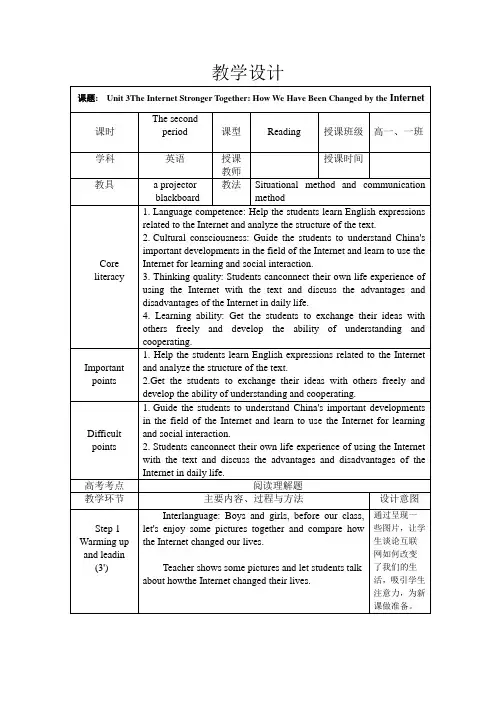
教学设计课时The secondperiod 课型Reading 授课班级高一、一班学科英语授课教师授课时间教具 a projectorblackboard 教法Situational method and communication methodCore literacy nguage competence: Help the students learn English expressions related to the Internet and analyze the structure of the text.2.Cultural consciousness: Guide the students to understand China's important developments in the field of the Internet and learn to use the Internet for learning and social interaction.3. Thinking quality: Students canconnect their own life experience of using the Internet with the text and discuss the advantages and disadvantages of the Internet in daily life.4. Learning ability: Get the students to exchange their ideas with others freely and develop the ability of understanding and cooperating.Important points 1. Help the students learn English expressions related to the Internet and analyze the structure of the text.2.Get the students to exchange their ideas with others freely and develop the ability of understanding and cooperating.Difficult points 1.Guide the students to understand China's important developments in the field of the Internet and learn to use the Internet for learning and social interaction.2.Students canconnect their own life experience of using the Internet with the text and discuss the advantages and disadvantages of the Internet in daily life.高考考点阅读理解题教学环节主要内容、过程与方法设计意图Step 1 Warming up and leadin(3')Interlanguage: Boys and girls, before our class,let's enjoy some pictures together and compare howthe Internet changed our lives.Teacher shows some pictures and let students talkabout howthe Internet changed their lives.通过呈现一些图片,让学生谈论互联网如何改变了我们的生活,吸引学生注意力,为新课做准备。
新课标人教版必修二Book2 Unit3 reading
Careful reading
Q1: Who built the first analytical machine? Charles Babbage Q2: Who was the next important person to design computers? Alan Turing
Q3: As a computer, do you know my goal? My goal is to provide humans with a life of high quality.
Strong
Network times
Tubes
Large
Small Narrow
Memory stored in
Develop ment Applications
Transistors ___________
Small chips
Communication
Finance Trade _______
ቤተ መጻሕፍቲ ባይዱ
Robots Mobile phones __________
Medical operations _______________ Space rockets
Wide
• Step3: Discusion
• Do you know the advantages and disadvantages of the computer? • You can use the following phrases:
Look at the following pictures and say their English names. calculator
abacus
PC
huge computer
Unit 3 Reading and Thinking 课件-高中英语人教版选择性必修第二册
Boiled dumplings
Lamb kebab Stewed noodles
Hale Waihona Puke Dim sumPancake rolls
Pre-reading
1 Before you read, discuss these questions in groups.
1. How many kinds of Chinese cuisine are there and how can these cuisines be described? ➢Eight well-known cuisines in China: ●Shangdong cuisine(鲁菜), Anhui cuisine(徽菜): ●Jiangsu cuisine(苏菜), Sichuan cuisine(川菜): ●Zhejiang cuisine(浙菜), Fujian cuisine(闽菜): ●Hunan cuisine(湘菜), Guangdong cuisine(粤菜): ➢They are quite different in taste and texture (口感)
➢It is about different knids of Chinese food and the culture each food represents.
4. What type of writing is the text? ➢Expository writing (about cause and effect)
ce
Kind of Chinese food People or culture
and typical dish
reflected by food
America
Unit 3 Reading and Thinking 课件-高中英语人教版选择性必修第二册
Unit 3 Food and Culture
1.What are the people doing ?
The guests are sitting at the tables sharing the food on the street.
2.Why do you think they are gathering together ?
How many kinds of Chinese cuisines in China?
hot from chillies
fresh herbs, oily colourful
mild, slight sweet
fresh flavours, soft tex different local cultures, as a result, they have different kinds of food.
Tips: How to identify causes and effects?
1. Look for signal words , such as
Typical dish
People or culture
General Tso’s chicken 左宗棠鸡
dish with Sichuan peppercorns
Americans love bold and simple flavours, and are not
afraid to try new foods.
A. English food
B. French food
C. American food
D. Chinese food
4. From the first visit to China, the writer found the Chinese
人教版高中英语 必修二 Unit3 《Computers Reading》 课件 (共25张PPT)
Parents’ view on mobile phone Smart phones
Debate show
Should we use smart phones in school?
Rules: • One student one point • Stand up to express your idea • Loudly • Clearly
Homework
1. Read the passage fluently after class; 2. Finish <名校学案> reading.
Mobile/cell phone
I am an electronic machine that can store, organize and find information, do calculations and control other machines. My nickname is “PC”.
13、He who seize the right moment, is the right man.谁把握机遇,谁就心想事成。2021/8/122021/8/122021/8/122021/8/128/12/2021 •14、谁要是自己还没有发展培养和教育好,他就不能发展培养和教育别人。2021年8月12日星期四2021/8/122021/8/122021/8/12 •15、一年之计,莫如树谷;十年之计,莫如树木;终身之计,莫如树人。2021年8月2021/8/122021/8/122021/8/128/12/2021 •16、教学的目的是培养学生自己学习,自己研究,用自己的头脑来想,用自己的眼睛看,用自己的手来做这种精神。2021/8/122021/8/12August 12, 2021 •17、儿童是中心,教育的措施便围绕他们而组织起来。2021/8/122021/8/122021/8/122021/8/12