
人教版英语八年级上册 Unit 2 Section B Reading 课件
to each question.
TF
1. About twenty-five percent of our students
do not exercise at all.
✓
2. We were surprised that most
students use the internet for fun and not
Task 5 Guess the meaning of the words
• We all know that many students often go online, but we…
• Although many students like to watch sports, game shows are…
Here are the r_e_s_u_l_tsof our students about their free
time activities we asked last month. We found that only fifteenp_e_r_c_e_ntof our students
How often do you watch TV? Every day./1-3 times a week./4-6times a week.
They practice dancing every day. They always practice dancing .
They practice basketball three or four times a week.
They usually practice basketball .
20 students
50 students
10 students
5 students
percent
_1_0_% of the students join the dancing club. _2_0_% of the students join the basketball club. _4_0_% of the students join the ping-pong club.
15% of the students
15
10
13
2
20
20
45
90
85
4 times a week
According to the article and the pie
2d charts, write sentences with the
percentages using always, usually or sometimes.
B.They don’t have any time to watch TV.
✓C.They watch TV every day.
3. How many percent of the students use the Internet every day?
✓A.Ninety percent of the students use the
Title:
Look at the title and predict what it is mainly about.(看标题,预测 内容)
1. I think the passage will mainly(主要) tell us_________
A. after school activities B. study
Read Para.2-3 again and answer the questions.
1.How many students do not exercise at all? Twenty percent do not exercise at all.
2.How many students use the Internet every day?
✓
Task 3: Read the article again and choose the best answers.
1.How many students do not exercise at all?
A.Ten percent of the students do not exercise at all.
Reading
Learning Aims
1. To learn some new words: result;percent online; body etc. 2. To practice students’ reading skills.
3. To learn to summarize and retell the passage.
2% 1-3 times a week watching TV
13% 4-6 times a week
conclusion
85% every day Start exercise before it’s too late
Task 7:Read the article. Then find the right words to fill in the blanks.
Free talk: Talk about your habits. How often do you exercise? Every day./1-3 times a week./ Never.
How often do you use the internet? Every day./3-4 times a week.
__a_lw__a_y_s_w__a_tc_h__T_V__. _________
3. 45%: _F__o_rt_y_-_fi_v_e_p_e_r_c_e_n_t_o_f_t_h_e__st_u_d_e_n_ts
_u__su_a_l_l_y_e_x_e_r_c_is_e_. ____________
Most students watch TV every day. They usually watch sports and game shows.
4. What does the writer think is the best way to relax? Why? The writer thinks the best way to relax is through exercise. Because it is healthy for the mind and the body. 5.Do you think the students at No. 5 are healthy? Why or why not?
6. 2%: _T__w_o__p_e_rc_e_n_t__o_f _th_e__s_tu_d__en__ts_____ __so_m__e_ti_m__e_s_w_a_t_c_h_T__V_._________
Groupwork
15% every day
exercise
45% 4-6 times a week 20% 1-3 times a week
Ninety percent of them use the Internet every day.
Read Para.4-5 again and answer the questions.
3. How often do most students watch TV? What do they usually watch?
A.Listen to music, because it help you to relax.
✓B.Exercise, because it is healthy for the mind
and the body. C.Sleep, it will help you to relax.
Task 4
activities. C. It tells how often students do exercise. D. The best way to relax is through exercise.
E. It is about how often students go online.
Task 2 Read the passage, choose your answer
✓
for homework.
3. Although many students like to watch
sports, music shows are the most
✓
popular.
4. It is not late to start exercising as “Old
habits die hard.”
Task 1
Read each paragraph quickly and draw a line to get the main idea. (快速阅读,获取大意。)
Para.1 Para.2
Para.3 Para.4 Para.5
A. It is about how often students watch TV. B. It is a survey about students’ free time
Internet every day.
B.Ten percent of the students use three or four times a week.
C.There is no one don’t know how to use the Internet.
4.What does the writer think is the best way to relax?
4. 10%: _T__e_n_p_e_r_c_e_n_t_o_f_t_h_e_s_t_u_d_e_n_t_s_s_o_m_etimes __u_se__th__e_I_n_te_r_n_e_t_.______________
人教版八年级英语上册第二单元课件

The results for “watch TV” are interesting.
_S_o_m__e students watch TV once or twice a week,
s_tio_m_me_es_
students watch TV __t_h_r_e_e__ _o_r_ _f_o_u_r__ a week, but most students watch _e_v_e_ry_
Do you know?
• sometime 某个时间 • some time 一段时间 • sometimes 有时 • some times 几次
I sometimes go to school by bus. I will go to America sometime this year.
人教版初中英语 八年级上册教学课件
Unit 2 How often do you exercise?
Section A Period 1
Are you healthy?
Do you often drink milk? Do you eat fruit and vegetables everyday? Do you often do your exercise?
人教版八年级上学期英语课件:unit 2 Section B(1a-2b)(共41张PPT)

5.How often do you eat junk food?
2 or 3 times a week
6.How often do you drink coffee? never
Bill hardly ever
Junk food is bad for our health.
1a Match the words with the pictures.
a
b
c
d
e
f
Check the answers!
1. __b__ junk food 2. ___a__ milk 3. __e___ fruit 4. __c___ vegetables 5. __f___ sleep 6. __d___ coffee
教学课件
英语 八年级上册 人教版
Unit 2 How often do you exercise?
Section B The Third Period 1a-2b
课前自主预习
1. 垃圾食品 __j_u_n_k__fo_o_d___ 2.对……有好处 ___b_e_g_o_o_d__fo_r_ 3.喝咖啡 _d_r_i_n_k_c_o_f_f_e_e_ 短语互译 4.去野营 __g_o_c_a_m__p_i_n_g_ 5.在某人的空闲时间
2.although conj.虽然;尽管;即使。引导让步状语从句。
Although/Though it was so cold,he went out without an overcoat.尽管天气很冷,但他还是没有穿大衣就出去了。 【注意】 although=though用作连词,意为“虽然,尽 管”,这两个词都不能与but连用,即用了although/though 就不能再用but。不过although可以与yet/still一起使用。 尽管他身体不好,但是他工作很努力。 正:Although/Though he is in poor health,he works hard. 正:He is in poor health,but he works hard. 误:Although he is in poor health, but he works hard.
人教版八年级上册英语Unit2_SectionB课课件
sleep nine hours every night
Do you have a healthy lifestyle?
Are they in good health(=healthy)? Of course, they aren’t.
Why are they so heavy? Because their eating habits are bad. They like eating junk food
Their Free Time?
2b
What do No. 5 High school students do in their free time
Last month we asked our students about their free time activities. Our questions were about exercise, use of the Internet and watching TV. Here are the results.
Discuss How can we keep healthy?
Try to eat more healthy food and less junk food.
1. Eat rice for meals. 2.Try to eat vegetables every day. 3.Eat fruit every day. 4. Eat some meat sometimes. 5.Don’t eat the food with too much oil. 6. Drink some milk every day.
healthy/unhealthy
I think in our class, _____ students like upgdlwioslaaitiineynntncgiggnhitnhgcihongaoebtcsgmtmaotahiobTcmnpseclktmwViepemne.routg.oenrbtsnvikeiancirnt.le.litgs.sh.a.em(pceoinsu.gn-tproyn. g)
人教版八年级英语上册Unit2SectionB(1a-1e)教案设计

Unit2 Section B(1a-1e)优质课课件(安徽省)人教英语八年级上Unit2 Section b1a-1e教学设计来安县水口中学杨成扣一、教学日标:1、能够掌握课标要求的“四会”词汇:junk,coffee,health。
2、学会谈论饮食习惯,了解哪些饮食习惯是健康的。
3、能阅读关于介绍饮食习惯方面的文章。
学会养成良好的生活习惯和饮食习惯。
4、培养学生的逻辑表述能力,激发学生的积极思维,并使学生互相了解,增进友谊。
二、学情分析:对于本单元的一般现在时态,学生掌握较好,部分学生在本章节的听力部分略有不足,建议多听多练练。
三、重点和难点:1、区分how many/how much,health/healthy,different/difference2、掌握以下重点句子How often do you eat fruit?How many hours do you sleep every night?How often do you eat junk food?How often do you drink coffee?四、教学过程Step 1 Lead-in(导入)Greeting & free talkStep 2 Match the pictures(1a)Let students pay attention to the pictures. Say something about the pictures. Match the words with the pictures. Check the answers and then practice reading.Step 3 Ask and answer(1b)Pair workT: Now look at the conversation in lB, ask two students to read it o the class.Work with your partner. Please make your own conversations using the words in la. Forexample:A: How often do you eat vegetables?B: I eat vegetables every day.A: Do you like it?B: No. But my mother wants me to eat it. She says it is good for my health. Then ask some pairs to present their conversations to the class.Explanation:Pay attention to the conversation in the box on the right. Read it to the class. Explain the phrases “be good for” means “有益于,,;对,有好处”Work in pairs. Choose a new partner. Use the words in la to make conversations Share the student’s conversations.Step 4 listening (&c 1d)1cT:Now you will hear a reporter interviewing two people. Tina and Bill. Read the two names for the students. In lc, we’ll know who is health, Bill or Tina? Read the questions in lc. Listen to the tape carefully twice.Circle “Yes” or “I don’t know” in the chart.1d1. Before we check the answers in Ic ll we read through the questions in ld. Pay attention to Tsnaand Bills answers.2. Play the tape again. This time, if we have heard one question, we will have a pause. Make sure Tsnaand Bills answers.3. From the answers in ld, ask the questions: Who is healthy, Bill or Tina?Step 5 Pair work(le)Student a is the reporter. Student b is Tina or Bill. Ask and answerquestions. Then change roles.Step6 Summary (课堂小结)Tell the students the difference of how many & how much,heath & healthy1. Fill in the blanks with how many or how much①—______ is the book?—It’s $10.②—______ students are there in the classroom?—______10.2. Fill in the blanks with health or healthy①Fruit and vegetables are ______ food.②Exercise is good for ______.Step7 Exercise(练习)单项选择1. I like English very much, so I ______ listen to the tape in morning.A. usuallyB. hardly everC. neverD. hardly2. What does your father do in the evening?—He usually ______.A. watch TVB. exercisesC. read booksD. go for a walk3. ______ do you go skating?—Every day.A. How oftenB. How manyC. WhenD. What time4. ______ does he do sports every day?—He does sports for two hours every day.A. How manyB. How oftenC. How longD. How soon5. ______ give up,then you can be successful.A. AlwaysB. SometimesC. NeverD. Usually6. ______ do you go to the bookshop?Once a week.A. How longB. How manC. How oftenD. How much7. Everyone knows girls ______ sweets.A. usually likesB. likes usually.C. usually1ikeD. like usually8. He too busy. He hardly ______ watches TV.A. oftenB. usuallyC. neverD. ever9. She ever y strict,but ______ kind to us some times.A. sometimesB. some timesC. some timeD. some times10. Jim never late for school, ______?A. is heB. is sheC. does heD. he doesStep8 Homework(作业)Writing:My Eating Habit。
英语 人教版 八年级上册(电子教案) Unit 2 第四课时 Section B (2a-4)
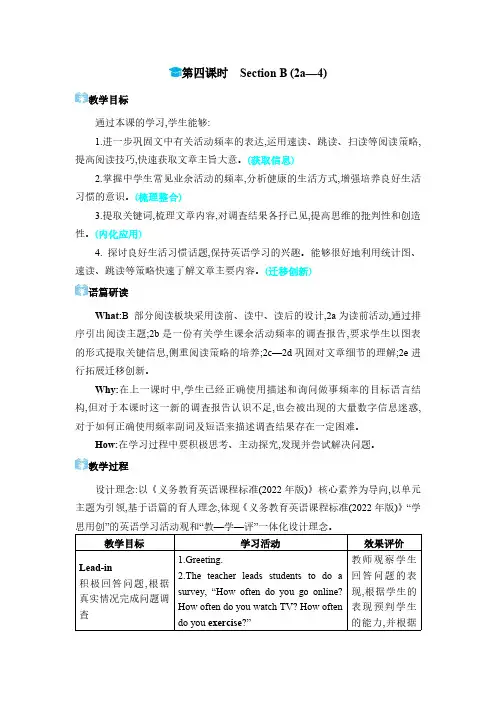
第四课时Section B (2a—4)教学目标通过本课的学习,学生能够:1.进一步巩固文中有关活动频率的表达,运用速读、跳读、扫读等阅读策略,提高阅读技巧,快速获取文章主旨大意。
(获取信息)2.掌握中学生常见业余活动的频率,分析健康的生活方式,增强培养良好生活习惯的意识。
(梳理整合)3.提取关键词,梳理文章内容,对调查结果各抒己见,提高思维的批判性和创造性。
(内化应用)4.探讨良好生活习惯话题,保持英语学习的兴趣。
能够很好地利用统计图、速读、跳读等策略快速了解文章主要内容。
(迁移创新)语篇研读What:B部分阅读板块采用读前、读中、读后的设计,2a为读前活动,通过排序引出阅读主题;2b是一份有关学生课余活动频率的调查报告,要求学生以图表的形式提取关键信息,侧重阅读策略的培养;2c—2d巩固对文章细节的理解;2e进行拓展迁移创新。
Why:在上一课时中,学生已经正确使用描述和询问做事频率的目标语言结构,但对于本课时这一新的调查报告认识不足,也会被出现的大量数字信息迷惑,对于如何正确使用频率副词及短语来描述调查结果存在一定困难。
How:在学习过程中要积极思考、主动探究,发现并尝试解决问题。
教学过程设计理念:以《义务教育英语课程标准(2022年版)》核心素养为导向,以单元主题为引领,基于语篇的育人理念,体现《义务教育英语课程标准(2022年版)》“学思用创”的英语学习活动观和“教—学—评”一体化设计理念。
教学目标学习活动效果评价Lead-in积极回答问题,根据真实情况完成问题调查1.Greeting.2.The teacher leads students to do asurvey,“How often do you go online?How often do you watch TV?How oftendo you exercise?”教师观察学生回答问题的表现,根据学生的表现预判学生的能力,并根据3.The teacher presents the survey results.4.The teacher asks students to finish the task in2a on page13.学生的回答情况给予帮助和鼓励设计意图通过做调查引出本节课的相关主题,有利于激发学生的学习兴趣。
【人教版】新目标八年级英语上册:Unit 2 单元说课稿

【人教版】新目标八年级英语上册:Unit 2 单元说课稿一. 教材分析新目标八年级英语上册Unit 2主要讲述了关于一般现在时的用法。
本单元包括两个部分:Section 1和Section 2。
Section 1主要介绍了一般现在时的基本结构和用法,通过一个关于家庭成员的对话和一个关于日常活动的,让学生理解和掌握一般现在时的构成和表示含义。
Section 2则通过一个故事和一个任务型阅读,进一步巩固一般现在时的用法,并引导学生运用一般现在时进行叙述和描述。
二. 学情分析八年级的学生已经掌握了英语学习的基本语法和词汇,具备一定的听、说、读、写能力。
但对于一般现在时的理解和运用,部分学生可能还存在一定的困难。
因此,在教学过程中,需要关注学生的个体差异,针对性地进行教学,帮助学生理解和掌握一般现在时的用法。
三. 说教学目标1.知识目标:学生能够理解一般现在时的概念、结构和用法,能够正确运用一般现在时进行叙述和描述。
2.能力目标:学生能够在日常交流中运用一般现在时,提高英语表达的能力。
3.情感目标:通过本单元的学习,学生能够培养对英语学习的兴趣,增强自信心。
四. 说教学重难点1.教学重点:一般现在时的结构、用法和意义。
2.教学难点:一般现在时的运用,特别是在具体情境中的运用。
五. 说教学方法与手段1.教学方法:采用任务型教学法、情境教学法和交际法,让学生在实际情境中理解和运用一般现在时。
2.教学手段:利用多媒体课件、图片、故事等教学资源,激发学生的学习兴趣,提高课堂参与度。
六. 说教学过程1.导入:通过一个与学生生活密切相关的场景,如询问学生家庭成员的姓名和年龄,引导学生进入一般现在时的学习。
2.新课呈现:通过一个关于家庭成员的对话和一个关于日常活动的,展示一般现在时的结构和用法。
3.实践环节:学生分组进行角色扮演,运用一般现在时进行对话,巩固所学知识。
4.任务型阅读:学生阅读一个关于故事的文章,回答相关问题,进一步理解一般现在时的用法。
人教版英语八年级上册教案:Unit2-SectionB(2a-2e)
Unit2 SectionB(2a-2e)教案【教材版本与册数】新目标人教版八年级上册【单元名称】Unit2 How often do you exercise?【课时】Section B 2a-2e (第四课时)【课型】Reading (阅读课型)2获取新知识.,{Step 3While-reading…,-—Careful- reading1. T: T asks Ss to read Para. 1 and find out the 3activities from it.Ss: Ss think it over about “What questions did the writerask?”.>2. Finish 2bT: T guides Ss to scan Para. 2 and complete the first pie.Then read Para.3 or 4, complete the pie and exchangethe information.S: Ss read the three paragraphs and finish the pie.(3.T: T asks Ss to look at the pie, and answer thequestions.Ss: Ss try to look at the pie and the article to answer thequestions.What percent of the students do not exercise at all?/训练学生阅读获取具体信息和提问能力,为后面的阅读教学活动做铺垫。
…训练学生理解并解释图表提供的信息,将文本的语言知识有效的挂靠到文本结构下的学习。
让学生学习观察和利用统计图,培养科研探究素养中必备的数据分析能力。
:通过分段细读Para. 1,学生是否能找出调查话题和调查内容。
How+often+do+you+exercise+Section+B+(2a-2e)教学设计
Unit 2 How often do you exercise? Section B (2a-2e)教学设计内容分析本课内容是义务教育人教版英语八年级上册第二单元第四课时阅读课。
What :阅读板块采用读前、读中、读后的设计,2a 为读前活动,通过排序引出阅读主题;2b 是一份有关学生课余活动频率的调查报告,要求学生以图表的形式提取关键信息,侧重阅读策略的培养;2c-2d 巩固对文章细节的理解;2e 进行拓展迁移创新。
Why :在上一课时中,学生已经正确使用描述和询问做事频率的目标语言结构,但对于本课时这一新的调查报告认识不足,也会被出现的大量数字信息迷惑,对于如何正确使用频率副词及短语来描述调查结果存在一定困难。
How :通过引导学生获取文章信息的同时还要关注文章结构,以及阅读策略。
在学习过程中要积极思考、主动探究,发现并尝试解决问题。
学情分析学生在前面课时的学习中,进一步了解了频率副词的意义以及语言功能,能够用频率副词进行简单的对话去表述做某事的频率,对包含频率副词的句型也有了更深刻的了解。
在七年级的学习中,学生基本掌握了英语阅读的基本技巧,培养了一定的利用关键词查找信息的阅读能力,因此在本课时中,可以在完成阅读任务的同时适当做一些小拓展,例如让学生进一步对什么是健康的生活进行评价与讨论。
课标要求能在学习过程中,了解相关主题,理解简单的语言材料。
能在学习过程中,具备一定的提取关键信息的能力并抓住要点。
在学习过程中积极思考主动探究,发现并尝试解决问题。
教学目标1.通过本文的学习,能够掌握百分比的表达和饼图的绘制方法。
2.能够了解统计类文章的语篇特征,以及运用阅读策略寻找文本结构和处理课文细节等。
3. 能够合理安排自己的课余活动,养成科学健康的生活习惯。
教学重难点重点:读懂调查报告类文章,将文本与图表进行转换。
难点:阅读策略的培养以及数字信息的正确提取。
教学工具 PPT,教材教学策略 情景体验式教学、启发式教学教学环节 教师活动学生活动设计意图Part1:情景导入1. Greeting2. Free talkQ1: What activities do you do inyourfree time after school?Q2: How often do you ...?积极回答问题.根据真实情况完成问题调查。
Unit5 Section B 2b Reading课文知识点串讲-2023学年人教版英语八年级上册
cartoon with sound and music. The man behind 中。当这部动画片于1928年11月18日
Mickey was Walt Disney. He became very rich and
在纽约公映时,它是第一部有声音和 音乐的动画片。米老鼠的幕后之人便
successful. In the 1930s, he made 87 cartoons with 是沃尔特·迪斯尼。他变得非常富有和
(2)appear 不及物动词,意为“出现;露面’。 My friends didn’t appear until seven o’clock. 我的朋友们直到七点才到。
3. When this cartoon came out in New York on November 18,1928,it was the first cartoon with sound and music. 这部卡通片于1928年11月18日在纽约上映,成为 第一部带有配音和音乐的卡通片。 (课本第37页2b)
famous 形容词,意为“著名的;出名的”,常作表语和定语,其同义 词为well-known。 He is a famous/well-known basketball player. 他是一位著名的篮球 运动员。 【辨析】 be famous for 与 be famous as
be famous for: 意为“因.......而出名”,强调出名的原因。
Mickey.
成功。在二十世纪三十年代,他制作 了87部与米老鼠有关的动画片。
Some people might ask how this cartoon
animal became so popular. One of the main
人教版2020年八年级英语上册unit 2 section b (1a-1d)
1. How many family words do you know?
2. Can you make a family tree of your family?
七年级(上)
Unit 2
七年级英语上(RJ) 教学课件
This is my sister.
Section B (1a-1d)
Words and expressions
son 儿子 cousin 堂 (表) 兄弟 daughter 女儿 grandpa (外)祖父 grandma (外)祖母
mom 妈妈 dad 爸爸 aunt 伯母;婶母;舅母
2、通过细致观察抓住事物特点,精描细绘。 3、融情于景,情景交融。 4、学习运用比喻、拟人等修辞手法描写 景物。 5、感悟作者对春天的热爱赞美之情。
6、有感情地朗读课文,积累背诵。
朱自清(1898—1948), 字佩弦,现代著名诗人,散文 家,学者,民主战士。江苏省 东海县人。朱自清是文学研究 会早期主要成员,一生勤奋, 共有诗歌、散文、评论、学术 研究著作26种,约二百多万字 。散文代表作有《荷塘月色》 《背影》《绿》等。
这是一篇诗意盎然的写景抒情散 文。作者抓住春天的主要特征,用诗意 的笔调,描绘了大地回春,万物复苏, 生机勃发,草木花卉争荣的景像象,抒 发了热爱春天,憧憬未来的欣喜之情。 这是一首抒情诗,一幅风景画,更是一 曲春天的赞歌。
读准下面的生字:
朗润(rùn) 酝酿( yùn niàng ) 嘹( liáo)亮 繁花嫩(nListen again. Which picture are Jiang Tao and Tom talking about?