
(沪教牛津版)四年级英语上册教案Module3Unit3Period1-2
沪教牛津版四年级上册英语Module 3 Places and activitiesUnit 3 A class picnicThe first periodAims & Demands:1.Be able to learn the new words and phrases2.Be able to practice and master the pattern of “to have”Teaching procedure:I.Pre-task1.Daily talkHave you got an ice-cream?What have you got?How many pencils/ packets of sweets have you got?How much are they?What has he/she got?How many books has he/she got?2.Fill in the blanks(1)W hat ______ you got, Eddie? I _____ got ______ ice-cream.(2)K itty_____ got a bottle ____ juice.(3)H ow _____ biscuits? Ten.How _____ are they? Ten yuan.(4)I have _____ water and _____ sweet.3.Make a dialogue like this--- What have you got?--- I’ve got some cards/ milk.--- How much are they/is it?--- Five yuan.II.While-task1.T: It’s sunny toda y. I want to go out for a picnic. Do you wanna go with me? Learn: picnica class picnichave a picnicgo out for a picnic2.T: What do you need for a picnic?Learn: camera 照相机digital camera 数码相机What brand of (digital) camera do you know?( I know Canon digital camera.)Learn: sunglassesa pair of sunglassesa pair of shoes/ trousers/ glasses/ pants/ socks/ gloves…Learn: sketch-book 速写本Who has got a sketch-book?3.T: Miss Fang and her students also want to go out for a picnic. Now they are talking about what they have got. Let’s listen to the tape, and then tell me who has what?Listen to the tape of “Look and read”, then answer the questions:What has Eddie/ Peter/ Danny/ Miss Fang got?4.Read the dialogue after the tapeUnderstand:I’ve got = I have got Miss Fang’s got = Miss Fang has gothe’s got = he has got she’s got = she has gotXX’s got= XX has gotwhat’s XX got = what has XX got5.Ask and answer according to the pictureS1: Wh at’s Kitty got in her bag?S2: She’s got… What’s Eddie got?S1: He’s got…III.Post-task1.Do a surveyS1: What have you got in/ on your…?S2: I’ve got …S3: What’s XX (S2) got in/ on his/ her …?S1: He’s/ she’s got …2.Rewrite the sentence(1) Danny has got a hat.否定句:Danny _______ got a hat.一般疑问句:______ Danny _____ a hat?划线提问:_____ ______ Danny ______?_______ Danny _____?用I 代替Danny: I ______ _______ a hat.(2) I’ve got some butter.否定句:I _____ _____ _____ butter.一般疑问句:____ ____ got _____ butter?划线提问:_____ _____ _____ got?3.Homework(1)Copy and recite the new words and phrases(2)Listen and read P30(3)Do the exercises ( III/2)The Second Period Aim & Demands:1. Be able to review the prepositions2. Be able to learn the new words and expressions3. Be able to learn and master the patterns of “Where’s / are …”Teaching procedureI. Pre-task1. Daily talk:What have you got in your bag ?What’s he got in his hand ?What’s she got on her desk ?Have you got a sketch-book ?Has Eddie got a camera ?How many sunglasses have you got?How much are they?Where are your sunglasses now ?Where’s your bag ?2. Read the following prepositionsin , on , under , near , in front of , behind , beside, between3. Fill in the blanks with the prep(1) I see a camera ____ the table.(2) My pencil is _____ my hand.(3) Please sit ______ Tom and Peter.(4) There are a lot of flowers _____ the tree.(5) Miss Fang is _______ the blackboard.(6) What have you got ____ your bed? A pair of shoes.II. While-task1. T: We know, Miss Fang and her students have a lot of things, such as crisps, camera, sunglasses , sketch-books and so on. They are ready for their picnic. They want to go to City Park.Learn: city 城市City ParkCompare: country city town countryside2. What’s in City Park? ( Imagine)Maybe there is/ are… in City Park.Learn: playgroundin / on the playgroundWhat can you do in/on the playground?Learn: pondWhat can you see in the pond?Learn: fountainWhere can you see a fountain?Learn: plant houseWhat’s in the plant house?Learn: aviaryWhat’s in the aviary?3. T: Look, Miss Fang and her students are in City Park now. They see a lot of things indifferent places. Let’s listen, where ar e they?Listen and then answer the questions:Where are the birds?Where’s the fountain?Where’s Alice?4.Show the questions and the answers, then readUnderstand the usage of where and pay attention to the following:Where are the bird s? Th ey’re in the aviary.Where’s the fountain? It’s under the tree.Where’s Alice? She’s on a swing.III. Post-task1. Ask and answer in pairs according to the hints and the picture on P312. Complete the dialogue--- Where’s Danny?--- ______ on the playground.--- What’s he doing there?--- He ___________ a rope.--- ______ ____ Alice and Kitty?--- _________ on the slide.---Let’s go and play with them.---OK.3. Homework(1) Listen and read P31(2) Complete the above dialogue(3) Copy and recite the new words and phrases。
四年级英语上册 Module 3Unit 3 A class picnic(period3)教案 沪教牛津版

1. Listen and answer.
…
2.Listen and guess
To practise their listening and answering task
2.To improve the listening skill.
制定依据:内容分析:重点:公园中一些路标的学习及使用,如:Don’t walk on the grass. 难点:祈使句否定句 Don’t…的表达。
Teaching Process
Stage
Content
Method
Purpose
Pre-task preparation
1.Practise the place of theCityPark.
While-task procedure
1 .Let the students to think when they go to the City Park What they should notice.
2.Listen to the tape and repeat after the tape
3.Put the signs in the correct place.
Module 3 Places and activitபைடு நூலகம்es
Unit:3 Aclass picnic
Period:3
Date:
Aims:
Purpose:
1. Know some signs for the park.
2. Obey the rules in the park when they go to there.
Module3Unit3Intheshop(教学设计)牛津上海版(试用本)英语四年级上册

Module 3 Places and activities Unit 3 In the shop【本课时(第一课时)教学目标】知识与技能:1、在制定蛋糕原料购物清单的过程中理解并学习词组:a bar of … a packet of…a bottle of…等。
2、在语境中操练并初步运用We need….来表达所需要的蛋糕原料。
3、在语境中学习如何制定购物清单。
过程与方法:1、听:通过听力的输入,感知、了解文本内容。
2、说:用We need…来表达所需要的蛋糕原料,并在小组活动中口头反馈。
3、读:通过各种形式的朗读,进一步掌握新授的词汇和句型。
4、写:通过简单的书写,检测并反馈本课语言知识的掌握情况。
情感态度与价值观:1、在本课的学习活动中,通过任务教学,激发学生的学习兴趣,从中养成多说、多练、多用的好习惯。
2、通过学习制定蛋糕原料的购物清单,做好购物准备,从而增强做事的条理性。
教学重难点:1. 在语境中学习并尝试运用量词词组:a packet of, a loaf of, a bar of, a bottle of2. 在语境中学习并尝试运用句型We need…来表达制作海绵蛋糕所需要的原料。
3. 在语境中学习句型How much is it/ are they? 试着在语境中运用此句型询问价格,并能用句型It’s/They’re… 进行回答。
i.e. How much is it? It’s twelve yuan, please. How much are they? They’re five yuan, please.4. 在语境中学习如何制作一个海绵蛋糕,并能用恰当的动词进行简单描述。
i.e. put, stir, pour, bake5. 学习辅音连缀/sm/, /sp/, /st/,并了解其在单词中的发音情况。
i.e. smoke, spider, star教学过程。
四年级第一学期Module3 Unit3教案

牛津英语(沪教版)四年级第一学期Module3 Unit3教案A Class Picnic【教学内容】义务教育课程标准试验教科书·牛津英语(沪教版)四年级上册第三单元第三课“A Class Picnic”【教学目标】1、知识与技能:能正确听说读写look and learn 部分的词汇能自如的使用“——What have you got? ——I've got…”句型掌握祈使句和介词的用法2、过程和方法:在预设的“a class picnic”的虚拟情景中,学生学会所学的知识,并能创造性的运用到日常会话中。
3、情感态度价值观:培养学生对英语学习的兴趣及增进学生之间的合作与交流,培养学生用英语对话的能力与意识。
【重点难点】1、重点:祈使句的构成及用法,介词的选择2、难点:What’s…got? I’ve/he’s got…句型如何区分’s的含义。
【教学思路】通过预设的“a class picnic”的虚拟场景下,把学生们带入到第一个公园野餐的场景中,用图片代替实物分发给学生,同时把学生分为几个小组进行对话,操练What’s…got? I’ve /he’s got…句型。
利用多媒体播放第二场city park 的场景,利用图片教学生本课的新词,及用in on under 说些简单的句子,用新词对Where be 句型作出回答,同时引出祈使句的用法。
播放野餐的照片,引出第三个野餐后一起看照片的场景,再次练习介词in on under的用法。
最后练习gr-、fr-、tr-的正确发音。
【教学过程】环节学生活动教师活动设计意图教学时间创设情境导入课程观看老师播放的内容,思考、回答自己想带什么去参加班级野餐用多媒体播放野餐图片导入这节课的主题,“a class picnic”,进入情景,询问学生想要带什么东西去野餐。
学习一些生词sunglass等,提起学生对这节课的兴趣和热情,让学生真正投入到情境中去。
牛津上海版(试用本)四年级上册英语Module 3 Unit 3 In the shop教案
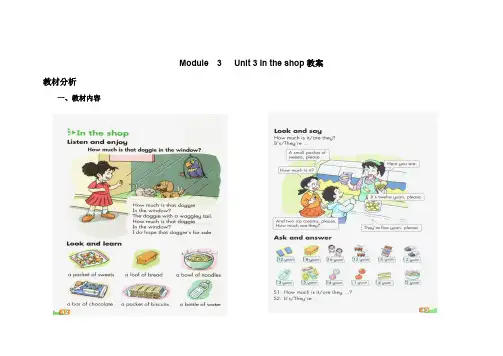
Module 3 Unit 3 In the shop教案教材分析一、教材内容【单元目标】知识与技能1、知晓字母组合sm-, sp-和st-在单词词首的发音,并能正确朗读相关儿歌。
2、能用a packet of sweets, a loaf of bread,a bowl of noodles, a bar of chocolate, a packet of biscuits, a bottle of water等核心词汇来表达物品的数量和名称,并能正确书写;了解在英语中可以用…of…来表示名词的数量。
3、能用How much is it /are they? 等核心句型来询问物品的价格,并做出正确应答。
4、会列出、介绍购物清单;学会简单的购物对话;并能读懂、表演故事Panda’s Glasses Shop。
文化与情感1、养成制定购物清单的习惯,学会根据自己的需要合理购买物品;2、体会购物的便捷,学会与人交际的礼仪,享受购物过程中的乐趣。
学习策略在课堂交流中,学会倾听同伴和老师之间的交流,学会提取信息,积极与他人交流,并能借助自制学具学习语段。
【语用任务】能根据自己的需要列购物清单,并能进行简单的购物对话,语音正确,表达较流利。
【课时话题】【课时目标】内容整合一、第二课时教学文本Shopping in the supermarketKitty and her mum are in the supermarket. They want to buy some food and drinks for the welcome party.Mum:Here’s the drinks section.Kitty:Wow!Mum:What do you want for your welcome party, Kitty?Kitty:Let me have a look. I want five bottles of water.Mum:OK.Kitty:Jill likes orange juice best. May I have a bottle of orange juice, Mum?Mum:All right. How much is it?Kitty:It’s four yuan. Oh, look! Three bottles of orange juice are only nine yuan.Mum:Really? Let’s have three bottles of orange juice.Kitty:Great!They buy some water and juice at the drinks section.At the bakery section, they buy some bread. At the snacks section, they buy some biscuits, sweets and chocolate.Kitty:Thank you, Mum.Mum:You’re welcome. Have a happy party with your friends.Kitty has all the things on the shopping list. She is so happy.第二课时教学设计一、重点、难点1、重点: 能在情境中,根据购物清单扮演Kitty和Mum进行购物对话。
(沪教牛津版)四年级英语上册教案Module3Unit1period2

Ask the students to complete the exercise.
ing the introductory ‘ there’ to express facts
制定依据:内容分析:重点:用How many句型询问数量并用There be句型作回答。难点:rope hoop的认读及表达。
Teaching Process
Stage
Content
Method
Purpose
Ask: How many hoops? There are seven hoops.
Work in pairs.
To catch the sentences.
To elicit:
To strengthen the knowledge.
To encourage.
Post-task activity
Workbook page 17
沪教牛津版四年级英语上册教案
Module 3 Places and activities
Unit:1 In the school
Period:2
Date:
Aims:
ing nouns to identify objects
2.Asking ‘How’ questions to find out the quantity
Ask: How many plants are there? to elicit 13. Have the students write the number and join the exercise.
(沪教牛津版)四年级英语上册教案Module3Unit2period1

Alarge ice-cream, pleasw.Ten yuan, please.
Thinking & Rebuilding
沪教牛津版四年级英语上册教案
Module 3 Places and activities
Unit:2 Food
Perioபைடு நூலகம்:1
Date:
Aims:
ing noun phrases to refer to the quantity of something.
ing nuns to identify things.
…
2.Ask and answer
To practise their listening and speaking task
While-task procedure
1 .Look at the food in the supermarket.
2.Listen to thetape and repeat after it
ing ‘How’questions to find out the price.
ing formulaic expressions to reply to requests.
Purpose: Open an interaction by buying things.
制定依据:内容分析:重点:用常用的表达在超市中买或卖东西,用谓语形容词表达要某样东西。难点:用模式词组买或卖东西。
Teaching Process
Stage
Content
Method
Purpose
Pre-task preparation
四年级英语上册Module3Unit3Aclasspicnicperiod1教案沪教牛津版
what goods
2.Describe the things
1. Listen and guess
…
2.Make a model
Ask sts to say
To practise their listening task
2.To ove the sts speaking skills
Module 3 Places and activities
Unit:3 Aclass picnic
Period:1
Date:
Aims:
Purpose:Open an interaction by asking what the other classmates have.
制定依据:内容分析:重点及难点:用模式句型What have you got? Have you got…? 作交流并作出回答。
3.Look and read then guess in pairs
Learn the new words and pronouciate it correctly.
practise the listening skill
Learn how to use the sentences
Post-task activity
学生情况:学生会使用介词 in on under 说些简单的句子,对Where be 句型也能作出回答,这些都需要进一步操练巩固。What’s…got? 对部分学生来说会成为难点,如何区分’s的含义有待反复操练。
Teaching Process
Stage
Content
Method
Purpose
Pre-task preparation
新牛津沪教四年级上册module 1《unit 3 what are you》period2优秀教案之一(重点资料).doc
Learn the sound
(1) Introduce a teacher, a doctor, a dentist, a nurse, a swaitress, a cook, a bus-drive and a postman.
To review
While-task procedure
Learn‘a teacher, a doctor, a dentist, a nurse, a shop assistant, a waiter, a waitress, a cook, a bus-drive and a postman’
(1) pair work
(2) Students in a group take turns to pick up a picture card and ask mother group member‘What’s he /she?’The students who answer the question has to give the answer first and then choose a word card turn it over if the pair of cards: The student with the most cards in a group will be the winner.
(2) Invite individual sts to come to the board and take away a picture card eachtime. The others try their best to remember which word card pairs with which‘picture card’.
上海秋季牛津英语四年级上册四上M3U3同步讲义教案(含词汇语法练习)
Ⅱ. Daily Expressions日常用语1.Don't worry. 别担心。
2.Can I help you? 你想要点什么?3.A small packet of sweets,please.请给我一小袋糖。
…,please.表示“请……”,在我们的日常生活中,该句型常用来表达某人想要吃/买某物,口语中经常出现。
please用在句末一般要用“,”隔开,用上please可使语气变得委婉。
例如:An ice cream,please.(我想要)一个冰淇淋。
回答时用:Here you are.给你。
4.How much is it? 多少钱?How much…可以用来表示不可数名词量的多少、表示价钱的多少以及到了什么程度三层含义。
在本单元中我们所学的How much…用来表示价钱的多少,用来询问某物的价钱是多少,胸物时的常用语。
例如:-How much is the pen? 钢笔多少钱一支?-Ten yuan,please.请付十元。
在问价格时,be动词用单数“is”还是复数“are”必须根据购买物品的单复数来决定。
例如:How much is the bunch of bananas? 一串香蕉多少钱How much are they?它们多少钱?特殊疑问词在划线提问中的应用【知识梳理1】特殊疑问词的复习:who 问人where 问地点how old 问年龄when 问时间which 问特征how many 问数量what 问事情、职业whose 问主人how much 问价格why 问原因how 问方式划线提问中的答题口诀:一代(用疑问词代替划线部分),二移(把疑问词移至句首),三找(找is , are, can, would)抄在疑问词后,没有则用do,does(用于主语是第三人称),出现I am 则直接改为Are you),四抄(照抄其它部分)A. willB. areC. doesKeys: BABBAIV.用情态动词揣测下列句子的说话语气Look at your shoes. (Can改为疑问句)You must clean them again. (must改为陈述句)They will be dirty again tomorrow.(must改为陈述句)Give me something to eat. (Can 改为疑问句)1、讲解达标检测部分学生的错题以及涉及到的本单元重点2、特殊疑问词的复习--划线提问中的答题口诀:一代二移三找四抄五改3、情态动词表原形过去式否定疑问回答Can Could Can’t/ couldn’t Can /Could you? Yes, I can/could.No, I can’t/couldn’t.Must Must Mustn’t Must you..? Yes, you must.No, you needn’t.(Shall) Should Shouldn’t Should I…? Yes, you should.No, you shouldn’t(此部分内容包含本次课所学内容相关的练习题以及综合练习题。
四年级英语上册Module3Unit3Aclasspicnic(period2)教案沪教牛津版
Module 3 Places and activities
尊敬的读者:
本文由我和我的同事在百忙中收集整编出来,本文稿在发布之前我们对内容进行仔细校对,但是难免会有不尽如人意之处,如有疏漏之处请指正,希望本文能为您解开疑惑,引发思考。
文中部分文字受到网友的关怀和支持,在此表示感谢!在往后的日子希望与大家共同进步,成长。
This article is collected and compiled by my colleagues and I in our busy schedule. We proofread the content carefully before the release of this article, but it is inevitable that there will be some unsatisfactory points. If there are omissions, please correct them. I hope this article can solve your doubts and arouse your thinking. Part of the text by the user's care and support, thank you here! I hope to make progress and grow with you in the future.。