
Research Methodology-An introduction(研究方法论)
研究工作计划英文

研究工作计划英文**Research Work Plan****Introduction**As a researcher, having a clear and concise work planis crucial for ensuring the smooth progress of a research project. A research work plan outlines the objectives, methods, and expected outcomes of a study, providing a roadmap for the investigator to follow. This document serves as a guide for the entire research team, ensuring that everyone is aligned with the goals and objectives of the project.**Objectives of the Research**The first step in creating a research work plan is to define the objectives of the study. These objectives should be specific, measurable, achievable, relevant, and time-bound (SMART). For example, the objective of a study may be to investigate the effectiveness of a new treatment for a particular disease. The objectives should guide the entireresearch process, from the selection of methods to the interpretation of results.**Methodology**The methodology section of the research work plan outlines the specific methods and techniques that will be used to achieve the research objectives. This includes the sampling methods, data collection techniques, andanalytical methods. The selection of these methods shouldbe based on the research objectives and the available resources. For example, if the objective is to test the effectiveness of a new treatment, the methodology mayinvolve randomized controlled trials or observational studies.**Timeline**A detailed timeline is essential for managing the research project effectively. The timeline should include key milestones and deadlines for each phase of the research. This ensures that the project remains on track and that resources are allocated efficiently. For example, the timeline may include deadlines for data collection, data analysis, and the preparation of the final report.**Expected Outcomes**The expected outcomes section of the research work plan outlines the anticipated results of the study. These outcomes should be directly linked to the research objectives and should be measurable. For example, the expected outcome of a study investigating a new treatment may be a statistically significant improvement in patient outcomes compared to the current standard of care.**Risk Management**Identifying and managing potential risks is crucial for ensuring the success of a research project. The research work plan should include a section dedicated to risk management, outlining potential risks and strategies to mitigate them. For example, risks may include unexpected changes in the research protocol or issues with data collection. Strategies to mitigate these risks may include regular monitoring of the progress of the study and adjustments to the research protocol as needed.**Conclusion**A research work plan is a crucial tool for managing and guiding a research project from start to finish. It ensures that the research objectives are clear, the methods are appropriate, and the timeline is realistic. By outlining the expected outcomes and managing potential risks, the research work plan helps to ensure that the study is successful and that the goals of the project are achieved. **中文内容****研究工作计划****引言**对于研究人员来说,制定明确且简洁的研究工作计划是至关重要的,这可以确保研究项目的顺利进行。
Research methodology教学内容

Can be difficult to collect and/or take a long time to collect.
Is expensive to collect.
May provide mis-leading results if the sample is not large enough or chosen with care; or if the questionnaire questions are not worded properly.
Strengths of Secondary research
The main advantages of using secondary research are:
Provided the information exists, it is usually quicker and cheaper than primary research.
Most primary research is collected using:-
Questionnaires – multiple choice, closed questions. Personal interviews Postal surveys Observations Focus group Test marketing
ResearchMethodology研究方法、目的

ResearchMethodology研究方法、目的Research MethodologyThis thesis will explore the feminism in Mrs. Dalloway in through analysis and induction and deduction process.Analysis is a classic research method by breaking a complex topic or substance into smaller parts to gain a better understanding of the topic. This technique has been applied in many fields, especially in the study of mathematics and logic, and it has been widely adopted in literary text interpretation. Woolf believes that human history should be interpreted from female perspective in order to create a new civilization, and her feminism is obviously embodied in her novels such as Mrs. Dalloway. In this novel犷Woolf shows several ideas about feminism and these ideas are analyzed respectively.Induction is a way of reasoning using known facts to produce general laws. Deduction is a way of determining from the general principle in relation to a particular event, thing or fact. In the paper author studied the novel and inducted from the creation of the characters and setting the general ideas of feminism developed in the novel. In the early 1920s, Virginia Woolf developed her ideology about social political, economic and cultural system in the patriarchal society, and her thoughts can be applied in the analysis of her feminism. Form her novels. By the two reasoning process, the paper attempts to explore the hidden theme and overall ideology in the novel.Research GoalChina's study on feminism was borrowed from the west, and the same kind of patriarchy ruled in some places in China, especially in the rural area, and women were suffering from thesame kind of pain and agony as one sees in' the novel. Virginia Woolf's perception on feminism helps one to achieve a better understanding on the issue. In this paper, Virginia Woolf's opinion in Mrs. Dalloway is explored, alongwith her effort to promote women in the fight against the masculine suppression in pursuit of equal social status.To take this step, women then explore the contexts and reasons for why we experience what we experience. They examine history, the economy, the political economy and material realities, and ask who benefits, and how it is that unhelpful but dominant ideas are held in place (such as `women must be youthful and beautiful', or `father knows best', or `boys will be boys'). We ask how it is that we find ourselves colluding with these ideas that hurt us; what are we up against when we try and resist or act differently; what are our successes and triumphs and the conditions for these, and so on. Importantly, they may also investigate men, men's actions, and ideology, practices and institutions which favor men, or they might research men and women together.All of these questions comprise the critical process of examining the `structural' matters which surround and shape them, so that they can begin to form theories about alternative ways of acting.This thesis aims to seek the thread of lines that offers clues to the issue of feminism, the question that concerns author's interest are: how women can acquireself-confidence to come back to oneself and become an individual with the identity and strong will, and how women in the novel search to break away from the confinesof the society, a complete being not like a flower in greenhouse. Virginia argued that women should expand their horizon and enrich life experience to embody a new value. Women can have a hopeful future if they make effort and find time to explore life in a new way. Society offers the best resources where women can draw on develop their capabilities.Chapter Two Literature ReviewVirginia Woolf's feminism has long been studied by scholars around the world.In this section, the researches of feminism in Mrs. Dalloway both abroad and at home are introduced.。
ResearchMethodologyResearchDesign…
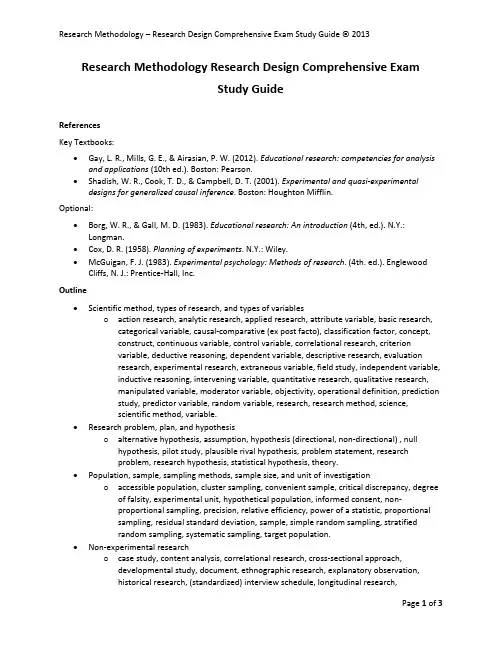
Research Methodology Research Design Comprehensive ExamStudy GuideReferencesKey Textbooks:∙Gay, L. R., Mills, G. E., & Airasian, P. W. (2012). Educational research: competencies for analysis and applications (10th ed.). Boston: Pearson.∙Shadish, W. R., Cook, T. D., & Campbell, D. T. (2001). Experimental and quasi-experimental designs for generalized causal inference. Boston: Houghton Mifflin.Optional:∙Borg, W. R., & Gall, M. D. (1983). Educational research: An introduction (4th, ed.). N.Y.: Longman.∙Cox, D. R. (1958). Planning of experiments. N.Y.: Wiley.∙McGuigan, F. J. (1983). Experimental psychology: Methods of research. (4th. ed.). Englewood Cliffs, N. J.: Prentice-Hall, Inc.Outline∙Scientific method, types of research, and types of variableso action research, analytic research, applied research, attribute variable, basic research, categorical variable, causal-comparative (ex post facto), classification factor, concept,construct, continuous variable, control variable, correlational research, criterionvariable, deductive reasoning, dependent variable, descriptive research, evaluationresearch, experimental research, extraneous variable, field study, independent variable,inductive reasoning, intervening variable, quantitative research, qualitative research,manipulated variable, moderator variable, objectivity, operational definition, predictionstudy, predictor variable, random variable, research, research method, science,scientific method, variable.∙Research problem, plan, and hypothesiso alternative hypothesis, assumption, hypothesis (directional, non-directional) , null hypothesis, pilot study, plausible rival hypothesis, problem statement, researchproblem, research hypothesis, statistical hypothesis, theory.∙Population, sample, sampling methods, sample size, and unit of investigationo accessible population, cluster sampling, convenient sample, critical discrepancy, degree of falsity, experimental unit, hypothetical population, informed consent, non-proportional sampling, precision, relative efficiency, power of a statistic, proportionalsampling, residual standard deviation, sample, simple random sampling, stratifiedrandom sampling, systematic sampling, target population.∙Non-experimental researcho case study, content analysis, correlational research, cross-sectional approach,developmental study, document, ethnographic research, explanatory observation,historical research, (standardized) interview schedule, longitudinal research,observational approach, primary observation, substitute primary observation, self-selection, supplementary observation for..., survey research.∙Characteristics, assumptions, and steps of experimental research suggested readings: o additivity, constancy of treatment effect, causation, comparative experiment, control, control (comparison) group, experiment, experimental error, experimental design,experimental (treatment) group, experimental variable, manipulation, independence,random error, systematic error, treatment, verification.∙Internal/external validity of a studyo bias, carry-over effect, Compensatory equalization of treatments, compensatory rivalry, confounding, construct validity (putative cause/effect), diffusion of treatment,ecological validity, expectancy effects, experimenter bias, generalization, halo effect,Hawthorne effect, (threat of) history, imitation of treatment, interference betweenunits, (threat of) instrumentation, interaction (selection X maturation, selection Xtreatment, testing X treatment), intra-session history, John Henry effect, (threat of)maturation, mortality, multiple-treatment interference, nonreactive, novelty effect,order effect, placebo effect, population validity, precision, reactive arrangement,reactive effect of testing, regression effect, representativeness, resentfuldemoralization, selection bias, sequence effect, specificity of variables, statisticalconclusion validity, threat of testing, unobtrusive measure.∙Randomization and other methods of controlo analysis of covariance, blocking, counterbalancing, double-blind technique, matching, matched-group, matched-pair, method of constancy, method of removal, randomassignment, randomization, random permutation, random selection, replication,restricted randomization, using subjects as their own control.∙Statistical concepts required for understanding designso alpha level, baseline, Beta weight (regression coefficient), chi-square, coefficient of determination, confidence interval, consistent estimator, contingency table, contrast,critical value, curvilinear relation, data, degree of freedom, descriptive statistics,efficient estimator, error rate, estimator, expected value, exploratory data analysis,family-wise error, F- test, frequency distribution, frequency polygon, histogram,inferential statistics, interval scale, level of significance, linear relation, mean,measurement scale, measurement of central tendency, measures of variability, median,meta-analysis, mode, multiple correlation, negative relationship, negatively skewed,nominal scale, nonparametric statistics, normal distribution, one-tailed test, ordinalscale, parameter, parametric statistics, percentile, percentile rank, plannedcomparisons, positive relationship, positively skewed, post hoc (multiple) comparison,probability, range, ratio scale, residual, sampling distribution, scatter plot, slope,skewed, spurious correlation, standard deviation, standard error of a statistic, standardscores, statistical significance, transformation, T-scores, t-test, two-tailed test, type Ierror, type II error, unbiased estimator, variance, z-score.∙Designs classified in terms of the degree of controlo intact group, multiple time-series design, nonequivalent control group design, one-group pretest-posttest design, one-shot case study, posttest-only control group design,pre-experimental design, pretest-posttest control group design, quasi-experimentaldesign, Solomon four- group design, static-group comparison, time-series design, true-experimental design.∙Randomized-group designso analysis of variance, between-group design, error term, error variance, fixed effect model, mean square between, mean square total, mean square within, mixed effectmodel, sum of square between, sum of square total, sum of square within, varianceratio.∙Blocking methods, matching, and randomized block designso post-hoc blocking, predefined range blocking, predefined value blocking, sampled range blocking, sampled value blocking∙Analysis of covarianceo adjusted mean square, adjusted sum of squares, adjusted treatment means, concomitant variable, covariate, slope-treatment interaction.∙Factorial designso crossed treatments, factor level, interaction (disordinal, ordinal), main effect, nested treatments, ranked qualitative factor, sampled qualitative factors, simple effect.∙Other topics/concepts/designs (definition only)o attenuation, balance, high-order interaction, incomplete block, index of response, Latin-square design, missing value, Monte Carlo method, multivariate analysis of variance,multivariate statistics, orthogonal comparison, randomization test, repeated measuresdesign, residual standard deviation, response curve, robustness, sequential method,standard Latin-square design, single subject design, split-plot, variance-covariancematrix.。
研究生学术英语读写教程unit3
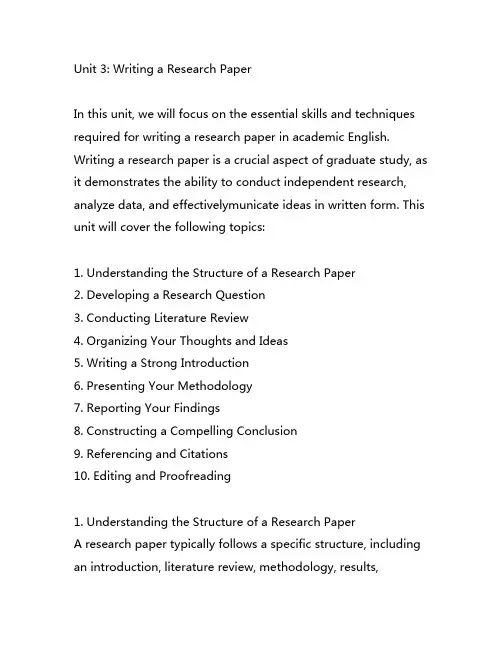
Unit 3: Writing a Research PaperIn this unit, we will focus on the essential skills and techniques required for writing a research paper in academic English. Writing a research paper is a crucial aspect of graduate study, as it demonstrates the ability to conduct independent research, analyze data, and effectivelymunicate ideas in written form. This unit will cover the following topics:1. Understanding the Structure of a Research Paper2. Developing a Research Question3. Conducting Literature Review4. Organizing Your Thoughts and Ideas5. Writing a Strong Introduction6. Presenting Your Methodology7. Reporting Your Findings8. Constructing a Compelling Conclusion9. Referencing and Citations10. Editing and Proofreading1. Understanding the Structure of a Research PaperA research paper typically follows a specific structure, including an introduction, literature review, methodology, results,discussion, and conclusion. Understanding the purpose of each section and how they relate to the overall research is essential for writing a cohesive and coherent paper.2. Developing a Research QuestionA well-crafted research question is the foundation of a successful research paper. It should be clear, concise, and focused, guiding the direction of the study and facilitating the identification of relevant literature and methodologies.3. Conducting Literature ReviewA literature review is a critical analysis of existing research related to your topic. It provides context for your study, identifies gaps in existing knowledge, and justifies the significance of your research. Learning how to effectively review and synthesize literature is essential for building a strong theoretical framework for your paper.4. Organizing Your Thoughts and IdeasOrganizing your thoughts and ideas is essential for creating a logical and coherent research paper. This can be achieved through outlining, mind mapping, or other organizational techniques. Clear organization will help you m本人nt本人nfocus and ensure that your paper flows logically.5. Writing a Strong IntroductionThe introduction sets the stage for your research paper, providing background information, stating the research problem, and outlining the structure of the paper. A strong introduction should captivate the reader's attention and provide a clear rationale for the study.6. Presenting Your MethodologyThe methodology section det本人ls the research methods and procedures used to collect and analyze data. It should beprehensive, transparent, and replicable, allowing other researchers to understand and evaluate the validity of your study.7. Reporting Your FindingsIn this section, you will present the results of your research in a clear and systematic manner. This may involve the use of tables, figures, and statistical analysis to convey the key findings of your study.8. Constructing a Compelling ConclusionThe conclusion summarizes the key findings of your research, discusses their implications, and makes rmendations for future research or practice. Apelling conclusion should leave a lasting impression on the reader and reinforce the significance of your study.9. Referencing and CitationsAccurate referencing and citation of sources are essential for m 本人nt本人ning academic integrity and avoiding plagiarism. Familiarizing yourself with the specific citation style required by your discipline is crucial for properly acknowledging the work of others.10. Editing and ProofreadingEditing and proofreading are essential steps in the writing process to ensure clarity, coherence, and accuracy. It is important to review your paper for grammar, spelling, and punctuation errors, as well as to refine the overall clarity and effectiveness of your writing.In conclusion, writing a research paper in academic English requires abination of critical thinking, analytical skills, and effectivemunication. Mastering the skills and techniquescovered in this unit will not only enhance your academic writing abilities but also contribute to the advancement of knowledge in your field of study. By understanding the structure of a research paper, developing a strong research question, conducting a thorough literature review, organizing your thoughts and ideas, and mastering the art of writing a strong introduction, presenting a clear methodology, reporting your findings, constructing apelling conclusion, referencing and citations, and editing and proofreading, you will be well-equipped to produce high-quality research papers that make a meaningful contribution to your academic discipline.。
教育技术学专业(代码077001)(修订版)
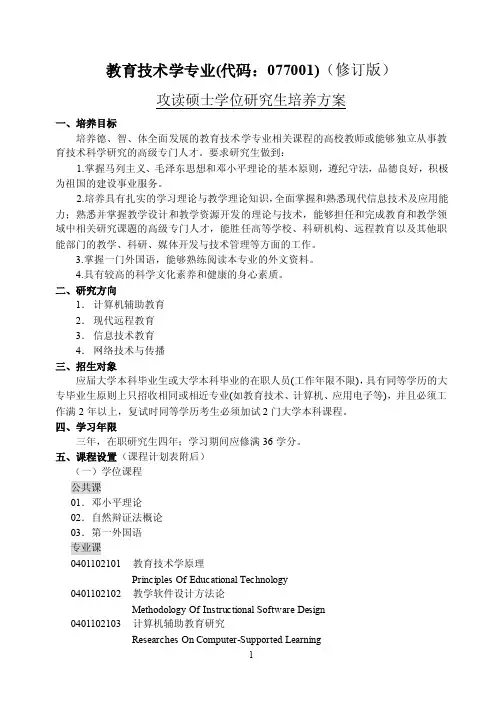
教育技术学专业(代码:077001)(修订版)攻读硕士学位研究生培养方案一、培养目标培养德、智、体全面发展的教育技术学专业相关课程的高校教师或能够独立从事教育技术科学研究的高级专门人才。
要求研究生做到:1.掌握马列主义、毛泽东思想和邓小平理论的基本原则,遵纪守法,品德良好,积极为祖国的建设事业服务。
2.培养具有扎实的学习理论与教学理论知识,全面掌握和熟悉现代信息技术及应用能力;熟悉并掌握教学设计和教学资源开发的理论与技术,能够担任和完成教育和教学领域中相关研究课题的高级专门人才,能胜任高等学校、科研机构、远程教育以及其他职能部门的教学、科研、媒体开发与技术管理等方面的工作。
3.掌握一门外国语,能够熟练阅读本专业的外文资料。
4.具有较高的科学文化素养和健康的身心素质。
二、研究方向1.计算机辅助教育2.现代远程教育3.信息技术教育4.网络技术与传播三、招生对象应届大学本科毕业生或大学本科毕业的在职人员(工作年限不限),具有同等学历的大专毕业生原则上只招收相同或相近专业(如教育技术、计算机、应用电子等),并且必须工作满2年以上,复试时同等学历考生必须加试2门大学本科课程。
四、学习年限三年,在职研究生四年;学习期间应修满36学分。
五、课程设置(课程计划表附后)(一)学位课程公共课01.邓小平理论02.自然辩证法概论03.第一外国语专业课0401102101 教育技术学原理Principles Of Educational Technology0401102102 教学软件设计方法论Methodology Of Instructional Software Design0401102103 计算机辅助教育研究Researches On Computer-Supported Learning0401102104 多媒体网络通信技术Multimedia、Networks & Communication (二)选修课程指定选修课(必选课):0401102205 远距离教育研究Researches On Distance Education0401102206 学习理论与教学设计Learning principles and Instructional Design 0401102207 多媒体信息处理技术Multimedia Information Processing0401102208 面向对象的程序设计Object-Oriented Program Design0401102209 信息技术教育研究Researches On Information Technology Education 0401102210 教育技术研究方法Research Methods On Educational Technology 任意选修课(自选课):0401102211 教育技术学论著选读Monographs Study Of Educational Technology 0401102212 网络课程设计与开发Design & Development Of Web-Based Curriculum 0401102213 人工智能与知识工程Artificial Intelligence & Knowledge Engineering 0401102214 教育评价与测量技术Methods of Educational Assessment & Measure 0401102215 网络教育标准与技术Standards & Techniques On E-Learning0401102216 数据库与管理信息系统Database & Management Information Systems 0401102217 教育绩效技术Performance Technology in Education0401102218 影视动画艺术设计Arts Design Of Video & Movie Animation 0401102219 教育技术学比较研究Comparative Research On Educational Technology 0401102220 基于项目的教育技术实践Project Based Research Of Educational Technology 0401102221专业外语Specialty Foreign Language六、教学实践和社会实践研究生参加教学实践和社会实践,应完成的教学工作量一般不少于36课时,计2学分,时间安排在第4学期。
学术英语写作的结构
学术英语写作的结构
学术英语写作的结构通常遵循一定的模式,以下是一种常见的结构:1.引言(Introduction):在引言部分,作者简要介绍论文的主题、
研究背景、研究目的和研究问题。
此外,还可以提供一些相关的文献综述,以帮助读者更好地理解论文的背景和重要性。
2.文献综述(Literature Review):文献综述部分对已有的相关研究
进行总结和分析,为论文的研究问题提供理论支持和背景信息。
这一部分应该包括对相关研究的批判性评价,以及当前研究的空白和需要进一步探讨的问题。
3.研究方法(Research Methodology):在研究方法部分,作者详细
介绍研究设计、数据采集和分析方法、样本和抽样方法等。
这一部分应该清楚地说明研究是如何实施的,以及如何收集和分析数据的。
4.结果与讨论(Results and Discussion):结果与讨论部分呈现研究
结果,并对结果进行解释和讨论。
这一部分应该包括对数据的描述性分析、推断性分析和解释性分析,以及对结果的讨论和意义。
5.结论(Conclusion):结论部分总结论文的主要发现和贡献,并对
未来研究提出建议。
这一部分应该强调研究的局限性、对理论和实践的贡献,以及对未来研究的启示。
6.参考文献(References):参考文献部分列出文中引用的各篇文献,
按照规定的格式编排,如APA、MLA等。
这一部分应该包括所有引用的文献,以便读者查阅和核实。
以上是一种常见的学术英语写作结构,但具体的结构安排可能因学科领域、论文类型和个人偏好而有所不同。
在写作时,作者应该根据论文的具体要求和规范进行适当的调整。
Research Proposal 的写作主要包括以下几个部分
Research Proposal 的写作主要包括以下几个部分:1. Statement of your hypothesis2. Review of Related Literature3. Methodology4. Analysis of the problems or significant issues involved. (Statistics)5. Summary of your findings and your conclusions and recommendationsResearch Proposal 一般的长度控制在2000-3000 词左右,必须回答下列问题: What you plan to accomplish, why you want to do it and how you are going to do it.必须要让读者相信you have an important research idea, 重要的研究想法that you have a good grasp of the relevant literature and the major issues, 对主要问题和相关文献有很好的把握and that your methodology is sound.方法是对路的【题目】:简单描述性,An investigation of可以省略【摘要】:300词,包括the research question, the rationale for the study, the hypothesis (if any), the method and the main findings. Descriptions of the method may include the design, procedures, the sample and any instruments that will be used.【Introduction】:为研究的问题提供主要的背景首先,让你的研究问题在一个当前热门或者仍旧可以讨论的旧领域的上下文中。
研究生学术英语写作教程Unit4DescribingMethodology
Unit 4 Describing MethodologyObjectives─ Be clear about the significance of this section─ Try to understand the importance of passive voice in academic writing─ Learn to be skilled in using sequential markers in writing a process─ Be familiar with proof-reading skills─ Learn to design a questionnaireContents─ Brief introduction to this section─ Reading & Discussion: What information elements are usually involved in writing a methodology section?─ Language Focus: Passive voice and sequential markers─ Writing Practice: Understanding the sentence patterns and sentence order in writing a process─ Writing Project: How to design a questionnaire1.Reading ActivityIn natural sciences the method section is often called Materials and Methods. In social sciences it is common to introduce a section called Theory and Methods. Sometimes it is divided in two sections: Theoretical Framework and Methods.Research methodology is mainly concerned with the answers to the following questions:1) Why is a particular research study undertaken?2) How has one formulated a research problem?3) What types of data have been collected?4) What particular methods have been used?5) Why is a particular technique of analysis of data used?1.1Pre-reading TaskThe following is the method section of a research article in the field of applied linguistics. Think about the following questions before reading the text and then havea discussion with your classmates:1) What is the function of the method section?2) What information elements does a method section include?3) What verb tenses are mainly used in the text? What is the proportion of activevoice verbs to passive voice verbs in this method section?1.2 Reading PassageEnglish for College Students in Taiwan:A Study of perceptions of English Needs in a Medical ContextThe experiment was initiated to investigate perceptions of English needs in a medical context among college students in Taiwan.The subjects were 341 medical students in the Department of Medicine, including 97 freshmen, 74 sophomores, 90 juniors, and 80 seniors, and 20 faculty members in the medical program at Chung Shan Medical College in Taichung, Taiwan, China.Two questionnaires were developed for the survey, based on two earlier survey instruments by Taylor & Hussein (1985) and Guo (1989). The questionnaires were translated into Chinese, piloted, and modified according to the feedback from l0 respondents: six medical students and four faculty members from Chung Shan Medical College. The questionnaire given to the medical students consisted of five sections of 23 questions, the topics of which were the importance of English incollege and professional careers, perceived language skill needs and problems, the activities needed in a freshman language course, and suggestions for development of course content and materials as well as demographic information. The faculty questionnaire consisted of four sections of l6 questions, which were parallel to those in the version given to the students except no demographic information was gathered (see Appendix).One of the authors, a faculty member at Chung Shan Medical College, selected one required class for each group of students (freshmen sophomores, juniors and seniors). Copies of the student questionnaire for administration to the students were then sent to cooperating instructors teaching these courses; copies of the faculty questionnaire were given to 20 teachers who were willing to complete the survey.The data were computer-analyzed using an SPSS program: in the questionnaire, percentages were determined for all questions except 8 and 13 for which means were computed. Chi-square, t-tests, and ANOVA analyses (方差分析) were conducted in order to determine the perceptions of English language needs of medical college students and their faculty and to compare the perceptions held by the various groups.( Pang, 2008)1.3 Reading Comprehension1.3.1 Fill in the following table with relevant details from the passage. Research objectiveResearch subjectsResearch locationMaterialsProcedureStatistical analysis1.3.2 Understand more about the method section of this research. Whatdo you know about the questionnaires used in the survey?2. Language Focus2.1 Passive voiceThe passive voice is usually used in academic writing, because passive structures have less subjective coloring in most cases than active ones. When describing a process or a scientific experiment, it is important to write in a neutral style, as an observer. To do this, you can use passive voice. There are three instances in which the passive voice is recommended: 1) when we do not know or do not care about who has performed the action; 2) when we focus on the receiver instead of the performer of the action; and 3) when we would like to remain in a neutral or objective position in writing. More examples from the methodology section are as follows:1) The study was conducted at the beginning of the semester and the final one was given at the end of the semester. ( procedure )2) In summer, the greenhouse was cooled by pulling in air through water saturated pads on the south end of the building. ( specially designed material )3) The quartz reactors tested for this work are fabricated by the A&B Sales Company of Wheeling, Leeds, UK. ( instrument )4) In order to provide a broad sampling of college students, respondents were recruited from diverse fields of study. ( sampling )5) The final scores were computed into mean averages (X) and standard deviations (SD). ( statistical analysis)2.1.1 Go over the Reading Passage and mark verbs in the passive voiceand then complete the following table:2.1.2 Rewrite the following text with passive voice.Some people consider a poison ivy infection to be humorous. But it is not funny at all. Contact with the plant causes a rash that has the intensity of a fresh mosquito bite and lasts for several days. Scientists have studied poison ivy infection for centuries, but they have found no preventive pill or inoculation. The poisonous substance in the plant is called urushiol. After urushiol has touched the skin, blisters and weeping sores will soon cover the exposed area.2.2 Sequential markersA process paragraph explains how to do something or how something works. Process paragraphs are usually developed step-by-step in a chronological or logical sequence. The following sequencing expressions are more frequently used to link steps in a description of a process or to divide a process into steps:● Firstly … To begin with … First of all … etc.● Secondly … Next … After that … In addition … etc.● Finally … Lastly …The following sentences describe a process of making paper. Use sequential words and rewrite them into a cohesive paragraph.1) The logs are placed in the shredder.2) They are cut into small chips and mixed with water and acid.3) They are heated and crushed to a heavy pulp which is cleaned.4) It is chemically bleached to whiten it.5) It is passed through rollers to flatten it.6). Sheets of wet paper are produced.7) The water is removed from the sheets which are pressed, dried and refined and the finished paper is produced.3. Writing PracticeA well organized, logically ordered and easily understandable chapter on methodology makes the thesis a really outstanding work. Normally, a method section includes:1) Overview of the experiment: one sentence briefly tells what was done (like a topicsentence);2) Population: state the people/subjects studied, or the things tested;3) Location : where the study took place;4) Restriction/Limiting conditions: precautions taken to make sure that the data are valid;5) Sampling Techniques : describe how the subject are selected for the study;6) Materials : describe the materials used to conduct the study or experiment;7) Procedures : State the steps of the experiment in a chronological order;8) Statistical Treatment: describe how the statistics are examined.Of all the items on this list, the only items that are always included in the method section are the materials and procedures.3.1 Read the following sentences. They are all taken from method sections from different research articles. In each case, determine which information element is represented.(1) A total of 369 participants of European origins (52.7% female) with a mean age of27.2 years were recruited by research assistants in public places in the Montrealregion.(2) The data used for the current analysis consists of 60 texts taken from 20engineering journals.(3) Experimenters approached potential participants by introducing themselves asstudents from the University of Quebec in Montreal and then asked if they would accept to participate in a short study on facial expressions.(4) The study aims to examine the use of SEF as a tool for providing evidence ofteaching effectiveness in tertiary education.(5) The results of the two questionnaires were subjected to statistical tests ofreliability and significance using SPSS.(6) Envelopes containing the survey materials were sent to the local business managerof each union. In the envelopes, there was a cover letter explaining the project, the questionnaire itself, and a pre-paid return envelope. The union business manager was contacted and asked to select workers from his union and to send the envelopes to the chosen workers.(7) The participants were 90 first-year students from the School of Foreign Languagesat a major university in Nanjing. Their average age was 18 years old. They constituted a convenience sample.(8) The investigation was performed in a national laboratory affiliated to a researchcenter for industrial automation in Nanjing, Jiangsu Province.3.2 Completing sentencesThe following words and phrasal verbs are more commonly used in Method Section Subjects / participants choose, include, recruit,volunteered / paid to participate, …Materials be composed of, be located, be installed,be equipped with, obtain, supply, …Research designapply, employ, develop, resort to, use, …Procedurecarry out, follow, perform, propose, …Complete the following paragraph by translating Chinese into English.A group of MBA students from a major metropolitan state university were recruited as participants for the investigation. (1)(问卷调查实施)after the topic of the BSC had been discussed in the course. 136 students enrolled in a managerial accounting course ( 2 ) (完成了此次问卷. _( 3 )_(表2给出了这些参与者的背景信息). As is shown, the majority of participants are male. _( 4 ) _(参与者的平均年龄约29岁), _( 5 )_(平均工作经历约6年), and the mean number of accounting classes was approximately four.(Liu, 2008)1)_________________________________________________________________2)_________________________________________________________________3)_________________________________________________________________4)_________________________________________________________________5)_________________________________________________________________3.3 Reordering sentencesThe following is the method section of a research article from the field of engineering with sentences in a scrambled order. Please rearrange them in a more conventional order. Write the sequential number in the box on the right side of the table below.a The data was rank-ordered from the lowest X value of 1.2 tothe highest of 3.8--- see Table 2 below.b The SD scores show to what extent the teachers agreedamong themselves when judging the gravity of each error.c The survey was conducted by means of a questionnaire, inwhich the errors appeared in a random order.d The assessors were instructed to view each error in itscontext and determine to what extent it deviated fromnormal English.e The questionnaire included the context in which each errorhad occurred and a marking scale ranging from 0 for "noerror” to 5 for “the most severe error".f After scoring, the assessors were given the option to writedown the principles that guided them in their scoring.g The scores were computed into mean averages (X) andstandard deviations (SD).h Unless otherwise indicated, the numerical data in the textrefer to the mean average scores.i The higher the SD score, the more diverse the assessors'opinions regarding the gravity of the item.3.4 Rewriting sentencesThe following sentences are taken from method sections of different published articles. Rewrite each sentence to make it more acceptable.(1) Table 5 shows the number of students per level and their L1 languagebackgrounds which are represented.__________________________________________________________________(2) Two questionnaires which were administered respectively to the personnel officersand business employees show a similar result in terms of their perception of the use of English in their firm.__________________________________________________________________ __________________________________________________________________ (3) The scores of the two raters were averaged and all the data were entered forstatistical analysis._________________________________________________________________ _________________________________________________________________ (4) The model which was used in the experiment was a modified version of the 2006Test package, which was originally developed by the Morrison Research Institute._________________________________________________________________ _________________________________________________________________ (5) Gray (1998) studied the effectiveness of the new schedule. He used scores on theStanford Achievement Test as the measure.__________________________________________________________________ __________________________________________________________________ (6) Having explained the directions, the students began to write.__________________________________________________________________ __________________________________________________________________ (7) The schedule was in effect only 1 year, with students achieving better results.__________________________________________________________________ (8) The teacher put the assignment on the board, and then she checked the roll andfound that three students were absent.____________________________________________________________________________________________________________________________________ (9) School administrators who are interested in making changes that are not tooexpensive or too complex for the most part have been overly receptive to simplistic solutions.__________________________________________________________________ __________________________________________________________________ __________________________________________________________________ (10) One of the obstacles that deter the installation of solar energy systems that aredesigned to achieve the savings that are important to all people is the reluctance of those same individuals to make large capital investments.__________________________________________________________________ __________________________________________________________________ __________________________________________________________________3.5 Turning notes into a passageYou are required to write the method section of a research paper about the experiment to investigate into students’ preferences and attitudes towards sugar-sweetened and artificially-sweetened beverages. Pay particular attention to the choice of tense and voice.Aim of research To determine student’s preferences and attitudestoward sugar-sweetened and artificially-sweetenedbeverages.Research subjects Ten people, five male and five female students, froma Science English class 1, chosen at random Materials Thirty straws, two cups, one blindfold, and twocontainers of Kool-Aid, a popular drink in the UnitedStates, one container with four cups of orange Kool-Aid sweetened with one half cup of sugar, the othercontainer with four cups of orange Kool-aidsweetened with 9 packets of Nutrasweet brandartificial sweetener.Procedure Ten volunteer students, five males, into two lines, one for males and the other for females. Alternately, men and women test, a blindfold over the eyes of the tester, he/she could not see, the two cups filled with beverage, one with artificially-sweetened Kool-Aid and the other with sugar-sweetened Kool-Aid. Then three questions asked from a survey and the answers tabulated. Next, use a straw, a sip from each cup.Data treatment The final two questions on the survey and the answers tabulated; finally, the remaining drink thrown away, and the next tester came forward, repeated the process.4. Writing Project4.1 Gathering information for a method section.You are required to write the method section of a research paper in the field of English language class attendance with the information elements given below. Gather information for your research.Aim of research To investigate into the status quo of your group ofstudents’ attendance in English classroom andreasons for absence.Research subjectsSampling techniquesMaterials mProceduresData treatment4.2 Designing a questionnaireThe design of a questionnaire will depend on whether the researcher wishes to collect exploratory information (i.e. qualitative information for the purposes of better understanding or the generation of hypotheses on a subject) or quantitative information (to test specific hypotheses that have previously been generated).A good questionnaire is one that: 1) enables collection of accurate data in a timely manner; 2) facilitates the work of data collection, data processing and the tabulation of data; 3) ensures that there is no collection of non-essential information; and 4) permits comprehensive and meaningful analysis as well as purposeful utilization of the data collected to ensure that the technical task of the questionnaire receives the various input that it requires.Types of questionsThere are many different types of questions you can use to get the information that you need. In the main, these fall into open and closed questions. An open question allows the respondents to use their own words to answer, e. g., “What do you think are the main causes of racism?” A closed question gives them pre-defined options, e.g., “Which of the following do you think are the main causes of racism: a, b, c, d”.The pros and cons of each are given in the following table.Rating design in a questionnaire: Look closely at the following example of a rating design.Please rate the quality of the medical insurance of this company.□ Poor □ Fair □ GoodThere are nine steps involved in the development of a questionnaire:1. Decide the information required;2. Define the target respondents;3. Choose the method(s) of reaching your target respondents;4. Decide on question content;5. Develop the question wording;6. Put questions into a meaningful order and format;7. Check the length of the questionnaire;8. Pre-test the questionnaire;9. Develop the final survey form.Now work in groups of four, and design a questionnaire to obtain information about students’ attendance and causes for their absence.4.3 Drafting your method sectionBegin your writing now with the information you have just obtained from your survey.5. Final ChecklistRevision gives you an opportunity to take another look at what you have written. Therefore, you have to do some extra work to revise your draft. Here are some general rules for your check.。
大学生英语毕业设计的主要阶段计划
大学生英语毕业设计的主要阶段计划全文共3篇示例,供读者参考篇1Title: Main Stage Plan of English Graduation Design for College StudentsIntroduction:The English graduation design is an essential part of a college student's academic journey, as it allows them to showcase their knowledge, skills, and creativity in the field of English studies. In order to successfully complete the graduation design, college students need to follow a main stage plan that outlines the key steps and tasks involved in the process. This document will provide a detailed overview of the main stage plan for English graduation design for college students.Main Stage Plan:Stage 1: Choosing a TopicThe first stage of the English graduation design process involves choosing a topic for the project. College students should select a topic that aligns with their interests and academicgoals, as well as one that is manageable within the scope of the project. It is important to conduct thorough research and review relevant literature to ensure that the chosen topic is appropriate and feasible.Stage 2: Conducting ResearchOnce the topic has been selected, college students should begin conducting research to gather information and data related to their chosen subject. This may involve reading academic articles, conducting interviews, and collecting data through surveys or other methods. It is essential to critically analyze the information gathered and use it to support the arguments and conclusions of the graduation design project.Stage 3: Developing a Thesis StatementBased on the research conducted, college students should develop a thesis statement that clearly articulates the main argument or hypothesis of the graduation design project. The thesis statement should be concise, specific, and supported by evidence from the research conducted. It is important for the thesis statement to guide the overall structure and focus of the project.Stage 4: Writing the Literature ReviewThe next stage of the English graduation design process involves writing a literature review, which provides an overview of the existing research and knowledge related to the chosen topic. College students should review and analyze academic articles, books, and other sources to identify key themes, debates, and gaps in the literature. The literature review should bewell-organized, logical, and critically engaged with the existing research.Stage 5: Collecting and Analyzing DataIf the graduation design project involves empirical research, college students should collect and analyze data to support their arguments and conclusions. This may involve conducting surveys, experiments, or case studies, and using statistical methods to analyze the data collected. It is important to ensure that the data collection and analysis methods are appropriate and ethical.Stage 6: Writing the Methodology SectionIn the methodology section of the graduation design project, college students should provide a detailed description of the research methods used to collect and analyze data. This should include information on the research design, sampling methods, data collection tools, and data analysis techniques. It is important to clearly demonstrate how the research wasconducted and why the chosen methods are appropriate for the project.Stage 7: Writing the Results and Discussion SectionAfter collecting and analyzing data, college students should write the results and discussion section of the graduation design project. This section should present the findings of the research and interpret them in relation to the thesis statement and existing literature. It is important to critically analyze the results, discuss their implications, and propose recommendations for future research.Stage 8: Writing the ConclusionIn the final stage of the English graduation design process, college students should write a conclusion that summarizes the main findings, contributions, and implications of the project. The conclusion should restate the thesis statement, highlight the key points made in the project, and make recommendations for future research or practice. It is important for the conclusion to be clear, concise, and logical in its presentation.Conclusion:The main stage plan outlined above provides college students with a comprehensive roadmap for successfullycompleting their English graduation design projects. By following each stage of the plan and dedicating time and effort to each task, college students can produce high-quality and impactful projects that demonstrate their knowledge, skills, and creativity in the field of English studies. The completion of the graduation design project marks a significant milestone in a college student's academic journey and prepares them for future success in their chosen field.篇2Planning is a critical part of any successful project, and a university student's English graduation design is no exception. In this document, we will outline the main stages of planning for a university student's English graduation design.Stage 1: Choosing a Topic (Weeks 1-2)The first stage in planning a university student's English graduation design is choosing a topic. This is a crucial decision as it will determine the direction and focus of the project. Students should consider their interests, strengths, and goals when selecting a topic. It is also important to choose a topic that is relevant and meaningful in the field of English studies.Stage 2: Research and Literature Review (Weeks 3-6)Once a topic has been chosen, the next stage is conducting research and performing a literature review. This involves reading relevant academic papers, books, and articles to gather information on the topic. Students should take detailed notes and organize their findings to identify key themes and trends in the literature.Stage 3: Developing a Research Question and Hypothesis (Weeks 7-8)After conducting research and performing a literature review, students should develop a research question and hypothesis. The research question should be specific, focused, and aligned with the topic of the project. The hypothesis should make a clear and testable prediction about the outcome of the research.Stage 4: Designing the Study (Weeks 9-12)The next stage in planning a university student's English graduation design is designing the study. This involves determining the methodology, data collection methods, and analysis techniques that will be used in the project. Students should carefully consider the practical and ethical considerations of their study design.Stage 5: Collecting and Analyzing Data (Weeks 13-16)Once the study design has been finalized, students can begin collecting and analyzing data. This may involve conducting surveys, interviews, experiments, or other data collection methods. Students should carefully record and organize their data to ensure accurate and reliable results.Stage 6: Writing the Thesis (Weeks 17-20)The final stage in planning a university student's English graduation design is writing the thesis. This involves summarizing the research question, hypothesis, methodology, findings, and conclusions of the project in a clear and concise manner. Students should also include a literature review, discussion of the implications of the research, and suggestions for future research.In conclusion, planning a university student's English graduation design involves several key stages, including choosing a topic, conducting research, developing a research question and hypothesis, designing the study, collecting and analyzing data, and writing the thesis. By following these stages, students can ensure a successful and meaningful graduation design project.篇3Title: Main Stages Plan for College Students' English Graduation DesignIntroduction:The college students' graduation design is an essential part of the undergraduate education process, which showcases the students' academic abilities and research skills. For English majors, the graduation design project is a crucial step towards obtaining their degree. In this article, we will discuss the main stages plan for college students' English graduation design.Main Stages Plan:1. Topic Selection:The first stage of the graduation design process is selecting a suitable topic for research. Students can choose a topic based on their interests, expertise, and the current trends in the field of English studies. It is important to select a topic that is specific, focused, and feasible within the given time frame.2. Literature Review:After selecting a topic, the next stage is conducting a thorough literature review. This involves studying the existing research, theories, and findings related to the chosen topic. The literature review helps students understand the current state ofknowledge and identify gaps in the existing research that they can address in their own study.3. Research Design:Once the literature review is completed, students need to design their research methodology. They need to decide on the research questions, data collection methods, sampling techniques, and data analysis procedures. It is important to ensure that the research design is rigorous, valid, and reliable.4. Data Collection:After the research design is finalized, students can begin collecting data for their study. Data collection methods may include surveys, interviews, experiments, observations, or secondary data analysis. Students need to ensure that the data collected is accurate, relevant, and representative of the research questions.5. Data Analysis:Once the data is collected, students need to analyze it using appropriate statistical or qualitative techniques. Data analysis helps students draw conclusions, identify patterns, and make inferences based on the findings. It is important to ensure that the data analysis is objective, systematic, and transparent.6. Writing and Presentation:After analyzing the data, students need to write up their findings in a coherent and well-organized manner. The written report should include an introduction, literature review, research methodology, results, discussion, and conclusion. Students also need to prepare a presentation to summarize their research findings and present them to the faculty and peers.7. Revision and Editing:Finally, students need to revise and edit their graduation design project to ensure that it meets the academic standards and requirements. They should review the content, structure, language, and formatting of the report to ensure clarity, coherence, and professionalism. It is important to seek feedback from supervisors, classmates, and mentors to improve the quality of the final project.Conclusion:In conclusion, the main stages plan for college students' English graduation design involves topic selection, literature review, research design, data collection, data analysis, writing and presentation, and revision and editing. By following this plan, students can successfully complete their graduation designproject and demonstrate their academic abilities and research skills in the field of English studies.。