
译林版八年级英语上册Unit 3 A day out Task教案
你知道邀请信的书写格式以及所包含的内容吗?
Step5:当堂反馈见导学案Step6:课后拓展见导学案Step7:布置作业
1.Copy new words and phrases.
2.Recite the dialogue
再备
教学反思
1. How many places will they visit? What are they?
2. How will they get to the Place Museum from Tian’anmen Square?
3. How much time will they spend at Beihai Park?
Part 3: Cost (Para 6)
Part 4: Instructions (Para 7)
附加:Date; Name of receiver; Closing; Signature(s)
任务五:小组交流讨论一个新的计划。(参照A部分的计划和B部分的要求)
任务六:模仿第41的邀请信,写一篇有自己特色的邀请信。
1. How many main parts are there in this letter? (Four.)
2.Read loudly and know what each main part is about.
Part 1: Purpose of the letter (Para 1)
Part 2: Plan (Four paragraphs. One place, one paragraph. )
任务四:总结邀请函书写的格式及可能包括的附件(日期、收信人、目的、计划、花费、说明、结束语等)。
Writing guide
T: Do you think it’s a good plan? What about their invitation letter?
But how to write an invitation letter? Let’s read and learn.
教学过程
Step1:预习指导与检测见导学案
Step2:展示目标见导学案
Step3:课堂导学与互动
任务一:Lead in: Free talk
T: Linda comes from the USA. She came to visit Kitty and Daniel in China. What place did she visit in Beijing?
And what will they do there?
4. Where will they go after that? And what will they do?
任务三:Finish the invitation letter on page 41 with the help of the plan on page 40 .根据40页A部分计划的内容将邀请信补充完整,注意重点句型
任务七:Group work
每个同学根据提纲独立完成自己的文章。教师可给学生提供一些有用的词汇。两人一组,互相批阅对方的文章。用红笔标注错误的地方。
成果展示(Work in groups)。
The reporter of each group should be made to read their letter before the whole class.
S: The World Park.
T: Yes. But there are many places of interest in Beijing, and Linda is going back to the USA soon. So Kitty and Daniel want to invite all their classmates on a trip with Linda before she goes back to the USA.
学习句型:We will take the underground/bus to Tian’anmen Square.
= We will go to Tian’anmen Square by underground/bus.
We will walk to Beihai Park.=We will go to Beihai Park on foot.
课题
Unit 3 Task
课时
第七课时
执教时间
复备人
教学目标
1.知识目标:
学习单词:square,
学习词组:meet everyone, see the biggest city square, visit the garden and row boats, plan a
day out, go back to …
We hope you can join us.
2.技能目标:
a.学会选择、组织并呈现信息。
b.能识别关键信息并将其归类,计划一次外出郊游。
c.会写一封邀请朋友外出郊游的信。
3.情感目标:培养学生学习英语的强烈兴趣。
教学重点
知识目标+技能目标。
教学难点
如何写一封邀请信。
学法指导
先构思旅行计划,再注意书信格式。
What places in Beijing do you think they will go to? What can they do there? T: Kitty and Daniel are making a plan now. Let’s take a look.
任务二:Read the plan on page 40 quickly, and underline the answers to these questions.仔细阅读53页的计划,回答下列问题。
译林版英语八年级上册Unit3教案
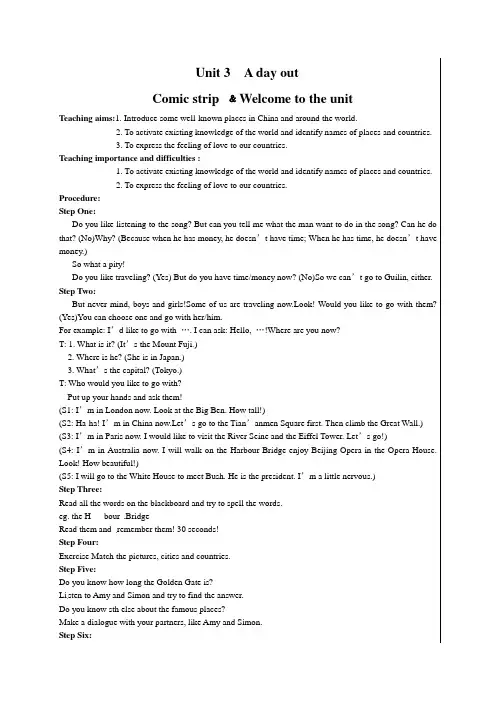
Unit 3 A day outComic strip ﹠Welcome to the unitTeaching aims:1. Introduce some well-known places in China and around the world.2. To activate existing knowledge of the world and identify names of places and countries.3. To express the feeling of love to our countries.Teaching importance and difficulties :1. To activate existing knowledge of the world and identify names of places and countries.2. To express the feeling of love to our countries.Procedure:Step One:Do you like listening to the song? But can you tell me what the man want to do in the song? Can he do that? (No)Why? (Because when he has money, he doesn’t have time; When he has time, he doesn’t have money.)So what a pity!Do you like traveling? (Yes) But do you have time/money now? (No)So we can’t go to Guilin, either. Step Two:But never mind, boys and girls!Some of us are traveling now.Look! Would you like to go with them? (Yes)You can choose one and go with her/him.For example: I’d like to go with …. I can ask: Hello, …!Where are you now?T: 1. What is it? (It’s the Mount Fuji.)2. Where is he? (She is in Japan.)3. What’s the capital? (Tokyo.)T: Who would you like to go with?Put up your hands and ask them!(S1: I’m in London now. Look at the Big Ben. How tall!)(S2: Ha-ha! I’m in China now.Let’s go to the Tian’anmen Square first. Then climb the Great Wall.) (S3: I’m in Paris now. I would like to visit the River Seine and the Eiffel Tower. Let’s go!)(S4: I’m in Australia now. I will walk on the Harbour Bridge enjoy Beijing Opera in the Opera House. Look! How beautiful!)(S5: I will go to the White House to meet Bush. He is the president. I’m a little nervous.)Step Three:Read all the words on the blackboard and try to spell the words.eg. the H_ _ bour BridgeRead them and remember them! 30 seconds!Step Four:Exercise Match the pictures, cities and countries.Step Five:Do you know how long the Golden Gate is?Li sten to Amy and Simon and try to find the answer.Do you know sth else about the famous places?Make a dialogue with your partners, like Amy and Simon.Step Six:T: You’re so great!So I want to give you some presents. Look! You can choose one!Oh! There is a postcard here.Nick →AmyGirls, who would you like to read it?Read it by yourselves! Try to remember them! 30 seconds!Step Seven: Boast!Just now you all did a good job!But now we’ll have a match.Let’s see who is the best! Can you? Give you 30 seconds.If you know, put up your hands quikly!Who is the fastest?Step Eight:Very interesting!So I think you can remember all the places now, right?But just look at me! Can you also say out the places?Look carefully! Who is the cleverest?The Harbour Bridgethe Opera Housethe Eiffel Towerthe River Seinethe White HouseBig BenTian’anmen SquareMount FujiStep Nine:Do you want to travel to these places?Look!Eddie also want to have a trip.Let’s see where he want to go.Listen and answer:Does Eddie really want to exercise to keep fit?Read after the tape.Ro le-playBlackBoard design:Unit 3 A day outComic strip ﹠Welcome to the unitthe Opera HouseSyndey Australiathe Eiffel TowerParis Francethe White HouseWashington the USATeaching reflection:Unit 3 A day outReading ⅠTeaching aims: 1.读懂文章,了解这次游玩的基本情况。
牛津译林版英语八年级上册U3 Task 教案
《英语》(八年级上册)Unit 3 A day outTaskI. Teaching aims and learning objectivesBy the end of the lesson, students should be able to:1. know the form of a trip plan and understand what a trip plan is;2. write a trip plan;3. grasp the structure of an invitation letter;4. write an invitation letter.II. Teaching contents1. New words and phrases: plan a day out, square, see the biggest city square in the world,take the underground/bus to …, by underground/walk to …, on foot,visit the garden and row boats, go back to…, per student2. New structure: We are planning a day out on …It will take about … minutes/hour(s) to get to …Then /After that /Next, we will go to…on foot/walk to …The cost is about … per student.III. Focus of the lesson and predicted area of difficultyDevelop students’ writing ability.IV. Teaching proceduresStep 1 Lead-in1. Guessing gameT: Today we’ll learn Task of Unit 3. Now let’s play a game. I will give some clues. Canyou tell me these places are? Are you ready? Let’s begin.2. Watch a video about places of interest in YangzhouT: If you are free, are you going to visit places of interest? Watch the video first.【设计意图】利用猜谜游戏复习前面的内容,用动感的视频创设情境,提高学生的学习热情,导入到新课。
【译林版】八年级英语上册:Unit 3 A day out Reading(1)教案
1.The understanding o f some long sentences.
2.The stud ents use their own words to express their own trips.
Teaching method
Task-based approach,Scene pedagogy and Teaching with humor
Homework:
1). Read and recite“Reading”.
2).Try to finish your own article about magic trip.
Teaching notes
1. Wher e did Linda meet Mr Wu and ot her students ?
2. Where did Linda see a lot of traffic, on the highway or on the city roads?
3. What is theEiffelTowermade of?
Teaching procedures
The second preparing lessons
Step One: Pre-reading
Warming up and lead in.
T: Do you like traveling? S1: Yes.
T: What places of interest did you visit before? S:…
1. Mr Wu invited Linda to join their school trip on October 25th.
2. It took them half an hour to get to theWorldParkby coach.
译林版八年级英语上册Unit 3 A day out!(全章教案)
译林版八年级英语上册Unit 3 A day out (全章教案)第1课时Comic strip and Welcome to the unit一、教学目标1、学习词汇、词组、句型。
2、识别国外著名城市及景点。
二、教学重点词汇识记运用,重点句型的运用,用英语和同伴谈论景点。
三、教学难点用英文向别人介绍国内外著名城市和景点。
四、教学过程(一)Warming up (Free talk)师:Have a free talk with students:If you have some free time, what are you going to do?生:Listen to the teacher and answer the question: I’m going to---(二)Presentation师:1. Show a picture of Eddie to the students and get the students to guess:What do you think Eddie is going to do if he has some free time.生:Look at the picture and try to guess.师:2. Ask the students “Usually, Eddie is a very lazy dog. Do you think he is going to climb the hill? Let’s listen to the tape and find out the answer. ”生:Listen to the tape and answer the question.师:3. Ask the students to read the dialogue and answer more questions.①Is Eddie really going to climb the hill?②What is he going to do?生:Read the dialogue and answer two more questions.No, he isn’t.He is going to eat some food.师:4. Ask another two questions orally for the students to answer.①Does he wants to exercise?②Does he wants to keep fit?生:Answer questions.Yes, he does.No, he doesn’t..(三)Practice1. Ask students to repeat the conversation after the tape.2.Ask students to read the conversation. Pay attention to the pronunciation and the intonation.3.Ask students to practice the conversation in pairs.4.Ask several pairs to act it out.(四)Presentation1. Show a map of the world. Ask students to look at it and say the names of the countries they know about. Get the students to talk about their own experiences. Then ask them questions:①Do you want to travel to foreign countries?②Do you know about these places?③Do you know the name of this famous building?④Do you know where it is?2. Write what they know about the countries and places on the blackboard and read aloud.3. To talk about more countries, and some famous places in the countries. Show more pictures and teach the famous places that are going to appear in the reading material. Ask students some questions:①Which country is it in?②Which city is it in.?’(五)Practice1、Invite students to match the cities and countries and the famous places.2、Discussion: There are many places of interest around the world, if you have enough time and money,where would you like to go ?Encourage students to make a dialogue in pairs , ask a students to make a dialogue with the teacher as a model.A: Which foreign country do you want to visit?B: I want to visit the USA.A: Which city do you want to go to?B: I want to go to Washington.A: Why do you want to go there?B: Because I want to see the White House there.(六)Presentation and practice1. Present the post cards. Read them first, and then find out: Who sent the first/ second/ third postcard? Which city did he/she go? What did he/she see?2. Get them to read again, and pay attention to some expressions marked in different colors.(七)Presentation1. After reading the postcards from his friends, Simon searched on the Internet for some information about places around the world. Which place of interest are Simon and Amy talking about? Ask students to listen to the dialogue and answer some questions.①How long is the Golden Gate Bridge?②How wide is the bridge?2. Play the tape again and ask the students to repeat after the tape.(八)Pair work1. Ask students to make up dialogues using Simon and A my’s as a model.2. Ask students to show their dialogues.(九)Conclusion and check out.Ask students to make a conclusion and finish the postcards and try to find pictures or draw pictures for your postcard.五、教学反思第2课时Reading(1)一、教学目标1、学习词汇、词组、句型。
最新牛津译林初中八年级英语上册《Unit 3 A Day out Task》教案
Unit 3 A day outTaskTeaching aims 掌握本课的生词、词组及重要的句型表达。
掌握书本中列出的出行计划,完成相关练习。
能够为自己一天的出行计划列出提纲。
写信邀请朋友外出郊游。
Importance and difficulties写信邀请朋友外出郊游。
ProceduresStep1 Warming upQuestionsDo you want to travel?Where would you like to go?Why?Do you want to go to Beijing?Can you tell me some famous places in Beijing?Step2预习展示1 T: Kitty and Daniel are making a plan now. Let’s take a look.2 Read Part A on P 40 and then answer the following questions.How many interesting places are they going to visit? What are they?What will they do in Beihai Park?What can they do at Tian’anmen Square?How long will they stay there?When will they leave Wangfujing Street?Step 3 PracticeT: So the plan is ready. And now Kitty and Daniel are writing an invitation letter to the classmates. Help them fill in the missing information on P 41.Students read the letter and fill in the blanks.Discuss the answers in groups and then check together.Read the letter again and then answer the following questions.Why do they write the letter?How much will they spend per person during the trip?Step 4 Writing guide1. How many main parts are there in this letter?Read loudly and know what each main part is about.Part 1: Purpose of the letter。
牛津译林版英语八上Unit3《Adayout》(task)说课稿

牛津译林版英语八上Unit 3《A day out》(task)说课稿一. 教材分析《牛津译林版英语八年级上册》Unit 3的主题是“A day out”,本节课主要讲述了一个关于人们在一个公园里度过的愉快一天的故事。
通过这个故事,学生可以学习到日常生活中的交际用语,提高他们的英语听说读写能力。
教材内容丰富,插图生动,练习多样,有助于激发学生的学习兴趣。
二. 学情分析根据我对学生的了解,他们已经具备了一定的英语基础,能够听懂并运用一些日常交际用语。
但是,他们在口语表达和语法运用上还存在一定的困难。
因此,在教学过程中,我需要关注他们的个体差异,因材施教,尽量让每个学生都能在课堂上得到锻炼和提高。
三. 说教学目标1.知识目标:学生能够掌握本节课的重点单词和短语,如“park”,“picnic”,“feed the ducks”等;能够理解并运用日常交际用语进行简单的交流。
2.能力目标:学生能够听懂、说准、读透文章内容,提高他们的英语听说读写能力;能够运用所学知识进行情景交际。
3.情感目标:通过本节课的学习,学生能够体会到英语学习的乐趣,增强学习英语的自信心。
四. 说教学重难点1.教学重点:学生能够掌握本节课的重点单词和短语,能够听懂、说准、读透文章内容。
2.教学难点:学生能够运用所学知识进行情景交际,特别是在实际生活中运用英语进行交流。
五. 说教学方法与手段本节课我将采用任务型教学法,以学生为主体,教师为指导,通过设置各种任务,让学生在实践中学习英语。
同时,我会运用多媒体教学手段,如图片、视频等,激发学生的学习兴趣,帮助他们更好地理解课文内容。
六. 说教学过程1.导入:我将以提问的方式引导学生回顾上节课所学内容,为新课的学习做好铺垫。
2.呈现:我会通过展示图片、播放视频等方式,引入本节课的主题,让学生整体感知课文内容。
3.精讲:我会在学生初步理解课文的基础上,讲解重点单词和短语,并通过例句、练习等方式,让学生充分理解和掌握。
牛津译林版八年级上册(新)英语教案Unit3AdayoutTask
5)We hope you can join us.
4. Read the above sentences loudly and try to remember them.
Step 4 Writing
1)Why do they write the letter?
Because they want to invite all their classmates on a trip with Linda.
2)How much will they spend per person during the trip?
S: The World Park.
T: Yes. But there are many places of interest in Beijing, and Linda is going back to the USA soon. So Kitty and Daniel want to invite all their classmates on a trip with Linda before she goes back to the USA.
Teaching notes
1)We will then take the underground to the centre of Beijing and change to the bus.
2)We’ll take the bus all the way to the Palace Museum.
3)We’ll make it a really fun day for everyone.
牛津译林版英语八上Unit 3《A day out》(Grammar)教学设计
牛津译林版英语八上Unit 3《A day out》(Grammar)教学设计一. 教材分析《牛津译林版英语八上Unit 3 A day out》是一篇关于日常活动的文章。
本节课的主要内容是学习一般过去时,通过阅读文章,让学生了解过去发生的事情,并在真实语境中运用一般过去时进行交流。
本节课的教学内容与学生的生活实际紧密相连,有助于激发学生的学习兴趣。
二. 学情分析学生在学习本节课之前,已经掌握了一般现在时、一般过去时和一般将来时的基本结构,能够运用这些时态进行简单的交流。
然而,学生在运用一般过去时描述过去发生的事情时,常常会出现时态混乱的情况。
因此,在教学过程中,教师需要帮助学生巩固一般过去时的用法,并将其运用到实际情境中。
三. 教学目标1.知识目标:–学生能够掌握一般过去时的基本结构。
–学生能够运用一般过去时描述过去发生的事情。
2.能力目标:–学生能够通过阅读文章,提高阅读理解能力。
–学生能够在真实语境中运用一般过去时进行交流。
3.情感目标:–学生能够培养对英语学习的兴趣。
–学生能够在学习中培养合作意识,提高团队协作能力。
四. 教学重难点•学生能够掌握一般过去时的基本结构。
•学生能够运用一般过去时描述过去发生的事情。
•学生能够在真实语境中灵活运用一般过去时进行交流。
五. 教学方法1.情境教学法:通过创设真实情境,让学生在实际语境中学习一般过去时。
2.任务型教学法:通过完成各种任务,提高学生的阅读理解能力和口语表达能力。
3.合作学习法:通过小组合作,培养学生的团队协作能力和沟通能力。
六. 教学准备1.教师准备:–制作PPT,展示文章内容和相关图片。
–准备教学道具,如图片、卡片等。
2.学生准备:–预习课文,了解文章大意。
–复习一般过去时的基本结构。
七. 教学过程1.导入(5分钟)教师通过提问方式引导学生回顾一般过去时的基本结构,如“What did you do yesterday?”,激发学生的学习兴趣。
牛津译林版八年级上册Unit3Adayout公开课
Unit 3 A day out Task教学设计一、教学目标1.三维目标a. Ss learn how to show information in a formb. find out the key points and sum up according to different sortsc. Plan a day out and write a letter2.教学内容及要求1 phrases:the center of Beijing; at each placereturn home; plan a day outmake it a really fun day change to the busmake a list of places of interest, work outtake the bus all the way to; as soon as possible2. sentences:(1) It will take about thirty minutes.(2) We hope you can join us.二、教学重点The same as the above ones三、教学难点The same as the above ones四、课的类型及主要教学方法归类写作五、自学与预习预习课本P53-54完成书上的练习六、教学程序设计Teaching procedures:Step 1: Revision1. Revise Speak up in Study Skills, read and practice it.2. Revise the places of interest in V ocabulary.Step II: PresentationT: Linda is going back to the USA soon. So Kitty and Daniel invite their classmates to go out together with Linda on a trip.(1) What places in Beijing do you think they will go to?(2) What can they do there?Step III: Read and answerT: Read the plan on page 53 and try to answer questions:(1)How many places of interest are they going to visit?(2)What are they? (Slide: What places and how to get there)Details:(1)What will they do in Beihai Park?(2)What will they do at Tian’anmen Square?(3)How much time will they spend at Tian’anmen Square?(4)When will they leave Wangfujing Street?Step IV:ExerciseT: The trip plan is ready. Kitty and Daniel are writing an invitation letter to the classmates, but they miss some information. They need your help. Fill in the blanksaccording to form on page 53.Important sentences:1. We will then take the underground to the center of Beijing and change to thebus.2. We will take the bus all the way to the Palace Museum.3. We will make it a really fun day for everyone.4. If you want to come, please let us know as soon as possible. We hope you canjoin us.Ss: Sum up what they should write in an invitation letter:Date, receiver, purpose of the letter, plan, cost, instructions, closing, signatureStep V: Writing1. Students write a form of plan, then show two students’ plan to the whole class.(Slides: try to write a trip to some places of interest in Nanjing.)2. Write an invitation letter using Kitty a nd Daniel’s letter as a model. (Theyshould know how to write an invitation letter first.)3. Show one of the student’s letter to the whole class.Step 4: Homework《评价手册》P43七、教学目标达成与检验1.当堂反馈训练题及反馈情况《评价手册》练习2.课外作业布置(较难题、易错题放在课堂上训练)。
牛津译林版英语八上Unit 3《A day out》(integrated skills)教学设计
牛津译林版英语八上Unit 3《A day out》(integrated skills)教学设计一. 教材分析《牛津译林版英语八上Unit 3 A day out》主要讲述了一个关于学生参加户外活动的故事,通过这个故事,学生可以学习到如何描述过去发生的事情,以及如何在日常生活中进行交流。
本课的主要语言点是过去式的动词时态,以及一些与户外活动相关的词汇和短语。
二. 学情分析学生在学习本课之前,已经掌握了基本的英语语法知识和一定的词汇量,能够进行简单的英语交流。
但部分学生对于过去式的动词时态掌握不够熟练,需要老师在教学中进行重点讲解和练习。
此外,学生对于户外活动的经验和描述方法的掌握程度不一,需要在教学过程中进行引导和激发。
三. 教学目标1.能够理解故事内容,把握故事的发展顺序。
2.能够运用过去式的动词时态,描述自己或他人过去发生的活动。
3.能够运用本课所学词汇和短语,进行日常英语交流。
4.能够提高对户外活动的兴趣和参与度。
四. 教学重难点1.过去式的动词时态的运用。
2.与户外活动相关的词汇和短语的掌握。
3.如何运用英语描述过去发生的事情。
五. 教学方法1.情境教学法:通过设置情境,让学生在实际语境中学习和运用英语。
2.交际法:引导学生进行小组讨论和交流,提高他们的英语口语表达能力。
3.任务型教学法:通过完成各种任务,激发学生的学习兴趣和积极性。
4.直观教学法:利用图片、视频等直观教具,帮助学生更好地理解和记忆。
六. 教学准备1.教学PPT:包括故事内容、词汇和短语、语法点等。
2.图片和视频素材:与户外活动相关的图片和视频。
3.练习题:针对本课内容设计的练习题。
4.教学道具:如户外活动用品等。
七. 教学过程1.导入(5分钟)老师通过提问方式引导学生谈论自己参加户外活动的经历,激发学生的学习兴趣。
2.呈现(10分钟)老师通过PPT呈现故事内容,让学生整体感知文本。
同时,老师讲解过去式的动词时态,让学生理解和掌握。