
中考英语介词知识点:常用介词比较法
中考英语介词知识点:常用介词比较法
常用介词用法比较
(1)as , like
as 表示作为强调身份,like (介词)表示像
As a teacher, he cares for these children.
Like a teacher, he cares for these children.
(2)with , in
with 表示外貌特征或附带的东西, 用作工具
in 表示衣着用某语言, 在固定搭配中也可用in
A man with dark glasses wanted to buy drinks.
A man in black wanted to buy drinks.
The boy is learning to write in pencil / with a pencil.
He retold the text in English.
(3)for , to
for表示为了.
To 表示动作对象, 对, 向. 如:
He would do anything for his motherland.
Did you mention this to my father?
你对我父亲提起过这件事吗?
for 表示就某情况而说, to 表示一对某对象而言如:
Its quite warm today for February.就二月的天气,今天够暖和的。
What he told you just now was not new to me
他刚才对你所说的话对我并不新鲜
for 表示目的,用途。
与go, come 动词连用,
(4)except , besides
except 表示从总体中排除一部分, 与bat 同义,besides 表示除了一部分还有另一部分
We all failed except him. 我们都失败了,但他没有。
He speaks German besides French.他懂法外还会讲英语。
(5)注意成对介词的用法:
get into (out of ) the car, get on (off) the bus, jump onto (off) the platform, out of
(6)介词和名词动词等有不少固定搭配和习惯用法:
to ones surprise / joy, in charge of , instead of, in bed (hospital), in trouble, in a hurry, in surprise, with a smile, with one voice,
according to, at once, on time, in time, in all, at home, (school, work), at last, at least, in the end, by the way, for example, at the same time, at the same speed, on ones way (to), in the sun, on the football team, in line, with the help of, in red / green put on, look for, look after, run after, send for, enter for, pay for, showaround, listen to, arrive in / at, get to, agree with, succeed in, think of (about), wait for,.
(7)表示加减乘除,分别用介词plus, minus, times 和动词过去分词divided + by。
初中英语语法——介词的用法

介词的用法【用法讲解】考试要求:主要体现在单项选择和完形填空中, 涉及的题目多, 考查的范围广, 主要考查介词的基本意义, 意义相近的介词辨析、固定搭配等。
知识总结:1.介词的概念介词是一种虚词, 一般用在名词、代词等的前面, 用来表示其后面的名词或者相当于名词的词或短语和其他句子成分的关系, 在句子中不能单独作句子成分, 需和它后面的词共同充当句子成分。
介词后面的名词或者相当于名词的词或短语叫介词宾语。
可以作介词宾语的词通常有:1)名词、代词或从句。
He lives near the school.他居住在学校附近。
Our teacher was very angry with him.我们的老师非常生他的气。
2)动名词。
They have a good idea for solving this problem.他们有一个解决这个问题的好方法。
3)动词不定式(仅限于介词but, except)。
I want nothing except to sleep.除了睡觉, 我什么也不想做。
2.介词的种类1)根据结构分类简单介词: 即由一个词构成的单一介词。
如: for, at, in, on, of, to等。
复合介词: 即由两个词组合在一起的介词, 也称合成介词。
如: without, inside, outside, into, within短语介词: 即由短语构成的介词。
如: because of, according to, thanks to等。
2)根据意义分类表示地点的介词: at, behind, beside, around, near, on, by, in front of, across等。
表示时间的介词: about, at, after, before, by, during, in, over, past, since, until等。
表示原因的介词: for, with, from等。
介词表比较
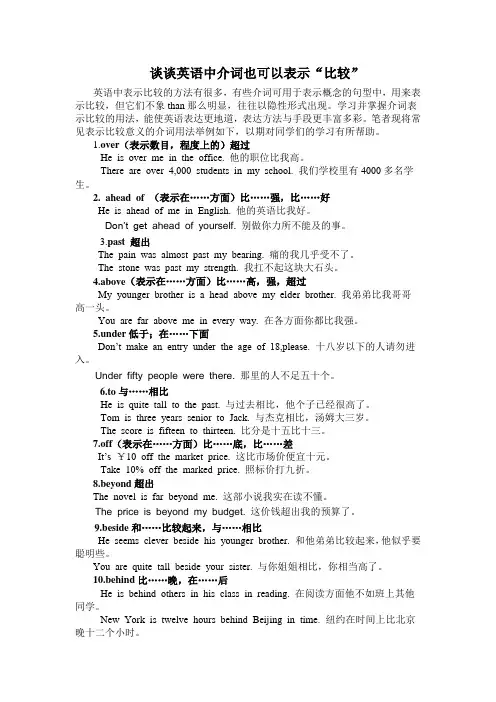
谈谈英语中介词也可以表示“比较”英语中表示比较的方法有很多,有些介词可用于表示概念的句型中,用来表示比较,但它们不象than那么明显,往往以隐性形式出现。
学习并掌握介词表示比较的用法,能使英语表达更地道,表达方法与手段更丰富多彩。
笔者现将常见表示比较意义的介词用法举例如下,以期对同学们的学习有所帮助。
1.over(表示数目,程度上的)超过He is over me in the office. 他的职位比我高。
There are over 4,000 students in my school. 我们学校里有4000多名学生。
2. ahead of (表示在……方面)比……强,比……好He is ahead of me in English. 他的英语比我好。
Don’t get ahead of yourself. 别做你力所不能及的事。
3.past 超出The pain was almost past my bearing. 痛的我几乎受不了。
The stone was past my strength. 我扛不起这块大石头。
4.above(表示在……方面)比……高,强,超过My younger brother is a head above my elder brother. 我弟弟比我哥哥高一头。
You are far above me in every way. 在各方面你都比我强。
5.under低于;在……下面Don’t make an entry under the age of 18,please. 十八岁以下的人请勿进入。
Under fifty people were there. 那里的人不足五十个。
6.to与……相比He is quite tall to the past. 与过去相比,他个子已经很高了。
Tom is three years senior to Jack. 与杰克相比,汤姆大三岁。
英语中考常考介词的用法与区别
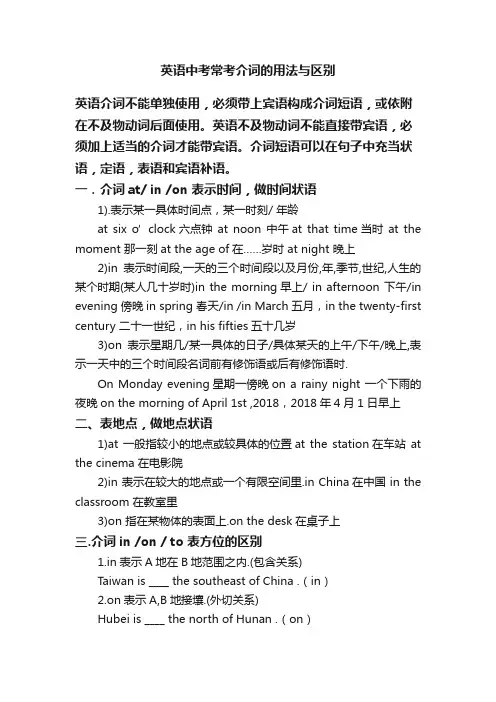
英语中考常考介词的用法与区别英语介词不能单独使用,必须带上宾语构成介词短语,或依附在不及物动词后面使用。
英语不及物动词不能直接带宾语,必须加上适当的介词才能带宾语。
介词短语可以在句子中充当状语,定语,表语和宾语补语。
一.介词at/ in /on 表示时间,做时间状语1).表示某一具体时间点,某一时刻/ 年龄at six o’clock六点钟at noon 中午at that time当时at the moment 那一刻at the age of在……岁时 at night 晚上2)in表示时间段,一天的三个时间段以及月份,年,季节,世纪,人生的某个时期(某人几十岁时)in the morning早上/ in afternoon 下午/in evening 傍晚in spring 春天/in /in March 五月,in the twenty-first century 二十一世纪,in his fifties五十几岁3)on表示星期几/某一具体的日子/具体某天的上午/下午/晚上,表示一天中的三个时间段名词前有修饰语或后有修饰语时.On Monday evening星期一傍晚on a rainy night 一个下雨的夜晚on the morning of April 1st ,2018,2018年4月1日早上二、表地点,做地点状语1)at 一般指较小的地点或较具体的位置at the station在车站at the cinema 在电影院2)in 表示在较大的地点或一个有限空间里.in China在中国 in the classroom 在教室里3)on 指在某物体的表面上.on the desk在桌子上三.介词in /on / to 表方位的区别1.in表示A地在B地范围之内.(包含关系)Taiwan is ____ the southeast of China .(in)2.on表示A,B地接壤.(外切关系)Hubei is ____ the north of Hunan .(on)3.to表示A,B两地有一定的间距.(外离关系)Japan is _____ the east of China .(to)四. between 与among 的区别1.between :指两者之间. 在…….之间.2.among :用于三者或三者以上人或物之间. 在……之中.You sit _____ him and me .(between)The song is popular ______ the students.(among)五.after与in 的区别1)after + 时间段. 表示以过去某一时刻为起点的一段时间之后, 用于过去时.2)after 作介词. after doing sth3).in +一段时间. 表示说话时或以现在为起点的将来一段时间之后.用于将来时.He came back ______ two days .(after)He will go home___finishing his homework .(after)He will come back _____ two days .(in)六.with 、 in 与 by 的区别1.with 表示“用…” 一般指有形的工具 / 手段 / 人体器官.He cut the apple into halves ____ a knife .(with)He came in _____ a big smile on his face .(with)2.in表示用某种语言,方式,途径. 或书写/绘画所用的材料. 也可表交通方式.Can you say it _____English ?(in)He wrote a letter ____ blue ink .(in)3.by表示乘坐交通工具, 表示方式,方法I study for a test _____ working with a group .(by)He makes a living ____ selling newspapers .(by)七.across 、through 、 over 、by 的区别1.across 指横穿,穿过. 表示动作从某一物体表面上经过.2.through 指穿过,透过,表示从某一物体空间内通过.3.over 表示从某人或某物的上空经过或越过,不与表面接触.4.by 表示从某人/某物的旁边经过.Can you swim ______ the river ?(across)The elephant is so big that it can’t go _____ the gate .(through)I don’t think anyone can jump ___ the fence.(over)I walked _____ the bank of China yesterday .(by)八.in front of / in the front of 的区别1.in the front of 表示在…….内部的前面2.in front of 表示在……外面的前面There is a desk in the front of our classroom .There is a big tree in front of our classroom.九.其它介词的用法:1.at的其它用法.1).表示“从事或正在做某事”,其后加的名词往往不加冠词.She is at work now = She is working now .2)at表示“价格或速度”The train ran at 120 kilometres an hour .2.in的其他用法:1)in表示“在……方面” ,词组:do well in = be good at , be weak in2)in 表示“穿着”后接表颜色的词或衣服.词组: be in +衣服 = be wearing +衣服3)in作副词, “在家” = at home3.like 的用法:1).像/和……一样. 常与系动词连用. 词组: look like sound like2).与what 连用, “是什么样子, 怎样”.What is he like ? He is kind .4.off的用法:1).从……下来, 脱离某物体.词组: fall off2). “休假”通常放在时间名词之后. 词组: have +时间+ offHe hasn’t had a night off for two hours .5.except / besides1).except 除了…….之外, 都……. . 不包括在范围之内. 注: nothing but … 除了……之外,什么也没有.2).besides除了……之外,还有…… . 包括在范围之内.We all went swimming ______ Lucy .(except)There is _______ a letter in the box .(nothing but )We study Japanese and French____ English .(besides)6.with / without1).with具有,含有-----反义词: without 没有;词组: with the help of = with one’s help =because of = thanks to ,without one’s help2).without 的用法:A).without + sb./ sth. 没有某人或某物B).without + doing sth .He left here without____(say ) “Goodbye “to us(saying)C). without sth 常与if 引导的否定的条件句.If there is no water , we can’t live .= We can’t live without water .7.on the tree /in the treeon the tree 表示“树上本身长的东西” 在树上. 而in the tree 表示“外界的物体进入树中” 人或物在树上.There are some apples _____ the tree .(on)There is a boy ____ the tree.(in)8.since / for注: since / for 用于现在完成时.1).since :a).since +时间点b). 现在完成时+ since +一般过去时c).since +一段时间+ ago.2)for: for +一段时间= since +一段时间+ ago9.be made +介词的区别:be made of 由…制成 (看得见原材料)be made from由…制成 (看不见原材料)be made in +地点由哪儿生产be made by sb. 由某人制造10.表示“数量的介词”about , round around over1). about , round around表示“大约……”2).over 表示“超过”= more than.11.inside / outsideInside 在……里面 ------反义词:outside在….外面12.in the wall /on the wallin the wall 表示“门窗在墙上” on the wall 表示“某东西张贴或挂在墙上”十、.不用介词的情况:1).当时间状为: tonight, today, yesterday, tomorrow 等时,不用介词.What are you going to do tonight ?2).含有this, that, these, those, last, next, every, each等时间状语.He went to Wuhan last week .3).以all 开头的时间状语前面不用介词.He has worked all day .4).以some ,any, one 等构成的时间状语前不用介词.He met a bad man one cold morning .= He met a bad man on a cold morning .。
比较介词英语词汇大全

比较介词英语词汇大全介词在英语中是一类重要的词性,它可以用来表示方向、位置、时间、原因、目的等。
其中,比较介词在句子中起到比较两者或多者之间的关系的作用。
比较介词英语词汇大全如下:1. like:像例句:He runs like a cheetah.(他跑起来像只猎豹。
)2. unlike:不像例句:Unlike his brother, he doesn't like sports.(和他的兄弟不同,他不喜欢运动。
)3. similar to:类似于例句:Her handwriting is similar to her mother's.(她的书写和她妈妈的类似。
)4. different from:不同于例句:My opinion is different from yours.(我的观点和你的不同。
)5. same as:和...一样例句:Her dress is the same as mine.(她的连衣裙和我的一样。
)6. as...as:和...一样例句:She is as tall as her sister.(她和她姐姐一样高。
)7. not as/so...as:不如...那样例句:He is not as/so fast as his friend.(他不如他的朋友跑得快。
)8. compared to/with:相比于...例句:Compared to/with last year, the weather is much better.(相比于去年,天气好多了。
)9. rather than:而不是例句:She prefers tea rather than coffee.(她更喜欢茶而不是咖啡。
)10. in contrast to:与...形成对比例句:In contrast to his brother, he is more introverted.(与他的兄弟形成对比,他更内向。
中考必备介词的用法

He may think himself above others. 他也许自以为高人一等。
Beyond
表示位置“在……的那一边;在更远处”。 __B__e_yo__n_d___ the river stood a power station. 过了这条河就是一个发电站。
表示时间的since和from:
since表示从过去到现在的一段时间的过程,常与现在完成时 from表示从时间的某一点开始,不涉及与现在的关系。
一般多与现在时、过去时、将来时连用。
I hope to do morning exercises _f_r_o_m_ today. We have not seen each other __s_in_c_e_ 1995. Since then, she ___h_a_s_w_o_r_k_e_d___ as a teacher here. From then on, she _w_o_r_k_e_das a teacher here.
The letter was posted without a stamp. 那封信没贴邮票就 寄出去了。 2. (用在no, not, never等否定副词之后,强调肯定)没有…… 不,没有……则不能……,每……必定……。如: Don't go out without a coat: you'll catch your death. 别不穿外 套出去,会得重感冒的 3. (与-ing形式连用)不,无,没。如:
He received her letter _____afoteurr weeks.
初中重要知识点解析介词的用法与搭配

初中重要知识点解析介词的用法与搭配介词是英语中一个很重要的语法部分,它在句子中起到连接和修饰的作用。
正确地使用介词不仅可以使句子更加清晰,而且能够表达出准确的语义。
本文将解析初中阶段学习英语时重要的介词知识点,包括介词的基本用法和常见的搭配。
一、介词的基本用法介词通常用来表达时间、地点、方式、原因、目的、对比等关系。
下面是一些常见的介词及其用法:1. 时间关系:- on:表示具体某一天或日期,如on Monday,在星期一;on June 1st,在6月1日;- at:表示某一具体时间,如at 8 o'clock,at noon,at night;- in:表示时间段,如in the morning,在早晨;in summer,在夏天。
2. 地点关系:- on:表示某一平面或表面上,如on the table,在桌子上;on the wall,在墙上;- in:表示在某一较大的区域内,如in the classroom,在教室里;in Beijing,在北京;- at:表示在某一具体的地点,如at the park,在公园里;at the station,在车站。
3. 方式关系:- by:表示通过某种交通方式,如by bus,乘公交车;by plane,乘飞机;- with:表示使用某种工具、方法,如write with a pen,用钢笔写作;- like:表示类似或像某种事物,如eat like a king,吃得像国王一样。
4. 原因关系:- because of:表示由于某种原因,如because of the rain,因为下雨;- due to:表示由于某种不可控制的原因,如due to bad weather,因为天气不好;- owing to:表示因为某种原因,如owing to his illness,因为他生病了。
5. 目的关系:- for:表示为了某种目的,如study for the exam,为了考试而学习;- to:表示到达某种目的地,如go to school,去学校。
介词用法指南:表示时间、方向、动态和比较
介词用法指南:表示时间、方向、动态和比较九年级英语介词及阅读知识1.空间介词2.表示在某处有某物,或表示某物在某位置,使用空间介词。
常用于以下几种表达方式:●在:用“on”表示,如“The book is on the table.”;●上:用“on”或“upon”表示,如“The cat is on the roof.”或“Thebird is upon the tree.”;●下:用“under”表示,如“The dog is under the bed.”;●里:用“in”表示,如“The book is in the drawer.”;●中间:用“in the middle of”表示,如“The car is in the middle of theroad.”。
1.时间介词2.表示时间的前后关系或特定时间点,使用时间介词。
常用于以下几种表达方式:●在……之前:用“before”表示,如“I will meet you before lunch.”;●在……之后:用“after”表示,如“I will go to bed after finishing myhomework.”;●在……时:用“at”表示,如“We will celebrate at Christmas.”;●在……之间:用“between”表示,如“The class is between 3:00 and5:00.”;●自从:用“since”表示,如“I have lived here since 2010.”;●直到:用“until”表示,如“I will wait until you come back.”。
1.方向介词2.表示方向或位置的移动,使用方向介词。
常用于以下几种表达方式:●向:用“to”表示,如“Go to the nearest post office.”;●从:用“from”表示,如“The letter is from my friend.”;●离:用“away from”表示,如“The boat is away from the shore.”;●到:用“to”表示,如“I am going to the airport.”;●在……方向:用“in the direction of”表示,如“The wind is blowing inthe direction of the sea.”;●沿着:用“along”表示,如“We are walking along the river.”;●穿过:用“through”表示,如“The train is going through thetunnel.”;●围绕:用“round”表示,如“We walked round the square.”;●上:用“on”表示,如“The book is on the table.”;●下:用“under”表示,如“The cat is under the bed.”。
(word完整版)初中英语介词用法总结,推荐文档
初中英语介词用法总结介词(preposition):也叫前置词。
在英语里,它的搭配能力最强。
但不能单独做句子成分需要和名词或代词(或相当于名词的其他词类、短语及从句)构成介词短语,才能在句中充当成分。
介词是一种虚词,不能独立充当句子成分,需与动词、形容词和名词搭配,才能在句子中充当成分。
介词是用于名词或代词之前,表示词与词之间关系的词类,介词常与动词、形容词和名词搭配表示不同意义。
介词短语中介词后接名词、代词或可以替代名词的词(如:动名词v-ing)•介词后的代词永远为宾格形式。
介词的种类:(1) 简单介词:about, across, after, aga in st, among, around, at, before, beh ind, below, beside,but, by, down, during, for, from, in, of, on, over, near, round, since, to, under, up,with 等等。
(2) 合成介词:in side, in to, outside, throughout, upon, without, with in(3) 短语介词:according to, along with, apart from, because of, in front of, in spite of, insteadof, owing to, up to, with reguard to(4) 分词介词:con sideri ng, reguard ing, in cludi ng, concerning介词短语:构成介词+ 名词We go to school from Mon day to Saturday.介词+ 代词Could you look for it in stead of me?介词+ 动名词He insisted on staying home.介词+ 连接代/ 畐U词I was thinking of how we could get there. 介词+ 不定式/ 从句Hegives us some advice on how to finish it.介词的用法:一、介词to的常见用法1. 动词+toa) 动词+ toadjust to 适应,attend to处理;照料,agree to 赞同,amount to力口起来达…,belong to 属于,come to 达到,drink to为…干杯,get to 到达,happen to 发生在某人身上, hold to 紧握, lead to 通向,listen to 听,occur to 想起, object to 反对, point to 指向, respond to 回答,refer to参考;指的是…;涉及reply to 回答,see to 负责,stick to 坚持, turn to 求助, write to 给某人写信。
初中英语知识点:介词
中考英语介词用法介词是一种虚词,用来表示名词或相当于名词的其它词语句中其它词的关系,不能单独使用。
介词可与名词或相当于名词的其它词构成介词短语。
1. 常用介词的用法辨析(1)表时间的介词1)at, in on表示时间点用at。
例如:at six o’clock, at noon, at midnight。
表示在某个世纪,某年,某月,某个季节以及早晨,上午,下午,晚上时,用in。
例如:in the nineteenth century, in 2002, in May, in winter, in the morning, in the afternoon等。
表示具体的某一天和某一天的上午,下午,晚上时,用on。
例如:on Monday, on July 1st, on Sunday morning等。
注意:在时间词(morning , afternoon , evening ; Sunday…)前有last, next , this , that时,不再用介词. tomorrow, tonight前也不用介词。
2)since, after由since和after 引导的词组都可表示从过去某一点开始的时段,但since词组表示的时段一直延续到说话的时刻,因而往往要与现在完成时连用。
而after词组所表示的时段纯系过去,因而要与一般过去时连用。
例如:I haven’t heard from him since last summer.After five days the boy came back.3)in, afterin与将来时态连用时,表示“过多长时间以后”的意思,后面跟表示一段时间的词语。
after 与将来时态连用时,后面只能跟表示时间点的词语。
after与过去时态连用时,后面才能跟表示一段时间的词语。
例如:He will be back in two months.He will arrive after four o’clock.He returned after a month.(2)表示地点的介词1)at, in, onat一般指小地方;in一般指大地方或某个范围之内;on往往表示“在某个物体的表面”。
初中英语语法:介词的用法归纳
初中英语语法:介词的用法归纳介词是一种用来表示词与词,句子与句子之间关系的词。
介词是一种虚词,不能独立使用。
介词之后一般有名词或代词(宾格)或相当于名词的其他词类、短语或从句作它的宾语,即构成介词短语。
有些介词是由两个以上的词构成的短语介词,如:out of(从…中出来),because of(因为),away from(距离…),on top of(在…顶上),ever since(自从…),next to(在…隔壁),according to(根据…),in front of(在…前方)等。
一、介词的分类1、按构成方式,可分为:①简单介词:即一个介词;②合成介词:由两个介词构成合成词;③短语介词:由短语构成;④双重介词:由两个介词搭配而成;⑤分词介词:由现在分词转化而来;⑥兼类介词:由形容词直接转化而来;2、按所表示的意义,可分如下几类:①地点(位置、范围)介词;②方向(目标趋向)介词;③时间介词;④方式介词;⑤涉及介词;⑥其它介词:目的介词,原因介词,比较介词,伴随/状态介词。
二、介词短语的句法作用介词与其宾语一起构成的短语叫做介词短语,可在句子中充当一定成分,通常用作状语、定语和表语和宾语补足语。
如:The man camedown the stairs。
(状)(那个人走下楼来)The womanwith a flower on her headisfrom the countryside.(定)(头上戴花的妇女来自乡下)The teacher is nowwith the pupils.(表)(老师现在和学生在一起)When she woke up,she found herselfin hospital.(宾补)当她醒来时,发现自己已经在医院里。
三、介词短语在句子中的位置介词短语做状语时,如果表示时间/地点,可以放在句首或句尾。
如果表示方向/方式/伴随/涉及/原因/目的/比较,一般放在句尾;介词短语作表语时放在连系动词之后;介词短语作定语时,只能放在被修饰的名词之后。