
高中英语新课标(人教版) 教案 必修一
高中英语新课标(人教版)教案必修一Unit4 EarthquakesThe fourth period●三维目标1.Knowledge:(1)Learn the Attributive Clause.(2)Learn the difference between Relative Pronouns for the Attributive Clauses.2.Ability:(1)Learn to choose the correct Relative Pronouns for the Attributive Clauses.(2)Train the students’ ability to report what others have said.3.Emotion:Train the students’ ability to cooperate with each other.●教学重点(1)Learn the Attributive Clause.(2)Train the students’ ability to report what others have said.●教学难点Learn to choose the correct Relative Pronouns for the Attributive Clauses.●教具准备(1)a tape recorder(2)a projector(3)the blackboard●教学过程Step 1 GreetingsGreet the whole class as usual.Step 2 RevisionT:In the last period,we learned the usage of s ome difficult words and expressions. Now let’s check your homework exercises. Look at Part 1 in Using Words and Expressions on Page 63.Describe an earthquake using the vocabulary in this unit. Then choose the words and expressions from the box to complete the passage. Change the form if necessary.Step 3 Grammar(The teacher writes the sentence “Workers built shelters for survivors whose homes had been destroyed.” on the blackboard before class begins.)T:A sentence with an attributive clause is a combination of two shorter sentences.In the sentence above,the two short sentences are:“The woman is a teacher.” and “The woman lives next door.” The Attributive Clause is the answer to the question:Which woman is a teacher?Would you try to divide the sample sentence on the blackboard into two short sentences?S1:Workers built shelters for survivors.The survivors’ homes had been destroyed.T:That’s right. Now try to find all the sentences with Attributive Clauses in the Reading passage.(After several minutes.)“Who” is used for people.e.g. The man has been caught. He did the robbery.→The man who did the robbery has been caught.“Which” is used for things?e.g. The chair was a broken one. I sat in the chair.→The chair which I sat in was a broken one.“That” is used for things or people.e.g. plane is a machine. It can fly.→A plane is a machine that can fly.Here is the boy. He damaged the vase.→Here is the boy that damaged the vase.“Whose” is used instead of his/her/their.e.g. She is the girl. Her English is the best in our class.→She is the girl whose English is the best in our class.“Whom” is quite formal,and in most cases it is all right to use who instead. But when whom has a preposition before it,it cannot be replaced by who.e.g.(1)I wanted to see the woman. She had already left.→The woman whom/who I wante d to see had already left.(2)The workers,some of whom stayed here for four years,come from different countries.T:Now look at Part 2 in Discovering Useful Structures on Page 28.Try to complete each sentence using that,which,who,or whose.Step 4 ConsolidationT:Now we are going to practice using the Attributive Clause. Think about an unusual experience and how you felt. Work in groups. Take turns asking questions,using “Was it something that?” or “Was there someone who?” Take notes about the experiences of your group members and report back to the class.Step 5 HomeworkT:After class,read the passage on Page 64.It’s about advice on how to protect your home from an earthquake. Complete the sentences below,using who,whom,which,that or whose. Second,please translate the following sentences into English,using the Attributive Clauses.1.她的父母不允许她嫁给任何家境贫寒的人。
2.两位朋友谈论了许多他们所记得的大学里的人和事。
3.正在那儿唱歌的女孩是我的妹妹。
4.这就是你上个月参观的博物馆吗?5.他正在写字用的那枝钢笔是我的。
●板书设计Unit 4 EarthquakeThe Fourth PeriodExample:Workers built shelters Answers:for survivors whose 1.who 2.that/whichhomes had been 3.that 4.whosedestroyed. 5.whoseRelative Pronouns:Useful Expressions:who,which,that 1.Was it something that ...?whose,whom 2.Was there someone who ...?●活动与探究Conducting a Survey:Conduct a survey on campus in pairs.Ask teachers or students that you can meet and write down the information you get.Then write a report based on the information.At last report your survey to the whole class and choose the best reporter.Questions:(1)Have you experienced any disaster?(2)What was it and when did it happen?(3)What did you do at first?Did you feel frightened?(4)How did you survive?(5)Did anyone come to help you?(6)What have you learnt from it?●备课资料定语从句关系词的选择1.只用that,不用which的情况:(1)当先行词是不定代词,如all,everything,anything,nothing,much,few,little,none,the one等。
All that can be done has been done.(2)先行词前有the only,few,one of,little,no,all,every,very 等词修饰时。
人教版高中英语必修1教案5篇
人教版高中英语必修1教案5篇人教版高中英语必修1教案篇1Where’s your pen pal from?一、单元教材分析本单元的中心话题是pen pals。
主要语言功能项目是talk about countries, cities and languages。
语法结构为 Where…from; Where…live and whatlanguage…speak。
先以Activity1复习语言与国家的配对练习入手,Activity2a, 2b一个综合的听力训练来展示学生的听力能力,并以听力内容为基础,通过人教版高中英语必修1教案篇2教学目标知识与技能(1)熟练掌握下列词汇:rules, arrive, late, hall, dinning hall, listen, , fight, sorry outside,wear, important, bring, uniform, quiet(2)熟练掌握下列短语:dining hall, arrive late for school, (be) on time, listen to music break the rules, in class, be/ keep quiet, a lot of, bring …to…,weara hat, have to, music players(3)掌握下列句型:1. Dont eat in class.2. You must be on time.3. Eat in the dining hall.4. 正确使用情态动词can, can’t——Can we wear a hat in school?——Yes, we can./No, we can’t.5. 能正确使用have to 和 must 谈论规章制度We must be on time/ We also have to be quiet in the library. 教学重难点重点:1) 肯定祈使句是省略掉主语的原形动词开头;2) 否定祈使句则是在肯定祈使句前加上“don’t”。
英语人教版高中必修一(新课标)教案Unit1 Reading for Writing 教案

Unit 1 Teenage LifePeriod 5 Reading for Writing教材分析该板块设计了读写结合的活动,活动主题是“写一封建议信”(Write a letter of advice)。
阅读文本是一封青少年咨询师Susan Luo写给一位因朋友沉迷于电脑游戏和网络而担忧的青少年的建议信。
青少年思想活跃,渴望独立,在“幼稚”与“成熟”之间徘徊,所以在这个年龄段会面临各种问题。
该板块引导学生思考网瘾、早恋、孤独、与父母之间的代沟等问题,并讨论解决的方法,最终落实到一封建议信的书写。
旨在让学生能够体会到互相沟通、真诚相助的重要性,并能对照反思自己的行为,解决现实生活中出现的问题。
教学目标1. 能正确理解使用下列词汇:behaviour, generation, attract, focus, addict, adult。
2. 了解中外青少年在学习生活、课外活动和成长中可能面临的身心问题。
3. 熟悉并掌握建议信的常见结构,掌握提建议的常用表达方式。
4. 能够写一封针对解决青少年问题的建议信。
5. 能够客观、理性地分析青少年学习生活中的问题,并提出解决方案。
教学重难点【教学重点】帮助学生掌握建议信的常见结构和语言特征,并能写出一封语义连贯、结构清晰的建议信。
【教学难点】掌握建议信的语言特征并能够写出一封语义连贯、结构清晰的建议信。
教学过程Task Writing a letter of adviceStep 1 Reading1. Read the letter. Then answer the following questions:(1) What is Worried Friend’s problem?(2) What suggestions does Susan Luo give to Worried Friend?(3) Besides suggestions, what else does Susan Luo say in her letter?Step 2 Pre-writing2. Work on Activity 1. Students discuss the last 2 questions in groups.3. Work on Activity 2. Study the organisation and language features. Then summarize the expressions used to make suggestions.设计意图:该环节属于语言输入阶段,活动一关注阅读文本内容,活动二关注文本结构和语言特点。
人教课标版高中英语必修一 Unit3 Reading for information 教案-新版
Unit3 Reading for information 教学设计Unit 3 Travel journal (BookⅠ)第一部分单元总览1. 教材解读本单元的中心话题是旅游(Travel),通过旅游日记的方式描述了“王坤”等人沿着湄公河自上而下的自行车旅行见闻。
一共六则日记(一、二、六为阅读材料,三、四、五则为听力材料),从开始为旅行做计划,直到圆满完成他们的旅行梦想。
具体涉及旅游所需的准备工作、选择安排旅游时间、景点、路线、交通工具以及沿途的一些见闻等。
通过本单元的听读学习与练习,不但使学生们学到了围绕旅游这一中心话题展开的语言技能和语言知识,而且了解了湄公河流域的文化背景和知识,使学生对旅游产生兴趣,增强对祖国大好河山的热爱,进而培养学生的跨国文化知识,同时也可启迪学生保护环境,爱护大自然,继承传统文化的意识。
同时,在学习现在进行时表示将来和听读旅行日记的同时,涵盖了课程标准24个话题项目中的个人情况Personal information、家庭、朋友与周围的人中的relatives and other people、兴趣与爱好Interests and hobbies中的hobbies、人际关系Interpersonal relationships 中的making plans、计划与愿望Plans and intentions、旅游与交通Travel and transport中的methods of transportation, travel and describing a journey、自然nature、历史和地理History and geography以及68个功能意念项目中的告别Farewells、祝愿Expressing wishes、偏爱和选择Preference、意愿和打算Intentions and plans等项目,让学生在话题情景中学习、巩固和运用谈论未来计划、祝愿与告别的表达,并在语境中理解掌握现在进行时表示将来的用法。
英语人教版高中必修一(新课标)教案Unit2 Listening and Speaking 教案
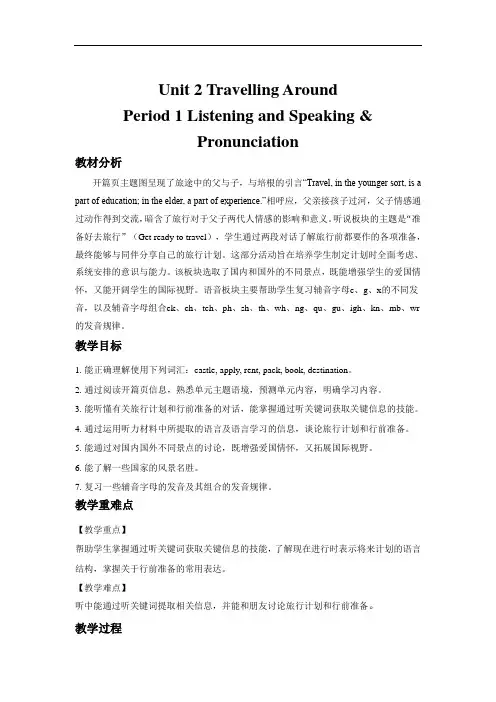
Unit 2 Travelling AroundPeriod 1 Listening and Speaking &Pronunciation教材分析开篇页主题图呈现了旅途中的父与子,与培根的引言“Travel, in the younger sort, is a part of education; in the elder, a part of experience.”相呼应,父亲接孩子过河,父子情感通过动作得到交流,暗含了旅行对于父子两代人情感的影响和意义。
听说板块的主题是“准备好去旅行”(Get ready to travel),学生通过两段对话了解旅行前都要作的各项准备,最终能够与同伴分享自己的旅行计划。
这部分活动旨在培养学生制定计划时全面考虑、系统安排的意识与能力。
该板块选取了国内和国外的不同景点,既能增强学生的爱国情怀,又能开阔学生的国际视野。
语音板块主要帮助学生复习辅音字母c、g、x的不同发音,以及辅音字母组合ck、ch、tch、ph、sh、th、wh、ng、qu、gu、igh、kn、mb、wr 的发音规律。
教学目标1.能正确理解使用下列词汇:castle, apply, rent, pack, book, destination。
2.通过阅读开篇页信息,熟悉单元主题语境,预测单元内容,明确学习内容。
3.能听懂有关旅行计划和行前准备的对话,能掌握通过听关键词获取关键信息的技能。
4.通过运用听力材料中所提取的语言及语言学习的信息,谈论旅行计划和行前准备。
5.能通过对国内国外不同景点的讨论,既增强爱国情怀,又拓展国际视野。
6.能了解一些国家的风景名胜。
7.复习一些辅音字母的发音及其组合的发音规律。
教学重难点【教学重点】帮助学生掌握通过听关键词获取关键信息的技能,了解现在进行时表示将来计划的语言结构,掌握关于行前准备的常用表达。
【教学难点】听中能通过听关键词提取相关信息,并能和朋友讨论旅行计划和行前准备。
英语人教版高中必修一(新课标)教案Unit1 Listening and Talking 教案
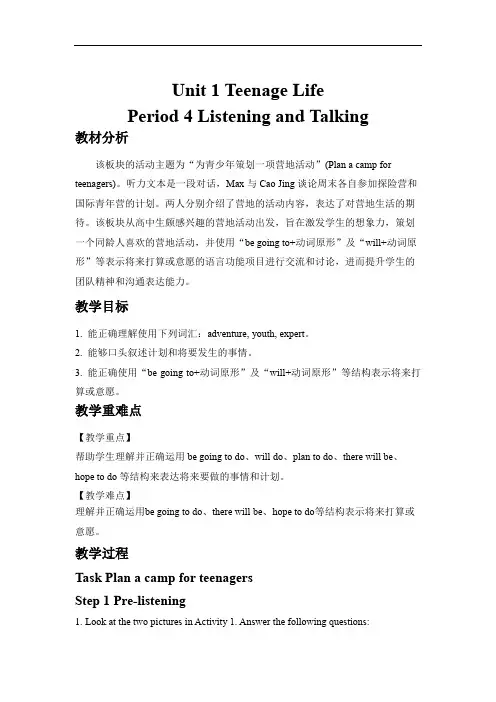
Unit 1 Teenage LifePeriod 4 Listening and Talking教材分析该板块的活动主题为“为青少年策划一项营地活动”(Plan a camp for teenagers)。
听力文本是一段对话,Max与Cao Jing谈论周末各自参加探险营和国际青年营的计划。
两人分别介绍了营地的活动内容,表达了对营地生活的期待。
该板块从高中生颇感兴趣的营地活动出发,旨在激发学生的想象力,策划一个同龄人喜欢的营地活动,并使用“be going to+动词原形”及“will+动词原形”等表示将来打算或意愿的语言功能项目进行交流和讨论,进而提升学生的团队精神和沟通表达能力。
教学目标1. 能正确理解使用下列词汇:adventure, youth, expert。
2. 能够口头叙述计划和将要发生的事情。
3. 能正确使用“be going to+动词原形”及“will+动词原形”等结构表示将来打算或意愿。
教学重难点【教学重点】帮助学生理解并正确运用be going to do、will do、plan to do、there will be、hope to do等结构来表达将来要做的事情和计划。
【教学难点】理解并正确运用be going to do、there will be、hope to do等结构表示将来打算或意愿。
教学过程Task Plan a camp for teenagersStep 1 Pre-listening1.Look at the two pictures in Activity 1. Answer the following questions:(1)What kind of camp is Adventure Camp/International Youth Camp?(2)What activities will it include?(3)What can students learn in these activities?2.Read the sentences in Activity 1. Then predict the main idea of the conversation. Step 2 While-listening1. Work on Activity 1. Listen to the conversation and tick what are heard about the camps.2.Work on Activity 2. Underline the expressions in the sentences above that Cao Jing and Max use to talk about the future.设计意图:该环节让学生通过勾画听力文本中的目标结构,关注对话中如何表达将来要做的事情和计划。
教案新人教版 必修一 Unit 1 Listening and Talking
Step4Homework
Plan a youth camp of your own.Then write a poster for your camp a After listening
(1)学生四人一组,利用活动3的步骤1中的四个问题,策划营地活动。教师可以提供或通过头脑风暴收集外国青少年营地活动(例如:Summer Camp for Science、Student Leadership Camp、Student Debate Camp等)的信息,帮助学生拓宽思路。
Step 1 Before listening
(1)利用该板块中的图片让学生谈论Adventure Camp和International Youth Camp。教师提问:
What kind of camp is Adventure Camp/International Youth Camp? What activities will it include? What can students learn in these activities?
(2)学生浏览活动1中的句子,预测听力内容。
Step 2 While listening
(1)学生听第一遍录音,勾选正确的信息。
(2)学生听第二遍录音,关注对话中如何表达将来要做的事情和计划,画出表示将来的语言结构,总结“We’ll ...”“There will be ...”“I’m going to ...”“I plan to ...”“I hope to ...”的表意功能。
(2)各小组仿照步骤2中提供的范例准备营地活动的介绍。
教学提示:在准备介绍词的过程中,提醒学生关注内容的逻辑性,即内容与所述营地活动的相关性,同时要关注表示先后顺序的词汇(first、then、also、finally等)对逻辑思维和内容的重要性。
新课标高中英语1必修全册教案
新课标高中英语1必修全册教案一、教学内容1. Unit 1 My First Day at Senior High详细内容:描述了学生在高中的第一天,通过对话和阅读了解校园生活。
2. Unit 2 My New Teachers详细内容:介绍了几位不同风格的老师,学习如何描述人物特点。
二、教学目标1. 掌握本单元的重点词汇和短语,并能灵活运用到实际情景中。
2. 提高学生的听说读写能力,尤其是描述人物和事件的能力。
3. 培养学生学会尊重和理解不同的教学风格,增强团队合作意识。
三、教学难点与重点1. 教学难点:描述人物特点的词汇和句型,以及如何运用到实际情景中。
2. 教学重点:听说读写技能的培养,尤其是口语表达能力的提高。
四、教具与学具准备1. 教具:多媒体设备、PPT、黑板、录音机、卡片等。
2. 学具:课本、练习本、字典、笔等。
五、教学过程1. 导入:通过展示一组学生在高中第一天的照片,引发学生讨论,导入新课。
2. 新课内容展示:讲解Unit 1 My First Day at Senior High 的重点词汇和句型,进行角色扮演活动。
3. 例题讲解:针对Unit 2 My New Teachers,讲解如何描述人物特点,给出示例。
4. 随堂练习:让学生运用所学知识,描述自己的老师,进行小组讨论。
5. 口语练习:模拟情景,让学生进行对话练习,提高口语表达能力。
六、板书设计1. Unit 1 My First Day at Senior High重点词汇:nervous, excited, confused, helpful, friendly等。
重点句型:I felt when; The teacher is and he/she等。
2. Unit 2 My New Teachers描述人物特点的词汇:strict, patient, humorous, knowledgeable等。
描述人物特点的句型:My teacher is; He/She always等。
高中英语新课标人教版教案必修一
高中英语新课标人教版教案必修一一、教学内容本节课选自高中英语新课标人教版必修一,具体章节为Unit 1 "My First Day at Senior High"。
教学内容主要包括:了解并描述学生在高中第一天的生活和感受;学会使用一般过去时描述过去的事件;掌握本节课的核心词汇和短语。
二、教学目标1. 能够听懂并准确说出与高中生活相关的词汇和短语。
2. 能够运用一般过去时描述过去的事件,提高语言运用能力。
3. 能够通过小组合作,交流并分享自己在高中第一天的经历和感受。
三、教学难点与重点1. 教学难点:一般过去时的运用,特别是动词过去式的变化规则。
2. 教学重点:核心词汇和短语的掌握,以及运用一般过去时进行简单的叙述。
四、教具与学具准备1. 教具:多媒体教学设备、黑板、粉笔、单词卡片。
2. 学具:英语课本、笔记本、字典。
五、教学过程1. 导入:通过播放一段关于高中生活的视频,引导学生关注本节课的主题。
2. 新课内容展示:展示本节课的核心词汇和短语,让学生跟读并模仿。
3. 例题讲解:以"Yesterday was my first day at senior high. I"为例,讲解一般过去时的用法。
4. 随堂练习:让学生运用一般过去时,描述自己在高中第一天的经历。
5. 小组活动:学生分成小组,互相交流并分享自己的经历,提高语言表达能力。
六、板书设计1. 核心词汇和短语:写在黑板的左边,方便学生查看。
2. 一般过去时的结构:写在黑板的右边,突出教学重点。
七、作业设计1. 作业题目:请用一般过去时描述你昨天的一天。
2. 答案示例:Yesterday was my busy day. I got up at 6:00, had breakfast and went to school. In the morning, I had four classes. After lunch, I played basketball with my friends. In the evening, I did my homework and watched TV.八、课后反思及拓展延伸1. 课后反思:本节课学生对于一般过去时的掌握程度较好,但仍有个别学生动词过去式变化不准确,需加强练习。
英语人教版高中必修一(新课标)教案Unit 4 Listening and Speaking 教案
Unit 4 Natural DisastersPeriod 1Listening and Speaking教材分析本单元以自然灾害为话题,探讨在“人与自然”的主题之下,当人类面临自然灾害的威胁时,应该树立防灾意识,提高在灾害中逃生和生存的能力。
主题图的内容是汶川地震时解放军战士在废墟中运送伤者的感人画面,体现了在发生重大自然灾害时军民同心,合力救助受灾人员的大无畏的人道主义精神。
而开篇页的引言“Live to Tell: Raising Awareness, Reducing Mortality.”中文可以译为:“用生命呼吁:增强减灾意识,减少人员伤亡。
”这句话是2016年联合国世界减灾日的活动主题,目的是呼吁全球各地的人们重视自然灾害,树立防灾意识。
听力板块的活动主题是“播报自然灾害”(Report natural disasters)。
学生通过观看视频并听新闻播报,最终完成模拟播报自然灾害新闻的活动。
教学目标1. 能正确理解使用下列词汇:disaster, drought, slide, flood, rescue, damage, destroy, death, affect, shelter。
2. 能根据听力问题,预判听力内容并能提炼出关键信息,例如:数字、时间、日期、事由等。
3. 了解新闻播报应包含的基本要素和语言特征。
4.能够简要模仿新闻播报,报道突发的自然灾害。
5. 复习清辅音和浊辅音p/b、t/d、k/g、f/v、th、s/z、sh/g、ch/dg、tr/dr、ts/ds的发音规律,并利用这些规律准确辨音,有效记忆单词。
教学重难点【教学重点】1. 引导学生运用听力策略,主动思考、预判听力要点;2. 引导学生运用新闻套语,模仿听力文本,完成自然灾害的新闻播报。
【教学难点】掌握听前预判听力要点的策略和技能。
教学过程Task 1Step 1 Warming-up1.Look at the opening page and discuss the following questions.(1) What problems/natural disasters do you see in the picture?(2) What do you think the soldiers are doing?(3) Can the person in the picture survive?(4) Can we stop natural disasters from happening?2. Read the quote and discuss the following questions.How do you understand the quote? Do you agree with it?设计意图:通过询问学生对引言的看法,启发学生思考,培养学生的思辨能力。
新课标人教版高中英语必修一全部教学案
新课标人教版高中英语必修一全部教学案一、教学目标1. 通过研究本单元的教学内容,帮助学生掌握必修一中的英语知识和技能。
2. 培养学生的英语听、说、读、写的综合能力。
3. 培养学生的团队合作意识和自主研究能力。
二、教学内容教学内容包括以下几个方面:1. 语法:复和巩固现在时态、过去时态、将来时态等基本语法知识。
2. 词汇:通过阅读和听力练,掌握本单元中的重点词汇和短语。
3. 阅读:通过阅读文本和相关的阅读理解题目,培养学生的阅读理解能力。
4. 听力:通过听对话和听文章练,提高学生的听力能力和听觉理解能力。
5. 口语:通过各种口语练,提高学生的口语表达能力。
三、教学方法1. 任务型教学法:通过让学生完成一系列任务,激发学生的研究兴趣,加强学生的实际运用能力。
2. 合作研究法:引导学生在小组内进行合作研究,促进学生之间的互动和交流。
3. 归纳法:通过教师引导和学生参与,将教学内容进行总结和归纳,提高学生的研究效果。
四、教学步骤1. 导入:通过引入生活例子或相关资料,唤起学生对新学知识的兴趣。
2. 语法讲解:教师通过讲解和示范,介绍本单元的语法知识。
3. 词汇研究:通过词汇游戏和词汇练,帮助学生记忆和掌握本单元的重点词汇。
4. 阅读训练:教师通过指导学生阅读文本和做阅读理解题目,提高学生的阅读理解能力。
5. 听力训练:教师播放相关听力材料,学生进行听力训练和听觉理解练。
6. 口语练:教师引导学生进行口语练,提高学生的口语表达能力。
7. 总结归纳:教师对本节课的教学内容进行总结和归纳。
8. 作业布置:教师布置相应的作业,巩固学生对本节课的研究。
五、教学评价1. 教师根据学生的课堂表现、作业完成情况和考试成绩等,进行教学评价。
2. 学生之间进行互评,促进学生之间的交流和研究成长。
六、教学资源1. 教材:新课标人教版高中英语必修一教材。
2. 多媒体设备:投影仪、电脑、音响设备等。
3. 课外资料:相关的练册、参考书和教育软件等。