
英语教学法技能训练提纲
《英语教学法》技能训练提纲本提纲依据《师范高等专科学校英语教育专业英语教学大纲》和《高等师范院校学生的教师职业技能训练大纲》,结合我校具体实际而制定。
只适用于我校英语专业对学生进行教师职业基本技能训练。
英语专业学生的教师职业技能基本技能训练内容包括讲普通话和口语表达、书写规范汉字和书面表达、教学工作、班主任工作技能等四部分。
它是高等师范院校英语专业学生都应具备的,是学生必修的内容。
对学生有目的、有计划地进行系统的教师职业技能训练,目的是引导学生将专业知识和教育学、心理学的理论与方法转化为具体从师任教的职业行为方式,并使之趋于规范化,对于形成学生教育和教学能力,对于学生毕业后胜任教师工作都具有重要的作用。
本提纲只提出教学工作技能、班主任工作技能两大方面的技能训练模式。
一、技能训练的依据本提纲依据《师范高等专科学校英语教育专业英语教学大纲》和《高等师范院校学生的教师职业技能训练大纲》,以教育学和教学论,特别是微格教学理论为指导。
微格教学的创始人艾伦(W.Allen)认为,复杂的教学行为在某种程度上可以被分成一些简单的、可以训练的技能或技术。
他说,微格教学是“一个有控制的实习系统,它使师范生有可能集中解决某一特定的教学行为,或者在有控制的条件下进行”。
结合我校及中学英语教学实际,可以把英语教学能力分成若干单项技能,从而进行技能训练。
二、技能训练的目标1、使学生将所学的教学理论尽快转化为实际教学技能,能灵活运用先进的教学方法组织英语课堂教学的听、说、读、写活动;2、使学生掌握班级管理,对学生进行思想品德教育和组织指导学生进行课外活动等方面的技能,能够胜任班主任工作。
三、技能训练的内容1、常规技能(1)语音技能现代语言科学告诉我们,教师要教好语音必须具备三个条件:A.教师本人有正确的发音。
B.教师必须有语音学的知识,了解发音器官特点、每个音的发音图以及发音要点。
C.教师必须懂得如何应用语音学和语音教学法指导学生掌握正确的语音、区别音的正误和纠正学生的发音。
语音教学的方法有以下几个方面:A.模仿为主,同时辅以语音知识。
B.语音学习与拼读结合。
C.进行英、汉语音的比较(2)英文书写(钢笔、粉笔)A.要求学生心中熟记英文字母大小写的下笔笔顺,观察其空间形态,注意相似字母的区别。
B.要求学生学习正确的握笔方法和书写姿势,认真体会要领,自己纠正或师生共同纠正。
C.按要求在练习薄上临摹字帖上的字母组合,提醒学生连写的规律,注意书写规则和字母的笔顺。
(3)英文歌曲教唱A.配合教材,精心设计B.辅助语音和朗读技巧方面的训练C.扩大词汇量,巩固所学语法知识D.借助歌曲巩固生词、提高听力的方法E.旧曲填新词(4)英语游戏的组织A.要重视学生的主体作用,教师应激发学生参加活动的愿望,吸引学生来做游戏,而不是强制学生活动B.要指导学生不仅在动作、表情等方面做表演,而且更要在语言上做表演,达到语音、语调准确,语法正确,用词贴切,语句流利等等C.教师不必时时纠正小错误,注意及时更换游戏,保持学生的学习积极性(5)简笔画A.要尽可能将复杂的物体简化成各种基本平面几何图形B.抓住特点,突出特征C.分析物体的图形组成D.合理地安排各部分的比例关系E.适当地忽略主体的细节和局部F.对物体的比较与鉴别G.要科学地安排笔序,力图简洁明了H.景别不同,笔划多少也不同(6)教具制作:要符合教学内容的要求,不能喧宾夺主(7)电教设备的操作和运用(包括幻灯片制作)A.播放教学法B.程序教学法C.成绩考查法D.微型教学法(8)计算机辅助教学(CAI)是利用教育软件,通过学生和计算机之间的相互作用,达到教学目的的一种现代化教学手段A.向学生介绍CAI的基本知识B.在学生参加CAI选修课的基础上,介绍英语教学CAI 从学生入学后的第一学期到二年级上学期一年半时间内,规定每周2课时用于常规技能训练,利用周末组织相应的竞赛活动,期末进行考查。
2、课堂教学技能(1)教学设计及备课A.选择中学某节教材的教学内容训练学生制订教学目标、分析处理教材和编写教案、设计练习题,并分组讲座相互交流,建立小题库B.备课不是“背课”,而是要备教材、备学生、备方法(2)教态,包括教师的仪容、风度、神色、情绪、表情、姿势、运用、举止、手势、目光等等A.练眼睛:眼为心灵之窗,教学的高层次是心灵的交流与和谐。
如何用眼睛表示肯定、否定,肯定中有期待、否定中有鼓励,亲切中有严肃、容忍中有警告,都是精细的交际艺术。
B.练身姿:胸部挺直,头部抬平,手不乱摸,腿不乱抖,站稳、立正、走平,不轻挑,无形的威风才压得住课堂阵脚。
C.练手势:手势应该在柔曼中隐含刚劲,徐缓中渗透坚定,圆弧形动作、直线性动作、快动作、慢动作、大动作、小动作等随着教学整体发展而适度地变化,并与语言、表情、身姿等有机配合。
手势是指挥学生有节奏地进行学习活动的最佳手段,比语言省时、直观,抑扬顿挫和动静行止都可以通过一个手势来实现。
D.练笑容:微笑地注视学生的活动,既是一个鼓舞,又是一个督促。
笑是有强烈传感性的,教师的笑容引起学生的笑容,再作用于教师,这样,英语课上就充满了温暖的阳光。
(3)课堂教学语言技能A.练习发声技巧:注意重音的使用;注意节奏;控制音量B.练习体语技巧:注意面部表情;注意服饰仪表;注意步移手势C.练习辞格运用(4)板书设计技能A.科学性B.简明扼要,突出主题C.整体感D.形式美(5)导入技能A.针对教学内容和学生的特点,导入目的明确B.能引起学生的兴趣,有启发性C.导入与新知识联系紧密,进入课题自然合理(6)呈现与演示技能A.对呈现与演示物精心选择B.呈现与演示前提出问题和观察重点C.呈现与演示要指导学生观察,充分感知D.多种媒体相互配合,综合利用E.呈现与演示后及时总结,明确观察结果(7)机械性操练组织技能A.明确技能、重点突出B.运用丰富的实例,套用已学过的知识(8)意义练习组织技能A.明确技能、重点突出C.运用丰富的实例,在套用已学过的知识基础上引导学生分析概括,培养学习方法(9)交际性练习组织技能A.明确技能、重点突出B.运用丰富的实例,在套用已学过的知识、学生初步掌握分析概括能力,具有一定的学习方法基础上及时巩固、应用,理论联系实际(10)巩固与强化技能:巩固及时准确,强化恰到好处(11)提问与启发技能A.设计多种水平的问题,问题要重点突出简明易懂B.把握提问时机C.给予启发引导D.给予分析和评价(12)诊断与纠错技能:对学生出现的问题诊断要准确,纠错要及时(13)组织与指导课外活动技能A.组织学生开展课外活动,由学生自己设计方案,执行方案,从而得到训练B.训练活动也可结合教育实习进行(14)教学研究技能A.可结合教学提出的研究课题,在教师的指导下,由学生自己设计研究方案、搜集资料、统计分析、写出研究报告B.结合教育实习中的教育调查或毕业论文进行训练在确立微技能时,突出课堂教学活动的组织技能。
常规技能是为课堂教学活动服务的;微技能,特别是5——10项技能,全面、整体地体现了语言教学的规律,具有普遍的指导意义。
将这些训练安排在二年级下学期至三年级上学期实习前进行训练。
3、班主任工作技能(1)集体教育技能A.通过观看班主任工作的录像、阅读班主任工作方面的书籍、走访优秀班主任或请他们来学校讲课、座谈,使学生对班主任工作有一个基本的认识和了解B.充分利用见习、实习,观摩、学习中学班主任工作,并提出自己的活动设想,在实习中进行组织(2)个体教育技能A.组织学生针对中学生生理、心理特点,进行模拟训练B.在实习中,针对班级几种不同类型的学生进行个体教育(3)与任课教师、学生家长沟通技能A.在学生之间开展模拟训练C.充分利用见习、实习,观摩、学习优秀班主任与任课教师、学生家长沟通技能,并积极参与四、技能训练的方法根据心理学关于心智活动分阶段形成的学说,应采取“循序渐进、观摩讨论、分组演练、录像自评、对比分析、自我纠正、多项综合、全面养成”的技能训练模式:循序渐进——按由简到繁,从易到难,先单项后综合的顺序进行训练。
观摩讨论——让师生带着问题观摩优秀教师的课堂教学实况录像,看他们是怎样组织教学活动的,怎样帮助学生学习和参与教学活动的,然后进行讨论以加深认识,强化技能意识。
分组演练——为学生提供训练素材和训练活动,将学生分为4——5人一组,根据讲义提供的教案实例进行模拟练习。
录像自评——在小组演练、评议、提高的基础上,对每位学生的授课进行实况录像,并当即放录像,及时反馈他们的教学和训练效果,然后让他们根据每项技能的评估指标进行自评(条件不成熟时,可暂不进行)。
对比分析——与录像中的优秀课对比,分析模拟教学中的得失,分析学生个体的优势和劣势,寻求改进和提高每一项教学技能的方法和措施。
自我纠正——学生自己备课,写教案,再演练,再录像,再反馈训练效果,纠正技能方面的缺点;加深学生对教学本质和教学过程的自我认识,提高自我决策、自我评价和自我更新的能力。
多项综合——选择多种课型,运用多种技能、多种方法、多种手段、多种设计相互配合,使各项技能和谐发展,互相促进。
全面养成——训练中突出技能自我养成训练,即在养成和矫正训练中以养成训练为主;要根据一定的技能套路对学生进行训练,使其全面掌握课堂教学的技能。
英语教学法第二版 复习提纲
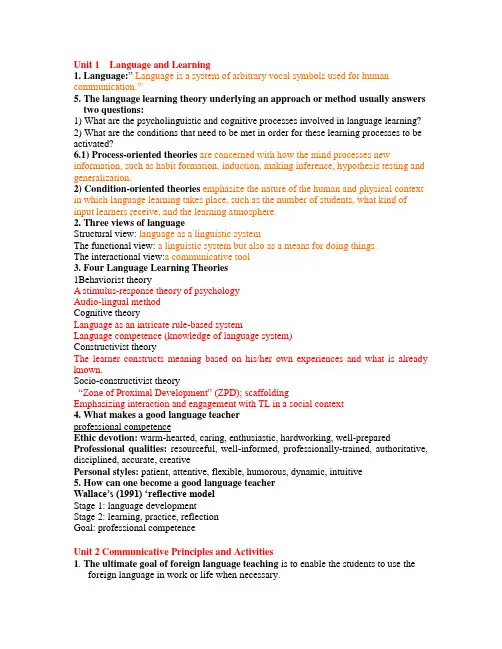
Unit 1 Language and Learning1. Language:” Language is a system of arbitrary vocal symbols used for human communication.”5. The language learning theory underlying an approach or method usually answers two questions:1) What are the psycholinguistic and cognitive processes involved in language learning?2) What are the conditions that need to be met in order for these learning processes to be activated?6.1) Process-oriented theories are concerned with how the mind processes new information, such as habit formation, induction, making inference, hypothesis testing and generalization.2) Condition-oriented theories emphasize the nature of the human and physical context in which language learning takes place, such as the number of students, what kind of input learners receive, and the learning atmosphere.2. Three views of languageStructural view: language as a linguistic systemThe functional view: a linguistic system but also as a means for doing things.The interactional view:a communicative tool3. Four Language Learning Theories1Behaviorist theoryA stimulus-response theory of psychologyAudio-lingual methodCognitive theoryLanguage as an intricate rule-based systemLanguage competence (knowledge of language system)Constructivist theoryThe learner constructs meaning based on his/her own experiences and what is already known.Socio-constructivist theory“Zone of Proximal Development” (ZPD); scaffoldingEmphasizing interaction and engagement with TL in a social context4. What makes a good language teacherprofessional competenceEthic devotion: warm-hearted, caring, enthusiastic, hardworking, well-prepared Professional qualities: resourceful, well-informed, professionally-trained, authoritative, disciplined, accurate, creativePersonal styles: patient, attentive, flexible, humorous, dynamic, intuitive5. How can one become a good language teacherW allace’s (1991) ‘reflective modelStage 1: language developmentStage 2: learning, practice, reflectionGoal: professional competenceUnit 2 Communicative Principles and Activities1. The ultimate goal of foreign language teaching is to enable the students to use theforeign language in work or life when necessary.1. The goal of CLT is to develop students‟ communicative competence.2.What is communicative compentence?3.Try to list some of its components and their implication to teaching.Communicative compentence refers to both the knowledge about the language and the knowledge about how to use the language appropriately in communicative situations. According to Hedge, it includes five components.Linguistic competence --- knowledge of the language itself, its form and meaning Pragmatic competence --- the appropriate use of language in social contextDiscourse competence--- one‟s ability to create cohere nt written text or conversation and the ability to understand them (ability to express or to understand a topic logically and coherently by effectively employing or comprehending the cohesive markers used in the discourse /ability to initiate, develop, enter, interrupt, check, or confirm in a conversation)Strategic competence--- strategies one employs when there is communication breakdown due to lack of resourcesFluency---- one‟s ability to …link units of speech together with facility and without strain or inappropriate slowness or undue hesitation4.Implications for teaching and learning:Linguistic competenceTeachers need to help learners----achieve accuracy in the grammatical forms of the language;----pronounce the forms accurately;----use stress, rhythm, and intonation to express meaning;----build a range of vocabulary;----learn the script and spelling rules;----achieve accuracy in syntax and word formation.Pragmatic competenceTeachers need to help learners---learn the relationship between grammatical forms and functions;---use stress and intonation to express attitude and emotion;---learn the scale of formality;---understand and use emotive tone;---use the grammatical rules of language;---select language forms appropriate to topic, listener, or setting, etc.Discourse competenceTeachers need to help learners----take longer turns, use discourse markers and open and close conversations;----appreciate and be able to produce contextualised written texts in a variety of genres; ----be able to use cohesive devices in reading and writing texts;----be able to cope with authentic texts.Strategic competenceTeachers need to enable learners----to take risks in using the language;----to use a range of communicative strategies;----to learn the language needed to engage in some of these strategies, e.g. …What do you call a thing that/person who…‟Teachers need to help learners-----deal with the information gap of real discourse;-----process language and respond appropriately with a degree of ease;-----be able to respond with reasonable speed in …real time”.5. Richards and Rodgers(1986:72)three principles of Communicative language teaching1) Communication principle: Activities that involve real communication promote learning.2) Task principle: Activities in which language is used for carrying out meaningful taskpromote learning.3) Meaningfulness principle: Language that is meaningful to the learner supports he learning process.16. Littlewood’s (1981)classification of communicative activities:1). Functional communicative activities:2). Social interaction activities:(1). Functional communicative activities:~ Identifying pictures~ Discovering identical pairs~ Discovering sequences or locations~ Discovering missing information~ Discovering missing features~ Discovering "secrets"~Communicating patterns and pictures~ Communicative models~ Discovering differences~ Following directions~ Reconstructing story-sequences~ Pooling information to solve a problem(2). Social interaction activities:~ Role-playing through cued dialogues~Role-playing through cues and information~Role-playing through situation and goals--Role-playing through debate or discussion~ Large-scale simulation activities~ Improvisation17.Ellis (1990) has listed six criteria for evaluating communicative classroom activities:1). Communicative purpose:2). Communicative desire:3). Content, not form:4). Variety of language:5). No teacher intervention:A task is believed to have four components:a purpose,a context,a product.任务情景化:有需要解决的问题;需要行动或语言+非语言类任务目标化学会行动;完成语言+非语言类任务复杂性;复杂成果;难以预料短期内不明显练习情景化:无需要解决的问题;纯语言练习(理想的是,一次解决一个语言难点)目标化学会行动;完成纯语言练习复杂性;单一成果;事先预设,明显但有限度(对/错)6.Differences between PPP and TBLT1.The way students use and experience language in TBLT is radically different from PPP. Free of language controlA genuine need to use language to communicateA free exchange of ideasAppropriateness & accuracy of language form in general, not production of a single form A genuine need for accuracy and fluency2TBL can provide a context for grammar teaching and form-focused activities.A task-established contextEncouraged to think, analyze, not simply to repeat, manipulate and apply A more varied exposure to natural languageLanguage forms not pre-selected for focusLearner-free selection of languageFluency accuracy (+fluency)Integrated skills practisedProblems with CLT1.Is it practical in the Chinese context?2.How to design the syllabus for classroom teaching?3.Is it suitable for all age level of learners or all competence level of learners? Constraints of TBLT1.It may not be effective for presenting new language items2.Time: teachers have to prepare task-based activities very carefully.3.Culture of learning4.Level of difficultyUnit 3National English Curriculum3.1 A brief history of foreign language teaching in China1A phase of restoration (1978-1985)2A phase of rapid development (1986-1992)3A phase of reform (1993-2000)4A phase of innovation from 20002,Designing principles for the National English Curriculum1) Aim for educating all students, and emphasize quality-oriented education.2) Promote learner-centeredness, and respect individual differences.3. Develop competence-based objectives, and allow flexibility and adaptability4) Pay close attention to the learning process, and advocate experiential learning and participation5. Attach particular importance to formative assessment, and give special attention to the development of competence.6. Optimize learning resources, and maximize opportunities for learning and using the language.3.3Goals and objectives of English language teachingThe new curriculum is designed to promote students‟ overall language ability3.4 Design of the National English CurriculumNine competence-based levelsLevel 2,For 6th gradersLevel 5,For 9th gradersLevel 7,For senior high school leaversUnit 4 Lesson Planning18. Lesson planningLesson planning means making decisions in advance about what techniques, activities and materials will be used in the class.19. Why is lesson planning necessary?1)Makes teachers aware of the aims and language contents of the lesson, so as to plan the activities and choose the techniques accordingly;2)Helps teachers distinguish the various stages of a lesson and see the relationship between them so that the activities of different difficulty levels can be arranged properly and the lesson can move smoothly from one stage to another;3)Gives teachers the opportunity to anticipate potential problems so that they can be prepared;4)Gives teachers, esp. novice ones, confidence in class;5)Raises teachers‟ awareness of the teaching aids needed;6)Planning is a good practice and a sign of professionalism21. There are four major principles behind good lesson planning:AimVariety means planning a number of different types of activities and where possible introducing students to a wide selection of materials so that learning is always interesting, motivating and never monotonous for the students.Flexibility means planning to use a number of different methods and techniques rather than being a slave to one methodology. This will make teaching and learning more effective and more efficient.Learnability means the contents and tasks planned for the lesson should be within the learning capability of the students. Of course, things should not be too easy either. Doing things that are beyond or below the students' coping ability will diminish their motivation (Schumann, 1999).Linkage means the stages and the steps within each stage are planned in such a way that they are somehow linked with one another. Language learning needs recycling and reinforcement.24. Lesson planning should be done at two levels:Macro planning is planning over time, for instance, the planning for a month, a term, or the whole course.micro planning: is planning for a specific lesson, which usually lasts 40 or 50 minutes. 25.Macro planning involves:1) Knowing about the course:2) Knowing about the institution:3) Knowing about the learners:4) Knowing about the curriculum/syllabus5)Knowing about the textbook6)Knowing about the objectives26. The advantage of a concrete teaching plan:Teachers can follow it in the class and check what they have done;The plan will be the basis of a record of what has been covered in class;It will make it easier to make achievement tests later;It will be good records for the entire course.4.4 Components of a Lesson Plan1.Background information2.Teaching aimsnguage contents and skills4.Stages and procedures5.Teaching aids6.end of lesson summary7.optional activities and Assignments8.after-lesson reflection28. The aims of a lesson include:language components to present,communicative skills to practice,activities to conductmaterials to be usedteaching aids to be used.Unit 5 Classroom Management1.What is classroom management?Classroom Management refers to the way teachers organize what goes on in the classroom.1. Teachers’ roles:Before the class---PlannerDuring the class—1 Controlle2 Assessor3 Organizer4 Prompter5 Participant6 Resource-providerAfter the class---Evaluatornew roles:facilitatorsguidesresearcher s2.Rules to follow for making instructions effectiveTo use simple instructions and make them suit the comprehension level of thestudents.To use the mother-tongue only when it is necessary. (to explain grammar rules or rules for a game or task which may be too complicated to explain in the targetlanguage)3. What are the most common types of Ss grouping?Whole class workPair work,Group work,Individual study:4.How to maintain discipline?P.79When students are engaged in learning, they will be disciplined.Q: How to engage students in learning?1)Ss are clear about learning purpose;2)Ss are able to do the work but find it challenging;3)Ss are emotionally, physically and intellectually involved by the tasks;4)The presentation, variety and structure of the work and activities generate curiosity and interest;5)Ss have opportunities to ask questions and try out ideas;6)Ss can see what they have achieved and how they had made progress;7)Ss get a feeling of satisfaction and enjoyment from the work.4. Harmer’s suggestions on measures for undisciplined acts and badly behaving Ss:1). Act immediately2). Stop the class3).Rearrange the seats4).Change the activity5).Talk to Ss after class6).creat a code of behavior5. In order not to hurt the Ss,Ur’s advice on problems in class:1).Deal with it quietly2).Don‟t take things personally 对事不对人3).Do not use threats6. What are the functions or purposes of questions?To focus students‟ attentionsTo invite thinking or imaginationsTo check understandingTo stimulate recall of informationTo challenge studentsTo assess learning7How to ask effective question1)Questions should be closely linked to the learning objectives in the lesson;2)Questions should be staged so that the level of challenge increases as the lesson proceeds;3)There should be a balance between closed and open, lower-order and higher-order questions;4)Wait time is important to allow students to think through their answers;5)Ss should be provided opportunities to ask their own questions and seek their own answers;6)A secure and relaxed atmosphere of trust is needed and ss‟ opinions and ideas are valued..6. correct dealing with errors and mistakeswe need to be clear whether the task or activity is focusing on accuracy or fluency.How to correct error:Direct teacher correctionIndirect teacher correctionSelf correctionPeer correctionWhole class correctionUnit 6Teaching Pronunciation1.The role of pronunciationOn the value of teaching pronunciation, there are different opinions:1.Students do not need to learn pronunciation because pronunciation will take care of itself as the students develop overall language ability.2.Failure in pronunciation is a great hindrance to language learn.2. The goals of teaching pronunciation:目的Consistency 连贯性: To be smooth naturalIntelligibility可理解性:To be understandable to the listenersCommunicative efficiency: To help convey the speakers‟ meaning3. Three aspects of pronunciation to teach? Stress, intonation, rhythm4. One common problem in learning English of Ss: (Neglect stress and intonation)5. Ways of practicing soundsPerception practice :Using minimal pairs,Which order,Same or different,Odd one out, CompletionProduction practice: Listen and repeat,Fill in the blanks,Make up sentences,Use meaningful context,Use pictures,Use tongue twisters6. Practicing stress:1).Two kinds of stress: word-level stress ; phrase-level stress2).Three ways to show stress pattern of words:Use gestures, use the voice, use theblackboard7. Practicing intonation:1). There are many subtle ways: surprise, complaint, …sarcasm讥讽,friendliness, threats etc.2). Two ways to make intonation:Use hand or arm movement to indicate change of intonaton: rising/falling arrows; draw linesUnit 7. Teaching Grammar1. What are grammar presentation methods? 演示法Deductive method演义法; Inductive method归纳法the guided discovery method (引导发现法2. Deductive method1). Definition: It relies on reasoning, analyzing and comparing.2). Steps: giving rules/definition------giving examples3). Advantages:To be successful with selected and motivated students;To save time;To help to increase students‟ confidence in some exam.4). Disadvantages:To teach grammar in the isolated way;To pay little attention to meaning;To be often mechanical practice.3. Inductive method1).Definition: the teacher induces the learners to realise grammar rules without any form of explicit explanation2). Steps: give examples-----induce rules4). Advantages: Inductive method is more effective in that students discover thegrammar rules themselves while engaged in language use,4. Ur’s definition of grammar practice:"Practice may be defined as any kind of engaging with结合/保证the language on the part of the learner, usually under the teacher supervision, whose primaryobjective(aim/task) is to consolidate learning "(Ur, 1988:11).5. Ur’s six factors contribute to successful grammar practice:1) Pre-learning.2) Volume and repetition(容量/重复).3) Success-orientation成功性联系.4) Heterogeneity多样性.5) Teacher assistance.6) Interest.6. Two categories of grammar practice:Mechanical practiceMeaningful practice.1).Mechanical practice involves activities that are aimed at form accuracy.Two drills in mechanical practice:(1) Substitution drills (2) Transformation drills2). Meaningful practice.In meaningful practice the focus is on the production, comprehension orexchange meaning though the students "keep an eye on" the way newly learnedstructures are used in the process. Meaningful practice usually comes aftermechanical practice.7. Using prompts for practice:1). Using picture prompts. Ss produce sentences based on the pictures provided2). Using mime or gestures as prompts.3).Using information sheet as prompts. E.g.:4). Using key phrases or key words as prompts.5). Using chained phrases for story telling.6). Using created situations.Unit 8 Teaching Vocabulary1. What does knowing a word involve?Knowing a word means knowing its pronunciation and stress;Knowing a word means knowing its spelling and grammatical properties;Knowing a word means knowing its meaning;Knowing a word means knowing how and when to use it to express the intended meaning.Vocabulary learning “involves at least two aspects of meaningThe first aspect involves the understanding of its denotative and connotative meaning.The second aspect involves understanding the sense relations among words.”Collocation , Synonyms,antonyms,hyponyms, Receptive and productive vocabulary2. List some ways of presenting new words1) Try to provide a visual or physical demonstration whenever possible,2) Provide a verbal context to demonstrate meaning.3) Use synonyms or antonyms to explain the meanings.4) Use lexical sets or hyponyms to show relations of words and their meanings.5) Translate and exemplify,6) Use word formation rules and common affixes7) Teach vocabulary in chunks.8) Think about the context in real life where the word might be used.9) Think about providing different context for introducing new words.10) Prepare possible misunderstanding or confusion that student may have.3. Some vocabulary consolidation activities that can be done in class. (12)1) Labeling2) Spotting the differences:3) Describing and drawing:4) Playing a game:5) Using word thermometers:6) Using word series7) Word bingo:9) word association10) Synonyms and antonyms:11) categories12) Using word net-work13)using the internet resources for more ideas4. Developing vocabulary building strategies.1). Review regularly:2). Guess meaning from context:3). Organize vocabulary effectively:4). Use a dictionary:5)keep a vocabulary notebook6).Discovery strategiesUnit 9Teaching Listening1.The reason why such difficulties arise can be quire complicated. however, one major reason for students‟ poor listening is often neglected in language due to1) Lack of teaching materials (audio and video tapes);2) Lack of equipment (tape players, VCRs, VCDs, computers);3) Lack of real-life situations where language learners need to understand spoken English;2 What do we listen to in everyday life? (Ur, 1996)Loudspeaker announcements1.Radio news2.Lesson, lecture3.Conversation, gossip4.Instructions5.Watching television6.Watching movies7.Telephone conversations8.Interview9.Shopping10.Story-telling11.Meetings12.Negotiations13.Theater show…3. One reason for students' unsatisfactory listening abilities:There is not enough variety in the materials that they listen to in class. In most cases, the listening materials are daily conversations or stories. But in reality we listen to far more things, regardless of which language is used.4. The characteristics of listening in real life (adapted from Ur, 1996:106-7):1) Spontaneity2) Context3) Visual clues4) Listener‟s response5) Speaker‟s adjustment5 Two major purposes in listening.*The first is for social reasons;*The second is for exchanging information.6 Principles of teaching listening:1). Focus on process:2). Combine listening with other skills:3). Focus on comprehending meaning:4). Grade difficulty level appropriately:7.dels for teaching listeningbottom-up model up- bottom modelthe teaching of listening generally follows three stages:pre-listening stagewhile-listening stage,post-listening stage.Unit 10Teaching Speaking1. What is speaking?Speaking is a skill that the students will be judged upon most in real-life situations.. 1.what are the differences between spoken and written language?SpokenspontaneousSentences are often incomplete, ungrammatical, and full of hesitations, false starts, and redundancies.If it is not recorded, spoken language can‟t be listened to again. It is expected to be understood immediately.WrittenWell-plannedSentences are often carefully constructed and well organized.Written language is comparatively speaking permanent. It can be read as often as necessary.3.There are four common features of spoken language:Using less complex syntax;Taking short cuts, e.g. incomplete sentences;Using fixed conventional phrases/chunks;Using devices such as fillers, hesitation devices to give time to think before speaking.4.Principles for teaching speaking1) balancing between accuracy-based practice and fluency-based practices :2) Contextualizing practice3) Personalizing practice4) Building up confidence5) Maximizing meaningful interactions6) Helping students develop speaking strategies7)making the best use of classroom learning environment to provide sufficient language input and practice for the students.5,factors should be considered in designing speaking tasksWhen we design speaking tasks, one important consideration is the language proficiency level of the students.6.how can we design speaking activities:1). Maximum foreign talk:2). Even participation3). High motivation4). Right language level4.Types of speaking activitiesLittlewood‟s (1981) framework for defining speaking activities:Pre-communicative activitiesStructural activitiesQuasi-communicative activitiesCommunicative activitiesFunctional communication activitiesSocial interaction activitiesSome speaking activities1)Controlled activities2)semi- Controlled activities3)communication activities1). Information-gap activities:2). Dialogues and role-plays3). Activities using pictures4). Problem-solving activities8,How to organise speaking activities.Using group work in speaking tasks☐Design small group work for three reasons:(1) it increases the time for each student to practise speaking in one lesson;(2) often ss are afraid of making mistakes or losing face or feel shy speaking in front of a whole class;(3) speaking in small groups is more natural in real life.☐Small group work helps ss learn to work cooperatively and helps them develop interpersonal skills—”foste ring development of tolerance, mutual respect andharmony” (Cooke & Nicholson, 1992:34)2). The advantages of using group in speaking tasksSmall group work helps students learn to work cooperatively and it helps them develop interpersonal skills. They learn how to work with a wider variety of people Development of tolerance, mutual respect and harmonyUnit 11 Teaching Reading1. Two types of reading practice in classrooms:Reading aloud and Silent reading2. Effective readers do the following:1) have a clear purpose in reading;2) read silently;3) read phrase by phrase, rather than word by word;4) concentrate on the important bits, skim the rest, and skip the insignificant parts;5) use different speeds and strategies for different reading tasks;6) perceive the information in the target language rather than mentally translate;7) guess the meaning of new words from the context, or ignore them;8) have and use background information to help understand the text.3. What is readingreading is the construction of meaning from a printed or Written message..4. Skills readers need:1.Specifying a purpose for reading2.Planning what to do/what steps to take3.Previewing the text4.Predicting the contents of the text5.Checking predictions6.Skimming the text for the main idea7.Scanning the text for specific information8.Distinguishing main ideas from supporting details9.Posing questions about the text10.Finding answers to posed questions5.The role of vocabulary in reading:Day & Bamford (1998): efficient reading begins with a lightening-like automatic recognition of words, which frees one‟s mind to use other resources to construct meaning. Helping ss to develop the ability of automatic word recognition is the basis for developing their reading skills.The way to develop si ght vocabulary is to read extensively (…Familiarity breeds automaticity‟).6. Some principles for teaching reading(6):1)The selected texts and attached tasks should be accessible to the students.2)Tasks should be clearly given in advance.3) Tasks should be designed to encourage selective and intelligent reading for the main meaning4) Tasks should help develop students' reading skills5) Teachers should help the students not merely to cope with one particular text in front of them but with their reading strategies and reading ability in general.6)Teachers should help the students to read on their own.7.three models of teaching reading1). Bottom-up modelletters---words---phrases---clauses---sentences---paragraphs---whole discours2). Top-down modelbackground knowledge--- guess meaning from the printed page3)Interactive model8. Three stages of reading:Pre-reading activities;While-reading activities;Post-reading ActivitiesPre-reading activities;Predictinga). Predicting based on the titleb). Predicting based on vocabularyc). Predicting based on the T/F questions2). Setting the scene* Besides discussing culture bound aspects of the text, we can also set the scene by relating what students already know to what they want to know.3). SkimmingSkimming means reading quickly to get the gist, i.e. the main idea of the text. Some suggestions may help teachers to set up skimming activities:。
《英语教师职业技能训练》课程标准
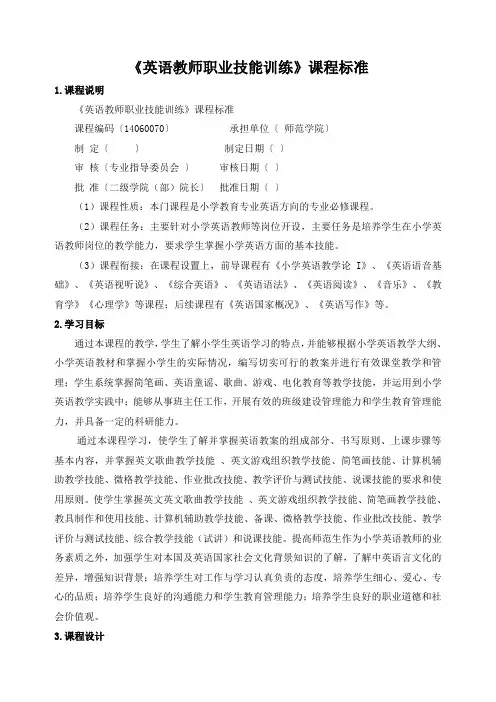
《英语教师职业技能训练》课程标准1.课程说明《英语教师职业技能训练》课程标准课程编码〔14060070〕承担单位〔师范学院〕制定〔〕制定日期〔〕审核〔专业指导委员会〕审核日期〔〕批准〔二级学院(部)院长〕批准日期〔〕(1)课程性质:本门课程是小学教育专业英语方向的专业必修课程。
(2)课程任务:主要针对小学英语教师等岗位开设,主要任务是培养学生在小学英语教师岗位的教学能力,要求学生掌握小学英语方面的基本技能。
(3)课程衔接:在课程设置上,前导课程有《小学英语教学论I》、《英语语音基础》、《英语视听说》、《综合英语》、《英语语法》、《英语阅读》、《音乐》、《教育学》《心理学》等课程;后续课程有《英语国家概况》、《英语写作》等。
2.学习目标通过本课程的教学,学生了解小学生英语学习的特点,并能够根据小学英语教学大纲、小学英语教材和掌握小学生的实际情况,编写切实可行的教案并进行有效课堂教学和管理;学生系统掌握简笔画、英语童谣、歌曲、游戏、电化教育等教学技能,并运用到小学英语教学实践中;能够从事班主任工作,开展有效的班级建设管理能力和学生教育管理能力,并具备一定的科研能力。
通过本课程学习,使学生了解并掌握英语教案的组成部分、书写原则、上课步骤等基本内容,并掌握英文歌曲教学技能、英文游戏组织教学技能、简笔画技能、计算机辅助教学技能、微格教学技能、作业批改技能、教学评价与测试技能、说课技能的要求和使用原则。
使学生掌握英文英文歌曲教学技能、英文游戏组织教学技能、简笔画教学技能、教具制作和使用技能、计算机辅助教学技能、备课、微格教学技能、作业批改技能、教学评价与测试技能、综合教学技能(试讲)和说课技能。
提高师范生作为小学英语教师的业务素质之外,加强学生对本国及英语国家社会文化背景知识的了解,了解中英语言文化的差异,增强知识背景;培养学生对工作与学习认真负责的态度,培养学生细心、爱心、专心的品质;培养学生良好的沟通能力和学生教育管理能力;培养学生良好的职业道德和社会价值观。
英语教学法
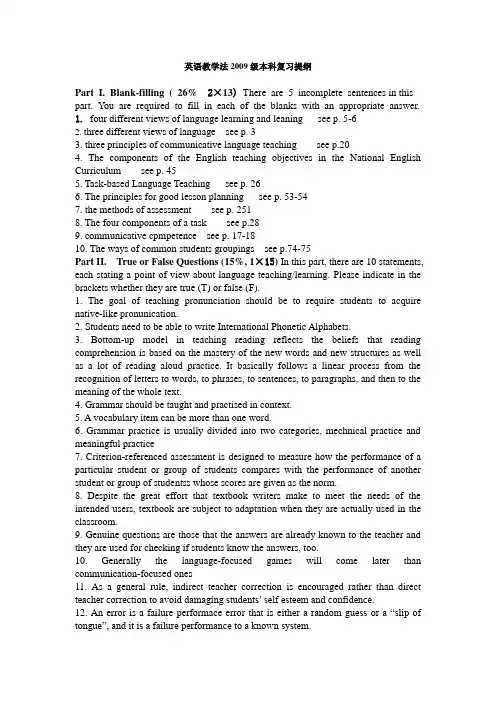
英语教学法2009级本科复习提纲Part I. Blank-filling ( 26% 2×13)There are 5 incomplete sentences in this part. You are required to fill in each of the blanks with an appropriate answer.1. four different views of language learning and leaning see p. 5-62. three different views of language see p. 33. three principles of communicative language teaching see p.204. The components of the English teaching objectives in the National English Curriculum see p. 455. Task-based Language Teaching see p. 266. The principles for good lesson planning see p. 53-547. the methods of assessment see p. 2518. The four components of a task see p.289. communicative cpmpetence see p. 17-1810. The ways of common students groupings see p.74-75Part II. True or False Questions (15%, 1×15) In this part, there are 10 statements, each stating a point of view about language teaching/learning. Please indicate in the brackets whether they are true (T) or false (F).1. The goal of teaching pronunciation should be to require students to acquire native-like pronunication.2. Students need to be able to write International Phonetic Alphabets.3. Bottom-up model in teaching reading reflects the beliefs that reading comprehension is based on the mastery of the new words and new structures as well as a lot of reading aloud practice. It basically follows a linear process from the recognition of letters to words, to phrases, to sentences, to paragraphs, and then to the meaning of the whole text.4. Grammar should be taught and practised in context.5. A vocabulary item can be more than one word.6. Grammar practice is usually divided into two categories, mechnical practice and meaningful practice7. Criterion-referenced assessment is designed to measure how the performance of a particular student or group of students compares with the performance of another student or group of studentss whose scores are given as the norm.8. Despite the great effort that textbook writers make to meet the needs of the intended users, textbook are subject to adaptation when they are actually used in the classroom.9. Genuine questions are those that the answers are already known to the teacher and they are used for checking if students know the answers, too.10. Generally the language-focused games will come later than communication-focused ones11. As a general rule, indirect teacher correction is encouraged rather than direct teacher correction to avoid damaging students’ self esteem and confidence.12. An error is a failure performace error that is e ither a random guess or a “slip of tongue”, and it is a failure performance to a known system.13. Discipline does not mean a series of punishment meted out to badly-bahaved students.14. During whole class work, the teacher should be cautious not to speak too much. Make your presentation and explanation brief and concise in meaningful contexts and then try to elicit replies or answers from the students.15. Classroom instructions refer to the type of language teachers use to organise or guide learning.16. Stess and intonation are not important for beginning learners.17. In the deductive method, the teacher provides learners with authentic language data and induces the learners to realise grammar rules without any form of explicit explanation.18. Top-dow n model in teaching reading believes that one’s background knowledge plays a more important role than new words and new strucutres in reading comprehension. Therefore, the teacher should teach the background knowledge first so that studentes equipped with such knowledge will be able to guess meaning from the printed page.19. Teaching and learning grammar should focus on practice rather than the study of grammar itself.20. V ocabulary cannot be taught. It must be learned by the individuals.21. There are three models for teaching reading, namely, bottom-up model, top-down model and interactive model.22. Norm-referenced language assessment is based on a fixed standard or a set ceriterion.23. A point worth remembering is that adaptation of materials does not necessarily imply that the textbook is defective. Adaptation is needed simply to make the materials more tailored to the needs of the learners or the particular teaching context.24. Display questions are questions which are used to find out new information and since they often reflect real contexts, they are therefore more communicative.25.Teachers should be always aware that classroom games are not simply for playing, there should be a language practice element and purpose within them and make sure this is considered in your design of the games.26. Generally, it is best not to interrupt students during fluency work unless communication breaks down.27. A mistake has direct relation with the learners’ language competence. Mistakes do not result from carelessness nor hesitation, but lack of knowledge in the target language.28. Discipline refers to a code of conduct which binds a teacher and a group of students together so that learning can be more effective.29. Each form of grouping has its advantages and disadvantages. The teacher should use the most appropriate grouping method and vary the form from time to time.30. As an assessor, the teacher does two things, that is correcting mistakes and organising feedback.Par tⅢ.Teachers’ roles ( 10% 2×5)See Task 3 on p. 69 of the coursebookPartⅣ. Match (14% 2 ×7 )The following are some statements about children’s characteristics and suggestions for teachers. Please match them.PartⅣ. Whole class work, pair/group work, and individual work (14% 1 ×14 ) The following are different types of classroom activities. Read them and decide which activities are best done with whole class, which are with pair work and group work, or which are for individual work.Part V. Plan a lesson ( 35% 35 ×1 )According to the following material, write a lesson plan, including teaching objectives, key & difficulities, teaching aids, and teaching procedures.。
教师教学技能培训大纲
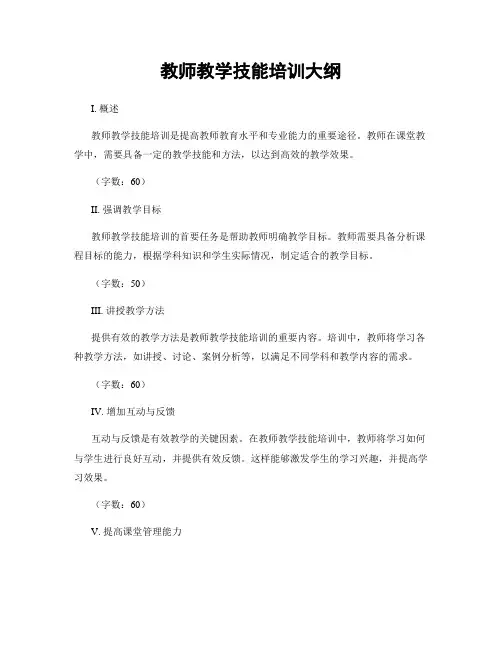
教师教学技能培训大纲I. 概述教师教学技能培训是提高教师教育水平和专业能力的重要途径。
教师在课堂教学中,需要具备一定的教学技能和方法,以达到高效的教学效果。
(字数:60)II. 强调教学目标教师教学技能培训的首要任务是帮助教师明确教学目标。
教师需要具备分析课程目标的能力,根据学科知识和学生实际情况,制定适合的教学目标。
(字数:50)III. 讲授教学方法提供有效的教学方法是教师教学技能培训的重要内容。
培训中,教师将学习各种教学方法,如讲授、讨论、案例分析等,以满足不同学科和教学内容的需求。
(字数:60)IV. 增加互动与反馈互动与反馈是有效教学的关键因素。
在教师教学技能培训中,教师将学习如何与学生进行良好互动,并提供有效反馈。
这样能够激发学生的学习兴趣,并提高学习效果。
(字数:60)V. 提高课堂管理能力良好的课堂管理是教师教学技能的重要组成部分。
在培训中,教师将学习课堂管理的基本原则和技巧,如如何建立秩序、提高学生参与度等,以提高课堂教学效果。
(字数:60)VI. 强调教师的专业素养除了教学技能,教师的专业素养也是培训的重要内容。
教师需要具备学科知识的扎实基础,了解最新的教育理论和研究成果,并不断提升自己的专业能力。
(字数:60)VII. 鼓励创新教学创新教学是提高教师教学技能的一种方式。
培训中,教师将学习如何运用新的教学技术和教育理念,开展创新教学实践,以提高教学效果和学生的学习兴趣。
(字数:60)VIII. 加强多元评价多元评价是了解学生学习情况的重要手段。
教师教学技能培训中,教师将学习如何进行多元评价,例如自我评价、同行评价、学生互评等,以更好地了解学生的学习进度和问题。
(字数:60)IX. 强化个性化教学个性化教学是适应不同学生差异的一种教学方式。
在教师教学技能培训中,教师将学习如何进行个性化教学,根据学生兴趣、学习能力等因素,制定个性化的教学计划和教学资源。
(字数:60)X. 教师专业发展教师在教学技能培训之后,应继续进行持续的专业发展。
《英语教学法教程》教案
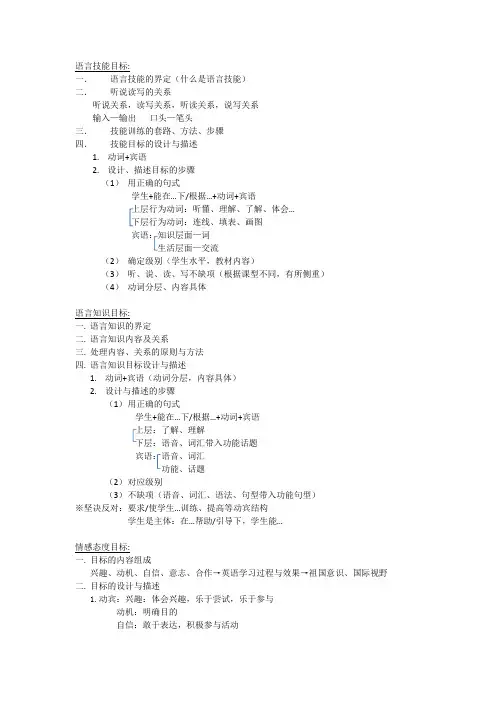
语言技能目标:一.语言技能的界定(什么是语言技能)二.听说读写的关系听说关系,读写关系,听读关系,说写关系输入—输出口头—笔头三.技能训练的套路、方法、步骤四.技能目标的设计与描述1.动词+宾语2.设计、描述目标的步骤(1)用正确的句式学生+能在…下/根据…+动词+宾语上层行为动词:听懂、理解、了解、体会…下层行为动词:连线、填表、画图宾语:知识层面—词生活层面—交流(2)确定级别(学生水平,教材内容)(3)听、说、读、写不缺项(根据课型不同,有所侧重)(4)动词分层、内容具体语言知识目标:一.语言知识的界定二.语言知识内容及关系三.处理内容、关系的原则与方法四.语言知识目标设计与描述1.动词+宾语(动词分层,内容具体)2.设计与描述的步骤(1)用正确的句式学生+能在…下/根据…+动词+宾语上层:了解、理解下层:语音、词汇带入功能话题宾语:语音、词汇功能、话题(2)对应级别(3)不缺项(语音、词汇、语法、句型带入功能句型)※坚决反对:要求/使学生…训练、提高等动宾结构学生是主体:在…帮助/引导下,学生能…情感态度目标:一.目标的内容组成兴趣、动机、自信、意志、合作→英语学习过程与效果→祖国意识、国际视野二.目标的设计与描述1.动宾:兴趣:体会兴趣,乐于尝试,乐于参与动机:明确目的自信:敢于表达,积极参与活动意志:勇于克服祖国意识、国际视野:愿意接触,初步/深刻了解,增强意识2.句式侧重点:小学:兴趣,在快乐中体验初中:动机、自信、合作、祖国意识、国际视野高中:意志力、祖国意识、国际视野应做到:找准教学对象对应的级别不缺项,把握不同级别的侧重点(激励积极,克服消极)使用目标描述基本句式情感态度目标在做事情、参与活动中实现学习策略目标:学习方法:构词法记忆、联想记忆、语音记忆、语境记忆学习策略:1.积累方法2.分析判断(自身学习策略、任务特征与要求、方法特征)3.做选择,做决定,做调整结论:方法是策略的基础,方法没有优劣,但选择有正误一. 策略的定义二. 策略目标的内容三. 策略目标的设计与描述动宾:认知:预习,复习,归纳,整理所学内容,记要点,使用图表等非语言信息,联想,集中注意力,自我纠错,阅读课外读物,借助母语正迁移调控:明确需要,确定目标,制定计划,反思不足,探索方法,交流体会资源:观察生活中使用的英语,借助工具书,利用网络、图书馆、音像资料交际:合作,请教,请求,倾听,交流,注意习俗差异应做到:1.找准教学对象对应的级别2.不缺项,把握不同级别/不同策略的侧重点3.使用目标描述的基本句式4.在具体学习行为中实现策略目标5.策略目标是具体化的学习行为方式文化意识目标:一. 内容:一级:文化知识:历史地理,风土人情,传统习俗,生活方式二级:文化理解、意识和态度:对文化差异的敏感度,对异域文化的包容三级:跨文化交际能力:语法性,可行性,得体性,现实性何时何地用何种方式对何人讲何话二. 设计与描述1.动宾:(1)知道/使用称谓语、问候语、告别语,了解体态、手势、表情(2)对赞扬,请求,道歉做出反应,正确表达赞扬,请求,道歉(3)区分西方人的男女姓名、昵称(4)了解人际交往习俗、饮食习俗(5)了解/介绍世界上主要的节假日及庆祝方式及文化习俗(6)知道世界文体活动(7)关注文化差异,加深理解(8)了解各国的首都、国旗、标志物、地理、气候、历史2.应做到:(1)定位找准级别(2)不缺项,把握侧重点(3)基本句式(4)文化意识在具体的功能话题提供的语境情境中实现任务设计方法确定任务目标:课程标准学生需求五个维度分解到活动步骤教材内容(单元内容、课时内容)确定任务活动类型:初级、单一、简单、学习性、练习性、输入性(机械操练、意义操练环节)高级、综合、复杂、交际性、任务性、输出性(交际性语言实践环节)编定任务名称:生活情景为主线,贯穿整个课堂,任务下串联教材中的各项活动活动设计:How long will it take?Will the students use the new language item?Will the students be interested in it?Will it be difficult for the students to carry it out?Is it best for pair work or group work? Listening or sorting?What skill is practiced?What is the purpose of this activity?规划任务活动:练习性活动→语言知识与技能准备(填表、拼图、分类、画图、写报告、排序)任务性活动→综合运用※输入与输出循环确定操作程序:活动的顺序:surprise 惊奇活动间的衔接:suspension 悬念S”心理角色分工等细节:satisfaction 满足调整任务难度:难度恰当,量度适宜,坡度适中,梯度刚好Code complexity 语码复杂性(完成任务所需词汇、句型的难度)Cognitive complexity 认识复杂性(认知能力的广度和深度)Communicative stress 交际压力(完成任务限定的时间、形式等对学生造成的压力)小结:1.任务就是活动,任务下的活动分为练习性与任务性2.由学生参与活动完成任务,而不是教师,教师的任务是设置情景,编定任务,规划活动3.在做任务的过程中,必须使用英语4.在做任务的过程中,交流双方必须有新信息的传递5.任务结束有成果6.学生通过做任务,由学语言知识、练语言技能到使用语言、发展思维能力,再到自我完善、自我教育英语课堂教学结构从课堂教学环节角度:导入呈现机械操练意义操练任务与活动交际产出巩固从语言知识角度:语言教学导入词汇教学↓句型教学呈现语法教学↓从语言技能角度:机械操练听的训练↓说的训练意义操练任务与活动读的训练↓写的训练交际产出从语言功能角度:↓功能话题教学巩固语篇阅读教学综合运用训练文化意识→上层(自上而下统领)功能话题应用→中层态度与策略影响效果知识学习与技能训练→下层结论:从功能话题出发,把语言知识与语言技能放到渗透着人文思想的语境情景中,设计与描述目标,借助方法策略以及良好的情感态度,通过做任务与活动,按六个环节进行课堂高效学习与训练。
基础英语教学大纲

基础英语教学大纲
引言:
英语作为全球通用的语言,在现代社会中扮演着非常重要的角色。
因此,教授基础英语的教学显得尤为重要。
本文将介绍一份基
础英语教学大纲,旨在帮助教师和学生达到理想的教学效果。
一、教学目标:
1. 帮助学生掌握英语的基本语法和句式结构。
2. 发展学生的听、说、读、写四项英语技能。
3. 培养学生的词汇量和语言运用能力。
4. 培养学生的自学能力和团队合作精神。
5. 培养学生的文化意识和跨文化交际能力。
二、教学内容:
1. 语法:教授基本的英语语法知识,包括时态、语态、疑问句、否定句等。
2. 句式结构:引导学生学习常见的句式结构,如主语+谓语、主语+谓语+宾语等。
3. 听力:通过听力活动提高学生的听力技能,包括理解对话、听取指令、听写等。
4. 口语:通过口语练习,提高学生的口语表达能力,让他们能够自信地进行日常对话。
5. 阅读:教授阅读技巧,提高学生的阅读理解能力,并帮助他们扩展词汇量。
6. 写作:引导学生进行简单的英文写作,包括日记、介绍人物或地点等。
7. 词汇:教授常用词汇和短语,帮助学生扩大词汇量并提高语言运用能力。
8. 文化:介绍英语国家的文化和习俗,增加学生的文化意识和跨文化交际能力。
三、教学方法:。
新技能英语 教学大纲
新技能英语教学大纲
教学大纲是课程教学设计的重要组成部分,它包括了课程的目标、内容、教学方法、评价方式等方面的安排。
针对新技能英语教
学大纲,我们可以从以下几个方面进行全面的回答:
1. 课程目标,新技能英语教学大纲首先需要明确课程的目标,
包括语言技能的培养、知识的掌握以及学生综合能力的提升。
这些
目标需要符合学生的年龄、学习水平和实际需求。
2. 课程内容,新技能英语教学大纲应当明确课程的内容安排,
包括听、说、读、写等语言技能的培养,以及相关的语法、词汇、
阅读材料和听力材料等方面的安排。
同时也要考虑到新技能英语的
特点,如口语表达能力、跨文化交际能力等方面的内容。
3. 教学方法,教学大纲需要说明教学方法和手段,包括课堂教学、课外活动、多媒体教学等方面的安排。
针对新技能英语的特点,可以采用任务型教学、沟通式教学等先进的教学方法。
4. 学习评价,教学大纲还应包括学习评价的方式和标准,包括
考试、作业、口语表达能力的评估等方面的安排。
评价方式应当能
够全面客观地反映学生的学习情况和能力水平。
5. 教学资源,最后,教学大纲还应包括教学资源的准备和利用,包括教材、多媒体设备、图书馆资源等方面的安排,以保障教学的
顺利进行。
综上所述,新技能英语教学大纲需要从课程目标、内容、教学
方法、评价方式和教学资源等方面进行全面的规划和安排,以确保
教学的有效开展和学生能力的全面提升。
初中英语大纲培训提纲
初中英语大纲培训提纲一、培训目标及原因1.培养学生的英语听、说、读、写的综合能力,提高其英语综合运用能力。
2.培养学生的跨文化交际能力,增强其国际视野和交流能力。
3.培养学生的自主学习能力,提高其学习英语的兴趣和学习效果。
二、培训内容1.听力训练a.培养学生的听力技巧和听力能力。
b.提高学生的听取关键信息的能力。
c.增强学生的听懂不同语调、口音、速度的能力。
2.口语训练a.提高学生的口语表达能力。
b.培养学生正确的语音、语调和语言节奏。
c.丰富学生的词汇量和语法知识。
d.提高学生的交流能力和语境适应能力。
3.阅读训练a.提高学生的阅读速度和阅读理解能力。
b.培养学生独立阅读的能力。
c.增强学生的词汇量、语法知识和阅读技巧。
4.写作训练a.增强学生的写作能力和写作表达能力。
b.培养学生的写作思维和组织能力。
c.提高学生的语法和拼写水平。
d.培养学生的写作习惯和规范。
5.文化意识训练a.培养学生的多元文化意识。
b.增加学生的国际视野和跨文化交际能力。
c.引导学生了解不同国家的风俗习惯和文化传统。
d.培养学生的尊重、理解和包容不同文化的态度。
三、培训教学方法1.集中培训a.采用集中授课的方式,注重知识的系统性和连续性。
b.引导学生主动参与课堂,提高学生的学习效果。
2.个别辅导a.根据学生的不同程度和能力,进行个别辅导和指导。
b.帮助学生解决具体问题和提高学习效果。
3.综合训练a.结合听、说、读、写,进行综合训练。
b.教师引导学生多角度、多层次对知识进行巩固和应用。
四、培训评估与反馈1.面试评估a.定期组织面试,对学生的口语和听力进行评估。
b.评估内容包括语音、流利度、词汇量和交流能力等。
2.阅读评估a.组织阅读测试,评估学生的阅读速度和理解能力。
b.评估内容包括词汇量、语法和阅读技巧等。
3.写作评估a.布置写作作业,对学生的写作水平和表达能力进行评估。
b.评估内容包括语法、拼写、写作思维和组织能力等。
最新王蔷主编的《英语教学法教程》第二版-Unit 1教学提纲
Unit 1 Language and Language LearningAims of the unitIn this unit we will discuss some general matters about language learning and teaching. We are going to discuss five questions on particular:1.How do we learn language?2.What are the common views on language?3.What are the common views on language learning?4.What are the qualities of a good language teacher?5.How can one become a good language teacher?1.1How do we learn languages?Mach of human behavior is influenced by their experiences. The way language teachers teach in the classroom is to some extent influenced by the way they learned languages. This is especially true in foreign language teaching. Before we discuss language learning theories, let us first reflect on our own language learning experience.Task 1Below is a list of interview questions on how people learn a foreign language. In the first column, write down your own responses. Then interview three other students in your class and enter their responses in the other columns. Discuss your findings inFrom the above task, you may have found that 1) people started learning a foreign language at different ages; 2) people have different experiences in learning a foreign language, some find it easy, some find it difficult; 3) people learn languages for different reasons; 4) people learn languages in different ways; 5) people have different understandings about language learning; 6) people have different capacities inlanguage learning; 7) learning can be affected by the way it is taught; 8) learning is affected by the degree of success one is expected to achieve; and more. Thus the challenge confronting language teaching is how teaching methodology can ensure successful learning by all the learners who have more differences than the commonality.1.2views on languageThe question that all approaches to language teaching should answer is, ‘what is language?’The answer to this question is the basis for syllabus designs, teaching methodology, teaching and assessment procedures in the classroom. Different views on language generate different teaching methodologies.Task 2Work in group of 4. Brainstorm possible answer to the question: what is language?To give a concise definition of language has always been difficult for linguists and philogists. Although there has been an enormous amount of research in language in the past century, no authoritative answer has been given to ‘what is language?’ rather, people have settle down to talk about views of language, seemingly allowing for or accepting different theories for the moment. However, language teachers clearly need to know generally what sort of entity they are dealing with and how the particular language they are teaching fits into that entity (Brown, 1994a). for sample definition of ‘language’ , please refer to Appendix 1.Structural viewThe structural view of language sees language as a linguistic system made up of various subsystems (Larsen-Freeman & Long, 1991): the sound system (phonology); the discrete units of meaning produced by sound combinations (morphology), and the system of combining units of meaning for communication (syntax). Each language has a finite number of such structural items. To learn a language means to learn these structural items so as to be able to understand and produce language. When this structural view of language was combined with the stimulus-response principles of behaviorist psychology, the audio-lingual approach to language learning emerged. Functional viewIn the 1960s, British linguists developed a system of categories based on the communicative needs of the learner (Johnson and Marrow, 1981) and proposed a syllabus based on communicative functions. The functional view not only seeslanguages as a linguistic system but also a means for doing things. Most of our day-to-day language use involves functional activities: offering, suggesting, advising, apologizing, etc. therefore, learners learn a language in order to be able to do with it. In order to perform functions, learners need to know how to combine the grammatical rules and the vocabulary to express notions that perform the functions. Examples of notions are the concept of present, past and future time, the expressions of certainty and possibility, the roles of agents, instruments with a sentence, and special relationships between people and objects.Interactional viewThe interactional view considers language to be a communicative tool, whose main use is to build up and maintain social relations between people. Therefore, learners not only need to know the grammar and vocabulary of the language but as importantly they need to know the rules for using them in a whole range of communicative contexts.These three views present an ever wider view of language. The structural view limits knowing a language to knowing its structural rules and vocabulary. The communicative or notional-functional view adds the need to know how to use the rules and vocabulary to do whatever it is one wants to do. The interactional view says that to know how to do what you want to do involves also knowing whether it is appropriate to do, and where, when and how it is appropriate to do it. In order to know this, you have to study the patterns and rules of language above the sentence level to learn how language is used in different speech contexts.The understanding of the nature of language may provide the basis for a particular teaching method (Richard and Rodgers, 1986), but more importantly, it is closely related to the understanding of language learning. If language is considered to have a finite number of structural items, learning the language probably means learning these items. If language is more than just a system of structures, it is more importantly a tool then to learn the language learning. If language is more than just a system of structures, it is more importantly a tool, then to learn the language means to use it, rather than just study what it is and how it is formed. The next section discusses some current theories about language learning.1.3 Views on Language learning and learning in generalA language learning theory underlying an approach or method usually answers two questions; 1) What are the psycholinguistic and cognitive processes involved in language learning? 2) What are the conditions that need to be met in order for these learning processes to be activated?Task3Work in groups of 4. Brainstorm the answers to the two questions stated above. When you are ready, join another group and share your ideas.Although these two questions have never been satisfactorily answered, a vast amount of research has been done from all aspects. The research can be broadly divided into process-oriented theories and condition-oriented theories. Process-oriented theories are concerned with how the mind organizes new information such as habit formation, induction, making inference, hypothesis testing and generalization. Condition-oriented theories emphasize the nature of the human and physical context in which language learning takes place, such as the number of students, the kind of input learners receive, and the atmosphere. Some researchers attempt to formulate teaching approaches directly from these theories. For example, the Natural Approach, Total Physical Response, and the Silent Way are based on one or more dimensions of processes and conditions. At this level, it is too early to formulate a specific approach, because some aspects are still too vague, for example, what is done in these processes. Behaviorist theoryThe behaviorist theory of language learning was initiated by behavioural psychologist Skinner, who applied Watson and Raynor’s theory of conditioning to the way human acquire language (Harmer, 1983). Based on their experiments, Watson and Raynor formulated a stimulus-response theory of psychology. In this theory all complex forms of behavior—motions, habits and such—are seen as composed of simple muscular and glandular elements that can be observed and measured. They claimed that emotional reactions are learned in much the same way as other skills. The key point of the theory of conditioning is that ‘you can train an animal to do anything (within reason) if you follow a certain procedure which has three major stages, stimulus, response, and reinforcement’ (Harmer, 1983:30).Based on the theory of conditioning, Skinner suggested that language is also a form of behavior. It can be learned the same way as an animal is trained to respond to stimuli. This theory of learning is referred to as behaviorism, which was adopted for some time by the language teaching profession, particularly in the U.S. One influential result is the audio-lingual method, which involves endless’ listen and repeat’ drilling activities. The idea of this method is that language is learned by constant repetition and the reinforcement of the teacher. Mistakes were immediately corrected, and correct utterances were immediately praised. This method is still used in many parts of the world today.Cognitive theoryThe term cognitivism is often used loosely to describe methods in which students are asked to think rather than simply repeat. It seems to be largely the result of Noam Chomsky’s reaction to Skinner’s behaviorist theory, which led to the revival ofstructural linguistics. The key point of Chomsky’s theory is reflected in his most famous question: if all language is a learned behavior, how can a child produce a sentence that never been said by others before?According to Chomsky, language is not a form of behavior, it is an intricate rule-based system and a large part of language acquisition is the learning of this system. There are a finite number of grammatical rules in the system and with a knowledge of these an infinite number of sentences can be produced. A language learner acquires language competence which enables him to produce language.Though Chomsky’s theory is not directly applied in language teaching, it has had a great impact on the profession. One influential idea is that students should be allowed to create their own sentences based on their understanding of certain rules. This idea is clearly in opposition to the audio-lingual method.Although people are pretty much still in the dark as to what language is and how language is learned, it is believed that general knowledge about language and language learning will help language teachers do a better job.Constructivist theoryThe constructivist theory believes that learning is a process in which the learner constructs meaning based on his/her own experiences and what he/she already knows. Although constructivist theory was not developed for the understanding of language learning, it is widely applicable to learning in general. It is believed that education is used to develop the mind, not just to rote recall what is learned. John Dewey provided a foundation for constructivism. He believed that teaching should be built based on what learners already knew and engage learners in learning activities. Teachers need to design environments and interact with learners to foster inventive, creative, critical learners. Therefore, teachers must balance an understanding of the habits, characteristics as well as personalities of individual learners with an understanding of the means of arousing learner’s interests and curiosity for learning (Archambault, 1964).Socio-constructivist theorySimilar to constructivist theory, socio-constructivist theory represented by Vygotsky (1978) emphasizes interaction and engagement with the target language in a social context based on the concept of ‘Zone of Proximal Development’(ZPD) and scaffolding. In other words, learning is best achieved through the dynamic interaction between the teacher and the learner and between learners. With the teacher’s scaffolding through questions and explanations, or with a more capable peer’s support, the learner can move to a higher level of understanding and extend his/her skills and knowledge and knowledge to the fullest potential.1.4 What makes a good language teacher?Some people with an excellent command of a foreign language may not be able to teach the language well while others with a general command of the language can teach it very effectively. What do you think might account for this phenomenon? Task 4Work in groups. Reflect on your own learning experience from early school years to the university. Have you had an excellent English teacher? Try to identify as many qualities as possible of your best English teacher(s). Note down all the qualities thatIt is clear that whether someone can become a good foreign language teacher does not solely depend on his\her command of the language. There are a variety of elements that contributes to the qualities of a good language teacher. These elements can be categorized into three groups: ethic devotion, professional qualities and personal styles (Parrot, 1993).Task 5Ethic devotion, professional qualities and personal styles jointly contribute to the making of a good English teacher. All the adjectives in the box below could be used to characterize these three aspects.1. Work in groups of 4 and decide which adjectives describe ethic devotion, whichdescribe personal styles and which describe professional qualities. Please write your answers on a separate piece of paper.2. Add any adjectives to the list which describe further qualities that you feel aremissing.3.These adjectives are intended to describe positive qualities or styles. Do you feelthat any of them could have a negative side as well? If yes, in what way? For example, an authoritative teacher may make the students feel assured, but may also make the student less free to disagree with him\her.From the above activities we can see that a good English teacher should have ethicdevotion, certain desirable personal styles, and more importantly, he or she should have necessary professional qualities. These three aspects constitute the professional competence of a good English teacher. A person who has a good command of English is not necessarily a good teacher because he has only one of the elements of professional competence.It is assumed that all responsible English teachers have ethic devotion, and they are supposed to make their personal styles compatible with their work. These two aspects, which are beyond the scope of this book, can be achieved as long as the teacher himself\herself has the willingness to do so.A question that many teachers often ask is: I like my job, and I love the students, but how can I become a good English teacher? Our answer is that they need professional competence, which we are going to discuss in the next section.1.5How can one become a good language teacher?The most important and most difficult part of the making of a good language teacher is the development of professional competence, which is the state or quality of being adequately qualified for the profession, and armed with a specific range of skills, strategies, knowledge, and ability.Task 6Work in pairs and discuss how one can become a professionally competent teacher of English. For example, we have to develop our English proficiency first and also we may need to learn from experienced teachers through observations. What else can you think of? Make a list and then pool all your ideas together to find out about your common beliefs.A language teacher’s professional competence is much more difficult than a driver’s skill to handle a car, and is more complicated than a student’s competence of speaking foreign language. It involves more factors and longer learning time, and may never be finished.Some people think teaching is a craft; that is, a novice teacher can learn the profession by imitating the experts’ techniques, just like an apprentice. Others hold the view that teaching is an applied science, based on scientific knowledge and experimentation. By making a compromise between these two views, Wallace (1991) uses a “reflective model” to demonstrate the development of professional competence. The followi ng model is an adapted version to illustrate the process of becoming a professionally competent teacher.(Adapted from Wallace, 1991:15)From the above model, we can see the development of professional competence for a language teacher involves Stage 1, Stage 2 and Goal. The first stage is language development. All English teachers are supposed to have a sound command of English. As language is the subject matter for language teachers and also because language is always changing, language development can never come to an end.The second stage is the most crucial stage and it is more complicated because it involves three sub-stages: learning, practice, and reflection. The learning stage is actually the purposeful preparation that a language teacher normally receives before he\she starts the practice of teaching. This preparation can include:1. learning from others’experiences (empirical knowledge gained through readingand observations)2. learning the received knowledge (language learning theories, educationalpsychology, language teaching methodology, etc.)3.learning from one’s own experiences as a learnerBoth experiential knowledge (others’and one’s own) and received knowledge are useful when a teacher goes to practice. This is the combination of ‘craft’ and ‘applied science’ knowledge. The learning stage is followed by practice. The term ‘practice’can be used in two senses. In one sense, it is a short period of time assigned to do teaching practice as part of one’s pre-service education, usually under the supervision of instructors. This practice is also called pseudo practice. The other sense of ‘practice’ is the real classroom teaching that a teacher undertakes after he/she finishesformal education.Teachers benefit from practice if they keep on reflecting on what they have been doing (Stanely, 1999). It should be noted that teachers reflect on their work not only after they finish a certain period of practice, but also while they are doing the practice.When the would-be teachers(trainees) are doing pseudo practice, they are often trying out ideas that they have learned in a methodology class. Therefore, they are likely to reflect on how well a certain idea or technique works and often their instructors may require them to do so. The pseudo practice is beneficial only if the student teachers take reflections seriously. The most difficult thing is to keep on reflecting on one’s work when one moves on to real classroom teaching.Ideally, a teacher should be able to attain his/her professional competence after some period of practice and reflection as shown in Figure 1.1. However, professional competence as an ultimate goal does not seem to have an end. With the ever-deepening of our understanding of teaching and learning, and with the ever changing needs of the society, of education, of students, and of the teaching requirements, one must keep on learning, practicing and reflecting. Actually professional competence is’ a moving target or horizon, towards which professionals travel all their professional life but which is never finally attained ‘. (Wallace, 1991:58)Task 7Work in groups. Discuss possible answers to the following questions in relation to the model presented in Figure 1.1.1.6 An overview of the bookThis second edition of A Course in English Language Teaching has allowed us the opportunity to expand the original 14 units into 18 in order to include topics reflecting the recent development in English language teaching both at home and abroad, to revisit a number of areas, to expand an clarify points that we felt were not sufficiently clear in the first edition, and to improve the pedagogical usefulness of the text. Overall, the book aims at introducing practical methods to teachers of English as a foreign language with some basic theories presented in the first two units. It is hopedthat classroom teachers or would-be teachers will not simply copy or imitate what are suggested but be able to choose or adapt with an understanding of why.Unit 1 serves as an introduction for setting the scene for this methodology course. It discusses issues concerning views on language and language learning or learning in general with the belief that such views will affect teachers’ways of teaching and thus learners’ ways of learning. The qualities of a good language teacher is also discussed in order to raise the participants’ awareness of what is required for a good English teacher.Communicative Language Teaching (CLT) and Task-based Language Teaching (TBLT) have been the most influential language teaching approaches in the past two decades and they have proven to be effective in a variety of language teaching contexts. In Unit 2 we introduce the basic principles of CLT and activities followed by an introduction to task-based approach. It is intended that most of the methods that we introduce in the remaining units will, to some extent, follow a communicative approach and task-based language teaching.Unit 3 is a new unit which focuses on the new National English Curriculum. It begins with a brief overview of the history of English language teaching in China followed by tasks and discussions on the goals, objectives, and design of the new English curriculum and ends with discussions on the challenges facing teachers today.We have arranged lesson planning and classroom management as the next two units of the book-Unit 4 and Unit 5 respectively. With regard to these two units, the new edition has replaced some previous lesson plan samples and added some relevant issues, i.e. giving effective instructions, asking effective questions, and dealing with students’ errors in the classroom. To have these two parts in the early units, our intention is that the reader will use what is covered in these two parts in the early units, our intention is that the reader will use what is covered in these two units to design mini classroom activities for the teaching of knowledge and skills that come in later units.Like the first edition of the book, Units 6, 7 and 8 focus on the teaching of language components, that is, the teaching of pronunciation, grammar, and vocabulary, while Units 9, 10, 11, 12 focus on the teaching of four skills of language, namely, listening, speaking, reading and writing, with Unit 13 discussing the integration of the four skills. Some new examples and new points are added to all these units in the new edition. It should be noted that neither the language components nor the language skills are taught in an isolated fashion. We present the teaching of these language components and skills in separate units so that there is a clearer focus of discussion. In classroom teaching, we hope teachers will be able to integrate all areas.Unit 14 is about moral education. This is a new unit aiming at raising teachers’学习资料awareness of the scope available for moral education in language teaching so that teachers will be able to create opportunities and use relevant materials and activities to help students form positive social values towards life and work.Unit 15 deals with language assessment. We have avoided ‘testing’ and ‘examination’as our unit title because we believe ‘assessment’ is a broader concept. In this unit we focus on classroom assessment rather than standard tests. Research evidence shows that classroom-based assessment provides a better evaluation of what the students have achieved during the course of study.Units 16 and 17 are also new units. Unit 16 is about learner differences and learner training. As the purpose of teaching is for learning to take place, learners will needto play a major role in the learning process. We think as teachers we need to understand learners and the differences among them so that appropriate methods and techniques can be selected or designed to cater for learner needs. Also, we teach in order not to teach. In this sense, we need to help learners develop awareness of different learning strategies and learn to take responsibility for their own learning . Unit 17 focuses on using and creating resources. It discusses how to use the available resources as well as how to explore hidden resources for teaching and learning.Unit 18 introduces the reader to the most basic things in the evaluation, selection and adaptation of textbooks used in language teaching and learning. In the future, classroom teachers will have to take more responsibility and be given more autonomy in selecting and adopting ELT textbooks for their students.Throughout the book, we provide a number of tasks for each unit. The tasks usually follow a discussion and are aimed at providing the reader with opportunities to relate theory to practice. Most of the tasks are open-ended, that is, they do not have fixed answers or solutions. Sometimes, discussions following the task provide the authors’further comments. Occasionally, some tasks seem to need more ‘concrete’ solutions. In that case, we remove the solutions to Appendix 1 at the back of the book. We intend that users of the book should solve the problems themselves before referring to the authors’ suggested solutions.Most of the tasks involve group work or pair work. If the book is used in class, we consider it very important for students to work in pairs or groups so that they can share knowledge and experience. Individual readers may find it inconvenient to perform the task. We suggest that they discuss the problems with their colleagues wherever possible.精品文档。
英语教学法教程-复习提纲
Unit 1 Language and Learning1. Language:” Language is a system of arbitrary vocal symbols used for human communication.” It can be understood in the following six aspects: Language as system;Language as symbolic;Language as arbitrary;Language as vocal;Language as human;Language as communication2. Structural view:The structural view sees language as a linguistic system made up of various subsystems: from phonological, morphological, lexical, etc. to sentences.3. The functional view:The functional view sees language as a linguistic system but also as a means for doing things. Most of our day-to-day language use involves functional activities: greetings; offering, suggesting, advising, apologizing, etc.4. The interactional view:The interactional view considers language as a communicative tool, whose main use is to build up and maintain social relations between people.5. The language learning theory underlying an approach or method usually answers two questions:1) What are the psycholinguistic and cognitive processes involved in language learning?2) What are the conditions that need to be met in order for these learningprocesses to be activated?6. Although these two questions have never been satisfactorily answered,a vast amount of research has been done from all aspects, which can be broadly divided into process-oriented theories andcondition-oriented theories.1) Process-oriented theories are concerned with how the mindprocesses new information, such as habit formation, induction,making inference, hypothesis testing and generalization.2) Condition-oriented theories emphasize the nature of the human andphysical context in which language learning takes place, such as thenumber of students, what kind of input learners receive, and thelearning atmosphere.7. Two theories:Some researchers attempt to formulate teaching approaches directly from these theories.1) The behaviorist theory( Skinne r)-- a stimulus-response theory of psychologyThe key point of the theory of conditioning is that "you can train an animal to do anything (within reason) if you follow a certain procedure which has three major stages, stimulus, response, and reinforcement"2) Cognitive theory( Noam Chomsky):The term cognitive is to describe loosely methods in which students are asked to think rather than simply repeat.8. A variety of elements that contribute to the qualities of a good language teacher:1) ethic devotion,道德素质2) professional qualities专业技能3) personal styles个人修养Adjectives which describe further qualitiesWallace‟s(1991)"Reflective model" to demonstrate the development of professional competence(两种测试法:叙述/填表)Wallace‟s(1991)"Reflective model"Stage 1 Stage 2GoalFrom the above model, we can see the development of professionalcompetence for a language teacher involves Stage 1, Stage 2, andGoal. The first stage is language training. All English teachers aresupposed to have a sound command of English. Of course, language is always changing so language training can never come to an end.The second stage seems to be more complicated because it involvesthree sub-stages:learning, practice, and reflection. The learningstage is actually the specific preparation(that a language teachershould make before they go to practice.)This preparation can be:1). learn from others' experience (empirical knowledge来自经验的知识)2). learn received knowledge (such as language theories,psycholinguistics, sociolinguistics, educational psychology,language teaching methodology, etc.)3). learn from one's own experienceBoth experiential knowledge (others' and one's own) and receivedknowledge are useful when the teachers go to practice. This is thecombination of "craft" and "applied science". The learning stage isfollowed by practice. The term "practice" can be used in two senses.In one sense, it is a short period of time assigned for student teachersto do teaching practice as part of their education, usually under thesupervision监督of their instructors. This practice is also calledpseudo practice. The other sense of "practice" is the real work that the teacher undertakes when he finishes his education.Unit 2 Communicative Principles and Activities10. The ultimate goal of foreign language teaching is to enable thestudents to use the foreign language in work or life when necessary.11. The goal of CLTThe goal of CLT is to develop students' communicative competence,12. Communicative competence:Competence simply means knowledge of the language system:grammatical knowledge in other words.13. Hymes (1979), communicative competence includes four aspects: 1) knowing whether something is formally possible (grammaticallyacceptable), which is roughly equivalent to Chomsky's linguisticcompetence交流内容是否规范2) knowing whether something is understandable to human beings;3) knowing whether something is in line with与、、、有关social norms;4) knowing whether something is in fact done: Do people actually use language this way?14. Based on the concept of communicative competence and aiming at developing such competence, communicative language teaching has the following features:1) It stresses the need to allow students opportunities for authentic andcreative use of the language.2) It focuses on meaning rather than form.3) It suggests that learning should be relevant to the needs of the students.4) It advocates提倡task-based language teaching. Students should begiven tasks to perform or problems to solve in the classroom.5) It emphasizes a functional approach to language learning (i.e. whatpeople do with language,such as inviting, apologizing, greeting and introducing, etc.).15. Richards and Rodgers(1986:72)three principles of Communicative language teaching1) Communication principle: Activities that involve real communication promote learning.2) Task principle: Activities in which language is used for carrying outmeaningful task promote learning.3) Meaningfulness principle: Language that is meaningful to the learnersupports he learning process.16. Littlewood’s (1981)classification of communicative activities:1). Functional communicative activities:2). Social interaction activities:(1). Functional communicative activities:~ Identifying pictures~ Discovering identical pairs~ Discovering sequences or locations~ Discovering missing information~ Discovering missing features~ Discovering "secrets"~Communicating patterns and pictures~ Communicative models~ Discovering differences~ Following directions~ Reconstructing story-sequences~ Pooling information to solve a problem(2). Social interaction activities:~ Role-playing through cued dialogues~Role-playing through cues and information~Role-playing through situation and goals--Role-playing through debate or discussion~ Large-scale simulation activities~ Improvisation17.Ellis (1990) has listed six criteria for evaluating communicative classroom activities:1). Communicative purpose:2). Communicative desire:3). Content, not form:4). Variety of language:5). No teacher intervention:Unit 3 Lesson Planning18. Lesson planningLesson planning means making decisions in advance about what techniques, activities and materials will be used in the class.19. Why is lesson planning necessary?Proper lesson planning is essential for both novice/beginner and experienced teachers.20. Benefit from lesson planning in a number of ways1). A clear lesson plan makes the teacher aware of the aims and languagecontents of the lesson.2). It also helps the teacher to distinguish the various stages of a lessonand to see the relationship between them so that the lesson can move smoothly from one stage to another.3). The teacher can also think about how the students can be fullyengaged in the lesson.4). when planning the lesson, the teacher also becomes aware of theteaching aids that are needed.5). Lesson planning helps teachers to think about the relative value ofdifferent activities and how much time should be spent on them.6). The teacher soon learn to judge lesson stages and phases with greater accuracy.7). Plans are also an aid to continuing improvement.8). After the lesson, the teacher can add an evaluation to the plan,identifying those parts which went well and those which were lesssuccessful.21. There are four major principles behind good lesson planning:1) variety,2) flexibility,,3) learnability,4) linkage.23. Definitions of variety, flexibility, learnability, and linkage.Variety means planning a number of different types of activities and where possible introducing students to a wide selection of materials so that learning is always interesting, motivating and never monotonous for the students.Flexibility means planning to use a number of different methods and techniques rather than being a slave to one methodology. This will make teaching and learning more effective and more efficient.Learnability means the contents and tasks planned for the lesson should be within the learning capability of the students. Of course, things should not be too easy either. Doing things that are beyond or below the students' coping ability will diminish their motivation (Schumann, 1999).Linkage means the stages and the steps within each stage are planned in such a way that they are somehow linked with one another. Language learning needs recycling and reinforcement.24. Lesson planning should be done at two levels: Macro planning and micro planning:The former is planning over time, for instance, the planning for a month,a term, or the whole course.The latter is planning for a specific lesson, which usually lasts 40 or 50 minutes.25.Macro planning involves:1) Knowing about the course:2) Knowing about the institution:3) Knowing about the learners:4) Knowing about the syllabus:26. The advantage of a concrete teaching plan:Teachers can follow it in the class and check what they have done;The plan will be the basis of a record of what has been covered in class;It will make it easier to make achievement tests later;It will be good records for the entire course.27. What does a lesson plan include? Three components:Teaching aims,Language contents and skills,Teaching stages and procedures.28. The aims of a lesson include:language components to present,communicative skills to practice,activitie s to conductmaterials to be usedteaching aids to be used.29. Language components and skills:By language contents, we mean structures (grammar), vocabulary, functions, topics and so on. By language skills, we mean communicative skills involved in listening, speaking, reading and writing.30. Teaching stages and procedures:Teaching stages are the major steps that language teachers go through in the classroom. Procedures are the detailed steps in each teaching stage.31. Three P's model: presentation, practice and production.(At the presentation stage, the teacher introduces new vocabulary and grammatical structures with reference to their contextualized use.At the practice stage, the lesson moves from controlled practice toguided practice and further to the exploitation of the texts whennecessary.At the production stage, the students are encouraged to use what they have learned and practiced to perform communicative tasks. At this last stage, the focus is on meaning rather than formal accuracy.)32. Another 3-stages frequently advised and adopted in reading lessons: Pre-reading,while-readingpost-reading stages.(This model is also often applied in listening lessons, which havepre-listening, while-listening and post-listening stages.)35. When presenting a new structure (presentation stage), a teacherneeds to consider the following:1) when to focus on the structure and2) when to study it in context;3) whether to present the structure orally or in written form;4) when to give out information and when to elicit from students;5) when and how to use visual aids to help with the presentation;6) what to do if students fail to understand.36. Sample lesson plans 1I. AIMS: a). b). c)….(include function)II. CONTENTS1. PRONUNCIATION2. NEW LEXIS: a). b). c)….3. STRUCTURE/GRAMMAR: a). b). c)….III.TEACHING AIDS:IV. PROCEDURES ( It should be specific )1. WARM-UP (3 minutes): a). b).2. PRESENTATION (approx. 7 mins): a). b). c)….3. EXPLOITATION (approx. 10 mins): a). b). c)….4. PERFORMANCE (approx. 15 mins): a). b). c)….5. OTHER ACTIVITIES: Check yesterday's homework (approx. 5 mins).6. Set homework, page 73, ex. 4.7. RESERVE ACTIVITY: Substitution, game-like:V. COMMENTS: (Filled in immediately after the lesson). a). b).c)….Sample lesson plan 2I. AIMS: a) b) c) .(include function)II. CONTENTS1. NEW VOCABULARY: three new lexical items2. NEW STRUCTURE: How about-ing ...? Function: making suggestion.3. ADDITIONAL LANGUAGE: Declining: I don't feel like -ing. III. VISUAL AIDS: Set of flashcards with suggestionsIV. PROCEDURE1. WARM-UP: Game (3 minutes), Going on a Picnic: You bringa/the/some ...!2. PRESENTATION (approx. 10 mins)a) New vocabulary: (three new lexical items above)b) New structure (flash cards)c) First model, spoken (BB drawings of speakers)3. PRACTICE (approx.15 mins)a) Repetition drill (backward build-ups)b) Cued substitution, chorus workc) Public pairs: cued acceptance/refusal and counter suggestions (flash cards)d) Ditto. Books closede) Public check3. PRODUCTION (to end of lesson, 17 mins)a) Public pairs, new suggestions.b) Private pair role play; New suggestion, counter suggestions, agreeing weekend activities.c) Acting out. Volunteer pairs.d) Write out created dialogues.4. HOMEWORK: Complete writing of dialogues.(5. RESERVE ACTIVITY: none)V. COMMENTS: (Filled in immediately after the lesson).Unit 4 Classroom Management37. Teachers’ roles:Before the class---PlannerDuring the class---1 Controller, 2 Assessor, 3 Organizer4 Prompter ,5 Participant,6 Resource-providerAfter the class---Evaluator38. Further comments on the different roles that the teachers play in thelanguage classroom:Controller: The teacher controls:1). the space (activities run smoothly),2) .the time (do lockstep activities)3. the whole class (Ss have equal chance)4. the production ( a degree of accuracy)Assessor: The teacher does two things:1). Correcting mistakes (not making a big fuss大惊小怪but gentle byHarmer)2). Organizing feedback (discouraging for the teacher to be critical不提倡吹毛疵, focusing on Ss‟ success progress) Organizer: The teacher should be important and difficult as it:1). Using creative/unlimited way2). Envisaging设想activities,3). Anticipating the problems4). Giving clear and concise instructions5). Demonstrating6 .Using native language to clarify if necessary7. Walking around and monitoring8. Rectifying订正9. Taking mental notes轮流惦记Prompter: The teacher shoulddo:1). Giving hints (just like time, place…)2). Eliciting more (by saying” and…?”“Anything else?” Yes, but why…?(Ss. read the example)Participant:The teacher shouldn‟t dominate or appear to be authoritative. Resource-provider:We have criticized the jug-and-mug method, but the teacher shouldwithhold his/her readiness to provide resources.39. What are the most common types of Ss grouping? And their definitions?Lockstep,Pair work,Group work,Individual study:40. Further suggestions about S groupingLockstepTeacher speaking little, Trying to elicit replies/answers Pair work:Teacher giving clearest instructions,Demonstrating,Keeping eyes on,Rearranging the seating,Explaining the problem,Encouraging SsGroup work:Grouping Ss according to seating arrangement,Ss selecting their own group members,Mixing strong and weak Ss,Giving different tasks to strong and weak Ss separately,Grouping Ss by drawing lots,All these methods have advantages and disadvantages.Individual study: It has some conditions: 1. Self-access centers,2. Materials aimed atself-instruction,3. Flexible time arrangement 41. Harmer’s suggestions on measures for undisciplined acts and badlybehaving Ss:1). Act immediately2). Stop the class3).Rearrange the seats4).Change the activity5).Talk to Ss after class6).Use the institution制度42. In order not to hurt the Ss, Ur’s advice on problems in class:1).Deal with it quietly2).Don‟t take things personally 对事不对人3).Do not use threatsUnit 5 Teaching Pronunciation43. The goals of teaching pronunciation:目的Consistency 连贯性: To be smooth naturalIntelligibility可理解性:To be understandable to the listenersCommunicative efficiency: To help convey the speakers‟ meaning44. Three aspects of pronunciation to teach? Stress, intonation, rhythm45. One common problem in learning English of Ss: (Neglect stress and intonation)46. Ways of practicing soundsand their definitions:Focusing on a sound 单音练习:(sounds difficult to learn)Perception practice 知觉/领会性练习:( identify /distinguish different sounds)Production practice 生成性练习: (develop Ss‟ ability to produce sounds)47. Six types of production practice activities:(1). Listen and repeat(2). Filling the blanks(3). Make up sentences(4). Use meaningful context(5). Use pictures(6). Use tongue twister48. Practicing stress:1).Two kinds of stress: word-level stress ; phrase-level stress2).Three ways to show stress pattern of words: Use gestures, use thevoice, use the blackboard49. Practicing intonation:1). The re are many subtle ways: surprise, complaint, …sarcasm讥讽,friendliness, threats etc.2). Two ways to make intonation: rising/falling arrows; draw linesUnit 6. Teaching Grammar50. What are grammar presentation methods? 演示法Deductive method演义/推论法; Inductive method归纳/诱导法51. Deductive method1). Definition: It relies on reasoning, analyzing and comparing.2). Steps: giving rules/definition------giving examplesFor example: (plural) “-s” s, x, ch.“-es” …y. –iesa book a busa bodybooks busesbodies3). Advantages:To be successful withselected and motivated主动的students;To save time;To help to increase students‟ confidence in some exam.4). Disadvantages: To teach grammar in the isolated way;To pay little attention to meaning;To be often mechanical practice.52. Inductive method1).Definition: It relies on inducing诱导2). Steps: give examples-----induce rules3). For example:(plural)“-s” s, x, ch. “-es” …y. –iesa book a busa bodybooks busesbodies4). Advantages:Inductive method is more effective in that studentsdiscover the grammar rules themselves while engaged in language use, 53. Ur’s definition of grammar practice:"Practice may be defined as any kind of engaging with结合/保证the language on the part of the learner, usually under the teacher supervision,whose primary objective(aim/task) is to consolidate learning "(Ur, 1988:11).54. Ur’s six factors contribute to successful grammar practice:1) Pre-learning.2) Volume and repetition(容量/重复).3) Success-orientation成功性联系.4) Heterogeneity多样性.5) Teacher assistance.6) Interest.55. Two categories of grammar practice: Mechanical practiceMeaningful practice.1).Mechanical practice involves activities that are aimed at form accuracy.Two drills in mechanical practice:(1) Substitution drills in mechanical practice: the students substitute apart in a structure so that they get to know how that part functions in a sentence. Sometimes certain prompts are given.For example (p64):(2) Transformation drills in mechanical practice::the students changea given structure in a way so that they are exposed to another similarstructure. The type of exercise also helps the students to have a deeper understanding of how the structures are formed and how they are used.For example (p65):2).Meaningful practice.In meaningful practice the focus is on the production, comprehension or exchange meaning though the students "keep an eye on" the waynewly learned structures are used in the process. Meaningful practice usually comes after mechanical practice.56. Using prompts for meaningful practice: (提示/刺激物,题词). This kind of practice is usually meaningful practice1). Using picture prompts. Ss produce sentences based on the pictures provided2). Using mime or gestures as prompts.produce language based on pictures and key phrases (words)provided by the teacher.For example(p69).5). Using chained phrases for story telling. Here is an example.7 o'clock -- got up -- had breakfast -- hurried to school -- school closed-- surprised --?6). Using created situations.Unit 7 Teaching Vocabulary57. The role of vocabulary uncertainty still remains regarding(about)What constitutes(组/构成)a vocabulary item,Which vocabulary items should be taught and learned, andHow vocabulary can be taught and learned most effectively.58. Seven suggestions helping teachers to present new words:1). Prepare examples to show meaning.2). Ask students to tell the meaning first.3). Think about how to show the meaning of a word with related wordssuch as synonyms, antonyms etc.4). Think about how to check students' understanding.5). Think about the context in real life where the word might be used.6). Think about possible misunderstanding or confusion that student may have.59. How do you present and explain vocabulary if you are a teacher? (Ways to present and explain vocabulary):l) Draw pictures, diagrams and maps to show meanings or connection of meanings;2) Use real objects (realia) to show meanings;3) Mime or act to show meanings, e.g. brushing teeth, playingPing-Pong;4) Use synonyms or antonyms to explain meanings;5) Use lexical sets, e.g. cook: fry, boil, bake, and grill;6) Translate and exemplify, especially with technical words or words with abstract meaning;7) Use word formation rules and common affixes.60. When does vocabulary learning become more fun and effective?(When students study vocabulary together, say in groups, through various activities, under the teacher's supervision, when students understand themeaning of the new vocabulary)61. Some vocabulary consolidation activities that can be done in class. (12)1) Labeling标注词汇:2) Spotting the differences:3) Describing and drawing:4) Playing a game:5) Using word thermometers:6) Using word series7) World bingo:9) Odd man out:10) Synonyms and antonyms:11) Using word categories word:12) Using word net-work62. Developing vocabulary building strategies.1). Review regularly:2). Guess meaning from context:3). Organize vocabulary effectively:4). Use learned vocabulary:Which clues can contribute to the discovery (revealing) of meaning.(1) The topic;(2) The grammatical structure;(3) The possible meaning connection between the given word and other words;(4)The linguistic pattern where the word appears.Unit 8 Teaching Listening63. Reasons for poor listening:1) Lack of teaching materials (audio and video tapes);2) Lack of equipment (tape players, VCRs, VCDs, computers);3) Lack of training in how to use the equipment;4) Listening is not included on many important tests;5) Lack of real-life situations where language learners need to understand spoken English;6) Lessons tend to test rather than to train students' listening skills.64. Why listening can be more difficult than reading:1) Different speakers produce the same sounds in different ways,2) The listener has little or no control over the speed of the input of spoken material;3) Spoken material is often heard only once. In most cases, we cannot goback and listen again4) The listener cannot pause to work out the meaning5) Speech is more likely to be distorted by background noise or the media that transmit sounds.6) The listener sometimes has to deal simultaneously with another taskwhile listening, such as formal note-taking, writing down directions or messages from telephone calls, or operating equipment while listening to instructions.65. One reason for students' unsatisfactory listening abilities:There is not enough variety in the materials that they listen to in class. In most cases, the listening materials are daily conversations or stories. But in reality we listen to far more things, regardless of which language is used.67. The following are situations where Chinese people need to listen toEnglish. Choose eight situations that you think are the most frequent:[] telephone conversations about business *[] radio news in English *[] lessons or lectures given in English *[] conversations with foreigners*[] instructions in English *[] watching television in English*[] watching movies in English [] shop assistants who sell goods to foreigners[] deal with tourists [] international tradefairs[] interviews with foreign-enterprises 企业[] negotiations withforeign businesses*[] socialize with foreigners *[] hotel and restaurant services*[] listening to English songs68. If you look back at the list of listening situations, you may judge thesituations according to the following criteria:1). Formal or informal?2). Rehearsed(背诵/排练/练习)or non-rehearsed?3). Can the listener interact with the speaker or not?69. The characteristics of listening in real life (adapted from Ur, 1996:106-7):1) Spontaneity2) Context3) Visual clues4) Listener‟s response5) Speaker‟s adjustment调节70. Two major purposes in listening.*The first is for social reasons;(Like when we have a casual conversation with friends oracquaintances to maintain or build social relationships).*The second is for exchanging information.(The second kind is more difficult, according to Anderson and Lynch (1988), and needs more emphasis in the language classroom,especially at intermediate中级and advanced levels).71. Principles of teaching listening:1). Focus on process: How to process the information:* They have to hear what is being said,* They have to pay attention,* They have to construct a meaningful message in their mind byrelating what they hear to what they already know.2). Combine listening and speaking:Why is it so important?Most of the time in real life, these two skills are needed at the sametime. (There are two problems with this approach手段.* It does not give students chance to practice listening and speaking skills together.* The listening comprehension questions do not train the students howto listen or how to develop effective listening strategies,and onlytest the students,3). Focus on comprehending meaning:4). Grade (分。