
高中英语必修第三册教案Unit 9 Learning Lesson 2 Language Learning Tips-北师大版(2019)
Unit 9 Lesson 3第2课时示范教案【高中英语北师大版必修第三册】
Unit 9 LearningLesson 3 The Secrets of Your MemoryPeriod 2教材分析本课为第九单元的阅读课,介绍的是关于人类记忆的秘密。
文章由问题展开,共分四部分,每部分均采用“问题—分析—建议”这一模式。
首先探讨了人们为何拥有儿时记忆,强调了“触发情绪变化”和“复述事件”的重要性;紧接着指出所谓“过目不忘”并无科学依据,但确实存在记忆力超群的人;作者随后介绍了记忆曲线,强调了及时复习的重要性;最后指出人的记忆力会随着年龄增长而逐渐衰退,25岁为记忆鼎盛期。
本文属于“人与自我”主题,旨在帮助学生正确认识关于记忆的那些“奥秘”,破除原有的误解,准确锁定加深记忆的关键因素,鼓励学生运用科学方法,强化记忆,提升学习效率。
教学目标在本课学习结束时,学生能够:1. 区分派生词之间的语音、语意及语用的差别,并在语境中准确使用派生词;2. 熟悉主谓一致语法规则并在句中准确应用;3. 讨论关于提升记忆的技巧。
教学重难点【教学重点】1. 区分派生词之间的语音、语意及语用的差别,并在句中准确使用;2. 理解主谓一致这一语法现象的核心概念,熟悉基本规则并能灵活应用。
【教学难点】1. 摆脱中式英语的影响,明辨英语中“数”的概念,比如everybody每个人,是单数概念;2. 准确划分长难句中的主语部分,锁定核心词,确定其单复数。
教学过程Step 1 Recalling1. What suggestions does the memory expert put forward to help memorise things?2. Reflect on your own study methods. Based on the forgetting curve, draft a new learning plan and illustrate the reasons.设计意图:激活学生上节课已学内容,对接上节课作业内容,提供平台帮助学生展示量身定制的学习计划。
北师大版(2019)英语必修 第三册 Unit 9 Learning—Writing Workshop 教案
Unit 9 LearningWriting Workshop【教学目标】Students will be able to1. read and understand a learning reflection2. identify the main idea of each paragraph and label it correctly3. use addition linkers4. prepare an outline of and write their reflective journal5. conduct peer assessment【教学重难点】1. understanding how to write a reflective journal2. producing a cohesive reflective journal【教学过程】1. Group Work: Talk about what you have learnt.1) Write the title of the lesson on the board and ask students to brainstorm ideas on learning reflection. Explain that when they look at themselves in the mirror, they see a “reflection” of themselves. A “learning reflection” is when someone stands back in order to “reflect” on what they have learnt and assesses this information.2) In groups, students discuss what they have learnt at school and generally in their life and the two questions on page 62. Encourage students to support their answers with reasoning and examples.3) Each student notes down their answers.2. Read and make a list.1) Invite students to read silently through the learning reflection. Students underline any words that they are unsure of. Explain any difficult words.2) Students underline (in a different colour) the things the writer has reflected on.3) Review the answers as a class.3. What does each paragraph talk about?1) Read the list of headings on page 63.2) Independently, students complete the task, by marking the paragraphs.3) Call out the headings for students to point at the corresponding paragraph.4. Write three things you have learnt.1) Tell students: I learnt that some people have amazing memories. It’s amazing to know how a person’s memory changes with age. I was surprised to learn that 25 is the age the human memory works best. Discuss with students on how these three sentences could be better linked.2) Read the Sentence Builder. Point out that using addition linkers makes both speech and writing easier and more interesting to follow.3) Students work through the learning reflection text on page 62 and underline any examples of addition linkers they can find.4) Students write down the three things they have learnt in this unit. Check students are using addition linkers correctly.5. Compose your writing: Outlining.1) Ask students to use their notes in Activity 4 and the structure of the learning reflection on page 62 in order to complete the outline of their own reflection.2) Remind them to only fill it in with notes at this point. Ask stronger students to help any struggling students with the preparation of their reflection.6. Compose your writing: Drafting.1) Read through the Writing Help. Point out that students need to organise the information they have into clearly structured paragraphs.2) Students should also pay attention to how they link sentences and paragraphs so that their work is cohesive.3) Students complete their learning reflection.7. Compose your writing: Editing.1) Tell students that the final stage of writing, before publishing, is editing. When we edit, we check that our ideas are clear and that our sentences are complete.2) Have students exchange their writing with a partner and offer each other suggestions to improve their drafts.3) After editing, writers will make changes to their drafts and either rewrite or print a clean copy of the work.4) Ask students to prepare a final draft of their work to submit for your review and then place ina writer’s portfolio.。
新教材北师大版高中英语必修第三册全册精品教学课件(共620页)

2.The...are just amazing.They are all very...
那些……太棒了。 他们都很…… [仿写] 那些音乐家/歌手/演员/舞蹈演员/画家/乐队太棒了。 他们都很有才华/专业/出色/有创造力。 The _m__u_si_c_ia_n_s_/_si_n_g_e_r_s/_a_c_to_r_s_(_a_c_tr_e_s_se_s_)_/d_a_n_c_e_r_s/_p_a_in_t_e_rs_/_b_a_n_d_s__ are just amazing. They are all very _ta_l_e_n_te_d_/_p_ro_f_e_s_s_io_n_a_l_/f_a_n_ta_s_ti_c_/c_r_e_a_ti_v_e_____.
Section Ⅲ Lesson 2
Section Ⅴ The rest parts of the unit
Unit 8 Green Living
Section Ⅰ Topic talk Section Ⅳ Lesson 3
Section Ⅱ Lesson 1
Section Ⅲ Lesson 2
Section Ⅴ The rest parts of the unit
贝多芬是最著名的古典音乐作曲家。 3.As far as I’m concerned, music is the source of joys and inspiration in life.
就我个人而言,音乐是生活中快乐和灵感的源泉。
4.Moreover, listening to some soft music does relax your mood and give you a new start. 而且,听轻音乐的确能使你心情放松,给你一个新的开端。
高中英语Unit9gLesson3TheSecretsofYourMemory教案北师大版必修第三册
Unit 9 LearningLesson 3 The Secrets of Your Memory【教学目标】Students will be able to1. read a text about memory2. read for detail and correct false statements3. understand the main theme of each paragraph in an extended text4. correct mistakes in a summary of the reading text5. study and understand the subject–verb agreement rules in sentences6. discuss tips on memory improvement【教学重难点】1.reading for detail and understanding the main themes2. Talking about ways to improve memory【教学过程】1. Talk about memory by identifying things that are easy to remember.1)In small groups, volunteer students discuss their first memory.2) Volunteers can share their answers with the class.3) Explain to students that the human brain remembers information roughly categorised into broader groups.4) Read the bulleted list.5) Conduct a survey to find out which things are the easiest and the hardest to remember. Each student shares the category they remember best and the one they struggle to remember.2. What do you want to know about memory?1)Give an example of one or two questions you would like to ask a memory expert,e.g., Does age play a role in the human’s brain ability to store and recall information? Is there any special food that helps memory?2) In pairs, students note down 4–5questions that they would like to ask a memory expert.3) If possible, students can find the answers online.4) Each student shares at least one question they would like to ask.3. Read the text and find out.1) Ask students to quickly skim through the text and find out if any of the questions they noted down in Activity 2 are answered by the memory expert.2) Students share the questions and answers that were addressed.4. Read again, write T or F, and correct false statements.1)Read the statements. Ask volunteer students to read the text. Explain any difficult words.2) Read each statement again. Students answer if they are true or false from memory. Do not confirm their answers at this point.3) Independently, students read through the text to check their answers and correct the false statements.4) To help struggling students, give them the paragraph number where the information for each statement is included.5) Read out loud each statement and pause after each one for students to call out “true” or “false” in chorus. If the answer is “false”, invite a volunteer to come to the board and write the corrected statement.5. Pair Work: Offer suggestions.1) In pairs, students read each paragraph in the text and discuss further advice that they would suggest. Revise empathy with the students. What do you do when you can’t remember something? What memory tricks do you suggest?2) If possible, students can research online some advice for each question.3) Review the answers as a class. Write the useful advice on the board.6. Match suggestions and questions.1) Read through each suggestion. Explain any difficult words.2) Students need to connect each comment to one of the four paragraphs in the readingtext on pages 58 and 59. Then, students write the suggestions on the lines provided in the text.3) Review the answers as a class.4) Compare the suggestions students gave in Activity 5 with the suggestions in Activity 6.Which suggestions are more helpful? Which suggestion works best for you? Why?Which suggestion was surprising?7. Find out truths and advice.1) Point out to students that each of Jemima Gryaznov’s answers can be divided into two sections: the truth and the advice section. Go through the first answer with the class and have volunteers identify the two parts to illustrate what students need to do.2) Students note the four truths and advice that Jemima Gryaznov gives in the text.3) Review the answers as a class. Which truth is the most significant to you? Why?8. Group Work: Think and share.1) Students underline the most and least convincing words in the text that Jemima Gryaznov puts forward using two different colours.2) Students discuss what methods she uses to convince others and share their answers in small groups.3) Challenge students in each group to convince one another of each answer that is being questioned.Conduct a class survey to find the most and least convincing answer shared by the majority of students.4) Assign groups of students to search online for additional information that could beer support or deny this answer.9. Find words and phrases to replace underlined words.1) Revise synonyms with students. In pairs, students replace the underlined words and phrase with the words from the text.Remind students that the meaning must be similar.2) Help students who are struggling by giving the first letter of the word or theparagraph number where the word can be found.3) Read aloud the sentences and pause before each item for students to call out the answer in chorus.4) Encourage students to provide their own words or expressions for the underlined part in the sentences.10. Find subjects and use the correct verbs to complete sentences.1) Write this example on the board: “We remembers things that have strong connections in our mind.” Ask students to think whether there’s anything wrong with the sentence (the verb “remembers” should be plural to match the subject “we”.) Ask students to correct the mistake, i.e., change the verb to “remember”.2) Explain to students that in English the verb always needs to match the subject in terms of singular/plural form and that this is called “subject–verb agreement”. Find out whether this is the case in the students’ first language.3) Point out that the -ing form of verbs, when used as a subject, is considered as singular.4) Revise subjects of the sentence with students; the subject of a sentence is the person, place, thing, or idea that is doing or being something.5) Read the sentence frames in the Sentence Builder. Independently, students complete the task. Remind students to first circle the subject in each sentence.6) In pairs, students read their answers and listen if they sound correct.7) Review the answers as a class.11. Group Work: Read the tips and discuss the most/least useful ones.1) In small groups, students read and discuss the tips.2) Each student explains, with reasoning, which is the most and least useful tips for learning English.3) Conduct a class survey to find out the most and least popular tips of all.。
Unit 9 Learning 大单元说课课件高中英语北师大版(2019)必修第三册

Step 1
Step 2 Reading Post-reading Step 3
Step 4
Step 5
Activity 8
Which of these suggestions do you think is the most useful for you?
Intention
To practice critical thinking
What attitude should be adopted to deal with learning and life under different cultural backgrounds so as to improve students' logical and critical thinking
Theme: Human & Self
What
Topic: Learning
Aim: To form correct outlook on
Why
learning & strive to be an active lifelong learner
Value Orientation: Willing to learn, good at learning, lifelong learning
Method
Activity-based Teaching
Method
Individual Study
Communicative Teaching Method
Cooperative Study
Audio-visual Teaching Method
P art
大观念 小观念 单元目标 语篇 学生活动 学生评价
北师大2019新版高中英语必修三UNIT 9 LEARNING 单词表
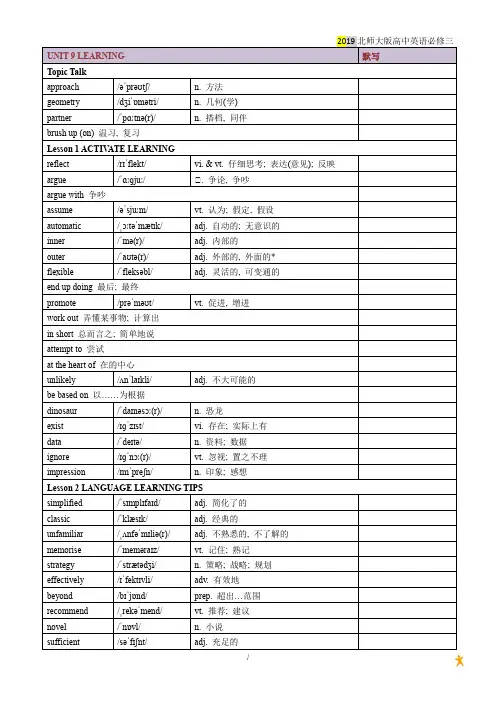
UNIT 9 LEARNING默写Topic Talkapproach /əˈprəʊtʃ/ n. 方法geometry /dʒiˈɒmətri/ n. 几何(学)partner /ˈpɑːtnə(r)/ n. 搭档, 同伴brush up (on) 温习, 复习Lesson 1 ACTIV ATE LEARNINGreflect /rɪˈflekt/ vi. & vt. 仔细思考; 表达(意见); 反映argue /ˈɑːɡjuː/ ⅵ. 争论, 争吵argue with 争吵assume /əˈsjuːm/ vt. 认为; 假定, 假设automatic /ˌɔːtəˈmætɪk/ adj. 自动的; 无意识的inner /ˈɪnə(r)/ adj. 内部的outer /ˈaʊtə(r)/ adj. 外部的, 外面的*flexible /ˈfleksəbl/ adj. 灵活的, 可变通的end up doing 最后; 最终promote /prəˈməʊt/ vt. 促进, 增进work out 弄懂某事物; 计算出in short 总而言之; 简单地说attempt to 尝试at the heart of 在的中心unlikely /ʌnˈlaɪkli/ adj. 不大可能的be based on 以……为根据dinosaur /ˈdaɪnəsɔː(r)/ n. 恐龙exist /ɪɡˈzɪst/ vi. 存在; 实际上有data /ˈdeɪtə/ n. 资料; 数据ignore /ɪɡˈnɔː(r)/ vt. 忽视; 置之不理impression /ɪmˈpreʃn/ n. 印象; 感想Lesson 2 LANGUAGE LEARNING TIPSsimplified /ˈsɪmplɪfaɪd/ adj. 简化了的classic /ˈklæsɪk/ adj. 经典的unfamiliar /ˌʌnfəˈmɪliə(r)/ adj. 不熟悉的, 不了解的memorise /ˈmeməraɪz/ vt. 记住; 熟记strategy /ˈstrætədʒi/ n. 策略; 战略; 规划effectively /ɪˈfektɪvli/ adv. 有效地beyond /bɪˈjɒnd/ prep. 超出…范围recommend /ˌrekəˈmend/ vt. 推荐; 建议novel /ˈnɒvl/ n. 小说sufficient /səˈfɪʃnt/ adj. 充足的input /ˈɪnpʊt/ n. 输入; 投入normally /ˈnɔːməli/ adv. 通常, 平常context /ˈkɒntekst/ n. 上下文; 语境; 背景chunk /tʃʌŋk/ n. 语块*acquire /əˈkwaɪə(r)/ vt. 学习, 获得(知识, 技能)be honoured to do sth 很荣幸做某事odd /ɒd/ adj. 奇特的soccer /ˈsɒkə(r)/ n. (美)足球subway /ˈsʌbweɪ/ n. (美)地铁in one way or another 不管怎样worldwide /ˌwɜːldˈwaɪd/ adj. & adv. 遍及世界的; 在全世界Lesson 3 THE SECRETS OF YOUR MEMORYarrangement /əˈreɪndʒmənt/ n. 计划; 安排childhood /ˈtʃaɪldhʊd/ n. 童年, 儿童时代emotional /ɪˈməʊʃənl/ adj. 情感上的; 情绪上的excitement /ɪkˈsaɪtmənt/ n. 兴奋, 激动as a result 作为结果photographic /ˌfəʊtəˈɡræfɪk/ adj. 详细准确的; 照片的; 摄影的digit /ˈdɪdʒɪt/ n. (09的任何一个)数字pi(π) /paɪ/ n. 圆周率*helicopter /ˈhelɪkɒptə(r)/ n. 直升机*publish /ˈpʌblɪʃ/ vt. & vi. 出版; 发表; 刊登curve /kɜːv/ n. 曲线, 弧线*sharp /ʃɑːp/ adj. 急剧的, 猛烈的; 尖的, 锋利的timely /ˈtaɪmli/ adj. 适时的, 及时的cell /sel/ n. 细胞periodically /ˌpɪərɪˈɒdɪkəli/ adv. 定期地take it easy 放轻松memorisation /,meməraɪ'zeɪʃən/ n. 记忆technique /tekˈniːk/ n. 技巧, 手法Writing Workshop A LEARNING REFLECTIONreflection /rɪˈflekʃn/ n. 沉思; 想法; 反射reflective /rɪˈflektɪv/ adj. 沉思的; 深思的journal /ˈdʒɜːnl/ n. 日记, 日志moreover /mɔːrˈəʊvə(r)/ adv. 此外, 而且Reading Club 1surfing /ˈsɜːfɪŋ/ n. 冲浪seafood /ˈsiːfuːd/ n. 海鲜Reading Club 2gap /ɡæp/ n. (大的)差距, 差额, 差别gender /ˈdʒendə(r)/ n. 性别identical /aɪˈdentɪkl/ adj. 完全相同的; 非常相似的comic /ˈkɒmɪk/ adj. 滑稽的, 好笑的fiction /ˈfɪkʃn/ n. 小说evidence /ˈevɪdəns/ n. 证据, 证明expose /ɪkˈspəʊz/ vt. 使接触; 使体验outcome /ˈaʊtkʌm/ n. 结果, 后果说明:带*号的词为《普通高中英语课程标准(2017年版)》必修和选择性必修以外词汇。
Unit 9 Lesson 2 On the Move 单词课件-高中英语北师大版必修三
passengers
boarding gate
air hostessplatormRely on pull up
▪ 1Rely on依赖,依靠。=depend on ▪ 2Pull on ▪ Pull out 离开,撤离 ▪ =pull through度过难关 ▪ Pull off 脱掉- pull on 穿上,继续 ▪ Pull up 拔起,停下来 ▪ Pull over 把车开到路边 ▪ Pull back 撤回
Teaching tasks and aims
▪1.first control lesson2 spelling ▪2;frequently asked keys about
lesson2 words
passport baggage
passport control boarding card
At an airport/ a train station
with/be satisfied with 对…满 意
▪be content to do sth满足于做. ▪content sb with sth使某人满
足于某事
responsibility
▪responsible adj. ▪be responsible for 对...负责 ▪=take the responsibility for ▪a sense of responsibility ▪It’s one’s responsibility to do
gentle fierce
▪Gentle-gentler-gentlest ▪ gently-general 一般的-
generally
▪Fierce-fiercely-fiercer-
北师大版高中英语同步测控必修第三册精品课件 UNIt 9 Section Ⅱ Lesson 2
阅读理解
阅读短文“THE SECRETS OF YOUR MEMORY”,选择正确 答案
1.We can learn from the first paragraph that D .
A.we can remember exciting things better B.we can remember new things better C.we can remember things happening in our childhood better D.we can remember things having strong connections in our mind better
2.Why did the writer give the examples of Daniel Tammet and Stephen Wiltshire? B A.To prove some people have photographic memories. B.To prove that some people have amazing memories. C.To show they are both good at remembering particular things for a limited time. D.To show us Daniel Tammet and Stephen Wiltshire are good at memorising figures.
【即学即用】 单句语法填空 ①You’d better buy your child the simplified (simplify) novels. ②I can buy something simply (simple) with a tap of my mobile phone. ③It is said that the palace was beautiful beyond description.
Unit 9 Learning Lesson 3 教案-高中英语北师大版(2019)必修第三册
Unit 9 LearningLesson 3 The Secrets of Your Memory 教学设计科目:英语课题:Lesson 3 The Secrets of Your Memory 课时:1课时教学目标与核心素养:知识目标:Students can learn some new words and expressions and subject-verb agreement.能力目标:Students can have a further understanding of the passage.情感目标:Students can think individually and learn cooperatively.教学重难点教学重点:How to learn the new words and expressions and subject-verb agreement.教学难点:How to make students have a better understanding of the passage.课前准备:多媒体,黑板,粉笔教学过程:一、Pre-reading1. Greeting2. Leading-inACTIVA TE AND SHARE1. 教师活动:教师提问Which of the following things do you find easy to remember? Can you explain why?·names and faces·numbers: telephone numbers, passwords, etc.·stories·facts and arrangements·things that happened long ago·things that happened recentlyAsk students to think and share their answers.2. 学生活动:回答问题。
Unit 9 Learning 必备知识清单高一英语单元同步知识梳理(北师大版2019必修第三册)
Unit 9 必备知识清单一、词汇知识清单Section A TOPIC TALK & LESSON 1I、阅读词汇知其意[注意英译汉]1.approach /əˈprəʊtʃ/ n. 方法2.geometry /dʒiˈɒmətri/ n. 几何(学)3.assume /əˈsjuːm/vt. 认为; 假定, 假设4.automatic /ˌɔːtəˈmætɪk/ adj. 自动的; 无意识的5.inner /ˈɪnə(r)/ adj. 内部的6.flexible /ˈfleksəbl/ adj. 灵活的, 可变通的7.promote /prəˈməʊt/ vt. 促进, 增进8.dinosaur /ˈdaɪnəsɔː(r)/n. 恐龙9.exist /ɪɡˈzɪst/ vi. 存在; 实际上有10.data /ˈdeɪtə/ n. 资料; 数据11.ignore /ɪɡˈnɔː(r)/vt. 忽视; 置之不理II、写作词汇知其形[注意汉译英]1.partner /ˈpɑːtnə(r)/ n. 搭档, 同伴2.reflect /rɪˈflekt/ vi. & vt. 仔细思考; 表达(意见); 反映3.argue /ˈɑːɡjuː/ⅵ. 争论, 争吵4.unlikely /ʌnˈlaɪkli/ adj. 不大可能的III、重点短语知搭配[注意固定短语的英汉互译]1.reflect on 思考2.argue with 争吵3.end up doing 最后,最终4.work out 弄懂某事物,计算出5.in short总而言之,简单说6.attempt to 尝试7.at the heart of 在…… 的中心8.be based on 以……为根据9.take part in 参与10.lead to 导致,通向IV、语法词汇知其变[注意词性变化]1.flexible --- flexibility[名词]2.promote --- promotion[名词]3.exist --- existence[名词]4.ignore --- ignorance[名词]5.reflect --- reflection[名词]6.argue --- arguement[名词]Section B LESSON 2 & LESSON 3I、阅读词汇知其意[注意英译汉]1.simplified /ˈsɪmplɪfaɪd/ adj. 简化了的2.memorise /ˈmeməraɪz/ vt. 记住; 熟记3.strategy /ˈstrætədʒi/ n. 策略; 战略; 规划4.effectively /ɪˈfektɪvli/ adv. 有效地5.beyond /bɪˈjɒnd/ prep. 超出…范围6.novel /ˈnɒvl/ n. 小说7.sufficient /səˈfɪʃnt/ adj. 充足的8.input /ˈɪnpʊt/ n. 输入; 投入9.normally /ˈnɔːməli/ adv. 通常, 平常10.context /ˈkɒntekst/ n. 上下文; 语境; 背景11.acquire /əˈkwaɪə(r)/ v t. 学习, 获得(知识, 技能)12.odd /ɒd/ adj. 奇特的13.soccer /ˈsɒkə(r)/ n. (美)足球14.photographic /ˌfəʊtəˈɡræfɪk/adj. 详细准确的; 照片的; 摄影的15.digit /ˈdɪdʒɪt/ n. (09的任何一个)数字16.cell /sel/ n. 细胞17.periodically /ˌpɪərɪˈɒdɪkəli/ adv. 定期地18.memorisation /,meməraɪ'zeɪʃən/ n. 记忆19.technique /tekˈniːk/n. 技巧, 手法II、写作词汇知其形[注意汉译英]1.impression /ɪmˈpreʃn/ n. 印象; 感想2.classic /ˈklæsɪk/ adj. 经典的3.unfamiliar /ˌʌnfəˈmɪliə(r)/ adj. 不熟悉的, 不了解的4.recommend /ˌrekəˈmend/ vt. 推荐; 建议5.worldwide /ˌwɜːldˈwaɪd/ adj. & adv. 遍及世界的; 在全世界6.arrangement /əˈreɪndʒmənt/ n. 计划; 安排7.childhood /ˈtʃaɪldhʊd/ n. 童年, 儿童时代8.emotional /ɪˈməʊʃənl/ adj. 情感上的; 情绪上的9.excitement /ɪkˈsaɪtmənt/ n. 兴奋, 激动10.subway /ˈsʌbweɪ/ n. (美)地铁11.publish /ˈpʌblɪʃ/ vt. & vi. 出版; 发表; 刊登12.sharp /ʃɑːp/adj. 急剧的, 猛烈的; 尖的, 锋利的13.timely /ˈtaɪmli/ adj. 适时的, 及时的III、重点短语知搭配[注意固定短语的英汉互译]1.as a result 作为结果2.take it easy 放轻松3.again and again 一次又一次的4.be good at 擅长5.according to 根据IV、语法词汇知其变[注意词性变化]1.simplified --- simplify[动词] --- simple[形容词]2.memorise --- memory[名词]3.effectively --- effective[形容词]4.periodically --- period[名词] --- periodical[形容词]5.impression --- impress[动词]6.recommend --- recommendation[名词]7.arrangement --- argue[动词]8.emotional --- emotion[名词]9.excitement --- excite[动词]Section C WRITING WORKSHOP & VIEWINGWORKSHOP & READING CLUB & ASSESSMENTI、阅读词汇知其意[注意英译汉]1.reflection /rɪˈflekʃn/ n. 沉思; 想法; 反射2.reflective /rɪˈflektɪv/ adj. 沉思的; 深思的3.journal /ˈdʒɜːnl/n. 日记, 日志4.moreover /mɔːrˈəʊvə(r)/ adv. 此外, 而且5.surfing /ˈsɜːfɪŋ/n. 冲浪6.seafood /ˈsiːfuːd/n. 海鲜7.gender /ˈdʒendə(r)/ n. 性别8.identical /aɪˈdentɪkl/ adj. 完全相同的; 非常相似的ic /ˈkɒmɪk/ adj. 滑稽的, 好笑的10.expose /ɪkˈspəʊz/ vt. 使接触; 使体验II、写作词汇知其形[注意汉译英]1.fiction /ˈfɪkʃn/ n. 小说2.evidence /ˈevɪdəns/ n. 证据, 证明3.outcome /ˈaʊtkʌm/ n. 结果, 后果4.gap /ɡæp/n. (大的)差距, 差额, 差别二、重点语篇清单语篇复述记忆语篇一We need to train ourselves to be better learners—to actively take part in the learning process and to reflect on what we have learnt.Listen to the outer voice. There are two kinds of voices: the inner voice and the outer voice. Active learners are open-minded and focus on what the speaker / writer is saying, not on what their brain is saying in the background.Argue with your inner voice. If you find your inner voice difficult to control, you can argue with it as most active learners do. Be flexible in your opinions and you might end up agreeing with the speaker / writer after all.Ask questions. Asking questions is the easiest way to promote active learning. The very act of working out questions will help you to achieve a higher level of understanding about the topic.Get to the truth. Active learners attempt to find the truth at the heart of each idea. Even when an idea sounds entirely unlikely, there may be an aspect of it that is based on truth.Focus on the message. Many people miss out on learning opportunities because they let their feelings get in the way. They refuse to learn or ignore what is said because of who the speaker / writer is.我们需要训练自己成为更好的学习者——积极参与学习过程并反思学到的东西。