
人教八年级英语下册第2单元重点语法详解及强化练习
Unit2语法:动词短语
动词与其它词语一起构成的表示动作的短语叫动词短语。
短语的结构可分为以下六种基本类型:
1、动词+副词
这种动词短语若是及物动
词时要注意,名词做宾语可以放在副词前面,也可以放在副词后面。
若是人称代词做宾语,人称代词要放在动词和副词之间。
常见的动副词组有:
clean up 打扫
cheer up 使某某高兴起来;振奋起来
give out=hand out 分发
put off 推迟
fix up 修理
put up 张贴
give up 放弃
give away 捐赠
hand in 上交
turn on/off 打开/关掉
turn up/down 调大/调小
2、动词+介词
动词+介词的短语在词意上相当于一个及物动词,宾语总是位于介词的后面。
常见的有:
look after 照顾
take after (长得)像
hear from 听说
wait for 等候;等待
care for 照顾
laugh at 嘲笑
worry about 担心
listen to 听
look at 看
agree with 同意
pay for 付款
belong to 属于
3、动词+副词+介词
这类动词短语,动词、副词、介词三者紧密结合,成为一体,相当于一个及物动词,宾语总是放在介词后面。
(介词后接动词要用-ing形式)
常见的有:
run out of 花光,用尽
get out of 离开
come up with 想出
look forward to 盼望
4、动词+名词
常见的有;
take/ have a rest 休息
make mistakes 犯错误
take a walk 散步
5、动词+名词+介词
这类短语只用作及物动词,名词前可加形容词说明程度,宾语位于介词后。
常见的有:
make friends with 与......交朋友
pay attention to 注意
take care of 照顾
have a look at 看一看
6、be+形容词(包括过去分词作形容词)+介词
常见的有:
be late for 迟到
be good at 擅长
be similar to 与......相似
be strict to 对......要求严格
be different from 与......不同
be busy with 忙于
be excited about对......感兴奋;激动
be worried about 担心
练一练
用所给词的适当形式填空
1、 Your little brother is watching TV, Can you heip me ___________ (turn把它调小)?
2、Don't ___________ what you want to do. (put 推迟做)
3、My classmates are ____________ the signs in the street. (give分发)
4、My grandma is ill in hospital, my parents are ______________ there. (care 照顾)
5、I _____________ my homework now. (busy忙于做作业)
6、My sister __________ those notices yesterday. (put张贴)
7、Tony _____________ his money just now .(run花光)
8、We _____________ the excting news.(be对......感到兴奋)
9、I'm ____________ hearing from you. (look 盼望)
10、Who ____________ this good idea?(came想出)。
人教新目标八年级英语下册Unit2-I’ll-help-to-clean-up-the-city-parks-全单元知识点和练习
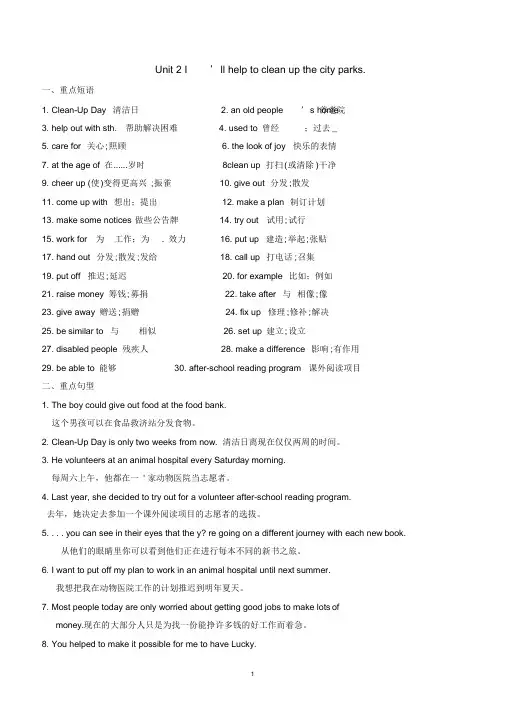
Unit 2 I ’ll help to clean up the city parks.一、重点短语1. Clean-Up Day 清洁日2. an old people ’s h养om老e院3. help out with sth. 帮助解决困难4. used to 曾经;过去_5. care for 关心; 照顾6. the look of joy 快乐的表情7. at the age of 在......岁时8clean up 打扫(或清除)干净9. cheer up (使)变得更高兴;振雀10. give out 分发;散发11. come up with 想出;提出12. make a plan 制订计划13. make some notices 做些公告牌14. try out 试用; 试行15. work for 为工作;为. 效力16. put up 建造; 举起; 张贴17. hand out 分发;散发;发给18. call up 打电话;召集19. put off 推迟; 延迟20. for example 比如;例如21. raise money 筹钱; 募捐22. take after 与相像;像23. give away 赠送; 捐赠24. fix up 修理;修补;解决25. be similar to 与相似26. set up 建立; 设立27. disabled people 残疾人28. make a difference 影响;有作用29. be able to 能够30. after-school reading program 课外阅读项目二、重点句型1. The boy could give out food at the food bank.这个男孩可以在食品救济站分发食物。
2. Clean-Up Day is only two weeks from now.清洁日离现在仅仅两周的时间。
人教版八年级下册英语Unit2 知识讲解+练习题
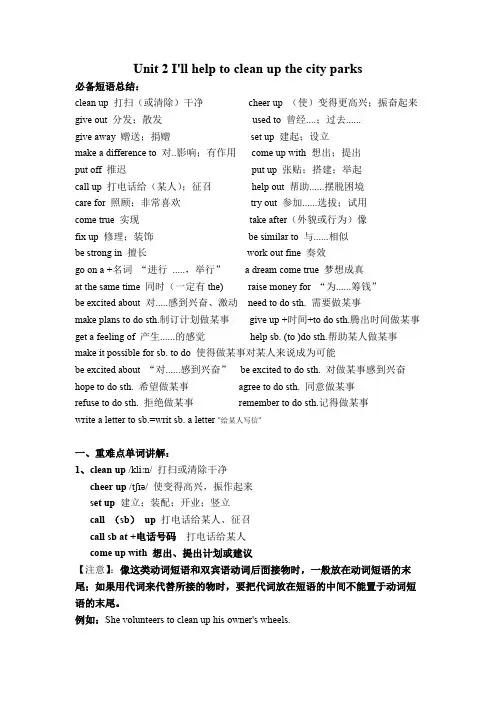
Unit 2 I'll help to clean up the city parks必备短语总结:clean up 打扫(或清除)干净cheer up (使)变得更高兴;振奋起来give out 分发;散发used to 曾经....;过去......give away 赠送;捐赠set up 建起;设立make a difference to 对..影响;有作用come up with 想出;提出put off 推迟put up 张贴;搭建;举起call up 打电话给(某人);征召help out 帮助......摆脱困境care for 照顾;非常喜欢try out 参加......选拔;试用come true 实现take after(外貌或行为)像fix up 修理;装饰be similar to 与......相似be strong in 擅长work out fine 奏效go on a +名词“进行.....,举行” a dream come true 梦想成真at the same time 同时(一定有the) raise money for “为......筹钱”be excited about 对.....感到兴奋、激动need to do sth. 需要做某事make plans to do sth.制订计划做某事give up +时间+to do sth.腾出时间做某事get a feeling of 产生......的感觉help sb. (to )do sth.帮助某人做某事make it possible for sb. to do 使得做某事对某人来说成为可能be excited about “对......感到兴奋”be excited to do sth. 对做某事感到兴奋hope to do sth. 希望做某事agree to do sth. 同意做某事refuse to do sth. 拒绝做某事remember to do sth.记得做某事write a letter to sb.=writ sb. a letter "给某人写信"一、重难点单词讲解:1、clean up /kliːn/ 打扫或清除干净cheer up /tʃɪə/ 使变得高兴,振作起来set up 建立;装配;开业;竖立call (sb)up 打电话给某人、征召call sb at +电话号码打电话给某人come up with 想出、提出计划或建议【注意】:像这类动词短语和双宾语动词后面接物时,一般放在动词短语的末尾;如果用代词来代替所接的物时,要把代词放在短语的中间不能置于动词短语的末尾。
Unit 2 知识点清单练习 人教版八年级英语下册

Unit 2 知识点清单填空版语法:不定式to do1、不定式作主语To be a doctor is my dream.不定式作主语表示还没发生的事,在写法上一般用It作形式主语,避免头重脚轻常考句式:①It is + adj. +(for sb.) to do sth. _____________________________________________②It takes/took sb. +时间to do sth. ____________________________________________2、不定式作宾语①V. + to do 的短语need to do sth.want to do sth.=would like to do sth.decide to do sth.agree to do sth.refuse to do sth.learn to do sth.hope to do sth. = wish to do sth.plan to do sth.help (to) do sth.try to do sth.forget to do sth.remember to do sth.start to do sth.= begin to do sth.promise to do sth.prefer to do sth.②it作形式宾语find/think/make it + adj. to do sth.3、不定式作宾语补足语①V. +sb. + to doneed sb. to do sth.want sb. to do sth.=would like sb. to do sth.agree sb. to do sth.refuse sb. to do sth.teach sb. to do sth.wish sb. to do sth.help sb. (to) do sth.ask sb. To do sth.tell sb. to do sth.warn sb. to do sth.encourage sb. to do sth.invite sb. to do sth.③省略to的不定式V.+sb. +domake sb. do sth.let sb. do sth.have sb. do sthsee/watch/notice sb. do sth.hear sb. do sth.4、不定式作定语①不定代词后Do you have something to eat?②最高级、序数词后He is the first/earliest to get to school.③the way to do sth. 做某事的方法5、作状语①目的状语He gets up early to catch the first bus.②结果状语He is too young to go to school.单词变形:1.volunteer n. 志愿者v. 自愿做volunteer to do sth. 自愿做某事2.notice n. 通知;通告v. 注意到notice sb. doing sth. _________________ notice sb. do sth.__________________ 3.lonely adj. 孤独的alone adv.独自;单独4.several adj.几个= a few +可数名词复数代词几个...5.feel v.感觉到feeling n. 感觉the feeling of...6.satisfy v. 使...满意satisfied adj. 满意的satisfaction n. 满足7.own v. 拥有adj. 自己的one’s own ___________ on one’s own =by oneself_______________owner n. 物主;主人8.raise v. 募集raise money for... 为......募集资金9.midnight n. 午夜at midnight 在午夜10.repair v. 修理11.broken adj. 破损的break v.打破;违反break—broke—broken12.able adj.能够,有能力的disabled adj. 丧失能力的;有残疾的13.different adj.不同的difference n. 不同make a difference to... 对......有影响;起作用14.difficult adj.困难的difficulty n. 困难have difficulty/difficulties (in) doing sth. _________________________15.carry v. 拿;提;抗;携带carry sth. with sb. 某人随身携带某物16.train n. 火车v. 训练trained adj. 经过训练的training n. 训练17.Kind n.种类;adj. 善良的kindness n. 善良18.clever adj. 聪明的19.understand v. 理解过去式:understoodunderstanding n. 理解20.change v. 改变21.interest n. 兴趣v. 使...感兴趣interested adj. 感兴趣的interesting adj. 令人感兴趣的;有趣的be interested in (doing) sth.= take an interest in (doing) sth. 对......感兴趣短语22.clean up ________________________23.cheer up ________________________24.give up ______________________25.put up ______________________26.give away ______________________27.give out ______________________28.hand out ______________________29.fix up ______________________30.take after = be similar to ______________________31.put off (doing) sth. ______________________e up with =think of ______________________33.call up ______________________ed to be ______________________used to do ... ______________________be used to doing ... ______________________35.care for =look after = take care of ______________________36.hard work ______________________work hard ______________________hard-working adj. ______________________37.How to do sth. ______________________38.a strong feeling of satisfaction ______________________39.the look of joy ______________________40.on one’s face ______________________41.at the age of... ______________________42.decide to do sth. ______________________43.try out for ______________________44.learn to do sth. ______________________45.go on ______________________e true ______________________47.at the same time ______________________48.be busy with sth. ______________________be busy doing sth. ______________________49.at least ______________________50.be worried about =worry about ______________________51.in one’s free time ______________________52.raise money for ______________________53.thank sb. For doing sth. ______________________54.be sure ______________________55.set up ______________________56.make it possible for sb. to do sth. ______________________57.make a difference to ______________________58.imagine doing sth. ______________________59.a friend of mine ______________________60.be excited about ______________________61.be able to do sth. ______________________62.give orders ______________________63.be strong in = be good at ______________________句子64.Volunteering here is a dream come true for me. 在这里做志愿者对我来说是梦想成真。
2023-2024学年八年级英语下册单元重难点易错题精练人教版Unit 2重点语法附解析
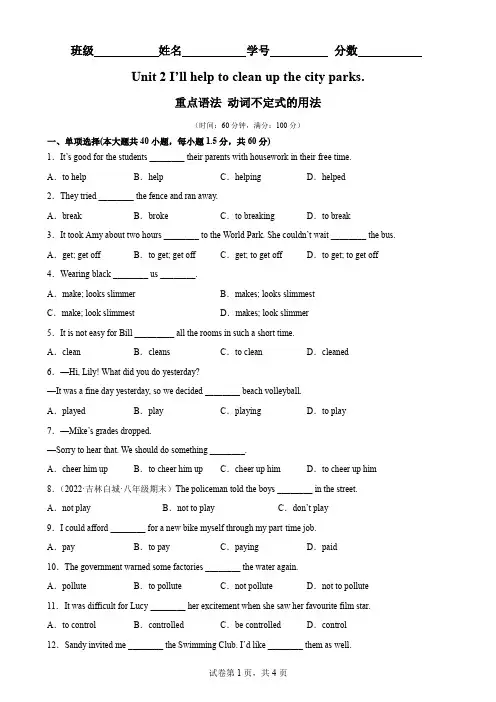
班级姓名学号分数Unit 2 I’ll help to clean up the city parks.重点语法动词不定式的用法(时间:60分钟,满分:100分)一、单项选择(本大题共40小题,每小题1.5分,共60分)1.It’s good for the students ________ their parents with housework in their free time.A.to help B.help C.helping D.helped2.They tried ________ the fence and ran away.A.break B.broke C.to breaking D.to break3.It took Amy about two hours ________ to the World Park. She couldn’t wait ________ the bus. A.get; get off B.to get; get off C.get; to get off D.to get; to get off 4.Wearing black ________ us ________.A.make; looks slimmer B.makes; looks slimmestC.make; look slimmest D.makes; look slimmer5.It is not easy for Bill _________ all the rooms in such a short time.A.clean B.cleans C.to clean D.cleaned6.—Hi, Lily! What did you do yesterday?—It was a fine day yesterday, so we decided ________ beach volleyball.A.played B.play C.playing D.to play 7.—Mike’s grades dropped.—Sorry to hear that. We should do something ________.A.cheer him up B.to cheer him up C.cheer up him D.to cheer up him 8.(2022·吉林白城·八年级期末)The policeman told the boys ________ in the street.A.not play B.not to play C.don’t play9.I could afford ________ for a new bike myself through my part-time job.A.pay B.to pay C.paying D.paid10.The government warned some factories ________ the water again.A.pollute B.to pollute C.not pollute D.not to pollute 11.It was difficult for Lucy ________ her excitement when she saw her favourite film star. A.to control B.controlled C.be controlled D.control 12.Sandy invited me ________ the Swimming Club. I’d like ________ them as well.试卷第1页,共4页A.to join in; to join in B.to join; to join inC.to join in; to join D.to join; to join13.What a heavy rain! The boys decided not ________ climbing.A.go B.going C.to go14.—Mum, can I have something ________ ?—Oh dear. You can only drink some water. There is ________ in the fridge.A.to drink ; nothing else B.to eat ; something elseC.drinking ; something else D.eating ; nothing else15.Mr. Smith expects ________ a job as a teacher in China.A.to find B.find C.finding D.found16.In the end, the police tried ________ the real criminal and put the result in newspapers. A.found B.finding C.to find out D.finding out 17.His mother often makes him ________ homework.A.to do B.doing C.does D.do18.Time seems ________ when we are playing computer games.A.to go faster B.going faster C.to going faster D.goes fastest 19.— I’m planning ________ the weekend with my grandparents.—Oh, don’t ________ to buy them some nice food.A.to spend; forget B.to spend; remember C.spending; forget D.spending; remember 20.Parents always ask us ________.A.to keep health B.keeping healthy C.to keep healthy D.keeping health 21.Mary often saw the boys ________ on the playground during the summer holiday.A.to run B.running C.run D.ran22.He likes to tell funny stories to make people ________.A.of laugh B.to laugh C.laughing D.laugh 23.Because of COVID-19 in February, the government advised us ________ to the public places. A.to go B.going C.not to go D.go24.I wanted to see the Beiing Opera, so Lingling offered ________ me there.A.take B.takes C.taking D.to take25.My parents allow me ________ the Internet for half an hour every weekend.A.surf B.surfs C.surfing D.to surf26.Lisa seemed ________ excited because her parents planned to take her to Sanya for vacation.试卷第2页,共4页A.getting B.to get C.got D.get27.If you want ________ what is happening around the world, watch the news every day. A.know B.known C.to know D.knowing 28.We hope _________ well so that we have more fans to watch the matches.A.play B.to play C.playing D.played 29.The teacher told us ________ English every day.A.read B.reading C.reads D.to read 30.Please stop ________ a rest if you feel tired.A.to have B.having C.have D.has 31.Jack’s sister likes playing the violin very much. Her dream is ___________ a musician. A.to be B.to being C.be D.being 32.—Would you like ________ coffee?—No, thanks. I’d like ________ some milk.A.some; drinking B.any; to drink C.any; drinking D.some; to drink 33.The teacher will give us a talk on how ________ English well.A.learn B.learnt C.to learn D.learning 34.Let’s ________ noise. Someone is sleeping.A.not make B.not to making C.not to make D.not making 35.Will you choose ________ in the front of the bus ________ in the back?A.to sit; and B.sitting; but C.sit; or D.to sit; or 36.________ improve my English, I would like to find a penfriend in England.A.In order that B.In order to C.Thanks for D.Thanks to 37.—What a surprise! I didn’t expect ________ you here.—Yeah. I just came back from Shanghai.A.see B.seeing C.to see D.to seeing 38.Dear passengers, don’t forget ________ your things when you get off the bus.A.to take B.take C.to taking D.taking 39.The mother told her son ________ the water dirty.A.don’t make B.not make C.to not make D.not to make 40.I often watch Bob ________ in the lake. He must be interested in swimming.A.to swim B.swam C.to swimming D.swim试卷第3页,共4页二、用所给单词的正确形式填空(本大题共20小题,每小题2分,共40分) 41.Ask your sister ___________ the piano when you are not studying. (play) 42.Mr. Lee’s smiling eyes make us ________ (feel) warm.43.We warn students ________ (not swim) in the river every summer. It’s dangerous. 44.My parents encourage me ________ (make) my own decisions.45.Girls seem ________ (learn) English better than boys.46.All of us want to know how ________ (play) computer games.47.Tom told me _________(not touch)anything in the science museum.48.Our teacher advised us ________ (not make) the same mistakes in the tests.49.It took us two hours to decide how ________ (spend) the coming vacation.50.All of us were quite surprised ________ (meet) the famous star in the shopping center. 51.How we wish ________ (visit) the Palace Museum!52.I’ve got no idea about how ________(stay) alive in the wild.53.It’s dangerous ________ (use) a lift during a fire.54.My mum often advises me ________(eat) more healthy food.55.I didn’t need ________(go) to the bank — Mary lent me the money.56.It took a lot of energy ________ (move) the furniture.57.Don’t forget ________ (bring) your elder sister here tomorrow.58.We didn’t stop ________(have) a rest until we reached the top of the mountain. 59.I have problems with my Maths. I want you ________ (help) me.60.Jackie Chan is planning ________(make)a new film. We are looking forward to it.试卷第4页,共4页参考答案:1.A【详解】句意:学生在空闲时间帮助父母做家务是有好处的。
人教版英语八年级下unit2讲解与练习
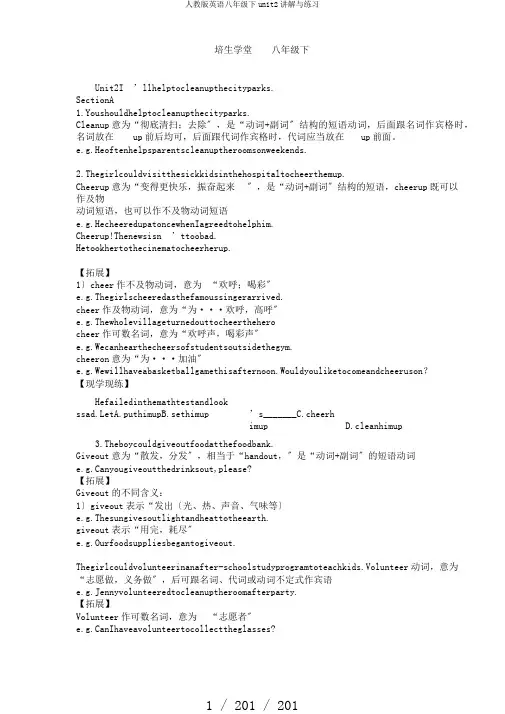
培生学堂八年级下Unit2I ’llhelptocleanupthecityparks.SectionA1.Youshouldhelptocleanupthecityparks.Cleanup意为“彻底清扫;去除〞,是“动词+副词〞结构的短语动词,后面跟名词作宾格时,名词放在up前后均可,后面跟代词作宾格时,代词应当放在up前面。
e.g.Heoftenhelpsparentscleanuptheroomsonweekends.2.Thegirlcouldvisitthesickkidsinthehospitaltocheerthemup.Cheerup意为“变得更快乐,振奋起来〞,是“动词+副词〞结构的短语,cheerup既可以作及物动词短语,也可以作不及物动词短语e.g.HecheeredupatoncewhenIagreedtohelphim.Cheerup!Thenewsisn ’ttoobad.Hetookhertothecinematocheerherup.【拓展】1〕cheer作不及物动词,意为“欢呼;喝彩〞e.g.Thegirlscheeredasthefamoussingerarrived.cheer作及物动词,意为“为···欢呼,高呼〞e.g.Thewholevillageturnedouttocheertheherocheer作可数名词,意为“欢呼声,喝彩声〞e.g.Wecanhearthecheersofstudentsoutsidethegym.cheeron意为“为···加油〞e.g.Wewillhaveabasketballgamethisafternoon.Wouldyouliketocomeandcheeruson?【现学现练】Hefailedinthemathtestandlookssad.LetA.puthimupB.sethimup’s_______C.cheerhimup D.cleanhimup3.Theboycouldgiveoutfoodatthefoodbank.Giveout意为“散发,分发〞,相当于“handout,〞是“动词+副词〞的短语动词e.g.Canyougiveoutthedrinksout,please?【拓展】Giveout的不同含义:1〕giveout表示“发出〔光、热、声音、气味等〕e.g.Thesungivesoutlightandheattotheearth.giveout表示“用完,耗尽〞e.g.Ourfoodsuppliesbegantogiveout.Thegirlcouldvolunteerinanafter-schoolstudyprogramtoteachkids.Volunteer动词,意为“志愿做,义务做〞,后可跟名词、代词或动词不定式作宾语e.g.Jennyvolunteeredtocleanuptheroomafterparty.【拓展】Volunteer作可数名词,意为“志愿者〞e.g.CanIhaveavolunteertocollecttheglasses?培生学堂八年级下5.Wecan ’tputoffmakingaplanPutoff意为“推迟〞,是“动词+副词〞的短语动词,其后可跟名词、代词或动名词作宾语e.g.Theyputoffthematchbecauseoftheheavyrain.Pleasedon ’tputoffdoingyourhomework.Neverputofftilltomorrowwhatyoucandotoday.【拓展】由put构成的常见短语有:Putaway将···收起来Putout熄灭;伸出puton穿上;上演putback放回原处putdownputup放下;记下张贴;搭建6.Let ’smake somenotices,tooNotice此处作可数名词,意为“公告牌;通告;布告e.g.Thereisanoticeonthewall,saying I’llputupanoticeaboutthemeeting.〞“NoParking〞【拓展】1〕notice作不可数名词,意为“注意〞e.g.Takenoticeofwhattheysay.notice作动词,意为“注意到,留心,看到〞e.g.DidyounoticeJackcomein?7.TheytoldmestoriesaboutthepastandhowthingsusedtobeUsedto意为“过去···,曾经···〞,后跟动词原形,表示“过去常常做某事〞,指表示过去和现在的比照,暗指现在已经不存在的动作或状态e.g.Heusedtoworkinthehospital.Hedidn’tusetowalkaftersupper.【拓展】beusedtodosth.意为“被用于做某事〞,不定式表目的e.g.Thebookisusedtoteachushowtowrite.2)beusedfor+n./ 表示“被用于···〞e.g.Astampisusedforsendingletters.3)get/beusedtodoingsth.e.g.Heisusedtoeatingoutallthetime.8.Yeah,alotofoldpeoplearelonely.Lonely是形容词,充当表语,指“孤独的〞,用于人时,表示一种心理状态,突出内心孤独寂寞的感觉,侧重缺少同伴友谊而感到孤独、寂寞。
(完整版)人教版英语八年级下unit2讲解与练习(含答案),推荐文档
Unit 2 I’ll help to clean up the city parks.Section A1. You should help to clean up the city parks.Clean up意为“彻底打扫;清除”,是“动词+副词”结构的短语动词,后面跟名词作宾格时,名词放在up前后均可,后面跟代词作宾格时,代词应当放在up前面。
e.g. He often helps parents clean up the rooms on weekends.2. The girl could visit the sick kids in the hospital to cheer them up.Cheer up意为“变得更高兴,振奋起来”,是“动词+副词”结构的短语,cheer up既可以作及物动词短语,也可以作不及物动词短语e.g. He cheered up at once when I agreed to help him.Cheer up! The news isn’t too bad.He took her to the cinema to cheer her up.【拓展】1)cheer作不及物动词,意为“欢呼;喝彩”e.g. The girls cheered as the famous singer arrived.2) cheer作及物动词,意为“为···欢呼,高呼”e.g. The whole village turned out to cheer the hero3) cheer 作可数名词,意为“欢呼声,喝彩声”e.g. We can hear the cheers of students outside the gym.4) cheer on 意为“为···加油”e.g. We will have a basketball game this afternoon. Would you like to come and cheer us on?【现学现练】He failed in the math test and looks sad. Let’s _______A. put him upB. set him upC. cheer him upD. clean him up3. The boy could give out food at the food bank.Give out 意为“散发,分发”,相当于“hand out”,是“动词+副词”的短语动词e.g. Can you give out the drinks out, please?【拓展】Give out 的不同含义:1)give out 表示“发出(光、热、声音、气味等)e.g. The sun gives out light and heat to the earth.2) give out表示“用完,耗尽”e.g. Our food supplies began to give out.4. The girl could volunteer in an after-school study program to teach kids.V olunteer动词,意为“志愿做,义务做”,后可跟名词、代词或动词不定式作宾语e.g. Jenny volunteered to clean up the room after party.【拓展】V olunteer作可数名词,意为“志愿者”e.g. Can I have a volunteer to collect the glasses?5. We can’t put off making a planPut off意为“推迟”,是“动词+副词”的短语动词,其后可跟名词、代词或动名词作宾语e.g. They put off the match because of the heavy rain.Please don’t put off doing your homework.Never put off till tomorrow what you can do today.【拓展】由put构成的常见短语有:Put away 将···收起来put on 穿上;上演put down 放下;记下Put out 熄灭;伸出put back 放回原处put up 张贴;搭建6. Let’s make some notices, tooNotice此处作可数名词,意为“公告牌;通告;布告”e.g. There is a notice on the wall, saying “No Parking”I’ll put up a notice about the meeting.【拓展】1)notice作不可数名词,意为“注意”e.g. Take notice of what they say.2) notice 作动词,意为“注意到,留心,看到”e.g. Did you notice Jack come in ?7. They told me stories about the past and how things used to beUsed to 意为“过去···,曾经···”,后跟动词原形,表示“过去常常做某事”,指表示过去和现在的对比,暗指现在已经不存在的动作或状态e.g. He used to work in the hospital.He didn’t use to walk after supper.【拓展】1) be used to do sth. 意为“被用于做某事”,不定式表目的e.g. The book is used to teach us how to write.2) be used for + n./ v.ing 表示“被用于···”e.g. A stamp is used for sending letters.3) get/be used to doing sth.e.g. He is used to eating out all the time.8. Yeah, a lot of old people are lonely.Lonely是形容词,充当表语,指“孤独的”,用于人时,表示一种心理状态,突出内心孤独寂寞的感觉,侧重缺少同伴友谊而感到孤独、寂寞。
人教版丨八年级下册英语Unit2重点句型解析(附练习题及答案)!
⼈教版⼁⼋年级下册英语Unit2重点句型解析(附练习题及答案)!Unit2 I‘ll help to clean up the city parks.重点句型解析:1. They told me stories about the past and how things used to be.used to do sth. 是⼀个固定结构,意思是“过去经常做某事”,后⾯⽤动词原形,表⽰过去的某种经常性、习惯性的⾏为或者动作,并意味着这种动作⽬前已经不存在。
肯定句:I used to play with my friends after school.过去放学后我常常和朋友们⼀起玩。
否定句:You didn’t use to like pop songs.=You usedn’t to like pop songs.你过去不喜欢流⾏歌曲。
⼀般疑问句:Did your sister use to be quiet? = Used your sister to be quiet?你的妹妹过去常常是很安静吗?there be句式:There used to be a lot of fishes in this river.过去这条⼩河常常有许多鱼。
【拓展】(1) be used to do something意思是“被⽤来做某事”,是动词短语use …to do的被动语态结构。
例如:Knives are used to cut things.⼩⼑是⽤来切东西的。
(2) be used to doing something意思是“习惯于做某事”,to后接动词-ing形式。
例如:My father is used to living in the village. 我爸爸习惯于住在⼩⼭村。
2. I take after my mother.take after意为“像……;与……相像”,指由于⾎缘关系⽽(在外貌、性格等⽅⾯)相似;相当于be similar to,其中after是介词,其后常接名词或代词。
八年级英语人教版下册Unit2_语法精讲精练
Unit2 语法精讲精练Grammar in UseA. Multiple choices.()1. I am a League Member. I volunteer my time________others.A. helpB. to helpC. helpingD.helped()2. I’d like________ a food bank to help hungry people.A. to setB. setting upC. set offD. set up()3. She________ by finding me a specially trained dog, which________ actually________.A. helped me; cheered meB. helped me out; cheered me upC. helped me up; cheered me upD. helped me out; cheered me out ()4. I have________ some books________ for the poor children.A. put, upB. put, onC. put, downD. given, away()5. Hi, Jack. Would you please________ the picture on the wall?A. pick upB. look upC. get upD. put upB. Fill in the blanks with the correct forms of the verbs in the box.Most people today are only worried about getting good jobs________ lots of money. In their free time, they think about what________ for fun or relaxation. However, few people think about what they can do________ others. There are many people who are less lucky than us. V olunteering our time to help these people is a good way________ our free time. For example, we can make plans________ sick children in the hospital or raise money for homeless people. Some people even stop doing their jobs for a few months to a year________ another place, like one of the countries in Africa, and help people there.C. Using parts of speech.Make your own sentences with these words according to the part of speech.(1) work(v.) My father works in a hospital.work(n.) My volunteer work is to help some pupils learn to read.(2) difficult(adj.)_________________________difficulties(n.)_________________________(3) difference(n.)_________________________(4) normal(adj.)_________________________(5) imagine (v.)_________________________(6) training(n.)_________________________【语法解析】一、动词不定式的用法(1)动词不定式作宾语:主语+谓语动词+to do例:①I hope to work outside.②You could help to clean up the city parks.③We need to come up with a plan for the City Park Clean-up Day.④Mario wants to be an animal doctor.(2)动词不定式作宾语补足语:主语+谓语动词+sb.+to do例:①What did they ask you to help out with?②It can help him to get his future dream job(3)动词不定式作状语:主语+谓语+(宾语)+(状语)+to do例:①The girl could visit the sick kids in the hospital to cheer them up.@)She still works there once a week to help kids learn to read.二、对词性的概念有一定了解,能辨别重点词汇词性并正确使用英语词性有十大类:1.名词n. 如:Alice China book orange glass2.动词v. 如:am speak spell live(in)write(to)3.形容词adj. 如:tall heavy popular windy relaxed4.副词adv. 如:quickly loudly really never hardly5.冠词art. 如:a an the6.代词pron. 如:I them your ours himself ourselves something nobody who both each every7.连词conj. 如:and but or so though8.介词prep. 如:in with of near beside about9.叹词inerj. 如:oh hi hello dear10.数词num.如:one twelve first second third ninth twelfth twentieth其中,需重点掌握名词、动词、形容词、副词的一般概念并清楚重点词汇的词性和一般用法。
Unit 2 语法思维导图及专练(解析版)八年级英语下册基础知识专项讲练(人教版)
Unit2I’ll help to clean up the city parks.(语法讲练)【知识导图】【要点拓展】1、动词(短语)用作介词宾语时通常要用v.-ing形式,但but与except等词后要接动词不定式(短语)。
如果but和except前有实义动词do,不定式(短语)的to通常要省去。
I have no choice but to stay here.我别无选择只能留在这里。
He did nothing last Sunday but repair his bike.上星期天他除了修理他的自行车外什么也没做。
(but前有实义动词did,因此不定式短语不带to)2、不定式(短语)作动词find、think等的宾语,常用it作形式宾语,而将真正的宾语放在句末。
I thought it best to call first.我认为最好还是先打个电话。
3、在表示感官、使役等意义的动词(短语)后,要用不带to的不定式(短语)作宾语补足语。
常见的:这类动词(短语)有feel、hear、listen to、see、watch、look at、notice等。
但是,句子是被动语态时,不能省略to 。
She heard Tom go upstairs.她听见汤姆上楼了。
The workers are made to work 12hours a day.工人们被迫一天工作12小时。
She was seen to read under the tree.(有人)看见她在树下看书。
4、不用不定式(短语)作宾语补足语的动词有hope 、agree 、demand 、suggest 、insist 等。
我希望你早点来。
【误】I hope you to come earlier.【正】I hope you come earlier.【奇思巧计】【知识导图】【要点拓展】1.“动词+介词”型短语。
这种结构的短语动词,跟宾语时,无论宾语是名词还是代词,都应不定式有标记,to 与动词连一起。
(2021年整理)人教版八下英语unit2知识点精讲及练习
人教版八下英语unit2知识点精讲及练习人教版八下英语unit2知识点精讲及练习编辑整理:尊敬的读者朋友们:这里是精品文档编辑中心,本文档内容是由我和我的同事精心编辑整理后发布的,发布之前我们对文中内容进行仔细校对,但是难免会有疏漏的地方,但是任然希望(人教版八下英语unit2知识点精讲及练习)的内容能够给您的工作和学习带来便利。
同时也真诚的希望收到您的建议和反馈,这将是我们进步的源泉,前进的动力。
本文可编辑可修改,如果觉得对您有帮助请收藏以便随时查阅,最后祝您生活愉快业绩进步,以下为人教版八下英语unit2知识点精讲及练习的全部内容。
人教版八下英语unit2知识点精讲及练习新目标八下英语Unit2 I'll help to clean up the city parks课前检测一.词组翻译1. Clean—Up Day2. an old people’s home3。
help out with sth. 4。
used to5. care for6. the look of joy7。
at the age of 8.clean up9。
cheer up 10. give out11。
come up w ith 12。
make a plan13. make some notices 14。
try out15. work for二、根据汉语写出英语1.建造;举起;张贴 2. 分发;散发;发给3。
打电话;召集 4. 推迟;延迟5。
比如;例如 6。
筹钱;募捐7。
与..。
..。
相像;像 8. 赠送;捐赠9. 修理;修补;解决 10. 与……相似11. 建立;设立 12. 残疾人13。
影响;有作用 14. 能够16. 有…感觉知识梳理一、基本知识点1。
sick 生病的,有病的;可在句中作表语Mary could not come because she is sick.也可作定语a sick child[区别ill] ill与sick同义;但是只在句中做表语,不做定语。