
外研版七年级英语下册Module 3 Making plans教学设计
Module3 Making Plans一、教学内容:Unit1 What are you going to do at the weekend?二、课型:Listening and speaking三、教学目标:1、能够正确使用下列单词和词组:go over, picnic, housework, on, else, nobody, at,nothing, silly, fantastic.2、能够听懂包含计划、安排的对话,并且判断出对话中人物的计划。
4、能够与人做有关计划的对话。
3、能用be going to表达自己的计划、安排,并能询问对方的计划、安排。
四、教学重难点:1、能够听懂对话中计划、安排的对话。
2、能够正确使用“ be going to” 来描述计划的相关信息。
五、教学准备:课堂整体运用任务型教学模式,培养学生独立自主的学习能力。
本课指导学生通过听说获取信息,培养学生的听说技能。
在教学过程中,采用多媒体手段辅助教学,利用各种图片和习题任务贯穿整个教学过程。
因此,本节课需准备:PPT课件、挂图、录音机、课堂练习表格、奖品六、教学过程:七、板书设计:Module 3. Making PlansUnit1. What are you going to do at the weekend?go over lessons 1) What are you going to do at the weekend? have a picnic I’m going to +V.help with the housework 2) Don’t be silly!3) Who else is going to be there?达标训练题一.翻译下列短语:1. 去野餐_____________2. 查收我的电子邮件__________________3. 复习_______________4. 在周日下午________________________5. 看电影_____________6. 上钢琴课_________________________7. 还有谁_____________ 8. 别傻了!__________________________9. 帮忙做家务_________ 10. 在周末___________________________二、选择填空。
( ) 1.—When are you going to Beijing?— _______ Sunday morning.A. OnB. InC. AtD. For( ) 2. — I think I’m going to die.—____________! You’re very healthy.A. I’m sorry to hear thatB. Don’t be sillyC. You’re a foolD. Great( ) 3. There ____________ a basketball match tomorrow.A. hasB. haveC. isD. is going to be( ) 4. Look! The baby _________ soundly.A. is going to sleepB. sleepsC. is sleepingD. sleep( ) 5. —___________ do you want?— Nothing. I have enough. Thanks.A. Who elseB. What elseC. WhenD. Where( )6. I _______ at home this Saturday.A. stayB. am stayingC. am going to stayD. going to stayModule3Making Plans七、教学内容:Unit2 We’re going to cheer the players.八、课型:Reading and writing九、教学目标:1、能够正确使用下列单词和词组:forward, look forward to, fan, make friends,shirt, cheer, player, hope, win, enjoy yourself, myself, during, May, May Day, late, walk, take a walk, country, second, collect, litter, fun, summer holiday, camp, Australian, sightseeing, go sightseeing, beach, early2、能够读懂描述计划安排的短文,并且判断出文中人物的计划、安排。
3、能够对自己的计划等方面进行简单的描述。
4、通过阅读他人的计划,学会自己做计划。
十、教学重难点:1、能够读懂简单描述计划的短文。
并能在阅读中找出有关作者的计划信息,完成学习任务。
(重点)2、能够正确使用“ be going to”的句子来描述计划并表达出计划相关的原因。
(难点)十一、教学准备:课堂整体运用任务型教学模式以及阅读课“四个阶段”教学模式。
本课指导学生通过阅读获取信息,培养学生阅读技能。
在教学过程中,采用多媒体手段辅助教学,利用各种图片和习题任务贯穿整个教学过程。
因此,本节课需准备:PPT课件、挂图、录音机、课堂练习表格、奖品十二、教学过程:七、板书设计:Module 3. Making plansUnit 2. We’re going to cheer the p layers.player look forward to sth./doing sth.fan make friends (with sb.)cheerhope I hope + 句子win(won)enjoy oneself…达标训练题一、根据中文完成下列句子:1.周末你们打算做什么?What ________ you ________ __________ _______ at the weekend?2.他们明天去野餐吗?Are they ___________ ________ _____________ a picnic tomorrow?3. 我正期待着明天的足球赛。
I’m ____________ ____________ ________ the football match tomorrow.4. 我们打算愉快地渡过五一假期。
We’re going ________ __________ ___________ during the May Day holiday.5. 我们要去为运动员们喝彩。
We’re going _________ ___________ the players.二、用所给词的适当形式填空:1. He’s going to __________ (meet) other fans.2. Are you going to make ____________ (friend) with me?3. The little boy is looking forward to ________ (stay) with his parents.4. Koala is an ___________ (Australia) animal.5. This year is going to ________ (be) very different.三、选择填空。
( )1. — Why is she going to England?— _______ she wants to see the Big Ben herself.A. BecauseB. ButC. ThenD. And( )2. — ________ on Sunday?—She’s going to wash her clothes.A.When is she going to wash her clothesB.What does she doC.What’s she going to doD.Where is she going to do( )3. He is looking forward to ______ out this Saturday.A. goB. goingC. going toD. go for( )4. I’ll have two days to ______ in Huizhou.A. sightseeingB. went cyclingC. going sightseeingD. go( )5. We are going to have a picnic _____ 1st May.A. atB. onC. inD. ofModule3 Making plans十三、教学内容:Unit3 Language in use十四、课型:Revision and application十五、教学目标:1. 正确运用本模块的词汇:picnic,go over, housework, nobody, nothing, lookforward to , make friends, enjoy oneself, litter, beach等。
2. 能运用“ be going to” 询问并回答有关将来的计划的事情,在同学之间进行真实的交际。
3. 能用运用所学知识介绍自己的周末计划。
4. 提高学习英语兴趣,树立信心,培养其积极主动参与各种语言实践活动的学习态度。
十六、教学重难点:能够用“be going to” 熟练的谈论自己的周末计划。
十七、教学准备:本节课型为Revision and application,根据新课标的要求,结合教材和学生特点,主要采用任务型互动式进行教学,结合情景法、交际法、听说法、归纳法等教学方法实施课堂活动,开启学生思维,通过一系列有条理的教学活动,引导学生自主探究学习和与他人互动合作学习,让学生体验愉快学习。
本节课所需教具及资料:幻灯、图片、调查表等。
十八、教学过程:达标训练题一、选择正确的答案:()1. We are all looking forward __________ the new film.A. to watchB. watchesC. to watchingD. watching ( ) 2. — What are you going to do next week?— We ____________ a picnic.A. haveB. are going to haveC. is going to haveD. will be( ) 3. I often ___________ an hour reading English.A. takeB. costC. spendD. pay ( ) 4. Don’t __________ silly!A. isB. areC. /D. be ( )5. We aren’t going to take a walk__________ it’s raining now.A. becauseB. butC. andD. so( )6. I want to go shopping. I’m going to ______ some clothes.A. washB. sendC. giveD. buy( )7. — Are you going to see a movie this evening?—_______. I’m going to have a piano lesson.A. Yes, I amB. No, I’m notC. Yes, I doD. No, I don’t二、短文填空:Hello, boys and girl. I’m Jim Smith, I’m 13 years old. I’m 1.___________ England and I’m English. This is my first time to come to China. I like 2._____________ very much. I’m going to have a busy 3._________________. On Saturday morning, I’m going to 4._______________ my homework, but in the afternoon, I’m going some 5._________ and I’m going to take a 6.___________ in the Summer Palace. On Sunday morning, I’m going to a basketball match, and I’m going to 7.___________ my favourite player. I hope my favourite team will8.___________ the match. In the afternoon, I’m going to help my mother do some9.______________, for example, to clean my house. I’m a happy boy. Do you want to make 10.______________ with me?。
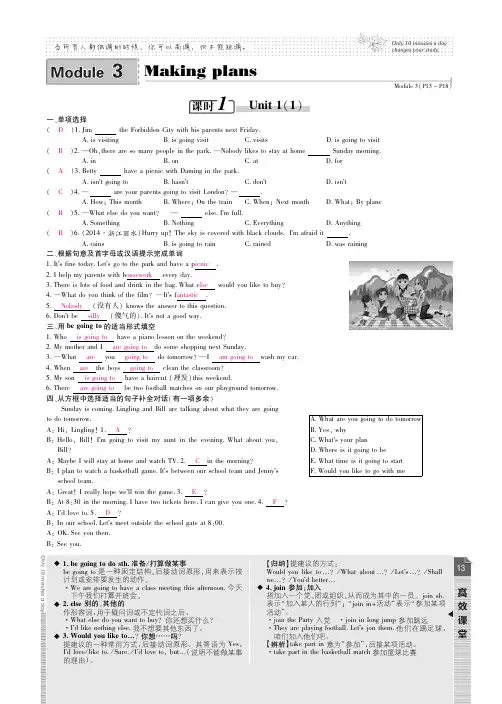
外研版七年级英语下册教师用书:Module 3 Making plans(pdf版)
/% 0 1 & 23 4 % & #
A & -.) * L& C BL D C BW '
!
FFFFFFFFF9;
;)<=>? & FJ F' B3 ] " +FFF % 6*! & # 9" --* ,I " % 04 " % 6 6" $ <( # * ,% $ ,* \ % ! # " -( 0 3 H 3 " $ 7 " $ " % " ,2 = 3 " $ 2 & " ,27 " $ " % I 3 7 " $ " % $ J 3 " $ 2 & " ,2% &7 " $ " % 0+ & # ," ,2 3 & F= F' K3 *U 6 !% 6* # *( # *$ &+ ( ,0<* & <) *" ,% 6*<( # ?3 *P & 9& -0) " ?* $ % &$ % ( 0( % 6& + *FFF S.,-( H 3 " , = 3 & , I 3 ( % J 3 ' & # & FH F' L3 = * % % 0FFF 6( 7 *(<" / ," /4 " % 6J ( + " ,2" ,% 6*<( # ?3 H 3 " $ ,@ % 2 & &
七年级英语下册 Module 3 Making plans May Day文章素材 (新版)外研版
五一劳动节1889年7月14日,由各国马克思主义者召集的社会主义者代表大会,在法国巴黎隆重开幕。
这次大会上,法国代表拉文提议:把1886年5月1日美国工人争取八小时工作制的斗争日,定为国际无产阶级的共同节日。
与会代表一致同意,通过了这项具有历史意义的决议。
从此,“五一”国际劳动节诞生了。
为什么要把这一天定为国际劳动节呢?这还得从19世纪80年代的美国工人运动说起。
当时,美国和欧洲的许多国家,逐步由资本主义发展到帝国主义阶段,为了刺激经济的高速发展,榨取更多的剩余价值,以维护这个高速运转的资本主义机器,资本家不断采取增加劳动时间和劳动强度的办法来残酷地剥削工人。
在美国,工人们每天要劳动14至16个小时,有的甚至长达18个小时,但工资却很低。
马萨诸塞州一个鞋厂的监工说:“让一个身强力壮体格健全的18岁小伙子,在这里的任何一架机器旁边工作,我能够使他在22岁时头发变成灰白。
”沉重的阶级压迫激起了无产者巨大的愤怒。
他们知道,要争取生存的条件,就只有团结起来,通过罢工运动与资本家作斗争。
工人们提出的罢工口号,就是要求实行八小时工作制。
1877年,美国历史上第一次全国罢工开始了。
工人阶级走向街头游行示威,向政府提出改善劳动与生活条件,要求缩短工时,实行八小时工作制。
罢工不久,队伍日渐扩大,工会会员人数激增,各地工人也纷纷参加罢工运动。
在工人运动的强大压力下,美国国会被迫制定了八小时工作制的法律。
但是,狠毒的资本家根本不予理睬,这项法律只不过是一纸空文,工人们仍然是生活在水深火热之中,倍受资本家的折磨。
忍无可忍的工人们决定将这场争取生存权利的斗争,推向一个新的高潮,准备举行更大规模的罢工运动。
1884年10月,美国和加拿大的八个国际性和全国性工人团体,在美国芝加哥举行一个集会,决定于1886年5月1日举行总罢工,迫使资本家实施八小时工作制。
这一天终于来到了。
5月1日,美国2万多个企业的35万工人停工上街,举行了声势浩大的示威游行,各种肤色,各个工种的工人一齐进行总罢工。
Module+3+Making+plans+Und_+课件2022-2023学年外研版英语七年级下册
a piano lesson
have
a picnic
see
lessons
help
my email
have
with the housework
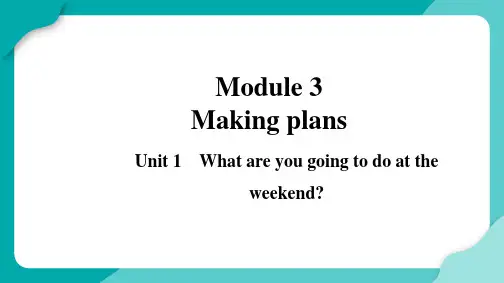
Match the expressions in Activity 1 with the pictures.
__g_o_o_v__e_r_l_e_s_so__n_s__ h_e_lp__w__it_h__th__e_h__o_u_s_e_w_o_rk
On Saturday afternoon On Sunday afternoon
check his email
Daming
do his 1. homework . help with the
2. housework .
Lingling have a 3. piano lesson
Betty and Daming 4. see a movie .
__
___
__s_e_e__a_m__o_v_i_e_____
__
_c_h__e_c_k_m__y__e_m__a_i_l _
__
h__a_v_e_a__p_i_a_n_o__l_e_s_so_n _h__a_v_e_a__p_i_c_n_i_c____
__
单词) 名词 1.家务劳动 housework 2.野餐 picnic 形容词 1.愚蠢的,傻气的 silly 2.极好的 fantastic
4.我打算独自待在家。
What are you going to do at the weekend? Would you like to join us? What are your plans for the weekend? I’m going to stay at home alone.
新外研版七年级英语下册导学案(M3-Unit 1讲义)
Module 3 Making PlansUnit 1 What are you going to do at the weekend?第一课时一、学习目标(1) 理解对话并能用所给信息谈论周末计划。
(2) 掌握本单元的单词,学会用be going to do 句型。
二、学习重点go over ,on , nobody, at , nothing, silly, fantasticWhat are you going to do…? I’m going to …Are you going to…? Yes ,we are./ No, we aren’t.三、学习难点be going to do sth. ;would like的用法课前预习一、使用说明与学法指导1、必须掌握重点单词。
2、预习要注意:(1)5分钟完成单词的学习,要求读音正确。
(2)15分钟完成课文的预习,所有生单词都画出来并标注汉语,疑点做出标记,并找出导学案上的词组和句子。
3、将预习中不能解决的问题标出来,并写在我的疑问处。
二、教材助读请同学们预习课文的基础上写出下列词组,并在书本上将这些词组画线。
查询我的电子邮件______________复习功课________________上钢琴课______________________看电影__________________野餐________________________帮助做家务_________________在周末______________________在周六的早上_______________呆在家里____________________ 别傻了_____________________三、预习自测题1.翻译下列单词picnic________ housework ______ else ________ nobody _______nothing_______ fantastic________2.翻译下列短语Do homework_________ help with the housework __________see a movie___________ Check emails____________have a piano lesson________ have a picnic___________Go over lessons___________ a fantastic weekend______________四、我的疑问_________________________________________________________________课内探究1、T: What day is it today? S:Today is Friday/...T:What's the weather like?S:It's sunny/...T:What are you going to do at the week end? S:I'm going to have a picnic/...2、利用句型,根据实际情况回答问题1、—What are you going to do this Sunday?—I'm going to...2、—What is your mother going to do at the weekend? —She is going to ...3、—what are your friends going to do at the weekend?—They are going to...3、听录音掌握大意并完成Activity4.(一)1、听力练耳Listen and match (听录音,连线组成短语,然后朗读这些短语,背诵)2、Write the phrases in Activity1 and the picture.(Activity2)(二)对话处理读前听Listen to the dialogue, and answer the questions.1、Is Daming going to check his email?2、Is Betty going to a party at a friend’s home on Saturday evening?3、What is Daming going to do on Saturday afternoon?听后读:最大声、最准确的朗读对话一遍,说一说Betty和Daming的计划。
外研版英语(新标准)七年级下册M3教学设计
《英语》(新标准)(初中阶段)七年级下册M3教学设计holiday(2)重点句型:—I’m looking forward to…—I’m going to…2.能力目标(1)在阅读中,提高学生的阅读能力(2)能读懂并明白关于计划的文章(3)能写一篇计划的文章3.情感目标培养学生团结合作与竞争的意识教学重点与难点 1.能正确运用“be going to”表计划2.提高学生的阅读能力教学辅助黑板,多媒体设备教学策略任务型教学法,情景教学法教学内容教学活动设计意图第一步:导入 1.师生相互问候2.运用图片,与学生谈论周末的计划创设英语学习环境,激活本课话题,进入课文的学习。
第二步:阅读课文 1.一读大意:完成Activity 1的练习——通读文章,将人物与段落匹对。
2.二抓细节:(1)完成Activity 2的练习——再读文章,完成表格。
(2)完成Activity 3的练习——小组合作,三读文章,回答问题。
3.三解疑惑(探究式问与答活动):让学生提“一读大意”:教师指导学生快速阅读课文,让学生初步了解文章的大意和段落结构。
“二抓细节”:运用Scanning的技巧,抓住问题中的关键词,在语篇中寻找相应信息,让学生填写表格,回答问题。
“三解疑惑”:教师鼓励学生大胆质疑,通过小组内部的合作交流,解决疑难。
体现了教师为主导,学识面。
第四步:模块任务 1.完成Activity 4的练习——小组成员讨论周末计划,如:A: What are you going to do at the weekend?B: I’m going to … (to C) What about you?C: I’m going to…2.完成Activity 5的练习,小组成员共同填写计划。
3.完成Activity 6的练习,以小组为单位,向全班展示本组的计划,如:On… we are goingto…从谈论自己的计划到谈论小组的计划,从说到写,做到语言运用能力的提升,将所学知识与实际生活紧密相连,做到学以致用。
外研版英语七年级下册:Module 3 Unit 1 What are you going to d
教学设计外研版七年级下册课题:Module 3 Making plans Unit 1:What are you going to do at the weekend?一.课型; Listening and speaking二.教材分析本单元是第三模块的核心组成部分,以讨论周末计划为主要话题。
该话题比较贴近学生生活,因此学生对介绍自己的周末计划很感兴趣,很容易展开教学活动,便于学生理解运用。
本节课在学生掌握有关周末活动的动词短语的基础上,在大量听说训练的基础上,通过讨论周末计划,学习用be going to 表达自己打算或计划做的事。
三.学生分析本节课的授课对象是七年级学生,他们活泼好动,善于表现自己,大多数学生对英语学习很感兴趣,尤其是在进行口语练习的环节时,都很积极。
本节课在设计用be going to 谈论周末计划这一话题时,设计了大量的pairwork 练习,便于学生根据自己的实际情况展开活动。
这节课的设计以学生感兴趣内容为出发点,以培养学生的听说能力为目的,使学生积极参与到课堂中来。
并充分利用多媒体等教学辅助设备,加强直观印象,增加课堂教学的趣味性。
四.教学目标根据《中学英语课程标准》制定如下目标:语言知识目标1. 学习掌握本课生词与短语:plan, go over, picnic, have a picnic, nothing,silly, fantastic, nobody, housework, else2. 观察并了解be going to 形式的构成, 能简单使用一般将来时(am/is/are going to do sth)3. 通过用英语与同伴谈论自己和周围人们打算做的事, 进一步熟悉be going to的用法。
语言技能目标1.听:能听懂含有be going to 加动词原形所表达的意思,并能听懂他人谈论周末计划的内容。
2.说:能借助所给词组进行pairwork 练习,能用be going to 谈论周末计划。
外研版七年级英语下册 Module 3 Unit 2教案
课题:Module 3 Making plansUnit 2 We’re going to cheer the players.学习目标:掌握重点词及短语forward, look forward to, make friends, cheer, player, hope, win, enjoy oneself /myself during walk, take a walk, country, second, collect, litter, fun, summer holiday, camp, sightseeing , go sightseeing 学习重点:1、学习并能够准确运用fantastic,fan,nobody,myself等本课相关词汇2、能够初步运用be going to 结构3、能够读懂有关介绍假期计划的文章难点:1、描述自己的假期计划New words and phrases study读课文预习下列短语和句子并熟读。
一、New words1.迷,支持者_________2.球衣,男衬衫________3.为… 喝彩________ 4.选手___________ 5. 希望_________ 6.获胜_______ 7我自己____________8.在___期间_____________9.迟的_________10.乡下. ________11.第二_________ 12.收集______13.垃圾__________14.乐趣__________ 15.营地______16.澳大利亚的________ 17.观光______ 18.海滩____19.五月_______ 20.向前,面向未来的_________二、New phrases1.期盼做_________2.观看我们最喜爱________________3.足球迷____________4.为队员喝彩_______________5.五一假期_____________6.玩的开心__________________7.乡村散步_______________8.去游泳____________9.暑假_______________ 10.夏令营________________11.观光__________________ 12.野炊_________________13.在沙滩上________________ 14.打算做_________________【课堂互动】Task 1: Fast reading : Read the passage and match the people with thepictures.Task 2: Careful reading: Activity 3,read the passage and answer thequestions.Task 3 : Read paragraph by paragraph ,then finish the tasks.Paragraph A(Task 1): What is Martin going to do tomorrow?(Task 2):Read and fill in the blanks.【play win cheer fun】Martin and his friends are going to watch their favourite football team趁热打铁:Paul looks forward to _____his pen pal. ( meet ) 2.wear , dress, (be)in , put on 的区别 趁热打铁: I don’t like _____ hats. The boy can ____himself.Do you know the girl ___red? 4.It’s cold.________your coat. 3.cheer 意为______. 常见短语:cheer sb.___________ cheer sb. up___________cheer sb. on_____________注意:cheer up 和cheer on ,当代词为宾语的时候,要放在cheer 与 up/on 中间.We should cheer ourselves up ._____________ They beat drums to cheer on the players.______________ The children are cheering their running classmates.________ cheer 做名词,意为:欢呼声、喝彩声,复数为______. cheers 单独使用时意为“干杯”,是感叹词。
外研版七年级下册(新)英语教案Module3Makingplans教案
外研版七年级下册(新)英语教案Module3Makingplans 教案Module 3 Making plans⼀、学习⽬标:A.单词和短语:go over, picnic, housework, on, else, nobody, at, nothing, silly, fantastic, forward, look forward to, fan, make friends, shirt, cheer, player, hope, win, enjoy oneself, during, May, May Day, late, something, walk, take a walk, country, second, collect, litter, fun, summer holiday, camp, Australian, sightseeing, go sightseeing, beach, early.B.交际⽤语:1. Sure!2. Would you like to join us?3. Don’t be silly!4.— What are you going to do on Saturday morning? — I’m going to ….5. What are you looking forward to this weekend?6. What are you going to do?7. Why are you going to do it?8. I’m going to check my email.9. Lingling and I are going to have a picnic.10. Lingling is going to have a piano lesson.11. — Are we going to meet here? — No, we aren’t.C. 教学⽬标1. Function : Talking about plans; making plans2. Structure: Be going to + verb; wh-questions and answers3. Skills: 1) Listening and understanding familiar topics (plans).2) Talking about familiar topics (plans).3) Reading and understanding simple passages.4) Composing a simple passage.4. Around the world: Weekend plans.5. Task: Talking about your weekend plans.⼆、重点及难点:be going to + verb; wh-questions and answers三、教学设计:Unit 1 What are you going to do at the weekend?ⅠTeaching modelListening and speakingⅡTeaching methodBottom-up approach to listeningⅢTeaching aims1. To understand conversations.2. Ask and answer: What are you going to do at the weekend?ⅣTeaching Objectives1. Key vocabulary: go over, picnic, housework, on, else, nobody, at, nothing, silly, fantastic2. Key structures:— What are you going to do on Saturday morning?— I’m going to ….ⅤTeaching aidsTape recorder, OHP, videoⅥTeaching StepsStep 1 Warming-up1. Show some pictures of school things. Say what they are.2. Read the words after the teacher.3. Introduce the new words.Step 2 Matching.1. Ask the students to read the word and expressions in Activity 1.AB2. Play the recording and ask the students to listen to the recording carefully.3. Match the words and expression from Box A with the word and expressions from Box B.4. Play the recording again, then they can check their answer with a partner.5. Call back the answer from the whole class and check the answer.Keys:1. check my email2. go over lessons3. have a piano lesson4. see a movie5. help with the housework6. have a picnic6. Match the expressions in Activity 1 with the pictures in Activity 2.7. Read the expressions together.Step 3 Listen and read.1. Ask the students to read the conversation silently.2. Play the recording and ask the students to listen and read the conversation.3. Read the conversation.4. Act it out.5. Learn “Everyday English”Welcome back!Please be careful with…from now on.Step 4 Answer the questions.1. Read the conversation again.2. Answer the questions.1) What’s Daming going to do on Saturday morning?2) What’s Betty going to do on Saturday afternoon?3) Who is going to have a piano lesson on Saturday?4) Where are they going to have a picnic?3. Ask the students to check with a partner.4. Play the recording again .Check the answers:Keys:1. He is going to check his email, do his homework and help with the housework on Saturday morning.2. She is going to see a movie on Saturday afternoon.3. Lingling is going to have a piano lesson on Saturday.4. They are going to meet in the park.Step 5 Complete the conversation.1. Ask the students to read the words in the box in Activity 4.2. Read through the conversation.Betty: What are your plans for next weekend, Lingling?Lingling: (1)____________. I don’t have any plans.Betty: Are you going to spend it (2)____________ at home?Lingling: Well, …what are you going to do?Betty: Tony and I are going to have a picnic in the park. We’re going to have a (3)____________ time. Are you going to come?Lingling: I’m not sure.Betty: Don’t be (4)____________! What (5)____________ are you going to do?3. Complete the conversation with the correct form of the words from the box.4. Ask the students to check with a partner.5. Check the answers:Keys: 1. Nothing 2. alone 3. fantastic 4. silly 5. else6. Read the conversation loudly.Step 6 Listen and repeat.1. Play the recording once without stopping.2. Play the recording again and stop at the end of each line. Ask the whole class to repeat.3. Play the recording again and stop at the end of each line. Ask individual students to repeat.4. Ask the students to practice the sounds in pairs.Step 7 Work in pairs.Ask and answer questions about your plants at the weekend.1. Ask and answer like this:—What are you going to do on Saturday morning?—I’m going to check my email and do my homework.2. Read through the example with the class.3. Pair them to ask and answer.4. Circulate and monitor their production.5. Complete the diary.Step 8 Guessing game.1. Show some pictures of school things.2. According to the information given and ask the students to guess what it is.3. Show the pictures to check the answers.Step 9 Language points1. On Saturday morning, I’m going to check my email and do my homework.I’m going to see a movie in the afternoon.如果我们要表达“在上午、下午、晚上”,可以说in the morning / evening / afternoon 三个词也常跟介词in连⽤。
Module 3 Unit 3 同步课件2022-2023学年外研版七年级英语下册
Exercise
1 Work in pairs. Look at the table. Ask and P18
answer questions about weekend plans.
People Activity
Hale Waihona Puke • you • your parents • your friends
• have a picnic • listen to music • play computer games • take a walk
(1) Dad and I are going to see a Beijing opera this afternoon. 今天下午我和爸爸打算去看京剧。 (2) We are going to have a meeting today. 今天我们要开会。 (3) I'm going to play the violin. 我打算拉小提琴。
Observe
Observe the following sentences carefully and pay attention to the words in red. 1. I'm going to check my email. 2. Lingling and I are going to have a picnic. 3. Lingling is going to have a piano lesson. 4. I'm going to do my homework.
- No, we aren’t.
1. I _a_m_ going to _c_h_e_c_k (check) my email.
2. Lingling and I a_r_e_ going to _h_a_v_e_ (have) a picnic.
外研版七年级下册英语精品教学课件 Module 3 Making plans Unit 1
Would you like to join us? Don’t be silly!
Now answer the questions. 1. What's Daming going to do on Saturday morning? He is going to check his email and do his homework and then help with the housework. 2.What's Betty going to do on Saturday afternoon? She is going to see a movie.
e.g. The student likes reading English in the morning.
e.g. See you on Sunday morning.
辨析on/in/at
on 表示在具体的某一天,如:日 on Monday
期、星期、节日等
on my birthday
on Teachers’ Day
表示在某一天的上午/下午/ 晚 on a cold winter morning
上
on the afternoon of Sunday
in 表示在较长时间内,如:年份 in Spring
/ 月份/ 季节/实际等
in July
用于某些固定搭配
in the morning/afternoon/evening
this afternoon / evening, tonight tomorrow (morning / afternoon / evening ) the day after tomorrow next Sunday / week / month / year...