
2012年12月N1真题解析+听力材料(完整版)
2012 年 12 月日语能力考试 N1 ----词汇部分解析
問題4 (20) 正解:2 解析:広大:广大,宏大 1 应该用:莫大 2 绿意盎然的广阔的校园是这所大学的魅力之一。 3 应该用:多様 4 应该用:巨大
(21) 正解:1 解析:秘める:隐藏,隐秘 1 那个人看上去很冷酷,其实内心很有热情。 2 应该用:隠して 3 应该用:抑える 4 应该用:我慢する
10 正解:1 解析:这篇论文大概能为今后医学的发展做出相当大的贡献吧。 1 寄与 きよ(贡献,有助于,「社会に寄与する」) 2 普及 ふきゅう(普及「標準語の普及」) 3 供与 きょうよ(提供,供给「生活費を供与する」) 4 波及 はきゅう(波及,影响「影響が世界に波及する」)
11 正解:4 解析:预测今年的烟火大会,预计外出(观看)的人群会超过 30 万人。 1 人込み ひとごみ(人群,人山人海「大変な人込みだ」)
(stock,储存,库存)
4 コーディネート (coordinate,同等,并列,协调化)
13 正解:2 解析:从早上开始头疼的厉害,吃了药之后,头疼就缓和很多了。 1 弱って よわって(衰弱,减弱「体が弱っていく」) 2 和らいで やわらいで(缓和起来,平静下来) 3 薄まって うすまって(弄淡,变淡「香りが薄まる」) 4 安らいで やすらいで(安乐,安稳,平静「心が安らぐ」)
2 人波 ひとなみ(潮水般的人群,人潮) 3 人通り ひとどおり(人来人往,通行「人通りがなくなる」) 4 人出 ひとで(外出的人群)
12
正解:1
解析:在决定工作分配之前,先把需要做的事情都列出来。
1 リストアップ
(list up,列表,列出)
2 エントリー
(entry,申请参加,报名参加)
3 ストック
(6)
正解:4
解析:那些年轻的员工,熟练地进行着生产作业。
1 しゅざい
取材(采访)
2 てきわ
干扰项,不存在
3 しゅさい
主催(主办)
4 てぎわ
手際(手法,技巧,本领)
2012 年 12 月日语能力考试 N1 ----词汇部分解析
問題 2
7
正解:4
解析:会议前,由于部长身体不舒服,随即马上决定由我代理出席会议。
2012 年 12 月日语能力考试 N1
----语法部分解析
問題 6 36 正解:3 解析:勉強に専念するためにアルバイトをすぐにでも 4 やめたいが 2 ス タッフ不足から 3 やめるに 1 やめられず 困っている。为了专心学习想 立刻辞去打工,但是由于打工的地方人手不足,想辞也辞不了,正为 此发愁。 要点:やめるにやめられず 想辞也辞不了
問題 3 (14) 正解:1 解析:虽然商品的成本上涨了,但是目前应该不会对销售价格产生影响吧。 当面:当前,目前;面临 しばらくは:暂时,不久 直接は:直接 まさか:(后接否定)怎能,决不;难道 大して:(后接否定)并不怎么,并不那么
(15) 正解:2 解析:这回的开发计划,和迄今为止的其他计划的规模不同。 スケール:规模;大小;尺寸 方針:方针 規模:规模 目的:目的,目标 意義:意思;价值
1 ひやす
冷やす(冰镇,使冷静)
2 つやす
干扰项,不存在
3 ついやす
費やす(花费,耗费)
4 ひいやす
干扰项,不存在
(5)
正解:2
解析:那儿可以看见的是,千年之前建造的有历史渊源的寺庙。
1 ゆうしょ
干扰项,不存在
2 ゆいしょ
由緒(渊源,历史来源)
3 ゆうしょう
優勝(优胜)
4 ゆいしょう 干扰项,不存在
37 正解:2 解析:昨日、息子が近所の公園で捕まえてきた昆虫を見て驚いた。虫につい
て 1 だったら 3 人よりも詳しく 2 知っているつもりの 4 私でも あん
な虫は見たことがなかった。昨天,看到儿子在附近的公园抓回来的虫, 我吃了一惊。关于昆虫,我自认为比其他人更了解,但是即便是这样 的我也没见过那种虫。 要点:つもり 表示说话人自己这样想或这样认为,至于别人如何认 为或与事实是否相符并无关紧要。
2012 年 12 月日语能力考试 N1 ----词汇部分解析
問題1
(1)
正解:2
解析:打破过去的限制,进入新的领域的企业正在增加。
1 かべ
壁(墙壁)
2 わく
枠(框,轮廓,限制范围)
3 みぞ
溝(水沟)
4 ふちBiblioteka 淵(潭,深渊)(2)
正解:3
解析:这本信息杂志几乎网罗了国内主要的有名观光场所。
1 ぼうろう
33 正解:4 解析:(会议上) 部长“关于这个方针有人有意见吗?啊,田村,请讲。” 田村“好的。我认为那个措施确实是有必要的。但是,从我们营业的 立场来说的话,以目前的情况做到那个程度很困难。“
~立場からいう:从(某个)立场来说 ~せ/させてもらう:请允许我做…… 立場から言わせてもらう:让(我)从某个立场说 立場から言わせてもらえば:让我从某个立场说的话
(22) 正解:4 解析: 1 应该用:伝播 2 应该用:こぼして 3 应该用:撒いて 4 冰箱靠对外部散热而将内部制冷。
(23) 正解:1 解析:仕業:勾当,做的事情,主要指不好的行为 1 商店卷帘门上的涂鸦是附近孩子们所画的。 2 应该用:行い 3 应该用:しぶり 4 应该用:行動
(24) 正解:3 解析:無造作:简单,不费事 1 应该用:気軽に 2 应该用:拘らないで 3 她似乎对打扮没什么兴趣,头发也只是随便扎着。
38
正解:4 解析:将棋は好きなら上達する。将棋が好きだということ 3 自体が 1 す
でに才能なのであって 4 好きだという気持ちが 2 あればこそ 強くなれる
のだ。将棋只要喜欢的话就会进步。喜欢将棋这件事本身就已经是一 种才能,正是因为喜欢所以才会变强。 要点:ばこそ 表示“正是这个理由”,句尾多用「のだ」。
27
正解:1 解析: (在打电话) A“想把您订的东西送过去,请问明天方便吗?” B“嗯。3 点之后的话会在家。” 上がる:在这里是「行く・訪ねる」的自谦语 差し上げる: 「与える・やる」等的自谦语
其他两项均不是自谦语,且不合文意。
28 正解:1 解析: “原来如此。因为那个吵架了啊。当然错在开了玩笑的他,但你因为 这点小事就生气了也不该。” 君も君だ:惯用搭配。一般前项说的是其他人的不好之处。用以表示 “别人有别人的不对,但你也有不好的地方”的意思。
39 正解:3 解析:動物園のゴリラが、私のことをずっと見ていた。私を仲間 2 だ 1
と 3 でも 4 思っていたの だろうか。
动物园里的大猩猩一直盯着我看。它是不是把我当成朋友了呢? 要点:~を~と思う 认为……是……。
でも 表示举例。
40 正解:1 解析:2 情報技術や交通手段の発達などで 4 異文化間の交流が活発した現
代にあっては 1 これまでの考え方にこだわらず 3 異なる価値観を理解しよ
うとする 姿勢を持つことが重要である。因为信息技术和交通手段等的 发达而让异文化的交流变得活跃的现代,不拘泥于现有的想法,抱有 理解不同价值观的姿态是非常重要的。 要点:にあって 处于……情况下。
(18) 正解:1 解析:完全没想到会被这样贬低。 けなされる:被贬低 悪く言われる:被说不好的话,被评价得低 高く評価される:被很高的评价 反対される:被反对
喜ばれる:令人高兴
(19) 正解:3 解析:山田像口头禅似的经常说“真麻烦”。 おっくうだ:不起劲;嫌麻烦 平気だ:冷静;不介意 愉快だ:愉快,高兴 面倒だ:麻烦,费事;照顾 退屈だ:厌倦;无聊
34 正解:1 解析:(手机) 夏子“喂喂,友子?对不起,电车晚了。” 友子“诶,那样呀?但是电影 7 点开始。” 夏子“嗯。如果看样子赶不上的话,我会再跟你联系。” 表示样态以及推测「そうだ」的否定形式:动词连用形+そうにない, 表示“看上去不……/估计不……“ 間に合いそうにない:估计赶不上 間に合いそうになかったら:如果估计赶不上的话
29 正解:3 解析:有约会的日子虽然一直是为了赶紧回去而完成了工作,但不知 道为什么总会突然开会,结果因为加班而约会迟到了。 动词基本形+べく:表示目的,为了~
动词基本形+べき:表示有义务这么做,也可用来表示“值得”“理 应如此”的意思。「动词基本形+べし」意思与其相同,用于结句。 「动词基本形+べからず」:表示禁止做某事。
(16) 正解:4 解析:朋友边听边一个劲儿的点头。
しきりに:再三,屡次 小さく:小的,轻微的 時々:有时,偶尔 大きく:(程度)大的,厉害的 何度も:多次,屡次;几次
(17) 正解:3 解析:在和对方确认之后,决定了计划书的内容。 先方:对方;前方 専門家:专家,内行 全員:全体人员 相手:对方;伙伴 上司:上司
30 正解:4 解析:他好像很喜欢骑自行车。无论是下雨还是下雪每天都愉快地骑 自行车上下班。 ~とも~とも:接在动词意志形或者形容词连用形后,表示“即使~ 即使~”。 ~でもなく:不是~ ~というか~というか:是~还是~。用于人或事,列举一些随时想 到的判断或印象,其后多为叙述总结性的判断。 ~だろうと~だろうと:前面接名词,表示“不管~还是~”。
35 正解:4 解析: A”西川先生的设计,魅力在哪里?“ B”对我而言,可以说一看先生的设计就有种让人放松,有温馨的感 觉,非常喜欢。“
~でしょう:推量和疑问的礼貌表达方式,“……吧。” ~ませんか:表示委婉的建议和邀请。 ~ましょうか:说话人礼貌地表达自己意志,主张或劝诱。 ~といいましょうか:可以说是……吧,应该说是……吧。
1 瞬時に しゅうじに(瞬间,短暂的时间)
2 迅速に じんそくに(迅速,多指行动迅速)
3 即刻
そっこく(即刻,立即)
2012年12月N1听力原文(第2大题)

沪江日语绿宝书之2012年12月日语能力考试N1听力原文----听力原文----問題21番1この会社しか受からなかったから2知名度が高いから3残業や休日出勤が少ないから4やりがいのある仕事ができるから正解:1会社で昼休みに、女の人と男の人が話しています。
男の人が今の会社に入った理由は何ですか。
男の人です。
女:吉田さんはどうしてこの会社に就職しようと思ったんですか。
私の場合、ここしか受からなかったんですけど。
男:うーん、そうだな。
最初はとにかく誰もが知ってるような知名度の高い会社に入りたいと思ったんだけど、いろいろ調べてるうちに、考えが変わってね。
女:へえ。
男:仕事だけじゃなくて、プライベートの時間も大事だっていう人もいるけど、僕はたとえ残業が多かろうが、休みが少なかろうが、自分のやりたいことができる会社が一番だと思ったんだ。
女:そうなんですか。
で、この会社には満足してるんですか。
男:まあね。
女:そうですか。
やっぱり仕事がやりがいが大事ですよね。
男:なんてね。
実を言うと、君と同じ理由なんだ。
ほかの選択肢がなくってね。
ここだけの話だけど。
女:なんだ。
男:でも、今はこの会社に入って正解だったって思ってるよ。
質問:男の人が今の会社に入った理由は何ですか。
2番1特別な効能のある温泉があるから2街のふんいきに心がいやされるから3都心からの交通の便がいいから4広大な自然が楽しめるから正解:2温泉地でアナウンサーが話しています。
この温泉地が人気のある理由は何だと言っていますか。
女:皆さん、こんにちは。
私は今、紅葉谷温泉に来ています。
ひっそりとした山奥にあるこの温泉、お湯の特別な効能を謳っているわけではありません。
古く歴史あるこの情調溢れる町並みが、心を癒してくれるともっぱらの評判なんです。
こちらまで電車はご利用になれませんが、車なら都心から日帰りで往復できない距離ではありません。
皆さんもぜひ一度訪れてみてください。
2012年12月N1听力和答案

問題1問題1では、まず質問を聞いてください。
それから話を聞いて、問題用紙の1から4の中から、最もよいものを一つ選んでください。
1番1) 山川→キム→林→田中2) 山川→林→キム→田中3) キム→林→山川→田中4) 林→キム→山川→田中2番1) しゅうしょくサイトに登録する2) しゅうしょく課に相談する3) しゅうしょく関連の本を読む4) 証明写真を撮る3番1) 新商品の説明文を作成する2) 表紙のデザインを変更する3) 品質管理について調べる4) げんこうを印刷会社に送る4番1) インタビューをする2) 質問こうもくを作る3) 関連する研究を調べる4) せんぱいの卒業論文を読む5番1) 製品紹介をトップページにのせる2) 製品紹介のリンクを目立たせる3) 使用体験へのリンクを目立たせる4) 特売情報をトップページにのせる6番1) 記事のテーマを決める2) 情報をまとめる3) 企画書を書く4) 打ち合わせに出席する問題2問題2では、まず質問を聞いてください。
そのあと、問題用紙のせんたくしを読んでください。
読む時間があります。
それから話を聞いて、問題用紙の1から4の中から、最もよいものを一つ選んでください。
1番1) この会社しか受からなかったから2) 知名度が高いから3) 残業や休日出勤が少ないから4) やりがいのある仕事ができるから2番1) 特別な効能のある温泉があるから2) 町のふんいきに心がいやされるから3) 都心からの交通の便がいいから4) 広大な自然が楽しめるから3番1) 作家の小説が文学賞を受賞したから2) 作家の最新作がしゅっぱんされたから3) 作家の作品が映画化されたから4) 作家の小説の売り上げが好調だから4番1) 親が選んだ記事を親が解説していっしょに読む2) 親が選んだ記事を子供に一人で読ませる3) 子供が選んだ記事を親が解説していっしょに読む4) 子供が選んだ記事を子供に一人で読ませる5番1) 家に品質が悪くてこわれやすい物が増えること2) 結果的に経済的な損失が大きくなること3) 買った物を大切に扱わなくなること4) 質のよい物を見る目が養われないこと6番1) 生地の水分吸収力が高くなったこと2) 生地がぬれても速く乾くこと3) 生地の肌触りがよくなったこと4) 生地が伸縮性に富んでいること7番1) ライブの演出が素晴らしいこと2) 曲のメロディーが優れていること3) 歌詞の言葉づかいがたくみなこと4) えんそうの技術が高いこと問題3問題3では、問題用紙に何も印刷されていません。
2012年12月英语听力答案及原文
2012年12月英语听力答案及原文短对话:11. Go to the park to enjoy the flowers.12. She cannot attend the presentation.13. He is a very successful businessman.14. She has every confidence in Susan.15. It is worth the money taking a train to Miami.16. The old furniture should be replaced.17. The man got home late due to the storm.18. The woman’s sons might enjoy team sports.长对话:Conversation One19. Take orders over the phone.20. Customers’questions could not be answered on the same day.21. They each take a week.Conversation Two22. Near a school.23. He did not notice it.24. It is no longer valid.25. He got a ticket.听力短文:Passage 126. They behave as if their memories have failed totally.27. Those with 15 items or less.28. Go back and pick up more items.29. It requires tolerance.Passage 230. A natural and spontaneous style of speech.31. Differences in style between writing and speaking.32. The key to becoming a good speaker.Passage 333. By comparing his performance with others.34. Children cannot detect their own mistakes.35. It is unhelpful to students’learning.复合式听写:36. foreign37. accomplished38. interpersonal39. detail.40. controlled41. abruptly42. references43. indication44. it is considered very rude to be late -- even by 10 minutes -- for an appointment in America.45. It has enabled Americans to be extremely productive, and productivity itself is highly valued in America.46. Americans believe in spending their time and energy today so that the fruits of their labor may be enjoyed at a later time.2012年12月英语四级考试听力原文汇总完整版Part III Listening ComprehensionSection ADirections: In this section, you will hear 8 short conversations and 2 long conversations. At the end of each conversation, one or more questions will be asked about what was said. Both the conversation and the questions will be spoken only once. After each question there will be a pause. During the pause, you must read the four choices marked A), B), C) and D), and decide which is the best answer. Then mark the corresponding letter on Answer Sheet 2 with a single line through the centre.11.W: I just heard about a really beautiful park in the east end of the town. There are a lot of roses in bloom.M: Why don’t we walk over there and see for ourselves?Q: What will the speakers probably do?12.M: My presentation is scheduled for 9:30 tomorrow morning at the lecture hall. I hope to see you there.W: Oh, sorry. I was about to tell you that I have an appointment with my dentist at 9:00 o’clock tomorrow.Q: What do we learn about the woman?13.W: How long have you been running this company?M: Twenty years if you can believe that. I brought it from a small operation to what it is today. Q: What do we learn about the man?14.M: Have you read the news on the campus net? Susan has won the scholarship for next year.W: I knew she would from the very beginning. Such a brilliant and diligent girl! She certainly deserves it.Q: What does the woman mean?15.W: Taking a bus to Miami, it’s cheaper than going by train.M: That’s true. But I’d rather pay a little more for the added comfort and convenience.Q: What does the man mean?16.M: I think it’s time we got rid of all this old furniture.W: Y ou’re right. We need to promote our image besides it’s not a real antique.Q: What do the speakers mean?17.M: That was some storm yesterday. How was I afraid I couldn’t make it home.W: Y eah, most of the roads to my house were flooded. I didn’t get home from the lab until midnight.Q: What do we learn from the conversation?18.W: My boys are always complaining that they’re bored.M: Why don’t you get them into some team sports? My son and daughter play soccer every Saturday. And they both look forward to it all week.Q: What does the man mean?Questions 19 to 21 are based on the conversation you have just heard.W: I don’t know what to do. I can’t seem to get anyone in the hospital to listen to my complaints and this outdated equipment is dangerous. Just look at it.M: Hmm, uh, are you trying to say that it presents a health hazard?W: Y es, I am. The head technician in the lab tried to persuade the hospital administration to replace it, but they are trying to cut costs.M: Y ou are pregnant, aren’t you?W: Y es, I am. I made an effort to get my supervisor to transfer me to another department, but he urged me not to complain too loudly. Because the administration is more likely to replace me than an X-ray equipment, I’m afraid to refuse to work. But I’m more afraid to expose my unborn child to the radiation.M: I see what you mean. Well, as your union representative, I have to warn you that it would take quite a while to force management to replace the old machines and attempt to get you transferred may or may not be successful.W: Oh, what am I supposed to do then?M: Workers have the legal right to refuse certain unsafe work assignments under two federal laws, the Occupation or Safety and Health Act and the National Labor Relations Act. But the requirements of either of the Acts may be difficult to meet.W: Do you think I have a good case?M: If you do lose your job, the union will fight to get it back for you along with back pay, your lost income. But you have to be prepared for a long wait, maybe after two years.Q19. What does the woman complain about?Q20. What has the woman asked her supervisor to do?Q21. What does the man say about the two federal laws?Q22. What will the union do if the woman loses her jobQuestions 23 to 25 are based on the conversation you have just heard.W: Mr. Green, is it fair to say that negotiation is an art?M: Well, I think it’s both an art and science. Y ou can prepare for a negotiation quite scientifically, but the execution of the negotiation has quite a lot to do with one’s artistic quality. The scientific part of a negotiation is in determining your strategy. What do you want out of it? What can you give? Then of course there are tactics. How do you go about it? Do you take an opening position in a negotiation which differs from the eventual goal you are heading for? And then of course there are the behavioral aspects.W: What do you mean by the behavioral aspects?M: Well, that’s I think where the art comes in. In your behavior, you can either be an actor. Y ou can pretend that you don’t like things which you are actually quite pleased about. Or you can pretend to like things which you are quite happy to do without. Or you can be the honest type negotiator who’s known to his partners in negotiation and always plays everything straight. But the artistic part of negotiation I think has to do with responding immediately to cues one gets in the process of negotiation. These can be verbal cues or even body language. This is where the artistic quality comes in.W: So really, you see two types of negotiator then, the actor or the honest one.M: That’right. And both can work. I would say the honest negotiator can be quite effective in some circumstances. In other circumstances you need an actor.Q23. When is a scientific approach best embodied in a negotiation according to the man?Q24. In what way is a negotiator like an actor according to the man?Q25. What does the man say about the two types of negotiator?Section BDirections: In this section, you will hear 3 short passages. At the end of each passage, you will hear some questions. Both the passage and the questions will be spoken only once. After you hear a question, you must choose the best answer from the four choices marked A), B), C) and D). Then mark the corresponding letter on Answer Sheet 2 with a single line through the center.Passage 1Questions 26 to 28 are based on the passage you have just heard.Since I started working part-time at a grocery store, I have learned that a customer is more thansomeone who buys something. To me, a customer is a person whose memory fails entirely once he or she starts to push a shopping cart. One of the first things customers forget is how to count. There is no other way to explain how so many people get in their express line, which is clearly marked 15 items or less, with 20, 25 or even a cart load of items. Customers also forget why they came to the store in the first place. Just as I finish ringing up an order, a customer will say, “Oops, I forgot to pick up a fresh loaf of bread. I hope you don’t mind waiting while I go get it.”Five minutes later, he is back with the bread, a bottle of milk, and three rolls of paper towels. Strange as it seems, customers also seem to forget that they have to pay for their groceries. Instead of writing a check or looking for a credit card while I am ringing up the groceries, my customers will wait until I announce the total. Then, in surprise, she says, “Oh no, what did I do with my check book?”After 5 minutes of digging through her purse, she borrows my pen because she’s forgotten hers. But I have to be tolerant of customers because they pay my salary, and that’s something I can’t afford to forget.Q26. What does the speaker say about customers’entering the grocery store?Q27. Which customers are supposed to be in the express line?Q28. What does the speaker say some customers do when they arrive at the check-out counter?Q29. What does the speaker say about his job at the end of the talk?Passage 2Questions 29 to 31 are based on the passage you have just heard.The speech delivery style of Europeans and Asians tends to be very formal. Speakers of these cultures often read oral presentations from carefully written manuscripts. On the other hand, American speakers are generally more informal relative to speakers in other cultures. American audiences prefer natural, spontaneous delivery that conveys a lively sense of communication. They don’t relate well to speakers who read from a manuscript. If you use an outline of your ideas instead of a prepared text, your speech will not only sound more natural, but you will also be able to establish better relationship with your listeners and keep their attention. The language and style you use when making an oral presentation should not be the same as the language and style you use when writing. Well-written information, that is meant to be read, does not work as well when it is heard. It is, therefore, important for you to adapt written texts or outlines for presentations. Good speakers are much more informal when speaking than when writing. They also use their own words and develop their own speaking styles. Whenever possible, they use short words. Listeners appreciate it when speakers use simple, everyday words in a presentation. One advantage is that it’s much easier for speakers to pronounce short words correctly. Another is that long and sophisticated vocabulary choices make listening more difficult.Question 30 to 3230. What does the speaker say American audiences prefer?31. What should one pay attention to when making an oral presentation?32. What does the speaker focus on in the talk?Passage 3Questions 32 to 35 are based on the passage you have just heard.Let children learn to judge their own work. A child learning to talk does not learn by beingcorrected all the time. If corrected too much, he will stop talking. He compares a thousand times a day the difference between language as he uses it and language as those around him use it. Bit by bit, he makes the necessary changes to make his language like other people’s. In the same way, kids learning to do all the other things they learn without adult teachers, to walk, run, climb, ride a bike, play games, compare their own performance with what more skilled people do, and slowly make the needed changes. But in school we never give a child a chance to detect his mistakes. We do it all for him. We act as if we thought he would never notice a mistake unless it was pointed out to him. Soon he becomes dependent on the expert. We should let him do it himself. Let him figure out, with the help of other children if he wants it, what this word says, what is the answer to that problem, whether this is a good way of saying or doing this or that. If right answers need to be given, as in mathematics or science, give him the answer book. Let him correct his own papers. Why should we teachers waste time on such tedious work? Our job should be to help children when they tell us that they can’t find a way to get the right answer.Question 33 to 3533. How does a child learn to do something according to the speaker?34. What belief do teachers commonly hold according to the speaker?35. What does the speaker imply about the current way of teaching?Section CDirections: In this section, you will hear a passage three times. When the passage is read for the first time, you should listen carefully for its general idea. When the passage is read for the second time, you are required to fill in the blanks numbered from 36 to43 with the exact words you have just heard. For blanks numbered from 44 to 46 you are required to fill in the missing information. For these blanks, you can either use the exact words you have just heard or write down the main points in your own words. Finally, when the passage is read for the third time, you should check what you have written.Time is, for the average American, of utmost importance. To the foreign visitor, Americans seem to be more concerned with getting things accomplished on time (according to a predetermined schedule) than they are with developing deep interpersonal relations. Schedules, for the American, are meant to be planned and then followed in the smallest detail. It may seem to you that most Americans are completely controlled by the little machines they wear on their wrists, cutting their discussions off abruptly to make it to their next appointment on time. Americans’language is filled with references to time, giving a clear indication of how much it is valued. Time is something to be “on,”to be “kept,”“filled,”“saved,”“wasted,”“gained,”“planned,”“given,”“made the most of,”even “killed.”The international visitor soon learns that it is considered very rude to be late -- even by 10 minutes -- for an appointment in America. Time is so valued in America, because by considering time to be important one can clearly achieve more than if one “wastes”time and doesn’t keep busy. This philosophy has proven its worth. It has enabled Americans to be extremely productive, and productivity itself is highly valued in America. Many American proverbs stress the value of guarding time, using it wisely, and setting and working toward specific goals. Americans believe in spending their time and energy today so that the fruits of their labor may be enjoyed at a later time.。
2012年12月日语能力考一级真题读解部分02
2012年12月日语能力考一级真题读解部分02 2012年12月日语能力考一级真题读解部分02。
考生们在日语备考中都会看大量资料,做大量习题来提高日语水平,可是在能力考前还是不能确定自己的掌握情况,那就让往年一级真题来帮你检测一下吧!問題10 次の文章を読んで、後の問いに対する答えとして最もよいものを、1、2、3、4から一つ選びなさい。
まず、教育とは何か、ということから考えてみよう。
さしあたってぼくは、教育とは、子どもを「社会の成員(大人)としてふさわしい存在」へと育て上げていくこと、と定義してみたい。
どんな時代、どんな社会の人びとでも、子どもを大人に育て上げなくてはならなかった。
そのさいには、①社会の成員として「ふさわしい」あり方が何かしら想定されていて、それが教育の営みを導いていたはずだ。
その「ふさわしさ」は、大きく二つに分けられるだろう。
一つは、働いて食べていけるために必要な能力、つまり農民なら農民としての、漁民ならば漁民としての、技能や知識。
もう一つは、他の人びとのあいだでふさわしいふるまいができること――基本的なルールを守り、他の人びとと協力する態勢をとれること、自分に与えられた役割を果たし、その責任をとれること等々、つまり、他者との関係能力である。
では、現代社会においては、どういうことが「大人としてふさわしい」のだろうか?教育理念を構築するとは、このことをあらためて考え、かつ共有しようとすることに他ならない。
だが、この「共有」ということはなかなかむずかしい。
そこには、社会のあり方と人間の生き方をどのようなものとして思い描くか、つまりは、異なった社会観·人間観がさまざまに入り込み、衝突してくるからだ。
たとえば、ぼくが最初にあげた「教育とは、子どもを社会の成員としてふさわしい存在にすることだ」という定義に対しても、②反発を覚える人がいるだろう。
「それは、社会的期待に子供を添わせようとするよくない発想だ。
2012年12月日语能力考一级真题文字部分
2012年12月日语能力考一级真题文字部分2012年12月日语能力考一级真题文字部分。
考生们在日语备考中都会看大量资料,做大量习题来提高日语水平,可是在能力考前还是不能确定自己的掌握情况,那就让往年一级真题来帮你检测一下吧!問題1_____の言葉の読み方として最もよいものを、1、2、3、4から一つ選びなさい。
1.従来の枠を超えて新しい分野に進出する企業が増えている。
1)かべ 2) わく 3) みぞ 4) ふち2.この情報誌は国内の主な観光名所をほぼ網羅している1) ぼうろう 2) もうろう 3) もうら 4) ぼうら3. このような賞を受けることは、私にとって大変名誉なことです1) めいゆう 2) めいゆ 3) めいよう 4) めいよ4. 新商品の開発には多額の資金を費やした。
1) ひやした 2) つやした 3) ついやした 4) ひいやした5. あそこに見えるのは、千年前に建てられた由緒あるお寺です。
1) ゆうしょ 2) ゆいしょ 3) ゆうしょう 4) ゆいしょう6. 若いスタッフたちが手際よく作業を進めていた。
1) しゅざい 2) てきわ 3) しゅさい 4) てぎわ問題2( )に入れるのに最もよいものを、1、2、3、4から一つ選びなさい。
7. 会議の直前に部長の都合が悪くなり、( )私が代理で出席することになった。
1) 瞬時に 2) 迅速に 3) 即刻 4) 急遽8. あの人は「申請書は締め切りまでに絶対に提出した」と、まだ( )いる1) 言い残して 2) 言い張って 3) 言い渡して 4) 言い放って9. このままでは交渉がまとまらないので、互いに( )せざるをえない。
1) 同調 2) 妥協 3) 和解 4) 融合10. この論文が今後の医学の発展に( )するところは大きいだろう。
1) 寄与 2) 普及 3) 供与 4) 波及11. 今年の花火大会は、30万人を超える( )が予想されている。
2012年12月四级考试真题汇总版真题+听力原文+答案详解
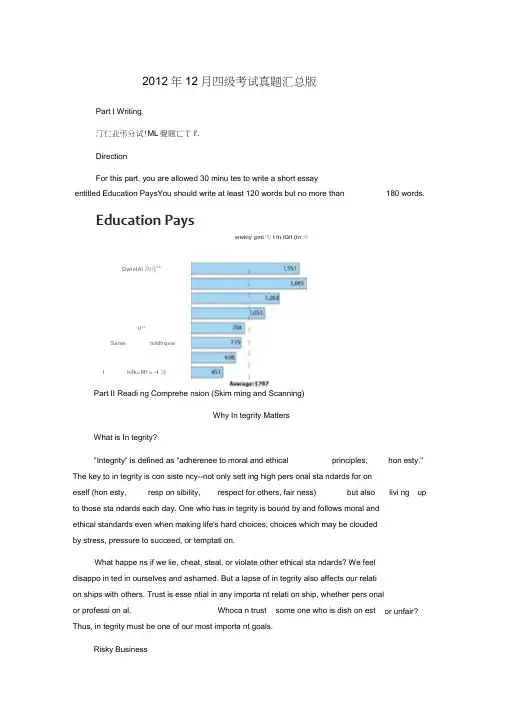
2012年12月四级考试真题汇总版Part I Writing汀仁业弔分试!ML 聲题匸T I'.DirectionFor this part, you are allowed 30 minu tes to write a short essayentitled Education PaysYou should write at least 120 words but no more than Education PaysPart II Readi ng Comprehe nsion (Skim ming and Scanning)Why In tegrity MattersWhat is In tegrity?"Integrity" is defined as "adherenee to moral and ethical principles; The key to in tegrity is con siste ncy--not only sett ing high pers onal sta ndards for on eself (hon esty, resp on sibility, respect for others, fair ness) but also to those sta ndards each day. One who has in tegrity is bound by and follows moral and ethical standards even when making life's hard choices, choices which may be clouded by stress, pressure to succeed, or temptati on.What happe ns if we lie, cheat, steal, or violate other ethical sta ndards? We feeldisappo in ted in ourselves and ashamed. But a lapse of in tegrity also affects our relati on ships with others. Trust is esse ntial in any importa nt relati on ship, whether pers onal or professi on al. Whoca n trust some one who is dish on est Thus, in tegrity must be one of our most importa nt goals.Risky Businesswwkiy gmi 叩t In IQll (in 沖 DwistAl A H }** U** Sanw nddhqvw I h4k>Mf > -1 謝 180 words.hon esty." livi ng up or unfair?We are each responsible for our own decisions, even if the decision-making process has been undermined by stress or peer pressure. The real test of characteris whether we can learn from our mistake, by understanding why we acted as we did, and then exploring ways to avoid similar problems in the future.Making ethical decisions is a critical part of avoiding future problems. We must learn to recognize risks, because if we can't see the risks we're taking, we can't make responsible choices. To identify risks, we need to know the rules and be aware of the facts. For example, one who doesn't know the rules about plagiarism may accidentally use words or ideas without giving proper credit, or one who fails to keep careful research notes may unintentionally fail to quote and cite sources as required. But the fact that such a violation is "unintentional" does not excuse the misconduct. Ignorance is not a defense."But Everybody Does It"Most people who get in trouble do know the rules and facts, but manage to fool themselves about the risks they ' re taking by using excuses: "Everyone else doesit," "I'm not hurting anyone," or "I really need this grade." Excuses can get very elaborate: "I know I'm looking at another's exam, even though I'm supposed to keepmy eyes on myown paper, but that's not cheating because I'm just checking myanswers, not copying." We must be honest about our actions, and avoid excuses. If we fool ourselves into believing we're not doing anything wrong, we can't see the real choice we're making--and that leads to bad decisions.To avoid fooling yourself, watch out for excuses and try this test: Ask how you would feel if your actions were public, and anyone could be watching over your shoulder. Would you feel proud or ashamed of your actions? If you'd rather hide your actions, that's a good indication that you're taking a risk and rationalizing it to yourself.Evaluating RisksTo decide whether a risk is worth taking, you must examine the consequences, in the future as well as right now, negative as well as positive, and to others as well as to yourself. Those who take risks they later regret usually focus on immediate benefits ("what's in it for me"), and simply haven't considered what might go wrong. The consequences of getting caught are serious, and may include a "0" on a test or assignment; an "F" in the class; Suspension or Dismissal from school; transcript notation; and a tarnished reputation. In fact, when you break a rule or law, you lose control over your life, and give others the power to impose punishment: you have no control over what that punishment might be. This is an extremely precarious and vulnerable position. There may be some matters of life and death, or highest principle, which might justify such a risk, but there aren't many things that fall in this category.Getting Away With It--Or NotThose who don't get caught pay an even higher price. A cheater doesn't learnfrom the test, depriving him/herself of an education. Cheating undermines confidence and independence: the cheater is a fraud, and knows that without dishonesty, he/she would have failed. Cheating destroys self-esteem and integrity, leaving the cheater ashamed, guilty, and afraid of getting caught. Worst of all, a cheater who doesn't get caught the first time usually cheats again, not only because he/she is fartherbehind, but also because it seems "easier." This slippery slope of eroding ethics and bigger risks leads only to disaster. Eventually, the cheater gets caught, and the later he/she gets caught, the worse the consequences. Students have been dismissed from school because they didn't get this simple message: Honesty is the ONLY policy that works.Cheating Hurts Others, TooCheaters often feel invisible, as if their actions "don't count" and don't really hurt anyone. But individual choices have a profound cumulative effect. Cheating can spread like a disease, and a cheater can encourage others just by being seen from across the room. Recent statistics suggest 30%or more of college students cheat. If a class is graded on a curve, cheating hurts others' grades. Even if there is no curve, cheating "poisons" the classroom, and others may feel pressured to join in. ("If I don't cheat, I can't compete with those who do.") Cheating also has a destructive impact on teachers. The real reward of good teaching is seeing students learn, but a cheater says, "I'm not interested in what you're trying to teach; allI care about is stealing a grade, regardless of the effect on others." The end result is a blatant and destructive attack on the quality of your education. Finally, cheating can hurt the reputation of the University, and harm those who worked hardfor their degree.Why Integrity MattersIf cheating becomes the norm, then we are in big trouble. We must rely on the honesty and good faith of others every day. If not, we couldn't put money in the bank, buy food, clothing, or medicine from others, drive across a bridge, get on a plane, go to the dentist--the list is endless. There are many examples of the vast harm that is caused when individuals forget or ignore the effect their dishonesty can have. The savings and loan scandal, the stock market and junk bond swindles, and, of course, Watergate, have undermined the faith of many Americans in the integrity of political and economic leaders and society as a whole. Such incidents take a tremendous toll on our nation's economy and our individual well-being. For example, but for the savings and loan debacle, there might be funds available to reduce the national debt and pay for education.In sum, we all have a commonstake in our school, our community, and our society. Our actions do matter. It is essential that we act with integrity in order to build the kind of world in which we want to live.1. A person of integrity not only sets high moral and ethical standards but also .A) sticks to them in their daily lifeB) makes them known to othersC) understands their true valuesD) sees that others also follow them2. What role does integrity play in personal and professional relationships?A) It helps to create team spiritB) It facilitates communicationC) It is the basis of mutual trustD) It inspires mutual respect3. why must we learn to identify the risks we are going to take ?A. To ensure we make responsible choices.B. To avoid being overwhelmed by stress.C. so that we don ' t break any rules.D. so that we don t run into trouble.4. Violation of a rule is misconduct even if ____ ?A. it has caused no harm.B. it is claimed to be unintentional.C. it has gone unnoticed.D. it is committed with good intentions.5. What should one do if he doesn ' t wish to fool himself?A. Avoid making excuses.B. Listen to other people ' s advice.C. Make his intensions public.D. Have others watch over his shoulder.6. Those who take risks they regret later on ____ .A. will often become more cautiousB. are usually very aggressiveC. value immediate benefits most.D. may lose everything in the end7. According to the author, a cheater who doesn ' t get caught right away willA) pay more dearlyB) become more confidentC) be widely admiredD) feel somewhat lucky8. Cheaters at exam don ' t care about their education, all they care about is how to9. Integrity matters in that all social activities rely on people ' s _______10. Many Americans lost faith in the integrity of their political leaders as a result of .Part III Listening ComprehensionSection ADirections: In this section, you will hear 8 short conversations and 2 longconversations. At the end of each conversation, one or more questions will be asked about what was said. Both the conversation and the questions will be spoken only once. After each question there will be a pause. During the pause, you must read the four choices marked A), B), C) and D), and decide which is the best answer.Then mark the corresponding letter on Answer Sheet 2 with a single line through the centre.11.W: I just heard about a really beautiful park in the east end of the town. There are a lot of roses in bloom.M: Why don ' t we walk over there and see for ourselves?Q: What will the speakers probably do?12.M: My presentation is scheduled for 9:30 tomorrow morning at the lecture hall.I hope to see you there.W: Oh, sorry. I was about to tell you that I have an appointment with my dentist at 9:00 o ' clock tomorrow.Q: What do we learn about the woman?13.W: How long have you been running this company?M: Twenty years if you can believe that. I brought it from a small operationto what it is today.Q: What do we learn about the man?14.M: Have you read the news on the campus net? Susan has won the scholarship for next year.W: I knew she would from the very beginning. Such a brilliant and diligent girl! She certainly deserves it.Q: What does the woman mean?15.W: Taking a bus to Miami, it ' s cheaper than going by train.M: That 's true. But I ' d rather pay a little more for the added comfort and convenience.Q: What does the man mean?16.M: I think it ' s time we got rid of all this old furniture.W: You' re right. Weneed to promote our image besides it 's not a real antique.Q: What do the speakers mean?17.M: That was some storm yesterday. How was I afraid I couldn ' t make it home.W: Yeah, most of the roads to my house were flooded. I didn ' t get home fromthe lab until midnight.Q: What do we learn from the conversation?18.W: My boys are always complaining that they ' re bored.M: Whydon't you get them into some team sports? My son and daughter play soccer every Saturday. And they both look forward to it all week.Q: What does the man mean?Questions 19 to 21 are based on the conversation you have just heard.W: I don ' t know what to do. I can ' t seem to get anyone in the hospital tolisten to my complaints and this outdated equipment is dangerous. Just look at it.M: Hmm, uh, are you trying to say that it presents a health hazard?W: Yes, I am. The head technician in the lab tried to persuade the hospital administration to replace it, but they are trying to cut costs.M: You are pregnant, aren ' t you?W: Yes, I am. I made an effort to get my supervisor to transfer me to another department, but he urged me not to complain too loudly. Because the administration is more likely to replace me than an X-ray equipment, I ' m afraid to refuse to work. But I ' m more afraid to expose my unborn child to the radiation.M: I see what you mean. Well, as your union representative, I have to warn you that it would take quite a while to force management to replace the old machines and attempt to get you transferred may or may not be successful.W: Oh, what am I supposed to do then?M: Workers have the legal right to refuse certain unsafe work assignments under two federal laws, the Occupation or Safety and Health Act and the National Labor Relations Act. But the requirements of either of the Acts may be difficult to meet.W: Do you think I have a good case?M: If you do lose your job, the union will fight to get it back for you along with back pay, your lost income. But you have to be prepared for a long wait, maybe after two years.Q19. What does the woman complain about?Q20. What has the woman asked her supervisor to do?Q21. What does the man say about the two federal laws?Q22. What will the union do if the woman loses her jobQuestions 22 to 25 are based on the conversation you have just heard.W: Mr. Green, is it fair to say that negotiation is an art?M: Well, I think it ' s both an art and science. You can prepare for a negotiation quite scientifically, but the execution of the negotiation has quite a lot to do with one' s artistic q uality. The scientific part of a negotiation is in determiningyour strategy. What do you want out of it? What can you give? Then of course there are tactics. Howdo you go about it? Do you take an opening position in a negotiation which differs from the eventual goal you are heading for? And then of course there are the behavioral aspects.W: What do you mean by the behavioral aspects?M: Well, that ' s I think where the art comes in. In your behavior, you can either be an actor. You can pretend that you don' t like things which you are actually quite pleased about. Or you can pretend to like things which you are quite happy to do without. Or you can be the honest type negotiator who ' s known to his partners in negotiation and always plays everything straight. But the artistic part of negotiation I think has to do with responding immediately to cues one gets in the process of negotiation. These can be verbal cues or even body language. This is where the artistic quality comes in.W: So really, you see two types of negotiator then, the actor or the honest one.M: That ' right. And both can work. I would say the honest negotiator can be quite effective in some circumstances. In other circumstances you need an actor.Q23. When is a scientific approach best embodied in a negotiation according to the man?Q24. In what way is a negotiator like an actor according to the man?Q25. What does the man say about the two types of negotiator?Section BDirections: In this section, you will hear 3 short passages. At the end of each passage, you will hear some questions. Both the passage and the questions will be spoken only once. After you hear a question, you must choose the best answer from the four choices marked A), B), C) and D). Then mark the corresponding letter on Answer Sheet 2 with a single line through the center.Passage 1Questions 26 to 28 are based on the passage you have just heard.Since I started working part-time at a grocery store, I have learned that a customer is more than someonewho buys something. To me, a customer is a person whose memory fails entirely once he or she starts to push a shopping cart. One of the first things customers forget is how to count. There is no other way to explain how so many people get in their express line, which is clearly marked 15 items or less, with 20, 25 or even a cart load of items. Customers also forget why they came to the store in the first place. Just as I finish ringing up an order, a customer will say, “ Oops, I forgot to pick up a fresh loaf of bread. I hope you don' t mind waiting while I go get it. ” Five minutes later, he is back with the bread, a bottle of milk, and three rolls of paper towels. Strange as it seems, customers also seem to forget that they have to pay for their groceries. Instead of writing a check or looking for a credit card while I am ringing up the groceries, my customers will wait untilI announce the total. Then, in surprise, she says, “ Oh no, what did I do with my check book?” After 5 minutes of digging through her purse, she borrows my pen because she' s forgotten hers. But I have to be tolerant of customers because they pay my salary, and that ' s something I can ' t afford to forget.Q26. What does the speaker say about customers ' entering the grocery store?Q27. Which customers are supposed to be in the express line?Q28. What does the speaker say some customers do when they arrive at the check-out counter?Q29. What does the speaker say about his job at the end of the talk?Passage 2Questions 29 to 31 are based on the passage you have just heard.The speech delivery style of Europeans and Asians tends to be very formal.Speakers of these cultures often read oral presentations from carefully written manuscripts. On the other hand, American speakers are generally more informal relative to speakers in other cultures. American audiences prefer natural, spontaneous delivery that conveys a lively sense of communication. They don't relate well to speakers who read from a manuscript. If you use an outline of your ideas instead of a prepared text, your speech will not only sound more natural, but you will also be able to establish better relationship with your listeners and keep their attention. The language and style you use when making an oral presentation should not be the same as the language and style you use when writing. Well-written information, that is meant to be read, does not work as well when it is heard. It is, therefore, important for you to adapt written texts or outlines for presentations.Good speakers are much more informal when speaking than when writing. They also use their own words and develop their own speaking styles. Whenever possible, they use short words. Listeners appreciate it when speakers use simple, everyday words in a presentation. One advantage is that it' s much easier for speakers to pronounceshort words correctly. Another is that long and sophisticated vocabulary choices make listening more difficult.Question 30 to 3230. What does the speaker say American audiences prefer?31. What should one pay attention to when making an oral presentation?32. What does the speaker focus on in the talk?Passage 3Questions 32 to 35 are based on the passage you have just heard.Let children learn to judge their own work. A child learning to talk does notlearn by being corrected all the time. If corrected too much, he will stop talking. He compares a thousand times a day the difference between language as he uses it and language as those around him use it. Bit by bit, he makes the necessary changes to make his language like other people 's. In the same way, kids learning to do all the other things they learn without adult teachers, to walk, run, climb, ride a bike, play games, compare their own performance with what more skilled people do, and slowly make the needed changes. But in school we never give a child a chance to detect his mistakes. We do it all for him. We act as if we thought he would never noticea mistake unless it was pointed out to him. Soon he becomes dependent on the expert. Weshould let him do it himself. Let him figure out, with the help of other children if he wants it, what this word says, what is the answer to that problem, whether this is a good way of saying or doing this or that. If right answers need to be given, as in mathematics or science, give him the answer book. Let him correct his own papers. Why should we teachers waste time on such tedious work? Our job should be to help children when they tell us that they can ' t find a way to get the right answer.Question 33 to 3533. How does a child learn to do something according to the speaker?34. What belief do teachers commonly hold according to the speaker?35. What does the speaker imply about the current way of teaching?Section CDirections: In this section, you will hear a passage three times. When the passage is read for the first time, you should listen carefully for its general idea. When the passage is read for the second time, you are required to fill in the blanks numbered from 36 to43 with the exact words you have just heard. Fo r blanks numbered from 44 to 46 you are required to fill in the missing inform ation. For these blanks, you can either use the exact words you have just hear d or write down the main points in your own words. Finally, when the passage i s read for the third time, you should check what you have written.(听力原文)Time is, for the average American, of utmost importanee. To theforeig n visitor, America ns seem to be more concerned with gett ing things accomplished on time (accord ing to a predeterm ined schedule) tha n they are with developing deep interpersonalrelations. Schedules, for the American, are meant tobe pla nned and the n followed in the smallest detail. It may seem to you that most America ns are completely con trolled by the little mach ines they wear on their wrists,cutting their discussions off abruptly to make it to their next appointment on time. America ns ' Ian guage is filled with refere nces to time, givi ng a clear in dicati onof how muchit is valued. Time is something to be “on, ” to be “kept, ”“filled, ”saved, wasted, gain ed, pla nn ed, give n, made the most of,even “ killed. ” The international visitor soon learns that it is considered very rude to be late -- even by 10 minutes -- for an appointment in America. Time is so valued in America, because by considering time to be important one can clearly achieve more than if one “ wastes ” time and doesn ' t keep busy. This philosophyhas prove n its worth. It has en abled America ns to be extremely productive, and productivity itself is highly valued in America. Many American proverbs stress the value of guarding time, using it wisely, and setting and working toward specific goals. America ns believe in spe nding their time and en ergy today so that the fruits of their labor may be enjoyed at a later time.Part IV Read ing Comprehe nsion (Readi ng in Depth)Sectio n ADirections: In this sect ion, there is a passage with ten bla nks. You are required to select one word for each bla nk from a list of choices give n in a wordbank follow ing the passage. Read the passage through carefully before making yourchoices. Each choice in the bank is identified by a letter. Please mark the correspondingletter for each item on Answer Sheet 2 with a single line through the centre. You may notuse any of the words in the bank more tha n once.Questi ons 47 to 56 is based on the follow ing passage.So many people use the cell phones so freque ntly every day. But 47 little _________is certa in about the health effects of its use. Manufacturers 48 that cell ___________phones meet gover nment sta ndards for safe radio-freque ncy radiati on emissi on, but eno ugh studies are begi nning to docume nt a possible 49 in rare brain tumors (脑瘤),headaches and behavioral disorders in children to cause concern. So far, theevide nee isn ' t 50 on whether the use of cell phones 51 to any in creasedrisk of can cer . In a new trial, researchers asked 47 volun teers to 52 in a _______ project to censure glucose (葡萄糖)consumption in the brain by scanning the brain to see how cells use energy. For both 50-minute scans, the volunteers had a cellphone 53 to each ear. During the first scan, the devices were turned off, but for the sec ond sca n, the phone on the right ear was 54 on and received arecorded-message call, although the volume was muted (消音) so the no ise would n 't bias the results. The results of the second scan showed that the 55 of the brain n earest to the device had higher rates of glucose con sumpti on tha n the restof the brain. The study shows that cell phones can cha nge brain activity,and 56 a whole new avenue for scientific inquiry, though it doesn ' t say anything about whether cell-ph one radiati on can cause cancer.Section B ( 略)Part V Cloze (略)Part W Tran slati onDirections: Complete the sentences by tran slat ing into En glish the Chin esegive n in brackets. Please write your tran slati on on An swer Sheet 2注意:此部分试题清在答题卡2上作答,只需写出译文部分。
2012天津高考英语听力 题+答案+录音稿
绝密★启用前2012年普通高等学校招生全国统一考试(天津卷)英语听力试卷A第一节(共5小题;每小题1分,满分5分)听下面五段对话。
每段对话后有一个小题,从题中所给的A、B、C三个选项中选出最佳选项,并标在试卷的相应位置。
听完每段对话后,你将有10秒钟的时间来回答有关小题和阅读下一小题。
每段对话仅读一遍。
例:How much is the shirt?E.£19.15. B.£9.15. C.£9.18.答案为B。
1.Why was George at the hospital?A.His wife was sick.B.His wife just had a baby.C.He was visiting his daughter.2.What is Robert’s occupation now?A.Novelist.B.Reporter.C.Secretary.3.What does the man plan to do in five years?A.To leave the company.B.To manage the company.C.To start his own company.4.What does the woman imply?A.She doesn’t appreciate John’s humor.B.She used to understand John’s humor.C.She doesn’t have any sense of humor.5.What is the man’s reaction to the woman’s words?A.Anger.B.Impatience.C.Surprise.第二节(共10小题;每小题1.5分,满分15分)听下面几段材料。
每段材料后有几个小题,从题中所给的A、B、C三个选项中选出最佳选项,并标在试卷的相应位置。
2012年12月n1阅读解析
2012年12月n1阅读解析1.引言在2012年12月的n1阅读考试中,各位考生们将会面对一系列考题,本文将对其中的重点内容进行解析,帮助大家更好地应对考试。
本文将围绕以下几个方面进行讲解:阅读理解题的解题技巧、常见的题型类型以及解题思路。
2.阅读理解题的解题技巧首先,我们来讨论一下解答阅读理解题的一些常用技巧。
2.1注意题目关键词阅读理解题通常会在问题中包含一些关键词,比如"主要观点是"、"作者认为"等等。
在解题过程中,我们应该着重寻找文章中与这些关键词相关的内容,这样可以更快、更准确地找到正确的答案。
2.2多次阅读阅读理解题的文章通常比较长,为了更好地理解文章的内容,建议考生在解题前多次阅读。
第一次阅读可以帮助我们了解文章主题,第二次阅读则可以更深入地理解文章细节,为后面的解题提供便利。
2.3找到文章结构阅读理解题中,往往存在一些描述事物顺序、因果关系或者对比等的词语。
通过找到这些词语,我们可以更好地理清文章的结构,从而快速准确地回答问题。
3.常见的题型类型下面,我们将会介绍一些常见的题型类型,并给出解题思路。
3.1主旨题主旨题是阅读理解题中最常见的题型之一。
在回答这类题目时,我们需要关注文章的标题、首尾段以及作者对于某个观点的介绍等。
同时,通过找出文章的中心思想,我们也可以帮助自己更好地理解文章的内容。
3.2事实细节题事实细节题要求我们根据文章中的具体细节来回答问题。
在解答这类题目时,我们需要注意文章的细节描述、数字、日期等内容,同时可以通过排除法来确定正确答案。
3.3推理判断题推理判断题要求我们通过对文章的阅读,进行逻辑推理,并给出正确的判断。
在解答这类题目时,我们需要仔细分析文章中的信息和观点,提炼出有效的线索,结合自己的逻辑思考,作出准确的判断。
3.4词义猜测题词义猜测题要求我们根据上下文的语境,猜测某个词的意思。
在解答这类题目时,我们需要通过上下文的提示,对比词语的使用环境,猜测词语的准确含义。
2012年12月N2真题听力原文(问题5)
沪江日语绿宝书之2012年12月新日本語能力試験2級听力原文問題5問題5では、長めの話を聞きます。
この問題には練習はありません。
問題用紙にメモを取ってもかまいません。
1番、2番、問題用紙に何も印刷されていません。
まず話を聞いてください。
それから、質問と選択肢を聞いて、1から4の中から最もよいものを一つ選んでください。
1番正解:3男の人と女の人がレストランについて話しています。
M:山本さんの結婚お祝い会をするお店んなんだけど、どんなとこがいいかな。
F:そうね。
参加者が全部で30人で、予算は一人5000円ぐらいまでかな。
落ち着いて話ができるところがいいねえ。
M:そうだなあ。
レストランミラノは?ミラノだったら、予算内でおいしいイタリア料理が食べられるよ。
あっ、でもスペースが厳しいかも。
そんなに入らないなあ。
F:そう。
それじゃあねえ。
M:うーん。
それから、金沢っていう日本料理屋もいいよ。
古い家が店になってて、広い庭もあるし、落ち着いた感じだよ。
F:よさそうねえ。
でも、予算、大丈夫?M:ああ、5000円じゃきかないねえ。
それだったら、桜ホテルのレストランはどうかな。
ホテルの中庭にあって、雰囲気がいいよ。
あそこなら、入れそうだし。
F:ホテルなら、集まりやすいしねえ。
M:うん。
そうそう、船でパーティができるところもあるよ。
未来まるっていう船。
料理はバイキング形式で、フランス料理から和食まで何でもあるけど、立食スタイルだから、座って話せないねえ。
F:やっぱり結婚のお祝いだから、ゆっくり話せるところがいいねえ。
二人はどの店を選びますか。
1レストランミラノ2金沢3桜ホテル4未来まる2番正解:3母親と姉と弟が語学留学について話しています。
M:お母さん、夏休みの語学留学のことだけど、大学で、パンフレットもらってきたんだ。
F:あら、そう。
M:うん。
この学校、去年お姉ちゃんが行ったとこだよね。
ね、どうだった?F2:うん、よかったよ。
N1听力真题详解
往年各级别合格分数线是一级70%、二级60%、三级60%,而此次合格线却仅为55.6%、50.0%、52.8%。
新的日语能力考试注重测试实际语言交流的能力。不仅测试日语作为语言知识的能力,更强调测试实际语言运用能力。
是何人,另外注意连接词的使用,如:まず,次は。通过
解读考试改革后听力题目的规律进行把握。
1、嘱咐型
一般涉及两位会话主体(男和女)。嘱咐方会列出一系列
的事情让对方做,对方多以汇报和笔记的形式作答。此类
题主要根据连接词判断动作的先后顺序。
如2010年12月课题理解
会社で社員がボランティアハ活動について説明しています。
新入社員です。
えー、今日のボランティア活動は地域の清掃活動です。新入社員には商店街の清掃を担当してもらいます。所属している方は関係なく動きますから注意してください。で、それ以外の人は課毎に動きます。経理課と営業課はここから駅までの道の清掃です。集まったゴミは総務課が回収してまわります。皆さん、清掃用具は駐車場に用意してありますから。各自取りに行ってください。但し商店街については商店街の皆さんのご好意で掃除用具をご提供していただけますので持って必要はありません。
男:うーん。国際比较ですが。やってみたいですが、難しそうです。
女:そう。じゃあ、まず、今の日本の問題点を調べて、?についてみましょうか。本当に?の流れと?と言いたいという検討し
だけと、時間もないし。
男:わかりました。がんばります。
男の学生はどのテーマで発表しますか。