
正确掌握英语各种数字的读法
正确掌握英语各种数字的读法(1)基数词的读法我们先从基数词人手。
首先掌握三位以内数字的读法,因为它是多位数字的基础,一旦熟练掌握,再借助一个逗号,便可轻松应付四位以上任何庞大的数字。
我们可以通过例子来说明这一点。
①3—5位数的读法202读作:two hundred(and)two234读作:two hundred(and)thirty-four1,234读作:one thousand two hundred(and)thirtyfour但是在读法上须注意以下几点:a.在英式英语中,一个数的最后两位(十位和个位)得用“and\'’,但美式英语中则不用。
如:3,077读作:U.S:three thousand seventy—seven.b.不定冠词“a”只在数的开头才和hundred,thousand等连用。
试比较:146读作:ahundred(and)forty-six2,146读作:twothousand,one hundred(and)fortysixc.1,000这个整数我们说athousand,在and前我们也说a thousand,但是在一个有百位数的数目前就得说one thousand试比较:1,031读作:a thousand,(and)thirty-one,1,150读作:one thousand,one hundred(and)fiftyd.hundred,thousand和million这几个词的单数可以和:“a”者“one”连用,但是不能单独使用。
在非正式文体中“a”比较常见;当我们说话比较准确的时候就用“one”试比较:I Want to live for a hundred years.The journey took exactly one hundred days.e.我们常常说eleven hundred(1,100),twelve hundred(1,200)等,而不说one thous and one hundred.从1,100到1,900之间的整数,这种说法最常见。
5位以上数字的读法11,234读作:eleven thousand two hundred(and),thirty—four155,721读作:one hundred(and)fifly-fivethous and sevenhundred(and)twenty-one6,155,702读作:six million one hundred(and)fifly-five thous and seven hundred and two26,000,008读作:twenty-six million and eight326,414,718读作:three hundred(and)twenty-six mil-lion,four hundred(and)four teen thous and,seven hundred(and)eigh-teen4,302,000,000读作:four billion three hundred(and)two million由以上一组数字可以看出,多位数由右向左每3位有一逗号,这个逗号的作用非同小可,在记忆数字时,它可以帮我们很大的忙!逆向第一个逗号读thousand;向左再推三位,第二个逗号读million;第三个逗号读billion;第四个逗号就是trillion。
这几个逗号的作用在于,当我们听到若干thousand时,立即写下这个数,并在其后打一个逗号,并留出3位;当听到若干million,则写下数字,并在其后打一逗号,留出6位;听到若干billion,方法同上,在后面留出9位,后面的million、thousand依此法类推,让所有数字各就其位。
例如,当你听到“twenty thous and andfour\'’写出20,“and four”意为后一组仅有个位,即:004,那么,这个数字完整地写下来就是20,004;若听到“six million twenty thousand four hundred and twenty—three,”则第一步先写:6,020,再将最后一组423写在第一个逗号后面。
完整的翠字为6,020,423。
若听到“One billion,one hundred and four million,twenty thousand four hundred and twenty-three”:主第一步写出1,104,第二步接下去写第三组020,第三步二写423,这样得到的完整数字便是1,104,020,423,由此:见这个三位一逗号的作用有多大。
只要我们在平时的训练中加强对三位数读写的训练,能分辨“ty”与“teen\'’,并能借助这个不可缺少的“逗号”,无论数字多么大,也不会对我们造成障碍。
(2)序数词的读法lst读作:(the)first2nd读作:(the)second3nd读作:(the)third4th读作:(the)fourth20th读作:(the)twentieth21st读作:(the)twenty-first22nd读作:(the)twenty-second23rd读作:(the)twenty-third其它以此类推。
A.分数(3)分数、小数和百分比的读法;分数中分子用基数词表示,分母用序数词表示。
先读分子,后读分母。
当分子大于1时,分母要加“s”。
例如1/2读作:a/one half(口语中更倾向于用“a”代替“one”)1/3读作:a/one third1/8读作:an/one eighth1/4读作:a/one quarter(fourth)2/3读作:two thirds1/5/9读作one and five ninths比较复杂的分数常常用over这个词表示。
如:317/509读作:three hundred and seventeen over five hundred and nine3/4hour,7/lOmile则说three quarters of an hour(三刻钟),seven tenths of a mile(十分之七英里)。
B.小数含小数点的数字,小数点“.”读“point”,小数点后的数若是两位以上,则分别读出。
0.5读作:(nought) * point five0.25读作:(nought) point two five0.125读作;(nought)point one two five93,64m读作:ninety-three point six four meters2’15.11’’读作:two minutes fifteen point one one secondsC.百分比读百分比只需在相应的数字后加“percent"。
如:25%读作twenty-five percent11.3%读作eleven point three percent(4)年代及日期的读法数字表示的年份通常分成两半来说。
2000B.C.读作:two thousand BC1558读作:fifteen fifty-eight1603读作:six teen(hundred and)three/sixteen oh three921读作:nine twenty-one日期的表达英式和美式有所不同,请注意区别。
在日期的写法上,英式先写日子,美式先写月份。
英1999年4月6日=6th April l999美1999年4月6日=April 6,1999在读法上,英国人有两种表达方式:1.April the sixth,nineteen ninety-nine2.The sixth of April,nineteen ninety-nine美国人则一般这样表示:April sixth,nineteen ninety-nine(省略“the")(5)钟点的读法钟点的读法分英式和美式两种,我们应对此加以注意。
英7:00 seveno’clock a.m./p.m.8:15 a quarter past eight/eight fifteen9:30 half past nine/nine thirty9:45 a quarter to ten/nine forty-five10:03 three(minutes)pastten/ten ohthree美用法基本相似,只是英国用past之处,美国通常用after;英国用to之处,美国常用fo。
美5:15 a quarter after five/five fifteen9:30 nine thirty/half past nine*9:45 a quarter of ten/nine forty-five9:55 five of ten/nine fifty-five当用于军事命令和旅行时间表时,其读法如下:07:00 (Oh)seven hundred hours=7:00a.m.09:15 (Oh) nine fifteen=9:15a.m.12:00 twelve hundred hours=midday/noon13:45 thirteen forty-five-1:45p.m.19:00 nineteen hundred hours:7:OOp.m.23:05 twenty-three(Oh)five--11:05p.m.24:00 twenty-four hundred hours=midnight24:10 twenty-fourten’ten past midnight(6)电话号码、温度与门牌号的读法A.电话号码读电话号码时,每个数字一一读出,“o”英式读d1〔ou];美式则读zero(有时也读nought)。
英国人在读两个相同数字时,通常读成doublex尤其是当这两个数处在同一组时(电话号码由右向左每两位一组)。
例如:345—6638读作:three four five,double six three eight307—4922读作:three oh seven,four nine double two而美式则读成:three zero seven,four nine two two但如果相同的两个数不在同一组,则可以有两种读法。
例如:62899033即可读成six two eight double nine oh double three,也可读作six two eight nine nine oh double three,但99033绝不可读作nine nine oh three three。
各种数字的英文表达读法
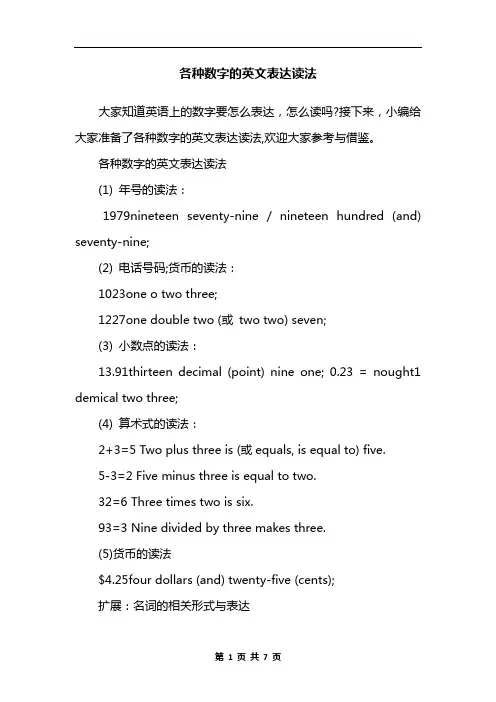
各种数字的英文表达读法大家知道英语上的数字要怎么表达,怎么读吗?接下来,小编给大家准备了各种数字的英文表达读法,欢迎大家参考与借鉴。
各种数字的英文表达读法(1) 年号的读法:1979nineteen seventy-nine / nineteen hundred (and) seventy-nine;(2) 电话号码;货币的读法:1023one o two three;1227one double two (或two two) seven;(3) 小数点的读法:13.91thirteen decimal (point) nine one; 0.23 = nought1 demical two three;(4) 算术式的读法:2+3=5 Two plus three is (或equals, is equal to) five.5-3=2 Five minus three is equal to two.32=6 Three times two is six.93=3 Nine divided by three makes three.(5)货币的读法$4.25four dollars (and) twenty-five (cents);扩展:名词的相关形式与表达在中考单项选择试题中,除了时态,名词的考查频率也较高。
一般考查以下几点:一、可数名词与不可数名词在可数名词与不可数名词上一般出现这样几类,(1)分辨是哪一类名词,并根据结论做选择。
(2)可数名词复数的不规则变化。
(3)不可数名词的量化表达。
所以,考生首先要能够明确哪些是可数名词,哪些是不可数名词。
其次,还要知道可数名词的复数的变化规则。
可数名词的变化规则一般是在单词后面加-s 或-es,如:1. desk---desks bed---beds piano---pianoshat---hats bag---bags photo---photos2. bus---buses box---boxeswatch---watches brush---brushes3. t omato---tomatoes potato---potatoeshero---heroes Negro---Negroes4. leaf---leaves knife---knives5. baby---babies family---families另外,还要记住一些特殊的名词的变化形式,如:Chinese---Chinese Japanese---JapaneseEnglishman---Englishmen Frenchman---FrenchmenRussian---Russians American---AmericansGerman1 --- Germans2child---children foot---feetman---men woman---womentooth---teeth goose --- geesedeer---deer sheep---sheep还要掌握不可数名词的量化表达有:a piece of、a bag of、a bottle of、a cup of、a glass of 。
英文数字读法0到9

英文数字读法0到9一、数字1:one;英[wʌn],美[wʌn]。
二、数字2:two;英[tu:],美[tu]。
三、数字3:three;英[θri:],美[θri]。
四、数字4:four;英[fɔ:(r)],美[fɔr]。
五、数字5:five;英[faɪv],美[faɪv]。
六、数字6:six;英[sɪks],美[sɪks]。
七、数字7:seven;英[ˈsevn],美[ˈsɛvən]。
八、数字8:eight;英[eɪt],美[et]。
九、数字9:nine;英[naɪn],美[naɪn]。
十、数字10:ten;英[ten],美[tɛn]。
十一、数字11:eleven;英[ɪˈlevn],美[ɪˈlɛvən]。
十二、数字12:twelve;英[twelv],美[twɛlv]。
十三、数字13:thirteen:英[θɜːˈtiːn],美[ˈθɜːtiːn]。
十四、数字14:fourteen:英[fɔːˈtiːn],美[ˈfɔːtiːn]。
十五、数字15:fifteen:英[fɪfˈtiːn],美[ˈfɪftiːn]。
十六、数字16:sixteen:英[sɪksˈtiːn],美[ˈsɪkstiːn]。
十七、数字17:seventeen:英[sev(ə)nˈtiːn],美[ˈsev(ə)ntiːn]。
十八、数字18:eighteen:英[eɪˈtiːn],美[ˈeɪtiːn]。
十九、数字19: nineteen:英[naɪnˈtiːn],美[ˈnaɪntiːn]。
二十、数字20:twenty:英[ˈtwentɪ],美[ˈtwentɪ]。
扩展资料英语中的年份、日期的读法:一、年份关于四位数年份的读法有下列几种情形:1、一般情况下,将表示年份的四个数字按前后分为两组,每一组的数字都按基数词来读。
例如:1865年读作 eighteen sixty-five。
2、如果前两个数字为非“零”数字,后两位数分别为“零”,则先读出前两位数,然后将后面的两个“零”读为hundred。
英语中各种数字的读法
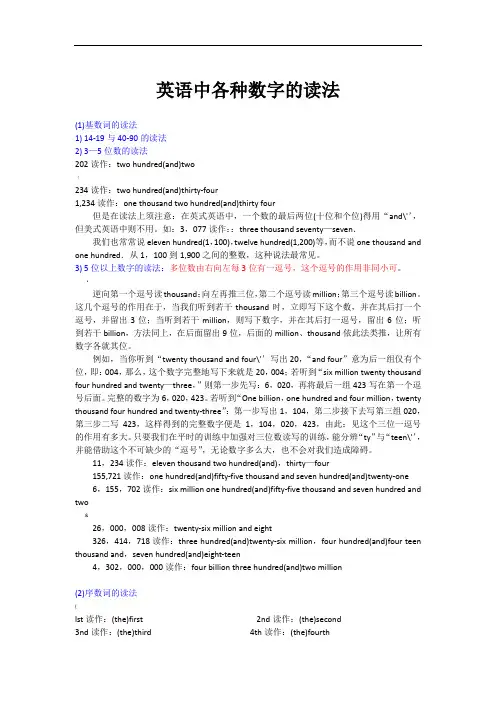
英语中各种数字的读法(1)基数词的读法1) 14-19与40-90的读法2) 3—5位数的读法202读作:two hundred(and)two(234读作:two hundred(and)thirty-four1,234读作:one thousand two hundred(and)thirty four但是在读法上须注意:在英式英语中,一个数的最后两位(十位和个位)得用“and\'’,但美式英语中则不用。
如:3,077读作::three thousand seventy—seven.我们也常常说eleven hundred(1,100),twelve hundred(1,200)等,而不说one thousand and one hundred.从1,100到1,900之间的整数,这种说法最常见。
3) 5位以上数字的读法:多位数由右向左每3位有一逗号,这个逗号的作用非同小可。
·逆向第一个逗号读thousand;向左再推三位,第二个逗号读million;第三个逗号读billion。
这几个逗号的作用在于,当我们听到若干thousand时,立即写下这个数,并在其后打一个逗号,并留出3位;当听到若干million,则写下数字,并在其后打一逗号,留出6位;听到若干billion,方法同上,在后面留出9位,后面的million、thousand依此法类推,让所有数字各就其位。
例如,当你听到“twenty thousand and four\'’写出20,“and four”意为后一组仅有个位,即:004,那么,这个数字完整地写下来就是20,004;若听到“six million twenty thousand four hundred and twenty—three,”则第一步先写:6,020,再将最后一组423写在第一个逗号后面。
完整的数字为6,020,423。
若听到“One billion,one hundred and four million,twenty thousand four hundred and twenty-three”:第一步写出1,104,第二步接下去写第三组020,第三步二写423,这样得到的完整数字便是1,104,020,423,由此:见这个三位一逗号的作用有多大。
英语1~20的单词怎么读
英语1~20的单词怎么读英语是世界上被广泛使用的语言之一,学会正确地发音对于提高英语口语水平至关重要。
在英语中,数字也是常用的词汇,1到20这些数字的读音是我们日常生活中经常会用到的。
下面将逐个介绍1到20的英文数字单词及其正确的发音。
1. One发音:/wʌn/2. Two发音:/tuː/3. Three发音:/θriː/4. Four发音:/fɔːr/5. Five发音:/faɪv/6. Six发音:/sɪks/7. Seven发音:/ˈsev.ən/8. Eight发音:/eɪt/9. Nine发音:/naɪn/10. Ten发音:/ten/11. Eleven发音:/ɪˈlev.ən/12. Twelve发音:/twelv/13. Thirteen发音:/ˌθɜrˈtiːn/14. Fourteen发音:/ˌfɔrˈtiːn/15. Fifteen发音:/ˌfɪfˈtiːn/16. Sixteen发音:/ˌsɪksˈtiːn/17. Seventeen发音:/ˌsevˈenˈtiin/18. Eighteen发音:/ˌeɪˈtiin/19. Nineteen发音:/ˌnaɪnˈtiin/20. Twenty发音:/ˈtwen.ti/以上便是1到20这些数字在英语中的单词及其发音。
通过反复练习,我们可以更好地掌握这些数字的正确发音,从而提高我们的英语口语水平。
希望这些发音指南对您学习英语有所帮助!。
如何正确发音英语单词数字1至100(带音标)中的每个音标?
如何正确发音英语单词数字1至100(带音标)中的每个音标?英语单词数字的正确发音对于研究英语是非常重要的。
下面是数字1至100的每个音标,以及对应的发音方式和音标注音。
数字1至10- 1: [wʌn],发音方式:唇齿音,音标注音:wun- 2: [tu:],发音方式:舌尖音,音标注音:too- 3: [θri:],发音方式:舌尖音,音标注音:three- 4: [fɔ:],发音方式:咬住下嘴唇,音标注音:four- 5: [faɪv],发音方式:嘴角微微上扬,音标注音:five- 6: [sɪks],发音方式:锐音,音标注音:six- 7: [sɛvən],发音方式:舌尖音,音标注音:seven- 8: [eɪt],发音方式:嘴角张开,音标注音:eight- 9: [naɪn],发音方式:突然放松舌尖,音标注音:nine- 10: [ten],发音方式:唇齿音,音标注音:ten数字11至20- 11: [ɪˈlɛv(ə)n],发音方式:舌尖音,音标注音:eleven- 12: [twɛlv],发音方式:咬住下嘴唇,音标注音:twelve- 13: [θɜrˈtin],发音方式:舌尖音,音标注音:thirteen- 14: [fɔːrˈtin],发音方式:咬住下嘴唇,音标注音:fourteen - 15: [faɪfˈtin],发音方式:嘴角微微上扬,音标注音:fifteen - 16: [sɪksˈtin],发音方式:锐音,音标注音:sixteen- 17: [sɛv(ə)nˈtin],发音方式:舌尖音,音标注音:seventeen - 18: [eɪtˈtin],发音方式:嘴角张开,音标注音:eighteen- 19: [naɪnˈtin],发音方式:突然放松舌尖,音标注音:een- 20: [twɛnˈti],发音方式:唇齿音,音标注音:twenty数字21至100- 21: [twɛnˈti-ˈwʌn],发音方式:唇齿音,音标注音:twenty-one- 22: [twɛnˈti-ˈtu:],发音方式:舌尖音,音标注音:o- 23: [twɛnˈti-θri:],发音方式:舌尖音,音标注音:twenty-three- 24: [twɛnˈti-ˈfɔːr],发音方式:咬住下嘴唇,音标注音:twenty-four- 25: [twɛnˈti-ˈfaɪv],发音方式:嘴角微微上扬,音标注音:twenty-five- 26: [twɛnˈti-sɪks],发音方式:锐音,音标注音:twenty-six- 27: [twɛnˈti-sɛv(ə)n],发音方式:舌尖音,音标注音:twenty-seven- 28: [twɛnˈti-eɪt],发音方式:嘴角张开,音标注音:twenty-eight- 29: [twɛnˈti-naɪn],发音方式:突然放松舌尖,音标注音:twenty-nine- 30: [θɜːrˈti],发音方式:舌尖音,音标注音:thirty... (继续填写剩余数字的音标)这是如何正确发音英语单词数字1至100(带音标)中的每个音标的指南。
英文数字1到100读法
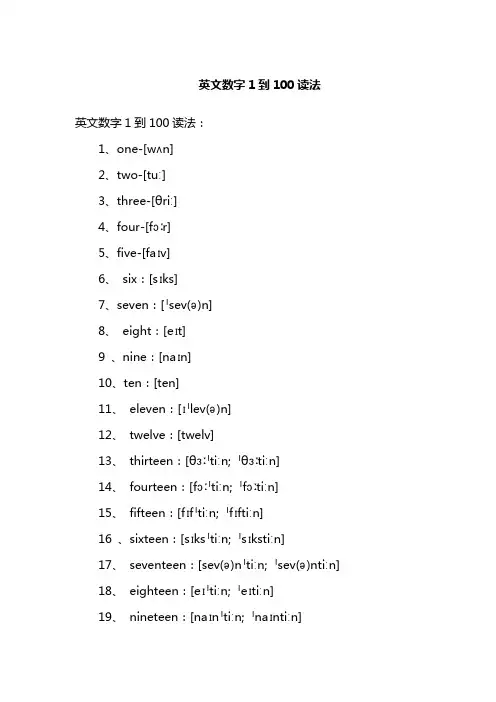
英文数字1到100读法英文数字1到100读法:1、one-[wʌn]2、two-[tuː]3、three-[θriː]4、four-[fɔːr]5、five-[faɪv]6、six:[sɪks]7、seven:[ˈsev(ə)n]8、eight:[eɪt]9 、nine:[naɪn]10、ten:[ten]11、eleven:[ɪˈlev(ə)n]12、twelve:[twelv]13、thirteen:[θɜːˈtiːn; ˈθɜːtiːn]14、fourteen:[fɔːˈtiːn; ˈfɔːtiːn]15、fifteen:[fɪfˈtiːn; ˈfɪftiːn]16 、sixteen:[sɪksˈtiːn; ˈsɪkstiːn]17、seventeen:[sev(ə)nˈtiːn; ˈsev(ə)ntiːn]18、eighteen:[eɪˈtiːn; ˈeɪtiːn]19、nineteen:[naɪnˈtiːn; ˈnaɪntiːn]20 、twenty:[ˈtwentɪ]21 、twenty-one:[ˈtwentɪˌwʌn]22 、twenty-two:[ˌtwentɪˈtuː]23、twenty-three:[tˈwentiːθrˈiː]24、twenty-four:[tˈwentiːfˈɔːr]25、twenty-five:[ˈtwentɪfaɪv]26、twenty-six:[tˈwentiːsˈɪks]27、twenty-seven:[tˈwentiːsˈevn]28、twenty-eight:[tˈwentiːˈeɪt]29 、twenty-nine:[tˈwentiːnˈaɪn]30、thirty:[ˈθɜːtɪ]31、thirty-one:[ˈθɜːtiːwˈʌn]32、thirty-two:[ˈθɜːtiːtˈuː]33、thirty-three:[ˈθɜːtɪθrɪ]34、thirty-four:[ˈθɜːtiːfˈɔːr]35 、thirty-five:[ˈθɜːtiːfˈaɪv]36、thirty-six:[ˈθɜːtiːsˈɪks]37、thirty-seven:[ˈθɜːtiːsˈevn]38 、thirty-eight:[ˈθəːtiˈeit]39、thirty-nine:[ˈθɜːtiːnˈaɪn]40、forty:[ˈfɔːtɪ]41、forty-one:[ˈfɔːtɪˌwʌn]42、forty-two:[ˈfɔːtiːtˈuː]43、forty-three:[ˈfɔːtiːθrˈiː]44、forty-four:[ˈfɔːtiːfˈɔːr]45、forty-five:[ˈfɔːtɪfaɪv]46 、forty-six:[ˈfɔːtiːsˈɪks]47、forty-seven:[ˈfɔːtiːsˈevn]48、forty-eight:[ˈfɔːtiˈeit]49、forty-nine:[ˈfɔːtiːnˈaɪn]50、fifty:[ˈfɪftɪ]51、fifty-one:[ˈfiftiwʌn]52、fifty-two:[ˈfɪftiːtˈuː]53、fifty-three:[ˈfɪftiːθrˈiː]54、fifty-four:[ˈfɪftiːfˈɔːr]55、fifty-five:[fːftifaiv]56、fifty-six:[ˈfɪftiːsˈɪks]57、fifty-seven:[ˈfɪftiːsˈevn]58、fifty-eight:[ˈfɪftiːˈeɪt]59、fifty-nine:[ˈfɪftiːnˈaɪn]60、sixty:[ˈsɪkstɪ]61、sixty-one:[ˈsɪkstiːwˈʌn]62、sixty-two:[ˈsɪkstiːtˈuː]63、sixty-three:[ˈsɪkstiːθrˈiː]65、sixty-five:[ˈsɪkstiːfˈaɪv]66、sixty-six:[ˈsɪkstiːsˈɪks]67 、sixty-seven:[ˈsɪkstiːsˈevn]68、sixty-eight:[ˈsɪkstiːˈeɪt]69、sixty-nine:[ˈsikstiˈnain]70、seventy:[ˈsev(ə)ntɪ]71、seventy-one:[ˈsevntiːwˈʌn]72、seventy-two:[ˈsevntiːtˈuː]73、seventy-three:[ˈsevntiːθrˈiː]74、seventy-four:[ˈsevəntiˈfɔː]75 、seventy-five:[ˈsevntiːfˈaɪv]76 、seventy-six:[ˈsevntiːsˈɪks]77、seventy-seven:[ˈsevntiːsˈevn]78 、seventy-eight:[ˈsevntiːˈeɪt]79、seventy-nine:[ˈsevntiːnˈaɪn]80 、eighty:[ˈeɪti]81、eighty-one:[ˈnaɪntɪ]82、eighty-two:[ˈeitiˈwʌn]83、eighty-three:[ˈeitiˈtuː]84、eighty-four:[ˈeɪtiːθrˈiː]85 、eighty-five:[ˈeitiˈfɔː]87 、eighty-seven:[ˈeɪtiːsˈɪks]88 、eighty-eight:[ˈeɪtiːsˈevn]89、eighty-nine:[ˈeɪtiːeɪt]90、ninety:[ˈeɪtiːnˈaɪn]91、ninety-one:[ˈnaɪntiːwˈʌn]92、ninety-two:[ˈnaɪntiːtˈuː]93 、ninety-three:[ˈnaɪntiːθrˈiː]94 、ninety-four:[ˈnaɪntiːfˈɔːr]95、ninety-five:[ˈnaintiˈfaiv]96、ninety-six:[ˈnaɪntiːsˈɪks]97 、ninety-seven:[ˈnaɪntiːsˈevn]98 、ninety-eight:[ˈnaɪntiːˈeɪt]99 、ninety-nine:[ˈnaɪntiːnˈaɪn]100 、one/a hundred:[wʌn] [ə; eɪ] [ˈhʌndrəd]。
如何朗读英文数字
【导语】以下是⽆忧考整理的《如何朗读英⽂数字》,⼀起来看看吧想正确的读出英语数字,我们先从基数词⼊⼿,百位以内的基数词还是⽐较好读的one, two, three, four或者两位数字23,读作twenty-three, 30-100之间的数字可以参照20⼏的读法,依此类推⼏⼗⼏,100以内的数字都是类似的表达。
那么三位以上的数字呢?1. 3-4位的数字读法英语中有“百”和“千”的计数单位,所以直接⽤数字+计数单位+数字就可以。
⽐如:105 读作 one hundred (and) five245 读作 two hundred (and) forty-five3,286 读作 three thousand two hundred (and) eighty-six注意:(1) 英式英语中,hundred后⾯的数字要加and,但美式英语却不⽤。
(2) 四位数字也可以读作thirty-two, eighty-six,也就是说两个两个的读出来。
2. 5-6位的数字读法处理5位以上的数字时,我们要记得看“逗号”,因为三个数字⼀个逗号,即三位⼀节,把三位看成⼀个整体,后⾯再加⼀个单位。
5位的数字在汉语中可以⽤“万”来表⽰,6位即是“⼗万”,在英语中却没有相应的单位词。
这时,我们换算⼀下:“万”=“⼗个千”=ten thousand“⼗万”=“百个千”a/one hundred thousand例如:12, 345: twelve thousand three hundred (and) forty-five325,189: three hundred (and) twenty-five thousand and one hundred (and) eighty-nine3. 7位以上的数字读法7位数在汉语中是 “百万”,在英语中有相应的基数词million。
但汉语中的“千万”和“亿”在英语中没有相应的基数词。
各种数字的英文读法
(1)基数词的读法我们先从基数词人手。
首先掌握三位以内数字的读法,因为它是多位数字的基础,一旦熟练掌握,再借助一个逗号,便可轻松应付四位以上任何庞大的数字。
我们可以通过例子来说明这一点。
①3—5 位数的读法202 读作:two hundred(and)two234 读作:two hundred(and)thirty-four1, 234 读作:one thousand two hundred(and)thirtyfour但是在读法上须注意以下几点:a.在英式英语中,一个数的最后两位(十位和个位)得用“and\'’,但美式英语中则不用。
如:3,077 读作:U.S:three thousand seventy—seven.b.不定冠词“a”只在数的开头才和 hundred,thousand 等连用。
试比较:146 读作:ahundred(and)forty-six2,146 读作:twothousand,one hundred(and)fortysixc.1,000 这个整数我们说 a thousand,在 and 前我们也说 a thousand,但是在一个有百位数的数目前就得说one thousand 试比较:1,031 读作:a thousand,(and)thirty-one,1,150 读作:one thousand,one hundred(and)fiftyd.hundred,thousand 和 million 这几个词的单数可以和:“a”者“one”连用,但是不能单独使用。
在非正式文体中“a”比较常见;当我们说话比较准确的时候就用“one”试比较:I Want to live for a hundred years.The journey took exactly one hundred days.e.我们常常说 eleven hundred(1,100),twelve hundred(1,200)等,而不说 one thous and one hundred.从 1,100 到 1,900 之间的整数,这种说法最常见。
正确掌握英语各种数字的读法
正确掌握英语各种数字的读法我们生活在数的世界里,每时每刻都与各种数字打交道。
从人口数量、价格、速度、高度、产量、时刻、年代、日期到比例、温度、银行账号、电话号码,生活中充满了数字,正因为如此,数字与计算在英语听力教学中占有相当的比重。
培养自己的耳朵对英文数字保持敏感是听力训练中一项必不可少的基本功。
那么怎样才能快捷有效地掌握这一技能呢?我们应从掌握数字的正确读法开始。
能流利地读出各种数字是记忆数字的前提。
(1)基数词的读法我们先从基数词人手。
首先掌握三位以内数字的读法,因为它是多位数字的基础,一旦熟练掌握,再借助一个逗号,便可轻松应付四位以上任何庞大的数字。
我们可以通过例子来说明这一点。
①3—5位数的读法202读作:two hundred(and)two234读作:two hundred(and)thirty-four1,234读作:one thousand two hundred(and)thirtyfour但是在读法上须注意以下几点:a.在英式英语中,一个数的最后两位(十位和个位)得用“and\'’,但美式英语中则不用。
如:3,077读作:U.S:three thousand seventy—seven.b.不定冠词“a”只在数的开头才和hundred,thousand等连用。
试比较:146读作:a hundred(and)forty-six2,146读作:two thousand,one hundred(and)forty sixc.1,000这个整数我们说a thousand,在and前我们也说a thousand,但是在一个有百位数的数目前就得说one thousand试比较:1,031读作:a thousand,(and)thirty-one,1,150读作:one thousand,one hundred(and)fiftyd.hundred,thousand和million这几个词的单数可以和:“a”者“one”连用,但是不能单独使用。
各种数字的英文表达读法
各种数字的英文表达读法大家知道英语上的数字要怎么表达,怎么读吗?接下来,小编给大家准备了各种数字的英文表达读法,欢迎大家参考与借鉴。
各种数字的英文表达读法(1) 年号的读法:1979←→nineteen seventy-nine / nineteen hundred (and) seventy-nine;(2) 电话号码;货币的读法:1023←→one o two three;1227←→one double two (或 two two) seven;(3) 小数点的读法:13.91←→thirteen decimal (point) nine one; 0.23 = nought1 demical two three;(4) 算术式的读法:2+3=5 Two plus three is (或equals, is equal to) five.5-3=2 Five minus three is equal to two.3×2=6 Three times two is six.9÷3=3 Nine divided by three makes three.(5)货币的读法$4.25←→four dollars (and) twenty-five (cents);扩展:名词的相关形式与表达在中考单项选择试题中,除了时态,名词的考查频率也较高。
一般考查以下几点:一、可数名词与不可数名词在可数名词与不可数名词上一般出现这样几类,(1)分辨是哪一类名词,并根据结论做选择。
(2)可数名词复数的不规则变化。
(3)不可数名词的量化表达。
所以,考生首先要能够明确哪些是可数名词,哪些是不可数名词。
其次,还要知道可数名词的复数的变化规则。
可数名词的变化规则一般是在单词后面加-s 或-es,如:1. desk---desks bed---beds piano---pianoshat---hats bag---bags photo---photos2. bus---buses box---boxeswatch---watches brush---brushes3. t omato---tomatoes potato---potatoeshero---heroes Negro---Negroes4. leaf---leaves knife---knives5. baby---babies family---families另外,还要记住一些特殊的名词的变化形式,如:Chinese---Chinese Japanese---JapaneseEnglishman---Englishmen Frenchman---FrenchmenRussian---Russians American---AmericansGerman1 --- Germans2child---children foot---feetman---men woman---womentooth---teeth goose --- geesedeer---deer sheep---sheep还要掌握不可数名词的量化表达有:a piece of、a bag of、a bottle of、a cup of、a glass of 。