
元宵节由来英文介绍
Lantern Festival 元宵节的由来英文介绍Lantern Festival The 15th day of the 1st lunar monthThe 15th day of the 1st lunar month is the Chinese Lantern Festival because the first lunar month is called yuan-month and in the ancient times people called night Xiao. The 15th day is the first night to see a full moon. So the day is also called Yuan Xiao Festival in China.According to the Chinese tradition, at the very beginning of a new year, when there is a bright full moon hanging in the sky, there should be thousands of colorful lanterns hung out for people to appreciate. At this time, people will try to solve the puzzles on the lanterns and eat yuanxiao (glutinous rice ball) and get all their families united in the joyful atmosphere.元宵节正月十五吃元宵的的习俗由来已久,元宵也叫“汤圆”、“圆子”。
据说元宵象征合家团圆,吃元宵意味新的一年合家幸福、万事如意。
元宵节闹花灯的习俗起源于道教的“三元说”;正月十五日为上元节,七月十五日为中元节,十月十五日为下元节。
主管上、中、下三元的分别为天、地、人三官,天官喜乐,故上元节要燃灯。
元宵节的节期与节俗活动,是随历史的发展而延长、扩展的。
就节期长短而言,汉代才一天,到唐代已为三天,宋代则长达五天,明代更是自初八点灯,一直到正月十七的夜里才落灯,整整十天。
与春节相接,白昼为市,热闹非凡,夜间燃灯,蔚为壮观。
特别是那精巧、多彩的灯火,更使其成为春节期间娱乐活动的高潮。
至清代,又增加了舞龙、舞狮、跑旱船、踩高跷、扭秧歌等“百戏”内容,只是节期缩短为四到五天。
HistoryUntil the Sui Dynasty in the sixth century, Emperor Yangdi invited envoys from other countries to China to see the colorful lighted lanterns and enjoy the gala(节日的,庆祝的)performances.By the beginning of the Tang Dynasty in the seventh century, the lantern displays would last three days. The emperor also lifted the curfew(宵禁令), allowing the people to enjoy the festive lanterns day and night. It is not difficult to find Chinese poems which describe this happy scene.In the Song Dynasty, the festival was celebrated for five days and the activities began to spread to many of the big cities in China. Colorful glass and even jade were used to make lanterns, with figures from folk tales painted on the lanterns.However, the largest Lantern Festival celebration took place in the early part of the 15th century. The festivities continued for ten days. Emperor Chengzu had the downtown area set aside as a center for displaying the lanterns. Even today, there is a place in Beijing called Dengshikou. In Chinese, Deng means lantern and Shi is market. The area became a market where lanterns were sold during the day. In the evening, the local people would go there to see the beautiful lighted lanterns on display.Today, the displaying of lanterns is still a big event on the 15th day of the first lunar month throughout China. People enjoy the brightly lit night. Chengdu in Southwest China's Sichuan Province, for example, holds a lantern fair each year in the Cultural Park. During the Lantern Festival, the park is literally an ocean of lanterns! Many new designs attract countless visitors. The mosteye-catching lantern is the Dragon Pole. This is a lantern in the shape of a golden dragon, spiraling up a 27-meter -high pole, spewing fireworks from its mouth. It is quite an impressive sight!元宵节是中国的传统节日,早在2000多年前的西汉就有了,元宵赏灯始于东汉明帝时期,明帝提倡佛教,听说佛教有正月十五日僧人观佛舍利,点灯敬佛的做法,就命令这一天夜晚在皇宫和寺庙里点灯敬佛,令士族庶民都挂灯。
以后这种佛教礼仪节日逐渐形成民间盛大的节日。
该节经历了由宫廷到民间,由中原到全国的发展过程。
在汉文帝时,已下令将正月十五定为元宵节。
汉武帝时,“太一神”的祭祀活动定在正月十五。
(太一:主宰宇宙一切之神)。
司马迁创建“太初历”时,就已将元宵节确定为重大节日。
另有一说是元宵燃灯的习俗起源于道教的“三元说”;正月十五日为上元节,七月十五日为中元节,十月十五日为下元节。
主管上、中、下三元的分别为天、地、人三官,天官喜乐,故上元节要燃灯。
元宵节的节期与节俗活动,是随历史的发展而延长、扩展的。
就节期长短而言,汉代才一天,到唐代已为三天,宋代则长达五天,明代更是自初八点灯,一直到正月十七的夜里才落灯,整整十天。
与春节相接,白昼为市,热闹非凡,夜间燃灯,蔚为壮观。
特别是那精巧、多彩的灯火,更使其成为春节期间娱乐活动的高潮。
至清代,又增加了舞龙、舞狮、跑旱船、踩高跷、扭秧歌等“百戏”内容,只是节期缩短为四到五天。
OriginThere are many different beliefs about the origin of the Lantern Festival. But one thing for sure is that it had something to do with religious worship.One legend tells us that it was a time to worship Taiyi, the God of Heaven in ancient times. The belief was that the God of Heaven controlled the destiny of the human world. He had sixteen dragons at his beck and call and he decided when to inflict drought, storms, famine or pestilence(瘟疫)upon human beings. Beginning with Qinshihuang, the first emperor to unite the country, all subsequent emperors ordered splendid ceremonies each year. The emperor would ask Taiyi to bring favorable weather and good health to him and his people. Emperor Wudi of the Han Dynasty directed special attention to this event. In 104 BC, he proclaimed it one of the most important celebrations and the ceremony would last throughout the night.Another legend associates the Lantern Festival with Taoism. Tianguan is the Taoist god responsible for good fortune. His birthday falls on the 15th day of the first lunar month. It is said that Tianguan likes all types of entertainment. So followers prepare various kinds of activities during which they pray for good fortune.The third story about the origin of the festival is like this. Buddhism first entered China during the reign of Emperor Mingdi of the Eastern Han Dynasty. That was in the first century. However, it did not exert any great influence among the Chinese people. one day, Emperor Mingdi had a dream about a gold man in his palace. At the very moment when he was about to ask the mysterious figure who he was, the gold man suddenly rose to the sky and disappeared in the west. The next day, Emperor Mingdi sent a scholar to India on a pilgrimage(朝圣)to locate Buddhist scriptures. After journeying thousands of miles, the scholar finally returned with the scriptures. Emperor Mingdi ordered that a temple be built to house a statue of Buddha and serve as a repository for the scriptures. Followers believe that the power of Buddha can dispel darkness. So Emperor Mingdi ordered his subjects to display lighted lanterns during what was to become the Lantern Festival.关于元宵节的来历,民间还有几种有趣的传说:关于灯的传说传说在很久以前,凶禽猛兽很多,四处伤害人和牲畜,人们就组织起来去打它们,有一只神鸟困为迷路而降落人间,却意外的被不知情的猎人给射死了。
元宵节的来历英文版
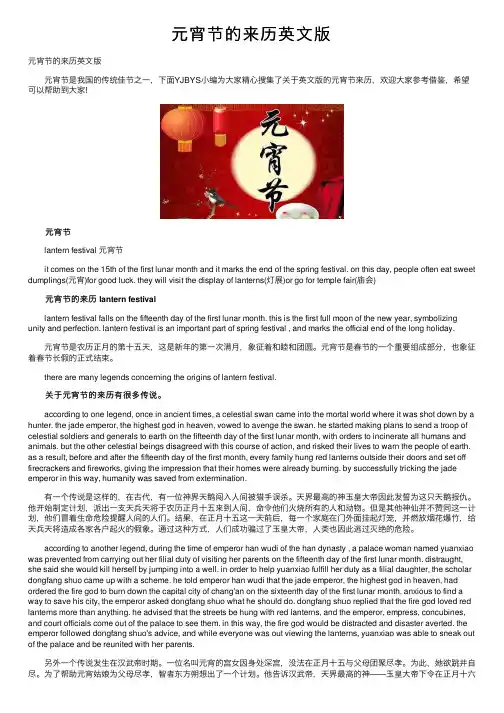
元宵节的来历英⽂版元宵节的来历英⽂版 元宵节是我国的传统佳节之⼀,下⾯YJBYS⼩编为⼤家精⼼搜集了关于英⽂版的元宵节来历,欢迎⼤家参考借鉴,希望可以帮助到⼤家! 元宵节 lantern festival 元宵节 it comes on the 15th of the first lunar month and it marks the end of the spring festival. on this day, people often eat sweet dumplings(元宵)for good luck. they will visit the display of lanterns(灯展)or go for temple fair(庙会) 元宵节的来历 lantern festival lantern festival falls on the fifteenth day of the first lunar month. this is the first full moon of the new year, symbolizing unity and perfection. lantern festival is an important part of spring festival , and marks the official end of the long holiday. 元宵节是农历正⽉的第⼗五天,这是新年的第⼀次满⽉,象征着和睦和团圆。
元宵节是春节的⼀个重要组成部分,也象征着春节长假的正式结束。
there are many legends concerning the origins of lantern festival. 关于元宵节的来历有很多传说。
according to one legend, once in ancient times, a celestial swan came into the mortal world where it was shot down by a hunter. the jade emperor, the highest god in heaven, vowed to avenge the swan. he started making plans to send a troop of celestial soldiers and generals to earth on the fifteenth day of the first lunar month, with orders to incinerate all humans and animals. but the other celestial beings disagreed with this course of action, and risked their lives to warn the people of earth. as a result, before and after the fifteenth day of the first month, every family hung red lanterns outside their doors and set off firecrackers and fireworks, giving the impression that their homes were already burning. by successfully tricking the jade emperor in this way, humanity was saved from extermination. 有⼀个传说是这样的,在古代,有⼀位神界天鹅闯⼊⼈间被猎⼿误杀。
元宵节的由来介绍简短50字英语
元宵节的由来介绍Brief Introduction to the Origin of Lantern Festival元宵节(Lantern Festival),又称为上元节、正月十五、照夜节等,是中国传统节日之一。
它是中国农历新年之后的第一个重要节日,通常在农历正月十五这一天举行。
元宵节这个节日起源悠久,有着丰富多样的文化内涵。
The Legend of Yuanxiao Festival关于元宵节的起源,有许多传说与故事。
其中最有名的一则传说是关于汉朝时期的民间英雄——黄飞鸿。
相传,在汉朝时期,民间英雄黄飞鸿曾经领导起义军反抗外敌。
在农历正月十五这一天,黄飞鸿曾智斗外敌,并成功保卫了自己的家园。
为了庆祝这一胜利,当地居民点亮了许多灯笼,游行庆祝,并呼唤黄飞鸿“元宵子”的名号。
从此,元宵节便成为了一个庆祝胜利和团聚的日子。
Lantern Festival Traditions元宵节的传统庆祝活动充满了创意和乐趣。
其中最具代表性的活动就是赏花灯。
这一传统可追溯到汉朝的民间习俗。
人们用竹子搭建框架,再用彩纸、丝线和烟火等材料装饰灯笼。
花灯的形状各异,有花、鸟、山石等各种各样的造型,色彩斑斓,给人们带来了视觉上的享受。
此外,元宵节还有其他传统活动,如猜灯谜、吃元宵等。
猜灯谜是元宵节最具特色的活动之一。
人们把灯谜写在纸条上,把它们贴在花灯上,然后邀请亲朋好友猜谜。
猜对的人可以获得小奖品。
而吃元宵则是元宵节的必备活动之一。
元宵是一种由糯米粉制成的糕点,里面可以包裹着各种馅料,如豆沙、花生和红枣等。
人们在元宵节这一天家人团圆,一边赏花灯一边品尝美食,共享欢乐时光。
Cultural Significance of Lantern Festival元宵节不仅是一个庆祝胜利和团聚的节日,也有着深厚的文化内涵。
这个节日传承着中华民族的传统文化,体现着人们对美好生活和幸福未来的向往。
元宵节也被称为中国的“情人节”,在这一天,人们希望能与心爱的人共度欢乐的时光,传递着爱和温暖。
元宵节的由来简介20字左右英文

Introduction to the Origins of Lantern Festival The Lantern Festival, also known as Yuanxiao Festival, is a traditional Chinese festival celebrated on the 15th day of the first month in the lunar calendar. It marks the end of the Chinese New Year celebrations and is one of the most important festivals in Chinese culture.The origins of the Lantern Festival can be traced back to ancient legends and customs. With a history of over 2,000 years, this festival carries a rich cultural significance and has become an integral part of Chinese traditions.According to one popular legend, the Lantern Festival has its roots in the Han Dynasty (206 BC – 220 AD). During that time, Emperor Hanmingdi was a strong advocate of Buddhism. He was informed by Buddhist monks that on the fifteenth day of the first lunar month, there would be a celestial convergence where gods would descend upon the earth to bestow blessings and protection on the people. To honor this special occasion, the emperor ordered the lighting of lanterns throughout the city and temples to create a festive atmosphere and welcome the gods.Lanterns hold a special significance during this festival. The lighting of lanterns symbolizes a desire for good fortune and the hope for a bright future. Traditionally, lanterns were made of paper and embellished with intricate designs. Today, lanterns come in various shapes, colors, and sizes, ranging from traditional designs to modern innovations.Another legend associated with the Lantern Festival is the tale of the Jade Emperor’s daughter. According to this story, the Jade Emperor became angry with a village for killing his favorite bird. As punishment, he planned to send a storm to destroy the village. However, a fairy came to the rescue and warned the villagers about the impending disaster. The villagers took her advice and hung red lanterns in front of their houses, lit fireworks, and set off firecrackers to create the illusion of a burning village. The Jade Emperor was fooled by the ruse and called off the storm. Since then, the practice of hanging red lanterns and setting off fireworks has become an integral part of the Lantern Festival celebrations.One of the main highlights of the Lantern Festival is the Yuanxiao, a sticky rice dumpling filled with sweet or savory fillings. The round shape of the Yuanxiao represents unity and harmony within the family. It is believed that by eating Yuanxiao, one can bring good luck and happiness in the coming year. Nowadays, various types of Yuanxiao can be found, catering to different tastes and preferences.In addition to lanterns and Yuanxiao, there are various traditional activities and performances that take place during the Lantern Festival. These include lion and dragon dances, martial arts demonstrations, folk arts and crafts exhibitions, as well as lantern riddle guessing games. The lantern riddle guessing game is particularly popular, where riddles are written on lanterns and participants try to solve them.Today, the Lantern Festival is celebrated not only in China but also in several countries with Chinese communities. The festival provides an opportunity for people to come together, enjoy the vibrant lantern displays, savor delicious food, and experience the rich cultural heritage of China.In conclusion, the Lantern Festival, also known as Yuanxiao Festival, is a significant Chinese festival that marks the end of the Chinese New Year celebrations. It has a rich history and is celebrated with various traditions, including lantern displays, the consumption of Yuanxiao, and cultural performances. The festival holds great cultural and historical value, reflecting the importance of unity, blessings, and hope for a prosperous future.。
元宵节由来英文介绍

Lantern Festival 元宵节的由来英文介绍Lantern Festival The 15th day of the 1st lunar monthThe 15th day of the 1st lunar month is the Chinese Lantern Festival because the first lunar month is called yuan-month and in the ancient times people called night Xiao. The 15th day is the first night to see a full moon. So the day is also called Yuan Xiao Festival in China.According to the Chinese tradition, at the very beginning of a new year, when there is a bright full moon hanging in the sky, there should be thousands of colorful lanterns hung out for people to appreciate. At this time, people will try to solve the puzzles on the lanterns and eat yuanxiao (glutinous rice ball) and get all their families united in the joyful atmosphere.元宵节正月十五吃元宵的的习俗由来已久,元宵也叫“汤圆”、“圆子”。
据说元宵象征合家团圆,吃元宵意味新的一年合家幸福、万事如意。
元宵节闹花灯的习俗起源于道教的“三元说”;正月十五日为上元节,七月十五日为中元节,十月十五日为下元节。
元宵节的由来介绍简短英文带翻译
Introduction to the Origin of Lantern Festival (元宵节) in ChinaThe Lantern Festival, also known as Yuanxiao Festival or Shangyuan Festival, is a traditional Chinese festival celebrated on the 15th day of the first month in the lunar calendar. It marks the end of the Chinese New Year celebration period. The festival is widely celebrated with various activities and customs, including lantern displays, lion dances, lantern riddles, and the consumption of rice dumplings known as tangyuan.The Origin of Lantern Festival: The Lantern Festival has a long history and its origins can be traced back to the Han Dynasty (202 BC - 220 AD). However, the exact origin and legend of this festival vary across different regions of China. The most widely accepted folk story that explains the origin of the Lantern Festival revolves around the worship of celestial beings and mythical figures.According to historical records, Emperor Wudi of the Han Dynasty was an advocate of Buddhism. He was greatly influenced by Buddhist teachings and believed in the existence of celestial beings. It is said that during the Han Dynasty, Buddhism was integrated with traditional Chinese customs and worship rituals. On the 15th day of the lunar month, Emperor Wudi ordered his officials to light lanterns and pray to the celestial beings. This practice gradually became a tradition, marking the beginning of the Lantern Festival.Another popular legend associated with the Lantern Festival is the tale of the Jade Emperor’s daughter. It is believed that the Jade Emperor, the supreme deity in Chinese folklore, was angered by humans who lit firecrackers and created chaos on the New Year’s Eve. In order to punish humans and protect his domain, the Jade Emperor planned to set fire to the earth on the 15th day of the lunar month. However, a servant on earth overheard this plan and shared it with the humans. In preparation for the Jade Emperor’s plan, people started lighting lanterns and hanging them outside their homes to make it appear as if the earth was already on fire. This deception fooled the Jade Emperor, and he spared humanity from his wrath.The Traditions and Activities of Lantern Festival: The Lantern Festival is celebrated with great enthusiasm and joy throughout China. The most iconic tradition of the festival is the display of lanterns in various shapes, sizes, and colors. These lanterns are usually made of colored silk, paper, or even carved out of gourds. They are decorated with intricate designs, patterns, and often depict scenes from ancient myths, folklore, or zodiac animals.In addition to lantern displays, lion dances are also performed during the Lantern Festival. The lion dance is a traditional Chinese dance that involves one or more performers dressed as a mythical lion. The dance is accompanied by drums, cymbals, and other musical instruments, creating a vibrant and energetic atmosphere.Another popular activity during the Lantern Festival is the solving of lantern riddles. Lantern riddles are written on lanterns or hung in public places for people to solve. These riddles are often witty and require creative thinking to decipher the hidden meaning.The consumption of tangyuan, a type of sweet rice dumpling, is another prominent tradition during the Lantern Festival. Tangyuan symbolizes reunion and harmony. These dumplings are made by wrapping glutinous rice flour around a sweet filling, such as sesame paste or sugar. They are then boiled and served in a sweet soup. Eating tangyuan is believed to bring good luck and happiness for the upcoming year.Conclusion: The Lantern Festival, also known as Yuanxiao Festival, celebrates the end of the Chinese New Year festivities. Its origins can be traced back to the Han Dynasty, with various legends and traditions associated with the festival. The festival is marked by the display of lanterns, lion dances, lantern riddles, and the consumption of tangyuan. It is a time for family gatherings, celebrations, and the start of a new year filled with joy and good fortune.(Word Count: 502 words)。
元宵节的由来介绍简短一点英文

The Origin of Lantern FestivalThe Lantern Festival, also known as Yuanxiao Festival, is a traditional Chinese festival celebrated on the fifteenth day of the first lunar month. It marks the end of the Chinese New Year celebrations and is regarded as one of the most important festivals in China. The festival is celebrated with various lantern displays, folk performances, and traditional customs.Historical BackgroundThe origins of the Lantern Festival can be traced back to more than 2,000 years ago during the Western Han Dynasty (206 BCE - 25 CE). It was initially celebrated as a way to worship the gods and pray for a good harvest. Over time, the festival acquired additional cultural significance and became a day to celebrate family reunions and exchange blessings.Legend of TangyuanOne popular legend associated with the Lantern Festival is the legend of Tangyuan. According to the legend, there was an evil spirit causing havoc in a village on the fifteenth day of the first lunar month. The villagers discovered that the spirit was afraid of red light, loud noises, and fire. Since then, the villagers feasted on Tangyuan, which is a sticky rice ball traditionally associated with the festival, as it closely resembles the shape of the full moon. They also lit lanterns, set off fireworks, and created a festive atmosphere to drive away the evil spirits.Lantern DisplaysThe Lantern Festival is renowned for its stunning lantern displays. Traditional lanterns are made of paper and are often intricately designed and decorated with beautiful patterns and vibrant colors. These lanterns can take on various shapes and sizes, ranging from animals and mythical creatures to historical figures and famous landmarks. During the festival, lanterns are hung up or placed in public spaces to create a magical and enchanting atmosphere. In recent years, lantern festivals have become grand events held in many cities, attracting visitors from all over the world.Folk Performances and ActivitiesIn addition to lantern displays, the Lantern Festival is also celebrated with various folk performances and activities. Lantern riddles are a popular part of the festival, where riddles are written on lanterns and people have to solve them. It is a fun and interactive way to engage with the festival. Lion and dragon dances, traditional music performances, and acrobatic shows are also common during the Lantern Festival. These performances add to the festive spirit and create a lively and joyful atmosphere.Lantern Festival FoodsApart from Tangyuan, there are several other traditional foods associated with the Lantern Festival. Sweet dumplings, known as Yuanxiao, are a must-have delicacy during the festival. These dumplings are made of sticky rice flour and filled with various sweet fillings, such as sesame, red bean paste, and peanut butter. The round shape of the dumplings symbolizes family reunion and complements the concept of the festival. Other festival foods include glutinous rice balls, rice cakes, and various regional specialties.Modern SignificanceIn modern times, the Lantern Festival has evolved into a cultural celebration that promotes Chinese traditions and customs. It serves as a platform for people to gather, appreciate traditional arts, and experience Chinese culture. Today, the Lantern Festival is not only celebrated in China, but also in many other countries with Chinese communities. It has become a significant cultural event that showcases the beauty and diversity of Chinese heritage.In conclusion, the Lantern Festival, with its rich history and cultural significance, continues to be cherished and celebrated by millions of people. It is a time for family reunions, joyful festivities, and a chance to appreciate the beauty of traditional Chinese customs. The lantern displays, folk performances, delicious foods, and warm atmosphere make the Lantern Festival a truly unique and memorable experience.The magic of the Lantern Festival lies in its ability to bring people together, fostering a sense of unity and joy as everyone celebrates under the glow of the lanterns.。
元宵节英文介绍简短
元宵节英文介绍简短一、元宵节的由来Origin of the Lantern Festival元宵节是我国主要的传统节日,也叫元夕、元夜,又称上元节,因为这是新年第一个月圆夜。
The Lantern Festival is the main traditional festival in China, also called the New Year's Eve, the Lantern Festival, or Shangyuan Festival, because it is the first full moon night of the New Year.因历代这一节日有观灯习俗,故又称灯节。
This festival is also known as the Lantern Festival because it has the custom of watching lanterns.二、元宵节的习俗Customs of the Lantern Festival1、赏花灯Ornamental lantern到了元宵节的时候,大街上、家门口、商店里都会挂上红灯笼。
When the Lantern Festival comes, red lanterns will be hung on the streets, in front of homes and in shops.在公园里,各种形状和类型的灯笼吸引了无数的游客,In the park, lanterns of various shapes and types have attractedcountless tourists.各式各样的灯笼如此生动地展示了中国的传统民俗,令人十分惊叹。
It is amazing how vividly lanterns display Chinese traditional folk customs.2、Eating Yuanxiao 吃元宵元宵,也叫汤圆,是一种用黏糯米和各种馅料做成的球团。
元宵节的来历英文版简短
元宵节的来历英文版简短篇一:元宵节英文介绍Lantern Festival falls on the fifteenth day of the first lunar month. This is the first full moon of the new year, symbolizing unity and perfection. Lantern Festival is an important part of Spring Festival , and marks the official end of the long holiday.元宵节是农历正月的第十五天,这是新年的第一次满月,象征着和睦和团圆。
元宵节是春节的一个重要组成部分,也象征着春节长假的正式结束。
元宵节习俗英文介绍:Eating Yuanxiao吃元宵Yuanxiao is the special food for the Lantern Festival. It is believed that Yuanxiao is named after a palace maid, Yuanxiao, of Emperor Wu Di of the HanDynasty. Yuanxiao is a kind of sweet dumpling, which is made with sticky rice flour filled with sweet stuffing. And the Festival is named after the famous dumpling. It is very easy to cook - simply dump them in a pot of boiling water for a few minutes - and eaten as a dessert.元宵是元宵节的特色食品。
据说,元宵是因汉武帝时期的一位名叫元宵的宫女而得名。
英文版元宵节的来历介绍
英文版元宵节的来历介绍元宵节是中国的传统节日,元宵节早在2000多年前的秦朝就有了。
用英文版介绍一下元宵节的来历吧!下面是小编为大家整理的英文版元宵节的来历,希望大家喜欢!元宵节的英文来历The Lantern Festival falls on the 15th day of the 1st lunar month, usually in February or March in the Gregorian calendar. As early as the Western Han Dynasty (206 BC-AD 25), it had become a festival with great significance. This day's important activity is watching lanterns. Throughout the Han Dynasty (206 BC-AD 220), Buddhism flourished in China. One emperor heard that Buddhist monks would watch sarira, or remains from the cremation of Buddha's body, and light lanterns to worship Buddha on the 15th day of the 1st lunar month, so he ordered to light lanterns in the imperial palace and temples to show respect to Buddha on this day. Later, the Buddhist rite developed into a grand festival among common people and its influence expanded from the Central Plains to the whole of China.每年农历的正月十五日,春节刚过,迎来的就是中国的传统节日--元宵节。
元宵节的由来介绍中英文对照_0
元宵节的由来介绍中英文对照篇一:LanternFestival元宵节的由来英文介绍LanternFestival元宵节的由来英文介绍LanternFestivalThe15thdayofthe1stlunarmonthThe15thdayofthe1stlunarmonthisthechineseLanternFestivalbecausethefirs tlunarmonthiscalledyuan-monthandintheancienttimespeoplecallednightxia o.The15thdayisthefirstnighttoseeafullmoon.sothedayisalsocalledYuanxiao Festivalinchina.Accordingtothechinesetradition,attheverybeginningofanewyear,whenthere isabrightfullmoonhanginginthesky,thereshouldbethousandsofcolorfullante rnshungoutforpeopletoappreciate.Atthistime,peoplewilltrytosolvethepuzzl esonthelanternsandeatyuanxiao(glutinousriceball)andgetalltheirfamiliesunitedinth ejoyfulatmosphere.元宵节正月十五吃元宵的的习俗由来已久,元宵也叫“汤圆”、“圆子”。
据说元宵象征合家团圆,吃元宵意味新的一年合家幸福、万事如意。
元宵节闹花灯的习俗起源于道教的“三元说”;正月十五日为上元节,七月十五日为中元节,十月十五日为下元节。
主管上、中、下三元的分别为天、地、人三官,天官喜乐,故上元节要燃灯。
元宵节的节期与节俗活动,是随历史的发展而延长、扩展的。