
2014年普通高等学校招生全国统一考试(广东卷):英语
绝密★启用前试卷类型:A2014年普通高等学校招生全国统一考试(广东卷)英语本试卷共12页,三大题,满分135分.考试用时120分钟注意事项:1. 答卷前,考生务必用黑色笔迹的钢笔或签字笔将自己的姓名和考生号、考场号、座位号填写在答题卡上。
用2B铅笔讲试卷类型(A)填涂在答题卡相应的位置上。
将条形码横贴在答题卡右上角“条形码粘贴处”。
2.选择题每小题选出答案后,用2B铅笔把答题卡上学科网对应题目选项的答案信息点涂黑;如需改动,用橡皮擦干净后,再选涂其他答案,答案不能答在试卷上。
3.非选择题必须用黑色字迹的钢笔或签字笔作答,答案必须写在答题卡各题目指定区域内相应位置上;如需改动,先划掉原来的答案,然后再写上新的答案;不准使用铅笔和涂改液。
不按以上要求作答的答案无效。
4.考生必须保持答题卡的整洁,考试结束后,将试题与答题卡一并交回。
I 语言知识及应用(共两节,满分45分)第一节完形填空(共15小题;每小题2分,满分30分)阅读下面短文,掌握其大意,然后从1—15各题所给的A、B、C和D项中,选出最佳选项,并在答题卡上将该项涂黑。
Parents feel that it is difficult to live with teenagers. Then again, teenagers have 1 feelings about their parents, saying that it is not easy living with them. According to a recent research, the most common 2 between parents and teenagers is that regarding untidiness and daily routine tasks. On the one hand, parents go mad over 3 rooms, clothes thrown on the floor and their children’s refusal to help with the 4 . On the other hand, teenagers lose their patience continually zxxkwhen parents blame them for 5 the towel in the bathroom, not cleaning up their room or refusing to do the shopping at the supermarket.The research, conducted by St. George University, shows that different parents have different 6 to these problems. However, some approaches are more 7 than others. For example, those parents who yell at their children for their untidiness, but 8 clean the room for them, have fewer chances of changing their children’s 9 . On the contrary, those who let teenagers experience the 10 of their actions can do better. For example, when teenagers who don’t help their parents with the shopping don’t find their favorite drink in the refrigerator, they are forced to 11 their actions.Psychologists say that 12 is the most important thing in parent-child relationships. Parents should 13 to their children but at the same time they should lend an ear to what they have to say. Parents may 14 their children when they are untidy but they should also understand that their room is their own private space. Communication is a two-way process. Itis only by listening to and 15 each other that problems between parents and children canbe settled.C.strongguilty D.1.A.natural B.similarlinkD.argumentC.2.A.interest B.knowledgezxxkC.messy D.crowded3.A.noisy B.lockedhousework C.problemD.homework B.4.A.research5. A. washing B. using C. dropping D. replacing6. A. approaches B. contributions C. introductions D. attitudes7. A. complex B. popular C. scientific D. successful8.seldom D.deliberately C.later B.A.thoroughlyfuture D.taste C.9.behavior B.A.nature10. A. failures B. changes C. consequences D. thrills11. A. defend B. delay C. repeat D. reconsider12. A. communication B. bond C. friendship D. trustC.attendattach D.13.A.reply B.talk14. A. hate B. scold C. frighten D.stop15. A. loving B. observing C. understanding D. praising第二节语法填空(共10题;每小题1.5分,满分15分)阅读下面短文,按照句子结构的语法性和上下文连贯的要求,在空格处填入一个适当的词或使用括号中词语的正确形式填空,并将答案填写在答题卡标号为16—25的相应位置上。
Last year, my brother and I went to Miami for a vacation. Some of my friends who had been there before said_16_____ was a wonderful holiday destination. Before we went, we had planned for months. When the day came, we were ready.After our plane landed, we went to the hotel. We had made our reservation six months__17____ (early), but the man at the front desk said there had been a mistake. We 18_____(tell)that our rooms hadn’t been reserved for that week, 19_____ for the week after. I didn’t understand 20____ this would happen and my credit card had already been charged______ the reservation. What’s worse, the hotel had been fully booked. When we were wondering what to do, the manager came out. She was 22_____(surprise)helpful. She apologized for the mistake and gave us a spare VIP room on 23_____ top floor. We had never stayed in such an amazing room, and we weren’t charged extra.The next day, my brother and I went to the beach 24____ we watched some people play volleyball. We got a little_____(sunburn),but the day had been so relaxing that we didn’t mind.2、语法填空16. it 考代词。
17. earlier 考形容词比较级。
18. were told 考谓语动词根据时态语态以及主谓一致规则的变化。
19. but 并列连词。
20. why 宾语从句的连接词。
21. for 考介词。
22. surprisingly 词性转换。
23. the 考冠词。
24. where 定语从句连接词。
25. sunburned/ sunburnt 考动词变为非谓语动词。
Ⅱ 阅读 (共两节,满分50分)第一节 阅读理解(共20小题;每小题2分,满分40分)阅读下列短文,从每题所给的A、B、C和D项中,选出最佳选项,并在答题卡上将该项涂黑。
ASamuel Osmond is a 19-year-old law student from Cornwall, England. He never studied the piano. However, he can play very difficult musical zxxk pieces by musicians such as Chopin and Beethoven just a few minutes after he hears them. He learns a piece of music by listening to it in parts. Then he thinks about the notes in his head. Two years ago, he played his first piece Moonlight Sonata(奏鸣曲)by Beethoven. He surprised everyone around him.Amazed that he remembered this long and zxxkdifficult piece of music and played it perfectly, his teachers say Samuel is unbelievable .They say his ability is very rare, but Samuel doesn’t even realize that what he can do is special. Samuel wanted to become a lawyer as it was the wish of his parents, but music teachers told him he should study music instead. Now, hestudies law and music.Samuel can’t understand why everyone is so surprised. “I grew up with music. My mother played the piano and my father played the guitar. About two years ago, I suddenly decided to start playing the piano, without being able to read music and without having any lessons. It comes easily to me ---I hear the notes and can bear them in mind---each and every note,” says Samuel.Recently, Samuel performed a piece during a zxxkspecial event at his college. The piece had more than a thousand notes. The audience was impressed by his amazing performance. He is now learning a piece that is so difficult that many professional pianists can’t play it. Samuel says confidently,” It’s all about super memory---I guess I have that gift.”However, Samuel’s ability to remember things doesn’t stop with music. His family says that even when he was a young boy, Samuel heard someone read a story, and then he could retell the story word for word.Samuel is still only a teenager. He doesn’t know what he wants to do in the future. For now, he is just happy to play beautiful music and continue his zxxkstudies.26. What is special about Samuel Osmond?A. He has a gift for writing music.B. He can write down the note he hears.C. He is a top student at the law school.D. He can play the musical piece he hears.27. What can we learn form the passage?A. Samuel chose law against the wish of his parents.B. Samuel planned to be a lawyer rather than a musician.C. Samuel thinks of himself as a man of great musical ability.D. Samuel studies law and music on the advice of his teachers.28. Everyone around Samuel was surprised because he _________.A. received a good early education in musicB. played the guitar and the piano perfectlyC. could play the piano without reading musicD. could play the guitar better than his father29. What can we infer about Samuel in Paragraph 4?A. He became famous during a special event at his college.B. He is proud of his ability to remember things accurately.C. He plays the piano better than many professional pianists.D. He impressed the audience by playing all the musical pieces.30. Which of the following is the best title of the passage?A. The Qualities of a MusicianB. The Story of a Musical TalentC. The Importance of Early EducationD. The Relationship between Memory and Music.BIt was a cold winter day. A woman drove up to the Rainbow Bridge tollbooth (收费站). “I’m paying for myself, and for the six cars behind me,” she said with a smile, handing over seven tickets. One after another, the next six drivers arriving at the tollbooth were informed, “Some lady up ahead already paid your fare.”It turned out that the woman, Natalie Smith, had read something on a friend’s refrigerator: “Practice random kindness and senseless acts of beauty.” The phrase impressed her so muchthat she copied it down.Judy Foreman spotted the same phrase on a warehouse wall far away from home. When it stayed on her mind for days, she gave up and drove all the way back to copy it down. “I thought it was beautiful,” she said, explaining why she’d taken to writing it at the bottom of all her letters, “like a message from above.” Her husband, Frank, liked the phrase so much that he put it up on the classroom wall for his students, one of whom was the daughter of Alice Johnson, a local news reporter. Alice put it in the newspaper, admitting that though she liked it, she didn’t know where it came from or what it really meant.Two days later, Alice got a call from Anne zxxkHerbert, a woman living in Marin. It was in a restaurant that Anne wrote the phrase down on a piece of paper, after turning it around in her mind for days.“Here’s the idea,” Anne says. “Anything you think there should be more of, do it randomly.” Her fantasies include painting the classrooms of shabby schools, leaving hot meals on kitchen tables in the poor part of town, and giving money secretly to a proud old lady. Anne says, “Kindness can build on itself as much as violence can.”The acts of random kindness spread. If you were one of those drivers who found your fare paid, who knows what you might have been inspired to do for someone else later. Like all great events, kindness begins slowly, with every single act. Let it be yours!31. Why did Natalie Smith pay for the six cars behind her?A. She knew the car drivers well.B. She wanted to show kindness.C. She hoped to please others.D. She had seven tickets.32. Judy Foreman copied down the phrase because she.A. thought it was beautifully writtenB. wanted to know what it really meantC. decided to write it on a warehouse wallD. wanted her husband to put it up in the classroom33. Who came up with the phrase according to the passage?A. Judy Foreman.B. Natalie Smith.C. Alice Johnson.D. Anne Herbert.34. Which of the following statements is closest in the meaning to the underlined sentence above?A. Kindness and violence can change the world.B. Kindness and violence can affect one’s behavior.C. Kindness and violence can reproduce themselves.D. Kindness and violence can shape one’s character.35. What can we infer from the last paragraph?A. People should practice random kindness to those in need.B. People who receive kindness are likely to offer it to others.C. People should practice random kindness to strangers they meet.D. People who receive kindness are likely to pay it back to the giver.CLike many new graduates, I left university full of hope for the future but with no real idea of what I wanted to do. My degree, with honors, in English literature had not really prepared me for anything practical. I knew I wanted to make a difference in the world somehow, but I had no idea how to do that. That’s when I learned about the zxxk Lighthouse Project.I started my journey as a Lighthouse Project volunteer by reading as much as I could about the experiences of previous volunteers. I knew it would be a lot of hard work, and that I would be away from my family and friends for a very long time. In short, I did not take my decision to apply for the Lighthouse Project lightly. Neither did my family.Eventually, however, I won the support of my family, and I sent in all the paperwork needed for the application. After countless interviews and presentations, I managed to stand out among the candidates and survive the test alone. Several months later, I finally received a call asking me to report for the duty. I would be going to a small village near Abuja, Nigeria. Where? What? Nigeria? I had no idea. But I was about to find out.After completing my training, I was sent to the village that was small and desperately in need of proper accommodation. Though the local villagers were poor, they offered their homes, hearts, and food as if I were their own family. I was asked to lead a small team of local people in building a new schoolhouse. For the next year or so, I taught in that same schoolhouse. But I sometimes think I learned more from my students than they did from me.Sometime during that period, I realized that all those things that had seemed so strange or unusual to me no longer did, though I did not get zxxkanywhere with the local language, and returned to the United States a different man. The Lighthouse Project had changed my life forever.36. What do we know about the author?A. His university education focused on the theoretical knowledge.B. His dream at university was to become a volunteer.C. He took pride in having contributed to the world.D. He felt honored to study English literature.37. According to the Project Lighthouse, it is likely that the authorA. Discussed his decision with his family.B. Asked previous volunteers about voluntary workC. Attended special training to perform difficult tasksD. Felt sad about having to leave his family and friends38. In his application for the volunteer job, the authorA. Participated in many discussionsB. Went through challenging survival testsC. Wrote quite a few paper on voluntary workD. Faced strong competition from other candidates39. On arrival at the village, the author wasA. Asked to lead a farming teamB. Sent to teach in schoolhouseC. Received warmly by local villagersD. Arranged to live in a separate house.40. What can we infer from the author’s experiences in Nigeria?A. He found some difficulty adapting to the local cultureB. He had learned to communicate in the local language.C. He had overcome all his weakness before he left for home.D. He was chosen as the most respectable teacher by his students.DScientists today are making greater effort to study ocean currents (洋流) . Most do it using satellites and other high-tech equipment. However, ocean expert Curtis Ebbesmeyer does it in a special way --- by studying movements of random floating garbage. A scientist with manyyears’ experience, he started this type of research in the early 1990s when he heard about hundreds of athletic shoes washing up on the shores of the northwest coast of the United States. There were so many shoes that people were setting up swap meets to try and match left and right shoes to sell or wear.Ebbesmeyer found out in his researches that the shoes — about 60,000 in total — fell into the ocean in a shipping accident. He phoned the shoe company and asked if they wanted the shoes back. As expected, the company told him that they didn't. Ebbesmeyer realized this could be a great experiment. If he learned when and where the shoes went into the water and tracked where they landed, he could learn a lot about the patterns of ocean currents.The Pacific Northwest is one of the world's best areas for beachcombing(海滩搜寻) because winds and currents join here, and as a result, there is a group of serious beachcombers in the area. Ebbesmeyer got to know a lot of them and asked for their help in collecting information about where the shoes landed. In a year he collected reliable information on 1, 600 shoes. With this data, he and a colleague were able to test and improve a computer program designed to model ocean currents, and publish the findings zxxkof their study.As the result of his work, Ebbesmeyer has become known as the scientist to call with questions about any unusual objects found floating in the ocean. He has even started an association of beachcombers and ocean experts, with 500 subscribers from West Africa to New Zealand. They have recorded all lost objects ranging from potatoes to golf gloves.41. The underlined phrase swap meets in Paragraph 1 is closest in meaning to ______________.A. fitting roomsB. trading fairsC. business talksD. group meetings42. Ebbesmeyer phoned the shoe company to find out _____________.A. what caused the shipping accidentB. when and where the shoes went missingC. whether it was all right to use their shoesD. how much they lost in the shipping accident第二节信息匹配(共5小题;每小题2分,满分10分)阅读下列应用文及相关信息,并按照要求匹配信息,请在答题卡上将对应题号的相应选项字母涂黑。
2014年全国卷2英语试题答案及详细解析
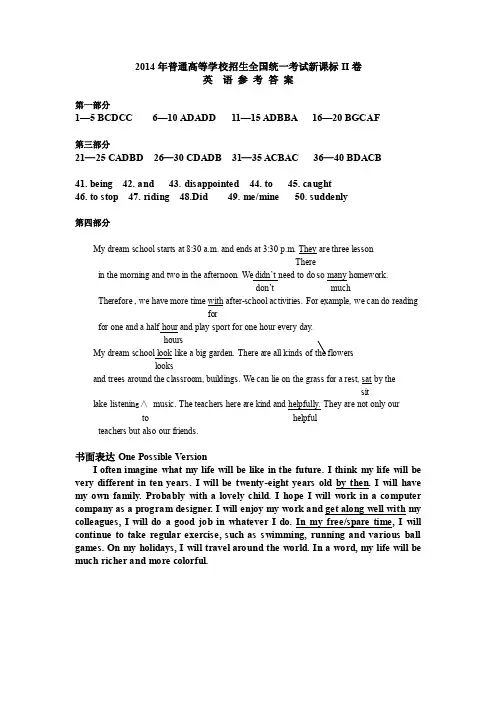
2014年普通高等学校招生全国统一考试新课标II卷英语参考答案第一部分1—5 BCDCC 6—10 ADADD 11—15 ADBBA 16—20 BGCAF第三部分21—25 CADBD 26—30 CDADB 31—35 ACBAC 36—40 BDACB41.being 42. and 43. disappointed 44. to 45. caught46. to stop 47. riding 48.Did 49. me/mine 50. suddenly第四部分My dream school starts at 8:30 a.m. and ends at 3:30 p.m. They are three lessonTherein the morning and two in the afternoon. We didn’t need to do so many homework.don’t muchTherefore , we have more time with after-school activities. For example, we can do readingforfor one and a half hour and play sport for one hour every day.hoursMy dream school look like a big garden. There are all kinds of the flowerslooksand trees around the classroom, buildings. We can lie on the grass for a rest, sat by thesit lake listenin g∧music. The teachers here are kind and helpfully. They are not only ourto helpfulteachers but also our friends.书面表达One Possible VersionI often imagine what my life will be like in the future. I think my life will be very different in ten years. I will be twenty-eight years old by then. I will have my own family. Probably with a lovely child. I hope I will work in a computer company as a program designer. I will enjoy my work and get along well with my colleagues, I will do a good job in whatever I do. In my free/spare time, I will continue to take regular exercise, such as swimming, running and various ball games. On my holidays, I will travel around the world. In a word, my life will be much richer and more colorful.2014年普通高等学校招生全国统一考试新课标II卷解析 阅读理解A篇genre美[ˈʒɑnrə]体裁 a story about kindness of people in Sydney 体现人性的真、善、美B篇topic:environmental protection(环保)C篇hot topic(热门话题): Chinese Fever(汉语热)au pair [,əu'pεə][法语][英国英语](尤指外地来的)以帮做家务换取食宿的年轻女佣工;“互裨[bì]”姑娘(以授课、协助家务等只换取膳宿、学习英语、不取报酬的外国女子)D篇地铁小手册/指南考查学生快速查找提取有用信息的能力信息匹配题关于在繁忙中如何烹饪的小建议,难度适宜。
2014年高考真题——英语(广东A卷) 解析版Word版含解析
绝密★启用前试卷类型:A 2014年普通高等学校招生全国统一考试(广东卷)英语本试卷共12页,三大题,满分135分.考试用时120分钟注意事项:1. 答卷前,考生务必用黑色笔迹的钢笔或签字笔将自己的姓名和考生号、考场号、座位号填写在答题卡上。
用2B铅笔讲试卷类型(A)填涂在答题卡相应的位置上。
将条形码横贴在答题卡右上角“条形码粘贴处”。
2.选择题每小题选出答案后,用2B铅笔把答题卡上对应题目选项的答案信息点涂黑;如需改动,用橡皮擦干净后,再选涂其他答案,答案不能答在试卷上。
3.非选择题必须用黑色字迹的钢笔或签字笔作答,答案必须写在答题卡各题目指定区域内相应位置上;如需改动,先划掉原来的答案,然后再写上新的答案;不准使用铅笔和涂改液。
不按以上要求作答的答案无效。
4.考生必须保持答题卡的整洁,考试结束后,将试题与答题卡一并交回。
I 语言知识及应用(共两节,满分45分)第一节完形填空(共15小题;每小题2分,满分30分)阅读下面短文,掌握其大意,然后从1—15各题所给的A、B、C和D项中,选出最佳选项,并在答题卡上将该项涂黑。
Parents feel that it is difficult to live with teenagers. Then again, teenagers have 1 feelings about their parents, saying that it is not easy living with them. According to a recent research, the most common 2 between parents and teenagers is that regarding untidiness and daily routine tasks. On the one hand, parents go mad over 3 rooms, clothes thrown on the floor and their children’s refusal to help with the 4 . On the other hand, teenagers lose their patience continually when parents blame them for 5 the towel in the bathroom, not cleaning up their room or refusing to do the shopping at the supermarket.The research, conducted by St. George University, shows that different parents have different 6 to these problems. However, some approaches are more 7 than others. For example, those parents who yell at their children for their untidiness, but 8 clean the room for them, have fewer chances of changing their children’s 9 . On the contrary, those wholet teenagers experience the 10 of their actions can do better. For example, when teenagers who don’t help their parents with the shopping don’t find their favorite drink in the refrigerator, they are forced to 11 their actions.Psychologists say that 12 is the most important thing in parent-child relationships. Parents should 13 to their children but at the same time they should lend an ear to what they have to say. Parents may 14 their children when they are untidy but they should also understand that their room is their own private space. Communication is a two-way process. It is only by listening to and 15 each other that problems between parents and children can be settled.1. A. natural B. strong C. guilty D. similar2. A. interest B. argument C. link D. knowledge3. A. noisy B. crowded C. messy D. locked4. A. homework B. housework C. problem D. research5. A. washing B. using C. dropping D. replacing6. A. approaches B. contributions C. introductions D. attitudes7. A. complex B. popular C. scientific D. successful8. A. later B. deliberately C. seldom D. thoroughly9. A. behavior B. taste C. future D. nature10. A. failures B. changes C. consequences D. thrills11. A. defend B. delay C. repeat D. reconsider12. A. communication B. bond C. friendship D. trus13. A. reply B. attend C. attach D. talk14. A. hate B. scold C. frighten D. stop15. A. loving B. observing C. understanding D. praising【考点】考察文化教育类阅读【文章大意】本文通过叙述父母和孩子之间的沟通难题告诉我们:对待孩子不能一味地指责,那样只会让情况更糟糕。
2014年高考英语广东卷(含详细答案)

英语试卷 第1页(共26页)英语试卷 第2页(共26页)绝密★启用前 2014普通高等学校招生全国统一考试(广东卷)英语本试卷共12页,三大题,满分135分,考试时间120分钟注意事项:1. 答卷前,考生务必用黑色笔迹的钢笔或签字笔将自己的姓名和考生号、考场号、座位号填写在答题卡上。
用2B 铅笔讲试卷类型(A )填涂在答题卡相应位置上。
将条形码横贴在答题卡右上角“条形码粘贴处”。
2. 选择题每小题选出答案后,用2B 铅笔把答题卡上对应题目选项的答案信息点涂黑;如需改动,用橡皮擦干净后,再选涂其他答案,答案不能答在试卷上。
3. 非选择题必须用黑色字迹的钢笔或签字笔作答,答案必须写在答题卡各题目指定区域内相应位置上;如需改动,先划掉原来的答案,然后再写上新的答案;不准使用铅笔和涂改液。
不按以上要求作答的答案无效。
4. 考生必须保持答题卡的整洁,考试结束后,将试题与答题卡一并交回。
第Ⅰ卷I 语言知识及应用(共两节,满分45分)第一节 完形填空(共15小题;每小题2分,满分30分)阅读下面短文,掌握其大意,然后从1~15各题所给的A 、B 、C 和D 项中,选出最佳选项,并在答题卡上将该项涂黑。
Parents feel that it is difficult to live with teenagers. Then again, teenagers have 1 feelings about their parents, saying that it is not easy living with them. According to a recent research, the most common 2 between parents and teenagers is that regarding untidiness and daily routine tasks. On the one hand, parents go mad over 3 rooms, clothes thrown on the floor and their children’s refusal to help with the 4 . On the other hand, teenagers lose their patience continually when parents blame them for 5 the towel in the bathroom, not cleaning up their room or refusing to do the shopping at the supermarket.The research, conducted by St. George University, shows that different parents have different 6 to these problems. However, some approaches are more 7 than others.For example, those parents who yell at their children for their untidiness, but 8 clean the room for them, have fewer chances of changing their children’s 9 . On the contrary, those who let teenagers experience the 10 of their actions can do better. For example, when teenagers don’t help their parents with the shopping don’t find their favorite drink in the refrigerator, they are forced to 11 their actions.Psychologists say that 12 is the most important thing in parent-child relationships. Parent should 13 to their children but at the same time they should lend an ear to what they have to say. Parents may 14 their children when they are untidy but they should also understand that their room is their own private space. Communication is a two-way process. It is only by listening to and 15 each other that problems between parents and children can be settled. 1. A. natural B. strongC. guiltyD. similar 2. A. interest B. argument C. link D. knowledge 3. A. noisyB. crowdedC. messyD. locked 4. A. homework B. housework C. problem D. research 5. A. washing B. usingC. droppingD. replacing 6. A. approachesB. contributionsC. introductionsD. attitudes 7. A. complex B. popular C. scientific D. successful 8. A. later B. deliberately C. seldom D. thoroughly 9. A. behaviorB. tasteC. futureD. nature 10. A. failures B. changes C. consequences D. thrills 11. A. defendB. delayC. repeatD. reconsider 12. A. communication B. bond C. friendship D. trust 13. A. reply B. attend C. attachD. talk 14. A. hate B. scoldC. frightenD. stop 15. A. lovingB. observingC. understandingD. praising第二节 语法填空(共10题;每小题1.5分,满分15分)阅读下面短文,按照句子结构的语法性和上下文连贯的要求,在空格处填入一个适当的词或使用括号中词语的正确形式填空,并将答案填写在答题卡标号为16~25的相应位置上。
2014年普通高等学校招生全国统一考试全国1卷英语试题与参考答案
2014年普通高等学校招生全国统一考试(全国卷)英语试题一. 听力第一节:(共5小题,每小题1分,满分5分)听下面5段对话。
每段对话后有一个小题,从题中所给的A 、B 、C 三个选项中选出最佳选项,并标在试卷的相应位置。
听完每段对话后,你将有10秒钟的时间来回答有关小题和阅读下一小题。
每段对话仅读一遍。
1.What are the two speakers doing at the moment?A. Drinking coffeeB. Doing the shoppingC. Seeing the doctor2. What does the man mean?A. It‟s easy to forget the keyB. People often make the same mistakesC. He takes the key out of the room3. How long will the man have to wait for the next bus?A .25 minutes B. 20 minutes C .15 minutes4. Where does the conversation probably take place?A .In the car B. On the bus C. Outside the lift5. Why is the man so excited?A. He has got marriedB. He has moved into a new houseC. His small cold house has been sold第二节:(共10小题,每小题1分,满分10分)听下面一段对话,回答第6至第8小题6 .When did the two speakers meet last?A. Five years agoB. Three years agoC. Two years ago7. Why does the woman stay here?A. She wants to accompany her familyB .She has to work tomorrow.C .She c an‟t afford the plane ticket8. Where will the two speakers go?A . To the cinema B. To the concert hall C To. the restaurant听下面一段对话,回答第9至第11小题9. What does the man think of his trip?A. ProductiveB. ComfortableC. Time-saving10. Why did the man go to Frankfurt?A. To attend a trade fairB. To attend a meetingC. To make a speech11. Which country does the woman mention in the conversation?A. AmericaB. Britain C .Germany听下面一段独白,回答第12至第15小题。
【2014茂名二模】广东省茂名市2014届高三第二次高考模拟英语试题和答案

绝密★启用前试卷类型:A 2014年普通高等学校招生全国统一考试(广东卷)茂名市第二次模拟考试英语本试卷共10页,三大题,满分135分。
考试用时120分钟。
注意事项:1. 答卷前,考生务必用黑色字迹的钢笔或签字笔将自己的姓名和考生号、试室号、座位号填写在答题卡上。
用2B铅笔将试卷类型(B)填涂在答题卡相应位置上。
将条形码横贴在答题卡右上角“条形码粘贴处”。
2. 选择题每小题选出答案后,用2B铅笔把答题卡上对应题目选项的答案信息点涂黑,如需改动,用橡皮擦干净后,再选涂其他答案,答案不能答在试卷上。
3. 非选择题必须用黑色字迹钢笔或签字笔作答,答案必须写在答题卡各题目指定区域内相应位置上;如需改动,先划掉原来的答案,然后再写上新的答案;不准使用铅笔和涂改液。
不按以上要求作答的答案无效。
4. 考生必须保持答题卡的整洁。
考试结束后,将试卷和答题卡一并交回。
Ⅰ语言知识及应用(共两节,满分45分)第一节完形填空(共15小题;每小题2分,满分30分)阅读下面短文,掌握其大意,然后从1—15各题所给的A、B、C和D项中,选出最佳选项,并在答题卡上将该项涂黑。
Sometimes it can be difficult to homeschool(进行家庭教育)on your own. That's why it's 1 to connect or have a support group that will help you succeed in homeschooling.The first step is to find a(n) 2 that has similar goals and ideas as you. Maybe they homeschool in the same way, use the same curriculum or have the same ages of students.It's important to make sure that you decide what you're looking for out of a support group and then you can go and 3 for it using the Internet or local organization. Do you want your group to just support homeschool families and parents or do you 4 want to hold classes? Are you organizing around a 5 event like field trips, a topic, or classes themselves?If your homeschool support group is just for parents, consider advertising 6 . Getting together a group of homeschooling parents can really help you to 7 ideas that will help improve your homeschool program and can help you succeed in the long run. If you're going to include 8 in your support group, make sure to organizethem by 9 level so they're with other students of the same age.If you want to include classes as a part of your homeschool group, you need to decide what type of 10 you'll offer, enrichment, art, athletic, or even core curriculum. Identify a teacher early on and a leader. You don't want to be the 11 leader in your homeschool group. You want to find people that you can trust to 12 alongside you.Communication is the key. You want to set up an email group, a phone chain and maybe even website to keep everyone 13 . Whether you find a local group to join or 14 one of your own, having a support group can really help you 15 in homeschooling.1.A.accessible B. important C. evident D. natural2. A. group B. companion C. league D. organization3. A. pay B. apply C. struggle D. search4. A.deliberately B. particularly C. actually D. consequently5. A.vital B. current C. specific D. random6. A. locally B. cautiously C. temporarily D. nationally7. A.approve B.exchange C. interpret D. adopt8. A.parents B.teachers C. managers D. students9. A. grade B. management C. stress D. security10. A.teachers B. classes C. leaders D. groups11. A. top B. former C. only D. same12. A.follow B. dictate C. obey D. lead13. A. informed B. accustomed C. contented D. alarmed14. A. purchase B.support C. subscribe D. start15. A. succeed B. reflect C. participate D. accumulate第二节语法填空(共10小题,每小题1.5分,满分15分)阅读下面短文,按照句子结构的语法性和上下文连贯的要求,在空格处填入一个适当的词或使用括号中词语的正确形式填空,并将答案填写在答题卡标号为16~25的相应位置上。
2014年广东省高考英语试题(含解析)
2014年广东省高考英语试题(含解析)2014年广东省高考英语试题(含解析) 本试卷共12页,三大题,满分135分.考试用时120分钟注意事项: 1. 答卷前,考生务必用黑色笔迹的钢笔或签字笔将自己的姓名和考生号、考场号、座位号填写在答题卡上。
用2B铅笔讲试卷类型(A)填涂在答题卡相应的位置上。
将条形码横贴在答题卡右上角“条形码粘贴处”。
2.选择题每小题选出答案后,用2B铅笔把答题卡上对应题目选项的答案信息点涂黑;如需改动,用橡皮擦干净后,再选涂其他答案,答案不能答在试卷上。
3.非选择题必须用黑色字迹的钢笔或签字笔作答,答案必须写在答题卡各题目指定区域内相应位置上;如需改动,先划掉原来的答案,然后再写上新的答案;不准使用铅笔和涂改液。
不按以上要求作答的答案无效。
4.考生必须保持答题卡的整洁,考试结束后,将试题与答题卡一并交回。
I 语言知识及应用(共两节,满分45分)第一节完形填空 (共15小题;每小题2分,满分30分) 阅读下面短文,掌握其大意,然后从1―15各题所给的A、B、C和D项中,选出最佳选项,并在答题卡上将该项涂黑。
Parents feel that it is difficult to live with teenagers. Then again, teenagers have 1 feelings about their parents, saying that it is not easy living with them. According to a recent research, the most common 2 between parents and teenagers is that regarding untidiness and daily routine tasks. On the one hand, parents go mad over 3 rooms, clothes thrown on the floor and their children’s refusal to help with the 4 . On the other hand, teenagers lose their patience continually when parents blame them for 5 the towel in the bathroom, not cleaning up their room or refusing to do the shopping at the supermarket. The research, conducted by St. George University, shows that different parents have different 6 to these problems. However, some approaches are more 7 than others. For example, those parents who yell at their children for their untidiness, but 8 clean the room for them, have fewer chances of changingtheir children’s 9 . On the contrary, those who let teenagers experience the 10 of their actions can do better. For example, wh en teenagers who don’t help their parents with the shopping don’t find their favorite drink in the refrigerator, they are forced to 11 their actions. Psychologists say that 12 is the most important thing in parent-child relationships. Parents should 13 to their children but at the same time they should lend an ear to what they have to say. Parents may 14 their children when they are untidy but they should also understand that their room is their own private space. Communication is a two-way process. It is only by listening to and 15 each other that problems between parents and children can be settled.1. A. natural B. strong C. guilty D. similar2. A. interest B. argument C. link D. knowledge3. A. noisy B. crowded C. messyD. locked 4. A. homework B. housework C. problem D. research5. A. washing B. using C. dropping D. replacing6. A. approachesB. contributionsC. introductionsD. attitudes 7. A. complex B. popular C. scientific D. successful 8. A. later B. deliberately C. seldom D. thoroughly 9. A. behavior B. tasteC. futureD. nature 10. A. failures B. changes C. consequencesD. thrills 11. A. defend B. delay C. repeat D. reconsider 12.A. communicationB. bondC. friendshipD. trust 13. A. replyB. attendC. attachD. talk 14. A. hate B. scold C. frighten D. stop 15. A. loving B. observing C. understanding D. praising 答案及解析:(“可乐”解释)本文首先指出父母与十几岁的孩子之间存在矛盾冲突及其原因,然后是研究发现的不同父母对此采取的不同方法,有的方法较另一些方法更有效果,最后一段是心理学家对解决冲突的建议。
2014年高考英语广东卷(含详细答案)
英语试卷 第1页(共26页)英语试卷 第2页(共26页)绝密★启用前 2014普通高等学校招生全国统一考试(广东卷)英语本试卷共12页,三大题,满分135分,考试时间120分钟注意事项:1. 答卷前,考生务必用黑色笔迹的钢笔或签字笔将自己的姓名和考生号、考场号、座位号填写在答题卡上。
用2B 铅笔讲试卷类型(A )填涂在答题卡相应位置上。
将条形码横贴在答题卡右上角“条形码粘贴处”。
2. 选择题每小题选出答案后,用2B 铅笔把答题卡上对应题目选项的答案信息点涂黑;如需改动,用橡皮擦干净后,再选涂其他答案,答案不能答在试卷上。
3. 非选择题必须用黑色字迹的钢笔或签字笔作答,答案必须写在答题卡各题目指定区域内相应位置上;如需改动,先划掉原来的答案,然后再写上新的答案;不准使用铅笔和涂改液。
不按以上要求作答的答案无效。
4. 考生必须保持答题卡的整洁,考试结束后,将试题与答题卡一并交回。
第Ⅰ卷I 语言知识及应用(共两节,满分45分)第一节 完形填空(共15小题;每小题2分,满分30分)阅读下面短文,掌握其大意,然后从1~15各题所给的A 、B 、C 和D 项中,选出最佳选项,并在答题卡上将该项涂黑。
Parents feel that it is difficult to live with teenagers. Then again, teenagers have 1 feelings about their parents, saying that it is not easy living with them. According to a recent research, the most common 2 between parents and teenagers is that regarding untidiness and daily routine tasks. On the one hand, parents go mad over 3 rooms, clothes thrown on the floor and their children’s refusal to help with the 4 . On the other hand, teenagers lose their patience continually when parents blame them for 5 the towel in the bathroom, not cleaning up their room or refusing to do the shopping at the supermarket.The research, conducted by St. George University, shows that different parents have different 6 to these problems. However, some approaches are more 7 than others.For example, those parents who yell at their children for their untidiness, but 8 clean the room for them, have fewer chances of changing their children’s 9 . On the contrary, those who let teenagers experience the 10 of their actions can do better. For example, when teenagers don’t help their parents with the shopping don’t find their favorite drink in the refrigerator, they are forced to 11 their actions.Psychologists say that 12 is the most important thing in parent-child relationships. Parent should 13 to their children but at the same time they should lend an ear to what they have to say. Parents may 14 their children when they are untidy but they should also understand that their room is their own private space. Communication is a two-way process. It is only by listening to and 15 each other that problems between parents and children can be settled. 1. A. natural B. strongC. guiltyD. similar 2. A. interest B. argument C. link D. knowledge 3. A. noisyB. crowdedC. messyD. locked 4. A. homework B. housework C. problem D. research 5. A. washing B. usingC. droppingD. replacing 6. A. approachesB. contributionsC. introductionsD. attitudes 7. A. complex B. popular C. scientific D. successful 8. A. later B. deliberately C. seldom D. thoroughly 9. A. behaviorB. tasteC. futureD. nature 10. A. failures B. changes C. consequences D. thrills 11. A. defendB. delayC. repeatD. reconsider 12. A. communication B. bond C. friendship D. trust 13. A. reply B. attend C. attachD. talk 14. A. hate B. scoldC. frightenD. stop 15. A. lovingB. observingC. understandingD. praising第二节 语法填空(共10题;每小题1.5分,满分15分)阅读下面短文,按照句子结构的语法性和上下文连贯的要求,在空格处填入一个适当的词或使用括号中词语的正确形式填空,并将答案填写在答题卡标号为16~25的相应位置上。
2014广东高考英语试题及详解
绝密★启用前试卷类型: B2014 年普通高等学校招生全国统一考试(广东卷 )英语本试卷共12 页 ,三大题 ,满分 135 分 .考试用时120 分钟注意事项:1.答卷前,考生务必用黑色笔迹的钢笔或签字笔将自己的姓名和考生号、考场号、座位号填写在答题卡上。
用 2B 铅笔讲试卷类型( A )填涂在答题卡相应的位置上。
将条形码横贴在答题卡右上角“条形码粘贴处”。
2.选择题每小题选出答案后,用2B 铅笔把答题卡上对应题目选项的答案信息点涂黑;如需改动,用橡皮擦干净后,再选涂其他答案,答案不能答在试卷上。
3.非选择题必须用黑色字迹的钢笔或签字笔作答,答案必须写在答题卡各题目指定区域内相应位置上;如需改动,先划掉原来的答案,然后再写上新的答案;不准使用铅笔和涂改液。
不按以上要求作答的答案无效。
4.考生必须保持答题卡的整洁,考试结束后,将试题与答题卡一并交回。
I语言知识及应用(共两节,满分45 分)第一节完形填空(共15 小题;每小题 2 分,满分30 分)阅读下面短文,掌握其大意,然后从1~15 各题所给的 A 、B 、C 和 D 项中,选出最佳选项,并在答题卡上将该项涂黑。
Parents feel that it is difficult to live with teenagers. Then again, teenagers have1 feelings about their parents, saying that it is not easy living with them. According to a recent research, the most common2between parents and teenagers is that regarding untidiness and daily routine tasks. On the one hand, parents go mad over3rooms, clothes thrown on the floor and their children?s refusal to help with the4. On the other hand, teenagers lose their patience continually when parents blame them for5the towel in the bathroom, not cleaning up their room or refusing to do the shopping at the supermarket.The research, conducted by St. George University, shows that different parents have different 6to these problems. However, some approaches are more7than others. For example, those parents who yell at their children for their untidiness, but8clean the room for them, have fewer chances of changing their children?s9. On the contrary, those who let teenagers experience the10of their actions can do better. For example, when teenagers who don?t help their parents with the shopping don?t find their favorite drink in the refrigerator,they are forced to11their actions.Psychologists say that12is the most important thing in parent-child relationships. Parents should13to their children but at the same time they should lend an ear to what they have to say. Parents may14their children when they are untidy but they should also understand that their room is their own private space. Communication is a two-way process. It is only by listening to and15 each other that problems between parents and children can be settled.1.A. natural B. strong C. guilty D. similar2.A. interest B. argument C. link D. knowledge3.A. noisy B. crowded C. messy D. locked4.A. homework B. housework C. problem D. research5.A. washing B. using C. dropping D. replacing6.A. approaches B. contributions C. introductions D. attitudes7.A. complex B. popular C. scientific D. successful8.A. later B. deliberately C. seldom D. thoroughly9.A. behavior B. taste C. future D. nature10.A. failures B. changes C. consequences D. thrills11.A. defend B. delay C. repeat D. reconsider12.A. communication B. bond C. friendship D. trust13.A. reply B. attend C. attach D. talk14.A. hate B. scold C. frighten D. stop15.A. loving B. observing C. understanding D. praising第二节语法填空(共 10 小题,每小题 1.5 分,满分 15 分)阅读下面短文,按照句子结构的语法性和上下文连贯的要求,在空格处填入一个适当的词或使用口号中词语的正确形式填空,并将答案填写在答题卡标号为16~25 的相应位置上。
2014广东省高考英语试题word版及参考答案解析
2014年普通高等学校招生全国统一考试(广东卷)英语(B卷)I 语言知识及应用(共两节,满分45分)第一节完形填空(共15小题;每小题2分,满分30分)阅读下面短文,掌握其大意,然后从1~15各题所给的A、B、C和D项中,选出最佳选项,并在答题卡上将该项涂黑。
Parents feel that it is difficult to live with teenagers. Then again, teenagers have ___1___ feeling about their parents, saying that it is not easy living with them, According to a recent research, the most common ___2___ between parents and teenagers is that regarding untidiness and daily routine task. On the one hand, parents go mad over ___3___ rooms, clothes thrown on the floor and their children’s refusal to help with the ___4___. On the other hand, teenagers lose their patience continually when parents blame them for ___5___ the towel in the bathroom, not cleaning up their room or refusing to do the shopping at the supermarket.The research, conducted by St. George University, shows that different parents have different ___6___ to these problems. However, some approaches are more ___7___ than others. For example, those parents who yell at their children for their untidiness, but ___8___ clean the room for them, have fewer chances of changing their children’s ___9___. On the contrary, those who let teenagers experience the ___10___ of their actions can do better. For example, when teenagers who don’t help their parents with the shopping don’t find their favorite drink in the refrigerator, they are forced to __11____ their actions.Psychologists say that ___12___ is the most important thing in parent-child relationships. Parents should ___13___ to their children but at the same time they should lend an ear to what they have to say. Parents may ___14___ their children when they are untidy but they should also understand that their room is their own private space. Communication is a two-way process. It is only by listening to and ___15___ each other that problems between parents and children can be settled.1. A. natural B. strong C. guilty D. similar2. A. interest B. argument C. link D. knowledge3. A. noisy B. crowded C. messy D. locked4. A. homework B. housework C. problem D. research5. A. washing B. using C. dropping D. replacing6. A. approaches B. contributions C. introductions D. attitudes7. A. complex B. popular C. scientific D. successful8. A. later B. deliberately C. seldom D. thoroughly9. A. behavior B. taste C. future D. nature10.A. failures B. changes C. consequences D. thrills11.A. defend B. delay C. repeat D. reconsider12.A. communication B. bond C. friendship D. trust13.A. reply B. attend C. attach D. talk14.A. hate B. scold C. frighten D. stop15.A. loving B. observing C. understanding D. praising第二节语法填空(共10小题; 每小题1.5分,满分15分)阅读下面短文,按照句子结构的语法性和上下文连贯的要求,在空格处填入一个适当的词或使用括号中词语的正确形式填空,并将答案填写在答题卷标号为16~25的相应位置上。
2014年高考真题——英语(广东A卷含答案)
2014年普通高等学校招生全国统一考试(广东卷)英语I 语言知识及应用(共两节,满分45分)第一节完形填空(共15小题;每小题2分,满分30分)阅读下面短文,掌握其大意,然后从1—15各题所给的A、B、C和D项中,选出最佳选项,并在答题卡上将该项涂黑。
Parents feel that it is difficult to live with teenagers. Then again, teenagers have 1 feelings about their parents, saying that it is not easy living with them. According to a recent research, the most common 2 between parents and teenagers is that regarding untidiness and daily routine tasks. On the one hand, parents go mad over 3 rooms, clothes thrown on the floor and their children’s refusal to help with the 4 . On the other hand, teenagers lose their patience continually when parents blame them for 5 the towel in the bathroom, not cleaning up their room or refusing to do the shopping at the supermarket.The research, conducted by St. George University, shows that different parents have different 6 to these problems. However, some approaches are more 7 than others. For example, those parents who yell at their children for their untidiness, but 8 clean the room for them, have fewer chances of changing their children’s 9 . On the contrary, those who let teenagers experience the 10 of their actions can do better. For example, when teenagers w ho don’t help their parents with the shopping don’t find their favorite drink in the refrigerator, they are forced to 11 their actions.Psychologists say that 12 is the most important thing in parent-child relationships. Parents should 13 to their children but at the same time they should lend an ear to what they have to say. Parents may 14 their children when they are untidy but they should also understand that their room is their own private space. Communication is a two-way process. It is only by listening to and 15 each other that problems between parents and children can be settled.1. A. natural B. strong C. guilty D. similar2. A. interest B. argument C. link D. knowledge3. A. noisy B. crowded C. messy D. locked4. A. homework B. housework C. problem D. research5. A. washing B. using C. dropping D. replacing6. A. approaches B. contributions C. introductions D. attitudes7. A. complex B. popular C. scientific D. successful8. A. later B. deliberately C. seldom D. thoroughly9. A. behavior B. taste C. future D. nature10. A. failures B. changes C. consequences D. thrills11. A. defend B. delay C. repeat D. reconsider12. A. communication B. bond C. friendship D. trust13. A. reply B. attend C. attach D. talk14. A. hate B. scold C. frighten D. stop15. A. loving B. observing C. understanding D. praising第二节语法填空(共10题;每小题1.5分,满分15分)阅读下面短文,按照句子结构的语法性和上下文连贯的要求,在空格处填入一个适当的词或使用括号中词语的正确形式填空,并将答案填写在答题卡标号为16—25的相应位置上。