
历年大学英语六级听力真题
历年大学英语六级听力真题
点击在线听》》
短对话:
1.
M:Before we play again, I’m going to buy a good tennis racket.
W:Your shoes aren’t in a very good shape either.
Q: What does the woman mean?
2.
M:Barbara, I’d like you could assist me in the lab demonstration. But aren’t you supposed to go to Dr. Smith’s lecture today?
W: I ask Cathy to take notes for me.
Q: What do we learn from the conversation?
3.
W: Steve invited me to the dinner party on Sunday evening. Have you received your invitation yet?
M: Yes, he found me this morning and told me he wanted all his old classmates to come to the reunion.
Q: What do we learn from the conversation?
4.
W:I’m afraid I’m a little bit seasick. I feel dizzy.
M:Close your eyes and relax. You’ll be all right as soon as we come at shore.
Q: Where does the conversation most probably take place?
5.
W:I wonder what’s happened to our train. It should
have been here twenty minutes ago according to the timetable. But it’s already 9:30.
M:There’s no need to get nervous. The announcement
says it’s forty minutes late.
Q: When is the train arriving?
6.
M: John is handsome and wealthy. Believe it or not, he
is still a bachelor.
W: He is a notorious guy in many girls’ eyes. I’m sick of hearing his name.
Q: What does the woman mean?
7.
M:Cars had lined up bumper to bumper. And I’ve been
held up on the express way for the entire hour.
W: Really? It must be a pain in the neck. But be patient, anyway, you can do nothing but wait.
Q: What do we learn about the man?
8.
W: Yesterday I was surprised to see Mary using that washing machine you’re going to throw away.
M:Yes, it’s quit e old and in a very poor condition. Frankly speaking, that she got it working amazes me a lot.
Q: What does the man imply about Mary?
长对话:
Conversation 1
M: A recent case I heard was of a man accused and found guilty of breaking into a house and stealing some money.
W: Well, was he really guilty, judge?
M:He admitted that he’d done it, and there were several witnesses saying that he had indeed done it. So I can only assume that he was guilty.
W: Why did he do it?
M: Well, the reasons were little muddied, probably at least it seemed in a trial that he did it to get some money to feed his family. You see, he’d been out of work for some time.
W:Well, he’d been out of work and he chose to break into a house to get money for his family and apparently in front of people that, err... could see him do it.
M: His attorney presented testimony that he had indeed applied for jobs and was listed with several employment agencies, including the state employment agency, but they weren’t any jobs.。
2024英语六级试题及答案
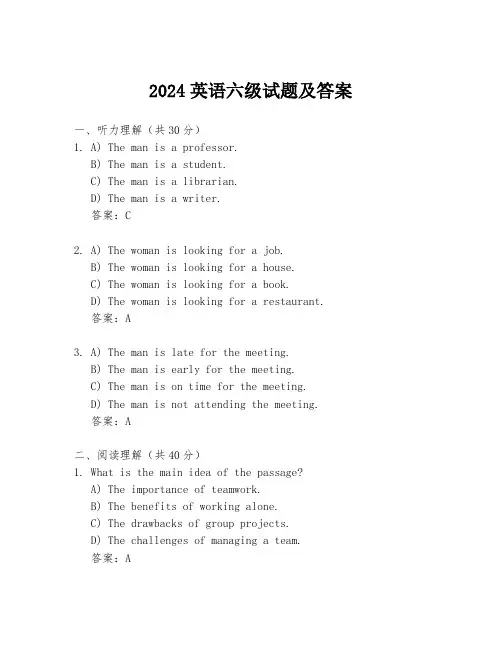
2024英语六级试题及答案一、听力理解(共30分)1. A) The man is a professor.B) The man is a student.C) The man is a librarian.D) The man is a writer.答案:C2. A) The woman is looking for a job.B) The woman is looking for a house.C) The woman is looking for a book.D) The woman is looking for a restaurant.答案:A3. A) The man is late for the meeting.B) The man is early for the meeting.C) The man is on time for the meeting.D) The man is not attending the meeting.答案:A二、阅读理解(共40分)1. What is the main idea of the passage?A) The importance of teamwork.B) The benefits of working alone.C) The drawbacks of group projects.D) The challenges of managing a team.答案:A2. According to the passage, which of the following is true?A) Teamwork always leads to success.B) Teamwork can be more efficient than working alone.C) Teamwork is only beneficial in certain situations.D) Teamwork is always less efficient than working alone.答案:C3. What is the author's opinion on team dynamics?A) They are essential for success.B) They are not important in modern work environments.C) They can be detrimental to productivity.D) They are only relevant in large organizations.答案:A三、完形填空(共20分)1. A) DespiteB) AlthoughC) BecauseD) If答案:A2. A) wasB) wereC) isD) are答案:B3. A) thatB) whichC) itD) this答案:B四、翻译(共10分)1. 随着科技的发展,我们的生活变得越来越方便。
2023年6月英语六级听力试题及答案
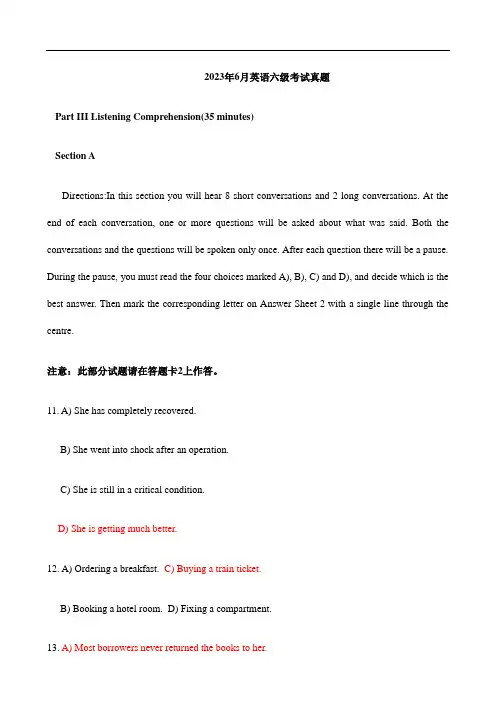
2023年6月英语六级考试真题Part III Listening Comprehension(35 minutes)Section ADirections:In this section you will hear 8 short conversations and 2 long conversations. At the end of each conversation, one or more questions will be asked about what was said. Both the conversations and the questions will be spoken only once. After each question there will be a pause. During the pause, you must read the four choices marked A), B), C) and D), and decide which is the best answer. Then mark the corresponding letter on Answer Sheet 2 with a single line through the centre.注意:此部分试题请在答题卡2上作答。
11. A) She has completely recovered.B) She went into shock after an operation.C) She is still in a critical condition.D) She is getting much better.12. A) Ordering a breakfast. C) Buying a train ticket.B) Booking a hotel room. D) Fixing a compartment.13. A) Most borrowers never returned the books to her.B) The man is the only one who brought her book back.C) She never expected anyone to return the books to her.D) Most of the books she lent out came back without jackets.14. A) She left her work early to get some bargains last Saturday.B) She attended the supermarket’s grand opening ceremony.C) She drove a full hour before finding a parking space.D) She failed to get into the supermarket last Saturday.15. A) He is bothered by the pain in his neck.B) He cannot do his report without a computer.C) He cannot afford to have a coffee break.D) He feels sorry to have missed the report.16. A) Only top art students can show their works in the gallery.B) The gallery space is big enough for the man’s paintings.C) The woman would like to help with the exhibition layout.D) The man is uncertain how his art works will be received.17. A) The woman needs a temporary replacement for her assistant.B) The man works in the same department as the woman does.C) The woman will have to stay in hospital for a few days.D) The man is capable of dealing with difficult people.18. A) It was better than the previous one.B) It dist orted the mayor’s speech.C) It exaggerated the city’s economy problems.D) It reflected the opinions of most economists.Questions 19 to 22 are based on the conversation you have just heard.19. A) To inform him of a problem they face.B) To request him to purchase control desks.C) To discuss the content of a project report.D) To ask him to fix the dictating machine.20. A) They quote the best price in the market.B) They manufacture and sell office furniture.C) They cannot deliver the steel sheets on time.D) They cannot produce the steel sheets needed21. A) By marking down the unit price.B) By accepting the penalty clauses.C) By allowing more time for delivery.D) By promising better after-sales service.22. A) Give the customer a ten percent discount.B) Claim compensation from the steel suppliers.C) Ask the Buying Department to change suppliers.D) Cancel the contract with the customer.Questions 23 to 25 are based on the conversation you have just heard.23. A) Stockbroker. C) Mathematician.B) Physicist. D) Economist.24. A) Improve computer programming.B) Predict global population growth.C) Explain certain natural phenomena.D) Promote national financial health.25. A) Their different educational backgrounds.B) Changing attitudes toward nature.C) Chaos theory and its applications.D) The current global economic crisis.Section BDirections: In this section you will hear 3 short passages. At the end of each passage, you will hear some questions. Both the passage and the questions will be spoken only once. After you hear a question, you must choose the best answer from the four choices marked A), B), C) and D). Then mark the corresponding letter on Answer Sheet 2 with a single line through the centre.注意:此部分试题请在答题卡2上作答。
2023年六级考试听力第一套试卷
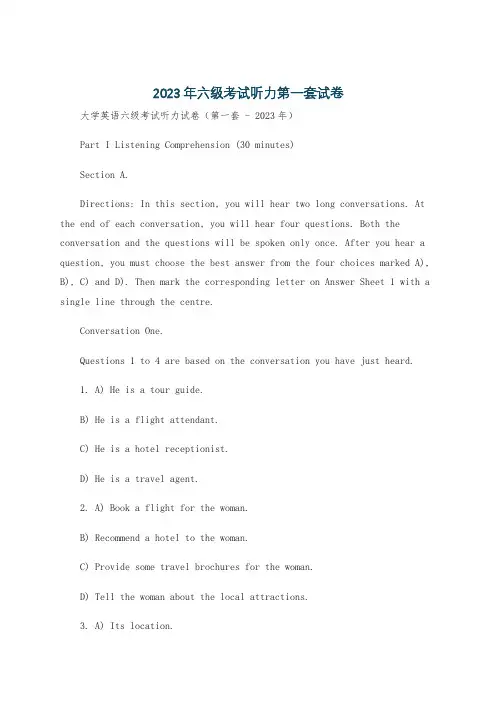
2023年六级考试听力第一套试卷大学英语六级考试听力试卷(第一套 - 2023年)Part I Listening Comprehension (30 minutes)Section A.Directions: In this section, you will hear two long conversations. At the end of each conversation, you will hear four questions. Both the conversation and the questions will be spoken only once. After you hear a question, you must choose the best answer from the four choices marked A), B), C) and D). Then mark the corresponding letter on Answer Sheet 1 with a single line through the centre.Conversation One.Questions 1 to 4 are based on the conversation you have just heard.1. A) He is a tour guide.B) He is a flight attendant.C) He is a hotel receptionist.D) He is a travel agent.2. A) Book a flight for the woman.B) Recommend a hotel to the woman.C) Provide some travel brochures for the woman.D) Tell the woman about the local attractions.3. A) Its location.B) Its price.C) Its facilities.D) Its service.4. A) By phone.B) By email.C) Through an app.D) In person.Conversation Two.Questions 5 to 8 are based on the conversation you have just heard.5. A) She is preparing for a job interview.B) She is writing a research paper.C) She is studying for an exam.D) She is working on a project.6. A) Look for relevant information online.B) Read some books in the library.C) Ask her professor for advice.D) Interview some experts in the field.7. A) It is too broad.B) It is too narrow.C) It is not relevant.D) It is not original.8. A) Narrow down the topic.B) Change the research method.C) Find more sources.D) Revise the outline.Section B.Directions: In this section, you will hear two passages. At the end of each passage, you will hear three questions. Both the passage and the questions will be spoken only once. After you hear a question, you must choose the best answer from the four choices marked A), B), C) and D). Then mark the corresponding letter on Answer Sheet 1 with a single line through the centre.Passage One.Questions 9 to 11 are based on the passage you have just heard.9. A) The development of modern technology.B) The increasing number of elderly people.C) The shortage of medical resources.D) The high cost of health care.10. A) Robots can perform complex surgeries.B) Robots can provide 24 - hour care.C) Robots can reduce medical errors.D) Robots can communicate with patients better.11. A) Ethical issues.B) Technical problems.C) High cost.D) Lack of training.Passage Two.Questions 12 to 14 are based on the passage you have just heard.12. A) It is a new form of energy.B) It is a traditional cooking method.C) It is a popular sport in some countries.D) It is a unique cultural heritage.13. A) It is time - consuming.B) It is environmentally friendly.C) It is difficult to learn.D) It is dangerous.14. A) To promote cultural exchange.B) To protect the environment.C) To improve people's health.D) To develop the tourism industry.Section C.Directions: In this section, you will hear three recordings of lectures or talks followed by three or four questions. The recordings will be played only once. After you hear a question, you must choose the best answer from the four choices marked A), B), C) and D). Then mark the corresponding letter on Answer Sheet 1 with a single line through the centre.Recording One.Questions 15 to 17 are based on the recording you have just heard.15. A) The origin of a certain language.B) The features of a particular culture.C) The history of a specific region.D) The development of a certain art form.16. A) Through archaeological excavations.B) Through analyzing ancient texts.C) Through studying folklores.D) Through interviewing local people.17. A) It has a long and complex history.B) It is influenced by many other languages.C) It is difficult to learn for foreigners.D) It is losing its popularity among the young.Recording Two.Questions 18 to 20 are based on the recording you have just heard.18. A) How to improve urban planning.B) The importance of green spaces in cities.C) The challenges of building sustainable cities.D) Different types of urban landscapes.19. A) They can reduce air pollution.B) They can increase property values.C) They can improve mental health.D) All of the above.20. A) Encourage more private investment.B) Strengthen government regulations.C) Promote public awareness.D) Collaborate with international organizations.Recording Three.Questions 21 to 23 are based on the recording you have just heard.21. A) The causes of climate change.B) The effects of climate change on wildlife.C) The solutions to climate change.D) The current situation of climate change.22. A) Migration patterns are changing.B) Habitats are being destroyed.C) Food sources are decreasing.D) All of the above.23. A) Protecting natural habitats.B) Reducing carbon emissions.C) Promoting sustainable development.D) All of the above.Recording Four.Questions 24 to 25 are based on the recording you have just heard.24. A) The significance of a historical event.B) The life and works of a famous writer.C) The evolution of a literary genre.D) The influence of a cultural movement.25. A) By reading his/her major works.B) By studying his/her personal letters.C) By analyzing his/her contemporaries.D) By researching his/her family background.。
2023年12月大学英语六级考试真题及答案(第二套)
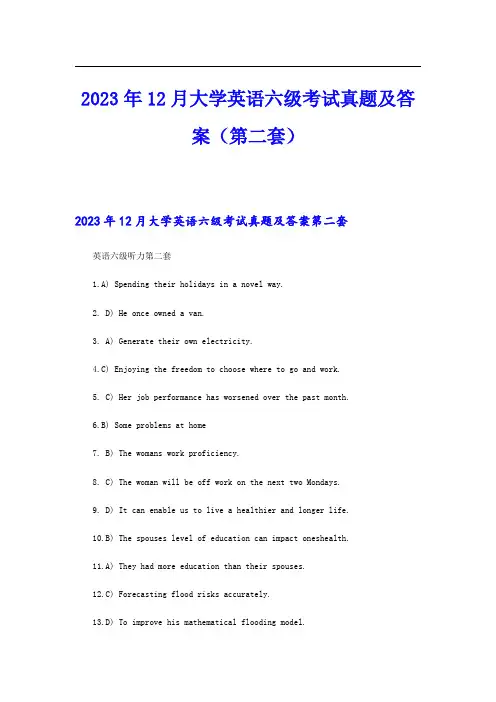
2023年12月大学英语六级考试真题及答案(第二套)2023年12月大学英语六级考试真题及答案第二套英语六级听力第二套1.A) Spending their holidays in a novel way.2. D) He once owned a van.3. A) Generate their own electricity.4.C) Enjoying the freedom to choose where to go and work.5. C) Her job performance has worsened over the past month.6.B) Some problems at home7. B) The womans work proficiency.8. C) The woman will be off work on the next two Mondays.9. D) It can enable us to live a healthier and longer life.10.B) The spouses level of education can impact oneshealth.11.A) They had more education than their spouses.12.C) Forecasting flood risks accurately.13.D) To improve his mathematical flooding model.14.A) To forecast rapid floods in real time.15.B) They set up Internet-connected water-level sensors.16.B) To argue about the value of a college degree.17.D) The factor of wages.18.A) The sharp decline in marriage among men with no college degrees.19.C) More and more people prioritize animal welfare when buying things to wear.20.D)Avoided the use of leather and fur.21.A)Whether they can be regarded as ethical.22.D) The era we live in is the most peaceful in history.23.C) They believed the world was deteriorating.24.B) Our psychological biases.25.A) Paying attention to negative information.翻译第二篇在中国,随着老龄化社会的到来,养老受到普遍关注。
2023年6月英语六级听力真题(第一套)题目,原文与答案
2023年6月英语六级听力真题(第一套)【四六级试卷采用花卷形式,核对答案时请找准具体选项内容,忽略套数和选项符号】Questions 1 to 4 are based on the conversation you have just heard.1. A) It was spacious and tranquil.B) It was warm and comfortable.C) It was shabby and solitary.D) It was tiny and noisy.2. A) She no longer hates people talking loudly in the dorm.B) She misses her roommates she used to complain about.C) She begins to enjoy the movies she once found irritating.D) She finds the crowded dorm as cozy as her new apartment.3. A) He found the apartment perfectly furnished.B) He had a feeling of despair and frustration.C) He had a similar feeling to the woman’s.D) He felt the new place was like paradise.4. A) Go to see the woman’s apartment.B) Make a phone call to his parents.C) Buy some furniture for the woman.D) Decorate the woman’s apartment.Questions 5 to 8 are based on the conversation you have just heard.5. A) He works as a literary critic.B) He hosts an educational program.C) He has initiated a university reform.D) He has published a book recently.6. A) It fails to keep up with the radical changes of society.B) It fails to ensure universities get sufficient resources.C) It has not prepared young people for the job market.D) It has not fostered the growth of the arts disciplines.7. A) More of the budget should go to science and technology.B) The underfunded music discipline should be prioritized.C) Subdisciplines like sculpture should get more funding.D) Literature should get as much funding as engineering.8. A) Build a prosperous nation.B) Make skilled professionals.C) Create ingenious artists.D) Cultivate better citizens.Questions 9 to 11 are based on the passage you have just heard.9. A) It is quite common.B) It is rarely noticed.C) It seldom annoys people.D) It occurs when one is alone.10. A) Seeing things in black and white.B) Engaging in regular contemplation.C) Having a special understanding of creativity.D) Knowing how to make their mental batteries work.11. A) Engaging in intense activity.B) Fantasizing in one’s down time.C) Working on a particular project.D) Reflecting during one’s relaxation.Questions 12 to 15 are based on the passage you have just heard.12. A) Farmers helped Native Americans grow crops.B) There were expansive university campuses.C) There existed post offices.D) Migrants found gold there.13. A) It helped to boost the economy in the American West.B) It provided job opportunities for many gold seekers.C) It extended the influence of the federal government.D) It kept people in the deserts and plains connected.14. A) It employed Native Americans to work as postmen.B) It commissioned private wagons to carry the mail.C) It subsidized the locals who acted as postmasters.D) It centralized postal services in its remote areas.15. A) He analyzed interactive maps of mail routes.B) He read a large collection of books on the topic.C) He examined its historical trends with data science.D) He collected data about its impact on local business.Questions 16 to 18 are based on the recording you have just heard.16. A) Higher levels of anxiety may improve people’s memory.B) Some experiences are easier to remember than others.C) Most people tend to remember things selectively.D) Simple things may leave a deep impression on one’s memory.17. A) They classified the participants’ mindset.B) They showed some photos to the participants.C) They measured the participants’ anxiety levels.D) They tested the size of the participants’ vocabulary.18. A) Anxiety has become a serious problem for an increasing number of people.B) Extreme levels of anxiety can adversely affect cognitive performance.C) People diagnosed with anxiety disorder may forget things selectively.D) There is no direct correlation between memory and levels of anxiety. Questions 19 to 21 are based on the recording you have just heard.19. A) They compare products from different companies before making a choice.B) They get information from other consumers’ postings and comments.C) They lose patience when their phone call is not promptly answered.D) They expect to get instantaneous responses to their inquiry.20. A) Giving them rewards on the spot.B) Broadening their scope of interest.C) Speaking directly to their emotions.D) Focusing on the details of the product.21. A) Change the rules of the game in the market every year.B) Keep up with the latest technological developments.C) Learn from technological innovators to do business.D) Make greater efforts to build up consumers’ confidence. Questions 22 to 25 are based on the recording you have just heard.22. A) People have only one social engagement per week.B) Working together enhances friendship.C) Few people have devoted friends.D) Friendships benefit work.23. A) The impact of friends on people’s self-esteem.B) How supportive friends can be in the workplace.C) How to boost one’s sense of value and worthiness.D) The role of family ties in people’s mental well-being.24. A) They show little interest in their friends’ work.B) They tend to be much more difficult to make.C) They are more trustworthy and reliable.D) They increase people’s job satisfaction.25. A) Allow employees to have a flexible work schedule.B) Encourage employees to be friends with colleagues.C) Help employees balance work and family responsibilities.D) Organize activities to nourish friendships outside of work.答案速查Conversation One1. B) It was warm and comfortable.2. B) She misses her roommates she used to complain about.3. C) He had a similar feeling to the woman’s.4. A) Go to see the woman’s apartment.Conversation Two5. D) He has published a book recently.6. C) It has not prepared young people for the job market.7. A) More of the budget should go to science and technology.8. D) Cultivate better citizens.Passage One9. A) It is quite common.10. B) Engaging in regular contemplation.11. D) Reflecting during one’s relaxation.Passage Two12. C) There existed post offices.13. D) It kept people in the deserts and plains connected.14. B) It commissioned private wagons to carry the mail.15. C) He examined its historical trends with data science. Recording One16. A) Higher levels of anxiety may improve people’s memory.17. C) They measured the participants’ anxiety levels.18. B) Extreme levels of anxiety can adversely affect cognitive performance.Recording Two19. D) They expect to get instantaneous responses to their inquiry.20. C) Speaking directly to their emotions.21. B) Keep up with the latest technological developments.Recording Three22. D) Friendships benefit work.23. A) The impact of friends on people’s self-esteem.24. D) They increase people’s job satisfaction.25. A) Allow employees to have a flexible work schedule.听力原文与答案Conversation OneM: Hi Lily, how’s the new apartment?W: It’s okay.M: What? How can it be just okay when last week you were thrilled about the place and kept posting photos of it online?W: (1) Well, last week when I moved in, the apartment seemed cozy, just the right size for one person. But now it just seems tiny, shabby and solitary.M: Ah, that’s the problem. You miss your roommates from university, don’t you?W:(2) I’m going to sound like an idiot, because I used to complain to you all the time about how crowded our dormitory room was, and about all the things they did to irritate me, like watching movies late at night without headphones, or talking loudly early in the morning. But now I miss them terribly. M: Of course, you do. That’s perfectly normal. (3) When I got my first place, I remember thinking I couldn’t wait to live by myself and get away from my juvenile roommates and all their annoying habits. But then I began missing them and feeling lonely and thinking that our dormitory was like paradise. Even though there were six of us guys in one small room.W: I thought it was just me who felt like that.M:Look, you lived at home with us, and then you had three roommates, and this is your first time living alone, so it’s hard. But your first apartment is a milestone in your life. And you should celebrate it. Tell me about the apartment.W: Actually, it’s not bad. In fact, it’s pretty adorable now that I have decorated it and it has everything I need. I have a kitchen to cook in and a bathroom all to myself, and then another room with my bed at one end and a sofa, a small table and chairs at the other end.M: That does sound adorable, and (4) I can’t wait to see it. And neither can mom and dad.Questions 1 to 4 are based on the conversation you have just heard.Q1. What was the woman’s first impression of the apartment? 答案: B)Q2. Why does the woman say she’s going to sound like an idiot? 答案: B)Q3. What do we learn about the man when he left the dormitory to live on his own? 答案: C)Q4. What does the man say he can’t wait to do? 答案: A)Conversation TwoW: Welcome to our program book talk. (5) Our guest today is Frank Jones, a critic of our education system and the author of a new book, How to Reform Our Universities.M: Hello, Susan.W: Frank, you support radically changing universities in America.M:Yes. (6) I believe that the purpose of higher education is to prepare young people to enter the workforce and that our current system fails to do this. We’re allocating too many resources to disciplines that don’t match the needs of employers.W:I think your attitude to education is a bit cynical, Frank. Surely the purpose of university is to prepare young people to participate fully in civic life rather than just to find well paid jobs.M: Susan, many young graduates struggle to find any job, let alone a good one. The job market is grim, particularly for students who study the arts.W:I agree that it isn’t easy for young people to find work, but you propose closing down all departments that aren’t directly related to science and technology. Is that really the solution?M: You’re overstating my point. (7) My argument is that we need to use more of our budget on areas like science and engineering. To do that, we need to take money from subjects like literature and music.W: (8) But the arts have value. They’re an important part of our culture. Studying literature or music or sculpture might not result in a job in that area, but it helps young people to think about the world in a deeper way, which makes them better citizens and makes for a better society.M: l agree that the arts are valuable to society, but it’s naive to think that not only the most talented, but all students should study them at university level. The odds are very competitive, and most graduates will end up with a great deal of debt obtaining a degree that has little value on the job market. Questions 5 to 8 are based on the conversation you have just heard.Q5. What do we learn from the conversation about the man? 答案: D)Q6. What does the man believe is the problem with the current American system of higher education? 答案: C)Q7. How should the education budget be allocated according to the man? 答案: A)Q8. What does the woman say the arts can do? 答案: D)Passage One(9) Do you ever have the annoying feeling that you don’t have time to really think anymore? You’re not alone. A variety of factors have conspired to rob us of time for reflection about ourselves and our lives. Today our preoccupied minds are rarely silent. The average person receives hundreds of texts and voice messages a day. And holidays for many of us are action packed weeks more likely full of family activities than opportunities for tranquility and contemplation.(10) Regular reflection, however, underlies all great professionals. It’s a prerequisite for you to recharge your mental batteries, see things in a new light and tap into your creativity. Almost all of the great advisors that I have studied have found ways to get away from it all and contemplate their life and work. Some researchers in the field of creativity, in fact, believe that insight occurs during the reflection and relaxation that follows a period of intense activity. Schedule your time for reflection about your work, or a particular project you’re engaged in.I usually block out half an hour. Don’t answer the phone. Push your papers to the side. Sketch, make lists, draw mind maps of ideas that come to you. At the end, write down any emerging ideas.When you’re alone, stop worrying and think. A lot of our downtime is spent worrying about troublesome things in our lives or fantasizing about how we’d like our lives to be. (11) Revisit things during moments of relaxation after a period of intense work. This is when we are the most creative. Questions 9 to 11 are based on the passage you have just heard.Q9. What do we learn about the feeling that one doesn’t have time to think anymore? 答案: A)Q10. What trait do all great professionals share? 答案: B)Q11. What do some researchers believe is conducive to creative ideas? 答案: D)Passage Two(12) Even before Colorado was a state, it had post offices. The first opened in 1859 in a settlement founded by migrants searching for gold. Life could be unpredictable out west. Gold failed to appear,drought ruined farmers, and settlers clashed with Native Americans.On the settlement’s location, now stands a sprawling university campus. Amid all the changes, one feature remained constant: the postal service. The maps tracing America’s westward expansion are telling. In 1864 there were few postal branches on land controlled by Native Americans, which still accounted for most of the West. Over the next 25 years, post offices grew quickly. Colonization of the West could be regarded as a result of big government rather than pioneers. (13) As federal subsidies and land grants tempted people into the deserts and plains, the post kept them connected.In the mid-19th century, the Post Office Department was far from a centralized bureaucracy. To keep up with migration patterns, postal services were added to existing businesses. (14) The federal government commissioned private wagons to carry the mail. Short-term contracts were granted to local businessmen to act as postmasters. These partnerships enabled the mail to quickly follow migrants, helping knit together remote parts of the country.Mr. Blevins, a digital historian, wrote a book on the history of the US postal service. (15) He used data science to analyze historical trends. Most strikingly, he built an accompanying website complete with interactive maps. They show readers how, within a generation, the postal service helped colonize a continent. These online interactive maps illustrate the formative power of snail mail.Questions 12 to 15 are based on the passage you have just heard.Q12. What does the passage say about Colorado before it became a state? 答案: C)Q13. How did the postal service contribute to America’s westward expansion? 答案: D)Q14. What did the federal government do to meet the increasing demand for the postal service in the West? 答案: B)Q15. What did Mr. Blevins do to study the history of the US postal service? 答案: C)Recording OneIn last week’s lecture, we discussed reasons why people forget things. This week, we will discuss a surprising reason why we might remember some things: anxiety. Think about something as simple as buying a coffee. That may not seem like an experience that would make a deep impression on your memory. But anxiety could change that. (16) In fact, a new study suggests that people with higher anxiety levels might remember certain information better than people with lower anxiety levels. That’s because higher levels of anxiety may make people more susceptible to negative feelings. Putting them in a more negative state of mind, that in turn, may make them able to better remember some events. Let’s take a closer look at that new study now. (17) In the study, the researchers started by giving 80 undergraduate students an anxiety test. The test measured the participants’anxiety levels over the proceeding two weeks.Then, to test memory, the participants were shown a series of neutral words one at a time. Some of the words were printed onto photos of negative scenes, meaning images that could affect their emotions negatively, such as a photo of a car accident, or a cemetery. The rest of the words were printed onto photos of neutral scenes, such as a photo of a lake or trees. Neutral words included words like table or desk that don’t elicit emotion.Later, the participants were asked to think back to the words they were shown earlier, which caused them to reenter either a negative or neutral mindset. The participants were then presented with another set of neutral words, and their memory of these new words was tested.The researchers found that the new words presented to people in a negative mindset were better remembered by people with higher levels of anxiety than those with lower levels of anxiety.In other words, when highly anxious individuals took in otherwise emotionally neutral information that was presented to them, it became colored by their negative mindset, making them remember the information better. But these same effects were not seen in people with low levels of anxiety.(18) Previous studies have found that extreme levels of anxiety such as those experienced by people diagnosed with an anxiety disorder can be quite detrimental to memory and cognitive performance. But the highly anxious people in this study represent individuals who are managing their anxiety and for whom anxiety is not a serious problem.Questions 16 to 18 are based on the recording you have just heard.Q16. What does the speaker say the new study suggests? 答案: A)Q17. What did researchers do first in the new study? 答案: C)Q18. What do we learn from previous studies about anxiety? 答案: B)Recording TwoOver the past 20 years, the internet has gradually become a dominant feature of our lives. It has changed how we communicate with each other. And it has definitely transformed the way we do business with each other. Marketing has also changed in a number of ways.For instance, in the past, consumers had to call a phone number and patiently wait on hold in order to get the information they wanted. (19) Today, they want the information immediately. They’ll go to the company’s social media page and post comments and questions, expecting to receive an immediate response. If they don’t get their questions answered soon, they’ll move on to another company that will answer them quickly.Marketing departments today need to follow technological development. For example, this year’s smartphone is smarter than last year’s; self-driving cars are now on the road. Marketers have to do research on which technologies are coming into being. Otherwise, they risk being left behind in the virtual dust.Marketing has also changed due to the importance of video. People don’t just want to read text; they want to watch things happening. Companies now have to explore how they can use video on a consistent basis to share information about their businesses. Fortunately, it’s extremely easy to shoot something these days. All you need is a smartphone.But what’s the result of all this? Shorter attention spans. We are n’t the same people that we were 20 years ago. Not only have we grown accustomed to getting the information we want instantaneously, our attention spans are much shorter. If something doesn’t capture our attention within a few seconds, we’re on to the next piece of content. (20) Marketers need to figure out ways to speak directly to the customer’s emotions, and they need to figure out how to do that as quickly as possible. Once people are emotionally engaged, they’ll stick with you.If marketing has changed this much in the past 20 years, imagine what the next 20 years will bring. In a recent survey, only nine percent of marketers could say with confidence that their marketing efforts were actually working. Their confidence is being shaken because the rules of the game change every year. That’s why (21) it’s important for marketers to pay attention to the latest technologicaldevelopments and consider collaborating with technological innovators. That way, they’ll be moving at the same pace as the tech industry.Questions 19 to 21 are based on the recording you have just heard.Q19. What does the speaker say about today’s consumers? 答案: D)Q20. How do marketers capture consumers’ attention as quickly as possible? 答案: C)Q21. What does the speaker suggest marketers do to meet future challenges? 答案: B)Recording ThreeYou might be surprised to learn that (22) the benefits of friendships extend beyond people’s social life and into their work, which is interesting when considering the extent to which people sacrifice friendships, or at least the time they spend with friends because of the extended hours they’re devoting to work. Just last week, I was remarking to a colleague that I’m content with only one social engagement per week. But according to recent research, that’s evidently not enough.(23) In an initial study of more than 700 respondents, scholars from an American university analyzed the impact that friends, as opposed to family, have on self-esteem and well-being. Friends came out substantially on top. That’s because to be someone’s mate is a voluntary act, unlike family who people rarely get to choose. The researchers found that when people choose to cultivate and maintain supportive friendships with an individual, it means that the person is valued and worthy of their limited time. Such sentiments of value and worthiness boost our self-esteem.The second study comprised more than 300 participants. It proved that the better we feel about ourselves, the more likely we will perform our job confidently and competently. (24) This follow-up study found that non-work friends even improved people’s job satisfaction. They have as much of an impact on how much they love their jobs, as do the friends they have at work, despite not actually being at our place of work. These types of friends tend to be our preferred outlet for venting about work-related matters. This is an avenue that may not be available at the office.So even though friendships can be easy to neglect when confronted by pressures at work, or even pressures at home, neglecting our friends can turn out to be harmful and counterproductive. That’s why when determining how to create a better work life balance, we need to consider not only how to balance work and family demands, but also how to cultivate and sustain supportive friendships. It’s for this reason that (25) managers should never discriminate when it comes to requests from employees for flexible work arrangements. It’s irrelevant whether their need for a desired schedule is due to, say, parenting responsibilities, or a craving to hang out with their best mate. What matters is the opportunity to engage in a nourishing activity outside of work. That will definitely have a follow-on effect at work. Questions 22 to 25 are based on the recording you have just heard.Q22. What does the speaker say is interesting? 答案: D)Q23. What did researchers from an American university analyze in their initial study? 答案: A)Q24. What did the second study find about non-work friends? 答案: D)Q25. What does the speaker suggest managers do? 答案: A)。
英语六级听力真题及答案
英语六级听⼒真题及答案 ⼤学六级英语听⼒,是我们在参加六级考试时,应该跨过的⼀道横沟。
下⾯是店铺给⼤家整理的⼤学六级英语听⼒真题及答案,供⼤家参阅! Section A Directions: In this section, you will hear 8 short conversations and 2 long conversations. At the end of each conversation, one or more questions will be asked about what was said. Both the conversation and the questions will be spoken only once. After each question there will be a pause. During the pause, you must read the four choices marked A., B., C. and D ), and decide which is the best answer. Then mark the corresponding letter on Answer Sheet 1 with a single line through the centre. 注意:此部分试题请在答题卡1上作答。
1. A. Prepare for his exams. B. Catch up on his work. C. Attend the concert. D. Go on a vacation. 2. A. Three crew members were involved in the incident. B. None of the hijackers carried any deadly weapons. C. The plane had been scheduled to fly to Japan. D. None of the passengers were injured or killed. 3. A. An article about the election. B. A tedious job to be done. C. An election campaign. D. A fascinating topic. 4. A. The restaurant was not up to the speakers expectations. B. The restaurant places many ads in popular magazines. C. The critic thought highly of the Chinese restaurant. D. Chinatown has got the best restaurants in the city. 5. A. He is going to visit his mother in the hospital. B. He is going to take on a new job next week. C. He has many things to deal with right now. D. He behaves in a way nobody understands. 6. A. A large number of students refused to vote last night. B. At least twenty students are needed to vote on an issue. C. Major campus issues had to be discussed at the meeting. D. More students have to appear to make their voice heard. 7. A. The woman can hardly tell what she likes. B. The speakers like watching TV very much. C. The speakers have nothing to do but watch TV. D. The man seldom watched TV before retirement. 8. A. The woman should have registered earlier. B. He will help the woman solve the problem. C ) He finds it hard to agree with what the woman says. D. The woman will be able to attend the classes she wants. Questions 9 to 12 are based on the conversation you have just heard. 9. A. Persuade the man to join her company. B. Employ the most up-to-date technology. C. Export bikes to foreign markets. D. Expand their domestic business. 10. A. The state subsidizes small and medium enterprises. B. The government has control over bicycle imports. C. They can compete with the best domestic manufacturers. D. They have a cost advantage and can charge higher prices. 11. A. Extra costs might eat up their profits abroad. B. More workers will be needed to do packaging. C. They might lose to foreign bike manufacturers. D. It is very difficult to find suitable local agents. 12. A. Report to the management. B. Attract foreign investments. C. Conduct a feasibility study D. Consult financial experts. Questions 13 to 15 are based on the conversation you have just heard. 13. A. Coal burnt daily for the comfort of our homes. B. Anything that can be used to produce power. C. Fuel refined from oil extracted from underground. D. Electricity that keeps all kinds of machines running. 14. A. Oil will soon be replaced by alternative energy sources. B. Oil reserves in the world will be exhausted in a decade. C. Oil consumption has given rise to many global problems. D. Oil production will begin to decline worldwide by 2025. 15. A. Minimize the use of fossil fuels. B. Start developing alternative fuels. C. Find the real cause for global warming. D. Take steps to reduce the greenhouse effect. Section B Directions: In this section, you will hear 3 short passages. At the end of each passage, you will hear some questions. Both the passageand the questions will be spoken only once. After you hear a question, you must choose the best answer from the four choices marked A ), B ), C. and D ). Then mark the corresponding letter on Answer Sheet 71 with a single line through the centre. Passage One Questions 16 to 18 are based on the passage you have just heard. 16. A. The ability to predict fashion trends. B. A refined taste for artistic works. C. Years of practical experience. D. Strict professional training. 17. A. Promoting all kinds of American hand-made specialties. B. Strengthening cooperation with foreign governments. C. Conducting trade in art works with dealers overseas. D. Purchasing handicrafts from all over the world. 18. A. She has access to fashionable things. B. She is doing what she enjoys doing. C. She can enjoy life on a modest salary. D. She is free to do whatever she wants. Passage Two Questions 19 to 22 are based on the passage you have just heard. 19. A. Join in neighborhood patrols. B. Get involved in his community. C. Voice his complaints to the city council. D. Make suggestions to the local authorities. 20. A. Deterioration in the quality of life. B. Increase of police patrols at night. C. Renovation of the vacant buildings. D. Violation of community regulations. 21. A. They may take a long time to solve. B. They need assistance from the city. C. They have to be dealt with one by one. D. They are too big for individual efforts. 22. A. He had got some groceries at a big discount. B. He had read a funny poster near his seat. C. He had done a small deed of kindness. D. He had caught the bus just in time. Passage Three Questions 23 to 25 are based on the passage you have just heard. 23. A. Childhood and healthy growth. B. Pressure and heart disease. C. Family life and health. D. Stress and depression. 24. A. It experienced a series of misfortunes. B. It was in the process of reorganization. C. His mother died of a sudden heart attack. D. His wife left him because of his bad temper. 25. A. They would give him a triple bypass surgery. B. They could remove the block in his artery. C. They could do nothing to help him. D. They would try hard to save his life. Section C Directions: In this section, you will hear a passage three times. When the passage is read for the first time,you should listen carefully for its general idea. When the passage is read for the second time, you are required to fill in the blanks with the exact words you have just heard. Finally, when the passage is read for the third time, you should check what you have written. When most people think of the word "education," they think of a pupil as a sort of animate sausage casing. Into this empty casing, the teachers(26) stuff "education." But genuine education, as Socrates knew more than two thousand years ago, is not (27 )the stuffings of information into a person, but rather eliciting knowledge from him; it is the 28 of what is in the mind. "The most important part of education," once wrote William Ernest Hocking, the (29) Harvard philosopher, "is this instruction of a man in what he has inside of him. And, as Edith Hamilton has reminded us, Socrates never said, "I know, learn from me." He said, rather, "Look into your own selvers and find the (30) of truth that God has put into every heart, and that only you can kindle (点燃) to a( 31)." In a dialogue, Socrates takes an ignorant slave boy, without a day of (32), and proves to the amazed observers that the boy really "knows" geometry--because the principles of geometry are already in his mind, waiting to be called out. So many of the discussions and (33) about the content of education are useless and inconclusive because they(34) what should "go into" the student rather than with what should be taken out, and how this can best be done. The college student who once said to me, after a lecture, "I spend so much time studying that I dont have a chance to learn anything," was clearly expressing his ( 35 ) with the sausage-casing view of education. Section A 参考答案 1. C)【精析】⾏动计划题。
六级考试真题试卷
六级考试真题试卷一、听力理解(共30分)Section ADirections: In this section, you will hear 8 short conversations and 2 long conversations. At the end of each conversation, a question will be asked about what was said. After each question, there will be a short pause. The conversations and questions will be spoken only once. After you hear a conversation and the question about it, read the four possible answers on your paper, and decide which one would be the best answer to the question you have heard.1. What does the man mean?a) He doesn't like the woman's new hairstyle.b) He's never seen the woman with short hair before.c) He thinks the woman should have kept her long hair.d) He's surprised that the woman cut her hair.2. Why is the woman upset?a) She missed her bus.b) She lost her wallet.c) She failed her exam.d) Her computer crashed.[Similar questions for the remaining 9 items.]Section BDirections: In this section, you will hear 3 short passages.At the end of each passage, you will hear some questions. Both the passage and the questions will be spoken only once, but you will have time to read all the questions again and consider your answers.Passage 1: [A short passage about a new technology in the field of renewable energy.]10. What is the main topic of the passage?a) The impact of new technology on the environment.b) The benefits of renewable energy.c) The challenges faced by the renewable energy industry.d) The history of renewable energy development.11. What does the speaker say about the new technology?a) It is very expensive.b) It is widely adopted.c) It has a limited impact.d) It has the potential to revolutionize the industry.[Similar questions for the remaining 2 passages.]Section CDirections: In this section, you will hear a lecture on a specific topic. After the lecture, you will hear some questions related to the content of the lecture. The lecture will be spoken only once, but the questions will be spoken twice.Lecture: [A lecture on the history and cultural significance of a famous Chinese festival.]Questions:16. What is the purpose of the lecture?a) To provide historical facts about the festival.b) To discuss the cultural importance of the festival.c) To compare different festivals in China.d) To analyze the economic impact of the festival.17. According to the lecture, what is the origin of the festival?a) It originated from a historical event.b) It was established to honor a famous person.c) It started as a religious celebration.d) It was created to promote tourism.[Similar questions for the remaining items.]二、阅读理解(共40分)Part IDirections: There are four reading passages in this part. Each passage is followed by several questions. For each question, there are four suggested answers marked A), B), C) and D). Choose the best answer and mark your answer on the Answer Sheet.Passage 1: [A passage about the impact of social media on interpersonal relationships.]21. What is the main idea of the passage?a) Social media has a positive impact on relationships.b) Social media has a negative impact on relationships.c) Social media has a mixed impact on relationships.d) Social media has no impact on relationships.22. According to the author, what is one of the benefits of social media?a) It allows people to stay in touch with friends and family.b) It helps people to make new friends easily.c) It improves the quality of face-to-face interactions.d) It reduces the need for physical meetings.[Similar questions for the remaining 3 passages.]Part IIDirections: In this part, you will read one longer passage with 5 questions or incomplete statements. For each question, there are four suggested answers. Choose the best answer and mark your answer on the Answer Sheet.Passage: [A passage about the importance of environmental conservation.]31. The author suggests that environmental conservation is important because ______.a) It is a legal requirement.b) It is essential for the survival of many species.c) It is a popular trend among young people.d) It is a profitable business.32. One of the measures to protect the environment mentioned in the passage is ______.a) Reducing industrial emissions.b) Planting more trees.c) Encouraging the use of public transportation.d) All of the above.[Similar questions for the remaining items.]三、完型填空(共20分)Directions: For each blank in the following passage,。
六级听力真题以及答案解析
六级听力真题以及答案解析近年来,六级考试作为大学英语教学中的一项重要考核项目,备受广大考生关注。
其中,听力部分一直是考生们感到困扰的一环。
为了帮助大家更好地应对六级听力考试,本文将针对六级听力真题进行解析,帮助考生们更好地理解听力材料,并提供一些应对技巧。
第一篇听力材料主要讲述了一个关于环境保护的科普信息。
考生们需要通过听力材料中的问题和选项来选择正确答案。
题目1:What causes air pollution?选项:A. Traffic exhaust.B. Industrial emissions.C. Agricultural activities.D. All of the above.听力材料解析:在听力材料中,会提到交通尾气、工业排放以及农业活动都是导致空气污染的原因。
因此,正确答案为D. All of the above.题目2:How can individuals help reduce air pollution?选项:A. Plant more trees.B. Use public transportation.C. Reduce energy consumption.D. All of the above.听力材料解析:在听力材料中,会提到植树造林、使用公共交通、减少能源消耗可以帮助个人减少空气污染。
因此,正确答案为D. All of the above.第二篇听力材料是一段学术讲座,讲述了关于大脑记忆力的研究。
考生们需要根据听力材料中的问题和选项来选择正确答案。
题目1:What part of the brain is responsible for memory formation?选项:A. The hippocampus.B. The prefrontal cortex.C. The amygdala.D. The cerebellum.听力材料解析:在听力材料中,会提到海马体是负责记忆形成的脑部结构。
大学英语六级真题试卷精选全文完整版
可编辑修改精选全文完整版大学英语六级真题试卷Part I Listening Comprehension (20 minutes)Section ADirections: In this section, you will hear 10 short conversations. At the end of each conversation, a question will be asked about what was said. Both the conversation and the question will be spoken only once. After each question there will be a pause. During the pause, you must read the four choices marked A), B), C) or D), and decide which is the best answer. Then mark the corresponding letter on the Answer Sheet with a single line through the centre.1. A) The foggy weather has affected Mary’s mood.B) They are puzzled about Mary’s low spirits.C) Mary is dissatisfied with her promotion.D) Mary cares too much about her looks.2. A) Go to an art exhibition.B) Attend the opening night of a play.C) Dine out with an old friend.D) See his paintings on display.3. A) Her mother was quite outstanding in academic word.B) She was not particularly interested in going to school.C) Her parents laid great emphasis on academic excellence.D) She helped upgrade the educational level of immigrants.4. A) The machines there were ill maintained.B) Tickets for its members were cheaper.C) It was filled with people all the time.D) It had a reputation for good service.5. A) Both Sarah and Tom have been awarded doctoral degrees.B) Tom has arranged to meet his bride Sarah in Hawaii.C) Tom was more excited than Sarah at the wedding.D) A double blessing has descended upon Tom.6. A) There were too many questions in the examination.B) The examination was well beyond the course content.C) The examination questions were somewhat too difficult.D) The course prepared him adequately for the examination.7. A) It’s less time consuming.B) His wife is tired of cooking.C) It’s part of his job.D) He is sick of home-cooked meals.8. A) He has just started to teach piano lessons.B) He seldom takes things seriously.C) He is very proud of his piano skills.D) He usually understates his achievements.9. A) It’s tedious.B) It’s absurd.C) It’s justifiable.D) It’s understandable.10. A) Arrange accommodation for her.B) Explain the cause of the cancellation.C) Compensate her for the inconvenience.D) Allow her to take another flight that night.Section BDirections: In this section, you will hear 3 short passages. At the end of each passage, you will hear some questions. Both the passage and the questions will be spoken only once. After you hear a question, you must choose the best answer from the four choices marked A), B), C) or D). Then mark the corresponding letter on the Answer Sheet with a single line through the centre.Passage OneQuestions 11 to 13 are based on the passage you have just heard.11. A) Producing legendary painting.B) Making a fortune from decorative arts.C) Manufacturing quality furniture.D) Setting up a special museum.12. A) To show his fascination with Asian culture.B) To tell the story of the American Revolution.C) To promote interest in American decorative arts.D) To increase the popularity of the DuPont Company.13. A) By theme of period.B) By style of design.C) By manufacturer of origin.D) By function of purpose.Passage TwoQuestions 14 to 16 are based on the passage you have just heard.14. A) People may use two or more languages.B) People will choose Chinese rather than English.C) The percentage of native speakers of English will increase.D) The number of people relying on their mother tongue will drop.15. A) The number of Spanish speakers is far greater than that of Arabic speakers.B) Arabic spoken in one Arab country may not be understood in another.C) Arabic spoken in Egypt differs from Arabic spoken in Morocco in origin.D) The number of Arabic speakers is declining because of the invasion of English.16. A) It is impossible for Arab countries to standardize their language.B) Most people in the world will learn to speak Chinese in the future.C) It is uncertain whether English will be the world language in the future.D) Spanish is very likely to become the top language of the world by 2050.Passage ThreeQuestions 17 to 20 are based on the passage you have just heard.17. A) Because they believe blind students prefer to mix with students who can see.B) Because it would cost lots of money to build such special colleges.C) Because it would constitute discrimination against blind students.D) Because they think blind people should learn to live among sighted people.18. A) By encouraging the to be more self-reliant.B) By showing them proper care and respect.C) By offering them more financial assistance.D) By providing them with free medical service.19. A) Financial aid from the American government.B) Modern technology.C) Professional support.D) Help from the National Federation of the Blind.20. A) Ask American professors to write recommendations on their behalf.B) Obtain American citizenship before they reach the age of 30.C) Turn to special institutions in their own country for assistance.D) Apply to the national federation of the Blind for scholarships.Part II Reading Comprehension (35 minutes)Directions: There are 4 passages in this part. Each passage is followed by some questions or unfinished statements. For each of them there are four choices marked A) B) C) and D).You should decide on the best choice and mark the corresponding letter on Answer Sheet with a single line through the centre.Passage OneQuestions 21 to 25 are based on the following passage.Each summer, no matter how pressing my work schedule, I take off one day exclusively for my son. We call it dad-son day. This year our third stop was the amusement park, where be discovered that he was tall enough to ride one of the fastest roller coasters (过山车) in the world. We blasted through face-stretching turns and loops for ninety seconds. Then, as we stepped off the ride, be shrugged and, in a distressingly calm voice, remarked that it was not as exciting as other rides he’d been on.As I listened, I began to sense something seriously out of balance. Throughout the season, I noticed similar events all around me. Parents seemed hard pressed to find new thrills for indifferent kids. Surrounded by ever-greater stimulation, their young faces were looking disappointed and bored.Facing their children’s complaints of “nothing to do“, parents were shelling out large numbers of dollars for various forms of entertainment. In many cases the money seemed to do little more than buy transient relief from the terrible moans of their bored children. This set me pondering the obvious question:“How can it be so hard for kids to find something to do when there’s never been such a range of stimulating entertainment available to them?”What really worries me is the intensity of the stimulation. I watch my little daughter’s face as she absorbs the powerful onslaught (冲击) of arousing visuals and bloody special effects in movies.Why do children immersed in this much excitement seem starved for more? That was, I realized, the point. I discovered during my own reckless adolescence that what creates excitement is not going fast, but going faster. Thrills have less to do with speed than changes in speed.I’m concerned about the cumulative effect of years at these levels of feverish activity. It is no mystery to me why many teenagers appear apathetic (麻木的) and burned out, with a “been there, done that”airof indifference toward much of life. As increasing numbers of friends’children are prescribed medications-stimulants to deal with inattentiveness at school or anti-depressants to help with the loss of interest and joy in their lives-I question the role of kids’boredom in some of the diagnoses.My own work is focused on the chemical imbalances and biological factors related to behavioral and emotional disorders. These are complex problems. Yet I’ve been reflecting more and more on how the pace of life and the intensity of stimulation may be contributing to the rising rates of psychiatric problems among children and adolescents in our society.21. The author tell surprised in the amusement park at fact that ________.A) his son was not as thrilled by the roller coasters ride as expectedB) his son blasted through the turns and loops with his face stretchedC) his son appeared distressed but calm while riding the roller coastersD) his son could keep his balance so well on the fast moving roller coasters22. According to the author, children are bored ________.A) unless their parents can find new thrills for themB) when they don’t have any access to stimulating fun gamesC) when they are left alone at weekends by their working parentsD) even if they are exposed to more and more kinds of entertainment23. From his own experience, the author came to the conclusion that children seem to expect ________.A) a much wider variety of sports facilitiesB) activities that require sophisticated skillsC) ever-changing thrilling forms of recreationD) physical exercises that are more challenging24. In Para 6 the author expresses his doubt about the effectiveness of trying to change children’s indifference toward much of life by ________.A) diverting their interest from electronic visual gamesB) prescribing medications for their temporary reliefC) creating more stimulating activities for themD) spending more money on their entertainment25. In order to alleviate children’s boredom, the author would probably suggest ________.A) adjusting the pace of life and intensity of stimulationB) promoting the practice of dad-son daysC) consulting a specialist in child psychologyD) balancing school work with extracurricular activitiesPassage TwoQuestions 26 to 30 are based on the following passage.It used to be that people were proud to work for the same company for the whole of their working lives. They’d get a gold watch at the end of their productive years and a dinner featuring speeches by their bosses praising their loyalty. But today’s rich capitalists have regressed (倒退) to the “survival of the fittest”ideas and their loyalty extends not to their workers or even to their stockholders but only to themselves. Instead of giving out gold watches worth a hundred or so dollars for forty or so years of word, they grab tens and even hundreds of millions of dollars as they sell for their own profit the company they may have been with for only a few years.The new rich selfishly act on their own to unfairly grab the wealth that the country as a whole has produced. The top 1 percent of the population now has wealth equal to the whole bottom 95 percent and they want more. Their selfishness is most shamelessly expressed in downsizing and outsourcing (将产品包给分公司做) because these business maneuvers don’t act to created new jobs as the founder of new industries used to do, but only out jobs while keeping the money value of what those jobs produced for themselves.To keep the money machine working smoothly the rich have bought all the politicians from the top down. The president himself is constantly leaving Washington and the business at the nation because he issummoned to “fundraising dinners”where fat cats pay a thousand or so dollars a plate to worm their way into government not through service but through donations of vast amounts of money. Once on the inside they have both political parties busily tearing up all the regulations that protect the rest of us from the greed of the rich.The middle class used to be loyal to the free enterprise system. In the past, the people of the middle class mostly thought they’d be rich themselves someday or have a good shot at becoming rich. But nowadays income is being distributed more and more unevenly and corporate loyalty is a thing of the past. The middle class may also wake up to forget its loyalty to the so-called free enterprise system altogether and the government which governs only the rest of us while letting the corporations do what they please with our jobs. As things stand, if somebody doesn’t wake up, the middle class is on a path to being downsized all the way to the bottom of society.26. It can be inferred from the first paragraph that people used to placea high value on ________.A) job securityB) bosses’praiseC) corporate loyaltyD) retirement benefits27. The author is strongly critical of today’s rich capitalists for________.A) not giving necessary assistance to laid-off workersB) maximizing their profits at the expense of workersC) not setting up long-term goals for their companiesD) rewarding only those who are considered the fittest28. The immediate consequence of the new capitalists’practice is ________.A) loss of corporate reputationB) lower pay for the employeesC) a higher rate of unemploymentD) a decline in business transactions29. The rich try to sway the policy of the government by ________.A) occupying important positions in both political partiesB) making monetary contributions to decision-makersC) pleasing the public with generous donationsD) constantly hosting fundraising dinners30. What is the author’s purpose in writing this passage?A) to call on the middle class to remain loyal to the free enterprise systemB) to warn the government of the shrinking of the American middle classC) to persuade the government to change its current economic policiesD) to urge the middle class to wake up and protect their own interests。
英语六级听力真题及
英语六级听力真题及答案【篇一: 2006-2014 历年大学英语六级听力真题及答案(完好版 )】s=txt> 答案会合在所有真题以后(复合式听写中的长句无答案)2006061.a) she met with thomas just a few days ago.b) she can help with orientation program.c) she is not sure she can pass on the message.d) she will certainly try to contact thomas.2.a) set the dinner table.b) change the light bulb. c)clean the dining room. d) hold the ladder for him.3. a) he’d like a piece of pie.b) he’d like some coffee.c) he ’d rather stay in the warm room. d) he’d just had dinner with his friends.4.a) he has managed to sell a number of cars.b) he is contented with his current position.c) he might get fired. d) he has lost his job.5. a) tony’s secretary. b) paul’s girlfriend.c) paul’s colleague. d) tony’s wife.6.a) he was fined for running a red light. b)he was caught speeding on a fast lane. c)he had to run quickly to get the ticket.d) he made a wrong turn at the intersection.7.a) he has learned a lot from his own mistakes.b) he is quite experienced in taming wild dogs.c)he finds reward more effective than punishment.d) he thinks it important to master basic training skills.8. a) at a bookstore. b) at the dentist’s. c) in a restaurant. d) in the library.9. a) he doesn’t want jenny to get into trouble.b) he doesn’t agree with the woman’s remark.c)he thinks jenny’s workload too heavy at collage.d)he believes most college students are running wild.10.a) it was applaudable. b) it was just terrible.c)the actors were enthusiastic.d) the plot was funny enough.section b11.a) social work. b) medical care. c) applied physics. d)special education.12.a) the timely advice from her friends and relatives.b)the two-year professional training she received.c)her determination to fulfill her dream.d)her parents ’ consistent moral support.13.a) to get the funding for the hospitals. b) to help thedisabled children there.c)to train therapists for the children there.d)to set up an institution for the handicapped.passage two14.a) at a country school in mexico. b) in a mountain valley ofspain.c)at a small american college. d) in a small village in chile.15. a) by expanding their minds and horizons.b)by financing their elementary education.c)by setting up a small primary school.d)by setting them an inspiring example.16.a) she wrote poetry that broke through national barriers.b) she was a talented designer of original school curriculums.c)she proved herself to be an active and capablestateswoman.d) she made outstanding contributions to children’s education.17.a) she won the 1945 nobel prize in literature.b) she was the first woman to win a nobel prize. c)she translated her books into many languages.d) she advised many statesmen on international affairs.passage three18.a) how animals survive harsh conditions in the wild.b) how animals alter colors to match their surroundings.c) how animals protect themselves against predators. d)how animals learn to disguise themselves effectively.19.a) its enormous size. b) its plant-like appearance.c) its instantaneous response. d) its offensive smell.20.a) it helps improve their safety.b) it allows them to swim faster.c)it helps them fight their predators. d) it allows them toavoid twists and turns.20061211 a) dr. smith’ s waiting room isn’ t tidy.b)dr. smith enjoys reading magazines.c)dr. smith has left a good impression on her.d)dr. smith may not be a good choice.12.a) the man will rent the apartment when it is available.b) the man made a bargain with the landlady over the rent.c) the man insists on having a look at the apartment first. d)the man is not fully satisfied with the apartment.13.a) packing up to go abroad.b)brushing up on her english.c)drawing up a plan for her english course.d)applying for a visa to the united states.14.a) he is anxious to find a cure for his high blood pressure. b) he doesn ’t think high blood pressure is a problem for him. c) he was not aware of his illness until diagnosed with it.d) he did not take the symptoms of his illness seriously.15.a) to investigate the causes of aids.b)to raise money for aids patients.c)to rally support for aids victims in africa.d)to draw attention to the spread of aids in asia.16. a) it has a very long history.b)it is a private institution.c)it was founded by thomas jefferson.d)it stresses the comprehensive study of nature.17.a) they can’t fit into the machine.b)they have not been delivered yet.c)they were sent to the wrong address.d)they were found to be of the wrong type.18. a) the food served in the cafeteria usually lacks variety.b)the cafeteria sometimes provides rare food for the students.c)the students find the service in the cafeteria satisfactory.d) the cafeteria tries hard to cater to the students’needs.19 .a) he picked up some apples in his yard.b) he cut some branches off the apple tree.d) he cleaned up all the garbage in the’s yard.woman 20. a) trim the apple trees in her yard.b) pick up the apples that fell in her yard. c)take the garbage to the curb for her. d)remove the branches from her yard.21.a) file a lawsuit against the man. b) ask the manfor compensation.c)have the man ’s apple tree cut down. d) throw garbage intothe man ’ syard.22.a) he was ready to make a concession.b) he wasnot intimidated.c)he was not prepared to go to court.d) he was a bitconcerned.【篇二: 2010 年大学英语六级听力真题及答案 (附听力原文 )】xt> 试题 part i listening comprehensionsection a11.a) the man failed to keep his promise.b) the woman has a poor memory.c) the man borrowed the book from the library. d)the woman does not need the book any more.12.a) the woman is making too big a fuss about her condition.b) fatigue is a typical symptom of lack of exercise.c) the woman should spend more time outdoors.d) people tend to work longer hours with artificial lighting.13.a) the printing on her t-shirt has faded.b)it is not in fashion to have a logo on a t-shirt.c)she regrets having bought one of the t-shirts.d)it is not a good idea to buy the t-shirt.14. a) he regrets having published the article.b)most readers do not share his viewpoints.c)not many people have read his article.d)the woman is only trying to console him.15. a) leave daisy alone for the time being.b)go see daisy immediately.c)apologize to daisy again by phone.d)buy daisy a new notebook.16. a) batteries.b)garden tools.c)cameras.d)light bulbs.17. a) the speakers will watch the game together.b)the woman feels lucky to have got a ticket.c)the man plays center on the basketball team.d)the man can get the ticket at its original price.18. a) the speakers will dress formally for the concert.b)the man will return home before going to the concert.c)it is the first time the speakers are attending a concert.d)the woman is going to buy a new dress for the concert.19. a) he wants to sign a long-term contract.b)he is good at both language and literature.c)he prefers teaching to administrative work.d)he is undecided as to which job to go for.20. a) they hate exams.b)the all plan to study in cambridge.c)they are all adults.d)they are going to work in companies.21.a) difficult but rewarding.b) varied and interesting.c) time-consuming and tiring.d) demanding and frustrating.22.a) interviewing a moving star.b) discussing teenage role models.c) hosting a television show.d) reviewing a new biography.23.a) he lost his mother.b)he was unhappy in california.c)he missed his aunt.d)he had to attend school there.24.a) he delivered public speeches.b) he got seriously into acting.c) he hosted talk shows on tv.d) he played a role in east of eden.25.a) he made numerous popular movies.b) he has long been a legendary figure.c) he was best at acting in hollywood tragedies.d)he was the most successful actor of his time.section bpassage one26. a) it carried passengers leaving an island.b)a terrorist forced it to land on tenerife.c)it crashed when it was circling to land.d)18 of its passengers survived the crash.27. a) he was kidnapped eight months ago.b)he failed in his negotiations with the africans.c)he was assassinated in central africa.d)he lost lots of money in his african business.28.a) the management and union representatives reached an agreement.b)the workers pay was raised and their working hours were shortened.c)the trade union gave up its demand.d)the workers on strike were all fired.29.a) sunny.b) rainy.c) windy. d)cloudy.passage two30.a) some of them had once experienced an earthquake.b) most of them lacked interest in the subject.c)very few of them knew much about geology.d)a couple of them had listened to a similar speech before.31.a) by reflecting on americans previous failures inpredicting earthquakes.b)by noting where the most severe earthquake in u. s. history occurred.c)by describing the destructive power of earthquakes.d)by explaining some essential geological principles.32.a) interrupt him whenever he detected a mistake.b) focus on the accuracy of the language he used. c)stop him when he had difficulty understanding. d)write down any points where he could improve.passage three33.a) it was invented by a group of language experts inthe year of 1887.b)it is a language that has its origin in ancient polish.c)it was created to promote economic globalization.d)it is a tool of communication among speakers ofdifferent languages.34.a) it aims to make esperanto a working language in the u. n.b) it has increased its popularity with the help of the media.c) it has encountered increasingly tougher challenges.d) it has supporters from many countries in the world.35.a) it is used by a number of influential science journals.b) it is widely taught at schools and in universities.c)it has aroused the interest of many young learners.d)it has had a greater impact than in any other country. section cgeorge herbert mead said that humans are talked into humanity. he meant that we gain personal identity as we communicate with others. in the earliest years of our lives, our parents tell us who we are. youre (36)______. youre so strong.we first see ourselves through the eyes of others, so their messages form important (37) of our self-concepts. later we interact with teachers, friends, (38)how we see ourselves (39) the (40)______connection between identity and communication is (41) _______evident in children who are (42)others reveal that they lack a firm self-concept, and their mental and psychological development is severely (43)communication with others not only affects our sense of identity but also directly influences our physical and emotional well-being. consistently, (44) people who lack close friends have greater levels of anxiety and depression than people who are closeto others. (45). the conclusion was that social isolation is statistically as dangerous as high blood pressure, smoking and obesity. many doctors and researchers believe that(46)answer:11~15acdba16~20adadc 21~25 bcabb26~30 cacbc31~35 bcddc36 intelligent 37 foundations 38 romantic39 reflects40 profound 41 dramatically 42 deprived 43 hindered44 research shows that communicating with others promotes health, whereas social isolation is linked to stress,disease,and early death45 a group of reseachers reviewed scores of studies that traced the relationship between health and interaction with others46 loneliness harms the immune system, making us more vulnerable to a range of minor and major illnesses.听力原文11.m: oh, i?m so sorry i forgot to bring along the book you borrowed from the library.w:what a terrible memory you have! anyway, i won?t needit until friday night. as long as i can get it by then, ok?q:what do we learn from this conversation?12.w: doctor, i haven?t been able to get enough sleep lately, and i?m too tired to concentrate inclass.m:well, you know, spending too much time indoors with all that artificial lighting can do that to you. your body losestrack of whether it?s day or night.q:what does the man imply?13.m: i think i?ll get one of those new t-shirts, you know, with the school?s logo on both the frontand back.w:you?ll regret it. they are expensive, and i?ve heard the printing fades easily when you wash them.q:what does the woman mean?14.w: i think your article in the school newspaper is righton target, and your viewpoints havecertainly convinced me.m:thanks, but in view of the general responses, you and i are definitely in the minority. q: what does the man mean?15.m: daisy was furious yesterday because i losther notebook. should i go see her andapologize to again?w:well, if i were you, i?d let her cool off a few days before i approach her.q:what does the woman suggest the man do?16.m: would you please tell me where i can get batteries for this brand of camera?w:let me have a look. oh, yes, go down this aisle, passthe garden tools, you?ll find them on the shelf next to the light bulbs.q: what is the man looking for?17.m: our basketball team is playing in the finals but i don?t have a ticket. i guess i?ll just watchit on tv. do you want to come over?w:actually i have a ticket. but i?m not feeling well. you can have it for what it cost me. q: what do we learn from the conversation?18.m: honey, i?ll be going straight to the theatre from work this evening. could you bring mysuit and tie along?w:sure, it?s the first performance of the state symphony orchestra in our city, so suit and tie is a must.q:what do we learn from the conversation?long conversationsconversation 1m:i got two letters this morning with job offers, one from the polytechnic, and the other from the language school in pistoia, italy.w: so you are not sure which to go for?m:that?s it. of course, the conditions of work are very different: the polytechnic is offering two-year contract whichcould be renewed, but the language school is only offering a year?s contract, and that?s a different minus. it could be renewed, but you never know.w:i see. so it?s much less secure. but you don?t need tothink too much about steady jobs when you are only 23.m: that?s true.w: what about the salaries?m: well, the pistoia job pays much better in the short term. i?llbe getting the equivalent of about £ 22,000 a year there, but only £20,000 at the polytechnic. but then the hours are different. at the polytechnic i?d have to do 35 hours a week, 20 teaching and 15 administration, whereas the pistoia school is only asking for 30 hours teaching.w: mmm⋯m: then the type of teaching is so different. the polytechnic isall adults and mostly preparation for exams like thecambridge certificates. the language school wants me to do abit of exam preparation, but also quite a lot of work in companies and factories, and a couple of children?s classes. oh, and a bit of literature teaching.w:well, that sounds much more varied and interesting. andi?d imagine you would be doing quire a lot of teaching outsidethe school, and moving around quite a bit.m:yes, whereas with the polytechnic position, i?d be stuckin the school all day.q19. what do we learn about the man from the conversation?q20. what do we learn about the students at the polytechnic?q21. what does the woman think of the job at thelanguage school?conversation 2good evening and welcome to tonights edition of legendary lives. our subject this evening is james dean, actor and hero for the young people of his time. edward murray is the author of a new biography of dean.w: good evening, edward.【篇三: 2015 年 12 月英语六级听力原文及答案】p;2 (沪江网校版)议论: 1 划词:封闭划词珍藏passage 1changing technology and markets have stimulated the team approach to management. inflation, resource scarcity, reduced personnel levels and budget cuts have all underscored the need for better coordination in organizations. team management provides for this coordination. team management calls for new skills if personnel potential is to be fully realized. although a team maybe composed of knowledgeable people, they must learn new ways of relating and working together to solve cross-functional problems.when teams consist of experienced employees from hierarchical organizations, who had been conditioned totraditional organizational culture, cooperation may notoccur naturally. it may need to be created.furthermore, the issue is not just how the team can function more effectively, but how it integrates with the overall organization or society it supposedly serves.a group of individuals is not automatically a team. therefore, teambuilding may be necessary in order to improve the group ’ s performance.casey, an expert in this filed, suggests that the cooperation process within teams, must be organized, promoted and managed. he believes that team cooperation results when members go beyond their individual capabilities, beyond what each is used to being and doing. together, the team may then produce something new, unique, and superior to that of any one member. for this to happen, he suggests that the multicultural managers exhibit understandings of their own and others ’ cultural influences and limitations. they should also cultivate such skills as toleration of ambiguity, persistence and patience, as well as assertiveness.if a team manager exemplifies such qualities, then the team as a whole would be better able to realize their potential and achieve their objectives.问题 +答案:16.what should team members do to fully realizetheir potential?b) follow closely the fast development of technology.17.what needs to be considered for effective team management?b)what type of personnel the team should be composed of.18. what conclusion can we draw from what casey says?英语六级听力真题及d)a team manager should develop a certain set skills.passage 2mosaic was an overnight success. it was put on theuniversity ’ s network at the beginning of 1993, and by the end ofthe year, it had over a million users. soon after, andreessen wentto seek his fortune in silicon valley. once he got there, he startedto have meetings with the man called jim clark, whowas one of the valley’ s most famous entrepreneurs.in 1994, nobody was making any real money from the internet,which was still very slow and hard to use. but andreessen hadseen an opportunity that would make him and clark rich within 2years. he suggested, they should create a new computerprogram that would do the same job as mosaic, but would bemuch easier to use. clark listened carefully to andreessen,whose ideas and enthusiasm impressed him greatly.eventually, clark agreed to invest 3 million dollars of his ownmoney in the project and raised an extra 15 million fromventure capitalists who are always keen to listen to clark ’ s new ideas.问题 +答案:19. what do we learn about mosaic?a)it is a program allowing people to share information on theweb.20.what did andreessen do upon arriving silicon valley?b) he met with an entrepreneur named jim clark.21. why would venture capitalists willing to join in’s clark investment?b) they had confidence in his new ideas.。