
Unit_2_We're_going_to_do_some_research终极版
3.What are we going to read? We're going to read books.
4.What are we going to find? We're going to find information.
1.What do you know about panda? 2.Are they big? 3.what's panda favorte food? 4.Where do they live? They live on mountains or forests.
Now we can write a report (报告).
rereasch (调查;研究)
find (找到;发现)
information (信息)
study (学习)
think (想;思考)
report (报告)
[part A]
What are we going to do today?
We're going to do some research.
(2) I am going to find some information (寻找一些信息) about Panda.
(3) I am going to collect some pictures about Panda.
(4) I am going to study and think (研究并思考) about Panda.
Tests for scientists 科学家小考验
❖考你记忆力,请连线
ReadHale Waihona Puke some pictures
Find
a report
Collect
and think
Study
some information
Write
some books
❖考你逻辑力,请排序(page.6)
• Study and think.
I saw a film about Panda movie. What kind of animal is Panda? What do they like? I am going to do some research (调查) about panda.
(1) I am going to read some books about Panda.
some research information a report pictures books
We're going to collect picture.
... ...
Read them(男生女生分别提问并且回答。)
1.What are we going to collect? We're going to collect picture.
今天学的写报告顺序, 你都记住了吗?
[part c]
do find read write collect
What are we going to
collect?
What are we going to do? We're going to
do some research.
read some books.
5.What are we going to write? We're going to write a report.
我已经学会这个句型了, 你呢?Enm...好累呀,Miss Guan该下课了吧...
Homework
• 抄写第六页C部分的对话三遍,并且在句子下面 翻译一遍中文,请按顺序抄写。
• 预习D部分,把学习的短语画出来。
We're going to read and find information.
And we're going to collect pictures.
We're going to study and think.
We're going to write a report.
[Report on Panda]
1. Read some books.
• Write a report.
2. Find some information.
• Read some books.
3. Collect some pictures.
• Collect some pictures. 4. Study and think.
• Find some information. 5. Write a report.
(5) I write a report about panda
Report on Panda
Panda are very big and cute.An adult panda has more than 100 kg. They are very like eating bamboos. They live on mountains and forests.
• 请用以下句型来说说你想对什么做一做小研究。
I am going to do some research about ______ .
Class is over, see you tomorrow!
[part B]
1.read some books
4.study and think
2.find some information
3.collect some pictures
5.write a report
Do some research 小小研究不简单
Read some books. Find some information. Collect some pictures. Study and think. Write a report.
高三英语Unit2教案:TheUnitedKingdom
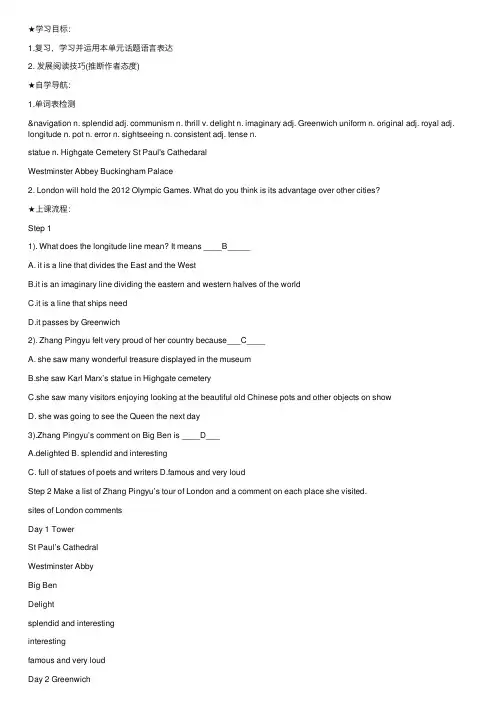
★学习⽬标:1.复习,学习并运⽤本单元话题语⾔表达2. 发展阅读技巧(推断作者态度)★⾃学导航:1.单词表检测&navigation n. splendid adj. communism n. thrill v. delight n. imaginary adj. Greenwich uniform n. original adj. royal adj. longitude n. pot n. error n. sightseeing n. consistent adj. tense n.statue n. Highgate Cemetery St Paul's CathedaralWestminster Abbey Buckingham Palace2. London will hold the 2012 Olympic Games. What do you think is its advantage over other cities?★上课流程:Step 11). What does the longitude line mean? It means ____B_____A. it is a line that divides the East and the WestB.it is an imaginary line dividing the eastern and western halves of the worldC.it is a line that ships needD.it passes by Greenwich2). Zhang Pingyu felt very proud of her country because___C____A. she saw many wonderful treasure displayed in the museumB.she saw Karl Marx’s statue in Highgate cemeteryC.she saw many visitors enjoying looking at the beautiful old Chinese pots and other objects on showD. she was going to see the Queen the next day3).Zhang Pingyu’s comment on Big Ben is ____D___A.delightedB. splendid and interestingC. full of statues of poets and writersD.famous and very loudStep 2 Make a list of Zhang Pingyu’s tour of London and a comment on each place she visited.sites of London commentsDay 1 TowerSt Paul’s CathedralWestminster AbbyBig BenDelightsplendid and interestinginterestingfamous and very loudDay 2 Greenwichfamous and interestingDay 3 Karl Marx’s statueBritish Museumfamous and interestingthrilledStep 3If you have the chance to go to London in 2012, which places do you like to go to most, and why? Make a dialogue with your partner. The dialogue should contain the information: what are the historical attraction mentioned famous for? Who built them? What happened to them in the history? Why do you want to visit these places?Step41. sightseeing n.& a.观光的 go sightseeing 观光游览sightsee v. 观光 sightseer n.观光客游客2.Worried about the time available, Zhang Pingyu had made a list if the sites she wanted to see in London. 由于担⼼时间不够,张萍⽟早就把她想要在伦敦参观的地点列了⼀张单⼦。
湘少版Unit 2 We are going to do some research 第二课时 教案

湘教版五年级下册第二单元第二课时教学设计
课题We are going to do some research. 单元第二单元学科英语年级五年下
学习目标学习掌握重点句型:What are we going to collect?
We’re going to collect pictures.
What are we going to read?
We’re going to read a book.
重点会用be going to句型,引导的特殊疑问句来提问并且回答。
难点会在相关的情境中灵活使用be going to句型
教学过程
教学环节教师活动学生活动设计意图导入新课做游戏
小猪吃蛋糕。
教师出示一些图片,出示单词的一些字母。
学生选出单词
缺少的字母。
为学习新句型做铺垫。
复习旧知。
讲授新课1.学习L et’s act.
今天又有两个小朋友给我们分别带来了一些单词。
你们能不能帮助老师把这些单词两个两个的组成短语。
好,现在我们一起看看他们怎样用这些短语说的句子吧!
What are you going to do?
We are going to do some research.
教师出示单独的词组。
2.学习L et’s read.学生把单词组
成短语。
生跟读。
看视频跟读句
子。
学生互相问
答。
猜谜游戏,学生
喜欢。
湘教小学五年级下英语课本解读unit2
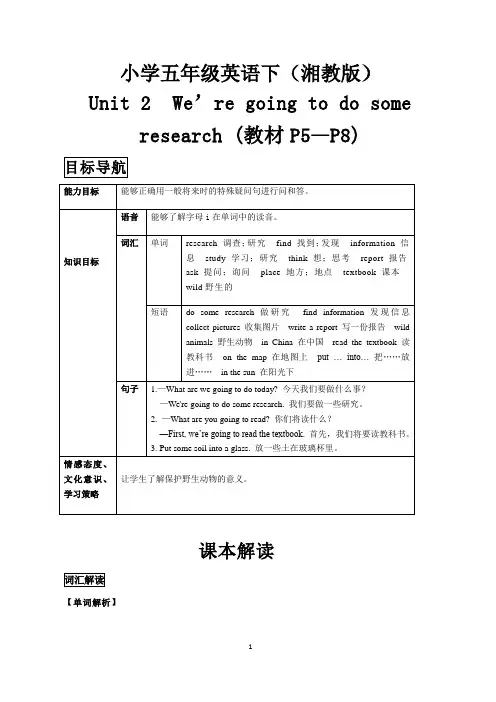
小学五年级英语下(湘教版)Unit 2 We’re going to do some research (教材P5—P8)课本解读【单词解析】[rɪ'sɜːtʃ]调查;研究例句:短语:近义词:拓展:巧记:[faɪnd]找到;发现例句:短语:形近词:同义词:联想:[ɪnfə'meɪʃ(ə)n] 信息发音:例句:短近义词:联想:注巧记:['stʌdɪ]学习;研究例句:短语:近义词:注意:拓展:[θɪŋk] 想;思考发音:例句:短语:形近词:近义词:[r ɪ'p ɔːt]报告例句:短语:形近词:近义词:联想:[ɑːsk]提问;询问例句:短语:形近词:近义词:联想:巧记:A Let ’s Listen and Say (教材第5页)B Let’s Learn(教材第6页)C Let’s Practise(教材第6页)D Let’s Read(教材第7页)【参考答案】:read the textbook, collect pictures, ask “Where do they live?”,find the places on the map, write a reportE Let’s Write(教材第8页)F Let’s Have Fun(教材第8页)课堂培优写作园地How to do some research about wild animalsI am going to do some research about wild animals in China. I am going to do these things.First, I am going to read some books about wild animals in China. Then I am going to find key information about them. Next, I am going to collect some pictures or photos of wild animals. Finally, I am going to write a report.I hope everything is going well.如何做一些关于野生动物的的研究我将做一些关于中国野生动物的研究。
五年级下册英语一课一练- Unit 2 We are going to do some resear

Unit 2 We are going to do some research.第二课时习题一.词组连线二.选择。
()1.We are going to _______ books.A.readB.reading()2.This is _____ books.A.JaneB.Jane’s()3.We are going to collect picture of these ______.A.animalB.animals()4.Where _____ they live?A.doB.does()5.We’re going to research wild animals _____ China.A.inB.to三.根据所给词的适当形式填空。
1.Where do they___(live)?2. We are going to collect picture of ______(this) animals.3.We are going to ___ (read) a book.4.What_____(be) you going to do?5.____(one),we are going to read a textbook.四、为句子选择正确的汉语意思。
( )1.My group is going to do some research.A.我的小组将要做一些调查。
B.我的小组将要写一些报告。
( )2.What are you going to collect?A.你将要收集什么?B.你将要读什么?( )3.Where do they live?A.它们住在哪里?B.它们喜欢吃什么?( )4.We are going to find information.A.我们将要做作业。
B.我们将要找信息。
( )5.We are going to write a report.A.我们将要读书。
B我们将要写报告。
湘少版五年级英语下册教案
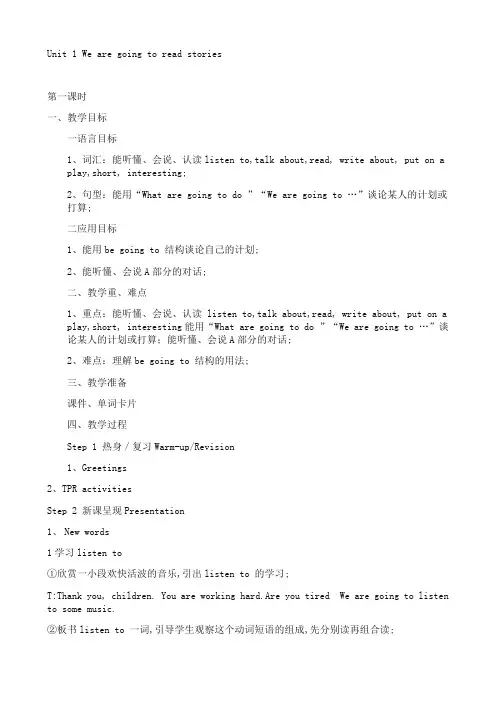
Unit 1 We are going to read stories第一课时一、教学目标一语言目标1、词汇:能听懂、会说、认读listen to,talk about,read, write about, put on aplay,short, interesting;2、句型:能用“What are going to do ”“We are going to …”谈论某人的计划或打算;二应用目标1、能用be going to 结构谈论自己的计划;2、能听懂、会说A部分的对话;二、教学重、难点1、重点:能听懂、会说、认读 listen to,talk about,read, write about, put on aplay,short, interesting能用“What are going to do ”“We are going to …”谈论某人的计划或打算;能听懂、会说A部分的对话;2、难点:理解be going to 结构的用法;三、教学准备课件、单词卡片四、教学过程Step 1 热身/复习Warm-up/Revision1、Greetings2、TPR activitiesStep 2 新课呈现Presentation1、New words1学习listen to①欣赏一小段欢快活波的音乐,引出listen to 的学习;T:Thank you, children. You are working hard.Are you tired We are going to listen to some music.②板书listen to 一词,引导学生观察这个动词短语的组成,先分别读再组合读;2学习read,read steries, interesting3学习talk about,put on a play,short, write about4学生跟读B部分的词汇,模仿原声带的地道发音;2、Dialogue课文学习:教师可分步骤循序渐进地引导学生熟悉课文;第一步:Listen and count不打开书,只听录音,听录音前,给出问题:孩子们在英语课上准备做哪些事情第二步:Listen and find打开课本,听录音,画出所有孩子们再英语课上准备做的事情,检查自己刚才做的是否正确; 第三步:Listen and number教师用课件呈现几张图片,请学生标号;第四步:Listen and repeat听录音,跟读,注意an eraser 的读音;第五步:Read and act出示没有文字的课文插图1和插图2,引导学生表演;Step 3 趣味练习Practise1、用闪卡复习已学过的动词短语;2、谈论周末的计划安排;T:Today is Friday.What day is it tomorrowSs:Tomorrow is Saturday.T: What are going to do,S1 Are you going to play ping-pongS1:Yes,I am/No, I’m not.3、游戏:你问我答教师做动作,学生猜教师要干什么;S: Are you going to…Step 4 巩固拓展Consolidation1、Group work:“精彩六一,我做主”;教师呈现六一儿童节情境,学生定计划,先小组讨论六一儿童节的活动方案,然后小组汇报,建议用句型:“What are we going to do ””We are going to… ”””Are we go ing to… ””Yes, we are.” “No, we aren’t.”2、Give a repoert 小组汇报;Step 5 作业布置Home work1、读写B部分的单词;2、读对话,并试着表演对话;第二课时一、教学目标一语言目标1、词汇:能听懂、会说、认读listen to,talk about,read, write about, put on a play,short, interesting;能听懂、会说discuss,write to sb.2、句型:能用“Are you going to do…”“Yes, we are.”“No,we aren’t.”对自己或他人将要做的事情进行询问和回答;二应用目标1、能在2-3种游戏情境中对自己或他人将要做的事情进行询问和回答;2、能借助插图阅读和理解课文D 部分的小短文;3、能借助头饰,给VCD种课文D部分的角色配音;二、教学重、难点1、重点:认读新短语write about;能在2-3种游戏情境中对自己或他人将要做的事情进行询问和回答;能借助插图阅读和理解课文D 部分的小短文;2、难点:begoing to 一般疑问句的构成和书写;三、教学准备幻灯片,单词卡片,教材视频;四、教学过程Step 1 热身/复习Warm-up/Revision1、Free talk2、Revision1、Relay race 接力活动:每个学生念一行,一个接一个进行单词或短语认读;; 词语如下:listen to stories read stories dancePut on the play sing write a play3、听课文B部分录音,跟读单词;Step 2 趣味练习Practice1、教师说明活动要求;2、学生根据本单元C部分进行问答的对子练习;S1:Are you going to do…S2: Yes,we are./No, we aren’tStep 3 趣味阅读Let’s read第一步:听课文,抓主旨;第二步:读课文,回答问题;第三步:读课文,给图片排序;第四步:学生观看D部分的VCD,并跟着VCD跟读D部分的课文;第五步:引导学生发散思维,说一说想对Miss Li说的话;Step 4 作业布置Homework1、用be going to 结构造句,写一写你周末打算做的事情;2、读 D部分;Unit 2 We are going to do some research第一课时一、教学目标一语言目标1、词汇:能听懂、会说、会读、会写新单词:read, find, collect, study, think, write;2、句型:能听懂、会说、会读、会写“What are going to do ”“We are going to …”;二应用目标1、能用“What are going to do ”“We are going to …”询问和谈论计划;2、能听懂、会说A部分的对话;二、教学重、难点1、重点:能听懂、会说、会读、会写新单词:read, find, collect, study, think, write能用“What are going to do ”“We are going to …”询问和谈论计划;2、难点:初步运用be going to 结构来谈论自己准备开展研究性学习的步骤与打算;三、教学准备课件、单词卡片、教学音频;四、教学过程Step 1 热身/复习Warm-up/Revision1、Greetings2、Revsion:复习be going to结构及单词read, draw, make write, show 等;Step 2 新课呈现Presentation1、Free talkT: What are you doing nowSs: We’re having an English class now.T:利用课程表询问What are you going to do this afternoon 自己回答We are going to study Chinese this afternoon. We are going to study maths, too.2、Learn the new words and phrases1T:Boys and girl, do you like the forest森林 Do you want to know something about the forest 你们想了解森林吗Ss: Yes, we do.T: There are some things in the forest. What are theySs: trees, animals, river…T: Yes, you’re clever. Now, let’s do some research on the forest.通过对话引出并教授短语do some research, 出示单词卡片进行操练;2同样的方法教授短语read and find information;3T: Next, what are we going to do接下来,根据完整的调查步骤,逐一教授以下新单词和短语:collect pictures → study and think → write a report3、Learn the text1通过挂图或课件呈现A部分场景,听录音,初步了解课文内容;Question: What are they going to do2真题听读课文,抓住研究的四个步骤read and find information,collect pictures, study and think, write a report,学习如何谈论自己准备开展研究性学习的步骤与打算;3细化朗读系列,熟悉对话,习得语感;Step 3 趣味操练Practice1、Quick response 快速反应:教师用课件呈现图片,学生根据图片说出相应的单词或短语,然后用be going to 句型进行练说;eg: research → do some research →We’re going to do some research.2、Retell the text教师用课件提供关键词或图片,让学生根据关键词或图片对课文进行复述;Step 4 巩固拓展Consolidation1、Group work:设计五一节活动计划,四人一组制定计划并先进行组内交流;2、Give a report 小组汇报;Step 5 作业布置Homework1、读课文;2、抄写B部分单词和短语;、第二课时一、教学目标一语言目标1、词汇:复习巩固词汇:read, find, collect, study, think, write;能听懂、会说、会读 wild animals, textbook, on the map;2、句型:能运用“What are going to do ”“We are going to …”询问和谈论计划;3、语篇:能理解课文D部分短文,完成相关练习;二应用目标1、能用英语向人询问其未来的计划,并给出简单的答复;2、能理解课文D部分短文,完成相关练习;二、教学重、难点1、重点:能理解课文D部分短文,完成相关练习;2、难点:询问和谈论未来的计划;三、教学准备单词卡片,课件;四、教学过程Step 1 热身/复习Warm-up/Revision1、Greetings2、Free talkT: What are you going to do this weekendS1: I’m going to the pet shop.S2: I’m going to the books hop.S3: I’m going to the park.Step 2 阅读前pre-reading1、看图片,说英语;2、教师用课件呈现C部分语言结构,示范对话练习;3、Let’s practice.S1: What are you going to doS2: We are going to collect pictures.4、导入D部分短文;Step 3 阅读中While-reading1、本单元D部分的语篇阅读的信息梳理;Step 4 趣味活动Let’s have fun1、用课件展示植物的生长过程;2、教师给出任务:对植物的生长过程进行调查,组内进行讨论、交流;Step 5 作业布置Homework1、朗读课文;Unit 3 Let’s make a kite第一课时一、教学目标一语言目标1、词汇:能听懂、会说、认读、会写新单词:draw, paint, cut, glue, tie;能听懂、会说、会运用first, then, and then, next, at last 等表示事件经过的词语;2、句型:能听懂、会说、会运用“First cut the bamboo.”“And then…”“Next…”“Lastly…”;二应用目标1、能理解介词with表示“用……”的意思;2、能使用first, then, and then, next, at last 等表示事件经过;3、能叙述制作风筝的过程;二、教学重、难点1、重点:能听懂、会说、认读新单词:draw, paint, cut, glue, tie,并能使用句型描述制作过程,感知并运用with 的用法;2、难点:感知并运用with 的用法;三、教学准备剪刀、胶水、纸、小刀、刷子、细绳、风筝等实物,课件;四、教学过程Step 1 热身/复习Warm-up/Revision1、Greetings2、Listen and doStep 2 新课呈现presentation1、Lead-in利用课件或制作活动图片,设计猜图游戏;2、New words and phrases1学习新单词:paper, bamboo, knife, scissors, brush, string, glue2Games.设计游戏活动,层层推进,以练习和巩固新单词;3T:Look A beautiful kite Do you know how to make a kiteLet’s have a look.4Number the pictures. 请按制作风筝的顺序给下列图片标号;5教师出示B部分关键动词图片:draw, paint, cut, glue, tie;学生边做动作边学说动词;3、New sentence pattern1T: Write with a pen. 教师边做动作边说句子,重复说出句子一次;2那蜡笔做画画状,鼓励学生尝试,和教师一起说:“Draw with crayons.”边做动作边说句子;3用课件或图片出示句子,先尝试,后学说句子:Cut the bamboo with a pen knife.Cut the paper with scissors.Paint the paper with a brush.4、The dialogue第一步:Look, listen and cross1、Let’s make a bamboo.2、First, cut the bamboo.3、Next, draw a picture and paint it with a brush.4、At last, fly the kite.第二步:Listen and check学生打开书,听录音,检查答案,并画出制作风筝过程的句子第三步:Listen and themselvesStep 3 趣味操练Practice1、为图片找到相应的句子;2、按顺序摆放图片,学生尝试看图说出制作风筝的过程;Step 4 角色表演Act and play1、小组合作,用英语交流制作风筝的过程;2、创设情境,自由会话;情景一:春天到了,小朋友们准备去放风筝,一起动手做风筝;情景二:小朋友要爷爷教他/她做风筝;Step 5 作业布置Homework1、读A、B部分;2、用英文叙述制作风筝的过程;第二课时一、教学目标一语言目标1、词汇:熟练使用first, then, and then, next, at last 来描述事件经过;2、句型:进一步学习使用介词with 的句型;3、语篇:能理解课文D部分短文,完成相关练习;二应用目标1、能使用first, then, and then, next, at last 等词语来描述事件经过;2、能在情景中描述制作物品的过程;二、教学重、难点1、重点:进一步巩固和运用first, then, and then, next, at last 等词语来描述事件经过;2、难点:在情景中描述制作物品的过程;三、教学准备单词卡片、教学课件;四、教学过程Step 1 热身/复习Warm-up/Revision1、Greetings2、教师快速出示单词卡片,学生认读:draw, paint, cut, glue, tie;或者请学生抽卡片,表演动作,其他学生用英语猜;Step 2 趣味操练practice1、Make sentences with the verbs.分组竞赛,抽取动词卡片,造句;2、Homework show3、创设情境,两组学生表演对话;4、打开书,看图、听录音,跟读;Step 3 阅读前Pre-reading1、师生接龙问答;教师鼓励学生观察教室里的人和物,开展问答接龙练习;T: What can you seeS1: I can see a… What can you seeS2: I can see a… What can you seeS3: …2、出示D部分相关图画,用I can see… 描述图画内容,开展组与组之间的PK赛;Step 4 阅读中While-reading1、初读课文;学生快速阅读课文D部分,了解文章大意;2、二读课文;学生再读D部分短文,画记制作中的关键词;3、听录音,跟读课文;Step 5 巩固拓展Consolidation1、教师呈现F部分的5幅关于Peter如何制作风筝的图片;学生根据制作的先后顺序,给图片标号;2、学生分小组讨论,分步骤用英语说明制作风筝过程使用first, then, and then, next, at last 等词3、教师板书问句,学生回答;Step 6 作业布置Homework1、完成练习册Unit 3 ;2、朗读D部分课文;Assessment I一、教学目标一语言目标1、词汇:能够听、说、读、写第1-3单元所学单词;2、句型:能够在已经熟悉的情境中理解并说出第1-3单元所学句型;二应用目标能够在模拟或熟悉的交际场景中初步运用be going to 结构来谈论自己的计划或打算;能用英语简单说明步骤;三、教学准备动植物图片、单词卡片;四、教学过程Step 1 热身Warm-up1、Greetings2、歌谣演练:What are you going to doStep 2 复习主题活动IA plan for the weekend1、自由问答:教师引导学生谈论周末计划的活动;2、A部分练习:Listen and tick学生听录音,完成A部分听力练习,教师通过问和答的形式讲评和核对答案;录音材料:A.Listen and tick1Are we going to make a card in classYes, we are.2 Are we going to talk about an interesting storyNo, we aren’t. We’re going to sing a new song.3What are we going to do in PE classWe’re going to play basketball.4What are you going to act in the play,DavidI’going to act as a dog.Step 3复习主题活动II The plan of Paper and his fiends1、课堂练习B部分的Listen and number;D部分的Look and write学生听录音,完成B部分听力练习,教师通过问和答的形式讲评和核对答案;录音材料:B.Listen and numberThe children are going to do some research.What are they going to doFirst,Peter and Jane are going to read a textbook.Then, Peter is going to collect pictures. Mingming and Fangfang are going to study and think. Next, Peter is going to talk about the research.At last, Kathy is going to write a report.2、学生根据教材第15页D部分的图片,完成D部分的练习,教师通过问和答的形式讲评和核对答案;Step 4复习主题活动III Make a pumpkin lamp学生完成C部分看图阅读并给句子排序的练习,教师通过问和答的形式讲评和核对答案;Step 5 自主评价Self-assessment1、E部分:我能做如果你能完成画如果不能完成就画;2、F部分:我爱做如果你喜欢做就画,如果你不喜欢做;Step 6 作业Homework朗读Unit 1- 3 的内容;Unit 4 Don’t talk here第一课时一、教学目标一语言目标1、词汇:能听懂、会说、认读、会写talk, eat, throw, waste, paper, draw on the wall, play football,on the road, throw waste paper, on the floor, pick flowers, in the park;2、句型:能听懂、会说、认读B部分的句子:“Don’t talk in the library.”“Don’t draw on the wall.”“Don’t eat in the class.”“Don’t play football on the road.”“Don’t throw waste paper on the floor.”“Don’t pick flowers in the park.”二应用目标1、了解一些公共场所需遵循的规则;2、能使用“Don’t…”向他人表示禁止和建议;3、能听懂、会说A部分的对话;二、教学重点、难点1、重点:能使用“Don’t…”这一祈使句的否定句式表示禁止和建议;2、难点:掌握和运用A、B部分表示禁止和建议的祈使句的否定句;三、教学准备幻灯片;四、教学过程Step 1 热身Warm-up1、Greetings2、Chant:用课件呈现教师自编的chant;What, what, what are you going to doRead,read, we’re going to read.Home, home, we’re going to read at home.What, what, what are you going to doPlay, play, we’re going to pla y.Park, park, we’re going to play in the park.Step 2 新课程现Presentation1、A guessing game:一名学生抽取动词卡片,根据卡片上的动词或动词词组做动作,其他学生猜;2、New words and phrases1library, reading room利用课件逐步呈现图书馆的图片,感知他的发音,学说单词;2Don’t talk in the library. Don’t talk in the reading room. Don’t talk here.呈现禁止说话图片;通过图片和动作理解“Don’t talk.”的意思;学说句子;No talking.Don’t talk.Don’t throw waste paper on the floor.通过实物使学生理解waste paper 的含义;4用课件或图片出示B部分图片,请学生尝试为图片配上表示禁止和建议的句子;3、The dialogue第一步:Listen and cross学生不打开书,教师用课件出示四句话,请学生听录音后判断那句话没有出现再对话中,在句子的括号前打“×”;1)Don’t talk here.2)Don’t eat in the library.3)Don’t draw on the book.4)Don’t write on the book.第二步:Listen and find学生打开书,检查刚才自己听到的、判断的是否正确;第三步:Listen and repeat听录音,跟读A部分对话;Step 3 趣味操练Practice1、图片游戏教师快速出示B部分图片,学生快速说出句子;2、图片游戏:为图片找到相应的句子;教师利用课件出示图片和句子,请学生为图片找到配对的句子;Step 4 角色表演Act and play1、表演课文A部分的对话2、创设情境,自由对话;情境一:In the classroom情境二:In the cinema情境三:In the parkStep 5 作业布置Homework1、读A、B部分;2、任意选择B部分种的4个句子,配上图并写上相应的英语句子;第二课时一、教学目标一语言目标1、词汇:巩固第一课时所学的词汇;2、句型:能熟练运用“Don’t…”这一祈使句的否定句式表示禁止和建议;3、语篇:能理解课文D部分短文,完成相关练习;二应用目标1、能使用所学的句型在适当的情境中表达禁止和建议;2、能理解课文D部分短文,完成相关练习;二、教学重、难点1、重点:能熟练掌握和运用表示禁止和建议的祈使句的否定句;2、难点:能理解课文D部分短文,完成相关练习;三、教学准备四、教学过程Step 1 热身/复习Warm-up/Revision1、Greetings2、用课件出示B部分图片,看图片说英语;Step 2 阅读前Pre-reading1、师生问答;T: I like reading. What do you likeS1: I like drawing/…T: Do you like swimmingS2:Yes, I like swimming./No, I like singing./…2、谈论对季节的喜好;Step 3 阅读中While-reading1、初读课文;学生快速阅读课文D部分,了解文章大意;完成下列判断题;1、Bob and Paul study in Sunshine School.2、Bob and Paul are not roommates.3、Bob like drawing.4、Paul likes singing.2、听录音,跟读第一段;任务:用短文中的句子解释rooommates;3、二读课文;学生在读D部分课文,完成表格;请在他们喜欢的项目下画Name music drawing reading singing BobPaulStep 4 趣味活动Let’s have fun1、解释呈现标志,学生说出祈使句的否定式;2、I can read学生选择任意一条规则,边做动作边读出句子;3、I can drawStep 5 作业布置homework1、收集生活中见到的标志;2、完成练习册unit 4;Unit 5 When’s your birthday第一课时一、教学目标一语言目标1、词汇:能听懂、会说、认读新单词January Jan. February Feb. March Mar. April Apr. May 注:五月没有缩写 June June. July July. August Aug. September Sept. October Oct. November Nov. December Dec.及月份的缩写形式和词组International Children’s Day;能听、说、读、写单词may, month, year, birthday;2、句型:能用“When’s your birthday ”及回答“My birthday is in…”“It’s on the…of…”进行对话;二应用目标1、能听懂、会说A部分的对话;2、能指认一月至八月的单词;3、能正确表达一月至八月中的具体日期;4、能借助图片和提示,简单了解中外重要的节日及英语表达方式;二、教学重、难点1、重点:能听懂、会说一月至八月的单词;能用“When’s your birthday ”及回答“My birthday is in…”“It’s on the…of…”进行交流;2、难点:新单词January, February的读音有一定的难度;新单词一月至八月的正确排列顺序;三、教学准备日历一本,单词卡片,幻灯片;四、教学过程Step 1 热身/复习Warm-up/Revision1、Greetings2、Free talkT: What day is todayT: How many days are there in a weekSs: Seven.T: What are theySs: Sunday, Monday , Tuesday , Wednesday, Thursday , Friday, Saturday.Step 2 新课呈现Presentation1、New words1教师用日历、图片教授单词month, year;2教师用日历、图片教授单词June, July, August, January, February和词组International Children’s Day;3Game 1: Listen and do游戏规则:以小组为单位,每个小组代表一个月份,听到相应的月份单词,迅速起立;2、The dialogue第一步:Listen and choose要求学生不打开书,听录音前,给出任务:完成连线题;1Lingling’s birthday It’s on the first of June.2Peter’s birthday It’s on the first of March.3 International Children’s Day It’s on the fourth of May.第二步:Listen and check要求学生打开书,听录音,核对答案;第三步:Listen and repeat学生分角色朗读;Step 3 趣味操练Practice1、教师呈现不同节日的图片,学生两人一组,看图连线;It’s on the 1st of January.It’s on the 8th of march.It’s on the 1st of May.It’s on the 1st of June.It’s on the 1st of August.It’s on the 1st of July.Step 4 作业布置Homework1、读对话,并试着表演对话;2、制作一月至八月的单词卡片;第二课时一、教学目标一语言目标1、语音:字母组合er在September,October, November , December等单词中的发音;2、词汇:复习和巩固已学单词;能听懂、会说、认读新单词September , October, November , December及其缩写形式;3、句型:能熟练运用“When’s your birthday ”及回答“My birthday is in…”“It’s on the…of…”进行对话;二应用目标1、能指认十二个月的单词,并能正确排列顺序;2、能借助图片和提示,阅读和理解D部分的短文,并完成问答题;3、能借助图片和提示,简单了解中外重要的节日及英语表达方式;二、教学重、难点1、重点:复习和巩固已学单词;能听懂、会说、认读新单词September , October, November , December及其缩写形式;阅读和理解D部分的短文,并完成问答题;2、难点:表示月份的正确排列顺序从1月到12月;能正确完成D部分的短文,并完成问答题;三、教学准备日历一本,单词卡片,幻灯片;四、教学过程Step 1 热身/复习Warm-up/Revision1、Greetings2、Free talk.Step 2 新课呈现Presentation1、教师呈现日历,并板书September , October, November , December2、让学生认真朗读,仔细观察,找出共同点;3、看图连线;It’s on 10th of September.National DayTeacher’s Day It’s on 1st of October.Christmas Day It’s on fourth Thursday of November.Thanks-giving Day It’s on 25th of December.Step 3 主题任务Task1、学生生日调查情况;2、学生父母生日调查情况;填写Family Birthday Card 活动;My name is .My birthday is on the of .My mother’s birthday is on the of . My father’s birthday is on the of .I love my family.Step 4 任务型阅读Let’s read and learn1、第一遍阅读短文要求学生独立阅读,快速说出收信人和写信人的名字;2、第二遍阅读短文要求学生完成选择题:1Fran’s birthday is . A、today B、tomorrow2 Tomorrow is birthday. A、Simon’s B、Fran’s3 We’re going to meet at . A. 7p.m. B. 7:00 a.m.4 We’re going to meet at .A. Room 305 B. Room 503 Step 5 作业布置 Homework1、阅读C部分的内容;2、完成练习册的作业;Unit 6 I’ll make a beautiful card第一课时一、教学目标一语言目标1、词汇:能听懂、会说、认读、会写Mother’s Day card, restaurant, gift, rose, a box of chocolates;2、句型:I’ll make a beautiful card. Happy Mother’s Day二应用目标1、能听懂、会说A部分的对话;2、能结合母亲节的话题和他人简单谈论将来的活动或计划;二、教学重、难点1、重点:能听懂、会说、认读B部分的词汇;能听懂、会说部分的对话;能和他人简单谈论母亲节;2、难点:学生再本单元首次接触到一般将来时的语法现象,如“I will…”,教师要多创设将来的情境,给学生多输入一般将来的句子,让学生在充分的感知中初步理解这一语法现象;三、教学准备关于母亲节的图片,单词卡片,幻灯片;四、教学过程Step 1 热身/复习Warm-up/Revision1、Greetings2、Free talk.Step 2 新课呈现Presentation1、Look and say教师通过课件呈现多幅展现动物母爱的图片;T: All the animals have got the mothers. We do have our mother. Do you love your mother WhyS1: Yes, I do. I love my mother because she loves me.S2: I love my mother because she cooks nice food for me.…T: It’s Mother’s Day. Here I have two questions for you about Mother’s Day.Q1: When is Mother’s Day Mother’s Day is on the 2nd Sunday of MayQ2: What can we do on Mother’s Day课件呈现礼物,玫瑰,巧克力的图片,学习gift, rose, a box of chocolates 并板书,然后带读;2、Let’s chantA card, a letter, for my mum.Chocolates, red roses for her, too.Mother, mother, mother, I love you.Mother, mother, mother, happy Mother’s DayStep 3 对话学习Learn the dialogue课文学习:教师可分布骤循序渐进地引导学生熟悉课文;第一步:Listen and fill in the formT: Mother’s Day is coming. The children will do something for their mothers. Listen to the tape, and try to fill in the following form.第二步:教师根据表格引导学生回答问题:“What will…do for her/his mother ”教师及时带全班同学复述正确答案;第三步:Read and actStep 4 趣味任务Task1、Group work:“母亲节快乐”角色表演2、Give a report 小组汇报Step 5 作业布置Homework读写B部分的生词;第二课时一、教学目标一语言目标1、词汇:复习巩固B部分的词汇;会听、会说、会认读fan, coloured paper, lucky stars, delicious;2、句型:复习巩固“What will you do ”及其答句“I will…”;二应用目标1、能在2-3种游戏情境中谈论自己和他人将来的打算和计划;2、能借助插图阅读和理解课文D部分的小短文;二、教学重、难点1、重点:能简单谈论自己和他人将来的打算和计划;能借助插图阅读和理解课文D部分的小短文;2、难点:D部分的文本为Amy 和Jane的一段长话,对话中有一些长句和难句,教师要通过情景设计或难句分解等方式帮助学生理解句意;三、教学准备单词卡片,幻灯片;四、教学过程Step 1 热身/复习Warm-up/Revision1、Greetings2、Free talk.Step 2 趣味阅读Let’s read1、教师呈现母亲节的情境及对话主人公Amy和Jane,导入问题情境:Who want to buy a gift for her mother What’s the gift2、学生阅读D部分的对话,完成课文后的正误判断练习;Step 3 趣味任务Task1.Group work: “母亲节创意”PK竞赛活动;2、Give a report 小组汇报;Step 4 作业布置Homework1、朗读A部分和B部分课文;2、完成练习册的作业;Assessment II一、教学目标一语言目标1、词汇:能够听、说、读、写第4—6单元所学单词;2、句型:能够在已经熟悉的情境中理解并说出第4—6单元所学句型;二应用目标能够在实际交际场景中比较熟练地运用所学句型进行自然交流,如:结合某人的生日复习具体的日期的有用表达;结合生日的话题复习一般将来时的有用表达;复习巩固用Don’t开头的祈使句来表达禁止和建议;二、教学重、难点够听、说、读、写第4—6单元所学单词,够在实际交际场景中比较熟练地运用所学句型进行自然交流;学会自我总结和检测;三、教学准备人物图片,节日图片,幻灯片;四、教学过程Step 1 热身Warm-up1、Greetings2、歌谣演练:Happy Birthday to YouStep 2 复习主题活动IJane’s birthday1、教师通过幻灯片呈现关于Jane的生日场景,并提供目标语言,引导学生用语言猜测Jane的生日在哪个月;2、教师随机出示关于月份的单词卡片:January , February , March , April , May , June , July , August, September , October , November , December ;学生快速说出卡片上的英文单词;3、学生完成P31C部分的短文“Read and answer”的笔头练习,教师讲评答案;Step 3 复习主题活动IIA gift Jane’s birthday1、教师呈现Jane的生日场景与生日礼物的图片,学生猜测Jane的生日收到了哪些礼物;复习巩固词汇:some red rose, a birthday card, a box of chocolates, a big birthday cake 等;2、教师引导学生用一般将来时表达自己将送给Jane什么生日礼物,如“I will make a birthday card for her.”“I will make a beautiful kite for her.”Step 4 趣味操练Practice1、教师出示公共场所中常见标识的图片,学生快速说出用Don’t开头的祈使句;2、B部分练习:Listen and number学生完成B部分听力练习,然后教师通过问答的形式讲评和核对答案;录音材料:B、Listen and number1. Don’t play football on the road.2. Don’t draw on the wall.3. Don’t run here.4. Don’t throw waster paper on the floor.5. Don’t talk in the library.6. Don’t pick flowers in the park.3、A部分练习:Listen and tick学生完成A部分听力练习,然后教师通过问答的形式讲评和核对答案;录音材料:A. Listen and tick1. What does that sign meanIt means “Be quiet”.2. Where are theyThey are in a restaurant.3. When’s your birthday, AnneMy birthday is in March, It’s on the fifth of March.4.Tomorrow is Mother’s Day. What will you do for your mother, Peter I’ll buy her some flowers.Step 5自主评价Self-assessment1、E部分:我能做如果你能完成画如果不能完成就画;2、F部分:我爱做如果你喜欢做就画,如果你不喜欢做;Step 6 作业布置Homework1、朗读Unit 4—6课文;。
新版八下unit2_I’ll_help_to_clean_up_the_city_park单元教学设计

Write three conversations about your discussions with your classmates. A: I’d like to help the old. What could I do? B: You could give them medical
service.
give out the posters
help homeless people
What else could we help others with?
help the old to go across the road. give your seat to the old , the children, or the woman who will have a baby. make the old people who are spending their left life in the elder community laugh. help the passengers with their luggage. help plant trees and grass to beautify your hometown. help the old people cross the street. help the police catch the thieves. help the old people clean up their houses. give the money to the charity and help the poor people.
1a. Look at the ways you could help people. in the picture. Then list other ways.
五年级下册英语教案-Unit 2 We're going to do some research 第
五年级下册英语教案-Unit 2 We’re going to do someresearch 第三课时湘少版(三起)课程简介本节课主要内容是学生通过阅读、倾听和讨论等方式学习研究和写作的相关知识。
同时,通过学习一些研究报告的例子,帮助学生对研究有更深入和全面的理解。
教学目标•能够理解并解释“research”一词,学会运用“be going to”谈论未来计划。
•能够培养学生读、写、倾听和口语表达的各种技能。
•能够掌握一些研究报告写作的基本技巧,了解研究报告的格式和要求。
教学重点•学生能够理解并解释“research”一词。
•学生能够应用“be going to”谈论未来计划。
教学难点•学生能够掌握研究报告写作的基本技巧。
•学生能够了解研究报告的格式和要求。
教学过程Step 1 导入新知1.教师可以在黑板上展示一些科学研究的图片,诱导学生讨论关于科学研究的话题。
2.采用简短的对话和问题引导学生,询问学生是否知道“research”一词的意思。
引导学生通过词根和词缀来猜测单词含义。
Step 2 学生实践1.谈论未来计划:教师通过图片和例句为学生介绍be going to的基本用法,让学生在对话中练习。
2.阅读科学研究报告:教师分发给学生一个研究报告的样本,让学生在阅读中理解研究报告的格式和要求。
3.写作练习:教师让学生根据自己的兴趣选择一个研究课题,自行编写一份研究报告。
Step 3 知识点总结教师对学生通过实践所学到的知识进行总结和归纳,并提供一些其他的研究资源供学生自行研究。
教学评价1.学生的研究报告能否满足格式和要求,语言是否符合表达规范。
2.学生在实践中是否能够理解并解释“research”一词。
3.学生能否通过be going to来表达未来计划。
4.学生对研究的理解是否更加深入和全面。
教学拓展1.给学生提供更多的科学研究资源,让学生自行研究和编写研究报告。
2.引导学生学习更多关于研究和写作的知识,提高学生的写作表达能力。
自然拼读法第二课:辅音字母口诀
自然拼读法第二课辅音字母的发音口诀:bag bent black bob bikepig plan pop pen planecat sock cup kick kite gap get gum glad gamedad dog duck nod datetick lot bat wet timefat fine fate five fun fox very vest visit vase hand happy help hot hike job just jump jeep jeans lake lot leaf late lamp lady make man map meal mix name need nest next noqueen quick quite quack red rice ride ring room sad same school seal send wake wall wash water waybox fox x-ray fix oxyes yellow your year you zoo zebra zero lazy2015 年五年级英语下册重点复习资料( 湘少版 )Unit 1一、词汇: ( 注: part B部分的词汇要求与图片一起记忆)story listen to interestingplaytalk about write about put ongreat好极了,太棒了二、句型:1、Are we going to write ? 我们要写吗?Yes, we are.是的,我们是。
No, we aren ’t. 不,我们不是。
2、What are we going to do today?我们今天要做什么?We are going to listen to interesting stories.我们准备听一些有趣的故事。
We are going to read them.我们要读它们。
五年级下册英语单元测试 Unit 2 We’re going to do some research单元测试卷 湘少版 含答案
Unit2 单元测试卷听力部分一、听音,选词填空。
( ) 1. Colin likes collecting ________.A. picturesB. maps( ) 2. We’re going to research ________ in China.A. animalsB. plants( ) 3. We’re going to find ________ on the map.A. placesB. rivers( ) 4. Can you find the ________?A. pandaB. tiger( ) 5. Put some ________ in the glass.A. milkB. juice二、听音,找出下列小朋友打算研究的动物,并用直线连接。
1. Daming A.2. Fangfang B.3. Tom C.4. Anne D.5. Peter E.三、听录音,选出你所听到的句子。
( ) 1. A. What are we going to do today?B. What are we going to do tomorrow?( ) 2. A. We’re going to collect photos.B. We’re going to collect pictures.( ) 3. A. We are going to think about the animals.B. We are going to talk about the animals.( ) 4. A. I am going to read the textbook.B. I am going to find the textbook.( ) 5. A. Are you going to put soil into a glass?B. Are you going to put oil into a glass?四、听音,判断句子正误。
外研版英语七年级下册Unit2We'regoingtocheertheplayers.课后练习题
一、改写句子1. Lucy was at school last night. (改为一般疑问句)____________ Lucy ____________ school last night?2. Everyone will use paper, pens and erasers. (改为否定句)________ ________ will use paper, pens ________ erasers.3. He’s going to see a film. I’m going to see a film. (合并成一句)He’s going to see a film _________ I’m going to see a film, _________.4. My mother is going to buy some clothes this afternoon. (改为否定句)My mother _________ _________ _________ _________ _________ clothes this afternoon.5. The view from the top of the hill is fantastic. (改为感叹句)________ ________ the view from the top of the hill is!二、单项选择6. Mr. Black is ________ medium height ________ a long face.A.of; with B.of; has C.in; of D.at; with7. —What’s that ________ English?— ________ is an egg.A.of; This B.at; It C.in; This D.in; It8. —Are you going to play ________ table tennis this afternoon?—No, I am going to play ________ piano.A.a; the B.the; a C./; the D.the; /9. — Our teacher Ms. Chen is great fun. She is very good ________ telling stories and she is good ________ us.—That’s true. And we all like her.A.at; to B.for; with C.with; at D.to; for10. Hangzhou is famous ________ its West Lake, so many tourists like to visit it every year.A.as B.for C.at D.to11. What do you like ________ dinner?A.for B.of C.at12. Her mother often cooks a big meal ________ her birthday.A.in B.at C.for D./13. A Bite of China(舌尖上的中国) is a TV show ________ nice Chinese food. A.to B.about C.at D.in14. —It’s seven o’clock now. It’s time ________ school.—Let’s go.A.for B.to C.at D.of15. My mother’s birthday is coming. I want to buy a new shirt ________ her. A.at B.for C.to D.with三、句型转换16. Everyone will use paper, pens and erasers. (改为否定句)________ ________ will use paper, pens ________ erasers.17. We never worry about anything. (改为同义句)There is ________ for ________ ________ ________ ________ .18. Today I don’t have anything to do.Today I ________ ________ to do.19. Millie’s computer works well. (改为同义句)________ ________ ________ with Millie’s computer.20. My mother is going to buy some clothes this afternoon. (改为否定句) My mother _________ _________ _________ _________ _________ clothes this afternoon.四、单词拼写21. You can call me _______ 6630568.22. Do you help your parents do ________ (家务)?23. They sell nice clothes ________ good prices.24. We know _______(没有什么)about her family.25. The basketball is not mine. It must be someone ________ (其他).五、用所给单词的正确形式填空26. 用所给动词的正确形式填空1. I ______ (watch) the football games on TV this Sunday.2. She ______ (not have) lunch at school tomorrow.3. ______ they ______ (study) English this year?4. What ______ you ______ (do) tomorrow?5. I ______ (play) basketball with Jim this afternoon.27. Mr. Smith ________ (cook) for his family this afternoon.28. —Who is going ____ (be) in the park this afternoon?—Mary and Linda.29. Would you like ________ (see) a film with me?30. 用括号内所给单词的适当形式填空1. She_______ (fly) to Beijing next Sunday.2. What would you like _______(eat) for supper?3. My mother has a lot of _________(housework) to do every day.4. How can I ________(drive) a car?5. Nobody ____(be) in the classroom now.六、完成句子31. 他把担忧埋藏在心底真愚蠢。