
Module6Unit1教案-外研版七年级英语上册
七年级上册Module 6 A trip to the zoo.教学设计
教材及年级名称
外语教学和研究出版社七年级上册模块名称Module 6 A trip to the zoo.
教材分析
本模块以“A trip to the zoo”为话题,重点学习谈论自己喜欢的动物,以及学习世界各地动物的栖息地、习性等,内容贴近学生生活,有利于激发学生的学习兴趣。
本模块通过三个单元的学习和训练,旨在让学生通过这一学习与体验的过程,能够就动物进行提问与回答,能够介绍动物的栖息地和生活习性,同时培养增强学生爱护动物、保护自然环境的意识。
本模块承接Module5继续学习一般现在时态,重点是运用助动词“do”“does”练习一般疑问句的表达及其回答,为下一模块练习特殊疑问句做好铺垫,起到了承上启下的作用。
学情分析
大多数学生喜欢动物,也渴望了解更多的动物。
经过小学阶段的学习,学生已经熟悉部分动物的英文名称和描述动物的句子。
本模块则是进一步学习并拓展有关动物物种、生活习性和地理方面的的知识,从而引入到谈论自己最喜爱的动物。
“Animal”的话题符合学生的性格特点,学习内容对学生来说难度不大,所以教学在很大程度上能有效地激发学生的兴趣和积极性。
模块教学目标知识
目标
1.能够听说读写本模块的四会单词: trip,zoo, tiger, camel, elephant,
giraffe…Europe, European, Asia, Asian, Africa, African, grass, leaf, bamboo…
2. 能够熟记下列句型:
---Does it eat meat?---Yes, it does./ No, it doesn’t.
--- Do lions eat…? ---Yes, they do. No, they don’t.
掌握一些描述性口语表达的句子: There are…in the zoo. The elephant
lives in…. They eat…
能力
目标
1.能听懂介绍动物的对话,并在听力中找出细节信息。
2.能熟练运用一般现在时的一般疑问句与同伴展开有关动物话题的交
流。
3.能阅读有关动物介绍的篇章,掌握阅读技能。
4.能用一般现在时描写自己喜爱的动物。
5.能向他人展示自己介绍动物的作品。
情感
目标
了解世界各地的野生动物的习性和生长状况,唤起学生热爱大自然、热爱动物、保护动物的意识。
教学重点及难点重
点
The useful words, phrases and sentence structures
难
点
运用一般现在时谈论动物、描写自己喜爱的动物。
教学辅助Multi-media , Trace board
教学方法Individual work、Pair work、Group work 、Communication 、Task-based approach、PWP、Game
教学过程
第一课时教学设计
教材分析本课时学习Unit1“Does i t eat meat?”的内容,通过孩子们和导游之间的问答,以动物习性和聚居地为话题展开对话,重点强调听、说训练。
学习内容包括动物的英文名称、一般现在时(主语为第三人称单数)的一般疑问句的句型问答和一般描述性的语句。
目的在于增加学生英语语言交流的表达法,拓展学生的视野,增
加综合知识。
课时教学目标1.能听说读写本单元的词汇和句型。
2.能听懂介绍动物的对话,并从中找出细节信息。
3.熟练掌握运用一般现在时的陈述句、一般疑问句,并能在情景对话中描述自己喜爱的动物。
4.培养并加强对动物的热爱,意识到保护动物、热爱动物就是热爱人类本身。
教学重点与难点本单元的词汇
一般现在时(主语第三人称单数)的一般疑问句及其回答。
教学辅助Multi-media , Trace board
教学方法Individual work、Pair work、Group work 、Task-based approach、PWP、Game
教学内容Teaching Process
Pre-listening Warming-up
教学活动设计意图
Purpose
通过看动画、
听歌曲、回答
问题,吸引学
生的注意力,
激发学生的学
习兴趣,同时
激活学生头脑
中已有的知识
储存。
教师活动
Listen to an English song
“Go to the zoo”
1.Tell students “First, let’s enjoy
an English song together.”
2.Play the video for the students
to listen.
3.Ask students
1) Where do they go?
2) What can you see in the zoo?
3) What animals do you know?
学生活动
1.Students enjoy the
video “Go to the zoo”
2.Answer the questions
about the song.
3.Think of animals as
many as possible.
4. Guess the names of
the animals according to
the description.
Pre-li stening
Step II Vocabulary learning Play a guessing game “Guess
out animals as quickly as you
can.”
1.Show the students pictures of
animals that are covered part.
2.Get the students to guess the
animals quickly.
3. Learn the new words with the
students.
1.Look at the pictures
and guess the animals
according to the
descriptions..
2.Learn the new words
after the teacher.
用游戏和图片
的方式学习新
单词容易引起
学生学习的兴
趣,通过单词
与图的匹配使
学生在头脑中
建立两者的联
系,减少汉语
的干扰。
While-listening
Step III Listening practice
1.Tell students “Tony and
Lingling are visiting the zoo.”
“What animals do they see?”
2.Get Ss to listen to the
materials and order the animals.
3.Check the answers.
1. Look at the animals in
the box. Try to guess.
2. Listen and order the
animals they see in the
zoo.
3. Check the answe rs.
通过此项听力训
练达到两个目
的,一是对前面
一个环节的词汇
学习进行巩固,
二是为后面的学
习和语言输出做
好铺垫。
外研版英语七年级的上册Unit1Nicetomeetyou.教案
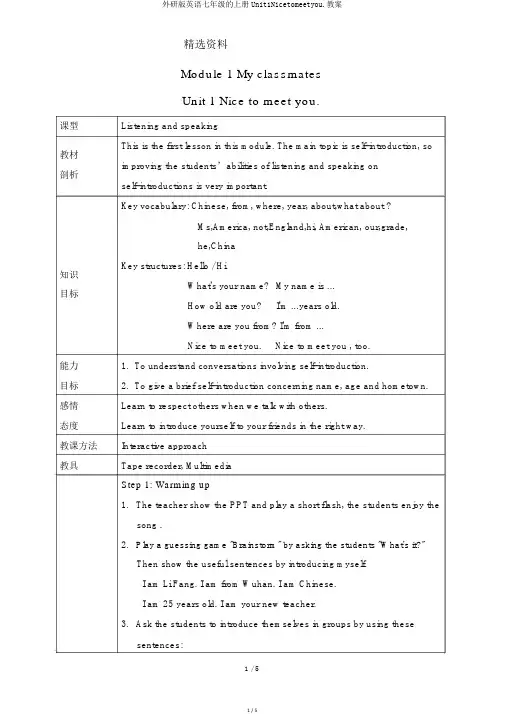
精选资料Module 1 My classmatesUnit 1 Nice to meet you.课型Listening and speakingThis is the first lesson in this module. The main topic is self-introduction, so 教材improving the students’abilities of listening and speaking on剖析self-introductions is very important.Key vocabulary: Chinese, from, where, year, about,what about ?Ms,America, not,England,hi, American, our,grade,he,ChinaKey structures: Hello / Hi知识What's your name? My name is ...目标How old are you? I'm ...years old.Where are you from? I'm from ...Nice to meet you. Nice to meet you , too.能力 1. To understand conversations involving self-introduction.目标 2. To give a brief self-introduction concerning name, age and hometown.感情Learn to respect others when we talk with others.态度Learn to introduce yourself to your friends in the right way.教课方法Interactive approach教具Tape recorder, MultimediaStep 1: Warming up1. The teacher show the PPT and play a short flash, the students enjoy thesong .2.Play a guessing game "Brainstorm" by asking the students "What's it?"Then show the useful sentences by introducing myself.I am Li Fang. I am from Wuhan. I am Chinese.I am 25 years old. I am your new teacher.3. Ask the students to introduce themselves in groups by using thesesentences:教课过程教课过程精选资料What's your name? Where are you from?How old are you?Which class are you in?Nice to meet you.Step 2: Listening1.Play the recording in activity 1 and ask the students to listen andcheck how many people speak.2.Play it again and ask the students to check the words their hear.3.Check the answers with the whole students.Step 3: Listen and read1.Play the recording in activity 3 and ask the students tolisten and answer the questions. Then check the answers.(1)How many people speak in the conversation?(2)Who are they?(3)Are they in the same class?2.Play it again and check the true sentences in act3. Asksome students to correct the wrong ones.3.Put the students into groups of four to practise the dialogue. The students repeat it several times, changing roles each time.4.Talk about the pictures in the PPT and show their performances.5.Ask the students to sum up the useful sentences in the dialogueand introduce “ Everyday English. ”6.Finish act 4 and 5 in groups. Teacher checks the answers.Step 4: Pronunciation1.Explain that this activity focuses on some English phonemes whichare difficult to pronounce for speakers of Chinese.2.Play the recording once without stopping.3.Play it again and ask the students to repeat.4.Practise the sounds in pairs, then finish the exercises on the PPT.Step 5: Speaking1.Talk about the pictures by asking and answer in paris like this:A: What ’s his name?B: His name is .A: Where is he from?B: He's from .A:How old is he?B:He's ...years old.Step 6: Module taskTask 1: Who has the most friends?运用本课句型,在规定的八分钟时间内,以小组为单位,看谁结交的朋友最多,她将获取一份丰厚的奖品。
最新七年级英语上册Module6AtriptothezooUnit2ThetigerlivesinAsia第1课时教案新外研版
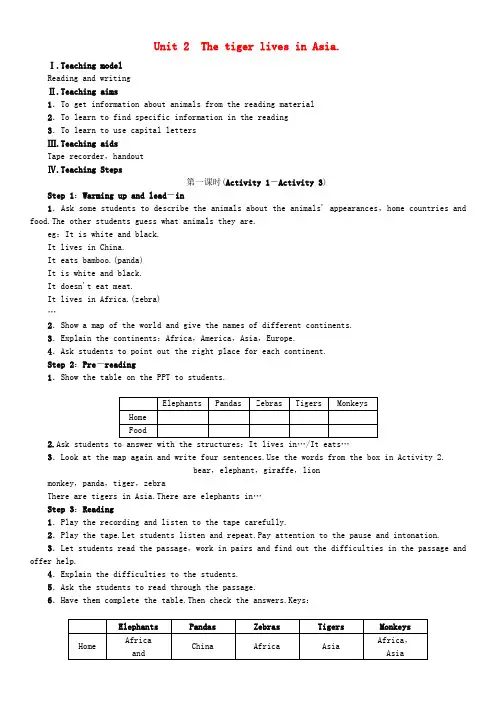
Unit 2 The tiger lives in Asia.Ⅰ.Teaching modelReading and writingⅡ.Teaching aims1.To get information about animals from the reading material2.To learn to find specific information in the reading3.To learn to use capital lettersⅢ.Teaching aidsTape recorder,handoutⅣ.Teaching Steps第一课时(Activity 1-Activity 3)Step 1:Warming up and lead-in1.Ask some students to describe the animals about the animals' appearances,home countries and food.The other students guess what animals they are.eg:It is white and black.It lives in China.It eats bamboo.(panda)It is white and black.It doesn't eat meat.It lives in Africa.(zebra)…2.Show a map of the world and give the names of different continents.3.Explain the continents:Africa,America,Asia,Europe.4.Ask students to point out the right place for each continent.Step 2:Pre-reading1.Show the table on the PPT to students.2.Ask students to answer with the structures:It lives in…/It eats…3.Look at the map again and write four e the words from the box in Activity 2.bear,elephant,giraffe,lionmonkey,panda,tiger,zebraThere are tigers in Asia.There are elephants in…Step 3:Reading1.Play the recording and listen to the tape carefully.2.Play the tape.Let students listen and repeat.Pay attention to the pause and intonation.3.Let students read the passage,work in pairs and find out the difficulties in the passage and offer help.4.Explain the difficulties to the students.5.Ask the students to read through the passage.6.Have them complete the table.Then check the answers.Keys:1.Learn the new words by heart.2.Read the passage in groups.3.Finish off the workbook exercises.Blackboard DesignUnit 2The tiger lives in Asia.(Activity 1-Activity 3)a little,only,large,catch,strong,even,kilo,dangerous,be good at,many kinds of,as well as,live alone,Africa—AfricanThere are…The elephant lives in…Does it eat…?The zebra doesn't eat…Where does it come from?Is good at…?Unit 2 My mother’s cleaning our houses and sweeping away bad luck第二课时(Activity 3-Activity 6)Step 1:ReviewAsk students to read the passage in Activity 2.Step 2:Have a dictationGet students to write the words and phrases in Unit 2,check them if they have grasped the usages of the points.Step 3:Practice1.Have a reading competition.Let two students read the passage in Activity 2 and see who reads better.2.Have students read the words in the box and the passage in Activity 3.celebrate,dumpling,few,luck mean,programme,sweep away,traditionalWe (1)________ Spring Festival in January or February.A (2)________ days before Spring Festival we clean our homes and (3)________ all the bad (4)________.On the evening before Spring Festival we have a big family dinner.We eat lots of (5)________ food,such as jiaozi—a kind of (6)________.We usually watch a special (7)________ on television,and parents usually give their children a hongbao.It (8)________ lucky money.3.Ask the students to complete the passage with the correct form of the words and expression from the box.4.Check with a partner.5.Call back the answers from the whole class.Keys:(1)celebrate (2)few (3)sweep away (4)luck (5)traditional (6)dumplings (7)programme(8)means6.Read the passage together.Step 4:Writing 11.Look at the notes about Christmas in Britain in Activity 4.a)go shopping for presentsb)have a traditional family dinnerc)open presents on Christmas Dayd)put the presents next to the Christmas treee)get lots of food readyf) sing Christmas songsg) say Merry Christmas to family and friendsh) have a Christmas tree2.Match the notes with the headings.Getting ready PresentsTraditional things on Christmas Day3.Call back the answers from the whole class.Keys:Getting ready:a,ePresents:c,dTraditional things on Christmas Day:b,c,d,f,g,h4.Read the phrases together.Step 5:Learning to learnWhen you write new words,write them under headings,in groups or in a word e pictures and drawings.Step 6:Writing 21.Write sentences with the notes in Activity 4.Join two notes and write one sentence with and.go shopping for presents;get lots of food ready→They go shopping for presents and they get lots of food ready.You can leave out the second they.→They go shopping for presents and get lots of food ready.2.Choose one of the headings in Activity 4 and write about Christmas in Britain.Getting readyPeople go shopping for presents and get lots of food ready.Step 7:Homework1.Finish the writing task.2.Finish the workbook.Blackboard DesignUnit 2My mother's cleaning our house and sweeping awaybad luck.(Activity 3-Activity 6)1.They go shopping for presents and get lots of food ready.2.People go shopping for presents and get lots of food ready.。
外研版七年级英语上册教案 Module6 Unit1 (1)

4.能正确地朗读课文。(语言知识、语言技能)
5.能在上述口语活动中做到语音、语调基本正确。(语言技能)
6.能使用简单的图表和海报等形式传达信息。(语言知识、语言技能)
7.能尝试使用适当的学习方法,克服学习中遇到的困难。(学习策略)
8.能意识到语言交际中存在文化差异。(文化意识)
寻求其他组或教师帮助。
4.学后读
朗读课文:
跟读、自读、小组分角色朗读和查读
模仿课文的语音、语调并对学生进行纠音,提高学生的口语
活动设计:跟读、自读、小组分角色朗读和查读
模仿课文的语音、语调
1.同桌互评
2.班内展示
3.其他同学纠正发音
问题预设:
语音语调,意群停顿,可数名词复数的发音/s/ /z/出现问题。
补救措施:
采取小组互助的形式或者询问老师
5读后说
活动设计
根据教师提示,小组讨论;小组代表展示
1.组内评价
2.小组展示
6.学以致用
教学内容:
活动设计
1学生在规定的时间内独立完成检测题
2.核对答案
3.学生互助讲解
1.班内展示
2.其他同学纠正发音
问题预设:
部分学生可能会在新知运用上存在问题;
补救措施:
采取小组互助的形式或者询问老师的方式
学习目标
目标认知维度分类
通过本课时学习,学生能够:
1.通过单词识记、跟读、听写,学生能够读出并根据音标拼写出本模块的重点词汇。
2.通过对话复述、两人对话练习,学生能就自己最喜爱的动物及生活习性进行讨论。
3.通过文本分析、小组合作、教师精讲点拨的方式找出、并会在具体语境中运用文本中的知识点。
Module6Unit1第一课时教学设计外研版英语七年级上册

(2)自读:有感情地朗读课文。
分角色朗读对话。
学生能较为流畅地表达自己的想法。
学生能准确、大声跟读课文。
Step4.Grammar points
1.Read the following sentences and find out the grammar rules.
fly-flies /z/;carry-carries /z/
study-studies /z/; worry-worries
(3)以“s, x, ch, sh”结尾的,在词尾加“es”,发音为/iz/如:
teach-teaches /iz/; watch-watches /iz/
(4)以“o”结尾的动词,加“es”,读/z/如:
学情
分析
学生对很多动物所熟知,学生们非常熟悉,有大量的生活经验。学生之前已经学习过一些动物的名词以及一些形容动物的形容词,对于一般现在时的一般疑问句。否定句等有所了解,但掌握的不够扎实。
对英语国家的标志性动物及文化,和一些不熟悉动物的生活习性不熟悉。
学习
目标
通过本课时学习,学生能够:
1.借助图片和语境理解单词的含义;
---Yes, _____________
③老虎吃肉,不吃蔬菜。
A tiger ___________ , but it _______________________.
④---熊猫来自日本吗?----不,不是。
---Does the panda ________________________?
----No, ____________
基于标准的“教学评一体化”设计
课题
M6U1A trip to the zoo Unit1 Does it eat meat?
外研版英语七年级上册教案全册

Unit 1 Nice to meet you教学流程图:教学步骤l (1课时)一、第一教学环节:情景创设、布置任务、激趣导入二、第二教学环节:师生互动、培养能力、给予成就感三、第三教学环节:评价总结、激发竞争、巩固提高附:评价表(小组成员之间进行评价,以星号为标记,五个星为最高,但是必须小组全票才能通过生效)Unit 2 I’m from China and I’m Chinese Teaching aimKnowledge: *useful expressions in introducing and greeting*nominal genitive pronoun & determinative genitive pronoun Abilities: To be able to introduce oneself and others and greet peopleMoral education:To build up students’ confid ence and interest in English- learning Key points: Introducing othersThis is Betty. This is my friend, Tony.Difficult points: 1) Asking for and receiving personal information.What’s your name?Can you introduce yourself please, Betty?I’m from America. I’m 13 years old.2) To master the names \ languages\ of some countriesTeaching methods: Group work, displayTeaching aids: puter recorderTeaching procedures:Step 1 Teacher’s self-introduction (Lead-in)Name, Country, language, Age otherKey Sentence Structures:My name is 。
秋季学期外研版初中七年级英语上册教案全册
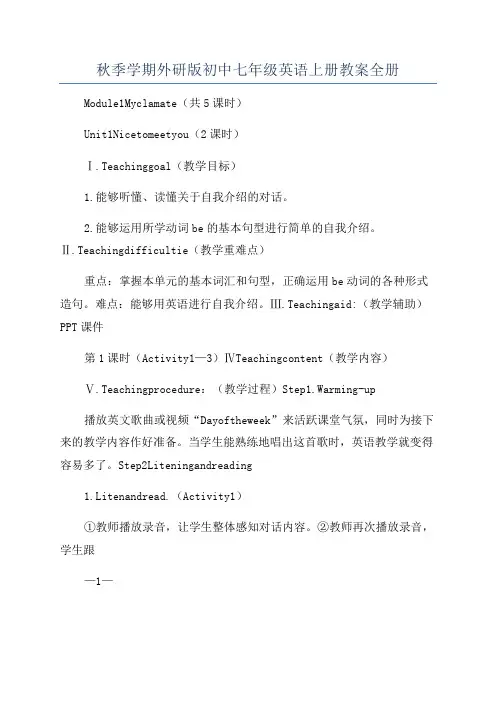
秋季学期外研版初中七年级英语上册教案全册Module1Myclamate(共5课时)Unit1Nicetomeetyou(2课时)Ⅰ.Teachinggoal(教学目标)1.能够听懂、读懂关于自我介绍的对话。
2.能够运用所学动词be的基本句型进行简单的自我介绍。
Ⅱ.Teachingdifficultie(教学重难点)重点:掌握本单元的基本词汇和句型,正确运用be动词的各种形式造句。
难点:能够用英语进行自我介绍。
Ⅲ.Teachingaid:(教学辅助)PPT课件第1课时(Activity1—3)ⅣTeachingcontent(教学内容)Ⅴ.Teachingprocedure:(教学过程)Step1.Warming-up播放英文歌曲或视频“Dayoftheweek”来活跃课堂气氛,同时为接下来的教学内容作好准备。
当学生能熟练地唱出这首歌时,英语教学就变得容易多了。
Step2Liteningandreading1.Litenandread.(Activity1)①教师播放录音,让学生整体感知对话内容。
②教师再次播放录音,学生跟—1—读、模仿。
③学生两人一组练习对话。
④教师让不同的小组展示对话,关注学生的发音。
2.Litenandrepeat.Nowpoint,akandanwer.(Activity2)①教师放录音,学生听录音。
②教师再次播放录音,学生跟读、模仿。
③学生两人一组根据日历练习对话。
④教师让部分小组展示对话。
环节说明:本活动以日历的形式让学生学习表示星期一至星期日的7个词汇,然后指着日历上的具体日期来询问星期几,进而练习相关句型“Whatdayiittoday”教师向学生说明在西方国家Sundayithefirtdayoftheweek,让学生了解这种文化差异。
Step3Practice1.Readandmatch.Nowlitenandcheck.(Activity3)①学生个体活动,完成匹配。
外研版七年级英语上册教案
初一英语教案2015 年 4 月1--2 日教案年 4 月 3 日教案年 4 月7--8 日教案年 4 月17--20 日初一英语教案年4 月21--22 日初一英语教案年4月23--24 日初一英语教案年4月27--28 日初一英语教案年 4 月29--30 日初一英语教案年 5 月15--18 日初一英语教案年 5 月25--26 日初一英语教案年5月27--28 日初一英语教案年 5 月29 日初一英语教案年 6 月1--2 日课题Module 10 Unit 3课型Revision Language in use教学目标To summarise and consolidate grammar focus.To summarise and consolidate expressions and vocabulary.教学重点Present simple: interrogative, negative and affirmative sentences教学难点Present simple: interrogative, negative and affirmative sentences 教具多媒体、录音机课时 1教学过程Step 1. Revision新课标第一网个人修改(1). Revise the words about computers(2). Put the Ss. in pairs to introduce how to use a computer.Step nguage practice1. Run through the examples with the Ss. and make sure that theyare familiar with the use of adverbs of interrogative, negativeand affirmative sentences.2. Ask the Ss. To repeat the sentences in the box.3. Ask ”Can you make other similar examples?”4. Act.1 and Act.2 on page 64. Grasp the use of usually and often.Step 3. Test:课后评价。
Module6Unit3(1)教案-外研版七年级英语上册
3.成果展示:每个小组将向全班展示他们的讨论成果和角色扮演的结果。
(四)学生小组讨论(用时10分钟)
1.讨论主题:学生将围绕“如何用英语谈论兴趣爱好”这一主题展开讨论。他们将被鼓励提出自己的观点和想法,并与其他小组成员进行交流。
4.文本理解:阅读课文,了解课文中人物的兴趣爱好及活动。
5.口语练习:通过小组活动,练习用英语询问和回答兴趣爱好。
二、核心素养目标
Module6 Unit3(1)教案-外研版七年级英语上册,本节课核心素养目标如下:
1.语言能力:培养学生运用英语进行日常交流的能力,学会表达个人兴趣爱好及活动安排,掌握一般现在时态的用法,灵活运用重点词汇和句型。
四、教学流程
(一)导入新课(用时5分钟)
同学们,今天我们将要学习的是Module6 Unit3(1)的内容。在开始之前,我想先问大家一个问题:“你们在日常生活中是如何度过闲暇时间的?”这个问题与我们将要学习的内容密切相关。通过这个问题,我希望能够引起大家的兴趣和好奇心,让我们一同探索兴趣爱好以及如何用英语表达它们。
2.教学难点
-词汇的准确记忆与运用:学生可能会在记忆和正确使用新词汇时遇到困难,特别是乐器类词汇和频率副词。
-一般现在时态的用法:学生需要理解并区分一般现在时态与现在进行时态,难点在于正确使用第三人称单数形式和动词原形。
-口语表达:学生在用英语表达个人兴趣爱好时可能会缺乏流畅性和自然性。
举例:
-学生可能会混淆词汇用法,如将"play the piano"误用为"play piano",或将"practice"误用为"do practice"。
七年级英语上册外研版课件:Module 6Unit1
课堂导学
2. They come from many different countries and they eat different food. 它们来自许多不同的国家,并且吃不同的食物。 ◆come from =be from来自,后常接表示国家或 地点名称的词。如: She comes from London. =She is from London. 她来自伦敦。
巩固提升
二、单项填空。
( B ) 1. I _____ English and Tom _____
Chinese.
A. studies;study B. study; studies
C. study;study
D. studies;studies
巩固提升
( A ) 2. The giraffe _____ from Asia.
课文理解
三、根据课本Act.3对话,完成下列短文填空。 There are many kinds of animals in Beijing
Zoo, such as bears, zebras, giraffes and pandas. They come from 1. _d_i_ff_e_r_e_n_t _ countries and eat different food. The lions eat meat, so they are 2. _d_a_n_g_e_r_o_u_s.
课堂导学
4. Here are the lions. 狮子在这儿。 ◆此句是倒装句,正常语序为:The lions are here. 句子中如果出现副词here(这儿), there(那儿)位于句首时,常用倒装句式。
课堂导学
5. Look at this elephant. 看这只大象。 ◆look at意为“看……”,后接名词或代词作宾语。 辨析:look,see,watch与read
外研版七年级英语上册教案Module 6 Unit 1 Does it eat meat
第一课时Unite1 Does it eat meat?环节1 新课导入T: Hello, boys and girls!Ss: Hello, Mr. Zhang.T: Today, we are going to learn Module 6 A trip to the zoo. Have you been to the zoo?Ss: Yes.T: Do you know Beijing zoo?S1: Yes, I went there last year. I saw many animals…S2:…T: OK. Today I’ll take you to visit Beijing zoo. Are you happy?Ss: Yes.T: Please look at the screen and get to know some information about Beijing Zoo.Ss: …(Look at the screen and try to know some information about it.)设计意图:以图片的形式进行直观教学,能很快导入课文,抓住学生的好奇心,吸引学生的学习兴趣。
环节2 学习1-81.教师给出一副图的某一部分,让学生猜出是什么动物,以此引入动物名词。
2.听活动2的录音,让学生勾出所听到的活动1中的单词。
3.听活动3的录音,完成表格。
4.核对答案。
再听一遍录音,让学生勾出文中重要的词汇和句子。
教师对文中的难句和知识点进行讲解。
5.让学生完成活动4 的任务。
教师核对答案。
6.听活动5和活动6的录音,让学生跟读,并完成相应任务。
7.让学生结对根据活动3短文中对动物的描述进行提问和回答。
8.让学生结对编写关于动物的对话,并抽取2-3组学生当堂进行表演。
9.学以致用。
根据首字母提示写出单词(1)Beijing Zoo has many kinds of a______.(2)The lions are d__________ because they eat meat.(3)Pandas are black and white and eat b__________.(4)The b_______ eat meat and plants.(5)An e__________ is tall and eats plants.Answers:(1)animals (2)dangerous (3)bamboo (4)bears (5)elephant设计意图:引导学生运用结对练习法进行初步的语言实践,鼓励学生大胆开口,培养学生运用目标语言进行交际的能力。