
沪教牛津版七年级英语 UNIT 2 Daily life
UNIT 2 Daily lifeⅡ重点短语\句型1.junior high school 初中senior high school 高中primary school 小学2.on foot 步行3.take part in 参加4.go to bed睡觉5.get up起床6.have a good/great/wonderful time =enjoy oneself =have fun 玩得开心,愉快7.How do /does... go to school?8.How long is...9.I always have a good time...10.Is...close to...?11.Once a month, I...12.How often do you...?13.They think ...as...III详细讲解1. once or twice a week每周一两次注意:在英语中,表示一次用“once”,两次用“twice”,表示三次或者三次以上就用“基数词+times”(time在这里是可数名词,表示次数,需要加“s”)如:once a week,twice a week, three(four/ five…)times a week2. brush one’s teeth刷牙brush ①在这里是动词,表示“刷”②n.可数名词,“刷子”复数形式是“ brushes”。
如:I need some brushes for painting. tooth的复数形式是“ teeth”牙齿(因为每个人刷牙的时候不止刷一颗牙齿,所以要用复数)3.watch television= watch TV 看电视4.ride a bicycle 骑自行车动词短语,交通工具前要加限定词(如a ,the)同义词:by bicycle/bike 介词短语,交通工具前不用加限定词5.be close to 离……近= near =beside= not far away from(上节课学过)6.so在此处用作连词,表示结果“因此;所以”的意思。
不可以将because和so同在一个句子里。
(他们两个就像两只老虎,一山不能容二虎。
类似的还有although/ though 和but。
)7.go to school on foot= walk to school步行去学校go to…on foot = walk to …8.Classes start at 8 a.m., and I am seldom late.①start 在这里是不及物动词,开始。
同义词:begin 反义词:end、finish还可以做及物动词,后加to do/doingstart at: 几点开始②be late: 迟到be late for school ····迟到如:He gets up late in the morning,so he is often late for school.later adv.后来,过后。
一段时间+later 如:He come back two days later。
③at 在这里表示时间,“在”如:at half past two 在两点半注意:arrive+地点名词=reach /get to (但是后面是home、here、there则不需要加介词)9.I enjoy learning about different places in the world.①different:不同的。
反义词:samebe different from “与····不同”②enjoy doing sth= like/love doing sth very much 喜欢做某事③learn about:获悉;了解10.We have our morning break at 9:50.a.m.break n.休息(可数名词) have /take a break=have /take a rest 休息一下v.打破,打碎break the window 打破了窗户11.When the bell rings, I run to the playground with my best friends Tom and Jack.①when在这里不是表示询问时间,而是一个连词,表示“当···时候”,后面加一个句子。
此处连接两个先后发生的动作;也可表示两个动作同时发生。
②ring 是不及物动词,“打电话”n.电话,环形物(戒指)。
如:give sb. a ring给某人打个电话 a magic ring 一枚魔戒12.How short it is. 这是一个由“how”引起的感叹句句型为:how+形容词/副词+主语+谓语(有时也可以省掉主谓语)What+a/an +形容词+单数可数名词+主语+谓语!What a kind man he is!What+形容词+不可数名词/复数名词+主语+谓语!What fine weather it is today!What beautiful flowers these are!13.Then Tom, Jack and I take part in the school band practice.(page17)IV语法一、一般现在时(一)含义:表示经常性或习惯性的动作,或表示现在的特征或状态。
1.表示事物或人物的特征、状态。
如:The sky is blue.天空是蓝色的。
2.表示经常性或习惯性的动作。
如:I get up at six every day.我每天六点起床。
3.表示客观现实和普遍真理。
如:The earth goes around the sun.地球绕着太阳转。
4.在时间状语从句和条件状语从句中,用一般现在时表示将来。
如:If you come this afternoon, we’ll have a party. 如果你今天下午来,我们就举行一个宴会。
5. 一般现在时还可以表示一个按规定、计划或安排将要发生的情况(这时都有一个表示未来时间的状语)。
但仅限于少数动词。
如: begin, come, leave, go, arrive, start, return, stop, close等。
如:The meeting begins at seven. 7点开会。
(二)一般现在时的构成1. be动词:主语+be(am, is, are)+其它。
如:I am a boy.我是一个男孩。
2.行为动词:主语+行为动词(+其它)。
如:We study English.我们学习英语。
当主语为第三人称单数(he, she, it)时,谓语动词要用第三人称单数,即要在动词后加"-s" 或"-es"。
如:Mary likes Chinese.玛丽喜欢汉语。
(三)一般现在时的变化1. be动词的变化。
①否定句:主语+ be + not +其它。
如:He is not a worker.他不是工人。
②一般疑问句:Be +主语+其它。
如:-Are you a student? -Yes. I am. / No, I'm not.③特殊疑问句:疑问词+一般疑问句。
如:Where is my bike?2.行为动词的变化。
(do/does)①否定句:主语+ don't( doesn't ) +动词原形(+其它)。
如:I don't like bread.当主语为第三人称单数时,要用doesn't构成否定句。
如:She does not play the guitar.②一般疑问句:Do( Does ) +主语+动词原形+其它。
如:- Do you often play football? - Yes, I do. / No, I don't.当主语为第三人称单数时,要用does构成一般疑问句。
如:- Does she go to work by bike? - Yes, she does. / No, she doesn't.③特殊疑问句:疑问词+一般疑问句。
如:How does your father go to work? (四)动词碰到第三人称单数时,要进行相应的变化:动词+s的变化规则1. 一般情况下,直接加-s,如:cook-cooks, milk-milks work - works2. 以s. x. sh. ch. o结尾,加-es,如:guess-guesses, wash-washes, watch-watches, go-goes3. 以“辅音字母+y”结尾,变y为i, 再加-es,如:study-studies carry - carries4. have – has二、频度副词一般现在时常用下列副词或副词短语来作时间状语:always, usually, often, sometimes, seldom, hardly, never, every day(week, year, night), on Sundays, on Monday, in the evening, once/ twice/ three times a month例句: I often visit my teachers. 我经常看望我的老师。
例句: They do morning exercises every day. 他们每天做早操。
①其中根据频度的“密疏”,频度副词的排列顺序是:always, usually, often, sometimes , seldom, hardly, never②频度副词通常放在行为动词之前,be动词、助动词和情态动词之后;而副词短语经常位于句末或句首。
例如:I often get up early. 我经常起得早。
He is always kind to others. 他总是对别人很好。
I walk to school every day. 我每天步行去上学。
③对频度副词提问时,用how often.--How often do you go to see your grandparents? --Once a week.区分:sometime, some time, sometimes, some times,every day,everyday课堂训练一. 单词辨音( ) 1. Geography A. / dʒe'D grəfi / B. / dʒi'D grəfi / C. / dʒi'D gr D fi /( ) 2. seldom A. / 'seldəm / B. / 'sældəm / C. / 'sedəm /( ) 3. market A. / 'ma:k I t / B. / 'mak I t / C. / 'mə:k I t /( ) 4. bell A./ bel/ B./beil/ C. / bəl /( ) 5. break A. / brek / B. / bre I k / C. / bri:k /二. 根据汉语或首字母提示写单词, 补全句子。
沪教牛津版-英语-七上-七上Unit_2_Daily_Life单元知识小结
Unit 2 Daily Life一.重点词组(必会)1. junior high school 初级中学2. go to school on foot == walk to school步行上学3. take part in == join in 参加4. have a good time == enjoy oneself == have fun过得愉快5. go to bed 去睡觉6. get up 起床7. brush one’s teeth 刷牙8. ride a bicycle == by bike 骑单车9. have a break 休息一下10. from …..to……11. do morning exercises 做早操12. daily life 日常生活13. arrive at == get to到达14. once a week 一周一次15. twice a month 一月两次16. be late 迟到17. make music 演奏音乐18. have breakfast 吃早餐19. have dinner 吃晚餐20. have classes 上课21. help sb. with sth. 帮某人某事== help sb.(to) do sth.二. 同义词(了解)1. seldom = not often2. break = a short rest3. ring = make a sound4. end = stop5. together = with each other6. daily = everyday三. 本单元核心语法点:一般现在时态:一,定义:1)经常性、习惯性的动作或存在的状态。
e.g. I go to school on foot. He is very busy now.2)表示主语的特征、性格、能力、爱好等。
e.g. He can swim. I work hard. I like watching TV.3)表示客观真理。
沪教牛津版广州英语七年级((上册))Unit2讲义全
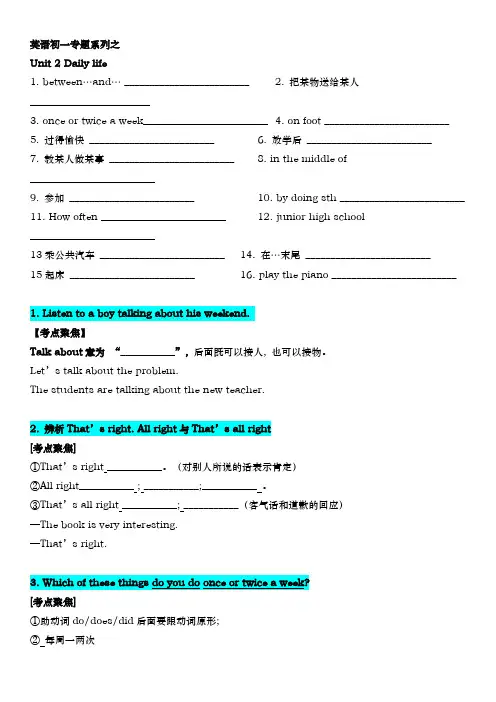
英语初一专题系列之Unit 2 Daily life1. between…and… _________________________2. 把某物送给某人________________________3. once or twice a week_________________________4. on foot _________________________5. 过得愉快_________________________6. 放学后_________________________7. 教某人做某事_________________________ 8. in the middle of_________________________9. 参加_________________________ 10. by doing sth _________________________ 11. How often _________________________ 12. junior high school_________________________13乘公共汽车_________________________ 14. 在…末尾_________________________15起床_________________________ 16. play the piano _________________________1. Listen to a boy talking about his weekend.【考点聚焦】Talk about意为“___________”,后面既可以接人, 也可以接物。
Let’s talk about the problem.The students are talking about the new teacher.2. 辨析That’s right. All right与That’s all right[考点聚焦]①That’s right ___________。
2024年沪教牛津版七年级英语上册 Unit2重点短语句型和知识

2024年新沪教牛津版初一上册Unit 2重点短语和知识一.重点短语compare with与...作比较would like to do sth.想要做某事be different from与...不同brush teeth刷牙go to school去学校do sports做运动do the dishes洗碗do some reading阅读go home回家do one’s homework做作业do the housework做家务wash clothes洗衣服have a lot to say about关于...有很多要说的in the morning在早上teach us by playing games通过做游戏教我们do some morning exercise做一些早间锻炼do morning exercises做早操from...to...从...到...after that在那之后take part in参与(活动)look forward to期望the answer to the question问题的答案be close to靠近be excited about对...感到激动in fact事实上in daily life在日常生活中solve problems解决问题all the time一直at times偶尔have classes上课have breakfast吃早餐get up起床on foot走路tell sb. About sth.告诉某人某事write to写信给某人full of energy精力充沛the breaks between classes课间休息get ready for准备好be ready to do sth.准备好去做某事half an hour半小时go to bed上床睡觉keep a diary记日记pick up取回;开车接hurry to充忙去某地in a hurry匆忙in time及时on time准时;按时in a good mind有好心情a happy ending一个美好的结局二.重点句型1.Which of these things do you do every day?这些事情中哪件是你每天都做的?2.What about you?你呢?3.---What do you usually do on weekends?你周末通常做什么?---I often exercise.我经常锻炼。
上海牛津版初一英语上册Daily life知识点梳理:Unit 2

中学 __________ __________ 足球 __________ __________ 最喜爱 __________ __________ 一楼 __________ __________ 美式足球__________ __________ 三、你知道下面句子中谈论的是哪门学科吗? 1. You can draw and paint pictures.__________________ 2. You can learn to use the computer. __________________ 3. You can learn about different countries, sea and rivers of the world. __________________ 4. You can learn to cook and sew. __________________ 5. You can learn to speak different language. __________________ 6.You can do a lot of physical exercise. __________________ 7. You can learn about the natural world through experiments(实验). __________________ 8. You can learn about the past. __________________ 四、After listening to the dialogue between Eddie and Hobo, please answer the question: What does Eddie think school is like? ___________________________________________________________________ ________ 五、你理解他们之间的对话了吗? One day Hobo asked Eddie ______ dogs _______ go to school. Eddie told him dogs were _________ than people, and they _________ go to school. Then Hobo wanted to know what the school _______ _______. Eddie told him it was _______ _________ TV, but there were ____________ __________________.
上海教育出版社牛津英语七年级上册Unit2Daily-life综合习题

Unit 2 daily life一、单项选择1 .All of my family __________ TVA . likes watching B. enjoys watchingC. enjoy to watchD. enjoy watching2. It's twelve o'clock at night , but he is _________ working .A .still B. ever C.sometimes D.often3. Every morning we discuss business __________ breakfast .A. withB. atC. onD. in4. My father usually drives me to school ______ his car .A . by B. to C.on D. in5. She sometimes makes phone calls to clients ___ the way to the school. A.byB. inC.onD. at6. She does well in all her subjects, she never _______ an exam .A .falls B. fell C.fails D. passes7. he usually ________ home at six.A. gets toB. arriveC. arrives atD. gets8. ---- ______ do you usually get to school ? -----At seven.A . How many B.How C. What time D. How much9. Sally is never late ______ school,A .for B. in C. to D.at10. ---- Do you drink milk every day ?------ No. I don't like milk at all. I _______ drink milkA .usually B. often C. sometimes D. never11 ________ your brother good at ________ football ?A. Is; playingB.Are; playingC.Does playD. Do; playing 12. He has ________ rice and drinks __________ tea .A. lot of; plenty ofB.a lot of , manyC.a lot of , plenty ofD.many plenty of13. Who _________ you English ?A .teach B. teaches C.does teach D.are teaching14 .----- __________ do you go swimming ? -------- sometimes.A. WhenB.What timeC.How oftenD. How long15. We go to school __________ Monday _________ Friday.A. on onB.from : toC. on toD. from; on16. It will be his ________ birthday next Sunday.A .twelve B.twelveth C. twelfth D.the twelfth17.She usually _______ two hours _______ her homeworkA. spends; doingB. spends; doC.takes doingD.takes to do 18. After school we usually play ____ basketball for half _______ hour . A .the an B. / a C. / an D. the /19. Many children enjoy ________ picture-booksA .read B.to read C. reading D. seeing20. Her mother is ill, she has to _________ her at homeA .look for B. look at C. look up D. look after二、单词拼写1.Sometimes he goes s_______ to buy something with his mother .2.2 It usually t______ her two hours to finish her homework3. Sometimes her mother is b____ and Zhaoxue makes her own breakfast4. She loo ks p_______ in her new dress .5. We goes to school every day e________ Saturday and Sunday .三、根据中文意思,完成句子。
深圳沪教牛津版七年级英语上册同步习题 Unit 2 Daily life(无答案)
深圳沪教牛津版七年级英语上册同步习题 Unit 2 Daily life (无答案)A.B.another B. otherC. the otherⅡ. 语法填空。
It will be very hard to make friends if you stay at home alone all the time. 1.________(make) a good friend can make your life 2._________(happy) and easier. Then how to make friends?If you are in a new class, don’t be nervous. Be 3.___________(friend) to others and they will be friendly to you, too. Give you enthusiasm to other 4._________(student). They will like you.The 5. _________(same) interest is important. Singing and dancing are most students’6.__________(hobby). If you have them, others will get close to you.At last, in order to keep a good 7.__________(friend), weshould help, understand and 8._________(respect) each other.In a word, 9._________ a good friend, giving others more means getting more from 10.________ (they).导入Free talk知识要点Unit 2词汇课文※知识点1. that’s right的用法辨析that's right, all right, that’s all rightthat对的,正对别人所’s right 确的说的话表示肯定或认同all right好的;好吧欣然接受别人所提的建议身体好,病好了表示健康状况,相当于fine, wellthat ’s all right不用谢,别客气对别人所说的感谢的话的回应没关系对别人道歉的回应例1:( )---The programme is very popular. ---______________. We all like it.A.That’s right.B. Not at all.C.It doesn’t matter. D. You’re welcome.※知识点2. 感叹句复习例2:( )___________excellent actor he is!A.WhatB. What aC.What an D. How※知识点3. 频率副词how often, how soon, how long的用法how often用于提问频率,表示“多久一次”Howoften do yousee a film?how soon用来提问多久,指再过多久,通常对“in+一段时间”进行提问How soonwill yoursister comeback?how long用于提问物体多长,还可以提问时间多长How longwill you stayin Beijing?例3:( )---__________ often does your mother go shopping?A.WhoB. HowC.What D. Which精选习题Ⅰ.单选题。
07A沪教牛津版七年级英语上册课文原文及翻译国标手写斜体描红版字帖Unit2
沪教版七年级上册同步课文内容国标手写斜体描红版字帖Module1Unit2说明:黑白打印,效果正常。
如网页显示单词对不齐线格,请放心下载,原文件是正常的。
Module1My life Unit2Daily life ReadingA day at school学校的一天by Sam作者:SamI am a junior high school student.I love going to school.我是一名初中学生,我喜欢上学。
My school is close to my home,我的学校离我家很近,so I always go to school on foot.所以我经常去步行上学。
Classes starts at8a.m.,and I am seldom late.上午8:00开如上课,我很少迟到。
My favourite subject is Geography.我最喜欢的科目是地理,I enjoy learning about different places in the world.我喜欢了解世界不同的地方。
In the morning,we usually study Chinese,Maths and English.上午,我们通常学习中文、数学和英语。
We have our morning break at9:50a.m.When the bell rings,I run to the playground with my best friendsTom and Jack.钟声一响,我就和我最好的朋友Tom和Jack跑到操场上,We often play games.Break ends at10:10a.m.我们经常一起做游戏。
学习有智慧淘店制作上午10:10,How short it is!短暂的休息结束!Lunch is from11:50a.m.to12:30p.m.午餐从上午11:50至下午12:30。
沪教牛津版七上英语单词表
沪教牛津版七年级上册英语单词表Unit 1 Making friends1. German /ˈdʒɜːmən/ adj. 德国的;德国人;德语;n. 德国人;德语2. blog /blɒɡ/ n. 博客3. grammar /ˈɡræmə(r)/ n. 语法4. sound /saʊnd/ n. 声音;v. 听起来5. complete /kəmˈpliːt/ v. 完成;adj. 完全的,完整的6. hobby /ˈhɒbi/ n. 爱好7. country /ˈkʌntri/ n. 国家8. age /eɪdʒ/ n. 年龄9. dream /driːm/ n. 梦想;v. 做梦10. everyone /ˈevriwʌn/ pron. 每个人11. Germany /ˈdʒɜːməni/ n. 德国12. mountain /ˈmaʊntən/ n. 山,山脉13. elder /ˈeldə(r)/ adj. 年长的14. friendly /ˈfrendli/ adj. 友好的15. engineer /ˌendʒɪˈnɪə(r)/ n. 工程师16. world /wɜːld/ n. 世界17. Japan /dʒəˈpæn/ n. 日本18. flat /flæt/ n. 公寓19. yourself /jɔːˈself/ pron. 你自己20. US /ˌjuːˈes/ n. 美国;美利坚合众国Unit 2 Daily life1. daily /ˈdeɪli/ adj. 每日的,日常的;n. 日报2. article /ˈɑːtɪkl/ n. 文章3. never /ˈnevə(r)/ adv. 从不4. table tennis /ˈteɪbl ˈtenɪs/ n. 乒乓球5. ride /raɪd/ v. 骑;乘6. usually /ˈjuːʒuəli/ adv. 通常地7. so /səʊ/ conj. 因此,所以;adv. 如此,这么8. seldom /ˈseldəm/ adv. 很少,不常9. geography /dʒiˈɒɡrəfi/ n. 地理10. break /breɪk/ n. 休息;v. 打破11. bell /bel/ n. 铃,钟12. ring /rɪŋ/ v. (使)发出钟声或铃声;n. 戒指13. end /end/ n. 结尾,末端;v. 结束14. band /bænd/ n. 乐队15. practice /ˈpræktɪs/ n. 练习;v. 练习16. together /təˈɡeðə(r)/ adv. 一起17. market /ˈmɑːkɪt/ n. 市场,集市18. guitar /ɡɪˈtɑː(r)/ n. 吉他19. grade /ɡreɪd/ n. 年级Unit 3 The Earth1. Earth /ɜːθ/ n. 地球2. quiz /kwɪz/ n. 知识竞赛;小测试3. pattern /ˈpætn/ n. 模式;图案4. protect /prəˈtekt/ v. 保护5. report /rɪˈpɔːt/ n. 报告;v. 报道6. part /pɑːt/ n. 部分7. land /lænd/ n. 陆地;v. 登陆8. field /fiːld/ n. 田野;场地9. large /lɑːdʒ/ adj. 大的10. provide /prəˈvaɪd/ v. 提供11. pollution /pəˈluːʃn/ n. 污染12. burn /bɜːn/ v. 燃烧13. energy /ˈenədʒi/ n. 能量;精力14. pollute /pəˈluːt/ v. 污染15. important /ɪmˈpɔːtnt/ adj. 重要的16. fact /fækt/ n. 事实17. kilometre /ˈkɪləmiːtə(r)/ n. 千米,公里Unit 4 Seasons1. season /ˈsiːzn/ n. 季节2. spring /sprɪŋ/ n. 春天3. warm /wɔːm/ adj. 温暖的4. summer /ˈsʌmə(r)/ n. 夏天5. hot /hɒt/ adj. 热的6. autumn /ˈɔːtəm/ n. 秋天7. cool /kuːl/ adj. 凉爽的8. winter /ˈwɪntə(r)/ n. 冬天9. cold /kəʊld/ adj. 冷的10. sunshine /ˈsʌnʃaɪn/ n. 阳光11. short /ʃɔːt/ adj. 短的;矮的12. holiday /ˈhɒlədeɪ/ n. 假期13. travel /ˈtrævl/ v. 旅行14. rise /raɪz/ v. 升起;上升15. set /set/ v. 落下;(日、月等)西沉16. late /leɪt/ adj. 晚的;迟的17. early /ˈɜːli/ adj. 早的Unit 5 Visiting the Moon1. visit /ˈvɪzɪt/ v. 参观;拜访2. moon /muːn/ n. 月亮;月球3. astronaut /ˈæstrənɔːt/ n. 宇航员4. space /speɪs/ n. 太空;空间5. leave /liːv/ v. 离开;出发6. breathe /briːð/ v. 呼吸7. if /ɪf/ conj. 如果8. return /rɪˈtɜːn/ v. 返回;归还9. more /mɔː(r)/ adj. 更多的;adv. 更,更多10. able /ˈeɪbl/ adj. 能够11. float /fləʊt/ v. 漂浮;浮动12. tie /taɪ/ v. 系;捆;n. 领带13. ourselves /ˌaʊəˈselvz/ pron. 我们自己14. without /wɪˈðaʊt/ prep. 没有15. weak /wiːk/ adj. 虚弱的;无力的Unit 6 Travelling around Asia1. Asia /ˈeɪʒə/ n. 亚洲2. guide /ɡaɪd/ n. 指南;导游;v. 引导3. area /ˈeəriə/ n. 地区;区域4. traditional /trəˈdɪʃənl/ adj. 传统的5. modern /ˈmɒdn/ adj. 现代的;时髦的6. sightseeing /ˈsaɪtsiːɪŋ/ n. 观光,游览7. centre /ˈsentə(r)/ n. 中心8. fountain /ˈfaʊntən/ n. 喷泉9. building /ˈbɪldɪŋ/ n. 建筑物10. just /dʒʌst/ adv. 正好,恰好11. across /əˈkrɒs/ prep. 穿过;横过12. light /laɪt/ n. 灯;光;v. 点燃;照亮13. direction /dəˈrekʃn/ n. 方向14. natural /ˈnætʃrəl/ adj. 自然的15. beauty /ˈbjuːti/ n. 美;美丽Unit 7 School clubs1. club /klʌb/ n. 俱乐部2. join /dʒɔɪn/ v. 加入;参加3. tell /tel/ v. 告诉;讲述4. first /fɜːst/ num. 第一;adv. 首先5. last /lɑːst/ adj. 最后的;v. 持续6. next /nekst/ adj. 下一个的;adv. 然后;接着7. term /tɜːm/ n. 学期8. start /stɑːt/ v. 开始;出发9. activity /ækˈtɪvəti/ n. 活动10. notice /ˈnəʊtɪs/ n. 布告,通告11. physics /ˈfɪzɪks/ n. 物理12. bored /bɔːd/ adj. 无聊的;厌烦的13. amazing /əˈmeɪzɪŋ/ adj. 令人惊异的14. useful /ˈjuːsfl/ adj. 有用的15. meeting /ˈmiːtɪŋ/ n. 会议Unit 8 Collecting things1. collect /kəˈlekt/ v. 收集;采集2. notebook /ˈnəʊtbʊk/ n. 笔记本3. postcard /ˈpəʊstkɑːd/ n. 明信片4. stamp /stæmp/ n. 邮票5. doorbell /ˈdɔːbel/ n. 门铃6. inside /ˌɪnˈsaɪd/ prep. 在……里面;adv. 在里面7. everywhere /ˈevriweə(r)/ adv. 到处,处处8. hardly /ˈhɑːdli/ adv. 几乎不9. space /speɪs/ n. 空间10. free /friː/ adj. 空闲的;免费的11. should /ʃʊd/ modal v. 应该12. hobby /ˈhɒbi/ n. 爱好13. fun /fʌn/ n. 乐趣;娱乐14. more than /mɔː(r) ðæn/ 多于,超过15. magazine /ˌmæɡəˈziːn/ n. 杂志。
沪教牛津版七上第二单元Daily life
I always have a good time (过得开心)at school.
基础测试
(二)More practice
My mother is a junior
high
school (级中学
)teacher. She teaches (教)English.
My mother gets
up
(起床)at 6 o’clock every day and
has (have)breakfast at 6:30 a.m. She always arrives at (到达)
school at 7:25 a.m. She usually (通常)has two lessons in the morning.
In
the
afternoon (在下午), she has one lesson. After
基础测试
My favourite subject is Geography. I enjoy learning (learn)about
different (不同的)places in the world.
In
the
morning (早上), we usually study
Chinese, Maths and English. We have our morning break (休息)at
time at Jim’s birthday party.
能力测试
二、写作翻译 1.我对地理非常感兴趣。(be interested in感兴趣) ______I_’_m__v_e_r_y_i_n_te_r_e_s_te_d__in__G__e_og__ra_p__h_y_. ________________________ 2.早上,我们通常学习语文、英语和数学。(in the morning在早上) ___I_n_t_h_e_m__o_r_n_i_n_g_, _w_e__u_su__a_ll_y_s_t_u_d_y_C__h_in__es_e_,_E_n__g_li_sh__a_n_d__M__a_th_s_.____
沪教牛津版七年级上册Unit2-Daily-life-单元归纳总结练习
Unit 2 Daily life (2016.12.20)班级:姓名:家长签名:一、重点短语once or twice a week 一周一两次on foot 步行learn about 了解,知道from...to... 从......到......take part in 参加have a good time玩得开心,过得愉快after-school activities课外活动talk about谈论,交谈between...and... 在......与......之间arrive at/in 到达help sb. with sth. 帮助某人做某事on the way to... 去......的路上around the world 世界各地one of the best... 最好的......之一同义词1. seldom = not often2. break = a short rest3. ring = make a sound4. end = stop5. together = with each other6. daily = everyday二、重点句子1.I love going to school.我喜欢去上学。
2.My school is close to my home, so I always go to school on foot.我的学校靠近我家,所以我总是走路上学。
3.My favourite subject is Geography.我最喜欢的科目是地理。
4.I enjoy learning about different places in the world.我喜欢了解世界不同的地方。
5.When the bell rings, I run to the playground with my best friends Tom and Jack. We often play games.铃声一响,我与我最好的朋友汤姆和杰克一起奔向操场。