
2020-2021学年牛津译林版高中英语必修3教案:Unit2 Language Word版含解析
Unit 2 Language
□vocabulary n.□nowadays adv. □mainland n.□mixture n.
□aside adv. □official adj. □phrase n.
□entire adj.
□servant n. □therefore adv. □mutton n. □bacon n.
□plural n.& adj. □highclass adj. □Greek adj.& n.
□process n.
□distinction n. □spelling n. □accent n. □pure adj.
□unique adj. □character n. □bark n.& vi. □rac ial adj.
□gentle adj. □backwards adv. □custom n. □mistaken adj.
□alphabet n. □deed n. □writing n. □hunt vi.& vt.
□appearance n. □drawing n. □combine vt.& vi. □indicate vt.
□shortcoming n. □ink n. □eyesight n. □wire n.
□battle n.& vi. □pattern n. □drag vt. □practical adj.
□thus adv. □typewriter n. □version n.
1.(2020·全国卷Ⅱ)Nicolo and another bidder battled until Nicolo finally won the paintings for $32.vi.竞争
2.(2020·江苏卷)Chinese customs began NAT (核酸检测) on inbound arrivals at all points of entry.n.海关
3.(2019·天津卷)My progress in reading raised my curiosity,and I wanted to know everything.vt.增加;提升
4.(2018·北京卷)Now Mr.Anderson has set up an online campaign to raise money for Mr.Smith and other homeless people in the area,which by yesterday had received
£8,000.vt
.募集
5.(2018·浙江卷) The steampowered printing press was still in its early stages;the literacy (识字) rate in England was under 50%.n.印刷机
6.(2018·天津卷)Future 3D food printers could make processed food healthier.
vt.加工,处理7.(2018·北京卷)Anger is rarely looked upon as a beneficial character trait,and is usually advised to reduce it.n.性格;个性
[单词拼写·运用]
核心单词语境运用
1.occupy vt.占领;占用(时间、空间等) 2.consist vi.组成,构成
3.raise vt.养育,培养;举起;增加,提高;筹募;提及用所给词的适当形式填空。
1.(2020·全国卷Ⅰ) We're thinking about how we can engineer plants
to_replace(replace) functions of the things that we use every day...
核心单词语境运用
4.conclusion n.结论;推论5.replace vt.替换,代替,取代6.defeat vt.击败,战胜
7.ban vt.& n.禁止;取缔8.distinguish vt.区分,辨别;使具有某种特征
9.interrupt vi.& vt.插嘴,打断,暂停
10.represent vt.代表;展示,描绘2.(2019·浙江卷)Rock music consists (consist) of many different styles. 3.(2019·全国卷Ⅲ)This in dicates that there is a certain way quantity
is_represented (represent) in their brains.
4.I'm glad you raised(raise)the subject of money.
5.The child is perfectly capable of distinguishing(distinguish) reality from fantasy.
6.In the USA a growing number of states have adopted laws to_ban (ban) throwing ewaste.
派生单词语境运用1.access vt.进入;使用n.通道;(使用所给词的适当形式填空。
牛津译林版高中英语必修三unit 2《language》language points优秀教案(重点资料).doc
Unit 2 Language Language pointsTeaching aims:Students will learn to use some important phrases and key words.Teaching procedures:Important phrases1. The English language is made up of the grammar and vocabulary these people brought to Britain.be made up of 由……组成(构成)e.g. The medical team was made up of twelve doctors.医疗队由十二名医生组成。
拓展:make up有多种含义:1) 形成,构成e.g. Women make up 56% of the student numbers.女生占学生人数的56%。
2) 编造e.g. The whole story is made up.整个故事都是虚构的。
3) 补足,弥补e.g. We need $50 to make up the loss.我们需要五十元以弥补损失。
4) 化妆e.g. It took her more than an hour to make herself up.她花了一个多小时才打扮好。
2. Old English consisted of a mixture of their languages.consist vi.组成,构成consist of 由……组成(构成)e.g. A university consists of teachers, administrators and students.大学由教师,行政人员和学生组成。
Our book consists of 3 units.我们的书有3单元。
consist with 一致,相符e.g. Our deeds must consist with our words. 我们必须言行一致。
牛津译林版高中英语必修三Unit2LanguageGrammarandusage教学设计
单元:Unit 2 Language板块:Grammar and usage课堂设计指导思想:万事皆有规律,规律是事物必然的、内在的、稳定的、固有的联系。
语言学习中的规律则是语法。
语法是枯燥的规律,但在这些规律指导下的语言是丰富多彩、生动活泼的。
语法的教学既要讲透规律,更要帮助学生通过多种途径,加深对于规律的感性认识,从而帮助学生将规律内化为语言使用的范式,进而成为自觉的语言综合运用的能力。
本节语法课从学生已有认知开始,带领学生温故知新,体验新的学习,并通过多种途径推动学生对语法规律的感性认识。
Teaching aims:1.To learn all noun clauses and help students judge different noun clauses.2.To learn question words in noun clause.3.To learn how to use it as an empty subject.Teaching procedures:Step 1 Lead-inI. Go over the different noun clauses such as subject clause, object clause, predictive clause, and appositive clause.1. You know that I am a teacher of English. (object clause)2. That I am a teacher of English is known to you all. (subject clause)3. It is known to you all that I am a teacher of English. (subject clause)4. The fact that I am a teacher of English is known to you all. (appositive clause)5. I am worried about whether you can do well in the exam. (object clause)6. What I am worried about is whether you can do well in the exam.(subject clause) (predictive clause)II. Introduc e all question words in noun clauses, such as what, which, who, whom, where, when, how, why, and whose. Tell students to pay attention to the order of noun clauses and don’t leave out question words.Conjunctions of Noun Clauses:连接词:that, whether, if, as if (as though)连接代词:what, whatever, who, whoever,whom, whose, which (作主语/宾语)连接副词:when, where, how, why(作状语)【设计说明】因为这是语法名词性从句的second period,所以一开始先对上一单元语法的first period进行简单复习与回顾:名词性从句的种类及语法成分,然后对名词性从句的连词进行归类,过渡到本课内容:由疑问词引导的名词性从句。
2020-2021学年牛津译林版(2020)高中英语必修第三册 Unit3 Reading2教学设计
Book 3 Unit 3 The world onlineReading 2The Internet: a world without frontiers一、教学目标By the end of this section, students will be able to:1. grasp the structure, outline and details of the article by skimming and scanning;2. understand how cohesive devices and comparisons are used in the article;3. adopt a critical attitude towards the Internet.二、教学重难点1. To read and understand the article;2. To describe your online activities and write a comparison of the life before and after smartphones areinvented.三、教学过程步骤教学活动设计意图互动时间/模式ApplicationStep 1 Building the languageStudents consolidate the use of new words andphrases and finish B1 on Page 33. Check theanswers together.创设语境,让学生运用生词,巩固新知,加深对文本内容的理解。
3’Individual WorkClass WorkStep 2 The teacher has students think of online activities.Students pay attention to the collocation of onlineactivities and summarize how the collocationsform. Then students put online activities into thecategories listed in B2 on Page 33. Students workin groups to create new categories and collocationof online activities. Students finish B2 on the same引导学生观察词组构成形式,掌握词组搭配构造特点,拓展词汇储备。
牛津译林版高中英语必修三Unit2LanguageReading教学设计1
单元:Unit 2 Language板块:Reading课堂设计指导思想:本节课是以理解文本为主,侧重听、说、读技能训练的阅读课。
英语的阅读是学生发展英语技能的主阵地,在整个单元的教学程序中具有极为重要的作用。
本教学设计涉及课文阅读的第一课时,以文本为依托,围绕文本理解展开了一系列的活动,主要目的就是要帮助学生多层次地理解文本内容,同时操练多项语言技能,拓展知识,提高能力。
在活动的设计上,依照了Top-down, Bottom-up, top-down交替螺旋式上升的模式,以文本为基础实现阅读的深入理解。
Teaching aims:1.Get t o know more about the development of the English language.2.Get further understanding of the text and be able to retell some importantelements in the development of English.3.Practice more skills in reading a history article.Teaching procedures:Step 1 Warm-upThe teacher starts the lesson with a free talk. Ask the students “How long have you been learning English? What have you learned?”Tell students that they will learn a passage dealing with English and its history. 【设计说明】通过看似随意的对话,教师对学生已有知识加以激活,同时,为阅读文章主题的导入和进一步的阅读做好铺垫。
Step 2 SkimmingStudents are allowed several minutes to skim the text. Their skimming is based on the task of questions on page 22 concerning the gen eral idea of the text.【设计说明】通过基于问题任务的快速文本浏览,掌握文本的主体大意,为进一步阅读建立框架。
牛津译林版-必修三-Unit 2 Language【市一等奖】
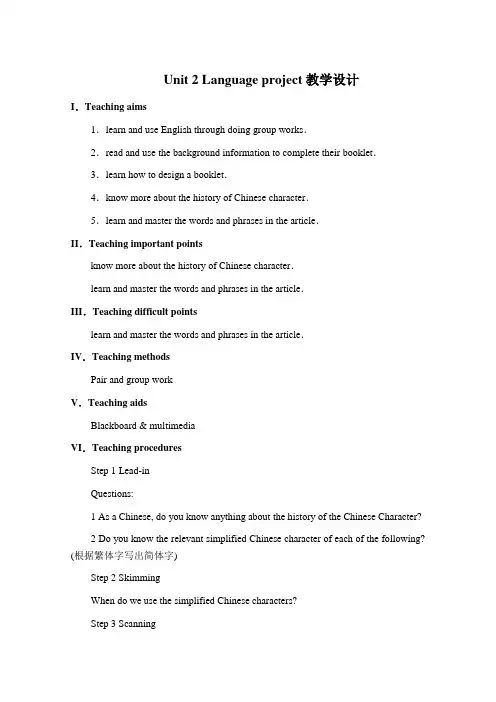
Unit 2 Language project教学设计I.Teaching aims1.learn and use English through doing group works.2.read and use the background information to complete their booklet.3.learn how to design a booklet.4.know more about the history of Chinese character.5.learn and master the words and phrases in the article.II.Teaching important pointsknow more about the history of Chinese character.learn and master the words and phrases in the article.III.Teaching difficult pointslearn and master the words and phrases in the article.IV.Teaching methodsPair and group workV.Teaching aidsBlackboard & multimediaVI.Teaching proceduresStep 1 Lead-inQuestions:1 As a Chinese, do you know anything about the history of the Chinese Character?2 Do you know the relevant simplified Chinese character of each of the following? (根据繁体字写出简体字)Step 2 SkimmingWhen do we use the simplified Chinese characters?Step 3 Scanning1.Why did Chinese people invent numerous characters?We invented characters to represent ideas, objects or actions.2.According to the legend, who invented Chinese characters? How did he get the idea?3.How did we combine two or more elements to express ideas? Can you give us an example?4.What characters are called pictophonetic ones?Step 4 Main idea of each partStep5 ConsolidationHave the group work and give more examples of how Chinese characters were formed.Guess what kind of characters they are.Step 6 Designing a bookletPlanningPreparingProducingPresenting。
牛津译林版高中英语必修三《Unit2 Language》 Reading 教学设计 1
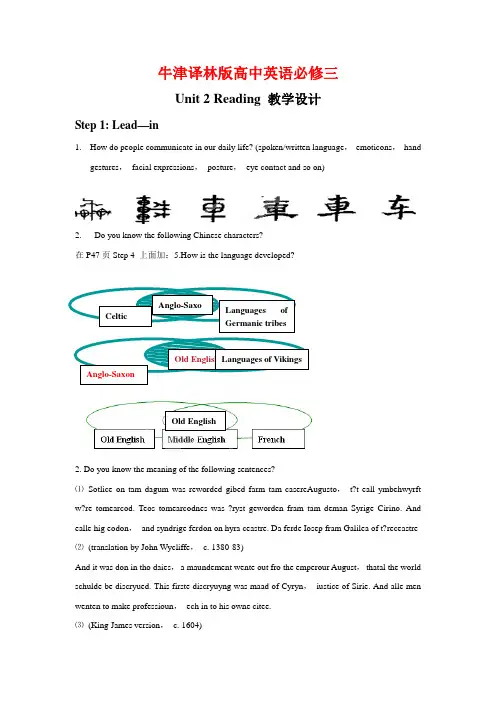
牛津译林版高中英语必修三Unit 2 Reading 教学设计Step 1: Lead —in1. How do people communicate in our daily life? (spoken/written language , emoticons , hand gestures , facial expressions , posture , eye contact and so on)2. Do you know the following Chinese characters?在P47页Step 4 上面加:5.How is the language developed?2. Do you know the meaning of the following sentences?⑴ Sotlice on tam dagum was reworded gibed farm tam casereAugusto , t?t eall ymbehwyrft w?re tomearcod. Teos tomearcodnes was ?ryst geworden fram tam deman Syrige Cirino. And ealle hig eodon , and syndrige ferdon on hyra ceastre. Da ferde Iosep fram Galilea of t?receastre ⑵ (translation by John Wycliffe , c. 1380-83)And it was don in tho daies , a maundement wente out fro the emperour August , thatal the world schulde be discryued. This firste discryuyng was maad of Cyryn , iustice of Sirie. And alle men wenten to make professioun , ech in to his owne citee.⑶ (King James version , c. 1604)Anglo-Saxon Old English Anglo-SaxoLanguages of VikingsOld EnglishCelticLanguages of Germanic tribesAnd it came to passe in those dayes,that there went out a decree from Cesar Augustus,that all the world should be taxed. (And this taxing was first made when Cyrenius was gouernor of Syria) And all went to bee taxed,euery one into his owne citie.Yes,the first passage comes from an old English article. The second one is a Middle English article. And the third one comes from a Modern English article.3. Let’s discuss the following questions:Since you have learnt English for several years,what do you know about the development or history of the English language?What do you think is the most difficult part of studying English —pronunciation,grammar,vocabulary or something else?Do you think English has always stayed the same?How did these changes happen?Step 2: Fast reading for general ideasLet’s skim the passage and try to find answers to these questions:1) What is the article about? (English and its history)2) What are the three kinds of English discussed in the article? (Old English,Middle English and Modern English)3) Is English still changing? (Yes)Step 3: Detailed reading for important information1. Let’s reread the article and complete Parts C1 and C2 individually to check your reading comprehension and to test your analytical thinking skills.AnswersC1 1. They came from the European mainland.2. Because each word or phrase came from a different language.3. It was replaced by the French way of making plurals.4. King Henry Ⅳ.5. During the Renaissance in the 16th century.C2 1. 5th century 2. Celtic 3. European 4. Angles5. French6. 10667. 10th century2. Let’s focus on the dates and years in the article,because they are very important when readinga history article. And fill in the table below.Time EventsBefore the middle of the 5th century People in Britain all spoke a language called Celtic.At the end of the 9th century The Vikings invaded Britain and brought their languages. By the 10th century Old English was the official language of England.In 1066 The Normans conquered England and took control of thecountry.By the latter half of the 14thcenturyEnglish was adopted by all classes in England.In 1399 Henry Ⅳbecame King of England and used English forall official occasions.During the Renaissance in the 16thcenturyModern English began.3. Please complete Parts D1 and D2 individually and then we’ll check the answers as a class. AnswersD1 1. e 2. f 3. a 4. d 5. c 6. bD2 beef mutton pork/bacon4. Part E is a summary of the article,which will help you become more familiar with the usage of words and expressions in the reading passage. Complete it individually and then we’ll check the answers as a class.AnswersE (1) dialects (2) consisted of (3) mixed (4) official(5) vocabulary (6) meat (7) servants (8) mother tongueStep 4: Post-reading activities1.Let’s hold a mini press conference in groups of four,suppose one is a linguistic expert coming to our school,making a brief introduction about the development of the English language and theyour answers to the class.3. Let’s read the article in Part B on page 103 in the workbook.AnswersPart B (page 103)1 In the 17th and 18th centuries,there were three wars between the British and the Dutch,and Dutch became a bad word.2 It’s not a good thing to take French leave because it means you are not present or leave somewhere without permission,like not being in class when you should be.3 No. It was Shakespeare who made his expression well known but it had appeared hundreds of years before he wrote the play Julius Caesar.4 Double Dutch,it’s all Greek to me,and Chinese puzzles have similar meaning. They can all be used to say you do not understand or know something.5 Because they have been part of the English language for hundreds of years,and you still hear them used in conversations today.4. Let’s do Parts A1 and A2 on page 98 in Workbook,so we will be more familiar with the text and the usage of some useful important words and phrases in this part.AnswersPart A1 (page 98)1. a sure b certain/sure2. a raised b risen3. an in the future b in futurePart A2 (page 98)1. confusing2. consists of3. created4. plus5. take control of6. mother tongue7. replacing8. dialects9. Throughout 10. ending。
【牛津译林版】高中英语必修3 Unit2 Language Reading教学设计1
单元:Unit 2 Language板块:Reading课堂设计指导思想:本节课是以理解文本为主,侧重听、说、读技能训练的阅读课。
英语的阅读是学生发展英语技能的主阵地,在整个单元的教学程序中具有极为重要的作用。
本教学设计涉及课文阅读的第一课时,以文本为依托,围绕文本理解展开了一系列的活动,主要目的就是要帮助学生多层次地理解文本内容,同时操练多项语言技能,拓展知识,提高能力。
在活动的设计上,依照了Top-down, Bottom-up, top-down交替螺旋式上升的模式,以文本为基础实现阅读的深入理解。
Teaching aims:1.Get t o know more about the development of the English language.2.Get further understanding of the text and be able to retell some importantelements in the development of English.3.Practice more skills in reading a history article.Teaching procedures:Step 1 Warm-upThe teacher starts the lesson with a free talk. Ask the students “How long have you been learning English? What have you learned?”Tell students that they will learn a passage dealing with English and its history. 【设计说明】通过看似随意的对话,教师对学生已有知识加以激活,同时,为阅读文章主题的导入和进一步的阅读做好铺垫。
Step 2 SkimmingStudents are allowed several minutes to skim the text. Their skimming is based on the task of questions on page 22 concerning the gen eral idea of the text.【设计说明】通过基于问题任务的快速文本浏览,掌握文本的主体大意,为进一步阅读建立框架。
2020-2021学年牛津译林版(2020)高中英语必修第三册 Unit2 skills1教学设计
Book 3 Unit 2 Natural disastersIntegrated skills 1Continuing a story about a flood一、教学目标By the end of the section, students will be able to:1. obtain the information about floods and flood safety tips;2. analyse the typical features of a story about a family caught in a flood;3. predict what would happen to a family caught in a flood.二、教学重难点1. To internalize the information about floods and flood safety tips;2. To predict what would happen to a family caught in a flood.三、教学过程步骤教学活动设计意图互动时间/模式Lead-inStep 1 The teacher introduces the lesson by showing students pictures and asking themquestions at random.•What can you see in the pictures?•What happens during the flood?•What do you know about floods?•When will floods happen?•What damage may floods cause?The t eacher draws students’ attention tothe topic of “floods” and activatesstudents’ knowledge of floods.Students gain some idea of floods and导入话题,通过自由发言,激发学生的学习兴趣,激活学生已有的相关知识和经验,让学生有话可说,有话能说。
【牛津译林版】高中英语必修3 Unit2 Language Reading教学设计2
单元:Unit 2 Language板块:Reading课堂设计指导思想:本课时为Reading理解过后的第二课时,着重于语言知识的讲授,即我们常说的语言点课。
语言点的讲解容易陷入枯燥的泥淖,要上得生动需要艺术。
而且,语言点的讲解宜精不宜多,宜多练优于多讲,因为了一旦内容过多,学生就会生吞活剥、囫囵吞枣无法消化;如果讲得过多,学生没有机会操练、体会、巩固,就不可能真正地理解掌握;因此,不如精选精练,扎扎实实。
本着这样的设想,本节课的设计为语言点课安排了一个课时,选择了课文中出现的十二个语言点,逐一讲解,在句子层面进行多方位练习,并在此基础上要求学生在课后将所学知识运用到语篇的写作中。
Teaching aims:1.Do some revision of what have been learned in the last lesson.2.Acquire the usage of the language items in the text.3.Apply the language items into practical use.Teaching procedures:Step 1 RevisionThe teacher starts the lesson with a short revision of what have been learned in the previous lessons. This part consists of two activities—to match the words and their definitions and to fill in the blanks.【设计说明】在课的一开始,设计了复习环节,优势有二:第一,帮助教师检查学生对之前学习内容的掌握,有利于教师及时了解教学对象的学习情况,了解教学的效果,在必要情况下,及时调整教学内容和进度,从而更好地为教学对象服务,以实现教学效果的提高;第二,传递有效学习策略的相关信息:复习是学习过程的一个重要环节,教师如果能常常有意设计复习活动,提高学生及时复习的意识,培养他们良好的学习习惯,这将会让学生终身受益。
最新牛津译林版高中英语必修三unit 2《language》period 2教案.doc
模块3 unit. 2 Period two 教案 (2)Unit 2 LanguageWord power课堂设计指导思想:“Word power”是新教材中出现的一个新板块,它旨在科学地、有效地、有趣地扩充学生的词汇量。
“Word power”在设计上采用了与本单元主题相照应的思路,内容上不受课后词汇表的限制,期冀在同一语意场中通过语境的辅助以及构词法等相关知识的输入实现学生词汇的扩展。
本节课是以听、说、读为主的词汇教学课。
词汇教学应当“有层次”并兼顾“知、情、意”。
首先,“有层次”是指词汇教学应努力遵循认知规律,按照学生温故知新——探索新知识——使用新知识——巩固新知识的客观规律进行教学。
其次,兼顾“知、情、意”是指词汇教学要有:知——词汇知识、学习策略以及词汇所蕴含的文化知识的输入;情——师生间的情感互动、学生的情感融入与兴趣的激发,以及情感体验的过程;意——人文精神和人生意义的体悟与提升。
Teaching aims:1.Get to know the names of some countries and their official languages;2.Learn the differences between formal and informal English;3.Get some background knowledge of related topics;4.To discuss the important ways that help to achieve better understandingbetween people from different cultures.Teaching procedures:Step 1 Lead-inThe teacher introduces the topic of the UN.Basic facts about the UN:Fact1: When was the United Nations founded?A clue: In the year 2005 the UN celebrated its 60th birthday. (backgroundknowledge)The students are supposed to get the answer: In 1945.Fact2: Why was it founded?Inform the students of the following aspects:The UN works on: ①peace and security ②human rights ③humanitarian affairs ④international law ⑤economic and social developmen tIn a word, it works on international affairs.Fact3: How was it organized?Show the students the diagram of the UN system.Point out three of them which the students might be familiar with: UNESCO, WHO, WTO.Introduce the 6 principal organs of the UN.Offer the students 2 websites where they can find more information about the UN.(Learning strategy: to help The students learn more by themse lves)Fact4: What about its members?Ask the students to read the paragraph on page27. (task-based reading) Task: Answer the following questions:① How many countries are members of the UN? (91)② Can you give me some examples of the member states? (China, France, etc.)③ How many languages are spoken in the world today? (About 6000)Check the answers and give more information.【设计说明】结合课文中的信息,为学生了解联合国提供了一系列的背景知识:联合国建立的时期、目的、组成、以及成员国和使用语言等等。