
2020年新高考全国卷Ⅰ英语高考试题文档版(山东)(含答案)
绝密★启用前2020年普通高等学校招生全国统一考试英语注意事项:1. 答卷前,考生务必将自己的姓名、准考证号填写在答题卡上。
2. 回答选择题时,选出每小题答案后,用铅笔把答题卡上对应题目的答案标号涂黑。
如需改动,用橡皮擦干净后, 再选涂其他答案标号。
回答非选择题时,将答案写在答题卡上,写在本试卷上无效。
3. 考试结束后,将本试卷和答题卡一并交回。
第一部分阅读(共两节, 满分50分)第一节(共15小题;每小题2.5分, 满分37.5分)阅读下列短文,从每题所给的A、B、C、D四个选项中选出最佳选项。
APOETRY CHALLENGEWrite a poem about how courage, determination, and strength have helped you face challenges in your life.Prizes3 Grand Prizes:Trip to Washington, D.C. for each of three winners, a parent and one other person of the winner’s choice. Trip includes round-trip air tickets, hotel stay for two nights, and tours of the National Air and Space Museum and the office of National Geographic World.6 First Prizes:The book Sky Pioneer:A Photobiography of Amelia Earhart signed by author Corinne Szabo and pilot Linda Finch.50 Honorable Mentions:Judges will choose up to 50 honorable mention winners, who will each receive a T-shirt in memory of Earhart’s final flight.RulesFollow all rules carefully to prevent disqualification.■Write a p oem using 100 words or fewer. Your poem can be any format, any number of lines.■Write by hand or type on a single sheet of paper. You may use both the front and back of the paper.■On the same sheet of paper, write or type your name, address, telephone number, and birth date.■Mail your entry to us by October 31 this year.1. How many people can each grand prize winner take on the free trip?A. Two.B. Three.C. Four.D. Six.2. What will each of the honorable mention winners get?A. A plane ticket.B. A book by Corinne Szabo.C. A special T-shirt.D. A photo of Amelia Earhart.3. Which of the following will result in disqualification?A. Typing your poem out.B. Writing a poem of 120 words.C. Using both sides of the paper.D. Mailing your entry on October 30.BJenifer Mauer has needed more willpower than the typical college student to pursue her goal of earning a nursing degree. That willpower bore fruit when Jennifer graduated from University of Wisconsin-Eau Claire and became the first in her large family to earn a bachelor’s degree.Mauer, of Edgar, Wisconsin, grew up on a farm in a family of 10 children. Her dad worked at a job away from the farm, and her mother ran the farm with the kids. After high school, Jennifer attended a local technical college, working to pay her tuition(学费), because there was no extra money set aside for a college education. After graduation, she worked to help her sisters and brothers pay for their schooling.Jennifer now is married and has three children of her own. She decided to go back to college to advance her career and to be able to better support her family while doing something she loves: nursing. She chose the UW-Eau Claire program at Ministry Saint Joseph’s Hospital in Marshfield because she was able to pursue her four-year degree close to home. She could drive to class and be home in the evening to help with her kids. Jennifer received great support from her family as she worked to earn her degree: Her husband worked two jobs to cover the bills, and her 68-year-old mother helped take care of the children at times.Through it all, she remained in good academic standing and graduated with honors. Jennifer sacrificed(牺牲)to achieve her goal, giving up many nights with her kids and missing important events to study. “Some nights my heart was breaking to have to pick between my kids and studying for exams or papers,” she says. However, her children have learned an important lesson witnessing their mother earn her degree. Jennifer is a first-generation graduate and an inspiration to her family — and that’s pretty powerful.4. What did Jennifer do after high school?A. She helped her dad with his work.B. She ran the family farm on her own.C. She supported herself through college.D. She taught her sisters and brothers at home.5. Why did Jennifer choose the program at Ministry Saint Joseph’s Hospital in Marshfield?A. To take care of her kids easily.B. To learn from the best nurses.C. To save money for her parents.D. To find a well-paid job there.6. What did Jennifer sacrifice to achieve her goal?A. Her health.B. Her time with family.C. Her reputation.D. Her chance of promotion.7. What can we learn from Jenifer’s story?A. Time is money.B. Love breaks down barriers.C. Hard work pays off.D. Education is the key to success.CIn the mid-1990s, Tom Bissell taught English as a volunteer in Uzbekistan. He left after seven months, physically broken and having lost his mind. A few years later, still attracted to the country, he returned to Uzbekistan to write an article about the disappearance of the Aral Sea.His visit, however, ended up involving a lot more than that. Hence this book, Chasing the Sea: Lost Among the Ghosts of Empire in Central Asia, which talks about a road trip from Tashkent to Karakalpakstan, where millions of lives have been destroyed by the slow drying up of the sea. It is the story of an American travelling to a strange land, and of the people he meets on his way: Rustam, his translator, a lovely 24-year-old who picked up his colorful English in California, Oleg and Natasha, his hosts in Tashkent, and a string of foreign aid workers.This is a quick look at life in Uzbekistan, made of friendliness and warmth, but also its darker side of society. In Samarkand, Mr Bissell admires the architectural wonders, while on his way to Bukhara he gets a taste of police methods when suspected of drug dealing. In Ferghana, he attends a mountain funeral(葬礼)followed by a strange drinking party. And in Karakalpakstan, he is saddened by the dust storms, diseases and fishing boats stuck miles from the sea.Mr Bissell skillfully organizes historical insights and cultural references, making his tale a well-rounded picture of Uzbekistan, seen from Western eyes. His judgment and references are decidedly American, as well as his delicate stomach. As the author explains, this is neither a travel nor a history book, or even a piece of reportage. Whatever it is, the result is a fine and vivid description of the purest of Central Asian traditions.8. What made Mr Bissell return to Uzbekistan?A. His friends’ invitation.B. His interest in the country.C. His love for teaching.D. His desire to regain health.9. What does the underlined word “that” in paragraph 2 refer to?A. Developing a serious mental disease.B. Taking a guided tour in Central Asia.C. Working as a volunteer in Uzbekistan.D. Writing an article about the Aral Sea.10. Which of the following best describes Mr Bissell’s road trip in Uzbekistan?A. Romantic.B. Eventful.C. Pleasant.D. Dangerous.11. What is the purpose of this text?A. To introduce a book.B. To explain a cultural phenomenon.C. To remember a writer.D. To recommend a travel destination.DAccording to a recent study in the Journal of Consumer Research, both the size and consumption habits of our eating companions can influence our food intake. And contrary to existing research that says you should avoid eating with heavier people who order large portions(份), it’s the beanpoles with big appetites you really need to avoid.To test the effect of social influence on eating habits, the researchers conducted two experiments. In the first, 95 undergraduate women were individually invited into a lab to ostensibly(表面上)participate in a study about movie viewership. Before the film began, each woman was asked to help herself to a snack. An actor hired by the researchers grabbed her food first. In her natural state, the actor weighed 105 pounds. But in half the cases she wore a specially designed fat suit which increased her weight to 180 pounds.Both the fat and thin versions of the actor took a large amount of food. The participants followed suit, taking more food than they normally would have. However, they took significantly more when the actor was thin.For the second test, in one case the thin actor took two pieces of candy from the snack bowls. In the other case, she took 30 pieces. The results were similar to the first test: the participants followed suit but took significantly more candy when the thin actor took 30 pieces.The tests show that the social environment is extremely influential when we’re making decisions. If this fellow participant is going to eat more, so will I. Call it the “I’ll have what she’s having” effect. However, we’ll adjust the influence. If an overweight person is having a large portion, I’ll hold back a bit because I see the results of his eating habits. But if a thin person eats a lot, I’ll follow suit. If he can eat much and keep slim, why can’t I?12. What is the recent study mainly about?A. Food safety.B. Movie viewership.C. Consumer demand.D. Eating behavior.13. What does the underlined word "beanpoles" in paragraph 1 refer to?A. Big eaters.B. Overweight persons.C. Picky eaters.D. Tall thin persons.14. Why did the researchers hire the actor?A. To see how she would affect the participants.B. To test if the participants could recognize her.C. To find out what she would do in the two tests.D. To study why she could keep her weight down.15. On what basis do we "adjust the influence" according to the last paragraph?A. How hungry we are.B. How slim we want to be.C. How we perceive others.D. How we feel about the food.第二节(共5小题:每小题2. 5分, 满分12. 5分)阅读下面短文, 从短文后的选项中选出可以填入空白处的最佳选项。
2020高考英语阅读理解七选五试题及答案解析
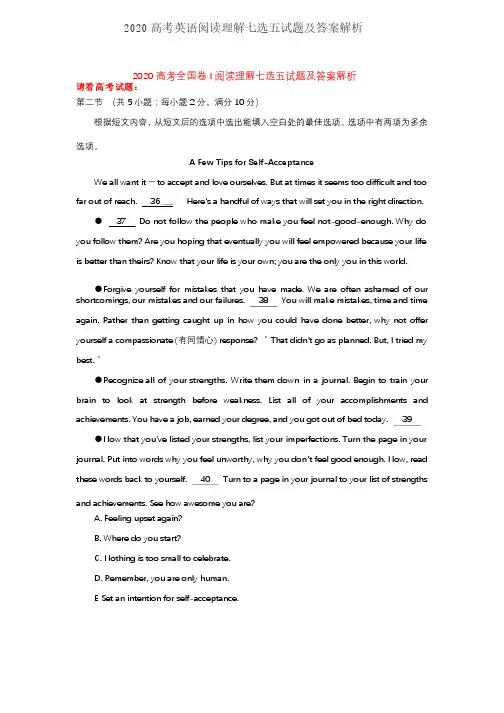
2020高考英语阅读理解七选五试题及答案解析2020高考全国卷I 阅读理解七选五试题及答案解析请看高考试题: 第二节 (共5小题;每小题2分,满分10分)根据短文内容,从短文后的选项中选出能填入空白处的最佳选项。
选项中有两项为多余选项。
A Few Tips for Self-AcceptanceWe all want it We all want it …… to accept and love ourselves. But at times it seems too difficult and too far out of reach. 36 ___Here Here’’s a handful of ways that will set you in the right direction. ● 37Do not follow the people who make you feel not-good-enough. Why do you follow them? Are you hoping that eventually you will feel empowered because your life is better than theirs? Know that your life is your own; you are the only you in this world.●Forgive yourself for mistakes that you have made. We are often ashamed of our shortcomings, our mistakes and our failures. 38You will make mistakes, time and time again. Rather than getting caught up in how you could have done better, why not offer yourself a compassionate (yourself a compassionate (有同情心有同情心有同情心) response? ) response? "That didn That didn’’t go as planned. But, I tried my best.best.""●Recognize all of your strengths. Write them down in a journal. Begin to train your brain to look at strength before weakness. List all of your accomplishments and achievements. You have a job, earned your degree, and you got out of bed today. 39●Now that you Now that you’’ve listed your strengths, list your imperfections. Turn the page in your journal. Put into words why you feel unworthy, why you don journal. Put into words why you feel unworthy, why you don’’t feel good enough. Now, read these words back to yourself. 40Turn to a page in your journal to your list of strengths and achievements. See how awesome you are?A. Feeling upset again?B. Where do you start?C. Nothing is too small to celebrate.D. Remember, you are only human.E Set an intention for self-acceptance.F. Stop comparing yourself with others.G. When does the comparison game start?请看答案及解析:本文是一篇说明文,语篇选材以“自我接纳”为主题,引导考生积极进行自我对话,关注青少年心理健康,体现了以人为本的价值理念。
专题10 全国新高考及地方卷试题语法填空(原卷版)
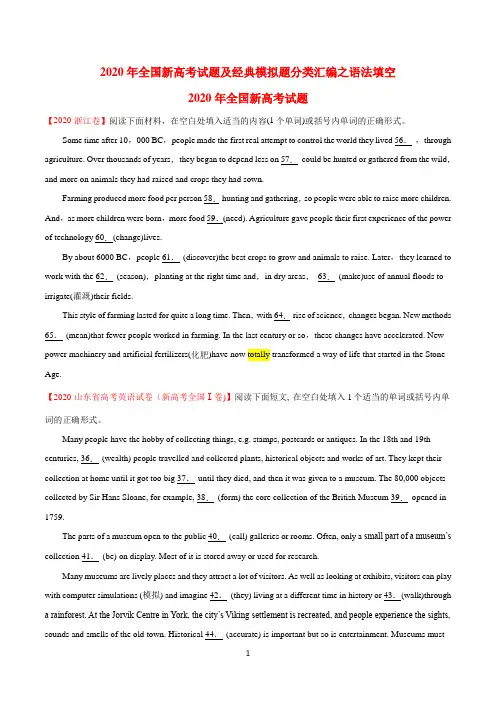
2020年全国新高考试题及经典模拟题分类汇编之语法填空2020年全国新高考试题【2020·浙江卷】阅读下面材料,在空白处填入适当的内容(1个单词)或括号内单词的正确形式。
Some time after 10,000 BC,people made the first real attempt to control the world they lived 56.,through agriculture. Over thousands of years,they began to depend less on 57.could be hunted or gathered from the wild,and more on animals they had raised and crops they had sown.Farming produced more food per person 58.hunting and gathering,so people were able to raise more children. And,as more children were born,more food 59.(need). Agriculture gave people their first experience of the power of technology 60.(change)lives.By about 6000 BC,people 61.(discover)the best crops to grow and animals to raise. Later,they learned to work with the 62.(season),planting at the right time and,in dry areas,63.(make)use of annual floods to irrigate(灌溉)their fields.This style of farming lasted for quite a long time. Then,with 64.rise of science,changes began. New methods 65.(mean)that fewer people worked in farming. In the last century or so,these changes have accelerated. New power machinery and artificial fertilizers(化肥)have now totally transformed a way of life that started in the Stone Age.【2020·山东省高考英语试卷(新高考全国Ⅰ卷)】阅读下面短文, 在空白处填入1个适当的单词或括号内单词的正确形式。
(精校版)2022年新高考全国Ⅰ卷英语高考真题文档版(原卷)(含答案)

2022年普通高等学校招生全国统一考试(新高考全国Ⅰ卷)英语本试卷共10页,满分120分。
考试用时120分钟。
注意事项:1. 答卷前,考生务必用黑色字迹钢笔或签字笔将自己的姓名、考生号、考场号和座位号填写在答题卡上。
用2B铅笔将试卷类型(A)填涂在答题卡相应位置上。
将条形码横贴在答题卡右上角“条形码粘贴处”。
因笔试不考听力,选择题从第二部分的“阅读”开始,试题序号从“21”开始。
2. 作答选择题时,选出每小题答案后,用2B铅笔把答题卡上对应题目选项的答案信息点涂黑;如需改动,用橡皮擦干净后,再选涂其他答案,答案不能答在试卷上。
3. 非选择题必须用黑色字迹钢笔或签字笔作答,答案必须写在答题卡各题目指定区域内相应位置上;如需改动,先划掉原来的答案,然后再写上新的答案;不准使用铅笔和涂改液,不按以上要求作答的答案无效。
4. 考生必须保持答题卡的整洁:考试结束后,将试卷和答题卡一并交回。
第二部分阅读(共两节,满分50分)第一节(共15小题;每小题2.5分,满分37.5分)阅读下列短文,从每题所给的A、B、C、D四个选项中选出最佳选项。
AGrading Policies for Introduction to LiteratureGrading Scale90-100, A; 80-89, B; 70-79, C; 60-69, D; Below 60, E.Essays(60%)Your four major essays will combine to form the main part of the grade for this course: Essay 1 =10%; Essay 2=15%; Essay 3=15%; Essay 4=20%Group Assignments(30%)Students will work in groups to complete four assignments(作业)during the course. All the assignments will be submitted by the assigned date through Blackboard, our online learning and course management system.Daily Work/In-Class Writings and Tests/Group Work/Homework(10%)Class activities will vary from day to day, but students must be ready to complete short in-class writings or tests drawn directly from assigned readings or notes from the previous class' lecture/discussion, so it is important to take careful notes during class. Additionally, from time to time I will assign group work to be completed in class or short assignments to be completed at home, both of which will be graded.Late WorkAn essay not submitted in class on the due date will lose a letter grade for each class period it is late. If it is not turned in by the 4th day after the due date, it will earn a zero. Daily assignments not completed during class will get a zero. Short writings missed as a result of an excused absence will be accepted.21. Where is this text probably taken from?A. A textbook.B. An exam paper.C. A course plan.D. An academic article.22. How many parts is a student's final grade made up of?A. Two.B. Three.C. Four.D. Five.23. What will happen if you submit an essay one week after the due date?A. You will receive a zero.B. You will lose a letter grade.C. You will be given a test.D. You will have to rewrite it.BLike most of us, I try to be mindful of food that goes to waste. The arugula(芝麻菜)was to make a nice green salad, rounding out a roast chicken dinner. But I ended up working late. Then friends called with a dinner invitation. I stuck the chicken in the freezer. But as days passed, the arugula went bad. Even worse, I had unthinkingly bought way too much; I could have made six salads with what I threw out.In a world where nearly 800 million people a year go hungry, "food waste goes against the moral grain," as Elizabeth Royte writes in this month's cover story. It's jaw-dropping how much perfectly good food is thrown away—from “ugly"(but quite eatable)vegetables rejected by grocers to large amounts of uneaten dishes thrown into restaurant garbage cans.Producing food that no one eats wastes the water, fuel, and other resources used to grow it. That makes food waste an environmental problem. In fact, Royte writes, "if food waste were a country, it would be the third largest producer of greenhouse gases in the world."If that's hard to understand, let's keep it as simple as the arugula at the back of my refrigerator. Mike Curtin sees my arugula story all the time —but for him, it's more like 12 bones of donated strawberries nearing their last days. Curtin is CEO of DC Central Kitchen in Washington, D.C., which recovers food and turns it into healthy meals. Last year it recovered more than 807,500 pounds of food by taking donations and collecting blemished(有瑕疵的)produce that otherwise would have rotted in fields. And the strawberries? V olunteers will wash, cut, and freeze or dry them for use in meals down the road.Such methods seem obvious, yet so often we just don't think. "Everyone can play a part in reducing waste, whether by not purchasing more food than necessary in your weekly shopping or by asking restaurants to not include the side dish you won't eat," Curtin says.24. What does the author want to show by telling the arugula story?A. We pay little attention to food waste.B. We waste food unintentionally at times.C. We waste more vegetables than meat.D. We have good reasons for wasting food.25. What is a consequence of food waste according to the text?A. Moral decline.B. Environmental harm.C. Energy shortage.D. Worldwide starvation.26. What does Curtin's company do?A. It produces kitchen equipment.B. It turns rotten arugula into clean fuel.C. It helps local farmers grow fruitsD. It makes meals out of unwanted food.27. What does Curtin suggest people do?A. Buy only what is needed.B. Reduce food consumption.C. Go shopping once a week.D. Eat in restaurants less often.CThe elderly residents(居民)in care homes in London are being given hens to look after to stop them feeling lonely.The project was dreamed up by a local charity(慈善组织)to reduce loneliness and improve elderly people's wellbeing, It is also being used to help patients suffering dementia, a serious illness of the mind. Staff in care homes have reported a reduction in the use of medicine where hens are in use.Among those taking part in the project is 80-year-old Ruth Xavier. She said: “I used to keep hens when I was younger and had to prepare their breakfast each morning before I went to school."I like the project a lot. I am down there in my wheelchair in the morning letting the hens outand down there again at night to see they've gone to bed."It's good to have a different focus. People have been bringing their children in to see the hens and residents come and sit outside to watch them. I'm enjoying the creative activities, and it feels great to have done something useful."There are now 700 elderly people looking after hens in 20 care homes in the North East, and the charity has been given financial support to roll it out countrywide.Wendy Wilson, extra care manager at 60 Penfold Street, one of the first to embark on the project, said: "Residents really welcome the idea of the project and the creative sessions. We are looking forward to the benefits and fun the project can bring to people here."Lynn Lewis, director of Notting Hill Pathways, said: "We are happy to be taking part in the project. It will really help connect our residents through a shared interest and creative activities."28. What is the purpose of the project?A. To ensure harmony in care homes.B. To provide part-time jobs for the aged.C. To raise money for medical research.D. To promote the elderly people's welfare.29. How has the project affected Ruth Xavier?A. She has learned new life skills.B. She has gained a sense of achievement.C. She has recovered her memory.D. She has developed a strong personality.30. What do the underlined words "embark on" mean in paragraph 7?A. Improve.B. Oppose.C. Begin.D. Evaluate.31. What can we learn about the project from the last two paragraphs?A. It is well received.B. It needs to be more creative.C. It is highly profitable.D. It takes ages to see the results.DHuman speech contains more than 2,000 different sounds, from the common "m" and "a" to the rare clicks of some southern African languages. But why are certain sounds more common than others? A ground-breaking, five-year study shows that diet-related changes in human bite led to new speech sounds that are now found in half the world's languages.More than 30 years ago, the scholar Charles Hockett noted that speech sounds called labiodentals, such as "f" and "v", were more common in the languages of societies that ate softer foods. Now a team of researchers led by Damián Blasi at the University of Zurich, Switzerland, has found how and why this trend arose.They discovered that the upper and lower front teeth of ancient human adults were aligned(对齐), making it hard to produce labiodentals, which are formed by touching the lower lip to the upper teeth. Later, our jaws changed to an overbite structure(结构), making it easier to produce such sounds.The team showed that this change in bite was connected with the development of agriculture in the Neolithic period. Food became easier to chew at this point. The jawbone didn't have to do as much work and so didn't grow to be so large.Analyses of a language database also confirmed that there was a global change in the sound of world languages after the Neolithic age, with the use of "f" and "v" increasing remarkably during the last few thousand years. These sounds are still not found in the languages of many hunter-gatherer people today.This research overturns the popular view that all human speech sounds were present when human beings evolved around 300,000 years ago. "The set of speech sounds we use has not necessarily remained stable since the appearance of human beings, but rather the huge variety of speech sounds that we find today is the product of a complex interplay of things like biological change and cultural evolution," said Steven Moran, a member of the research team.32. Which aspect of the human speech sound does Damián Blasi's research focus on?A. Its variety.B. Its distribution.C. Its quantity.D. Its development.33. Why was it difficult for ancient human adults to produce labiodentals?A. They had fewer upper teeth than lower teeth.B. They could not open and close their lips easily.C. Their jaws were not conveniently structured.D. Their lower front teeth were not large enough.34. What is paragraph 5 mainly about?A. Supporting evidence for the research results.B. Potential application of the research findings.C. A further explanation of the research methods.D. A reasonable doubt about the research process.35. What does Steven Moran say about the set of human speech sounds?A. It is key to effective communication.B. It contributes much to cultural diversity.C. It is a complex and dynamic system.D. It drives the evolution of human beings.第二节(共5小题;每小题2.5分,满分12.5分)阅读下面短文,从短文后的选项中选出可以填入空白处的最佳选项。
2020年高考全国Ⅰ卷英语试题听力部分(含听力音频、听力原文和答案)

绝密★启用前2020年普通高等学校招生全国统一考试英语听力部分2020年高考全国I卷英语听力音频 双击图标收听.mp3(请用电脑,双击上面图标,打开收听)第一部分听力(共两节,满分30分)做题时,先将答案标在试卷上。
录音内容结束后,你将有两分钟的时间将试卷上的答案转涂到答题卡上。
第一节(共5小题;每小题1.5分,满分7.5分)听下面5段对话。
每段对话后有一个小题,从题中所给的A、B、C三个选项中选出最佳选项。
听完每段对话后,你都有10秒钟的时间来回答有关小题和阅读下一小题。
每段对话仅读一遍。
例:How much is the shirt?A. £19.15.B. £9.18.C. £9.15.答案是C。
1. Where does the conversation probably take place?A. In a supermarket.B. In the post office.C. In the street.2. What did Carl do?A. He designed a medal.B. He fixed a TV set.C. He took a test.3. What does the man do?A. He’s a tailor.B. He’s a waiter.C. He’s a shop assistant.4. When will the flight arrive?A. At 18:20.B. At 18:35.C. At 18:50.5. How can the man improve his article?A. By deleting unnecessary words.B. By adding a couple of points.C. By correcting grammar mistakes.第二节(共15小题;每小题1.5分,满分22.5分)听下面5段对话或独白。
2020年新高考全国Ⅰ卷英语高考试题文档版(word版含答案)
绝密★启用前2020年普通高等学校招生全国统一考试英语试卷注意事项:1.答卷前,考生务必将自己的姓名、准考证号填写在答题卡上。
2.冋答选择题时,选出每小题答案后,用铅笔把答题卡上对应题目的答案标号涂黑。
如需改动,用橡皮擦干净后,再选涂其他答案标号。
冋答非选择题时,将答案写在答题卡上,写在本试卷上无效。
3.考试结束后,将本试卷和答题卡一并交冋。
第一部分阅读(共两节,满分50分)第一节(共15小题;每小题2.5分,满分37.5分)阅读下列短文,从每题所给的A、B、C、D四个选项中选出最佳选项。
APOETRY CHALLENGEWrite a poem about how courage, determination, and strength have helped you face challenges in your life.Prizes3 Grand Prizes: Trip to Washington, D.C. For each of three winners, a parent and one other person of the winner's choice. Trip includes round-trip air tickets, hotel stay for two nights, and tours of the National Air and Space Museum and the office of National Geographic World.6 First Prizes: The book Sky Pioneer: A Photobiography of Amelia Earhart signed by author Corinne Szabo and pilot Linda Finch.50 Honorable Mentions: Judges will choose up to 50 honorable mention winners, who will each receive a T-shirt in memory of Earhart's final flight.RulesFollow all rules carefully to prevent disqualification.■ Write a poem using 100 words or fewer. Your poem can be any format, any number of lines.■Write by hand or type on a single sheet of paper. You may use both the front and back of the paper.■On the same sheet of paper, write or type your name, address, telephone number, and birth date.■Mail your entry to us by October 31 this year.1.How many people can each grand prize winner take on the free trip?A.Two.B. Three.C. Four.D. Six.2.What will each of the honorable mention winners get?A.A plane ticket.B. A book by Corinne Szabo.C. A special T-shirt.D. A photo of Amelia Earhart.3.Which of the following will result in disqualification?A.Typing your poem out.B. Writing a poem of 120 words.C. Using both sides of the paper.D. Mailing your entry on October 30.BJennifer Mauer has needed more willpower than the typical college student to pursue her goal of earning a nursing degree. That willpower bore fruit when Jennifer graduated from University of Wisconsin-Eau Claire and became the first in her large family to earn a bachelor's degree.Mauer, of Edgar. Wisconsin, grew up on a farm in a family of 10 children. Her dad worked at a job away from the farm, and her mother ran the farm with the kids. After high school, Jennifer attended a local technical college, working to pay her tuition (学费).because there was no extra money set aside for a college education. After graduation, she worked to help her sisters and brothers pay for their schooling.Jennifer now is married and has three children of her own. She decided to go back to college to advance her career and to be able to better support her family while doing something she loves: nursing. She chose the UW-Eau Claire program at Ministry Saint Joseph's Hospital in Marshfield because she was able to pursue her four-year degree close to home. She could drive to class and be home in the evening to help with her kids. Jennifer received great support from her family as she worked to earn her degree: Her husband worked two jobs to cover the bills, and her 68-year-old mother helped take care of the children at times.Through it all, she remained in good academic standing and graduated with honors. Jennifer sacrificed (牺牲)to achieve her goal, giving up many nights with her kids and missing importantevents to study. "Some nights my heart was breaking to have to pick between my kids and studying for exams or papers;' she says. However, her children have learned an important lesson witnessing their mother earn her degree. Jennifer is a first-generation graduate and an inspiration to her family - and that's pretty powerful.4.What did Jennifer do after high school?A.She helped her dad with his work.B.She ran the family farm on her own.C.She supported herself through college.D.She taught her sisters and brothers at home.5.Why did Jennifer choose the program at Ministry Saint Joseph's Hospital in Marshfield?A.To take care of her kids easily.B. To learn from the best nurses.C. To save money for her parents.D. To find a well-paid job there.6.What did Jennifer sacrifice to achieve her goal?A. Her health.B. Her time with family.C. Her reputation.D. Her chance of promotion.7.What can we learn from Jennifer’s story?A. Time is money.B. Love breaks down barriers.C. Hard work pays offD. Education is the key to success.CIn the mid-1990s, Tom Bissell taught English as a volunteer in Uzbekistan. He left after seven months, physically broken and having lost his mind. A few years later, still attracted to the country, he returned to Uzbekistan to write an article about the disappearance of the Aral Sea.His visit, however, ended up involving a lot more than that. Hence this book, Chasing the Sea: Lost Among the Ghosts of Empire in Central Asia, which talks about a road trip from Tashkent to Karakalpakstan, where millions of lives have been destroyed by the slow drying up of the sea. It is the story of an American travelling to a strange land, and of the people he meets on his way: Rustam, his translator, a lovely 24-year-old who picked up his colorful English in California, Oleg and Natasha, his hosts in Tashkent, and a string of foreign aid workers.This is a quick look at life in Uzbekistan, made of friendliness and warmth, but also its darkerside of society. In Samarkand. Mr Bissell admires the architectural wonders, while on his way to Bukhara he gets a taste of police methods when suspected of drug dealing. In Ferghana, he attends a mountain funeral (葬礼)followed by a strange drinking party. And in Karakalpakstan, he is saddened by the dust storms, diseases and fishing boats stuck miles from the sea.Mr Bissell skillfully organizes historical insights and cultural references, making his tale a well-rounded picture of Uzbekistan, seen from Western eyes. His judgment and references are decidedly American, as well as his delicate stomach. As the author explains, this is neither a travel nor a history book, or even a piece of reportage. Whatever it is, the result is a fine and vivid description of the purest of Central Asian traditions.8.What made Mr Bissell return to Uzbekistan?A. His friends, invitation.B. His interest in the country.C. His love for teaching.D. His desire to regain health.9.What does the underlined word "that” in paragraph 2 refer to?A.Developing a serious mental disease.B.Taking a guided tour in Central Asia.C.Working as a volunteer in Uzbekistan.D.Writing an article about the Aral Sea.10.Which of the following best describes Mr Bissell’s road trip in Uzbekistan?A. Romantic.B. Eventful.C.Pleasant.D. Dangerous.11.What is the purpose of this text?A. To introduce a book.B.To explain a cultural phenomenon.C. To remember a writer.D.To recommend a travel destination.DAccording to a recent study in the Journal of Consumer Research,both the size and consumption habits of our eating companions can influence our food intake. And contrary to existing research that says you should avoid eating with heavier people who order large portions (份).ifs the beanpoles with big appetites you really need to avoid.To test the effect of social influence on eating habits, the researchers conducted two experiments. In the first, 95 undergraduate women were individually invited into a lab to ostensibly (表面上)participate in a study about movie viewership. Before the film began, each woman wasasked to help herself to a snack. An actor hired by the researchers grabbed her food first. In her natural state, the actor weighed 105 pounds. But in half the cases she wore a specially designed fat suit which increased her weight to 180 pounds.Both the fat and thin versions of the actor took a large amount of food. The participants followed suit, taking more food than they normally would have. However, they took significantly more when the actor was thin.For the second test, in one case the thin actor took two pieces of candy from the snack bowls. In the other case, she took 30 pieces. The results were similar to the first test: the participants followed suit but took significantly more candy when the thin actor took 30 pieces.The tests show that the social environment is extremely influential when we're making decisions. If this fellow participant is going to eat more, so w ill I. Call it the “I’ll have what she's having'' effect. However, we'll adjust the influence. If an overweight person is having a large portion, Til hold back a bit because I see the results of his eating habits. But if a thin person eats a lot. I’ll follow suit. If he can eat much and keep slim, why can't I?12.What is the recent study mainly about?A. Food safety.B. Movie viewership.C.Consumer demand.D. Eating behavior.13.What does the underlined word “beanpoles" in paragraph 1 refer to?A. Big eaters.B. Overweight persons.C. Picky eaters.D. Tall thin persons.14.Why did the researchers hire the actor?A.To see how she would affect the participants.B.To test if the participants could recognize her.C.To find out what she would do in the two tests.D.To study why she could keep her weight down.15.On what basis do we "adjust the influence'' according to the last paragraph?A. How hungry we are.B. How slim we want to be.C. How we perceive others.D. How we feel about the food.第二节(共5小题;每小题2.5分,满分12.5分)阅读下面短文,从短文后的选项中选出可以壊入空白处的最佳选项。
2021年高考英语真题试题——新高考全国Ⅰ卷(word版-含答案与解析)

2021年全国普通高等学校招生统一考试全国新高考Ⅰ卷英语试卷第一部分听力(共两节, 满分30分)做题时, 先将答案标在试卷上。
录音内容结束后, 你将有两分钟的时间将试卷上的答案转涂到答题卡上。
第一节(共5小题;每小题1.5分, 满分7.5分)听下面5段对话。
每段对话后有一个小题, 从题中所给的A.B.C三个选项中选出最佳选项。
听完每段对话后, 你都有10秒钟的时间来回答有关小题和阅读下一小题。
每段对话仅读一遍。
例: How much is the shirt?A.£19.15.B.£9.18.C.£9.15.答案是C。
1.Why did the woman go to Mallorca?A.To teach Spanish.B.To look for a job.C.To see a friend.2.What does the man ask the woman to do?A.Take him to hospital.B.Go to a class with him.C.Submit a report for him.3.Who will look after the children?A.Jennifer.B.Suzy.C.Marie.4.What are the speakers going to do?A.Drive home.B.Go shopping.C.Eat out.5.What are the speakers talking about?A.How to fry fish.B.How to make coffee.C.How to remove a bad smell.第二节(共15小题;每小题1.5分, 满分22.5分)听下面5段对话或独白。
每段对话或独白后有几个小题, 从题中所给的A、B、C三个选项中选出最佳选项。
听每段对话或独白前, 你将有时间阅读各个小题, 每小题5秒钟;听完后, 各小题将给出5秒钟的作答时间。
高中英语 2020年全国卷Ⅰ英语高考试题文档版(含答案)
绝密★启用前2020年普通高等学校招生全国统一考试(全国卷I)第二部分阅读理解(共两节,满分40分)第一节(共15小题;每小题2分,满分30分)阅读下列短文,从每题所给的A、B、C和D四个选项中,选出最佳选项。
ATrain InformationAll customers travelling on TransLink services must be in possession of a valid ticket before boarding. For ticket information,please ask at your local station or call 13 12 30.While Queensland Rail makes every effort to ensure trains run as scheduled,there can be no guarantee of connections between trains or between train services and bus services.Lost property(失物招领)Call Lost Property on 13 16 17 during business hours for items lost on Queensland Rail services.The lost property office is open Monday to Friday 7:30am to 5:00pm and is located(位于)at Roma Street station.Public holidaysOn public holidays, generally a Sunday timetable operates. On certain major event days,i.e.Australia Day, Anzac Day, sporting and cultural days, special additional services may operate.Christmas Day services operate to a Christmas Day timetable,Before travel please visit translink. com. au or call TransLink on 13 12 30 anytime.Customers using mobility devicesMany stations have wheelchair access from the car park or entrance to the station platforms.For assistance, please Queensland Rail on 13 16 17.21. What would you do get ticker information?A. Call 13 16 17.B. Visit translink .com.au.C. Ask at the local station.D. Check the train schedule.22. At which station can you find the lost property office?A. Altandi.B. Roma Street.C. Varsity Lakes.D. Fortitude Valley.23. Which train would you take if you go from Central to Varsity Lakes?A.6:42 pm.B.7:29 pm.C.8:57 pm.D.11:02 pm.BReturning to a book you’ve read many times can feel like drinks with an old friend. There’s a welcome familiarity —but also sometimes a slight suspicion that time has changed you both, and thus the relationship. But books don’t change, people do. And that’s what makes the act of rereading so rich and transformative.The beauty of rereading lies in the idea that our bond with the work is based on our present mental regist er. It’s true, the older I get, the more I feel time has wings. But with reading, it’s all about the present. It’s about the now and what one contributes to the now, because reading is a give and take between author and reader. Each has to pull their own weight. There are three books I reread annually The first, which I take to reading every spring is Emest Hemningway’s A MoveableFeast. Published in 1964, it’s his classic memoir of 1920s Paris. The language is almost intoxicating (令人陶醉的),an aging writer looking back on an ambitious yet simpler time. Another is Annie Dillard’s Holy the Firm, her poetic 1975 ramble (随笔) about everything and nothing. The third book is Julio Cortazar’s Save Twilight: Selected Poems, because poetry. And because Cortazar.While I tend to buy a lot of books, these three were given to me as gifs, which might add to the meaning I attach to them. But I imagine that, while money is indeed wonderful and necessary, rereading an author’s work is the highest currency a reader can pay them. The best books are the ones that open further as time passes. But remember, it’s you that has to grow and read and reread in order to better understand your friends.24. Why does the author like rereading?A. It evaluates the writer-reader relationship.B. It’s a window to a whole new world.C. It’s a substitute for drinking with a friend.D. It extends the understanding of oneself.25. What do we know about the book A Moveable Feas!?A. It’s a brief account of a trip.B. It’s about Hemingway’s life as a young man.C. It’s a record of a historic event.D. It’s about Hemingway’s friends in Paris.26. What does the underlined word "currency"in paragraph 4 refer to?A. DebtB. Reward.C. Allowance.D. Face value.27. What can we infer about the author from the text?A. He loves poetry.B. He’s an editor.C. He’s very ambitious.D. He teaches reading.CRace walking shares many fitness benefits with running, research shows, while most likely contributing to fewer injuries. It does, however, have its own problem.Race walkers are conditioned athletes. The longest track and field event at the Summer Olympics is the 50-kilometer race walk, which is about five miles longer than the marathon. But the sport’s rules require that a race walker’s knees stay straight through most of the leg swing and one foot remain in contact (接触) with the ground at all times. It’s this strange form th at makes race walking such an attractive activity, however, says Jaclyn Norberg, an assistant professor of exercise science at Salem State University in Salem, Mass.Like running, race walking is physically demanding, she says, According to most calculations, race walkers moving at a pace of six miles per hour would burn about 800 calories(卡路里) per hour, which is approximately twice as many as they would burn walking, although fewer than running, which would probably burn about 1,000 or more calories per hour.However, race walking does not pound the body as much as running does, Dr. Norberg says. According to her research, runners hit the ground with as much as four times their body weight per step, while race walkers, who do not leave the ground, create only about 1.4 times their body weight with each step.As a result, she says, some of the injuries associated with running, suc h as runner’s knee, are uncommon among race walkers. But the sport’s strange form does place considerable stress on the ankles and hips, so people with a history of such injuries might want to be cautious in adopting the sport. In fact, anyone wishing to try race walking should probably first consult a coach or experienced racer to learn proper technique, she says. It takes some practice.28. Why are race walkers conditioned athletes?A. They must run long distances.B. They are qualified for the marathon.C. They have to follow special rules.D. They are good at swinging their legs.29. What advantage does race walking have over running?A. It’s more popular at the Olympics.B. It’s less challenging physically.C. It’s more effective in body building.D. It’s less likely to cause knee injuries.30 What is Dr. Norberg’s suggestion for someone trying race walking?A. Getting experts’ opinions.B. Having a medical checkup.C. Hiring an experienced coach.D. Doing regular exercises.31. Which word best describes the author’s attitude to race walking?A. Skeptical.B. Objective.C. Tolerant.D. Conservative.DThe connection between people and plants has long been the subject of scientific research. Recent studies have found positive effects. A study conducted in Youngstown,Ohio,for example, discovered that greener areas of the city experienced less crime. In another,employees were shown to be 15% more productive when their workplaces were decorated with houseplants.The engineers at the Massachusetts Institute of Technology(MIT)have taken it a step further changing the actual composition of plants in order to get them to perform diverse,even unusual functions. These include plants that have sensors printed onto their leaves to show when they’re shor t of water and a plant that can detect harmful chemicals in groundwater. "We’re thinking about how we can engineer plants to replace functions of the things that we use every day,"explained Michael Strano, a professor of chemical engineering at MIT.One of his latest projects has been to make plants grow(发光)in experiments using some common vegetables. Strano’s team found that they could create a faint light for three-and-a-half hours. The light,about one-thousandth of the amount needed to read by,is just a start. The technology, Strano said, could one day be used to light the rooms or even to turn tree into self-powered street lamps.in the future,the team hopes to develop a version of the technology that can be sprayed onto plant leaves in a one-off treat ment that would last the plant’s lifetime. The engineers are also trying to develop an on and off"switch"where the glow would fade when exposed to daylight.Lighting accounts for about 7% of the total electricity consumed in the US. Since lighting is often far removed from the power source(电源)—such as the distance from a power plant to street lamps on a remote highway-a lot of energy is lost during transmission(传输).Glowing plants could reduce this distance and therefore help save energy.32. What is the first paragraph mainly about?A. A new study of different plants.B. A big fall in crime rates.C. Employees from various workplaces.D. Benefits from green plants.33. What is the function of the sensors printed on plant leaves by MIT engineer?A. To detect plants’ lack of waterB. To change compositions of plantsC. To make the life of plants longer.D. To test chemicals in plants.34. What can we expect of the glowing plants in the future?A. They will speed up energy production.B. They may transmit electricity to the home.C. They might help reduce energy consumption.D. They could take the place of power plants.35. Which of the following can be the best title for the text?A. Can we grow more glowing plants?B. How do we live with glowing plants?C. Could glowing plants replace lamps?D. How are glowing plants made pollution-free?第二节(共5小题;每小题2分,满分10分)根据短文内容,从短文后的选项中选出能填入空白处的最佳选项。
2020年山东高考英语听力试题暨原文(附提示)(含参考答案)
2020年普通高等学校招生全国统一考试(山东卷)第一部分听力(共两节,满分30分)做题时,先将答案标在试卷上。
录音内容结束后,你将有两分钟的时间将试卷上的答案转涂到答题卡。
第一节(共5小题;每小题1.5分,满分7.5分)听下面5段对话。
每段对话后有一个小题,从题中所给的A、B、C三个选项中选出最佳选项,并标在试卷的相应位置。
听完每段对话后,你都有10秒钟的时间来回答有关小题和阅读下一小题。
每段对话仅读一遍。
1. Where does the conversation take place?A. At a store.B. At a gym.C. At home.2. How will David get to the club?A. By car.B. By train.C. By bike.3. What is Jane studying?A. Biology.B. Chemistry.C. Calligraphy.4. What is the man doing?A. Buying an air conditioner.B. Returning an air conditioner.C. Fixing an air conditioner.5. How does the woman probably feel?A. Excited.B. Annoyed.C. Puzzled.第二节(共15小题;每题1.5分,满分22.5分)听下面5段对话。
每段对话后有几个小题,从题中所给的A、B、C三个选项中选出最佳选项,并标在试卷的相应位置。
听每段对话前,你将有时间阅读各个小题,每小题5秒钟;听完后,每小题将给出5秒钟的作答时间。
每段对话读两遍。
听第6段材料,回答第6、7题。
6. How many people will be travelling?A. Four.B. Three.C. Two.7. When will the man leave for Seattle?A. This Wednesday.B. Next Monday.C. Next Wednesday.听第7段材料,回答第8、9题。
(精校版)2020年全国卷Ⅰ英语高考试题文档版(含答案)
2020年普通高等学校招生全国统一考试(全国卷I)英语注意事项:1. 答卷前,考生务必将自己的姓名、准考证号填写在答题卡和试卷指定位置上。
2. 回答选择题时,选出每小题答案后,用铅笔把答题卡上对应题目的答案标号涂黑。
如需改动,用橡皮擦干净后,再选涂其他答案标号。
回答非选择题时,将答案写在答题卡上,写在本试卷上无效。
3. 考试结束后,将本试卷和答题卡一并交回。
第一部分听力(共两节,满分30分)做题时,先将答案标在试卷上。
录音内容结束后,你将有两分钟的时间将试卷上的答案转涂到答题卡上。
第一节(共5小题;每小题1.5分,满分7.5分)听下面5段对话。
每段对话后有一个小题,从题中所给的A、B、C三个选项中选出最佳选项。
听完每段对话后,你都有10秒钟的时间来回答有关小题和阅读下一小题。
每段对话仅读一遍。
例:How much is the shirt?A. £19.15.B. £9.18.C. £9.15.答案是C。
1. Where does the conversation probably take place?A. In a supermarket.B. In the post office.C. In the street.2. What did Carl do?A. He designed a medal.B. He fixed a TV set.C. He took a test.3. What does the man do?A. He’s a tailor.B. He’s a waiter.C. He’s a shop assistant.4. When will the flight arrive?A. At 18:20.B. At 18:35.C. At 18:50.5. How can the man improve his article?A. By deleting unnecessary words.B. By adding a couple of points.C. By correcting grammar mistakes.第二节(共15小题;每小题1.5分,满分22.5分)听下面5段对话或独白。
2020年新高考全国卷Ⅰ语文高考试题文档版(山东)(含答案)
绝密★启用前2020年普通高等学校招生全国统一考试语文本卷满分150分,考试时间150分钟。
注意事项:1.答卷前,考生务必将自己的姓名、准考证号填写在答题卡上。
2.回答选择题时,选出每小题答案后,用铅笔把答题卡上对应题目的答案标号涂黑。
如需改动,用橡皮擦干净后,再选涂其他答案标号。
回答非选择题时,将答案写在答题卡上。
写在本试卷上无效。
3.考试结束后,将本试卷和答题卡一并交回。
一、现代文阅读(35分)(一)现代文阅读Ⅰ(本题共5小题,19分)阅读下面的文字,完成1~5题。
材料一:历史地理学的起源至少可以追溯到我国最早的地理学著作《禹贡》。
这篇托名大禹的著作实际产生在战国后期。
《禹贡》虽以记载传说中的大禹治水后的地理状况为主,但也包含了对以往地理现象的追潮,含有历史地理学的成分。
成书于公元1世纪的《汉书·地理志》对见于典籍记载的重要地理要素,包括古国、历史政区、她名、河流、山岭、古迹等都做了记载和简要考证,并不局限于西汉一朝。
作者班固比较充分地利用己有的地理记载和地理研究成果,使得中国历史地理学研究初具雏形。
同样,成书于公元6世纪的《水经注》也从传世的数百种地理著作中搜集整理了大量史料,并做了深入的考证和研究。
今天,我们之所以还能知道先秦的某一个地名在现在的什么地方,能知道秦汉以降的疆域范围,能够大致了解黄河早期的几次改道,都离不开这两种著作。
在中国漫长的历史中,皇朝的更迭、政权的兴衰、疆域的盈缩、政区的分合和地名的更改不断发生;黄河下游及其支流的频繁决溢改道又经常引起有关地区地貌及水系的变迁,给社会生活带来相当大的影响。
中国古代繁荣的文化使这些变化大多得到了及时而详尽的记载,但由于在如此巨大的空间和时间中所发生的变化是如此复杂,已不是一般学者所能随意涉足,因而产生了一门专门学问——沿革地理。
沿革地理研究的内容关系有国计民生,也是治学的基础,例如历史她名的注释和考证、历代疆域和政区的变迁、黄河等水道的变迁,特别是与儒家经典和传统正史的理解有关的地理名称和地理知识,都被看成是治学的基本功。