
江苏大学外国语学院《243英语(二外)》历年考研真题及详解
西安外国语大学241英语二外历年考研真题及详解

2005年西安外国语大学211英语二外考研真题Part I. Structure and V ocabulary (20 points)Section ADirections: Beneath each of the following sentences, there are four choices marked A, B, C and D. Choose the one that best completes the sentence and write your answer on the answer sheet.1. _____ at the meeting that everyone present was convinced.A. So forcefully he speakB. So forcefully was he spokenC. So forcefully did he speakD. So forcefully has he spoken2. Helen probably _____ her rapid recovery, to her husband‟s devoted care.A. was owingB. ownedC. owedD. was owning3. The young girl was chosen to ______ our school for a diving competition in Asia.A. representB. recallC. respectD. resemble4. Our society _____ on “making it” that we assume that any failure is bad.A. takes so much emphasisB. gets so much emphasisC. stresses so much emphasisD. places so much emphasis5. The couple can _____ on their income at the moment, but they‟ll need more money when their son goes to school.A. get offB. get byC. get backD. get about6. The ozone layer ______ the earth from harmful radiation.A. shadesB. shieldsC. shadowsD. shapes7. The boy took an apple and ______ it into quarters.A. dividedB. decidedC. decreasedD. distributed8. Having worked for five years, she is extremely well ______ for the job.A. superiorB. satisfiedC. qualifiedD. abundant9. She rang up to _____ when her car would be ready.A. inquireB. require10. Barbara ______ a job-training program in the city to learn computer operation.A. signed toB. applied toC. signed up forD. made for11. When she was in danger, she screamed and some passers-by came to her _____.A. safeB. wayC. mindD. rescue12. It is urgent that the police ______ informed about those strange phone calls.A. will beB. areC. have to beD. be13. ______ criticizing Alice for what she has done, the teacher praised her highly for it.A. Thanks toB. Instead ofC. Owing toD. In spite of14. Usually excellent work leads to frequent pay increase and _____.A. progressB. advanceC. promotionD. lift15. Attempts to swim across the English Channel have been made by over 3,700 people, but _____ have succeeded.A. of whom only 298B. of them only 298C. only 298 of themD. only 298 of whom16. Y ou should save your work often as a _____ against computer failure.A. precautionB. preparationC. presentationD. prescription17. The boy _____ to be the descendant of the rich businessman.A. clappedB. claimedC. decidedD. demanded18. Reform is rather difficult, for it will face the _____ between tradition and innovation.A. tissueB. matterC. solutionD. conflict19. Seeing the children in the park _____ thoughts of her own sons on the other side of the Atlantic.A. aroseB. prompted20. They _____ bravely against repeated enemy bombing.A. held downB. held onC. held upD. held outPart II. Cloze Test (15points)Directions: For each numbered blank in the following passage, there are four choices marked A, B, C and D. Choose the best one and write your answer on the answer sheet.Silas Minton‟s funeral was a quiet affair. It was attended by the only relations he had in the world, his niece and nephew, and by a few friends. The priest who 1 over a hundred miles into this wild part of the county was now getting 2 for the simple ceremony. Minton, 3 …Minty‟ as his friends used to call him, 4 a hard life 5 for gold in a lonely part of Western Australia. He had always refused to work in a gold mine 6 he believed that he could do better 7 his own. Although he was not a boastful(夸口的)person, he had often declared that one day he 8 find a lump(块) of gold as big as his head and 9 he would retire and live in 10 for the rest of his life. But his dreams of great wealth 11 came true. For many years he had hardly earned enough money to keep himself 12 .Two men now gently lifted the rough wooden box that 13 Minty‟s body, but they almost dropped it when they heard a loud cry from the grave-digger. His spade(铁鍬)had struck something hard in the rocky soil and he was shouting excitedly. Then he held up a large stone. 14 it was covered 15 dirt, the stone shone curiously in the fierce sun1ight: it was unmistakably a heavy piece of solid gold!1. A. travelledB. was travellingC. had travelledD. used to travel2. A. readyB. betterC. preparationD. worse3. A. andB. butC. orD. except4. A. leadedB. had leadedC. had ledD. led5. A. lookB. lookingC. lookedD. had looked6. A. becauseB. soC. evenD. only7. A. toB. inC. on8. A. wouldB. mustC. ought toD. for9. A. sinceB. whichC. whenD. with that10. A. comfortB. comfortsC. comfortableD. comfortably11. A. everB. neverC. alwaysD. once12. A. liveB. lifeC. livedD. alive13. A. containsB. containingC. containedD. having contained14. A. ThoughB. ForC. ThenD. Because15. A. inB. withC. withinD. belowPart III. Reading Comprehension (50 points)Section ADirections: Each of the passages below is followed by some questions. For each question there are four answers marked A, B, C, and D. Read the passages carefully and choose the best answer to each of the questions. Write your answer on the answer sheet.Questions 1 through 5 are based on the following passage.Television can help us see the pattern of American life and understand the events that unite or divide us.Consider an example of the deaths of the political leaders, including John F. Kennedy, Martin Luther King, Jr and Robert Kennedy. These deaths caused a profound unification of the whole nation. Therefore the whole nation shared the experience of grief and shame. Television let us intensely and dramatically participate in these historical events. Through it we are joined with other people for a few electric moments.But television can also divide us from each other. The dividing has occurred in confrontations between young and old, radicals and conservatives, police and students, blacks and whites, and hawks and doves. These confrontations have dramatized the feeling beneath the surface of society. They have shown Americans in conflicts which stem from our policy in southeast Asia and range to the busing of school children. Such events have provided an opportunity for bigots (抱偏见的人), who promote stereotyped thinking. And these confrontations have infected our social and emotionalSo television does more than transmit movies, weather, sports and variety shows. It helps shape our feelings toward each other and ourselves, and some time unites us, and sometimes divides us.1. Television can help us take part in _____.A. Electric moments.B. Historical eventsC. Emotional woundsD. Stereotyped thinking2. Television can also make worse _____.A. the social contradictionB. the surface of societyC. conservative thinkingD. grief and shame3. The confrontations are only welcomed by those who are _____.A. infected by the social woundsB. going to shape their feeling toward themselvesC. obstinately devoted to their own beliefD. providing the opportunity for thinking4. Which of the following statements is true?A. Some political leaders were once bigots.B. Television sometimes transmits more movies than historical events.C. Confrontations are the sigh of division.D. Television often provides stereotyped thinking.5. A suitable title for this passage would be _____.A. Social Unity and DivisionB. Television‟s ConflictsC. Unification and ConfrontationsD. Television‟s Social InfluenceQuestions 6 through 10 are based on the following passage.Andrew Carnegie, American industrialist and philanthropist (慈善家), make a fortune by manufacturing iron and steel protected by custom tariff (关税). In 1873, on one of his frequent trips to England, he met Henry Bessemer and became convinced that the industrial future lay in steel. He built the J. Edgar Thomson Steel Mills near Pittsburgh, and from that moment on, the Carnegie empire was one of constant expansion. Later on, the Caregie Steel Co. became an immense organization. It included all the processes of steel production from the great furnaces and finishing mills of Pittsburgh to the inroads and lake steamers that move the ores and the finished products.Like his grandfather, Andrew Caregie did not abandon the radical idealism of his forebears for the benefit of the working class and the poor people. In spite of his espousal (拥护) Herber Spencer‟s philosophy and the social Darwinism of the period, Caregie remained deeply committed to many of the Charitist ideals of his boyhood. He believed in the social responsibility that fortune to provide greater opportunity for all and to increase man‟s knowledge of himself and of his universe. Furthermore, Carnegie considers that the dispensation (分配) of wealth for the benefit of society must never be in the form of free charity but rather must be as a buttress (支柱) to the community‟s responsibility for its own people.When Carnegie died in 1919, most of his fortune was already gone. People wonder that if Caregie had known this when he was alive, he would have spread most of wealth to the poor people.6. Carnegie was able to develop his vast industrial fortunes _____.A. Because he was both an industrialist and a philanthropistB. Because he obtained large loans from the American government for his steel millsC. Because the American government had special tariffs to protect the American steel and iron industryD. Because he had relatives in the English steel industryA. Developing a large industrial companyB. Caring for and improving benefits for the workers and the poorC. Furthering Spencer‟s philosophyD. Being a follower of social Darwinism8. The industry Carnegie was not concerned with was _____.A. the manufacturing of steelB. the transporting of the finished productC. the movement of raw materialsD. the lumber business9. Carnegie‟s trips to England _____.A. Were purely for pleasure and visiting relativesB. Introduced him to the Charitist ideals which would influence his lifeC. Helped him gain steel contracts with the British industrialistsD. Led him to believe that the industrial future would be with steel10. We can infer from the passage that as a philanthropist Carnegie was willing to give money to all of the followingexcept ______.A. a schoolB. poor manC. a hospitalD. a charity performanceQuestions 11 through 15 are based on the following passage.If you want to stay young, sit down and have a good think. This is the research findings of a team of Japanese doctors, who say that most of our brains are not getting enough exercise and as a result we are aging unnecessarily soon.Professor Taiju Matsuzawa wanted to find out why otherwise healthy farmers in northern Japan appeared to be losing their ability to think and reason at a relatively early age and how the process of aging could be slowed down. With a team of colleagues at Tokyo National University, he set about measuring brain volumes of a thousand people of different ages and varying occupations.Computer technology enabled the researchers to obtain exact measurement of the volume of the front and side sections of the brain, which are related to thinking and emotion contraction of these parts as cells die off. That was observed in some people in their thirties, but it was still not evident in some sixty-year-olds who mainly used brains in their profession.11. The new findings show that people get old also because _____.A. they do not use their brains enoughB. they do not have enough exercisesC. they do not have their health checked regularlyD. they do not have the right choice of food12. The team of doctors wanted to find out _____.A. why certain people are aging sooner than othersB. how to make people live longerC. the size of certain people‟s brainsD. which people are most intelligent13. On what are their research findings based?A. A survey of farmers in northern Japan.B. Tests performed on a thousand old people.C. The study of brain volumes of different people.D. The latest development of computer technology.14. The researcher‟s tests show that _____.A. our brains contract as we grow olderC. the front and side sections do not contractD. some people‟s brains have contracted more than other people‟s15. According to the passage, which group of people seems to age more slowly?A. Farmers.B. Lawyers.C. Laborers.D. Shop assistants.Questions 16 to 20 are based on the following passage.Current income for most consumers is their wages or salaries. This income is used to pay regular and day-to-day expenses such as rent, food, movies, gasoline, newspapers, haircuts, and so on. But suppose a person is faced with an unexpected expense too big to be paid out of current income, it may be an illness or costly household repairs. In Frank and Sandy Dexter‟s case, the roof on their house had to be replaced. They did not have enough savings to cover the cost, so they borrowed the money needed. They then repaid the loan with small and regular payment out of their future income. By using credit, they avoided what might have been a serious hardship.Credit also enables consumers to buy goods and services when they need them most. For example, when does a married couple most need a house? While their children are young and living at home. It would take most couples many years to save enough money to pay cash for a house. By then, their children would be grown, and the house would not be needed so much. In the meanwhile, they would have to continue paying rent out of current income. By using credit, a couple can buy a house and live in it while they pay for it. The money they would otherwise spend for rent could go to the payment.What is true of houses is true of many goods that consumers buy today, such as appliances, automobiles, and furniture. By using credit, consumers can …buy now and pay later‟ as the ads say. They have the use of the goods while for them. Today many high school graduates are using credit to pay for additional education. They will pay off their loan with money earned in the future from full-time jobs.16. By using credit, people can _____.A. pay regular and day-to-day expensesB. avoid unnecessary paymentC. save money to cover future costD. pay an unexpected expense too big to be paid at the moment17. A married couple most needs a house _____.A. after they have spent years saving enough money to buy it in cashB. when their children have grown upC. when their children are still young and living at homeD. when they can rent it out of current income18. “The money they would otherwise spend for rent could go to the payment” means _____.A. they would rent the houseB. they had bought the houseC. they would not pay for the houseD. they could buy the house otherwise19. With regard to credit, what do house have in common with good that consumers buy today?A. Both can be bought on credit.B. Neither can be used until the loan has been paid.C. Both must be paid as soon as they are bought.D. Both should be paid in cash.20. What‟s true of high school graduates today?A. They can‟t get additional education without money.B. They can get additional education without payment.C. They can have additional education when they have full-time jobs.Section BDirections: Read the following passage carefully and fill in each blank with the most appropriate sentence given according to the passage.From good reading we can derive pleasure, companionship, experience, and instruction. A good book may absorb our attention so completely that for the time being we forget our surroundings and even our identity. Reading good books is one of the greatest pleasures in life 1 Whatever may be our main purpose in reading, our contact with good books should never fail to give us enjoyment and satisfaction.With a good book in our hands we need never be lonely 2 . In the pages of books we can walk with the wise and the good of all lands and all times. The people we meet in books may delight us either because they resemble human friends whom we hold dear or because they represent unfamiliar types whom we are glad to welcome as new acquaintances. Our human friends sometimes may bore us, but friends we make in books need never weary us with their company. By turning the pages we can dismiss them without any fear of hurting their feelings 3 .One of the most valuable gifts bestowed by books is experience. Few of us can travel far from home or have a wide range of experiences, but all of us can lead varied lives through the pages of books. 4 To travel by book we need no bank account to pay for our way; no airship or ocean liner or streamlined train to transport us; no passport to enter the land of our heart‟s desire. Through books we may get the thrill of hazardous adventure without danger. We can climb lofty mountains, brave the perils of an Antarctic winter, or cross the scorching sands of the desert, all without hardship. In books we may visit the studios of Hollywood; we may mingle with the gay throngs of the Paris boulevards; we may join the picturesque peasants in an Alpine village or the kindly natives on a South Sea island. 5 The possibilities of our literary experiences are almost unlimited. The beauties of nature, the enjoyment of music, the treasures of art, the triumphs of architecture, the marvels of engineering, are all open to the wonder and enjoyment of those who read.A. Indeed, through books the whole world is ours for the asking.B. whether the characters portrayed are taken from real life or are purely imaginary, they may become our companionsand friends.C. Whether we wish to escape from the seemingly dull realities of everyday life or whether we long to visit some far-offplace, a book will help us when nothing else can.D. when human friends desert us, good books are always ready to give us friendship, sympathy, and encouragement.E. It increases our contentment when we are cheerful, and lessens our troubles when we are sad.F. We forgot our surroundings and even our identity because we are alone and no one interrupts us.Part IV. English-Chinese Translation (15 points)Directions: Read the following passage carefully and then translate the underlined sentences into Chinese.In the United States, advertising itself is a big business. 1. Millions of dollars are spent on television, radio and printed messages to prospective consumers. Advertising firms do “market research” for their clients, testing our various “pitches” in the quest for ones that are effective.From the viewpoint of American consumers, advertising functions to inform them about available products and services, as well as to encourage them to buy 2. From the viewpoint of visitors from abroad, though, advertising serves as additional function, and it affords countless insights into American values, tastes and standards. From American advertising, foreign visitors can gain some understanding of these and other aspects of American society: American ideas about physical attractiveness in males and females, American ideas about hygiene, the emphasis Americans place on sex, speed and technical sophistication, the amount of faith Americans in arguments that include specific numbers, materialism in American society, male-female relationships, both pre-and post-marital, the attention Americans pay to the words of celebrities, the characteristics of people who, in Americans‟ eyes, are considered “authorities”, whose ideas and recommendations are persuasive, and the sorts of things Americans find humorous.3. By Comparing advertising they see in the States to what they have seen at home, foreign visitors can gain understanding not just of American society, but of their own as well.PricingWith few exceptions, Americans are accustomed to fixed prices on merchandise they buy and sell. The usualAnother exception is a private sale. Americans are not accustomed to bargaining over prices, and in fact usually feel quite uncomfortable with the idea.4. Foreign visitors must realize that the price marked on an item does not include the sales tax that is added as part of the payment.Americans do not believe, as people from many cultures do, that a commercial transaction includes particular attention to the human relationships involved. They look for the item they want, decide whether they can afford the price marked on it, and, if they want to buy it, find a clerk or salesperson to take the money or do the paper work for a credit-card purchase.5. People who try to bargain for a lower price in a shop or store are likely to be considered either quite odd or startlingly aggressive.2005年西安外国语大学211英语二外考研真题及详解Part I. Structure and V ocabulary (20 points)Section ADirections: Beneath each of the following sentences, there are four choices marked A, B, C and D. Choose the one that best completes the sentence and write your answer on the answer sheet.1. _____ at the meeting that everyone present was convinced.A. So forcefully he speakB. So forcefully was he spokenC. So forcefully did he speakD. So forcefully has he spoken【答案】C【解析】句意:他在会上的言辞很有力量以至于每个人都被说服了。
中国传媒大学外国语学院245二外俄语历年考研真题及详解专业课考试试题
目 录2012年中国传媒大学外国语学院245二外俄语考研真题及详解2013年中国传媒大学外国语学院245二外俄语考研真题及详解2014年中国传媒大学外国语学院245二外俄语考研真题及详解2015年中国传媒大学外国语学院245二外俄语考研真题及详解2016年中国传媒大学外国语学院245二外俄语考研真题及详解2012年中国传媒大学外国语学院245二外俄语考研真题及详解一、填上适当的前置词,并将括号里的词或词组变成适当形式。
(20分)1.______ (первый день. он ничего не сказал о Вере Михайловне).【答案】В первый день2.Твоё пальто висит ______ (дверь).【答案】за дверью3.Рано утром ______ (моё окно. начинают петь птицы).【答案】за моим окном4.______ (все студенты) есть русско-китайский словарь.【答案】У всех студентов5.Дождь продолжался ______ (раннее утро).【答案】до раннего утра6.Собака бежала ______ (хозяин).【答案】к хозяину7.Антона сейчас нет в Москве. Он уехал в командировку ______ (тридня).【答案】на три дня8.______ (экзамены) студенты уезжают домой на каникулы.【答案】После экзаменов9.Мы вернулись ______ (он. поздно0.【答案】к нему10.Самолёт летел ______ (город).【答案】в город11.______ (Будущий месяц) у студентов начинаются экзамены.【答案】В будущем месяце12.У него плохо ______ (сердце).【答案】с сердцем13.Молодые люди гуляли ______ (берег реки).【答案】по берегу реки14.______ (передача) по радио мы узнали последние новости.【答案】Из передачи15.Наша столовая открыта ______ (час) ______ (семь утра)【答案】с часу до семи утра16.______ (сколько времени. начинается занятие ______ (русскийязык)?【答案】Во сколько времени, по русскому языку17.В воскресенье мать бегает ______ (магазины) ______ (продукты).【答案】по магазинам, за продуктами二、选择正确的答案。
2017年江苏大学_243英语二外考研真题_真题(含答案与解析)-交互
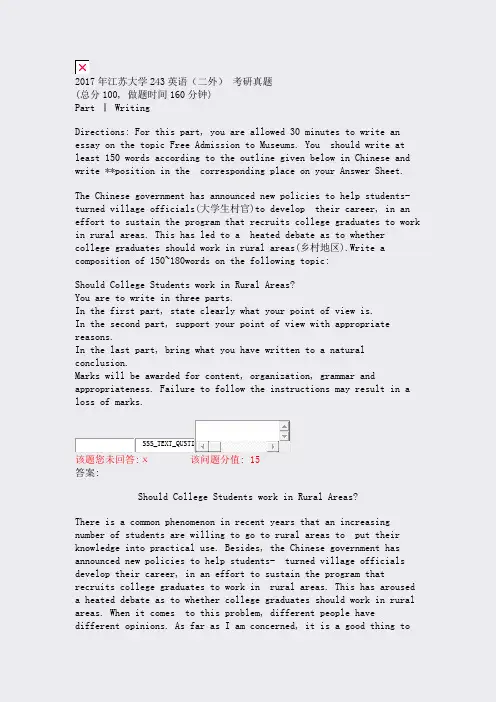
2017年江苏大学243英语(二外)考研真题(总分100, 做题时间160分钟)Part Ⅰ WritingDirections: For this part, you are allowed 30 minutes to write an essay on the topic Free Admission to Museums. You should write at least 150 words according to the outline given below in Chinese and write **position in the corresponding place on your Answer Sheet.The Chinese government has announced new policies to help students-turned village officials(大学生村官)to develop their career, in an effort to sustain the program that recruits college graduates to work in rural areas. This has led to a heated debate as to whether college graduates should work in rural areas(乡村地区).Write a composition of 150~180words on the following topic:Should College Students work in Rural Areas?You are to write in three parts.In the first part, state clearly what your point of view is.In the second part, support your point of view with appropriate reasons.In the last part, bring what you have written to a natural conclusion.Marks will be awarded for content, organization, grammar and appropriateness. Failure to follow the instructions may result in a loss of marks.SSS_TEXT_QUSTI该题您未回答:х该问题分值: 15答案:Should College Students work in Rural Areas?There is a common phenomenon in recent years that an increasing number of students are willing to go to rural areas to put their knowledge into practical use. Besides, the Chinese government has announced new policies to help students- turned village officials develop their career, in an effort to sustain the program that recruits college graduates to work in rural areas. This has aroused a heated debate as to whether college graduates should work in rural areas. When it comes to this problem, different people havedifferent opinions. As far as I am concerned, it is a good thing tosend college students to work in rural areas. The reasons are as follows.In the first place, it can ease employment pressures because China now is facing a severe employment crisis. What’s more, it can enhance the development of rural areas. Last but not least, it can cultivate undergraduate students’ spirit of work hard and perseverance, especially those from urban areas.From what has been discussed above, we may safely draw the conclusion that sending college students to work in rural areas is beneficial to both the country and individuals. So we ourselves as college students should support these new policies the government has announced.Part Ⅱ Vocabulary and GrammarDirections: There are thirty sentences in this section. Beneath each sentence there are four words or phrases marked A,B, C and D. Choose one word or phrase that **pletes the sentence.1.With the ________ of Mary, all the girl students are eager to go to the party.SSS_SINGLE_SELAexhibitionBexceptionCexceptDreception该题您未回答:х该问题分值: 0.5答案:B句意:除了玛丽,所有女生都渴望参加聚会。
(NEW)苏州大学外国语学院211翻译硕士英语[专业硕士]历年考研真题及详解
![(NEW)苏州大学外国语学院211翻译硕士英语[专业硕士]历年考研真题及详解](https://360docs-1393072327.cos.ap-beijing.myqcloud.com/bb71ddd57fd5360cbb1adb70.webp)
目 录2010年苏州大学211翻译硕士英语考研真题及详解2011年苏州大学211翻译硕士英语考研真题及详解2012年苏州大学211翻译硕士英语(A 卷)考研真题及详解2015年苏州大学211翻译硕士英语考研真题及详解2010年苏州大学211翻译硕士英语考研真题及详解I. Vocabulary and Structure (30%)Directions: Each of the following sentences has an underlined word or phrase. Below each sentence are four other words or phrases marked A), B), C) and D). You are to choose the ONE word or phrase which, if substituted for the underlined word or phrase, would keep the meaning of the original sentence.1.This is an abstract of a sermon.A. an agentB. an accommodationC. an abbreviationD. a summary【答案】D【解析】句意:这是布道的概要。
accommodation住处,膳宿。
abbreviation缩写;缩写词。
2.The Statue of Liberty was a gift to the United States from the people of France to memorialize the alliance between the two countries.A. negotiationB. anniversaryC. treatyD. association【答案】D【解析】句意:自由女神像是法国人民送给美国的礼物,以纪念两国之间的联盟。
2016年-2018年江苏大学240单独考试英语考研真题试题试卷汇编

...让知识更美味...
第 22 页,共 24 页
芝士传媒 × 题源库
...让知识更美味...
第 23 页,共 24 页
芝士传媒 × 题源库
...让知识更美味...
第 24 页,共 24 页
...让知识更美味...
第 19 页,共 24 页
芝士传媒 × 题源库
...让知识更美味...
第 20 页,共 24 页
芝士传媒 × 题源库
ห้องสมุดไป่ตู้
...让知识更美味...
第 21 页,共 24 页
芝士传媒 × 题源库
芝士传媒 × 题源库
...让知识更美味...
目 录
2016 年江苏大学 240 英语(单)考研真题试题试卷················································· 2 2017 年江苏大学 240 英语(单)考研真题试题试卷················································· 8 2018 年江苏大学 240 单独考试英语考研真题试题试卷············································ 18
...让知识更美味...
第 16 页,共 24 页
芝士传媒 × 题源库
...让知识更美味...
第 17 页,共 24 页
芝士传媒 × 题源库
...让知识更美味...
第 18 页,共 24 页
芝士传媒 × 题源库
第 4 页,共 24 页
芝士传媒 × 题源库
...让知识更美味...
2019年江苏大学硕士研究生入学考试243英语(二外)考研大纲

全国硕士研究生入学统一考试自命题科目《英语(二外)》考试大纲I 考查目标全国硕士研究生入学统一考试自命题科目《英语(二外)》考试是为我校招收日语语言文学硕士研究生而设置的具有选拔性质的考试科目。
其目的是科学、公平、有效地测试考生是否具备攻读该专业所必须的第二外国语(英语)技能,是否具有入学后继续深入学习英语(二外)的语言基础。
该考试是测量考生的英语综合应用能力,包括阅读理解、写作、翻译、词汇和句法运用能力。
具体来说,要求考生:1、应掌握一定量的英语词汇(参见《全国大学英语四、六级考试大纲》附录的分级词汇表);2、掌握英语语法知识(非谓语动词、时态、语态等);3、具有较强的阅读理解能力,能够读懂一般性题材的英语报刊文章和其他英语材料;能阅读题材较为熟悉的学术文章;4、具有一定的英译汉能力;5、能用英语写150-200字左右的短文。
II 考试形式和试卷结构一、试卷满分及考试时间试卷满分为100分,考试时间180分钟。
二、答题方式答题方式为闭卷、笔试。
无听力试题,考试过程中不允许携带字典。
三、试卷内容与题型结构1. Vocabulary 20题,每题1分,共20分2. Grammar 10题,每题1分,共10分3. Reading Comprehension 20题,每题2分,共40分4. Writing 1题,共15分5. Translation 1题,共15分III 考查内容1. 英语词汇知识2. 英语句法运用3. 英语阅读理解能力4. 英译汉翻译能力5. 英语写作能力6. 逻辑思考能力English as a Second Foreign Language Examination forGraduate CandidatesPart I Vocabulary (20 points)Please choose the best answer for each sentence below.1. A word processor is much better than a typewriter in that it enables you to enter and_______your text more easily.A. registerB. editC. proposeD. discharge2. We don’t know why so many people in that region like to wear dresses of such ______colors.A. lowB. humbleC. mildD. dull3. The news has just ______ that the president is going to visit China next month.A. come downB. come upC. come outD. come about4. The ______ that exists among nations could certainly be lessened if misunderstanding andmistrust were removed.A. tensionB. strainC. stressD. intensity5. The other day, Mum and I went to St. James’s Hospital , and they did lots and lots of tests onme, most of them _____ and frightening.A. cheerfulB. horribleC. hostileD. friendly6. In the Mediterranean seaweed is so abundant and so easily harvested that it is never of great_____.A. fareB. paymentC. worthD. expense7. The writer was so ______ in her work that she didn’t notice him enter the room.A. absorbedB. abandonedC. focusedD. centered8. Actually, information technology can ______ the gap between the poor and the rich.A. linkB. breakC. allyD. bridge9. Some research workers completely ______ all those facts as though they never existed.A. ignoreB. leaveC. refuseD. miss10. Computer power now allows automatic searches of fingerprint files to match a print at acrime ______.A. stageB. sceneC. locationD. occasion11. The most basic reason why dialects should be preserved is that language helps to ______ aculture.A. retainB. relateC. remarkD. review12. Companies are struggling to find the right _______between supply and demand, but it is noeasy taskA. equationB. formulaC. balanceD. pattern13. Mass advertising helped to _______ the emphasis from the production of goods to theirconsumption.A. varyB. shiftC. layD. moderate14. Because of his excellent administration, people lived in peace and _____ and all previouslyneglected matters were taken care of.A. convictionB. contestC. consentD. content15. I know you’ve got a smooth tongue , so don’t talk me ______ buying it.A. awayB. downC. outD. into16. Showing some sense of humor can be a (n) _______ way to deal with some stressfulsituationA. effectiveB. efficientC. favorableD. favorite17. The situation described in the report ______ terrible, but it may not happen.A. inclinesB. maintainsC. soundsD. remains18. The company is trying every means to ______ the wholesale price of its products.A. pull downB. put downC. set downD. bring down19. The mayor ______ the police officer a medal of honor for his heroic deed in rescuing theearthquake victimsA. rewardedB. awardedC. creditedD. prized20. The native Canadians lived in _______ with nature, for they respected nature as a providerof life.A. coordinationB. acquaintanceC. contactD. harmonyPart II Grammar (10 Points)Please read the following sentences and fill in the blanks with the correct word forms.21. There is little doubt that ______ (attend) college has the potential of exposing young people tonew ideas and relationships and helps promote their critical thinking skills.22. The US Department of Education estimates that only 62 percent of those enrolled in four-yearinstitutions had _____ (earn) a bachelor’s degree six years later.23. Do not be intimidated by people who think they are smarter than you, and don’t back off when_____ (face) competition; inner confidence is important.24. In order to persuade his daughter to put off the marriage, the father quoted statistics _____(show) mixed-face couples had higher divorce rates than same-race couples.25. The controversy in his article about women’s role in modern society _____ (be) that being ahousewife is greatly inferior to every other occupation.26. When he _____ (give) a talk, the topic is usually specified in advance, so you are able toexpect what to follow without any difficulties.27. When the police caught up with him, Mr. Foster had to confess that he _____ (break) the speedlimit.28. When she heard of her failure in the experiment, her eyes were filled with tears; whether it wasof shame, frustration, or grief was difficult ____ (tell).29. Rose knows that continuous letters from John, together with countless roses, are ____ (aim) atmaking her fall in love with him.30. Having been expelled from public school for drinking and smoking and then ____ (fail) inshow business as a singer, she joined her father’s bushiness 10 years ago.Part III Reading Comprehension (40 points)Directions: There are 4 passages in this section. Each passage is followed by some questions or unfinished statements. For each of them there are four choices marked A), B), C) and D).You should decide on the best choice.Passage OneQuestions 31 to 35 are based on the following passage.The Paris climate agreement finalised in December last year heralded a new era for climate action. For t he first time, the world’s nations agreed to keep global warming well below 2℃.This is vital for climate-vulnerable nations. Fewer than 4% of countries are responsible for more than half of the world’s greenhouse gas emissions. In a study published in Nature Scientific Reports, we reveal just how deep this injustice runs.Developed nations such as Australia, the United States, Canada, and European countries are essentially climate “free-riders”: causing the majority of the problems through high greenhouse gas emissions, while incurring few of the costs such as climate change’s impact on food and water. In other words, a few countries are benefiting enormously from the consumption of fossil fuels, while at the same time contributing disproportionately to the global burden of climate change.On the flip side, there are many “forced riders”, who are suffering from the climate change impacts despite having scarcely contributed to the problem. Many of the world’s most climate-vulnerable countries, the majority of which are African of small island states, produce a very small quantity of emissions. This is much like a non-smoker getting cancer from second-hand smoke, while the heavy smoker is fortunate enough to smoke in good health.The Pairs agreement has been widely hailed as a positive step forward in addressing climate change for all, although the details on addressing “climate justice” can be best described as sketchy.The goal of keeping global temperature rise “well below”2℃is commendable but the emissions-reduction pledges submitted by countries leading up to the Pairs talks are very unlikely to deliver on this.More than $100 billion in funding has been put on the table for supporting developing nations to reduce emissions. However, the agreement specifies that there is no formal distinction between developed and developing nations in their responsibility to cut emissions, effectively ignoring historical emissions. There is also very little detail on who will provide the funds or, importantly, who is responsible for their provision. Securing these funds, and establishing who is responsible for raising them will also be vital for the future of climate-vulnerable countries.The most climate-vulnerable countries in the world have contributed very little to creating the global disease from which they now suffer the most. There must urgently be a meaningful mobilisation of the polices outlined in the agreement if we are to achieve national emission reductions while helping the most vulnerable countries adapt to climate change.And it is clearly up to the current generation of leaders from high-emitting nations to decide whether they want to be remembered as climate change tyrants or pioneers.31. The author is critical of the Paris climate agreement because__________.A) it is unfair to those climate-vulnerable nationsB) it aims to keep temperature rise below 2℃ onlyC) it is beneficial to only fewer than 4% of countriesD) it burdens developed countries with the sole responsibility32. Why does the author call some developed countries climate “free-riders”?A) They nee dn’t worry about the food and water they consume.B) They are better able to cope with the global climate change.C) They hardly pay anything for the problems they have caused.D) They are free from the greenhouse effects affecting “forced riders”.33. Why does the author compare the “forced riders” to second-hand smokers?A) They have little responsibility for public health problems.B) They are vulnerable to unhealthy environmental conditions.C) They have to bear consequences they are not responsible for.D) They are unaware of the potential risks they are confronting.34. What does the author say about the $100 billion funding?A) It will motivate all nations to reduce carbon emissions.B) There is no final agreement on where it will come from.C) There is no clarification of how the money will be spent.D) It will effectively reduce greenhouse emissions worldwide.35. What urgent action must be taken to realize the Paris climate agreement?A) Encouraging high-emitting nations to take the initiative.B) Calling on all the nations concerned to make joint efforts.C) Pushing the current world leaders to come to a consensus.D) Putting in effect the policies in the agreement at once.Passage TwoQuestions 36 to 40 are based on the following passage.Open data sharers are still in the minority in many fields. Although many researchers broadly agree that public access to raw data would accelerate science, most are reluctant to post the results of their own labors online.Some communities have agreed to share online—geneticists, for example, post DNA sequences at the GenBank repository (库) , and astronomers are accustomed to accessing images of galaxies and stars from, say, the Sloan Digital Sky Survey, a telescope that has observed some 500 million objects—but these remain the exception, not the rule. Historically, scientists have objected to sharing for many reasons: it is a lot of work; until recently, good databases did not exist; grant funders were not pushing for sharing; it has been difficult to agree on standards for formatting data; and there is no agreed way to assign credit for data.But the barriers are disappearing, in part because journals and funding agencies worldwide are encouraging scientists to make their data public. Last year, the Royal Society in London said in its report that scientists need to “shift away from a research culture where data is viewed as a private preserve”. Funding agencies note that data paid for with public money should be public information, and the scientific community is recognizing that data can now be shared digitally in ways that were not possible before. To match the growing demand, services are springing up to make it easier to publish research products online and enable other researchers to discover and cite them.Although calls to share data often concentrate on the moral advantages of sharing, the practice is not purely altruistic (利他的). Researchers who share get plenty of personal benefits, including more connections with colleagues, improved visibility and increased citations. The most successful sharers—those whose data are downloaded and cited the most often---get noticed, and their work gets used. For example, one of the most popular data sets on multidisciplinary repository Dryad is about wood density around the world; it has been downloaded 5,700 times. Co-author Amy Zanne thinks that users probably range from climate-change researchers wanting to estimate how much carbon is stored in biomass, to foresters looking for information on different grades of timber. “I'd much prefer to have my data used by the maximum number of people to ask their own questions,” she says. “It's important to allow readers and reviewers to see exactly how you arrive at your results. Publishing data and code allows your science to be reproducible.”Even people whose data are less popular can benefit. By making the effort to organize and label files so others can understand them, scientists become more organized and better disciplined themselves, thus avoiding confusion later on.36. What do many researchers generally accept?A) It is imperative to protect scientists’ patents.B) Repositories are essential to scientific research.C) Open data sharing is most important to medical science.D) Open data sharing is conducive to scientific advancement.37. What is the attitude of most researchers towards making their own data public?A) Opposed.B) Ambiguous.C) Liberal.D) Neutral.38. According to the passage, what might hinder open data sharing?A) The fear of massive copying.B) The lack of a research culture.C) The belief that research data is private intellectual property.D) The concern that certain agencies may make a profit out of it.39. What helps lift some of the barriers to open data sharing?A) The ever-growing demand for big data.B) The advancement of digital technology.C) The changing attitude of journals and funders.D) The trend of social and economic development.40. Dryad serves as an example to show how open data sharing ________.A) is becoming increasingly popularB) benefits sharers and users alikeC) makes researchers successfulD) saves both money and laborPassage ThreeQuestions 41 to 45 are based on the following passage.In the past, falling oil prices have given a boost to the world economy, but recent forecasts for global growth have been toned down even as oil prices sink lower and lower. Does that mean the link between lower oil prices and growth has weakened?Some experts say there are still good reasons to believe cheap oil should heat up the world economy. Consumers have more money in their pockets when they’re paying less at the pump. They spend that money off other things, which stimulates the economy.The biggest gains go to countries that import most of their oil like China, Japan and India. But doesn't the extra money in the pockets of those countries’ consumers mean an equal loss in oil-producing countries, cancelling out the gains? Not necessarily, say economic researcher Sara Johnson. "Many oil producers built up huge reserve funds when prices were high, so when prices fall they will draw on their reserves to support government spending and subsidies (补贴) for theirconsumers.But not all oil producers have big reserves. In Venezuela, collapsing oil prices have sent its economy into free-fall.Economist Carl Weinberg believes the negative effects of plunging oil prices are overwhelming the positive effects of cheaper oil. The implication is a sharp decline in global trade, which has plunged partly because oil-producing nations can't afford to import as much as they used to.Sara Johnson acknowledges that the global economic benefit from a fall in oil prices today is likely lower than it was in the past. One reason is that more countries are big oil producers now, so the nations suffering from the price drop account for a larger share of the global economy.Consumers, in the U.S. at least, are acting cautiously with the savings they're getting at the gas pump, as the memory of the recent great recession is still fresh in their mind. And a number of oil-producing countries are trimming their gasoline subsidies and raising taxes, so the net savings for global consumers is not as big as the oil price plunge might suggest.41. What does the author mainly discuss in the passage?A. The reasons behind the plunge of oil prices.B. Possible ways to stimulate the global economy.C. The impact of chape oil on global economic growth.D. The effect of falling oil prices on consumer spending.42. Why do some experts believe cheap oil will stimulate the global economy?A. Manufacturers can produce consumer goods at a much lower cost.B. Lower oil prices have always given a big boost to the global economy.C. Oil prices may rise or fall but economic laws are not subject to change.D. Consumers will spend their savings from cheap oil on other commodities.43. What happens in many oil-exporting countries when oil prices go down?A. They suspend import of necessities from overseas.B. They reduce production drastically to boost oil prices.C. They use their money reserves to back up consumption.D. They try to stop their economy from going into free-fall.44. How does Carl Weinberg view the current oil price plunge?A. It is one that has seen no parallel in economic history.B. Its negative effects more than cancel out its positive effects.C. It still has a chance to give rise to a boom in the global economy.D. Its effects on the global economy go against existing economic laws.45. Why haven't falling oil prices boosted the global economy as they did before?A. People are not spending all the money they save on gas.B. The global economy is likely to undergo another recession.C. Oil importers account for a larger portion of the global economy.D. People the world over are afraid of a further plunge in oil prices.Passage FourQuestions 46 to 50 are based on the following passage.Female applicants to postdoctoral positions in geosciences were nearly half as likely to receive excellent letters of recommendation, compared with their male counterparts. Christopher Intagliata reports.As in many other fields, gender bias is widespread in the sciences. Men score higher starting salaries, have more mentoring (指导), an d have better odds of being hired. Studies show they’re also perceived as more competent than women in STEM (Science, Technology, Engineering, and Mathematics) fields. And new research reveals that men are more likely to receive excellent letters of recommendation, too.“Say, you know, this is the best student I’ve ever had,” says Kuheli Dutt, a social scientist and diversity officer at Columbia University’s Lamont campus. “Compare those excellent letters with a merely good letter: ‘The candidate was produc tive, or intelligent, or a solid scientist or something that’s clearly solid praise,’ but nothing that singles out the candidate as exceptional or one of a kind.”Dutt and her colleagues studied more than 1,200 letters of recommendation for postdoctoral positions in geoscience. They were all edited for gender and other identifying information, so Dutt and her team could assign them a score without knowing the gender of the student. They found that female applicants were only half as likely to get outstanding letters, compared with their male counterparts. That includes letters of recommendation from all over the world, and written by, yes, men and women. The findings are in the journal Nature Geoscience.Dutt says they were not able to evaluate the actual scientific qualifications of the applicants using the data in the files. But she says the results still suggest women in geoscience are at a potential disadvantage from the very beginning of their careers starting with those less than out-standing letters of recommendation.“We’re not trying to assign blame or criticize anyone or call anyone consciously sexist. Rather, the point is to use the results of this study to open up meaningful dialogues on implicit gender bias, be it at a departmental level or an institutional level or even a discipline level,” which may lead to some recommendations for the letter writers themselves.46. What do we learn about applicants to postdoctoral positions in geosciences?A) There are many more men applying than women.B) Chances for women to get the positions are scarce.C) More males than females are likely to get outstanding letters of recommendation.D) Male applicants have more interest in these positions than their female counterparts.47. What do studies about men and women in scientific research show?A) Women engaged in postdoctoral work are quickly catching up.B) Fewer women are applying for postdoctoral positions due to gender bias.C) Men are believed to be better able to excel in STEM disciplines.D) Women who are keenly interested in STEM fields are often exceptional.48. What do the studies find about the recommendation letters for women applicants?A) They are hardly ever supported by concrete examples.B) They contain nothing that distinguishes the applicants.C) They provide objective information without exaggeration.D) They are often filled with praise for exceptional applicants.49. What did Dutt and her colleagues do with the more than 1,200 letters of recommendation?A) They asked unbiased scholars to evaluate them.B) They invited women professionals to edit them.C) They assigned them randomly to reviewers.D) They deleted all information about gender.50. What does Dutt aim to do with her study?A) Raise recommendation writers’ awareness of gender bi as in their letters.B) Open up fresh avenues for women post-doctors to join in reaserach work.C) Alert women researchers to all types of gender bias in the STEM disciplines.D) Start a public discussion on how to raise women’s status in academic circles.Part IV Writing (15 points)For this part, you are supposed to write an essay commenting on the saying “The question mark is the key to any science.” You r essay should emphasize the importance of asking right questions in the pursuit of science. Please write at least 200 words but no more than 250 words.Part V Translation (15 points)Please translate the following paragraph into Chinese.As we enter the 21st century, direct contacts with dissimilar others in our neighborhoods, schools, and workplace are an inescapable part of life. Each intercultural contact can bring about identity dissonance or stress because of attributes such as an unfamiliar accent, way of speaking, way of doing things, and way of nonverbal expression. In a global workplace, people bring with them different work habits and cultural practices. For example, cultural strangers may appear to approach teamwork and problem-solving tasks differently. They may appear to have a sense of different time, and they may appear to have different spatial needs. They also may look and move differently.Key Part I Vocabulary (20 points)1-5 BDCAB6-10 CADAB11-15 ACBDD16-20 ACDBDPart II Grammar (10 points)21. attending22. earned23. facing24. showing25. is26. gives27. had broken28. to tell29. aimed30. failingPart III Reading Comprehension (40 points) 31-35 ACCBD36-40 DACCB41-45 CDCBA46-50 CCBDAPart IV Writing (15 points)Omitted.Part V Translation (15 points)Omitted.11。
江苏大学502历年真题
江苏大学502历年真题江苏大学硕士研究生入学考试样题A卷科目代码:243科目名称英语(二外)满分:100分注意:①认真闽读答题纸上的注意事项:②所有答案必须写在答题纸上,写在本试题纸或草稿纸上均无效:③本试题纸须随答题纸一起装入试题袋中交回!Part I Vocabulary (20 points)Please choose the best answer for each sentence below.to go to the party with us.1.After working all day,he was so tired that he was in noA) tasteB) moodC) senseD) emotion2. Finding a job can be _______and disappointing, and therefore it is important that you are prepared.A)exploitingB) frustratingC) profitingD)misleading3. Workers in the fine arts thoughts and feelings through theircreative works.A) transmitB) elaborateC) conveyD) contribute4. Three university departments have been S600,000 to develop good practice in teaching and learning.A) promotedB) includedC) securedD) awarded5. The rapid development of communications technology is transforming the in which people communicate across time and space.A) moodB)missionC)mannerD) vision6. Mr. Jones holds strong views against video games and the closing of all recreation facilities for such games.A) assistsB) acknowledgesC) advocates7. Apart from caring for her children, she has to take on suchheavy housework as carrying water and firewood.A) time-consumedB) timely-consumedC) time-consumingD) timely-consuming8.Anna was reading a piece of science fiction, completely to the outside world.A) having been lostB) to be lostC) losingD) lost9. The police are trying to find out the of the woman killed in the traffic accident.A) evidenceB) recognitionC) statusD) identity10. All human beings have a comfortable zone regulating the they keep from someone they talk with.A) distanceC)rangeD)boundary11. We have planned an exciting publicity with our advertisers.A) struggleB)campaignC) battleD) conflict12. the help of their group, we would not have succeeded in the investigation.A) BesidesB) Regardless ofC) But forD) Despite13. John doesn't believe in medicine; he has some remedies of his own.A) standardB) regularC)routineD) conventional14. Owing to competition among the airlines, travel expenses have been reduced considerably.B) strainedC) eagerD) critical15. Though in a big city, Peter always prefers to paint the primitive scenes of country life.A)grownB) raisedC) tendedD) cultivated16. If people feel hopeless, they don't bother to the skills they need to succeed.A) adoptB) acquireC) accumulateD) assemble17. The shop assistant was dismissed as she was of cheating customers.A) accusedB) chargedC) scoldedD) cursed18. All her energies are upon her children and she seems to have little time for anything else.A) guidedB) aimedC) directedD) focused19. Everyone should be to a decent standard of living and an opportunity to be educated.A) attributedB) entitledC) identifiedD) justified20. His wife is constantly finding with him, which makes him very angry.A)errorsB) shortcomingsC) faultD) flawPart I Grammar (10 Points)Please read the following sentences and fill in the blanks with the correct word forms.21.(finish) preparing dinner, she stood at the front door waitingfor her children to return.22. The boy had no choice but (follow) his father into the room.23. While (apply) for a job, the graduate student got an offer to study abroad.24. Rose knows that continuous letters from John, together with countless roses, are (aim) at making her fall in love with him. 25. Perhaps the most popular tourist attraction on the island is the beautiful beach (offer) warm water, abundant sea life, and clean sand.26. Asking about a lady's age is considered to be an (embarrass) question in western cultures.27. In Chinese culture, "red" (represent) happiness, while in some western countries,"red" is more connected with danger and warning. 28. Recently a kind of traditional Chinese medicine is quite popular in the United States, for it is effective (cure) patients of their cough. 29. Only 10 out of the 97 passengers (survive) the plane crash in Russia last month.30. The mayor awarded the police officer a medal of honor for his heroic deed in (rescue) the earthquake victims.Part III Reading Comprehension (40 points)Directions: There are 4 passages in this section. Each passage is followed by some questions or unfinished statements. For each of them there arefour choices marked A), B), C) and D). You should decide on the best choice.Passage OneQuestions 31 to 35 are based on the following passage.Some of the world's most significant problems hit headlines. One example comes from agriculture. Food riots and hunger make news. But the trend lying behind these matters is rarely talked about. This is the decline in the growth in yields of some of the world's major crops. Anew study by the University of Minnesota and MeGill University in Montreal looks at where,and how far, this decline is occurring.The authors take a vast number of data points for the four most important crops: rice,wheat,corn and soybeans(大豆).They find that on between 24% and 39% of all harvested areas, the improvement in yields that took place before the 1980s slowed down in the 1990s and2000s.There are two worrying features of the slowdown.One is that it has been particularly sharp in the world's most populous(人口多的)countries,India and China. Their ability to feed themselves has been an important source of relative stability both within the countries and on world food markets. That self-sufficiency cannot be taken for granted if yields continue to slowdown or reverse.Second, yield growth has been lower in wheat and rice than in cornand soybeans. This is problematic because wheat and rice are more important as foods, accounting for around half of all calories consumed. Corn and soybeans are more important as feed grains. The authors note that "we have preferentially focused our crop improvement efforts on feeding animals and cars rather than on crops that feed people and are the basis of food security in much of the world."The report qualifies the more optimistic findings of another new paper which suggests that the world will not have to dig up a lot more land for farming in order to feed 9 billion people in2050, as the Food and Agriculture Organization has argued.Instead, it says,thanks to slowing population growth, land currently ploughed up for crops might be able to revert(回返)to forest or wildemess. This could happen.The trouble is that the forecast assumes continued improvements in yields, which may not actually happen.31. What does the author try to draw attention to?A) Food riots and hunger in the world.B) The decline of the grain yield growth.C) News headlines in the leading media.D) The food supply in populous countries.32.Why does the author mention India and China in particular?A) Their self-sufficiency is vital to the stability of world food markets.B) Their food yields have begun to decrease sharply in recent years.C) Their big populations are causing world wide concerns.D) Their food self-sufficiency has been taken for granted.33.What does the new study by the two universities say about recent crop improvement efforts?A) They fail to produce the same remarkable results as before the 1980s.B) They contribute a lot to the improvement of human food production.C) They play a major role in guaranteeing the food security of the world.D) They focus more on the increase of animal feed than human food grains.34.What does the Food and Agriculture Organization say about world food production in the coming decades?A) The growing population will greatly increase the pressure on world food supplies.B) The optimistic prediction about food production should be viewed with caution.C) The slowdown of the growth in yields of major food crops will be reversed.D) The world will be able to feed its population without increasing farmland.35. How does the author view the argument of the Food and Agriculture Organization?A) It is built on the findings of a new study.B) It is based on a doubtful assumption.C) It is backed by strong evidence.D) It is open to further discussion.Passage TwoQuestions 36 to 40 are based on the following passage.Across the rich world, well-educated people increasingly work longer than the less-skilled.Some 65% of American men aged 62-74 with a professional degree are in the workforce,compared with 32% of men with only a high-school certificate. This gap is part of a deepening divide between the well-educated well-off and the unskilled poor. Rapid technological advance has raised the incomes of the highly skilled while squeezing those of the unskilled. The consequences, for individuals and society, are profound.The world is facing an astonishing rise in the number of old people. And they will live longer than ever before. Over the next 20 years the global population of those aged 65 or more will almost double, from 600 million to 1.1 billion. The experience of the 20th century, when greater longevity(长寿)translated into more years in retirement rather than more years at work,has persuaded many observers that this shift will lead to slower economic growth, while the swelling ranks of pensioners will create government budget problems.But the notion of a sharp division between the working young andthe idle old misses a new trend, the growing gap between the skilled and the unskilled. Employment rates are falling among younger unskilled people, whereas older skilled folk are working longer. The divide is most extreme in America, where well-educated baby-boomers are putting off retirement while many less-skilled younger people have dropped out of the workforce.Policy is partly responsible. Many European governments have abandoned policies that used to encourage people to retire early.Rising life expectancy(预期寿命),combined with there placement of generous defined-benefit pension plans with less generous defined-contribution ones, means that even the better-off must work longer to have a comfortable retirement. But the changing nature of work also plays a big role. Pay has risen sharply for the highly educated, and those people continue to reap rich rewards into old age because these days the educated elderly are more productive than the preceding generation. Technological change may well reinforce that shift: the skills that complement computers, from management know how to creativity, do not necessarily decline with age.36. What is happening in the workforce in rich countries?A) Younger people are replacing the elderly.B) Well-educated people tend to work longer.C) Unemployment rates are rising year after year.D) People with no college degree do not easily find work.37. What has helped deepen the divide between the well-off and the poor?A) Longer life expectancies.B) A rapid technological advance.C) Profound changes in the workforce.D) A growing number of the well-educated.38. What do many observers predict in vie w of the experience of the 20th century?A) Economic growth will slow down.B) Government budgets will increase.C) More people will try to pursue higher education.D) There will be more competition in the job market.39. What is the result of policy changes in European countries?A) Unskilled workers may choose to retire early.B) More people have to receive in-service training.C) Even wealthy people must work longer to live comfortably in retirement.D) People may be able to enjoy generous defined-benefits from pension plans.40. What is characteristic of work in the 21st century?A) Computers will do more complicated work.B) More will be taken by the educated young.C)Most jobs to be done will be creative ones.D) Skills are highly valued regardless of age.Passage ThreeQuestions 41 to 45 are based on the following passage.Human wants seem endless. When a starving man gets a meal, he begins to think about an overcoat, when an executive gets a new sports car, visions of country clubs and pleasure boats dance into view.The many wants of mankind might be regarded as making up several levels. When there is money enough to satisfy one level of wants, another level appears.The first and most basic level of wants involves food. Once this want is satisfied, a second level of wants appears: clothing and some sort of shelter. By the end of World War II these wants were satisfied for a great majority of Americans. Then a third level appeared. It included such items as automobiles and new houses.By 1957 or 1958 this third level of wants was fairly well satisfied. Then, in the late 1950s a fourth level of wants appeared: the"life-enriching" level. While other levels involve physical satisfaction——the feeding, comfort, safety, and transportation of the human body——this level stresses mental needs for recognition, achievement, and happiness. It includes a variety of goods and services, many of whichcould be called "luxury" items. Among them are vacation trips, the best medical and dental care, and entertainment. Also included here are fancy foods and the latest styles in clothing.On the fourth level, a greater percentage of consumer spending goes to services, while on the first three levels more is spent on goods. Will consumers raise their sights to a fifth level of wants as their income increases,or will they continue to demand luxuries and personal services on the fourth level?A fifth level probably would involve wants that can be achieved best by community action.Consumers may be spending more on taxes to pay for government action against disease,ignorance, crime, and prejudice. After filling our stomachs, our clothes closets, our garages, our teeth, and our minds, we now may seek to ensure the health, safety, and leisure to enjoy more fully the good things on the first four levels.41. According to the passage, man will begin to think about such needs as housing and clothing only when .A) he has saved up enough moneyB) he has grown dissatisfied with his simple shelterC) He has satisfied his hungerD) He has learned to build houses42. It can be inferred from the passage that by the end of the World War II most Americans .A) were very richB) lived in povertyC) had the good things on the first three levelsD) did not own automobiles43.All of the following EXCEPT are related to "physical satisfactions".A) a successful careerB) a cozy homeD) a family carC) a new house44. All of the following EXCEPT belong to the wants on the fourth level.A) going for holiday tripsB) finding a shelterC) going to a cinemaD) the best medical care45. The author tends to think that a fifth level .A) would be little better than the fourth levelB) may be a lot more desirable than the first fourC) can be the last and most satisfying levelD) will become attainable if the government takes actionsPassage FourQuestions 46 to 50 are based on the following passage.Technology can make us smarter or stupider, and we need to develop a set of principles to guide our everyday behavior and make sure that tech is improving and not hindering our mental processes. One of the big questions being debated today is: What kind of information do we need to have stored in our heads, and what kind can we leave "in the cloud," to be accessed as necessary?An increasingly powerful group within education are championing "digital literacy". In their view, skills beat, knowledge, developing "digital literacy" is more important than learning mere content, and all facts are now Google-able and therefore unworthy of committing to memory. But even the most sophisticated digital literacy skills won't help students and workers navigate the world if they don't have a broad base of knowledge about how the world actually operates. If you focus on the delivery mechanism and not the content, you're doing kids a disservice.Indeed, evidence from cognitive science challenges the notion that skills can exist independent of factual knowledge. Data from the last thirty years leads to a conclusion that is not scientifically challengeable: thinking well requires knowing facts, and that's true not only because you need something to think about. The very processes that teachers care about most-—critical thinking processes—are intimately intertwined (交织) with factual knowledge that is stored in long-termmemory.In order words, just because you can Google the date of Black Tuesday doesn't mean you understand why the Great Depression happened or how it compares to our recent economic slump. There is no doubt that the students of today, and the workers of tomorrow, will need to innovate, collaborate and evaluate. But such skills can't be separated from the knowledge that gives rise to them. To innovate, you have to know what, came before. To collaborate, you have to contribute knowledge to the joint venture. And to evaluate, you have to compare new information against knowledge you've already mastered.So here's a principle for thinking in a digital world, in two parts. First, acquire a base of factual knowledge in any domain in which you want to perform well. This base supplies the essential foundation for building skills,and it can't be outsourced(外包) to a search engine.Second, take advantage of computers' invariable memory, but also the brain's elaborative memory. Computers are great when you want to store information that shouldn't change. But brains are the superior choice when you want information to change, in interesting and useful ways: to connect up with other facts and ideas, to acquire successive layers of meaning, to steep for a while in your accumulated knowledge and experience and so produce a richer mental brew.46. What is the author's concern about the use of technology?A) It may leave knowledge "in the cloud".B) It may misguide our everyday behavior.C) It may cause a divide in the circles of education.D) It may hinder the development of thinking skills.47. What is the vie w of educators who advocate digital literacy?A) It helps kids to navigate the virtual world at will.B) It helps kids to broaden their scope of knowledge.C) It increase kids' efficiency of acquiring knowledge.D) It liberates kids from the burden of memorizing facts.48. What does evidence from cognitive science show?A) Knowledge is better kept in long-term memory.B) Critical thinking is based on factual knowledge.C) Study skills are essential to knowledge acquisition.D) Critical thinking means challenging existing facts.49. What does the author think is key to making evaluations?A) Gathering enough evidence before drawing conclusions.B) Mastering the basic rules and principles for evaluation.C) Connecting new information with one's accumulated knowledge.D) Understanding both what has happened and why it has happened.50. What is the author's purpose in writing the passage?A) To warn against learning through memorizing facts.B) To promote educational reform in the information age.C) To explain human brains' function in storing information.D) To challenge the prevailing overemphasis on digital literacy.Part IV Writing (15 points)For this part, you are supposed to write an essay commenting on the argument "It is useless to learn English as a second foreign language since I major in Japanese." Your essay should emphasize the role of learning English as a second foreign language for Japanese language majors. Please write at least 160 words but no more than 200 words. Part V Translation (15 points)Please translate the following paragraph into Chinese.As we enter the 21st century,there is a growing sense of urgency that we need to increase our understanding of people from diverse cultural and ethnic backgrounds. From interpersonal misunderstandings to intercultural conflicts, frictions exist within and between cultures. With rapid changes in global economy, technology, transportation, and immigration policies, the world is becoming a small, intersecting community. We find ourselves in increased contact with people who are culturally different, working side by side with us. From workplace to classroom diversity, different cultural beliefs, values, and communication styles are here to stay. In order to achieve effective intercultural communication, we have to learn to manage differences flexibly and mindfully.。
江苏大学外国语学院241日语(二外)历年考研真题专业课考试试题
目 录
2015年江苏大学外国语学院241日语(二外)考研样题2014年江苏大学外国语学院241日语(二外)考研样题2013年江苏大学外国语学院241日语(二外)考研样题2012年江苏大学外国语学院241日语(二外)考研真题2011年江苏大学外国语学院241日语(二外)考研真题2010年江苏大学外国语学院241日语(二外)考研真题2009年江苏大学外国语学院212日语(二外)考研真题2008年江苏大学外国语学院212日语(二外)考研真题2007年江苏大学外国语学院212日语(二外)考研真题2006年江苏大学外国语学院日语(二外)考研真题2005年江苏大学外国语学院日语(二外)考研真题2004年江苏大学外国语学院日语(二外)考研真题
2015年江苏大学外国语学院241日语(二
外)考研样题。
2019苏州大学241英语、243日语、244法语和245德语考研复习全析(含历年真题)
2019苏州大学241英语、243日语、244法语和245德语考研复习全析(含历年真题)2019苏州大学241英语考研复习全析(含历年真题)共五册,由东吴苏大考研网依托多年丰富的教学与辅导经验,组织官方教学研发团队与苏州大学外国语学院的优秀研究生共同合作编写而成。
全书内容紧凑权威细致,编排结构科学合理,为参加2019苏州大学考研的考生量身定做的必备专业课资料。
2019苏州大学241英语考研复习全析(含历年真题)全书编排根据:李荫华《全新版大学英语综合教程(1、2、3、4)》结合往年苏州大学考研真题内容,帮助报考苏州大学考研的同学通过苏大教材章节词汇短语解析、框架分解、全文翻译、配套的课后练习讲解,梳理指定教材的各章节内容,深入理解核心重难点知识,把握考试要求与考题命题特征。
通过研读演练本书,达到把握教材重点知识点、适应多样化的专业课考研命题方式、提高备考针对性、提升复习效率与答题技巧的目的。
同时,透过测试演练,以便查缺补漏,为初试高分奠定坚实基础。
适用院系:外国语学院:【俄语语言文学、日语语言文学】适用科目:241英语内容详情本书包括了以下几个部分内容:Part 1 - 词汇短语通过总结和梳理李荫华《全新版大学英语综合教程(1、2、3、4)》的各章节词汇及短语的发音、中文意思、延伸变化、例句说明等,增进考生对于逐个词汇及短语的理解。
Part 2 - 课文精解针对教材李荫华《全新版大学英语综合教程(1、2、3、4)》的课文内容,尤其是长难句等进行详细的翻译解释,做到对苏大考研核心考点及参考书目内在重难点内容的深度领会与运用。
Part 3 - 全文翻译对李荫华《全新版大学英语综合教程(1、2、3、4)》各章节正文的总体内容翻译,令考生对教材的内容理解更加全面深刻,通过翻译文本正确理解全文翻译的技巧,有助于大家透析全文意思,了解中心思想。
Part 4 - 练习答案根据教材编排的顺序,对于各章节的练习题逐个进行解答,帮助考生及时掌握教材的知识点内容,学以致用。