
人教版高中英语必修2Unit4 Wildlife protection
But …
They are dying out!
Why do we have to protect wild animals?
1.It is against the law to kill the wildlife . 2. To keep the balance of the ecosystems.We will not be able to survive if animals and plants die out. Protecting animals is protecting ourselves. 3.They are very valuable in science and medicine. 4. You are likely to suffer some diseases if eating wild animals. (bird flu, SARS, etc.)
2.Scanning: Fill in the table below about Daisy’s journey
Animals she met Places she went
First visit
antelope
elephant
Tibet Zimbabwe Rainforest
Second visit Third visit
Human beings
Live in harmony
Rain forest
Animals
No protection! No animals! No earth! No human beings!
Thank you!
See you!
2
3 Result: numbers are decreasing rapidly 1 Animal: elephants in Zimbabwe 2 Situation :previously hunted with numbers decreasing rapidly 3 Result: protection by farmers who make money from tourism. a monkey and a millipede from 1 Animal: tropical rainforest 2 Situation : produces a drug naturally which can protect us from mosquitoes 3 Result: Daisy plans to tell WWF about the drug.
Red-crowned Crane
Warming up & Reading
Who am I ?
1.I live in China. I’m black and white. I eat bamboo and move by walking.
Giant panda
2.I look like a big cat .I have a yellow-brown coat with blank stripes.I live in south China.
Animals made the world around us so wonderful.
So we should try our best to protect our animals ,protect their living environment. Let them live happily and play happily!
monkey
CaБайду номын сангаасeful reading:
Animal s
Where
What did she find?
How
Sad
fur Antelope being killed for ____
Tibet
Farmers used to_____ hunt them. an endangered species They were_______ Government ___________ __________offered help.
T
T
Careful Reading
Para
1
Main idea
Supporting details
Why we need 1 Animal: Tibetan Antelope 2 Situation :being hunted for the fur under wildlife its stomach protection a good example of wildlife protection
Pre-Reading
We have learned a lot about wildlife protection.
Now think about How Daisy learned to help wildlife? What’s the passage about?
Let’s go with Daisy and see what will happen.
South China Tiger
Tibetan antelopes
Golden Monkey elephant
What do you think of these animals What happened to them?
They are cute ,rare ,precious. They are national treasure.
Can you make some predictions?
Daisy
Fast Reading(page26)
1.Skimming Read the text quickly and grasp the main idea of the text .
The main idea Daisy took a flying carpet to travel and talked with some animals, which made her know the importance of the wildlife protection.
Comprehending
1. At first, the flying carpet flew to Hebei in China.
F
2. Farmers always like to hunt elephants in Zimbabwe.
F
3. Daisy would like to help the wildlife as the WWF suggests. 4. Daisy learned so many things in this experience.
Zimbabwe
The tour companies had pay to visit or hunt. to______ Farmers _________ no longer hunt.
Happy
Rain forest
A monkey and a millipede insect containing a amazed powerful drug could _______ ____ mosquitoes. protect it from
3 and 4
What can we get from wildlife protection
Daisy had learned so much! What can you learn from Daisy’s traveling?
Some useful phrases as a result die out in peace long to do in danger(of) protect… from be used to do
人教版高一英语必修二《Unit4Wildlifeprotection》评课稿
人教版高一英语必修二《Unit4Wildlifeprotection》评课稿1. 前言《Unit4Wildlifeprotection》是人教版高一英语必修二课程的一部分,主要介绍了野生动物保护的重要性和相关的实践措施。
本评课稿将从教材内容、教学目标、教学方法和教学评价四个方面进行评价,以便更好地指导教学实践。
2. 教材内容评价2.1 教材内容贴切性教材内容贴切地围绕了野生动物保护这一主题展开。
课本中引入了大量的真实案例和相关资料,如濒临灭绝的物种和它们所面临的挑战,以及人类与野生动物共存的方法等。
通过这些丰富的内容,学生能够了解到野生动物保护的紧迫性和必要性。
2.2 教材内容的连贯性和层次性教材内容在层次性上进行了合理的组织。
从引入野生动物保护的重要性开始,逐渐深入探讨了保护措施和相关的法律法规。
学生通过逐步深入的学习,能够逐渐理解和掌握这一主题的各个方面,形成一个完整的知识体系。
2.3 教材内容的兴趣性教材内容设计十分兴趣引人。
除了传统的文字阅读材料外,课本中还包含了图表、图表解读和角色扮演等多种形式的活动。
这些形式多样的活动设计不仅能够激发学生的兴趣,还能培养学生的动手能力和实践能力。
3. 教学目标评价3.1 知识目标根据教学大纲的要求,教学目标明确。
通过学习本单元的内容,学生应该能够掌握有关野生动物保护的相关知识,了解保护措施和相关的法律法规。
3.2 能力目标教学目标中强调了培养学生的口头表达能力、独立思考能力和解决问题的能力。
通过课堂上的互动和小组活动,学生能够得到锻炼,并在实践中不断提升这些能力。
3.3 情感目标教学目标中也涵盖了培养学生的环保意识和责任感。
通过学习野生动物保护的案例和相关知识,学生能够更好地理解人类与自然环境的关系,并形成积极的环保态度。
4. 教学方法评价4.1 多媒体教学法多媒体教学法在本单元教学中得到了广泛运用。
通过使用图片、音频和视频等多种媒体形式,能够更直观地展示野生动物保护的案例和实际情况,提高学生的学习兴趣和理解能力。
新人教版高一英语必修二Unit 4 Wildlife Protection全套教案
Unit 4 Wildlife ProtectionThe first periodWarming upKnowledge aims:a. help Ss to understand and master the words and expressions in warming up.b. Let the students know some basic information about the endangered animals and wildlife situation and protection.Ability aims:Encourage Ss to think and express their attitude towards the wildlife and the wildlife protection.Emotional aims:a. Help Ss understand the importance of the wildlife protection and make them be more active in the helping wildlife.b. Develop Ss’ sense of cooperative learning.Teaching Key Points:Enable the students to know some basic information about the endangered animals and wildlife protection.Encourage Ss to think and express their attitude towards the wildlife and the wildlife protection.Teaching Difficult Points:How to enable the students express themselves freely.Teaching Materials:Blackboard, multi-media, and other normal teaching tools.Teaching methods:Co-operative learningStudents-centered approach & Task-based teaching and learningTeaching Procedures:Step 1: Lead-inLead in by explaining the title and predicting what will be learned in this lesson. Step 2: ExplorationTask: let the students explore the following question:What is the problem of wild animals commonly facing?1. Show some pictures to the students. Students watch the pictures and say what the pictures tell us.References: food shortage, pollution, destruction of habitat, over-hunting.2. Show the students three more pictures and ask: what do people kill or hunt these animals for?From these pictures, students can conclude that people kill animals for food, for fur, for medicine and for works of art.3. Ask the students to give their answers to the question: What is the problem of wild animals commonly facing?Step 3: Discussion1. Let the students discuss the following question: why should we pay attention to wild animals and plants.Students discuss the question in groups and then give their opinions.2. After discussion, tell students what is wildlife protection about.Step 4: Group work1. Let the students read the report on some endangered wildlife in China at page 25, SB.2. Ask the students some questions about the report.3. Let the students describe the chart in small groups according to the sample.4. Discussion. More and more animals are killed by humans, as a student what should you do to protect the wild animals?Step 5: HomeworkWrite a composition according to the tips.假如你是一名记者,采访某动物园负责人有关国宝大熊猫的情况。
Unit 4 重要知识点讲解2021-2022学年人教版高中英语必修二
Unit 4Wildlife protection重要知识点讲解1. If their habitat is threatened or they can’t find enough food, their numbers may decrease. 如果他们的栖息地受到威胁或者他们找不到足够的食物,他们的数目就可能减少。
The number of children in the school has decreased this year. 今年在校的儿童人数减少了。
There was a decrease in the number of children in school. 在校的儿童人数有所减少。
decrease in number 数目减少2. As a result these endangered animals may even die out.结果,这些濒临危险的动物可能会灭绝。
The polluted air in the city is badly endangering the health of the residents.城里被污染的空气正严重地危及居民的健康。
an endangered species; an endangered culture.濒临绝种的生物种类;濒临绝传的文化die out 逐渐消失,灭绝die off相继死去die away逐渐停止,逐渐消失die down逐渐减弱,逐渐模糊3.loss of bamboo growing areas竹子生长区的损失His unfortunate death was a great loss to the firm. 他的不幸去世对他的商行来说是个重大损失。
Their company suffered loss on loss in business last year. 他们公司去年在生意上接二连三地亏本。
高考英语人教版讲义:Book 2 Unit 4 Wildlife protection Word版含解析
Book 2Unit 4Wildlife protection(主题语境:人与自然——环境保护)1 contain vt.包含;容纳;克制(强烈的感情等);抑制◆赏句猜义①Along with the items mentioned above, the wallet contains a family photo, my precious memory.②The stadium is large enough to contain 100 thousand people.③Hearing the disappointing news, he was too sad to containhimself.◆用contain和include的适当形式填空My friend offered me a container ④many kinds of fruits, bananas⑤. But I refused to accept it. He was so angry that he couldn’t⑥himself and threw it away. What he did surprised all the people present, ⑦me.答案①包含②容纳③克制;抑制④containing⑤included⑥contain⑦including(1)contain表示所含之物的全部或一部分;侧重所含的数量或成分,不用于进行时。
(2)include指作为整体中的一部分而被包括进去,通常指同类。
常使用“including+被包括部分”或“被包括部分+included”的结构。
助记2 affect vt.影响;感动;侵袭◆单句填空①With the aid of the government, those people (affect) by the earthquake have moved to the new settlements.②If a basketball star is, for example, trying to gain a high personal point total, he may take a shot himself when it would be better to pass the ball to a teammate,(affect) the team’s performance.(2019北京)③They are extremely important in the safe and (effect) running of our programmes. (2019北京)◆赏句猜义④The researchers call the effect“enclothed cognition”, suggesting that all manner of different clothes probably affect our cognition in many differentways.⑤No area was spared or unaffected, from the foggy northern coast to the Sierra Nevada Mountains to the San Gabriels above Los Angeles.(2019浙江阅读理解)◆句型升级Many young people were affected by his story and began to pay attention to wildlife protection.→⑥, many young people began to pay attention to wildlife protection. (分词作状语)答案①affected②affecting③effective④影响;影响⑤未受影响的⑥Affected by his story(1)be deeply affected by被……深深打动be affected by the heat/the cold中暑/着凉(2)effect n.作用;影响have an effect/influence on对……产生影响(3)effective adj.有效的;起作用的联想表“影响”的其他动词短语:have an impacton。
人教版英语必修二unit4_wildlife_protection_words

2.decrease → increase v.& n.增加;增大
(1) vi.& vt.减少;(使)变小;或变少 Car sales are decreasing. 汽车销量正在减少。 The number of traffic accidents has decreased. 交通事故的数量已经减少了。 (2) n. 减少;减小
运用 用适当的介词或副词填空
①Now many wild plants and animals are in danger of dying________. out
②The firefighters fought against the forest fire and it finally died __________. down ③The noise of the car died ________ in the away distance. ④The family members died ________ from the war. died of hunger. ⑤The poor woman ________
②The crowdburst ___________________________ into cheers/burst out cheering __ (一片欢呼).
牛刀小试 (1)When the girl learnt that her boyfriend C in the earthquake, she ______. was ______ A.injured;burst in tear B.killing;burst into tears C.still alive;burst into tears D.missing;burst into laughter 解析:be still alive还活着; burst into tears突然哭起来。
人教版高中英语·必修二·Unit 4 Wildlife protection 词汇拓展与练习(无答案)
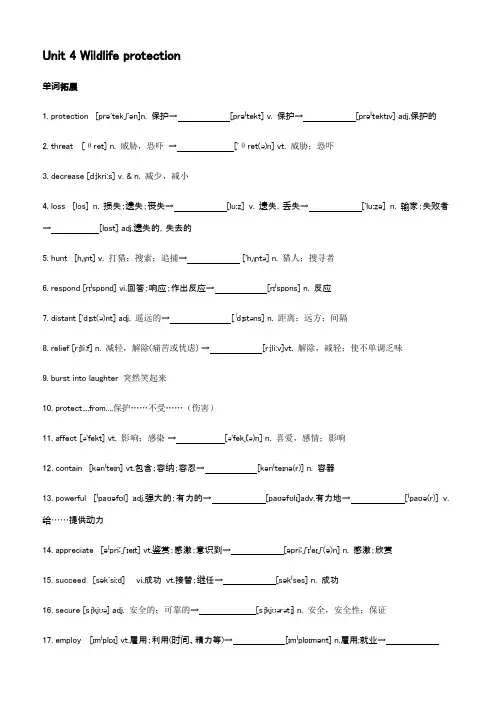
Unit 4 Wildlife protection单词拓展1.protection [prə'tekʃən]n. 保护→[prəˈtekt] v. 保护→[prəˈtektɪv] adj.保护的2.threat [θret] n. 威胁,恐吓→['θret(ə)n] vt. 威胁;恐吓3.decrease [dɪ'kriːs] v. & n. 减少,减小4.loss [lɔs] n. 损失;遗失;丧失→[lu:z] v. 遗失,丢失→['lu:zə] n. 输家;失败者→[lɒst] adj.遗失的,失去的5.hunt [hʌnt] v. 打猎;搜索;追捕→ ['hʌntə] n. 猎人;搜寻者6.respond [rɪˈspɒnd] vi.回答;响应;作出反应→[rɪˈspɒns] n. 反应7.distant ['dɪst(ə)nt] adj. 遥远的→[ˈdɪstəns] n. 距离;远方;间隔8.relief [rɪ'liːf] n. 减轻,解除(痛苦或忧虑) →[rɪ'liːv]vt. 解除,减轻;使不单调乏味9.burst into laughter 突然笑起来10.protect....from....保护……不受……(伤害)11.affect [ə'fekt] vt. 影响;感染→[ə'fekʃ(ə)n] n. 喜爱,感情;影响12.contain [kənˈteɪn] vt.包含;容纳;容忍→[kənˈteɪnə(r)] n. 容器13.powerful [ˈpaʊəfʊl] adj.强大的;有力的→[paʊəfʊlɪ]adv.有力地→[ˈpaʊə(r)] v. 给……提供动力14.appreciate [əˈpriːʃɪeɪt] vt.鉴赏;感激;意识到→[əpriːʃɪˈeɪʃ(ə)n] n. 感激;欣赏15.succeed [sək'si:d] vi.成功vt.接替;继任→[səkˈses] n. 成功16.secure [sɪ'kjʊə] adj. 安全的;可靠的→[sɪ'kjʊərətɪ] n. 安全,安全性;保证17.employ [ɪmˈplɒɪ] vt.雇用;利用(时间、精力等)→[ɪmˈplɒɪmənt] n.雇用;就业→[ɪmˈplɒɪə(r)] n.雇主→[emplɒɪˈiː] n.雇工,雇员18.harm [hɑ:m] n. & vt.损害;危害→[ˈhɑːmfʊl] adj.有害的19.bite [baɪt] vt. & vi.咬;叮;刺痛→[bɪt] (过去式)→[ˈbɪtn] (过去分词)20.fierce [ˈfɪəs] adj.凶猛的;猛烈的→[fɪəslɪ]adv.猛烈地→[ˈfɪə.snəs]n. 猛烈e into being 形成单词活用用所给词的正确形式填空1. I offered him a drink but he didn't (response).2. The foreign visitors came from a (distance) country.3. Alcoholic drink can have a bad (affect) on your body.4. More attention should (pay) to your pronunciation.5. Her coat gave her (protect) from the rain.6. A large office requires the (employ) of many people.7. The (important) of washing one's hands before a meal is that it prevents infection.8. hen he became angry and (threaten) that he would go to the police.9. The two neighbouring countries had been (enemy) for centuries.10. When a person (bite) by snake, wash the wound with cold running water before he is taken to seea doctor.短文改错1.After three years she finally finished the book and smiled in relieve.2.I would appreciate if you could come to my birthday party.3.The storm did a power lot of harm.4.Every smoker should keep in mind that smoking really do harm to health.5.My sister suggests that we will eat out for a change this weekend.6.Doctors are the most fierce independent thinkers on the planet.7.If we have no knowledge, we cannot succeed doing any work.8.This raincoat and umbrella will protect you the rain.。
高中英语必修二Unit4《Wildlifeprotection》教学课件
基础自主梳理
3.“关注”词汇一览 ①pay attention to注意 ②keep an eye on 密切注视 ③focus one's attention on 关注 ④concentrate on 关注;集中于 ⑤keep a close watch on 密切关注
基础自主梳理
【句式再现】攻克句型 对接高考
4. It is a pity that in the story nobody helped the dodo. 遗憾的是,在这个故事里没有人 帮助渡渡鸟。
It is a pity 是……
他们从它们骨骼的连接方式上 的定语从句
your daily life will change
了解到这一点。
___t_h__e__w_a_y__y_o__u__l_o_o_k__a_t________ . the world
基础自主梳理
背句型(课本这样讲)
2.They lived on the earth tens of millions of years ago,_l_o_n__g__b_e_f_o__re__h__u_m__a_n__s …came into being 数千万年前,在人类诞生之前 很久,它们就生活在地球 上……
(过去式)→ bitten (过去分词)
基础自主梳理
Ⅱ.填一填(阅读识其义)
1.wild adj. 野生的; 未开发的 2.mosquito n. 蚊子 ughter n. 笑声 4.income n. 收入 5.ending n. 结局; 结尾 6.habitat n. (动植物的)栖息地 7. insect n. 昆虫 8. reserve n. 保护区
基础自主梳理
人教版高一英语 必修二 Unit4 Wildlife protection 单词[有音标]
△ Daisy /'dez/ n.戴茜(女名) △ species /'spi:i:z/ n. 种类;物种 carpet /'kɑ:pt/ n. 地毯 responsibility n.责任 respond /r'spnd/ vi. 回答;响应;做出反应 distance n.距离 distant /'dstnt/ adj. 远的;远处的 fur /f:/ n. 毛皮;毛;软毛 △ antelope /'æntlp/ n. 羚羊 △ Zimbabwe /zm'ba:bwe/ n.津巴布韦 relief /r'li:f/ n. (痛苦或忧虑的)减轻或解除;减轻痛苦 的事物 in relief 如释重负;松了口气 laugh v.笑 laughter /'lɑ:ft/ n. 笑;笑声 burst into laughter 突然笑起来;大声笑了出来 mercy /'m:s/ n. 仁慈;宽恕;怜悯 certain /'s:tn/ adj. 确定的;某一;一定 certainly adv. importance /m'pɔ:tns/ n. 重要(性)important 重要的
△ WWF (World Wildlife Fund) 世界野生生物基金会 rub /rb/ vt. 擦;摩擦 protect … from 保护……不受……(危害) mosquito /m'ski:t/ n. 蚊子 △ millipede /'mlpi:d/ n.(=millepede)千足虫 insect /'nsekt/ n. 昆虫 contain /kn'ten/ vt. 包含;容纳;容忍 powerful /'pafl/ adj. 强大的;有力的 affect /'fekt/ vt. 影响;感动;侵袭 effect n.影响,效果 attention /'tenn/ n. 注意;关注;注意力 pay attention to 注意 appreciate /'pri:et/ vt. 鉴赏;感激;意识到 succeed /sək'si:d/ vi. 成功 vt. 接替;继任 success n.成功 △Indonesia /ndəu'ni: ; -z/ n.印度尼西亚 △ rhino /'ran/ n. 犀牛 secure /s'kj/ adj. 安全的;可靠的 ≈safe adj.安全的
人教英语必修二Unit 4-Wildlife Protection-知识点+语法全
She was engaged in protecting wild birds. 她致力于保护野生鸟类的工作。
be wild to do sth.
迫切地想做某事
be wild with+抽象名词 …得发狂,因…而发狂的状态
be wild out
极其热心或热爱
run wild
自由生长,不受控制
[教材P25原句] This is what wildlife protection is all about.
Unit 4 Wildlife protection
第一 讲
MAIN CONTENTS ✓ 1. 核心词汇 ✓ 2. 句子控 ✓ 3. Have a try
PART ONE Vacabulary & Phrase
核心词汇
wild /waIld/
n. 荒野 adj. 野生的;野蛮的;
狂热的;荒凉的
即学即用 用适当的介词填空 (1) The povertystricken families can apply __t_o the local government
__fo_r___ financial and technical help. (2) After the company put an advertisement __fo_r__ two sales managers
如果它们的栖息地受到威胁,或者找不到足够的食物,它们的数量就会减少。
threaten v. 威胁;恐吓
threat n. 威胁;凶兆 be a threat to sb/sth
对某人/物构成威胁
threaten sb with sth 用某事威胁某人 threaten to do sth 威胁要做某事
人教版高一英语必修二 Book2 Unit 4 Wildlife protection PPT课件
2. Suppose you are a reporter working for WWF, you went to Zimbabwe to see the condition of the elephants there, please make an interview with the elephant you met there according to paragraph two.
How Daisy Learned to Help Wildlife
Step 2: Fast-reading
Task1: Fill in the following form. Place Animal
First visit Second visit Third visit
Tibet Zimbabwe Rain forest
保护________,动词为________,保护…不受…(危害)_________
注意_____________, 毛皮,毛___________
What has happened to the wild animals? What do you think will happen if animals are treated this way?
antelope elephant monkey
Step3 While-reading
What does Daisy learn about these animals?
Para1
Para 2
Para 3-4
Tasks:
1. Please make a speech on The Antelope in Tibet.