
牛津深圳版八下Unit 3 Traditional skills词汇短语精讲(包含答案)
Unit 3 Traditional skillsWarm-up: 口语角一.用正确的语音和语调朗读下列短文。
Doctor Li is a well-known doctor. People from all over the city come to see him. Last week, Doctor Li was even busier than usual. On Monday morning, some children came to see him. They all had colds. In the afternoon, he went to Bill’s house. Bill is a ten-year-old boy. He can’t walk, so Doctor Li always goes to him when he is sick. Bill had a cough last week. Doctor Li then went to Beijing. He was there from Tuesday to Friday. He had a meeting at a big hospital. On Saturday, there was a football match at the stadium. Doctor Li went to the stadium, but not to watch the game! He went there to help the team, because the team’s usual doctor was ill.二.情景对话1.My grandpa is a farmer. What about yours?2.I saw cormorants in Guangxi. Do you know what they are good at?3.Your paper picture is beautiful. How much is it?4.Can you tell me what your English teacher looks like?5.Do you like Chinese knots? Why?三.根据所给提示简短说话在英语课上,你向同学们介绍你的爸爸或妈妈。
请用6句以上的英语句子谈谈爸爸或妈妈的外貌特点和职业。
一. 知识探究Reading1.Although he is over 65, he is very fit and still enjoys working.他虽然已经超过65岁了,但任然非常健壮,享受工作。
although conj. “尽管、虽然”引导让步状语从句,相当于though。
在英语中如果用了although 或though, 就不能再有but,但可以用yet或still; 反之,如果用了but , 就不能用although 和though.。
He said he would come, he didn’t though. 他说他要来,却没来。
Although he is in poor health, (yet) he works hard.= He is in poor health, but he works hard. 虽然他身体不好,但他工作仍努力。
随堂练习:_________ it was very late, he still _________ _________ _________.虽然很晚了,他还是继续工作。
2.Damin usually sets off in the late afternoon and gets the cormorants ready for work.达敏通常在傍晚出发,让鸬鹚准备好工作。
ready adj. 意思“准备好”,常用搭配be\ get ready for...“将……准备好”随堂练习:We _________ _________ _________ _________ the final exams.我们正在为期末考试做准备。
3.Then when Damin’s boat reaches the ri ght place in the river, he pushes them into the river.当达敏的船到河的适当位置时,他把它们赶进河里。
辨析:arrive, reach, get to 均有“到达”之意。
①arrive 是不及物动词,后面接in或at再接地点。
一般说,到达大地方(国家、城市等)常用in, 到达较小的地方(公共设施等)常用at。
②reach 是及物动词,后面直接跟地点。
③get to较口语化。
注意:这些词接地点副词(home\ here\ there等)不用to。
He arrived in Beijing yesterday.=He got to Beijing yesterday.=He reached Beijing yesterday.他昨天到达北京。
When I got there, the film had been on for 5 minutes.当我到那时,电影开场五分钟了。
随堂练习:他昨天下午五点到了广州。
(可一空多词)He ___________ the shop at 5:00 o’clock yesterday afternoon.4. The fish are then taken and thrown into a big basket by Damin.鱼被达敏取出并投进一个大篮子里。
这是一个含有被动语态的句子,其基本结构式“be动词+ 过去分词”,用于强调动作的承受者。
The room is cleaned every day.房间每天被清洁。
随堂练习:The old bridge ________ ________ many years ago.这座古桥是多年前建造的。
5. In 50 years, perhaps there will be no more cormorant fishermen in the world.五十年后也许世上再也没有鸬鹚渔人了。
解析:no more意思是“不再,再也不”,侧重数量和程度,和not…any more意思差不多。
We have no more bread, and we have to buy some.我们没面包了,我们得去买一些。
I see him no more.= I don’t see him any more.我不再见到他了。
随堂练习:Playing computer games is harmful. I _____ play it ______.A. not, any moreB. don't, no moreC. won't, no moreD. won't, any moreMore Practice1.Every Saturday, Wang Weifang puts on a play with his friends in a small town near Xi’an.put on “上演;展出”,还有“穿;戴”之意e.g. Hurry up! Put your coat on. 快点!把外套穿上。
随堂练习:Our school drama club will ________ ________ a new play this Friday.本周五,我们学校的戏剧社将要演出一个新剧。
2.Shadow puppets are made of hard leather. 皮影人偶是由硬皮革做成的。
be made of “用……做成”,+看得出原材料的名词。
拓展:be made from +看不出原材料的名词随堂练习:All our furniture ______ ______ _____ wood.我们的家具都是用木头做成的。
Paper______ ______ _____ wood. 纸是用木头做的。
3. Now with TV and films, shadow puppet plays are not as popular as before.With在本句的意思是“与(某物)同时,随着”as …… as “与……一样”,否定形式:not so/as …… as “不够……”随堂练习:He is ______ ______ ______ ______ his twin brother. 他不够他的孪生兄弟高。
随堂练习Reading一、翻译下列词组1. 下潜__________________2. 到达(某数量、程度等)______________3. 出发;动身____________4. 傍晚______________________________5. 让……准备好___________6. 起伏;上下波动___________________7. 天黑后;黄昏后__________8. 不再;再也不_____________________9. 过去常常_______________ 10. 阻止……做某事__________________二、根据句意和所给的首字母完成下列句子1. The police asked the shopkeeper to d______ the thief so that they could get the details.2. She spends one hour doing exercise every day to keep f_______.3. I will call you as soon as I r______ the airport.4. Guangzhou is such a beautiful city that it a_____ visitors from all over the country.5. After he washed the shirt, he h_____ it outside the house.6. Besides food, these pets r______ a lot of care and attention.7. If you want to play basketball well, you should p_____ it more often.三、语言知识运用1. With the help of the Internet, news can _____ every corner of the world.A. getB. reachC. arriveD. appear2. We will ______ for Beijing this Sunday.A. give offB. put offC. set offD. take off3. ______ the poor man said he wasn’t hungry, he ate a big breakfast.A. AlthoughB. ButC. BecauseD. However4. My uncle used _____ a very good football player, but that was a long time ago.A. to beingB. beingC. beD. to be5. From then on Mary practised ______ the piano every day.A. playsB. playingC. playedD. to play四、根据中文提示完成下列句子1. 战士下潜并在水下寻找那名妇女。
2017年牛津沪教版初中英语八年级英语下Unit-3-Traditional-skills重难点及语法总结巩固训练
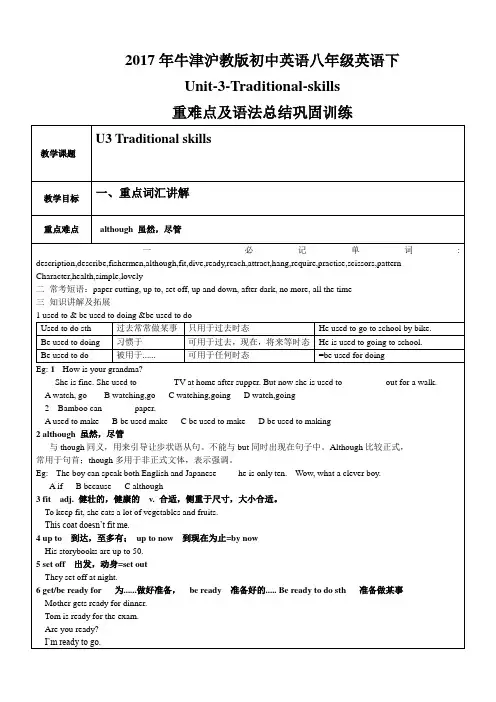
2017年牛津沪教版初中英语八年级英语下Unit-3-Traditional-skills重难点及语法总结巩固训练U3 Traditional skills教学课题一、重点词汇讲解教学目标重点难点although 虽然,尽管一必记单词: description,describe,fishermen,although,fit,dive,ready,reach,attract,hang,require,practise,scissors,patternCharacter,health,simple,lovely二常考短语:paper cutting, up to, set off, up and down, after dark, no more, all the time三知识讲解及拓展1 used to & be used to doing &be used to doUsed to do sth 过去常常做某事只用于过去时态He used to go to school by bike.Be used to doing 习惯于可用于过去,现在,将来等时态He is used to going to school.Be used to do 被用于...... 可用于任何时态=be used for doingEg: 1 --How is your grandma?--She is fine. She used to ________TV at home after supper. But now she is used to _________ out for a walk.A watch, goB watching,goC watching,goingD watch,going2 Bamboo can _______paper.A used to makeB be used makeC be used to makeD be used to making2 although 虽然,尽管与though同义,用来引导让步状语从句。
2017年牛津沪教版初中英语八下-Unit-3-Traditional-skills知识点及重难点精讲精炼

牛津沪教版初中英语八下Unit 3 Traditional skills一、要点概括二、hang on 用作电话用语(其后可接a minute, a moment, a while之类的词),意为:等一下;别放下电话;别挂断。
1.reach 除了“到达”外,还有“伸手去够或拿”的意思。
如:Some oranges are hard to reach.The girl was short so she couldn’t reach the cup on the table.【区别】get, reach和arrive♣get是不及物动词,常和to连用。
但当“到达”的地点是home或副词(here, there)时,to需要省略。
如:When did you get there last night?I get home at 7:00 pm every day.♣ arrive为不及物动词,后须加上介词in/ at才能连接表示地点的名词。
表示到达大城市或国家时要用arrive in,而到达乡村、车站等小地方则用arrive at。
如:We arrived in London last week.The doctor arrived at the village at last.♣ reach为及物动词,其后既可以跟名词也可跟副词。
如:I reached Beijing the day before yesterday.We reached here on foot.一、单词拼写。
1.The English teachers r________ the students to listen carefully.2.Let’s h__________ the picture on the wall.3.When he r________ Guangzhou, it was almost 11 pm.4.The books over there are on science. Waht about the r________.5.Eating much vegetable is good for you to keep f_________.二、完成句子。
【最新】英语下册 unit 3 traditional skills(第1课时)词汇课件 牛津深圳版
B.require
C.attract
( A )3.These pets require a lot of care and attention.
A.need
B.attract
C.hope
( B )4.The scientists set off before sunrise so that they would
【小试牛刀】 (1)言语无法形容她的美丽。
Words can’t describe her beauty.
(2)他向我描述了他的计划。
He described his plan to me.
(广州沈阳级英语下册 Unit 3 Traditional skills(第1 课时)词汇课件 牛津深圳版-牛津深圳级下册英语课件
【小试牛刀】 虽然下着雪,他们还是出去了。
Although/Thoughit was snowing, they still went out.
(广州沈阳级英语下册 Unit 3 Traditional skills(第1 课时)词汇课件 牛津深圳版-牛津深圳级下册英语课件
【小试牛刀】
( A )When Jay Chou ____________ the airport, his fans
not get sunburn at noon.
A.set up
B.set out
C.return fromቤተ መጻሕፍቲ ባይዱ
(广州沈阳级英语下册 Unit 3 Traditional skills(第1 课时)词汇课件 牛津深圳版-牛津深圳级下册英语课件
( C )5.It was a pity that you couldn’t answer such a simple
八年级下册unit3Traditionalskills知识点归纳
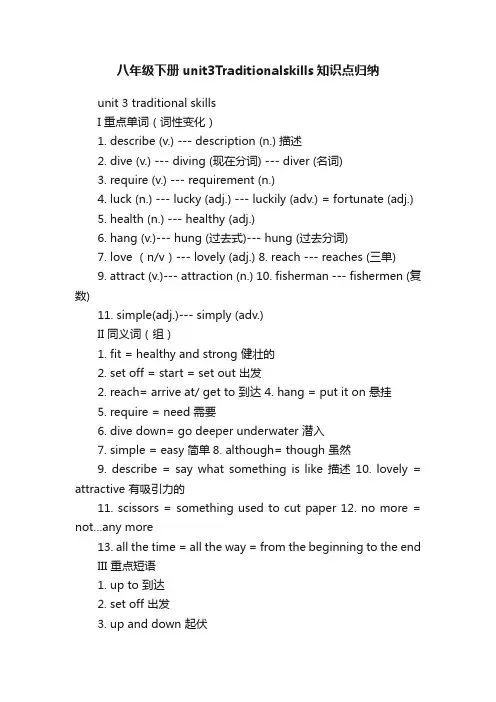
八年级下册unit3Traditionalskills知识点归纳unit 3 traditional skillsI 重点单词(词性变化)1. describe (v.) --- description (n.) 描述2. dive (v.) --- diving (现在分词) --- diver (名词)3. require (v.) --- requirement (n.)4. luck (n.) --- lucky (adj.) --- luckily (adv.) = fortunate (adj.)5. health (n.) --- healthy (adj.)6. hang (v.)--- hung (过去式)--- hung (过去分词)7. love (n/v)--- lovely (adj.) 8. reach --- reaches (三单)9. attract (v.)--- attraction (n.) 10. fisherman --- fishermen (复数)11. simple(adj.)--- simply (adv.)II 同义词(组)1. fit = healthy and strong 健壮的2. set off = start = set out 出发2. reach= arrive at/ get to 到达 4. hang = put it on 悬挂5. require = need 需要6. dive down= go deeper underwater 潜入7. simple = easy 简单8. although= though 虽然9. describe = say what something is like 描述10. lovely = attractive 有吸引力的11. scissors = something used to cut paper 12. no more = not…any more13. all the time = all the way = from the beginning to the endIII 重点短语1. up to 到达2. set off 出发3. up and down 起伏4. after dark 天黑后5. no more 不再6. all the time 一直7. dive down 潜入8. a piece of grass 一根草9. during the day 在白天10. tie…to 11. use sth. to do sth 12. stop sb. from doing sth13. in the late afternoon 黄昏时分14. get ready for 为…做准备15. push…into 把…推进…16. bring…back 把…带回17. throw …into 把…扔进18. at the front of…在…前面19. turn…into…把…变成IV 重点句子1. Although he is over 65, he is very fit and still enjoys working.虽然他已年过65 岁,但身体健康,依然喜欢劳作。
牛津深圳版英语八年级下册Unit 3 Traditional skills 第3课时——语法 课件
Are
trees and flowers planted (plant)every
It is said (say)that Mr. Li won’t come back until next
This smart phone was made (make)in China.
谢谢观看
Thank you for watching
( A ) —What do you think of the football match
—Well. It’s surprising. The strongest team of our school _______. A.was beaten B.scored C.
(C )
— —OK. I will. A.listen to B.be listening C.be listened to
(build)here. It will be
Our clothes are washed (wash)by my mother every
I was asked (ask) Some new books will be offered (offer) Was the boy hurt (hurt)on this road la
— Why is your classroom so clean and tidy? — A.is cleaning B.is cleaned C.cleans
(C )
— —When and where to go for the holiday ________ tomorrow. A.are not decided B.was not be decided C.will be decided
牛津深圳版八年级英语下册Unit 3 Words优课件
someone who catches fish, especially as their job
n. 渔夫
fisherman
a piece of material made of long, narrow
strips woven so that there are spaces
9. Please give a simple dd_e_s_c_r_ip__ti_oonf this new product. 10. He h_u_n_g___ his coat as soon as he entered the door. 11.AAl_t_h_o_u_g__h_he is only ten years old, he can speak
谢谢观赏
You made my day!
我们,还在路上……
1.Our teaching now is very different from
the ttr_a_d__it_i_o_n_a_lone. 2. This plan rr_e_q_u_i_r_e_s__careful consideration(考虑) 3. I think we should s_s_e_t_o_f_f__ for the
__fi_s_h_e_r_m__a.nHe made a living by __f_is_h_i_n_g__. (fish) 7. There are many beautiful _a_t_tr_a_c_t_io_n_sin this area.
(attract) 8. The newest movie aa_t_tr_a_c_te_d__ the young very much
牛津深圳版八下Unit-3-Traditional-skills词汇短语精讲(包含答案)
Unit 3 Traditional skillsWarm-up: 口语角一.用正确的语音和语调朗读下列短文。
Doctor Li is a well-known doctor. People from all over the city come to see him. Last week, Doctor Li was even busier than usual. On Monday morning, some children came to see him. They all had cold s. In the afternoon, he went to Bill’s house. Bill is a ten-year-old boy. He can’t walk, so Doctor Li always goes to him when he is sick. Bill had a cough last week. Doctor Li then went to Beijing. He was there from Tuesday to Friday. He had a meeting at a big hospital. On Saturday, there was a football match at the stadium. Doctor Li went to the stadium, but not to watch the game! He went there to help the team, because the team’s usual doctor was ill.二.情景对话1.My grandpa is a farmer. What about yours2.I saw cormorants in Guangxi. Do you know what they are good at3.【4.Your paper picture is beautiful. How much is it5.Can you tell me what your English teacher looks like6.Do you like Chinese knots Why三.根据所给提示简短说话在英语课上,你向同学们介绍你的爸爸或妈妈。
牛津深圳八年级下册知识点Unit 3 Traditional skills
Unit 31. describe v. 描述;形容description n. 说明;形容2. health n. 健康healthy adj 健康的healthily adv 健康地healthy (比较级healthier)adj. 健康的= fit adj. 健壮的;健康的keep fit/healthy 保持健康be in good (poor/bad) health 健康状况好(不好)3. attract v. 吸引;使...喜爱attraction n. 吸引;魅力;引人注意的东西attractive adj. 有魅力的;引人注目的attract one’s attention 吸引某人的注意get one’s attention得到某人的关注4. ready adj. 准备好的get/be ready for sth为...做好准备I am ready for the exam.= I get ready for the exam.be ready 准备好的be /ready to do sth, 准备做某事I am ready to pass the exam= I get ready to pass the exam.5. luck n. 幸运lucky adj. 幸运的unlucky adj. 不幸的luckily adj. 幸运地unluckily adv. 不幸地6. fisherman n. 渔民复数是fishermen 很多渔民7. net n. 网Internet 互联网15. practise v. 从事practice n 练习;实践;practical adj. 实践的,实际的;practically adv. 实际上;几乎practise doingShe and I used to practise drawing and writing poetry together. 我们天天在一处学画,学诗。
深圳新版英语八下Unit_3_Traditional_skills(单词_词组_Reading知识点)
Lesson 5 Unit 3 Traditional skills(单词、词组)一、知识导航:知识目标必记单词1. describe v. 描述;形容 description n. 说明;形容2. health n. 健康 healthy (比较级healthier) adj. 健康的=fit adj. 健壮的;健康的 keep fit/healthy 保持健康 bein good (poor/bad) health 健康状况好(不好)3. attract v. 吸引;使...喜爱 attraction n. 吸引;魅力;引人注意的东西 attractive adj. 有魅力的;引人注目的 attractone’s attentin 吸引某人的注意 get one’s attention得到某人的关注 4. ready adj. 准备好的 get/be ready for 为...做好准备 be ready 准备好的 be ready to do sth, 准备做某事5. luck n. 幸运 lucky adj. 幸运的 unlucky adj. 不幸的luckily adj. 幸运地 unluckily adv. 不幸地6. fisherman n. 网民 net n. 网 although conj. 尽管cormorant n. 鸬鹚 dive v. 下潜 reach v. 到达hang(hung,hung) v. 悬挂;吊 post n. 柱;杆;桩require v. 需要;依靠 practice v. 从事 tool n. 工具scissors【pl】 n. 剪刀 pattern n.图案 character n. 文字;符号;人物;角色 wedding n. 婚礼;结婚庆典 dough n.生面团 rough adj. 粗糙的 size n. 大小 simple adj. 简单的 lovely adj. 有吸引力的;迷人的常考短语1. paper cutting 剪纸2. up to 到达(某数量、程度等);至多有3. set off /out 出发 set out/off for 出发去...4. up and down 起伏;上下波动 5. after dark 天黑后;黄昏后 6. no more 不再;再也不 7 . all the time (在某段时间内)一直;始终 8.a kind of 一种 9. tie...around 拴...在...周围 tie...to 拴...在...上10. at the front of 在...前面 11. throw...in to 把...扔进 12. lookup 抬头看 13. bring up 抚养;养育; 14. turn...in to 把...变成二、要点全解1. W used to use horses.Use to do 表示“过去常常,过去是“,没有人称和数的变化,可以和过去的时间状语连用。
深圳新版英语八下Unit_3_Traditional_skills(单词_词组_Reading知识点)
Lesson 5 Unit 3 Traditional skills(单词、词组)一、知识导航:二、要点全解1. W used to use horses.Use to do 表示“过去常常,过去是“,没有人称和数的变化,可以和过去的时间状语连用。
否定形式:usedn’t to 或didn’t use to ,疑问句将used提前或Did…use to …?Eg:We usen’t to use horses./We didn’t use to use horses.Used you to use horses?/Did you use to use horses?跟踪练习1.翻译下列句子(1)My father used to eat meat.(2)My father is used to eating meat.(3)He wasn’t used to eating i n a restaurant.(4)The boy use remote control to drive the toy car all around the playground.(5)The birds use the wings to fly.(6)The cormorants was once used to catch fish.2.--How is your grandma?--She’s fine. She used to ______ TV at home after supper. But now she is used to ______ out for a walk.A. watch; goB. watching; goC. watching; goingD. watch; going3.Bamboo can ______ paper.A. used to makeB. be uesd makeC. be used to makeD. be used to making2.Although he is over 65, he is very fit and still enjoys working.(1)Although连词,虽然;尽管, 连词,与though同义,用来引导让步状语从句,不能和but同时出现,但可以用yet 或still。