
外研版英语七年级上册Module 4知识点归纳
七年级上册第四模块
一:要求掌握的单词
many: 许多people: 人们,人aunt: 伯母,婶母,姑姑姨grandfather: 祖父,外祖父grandmother: 祖母,外祖母grandparent: (外)祖父,(外)祖母uncle: 叔叔,伯伯,舅舅,姑父,姨夫sister: 姐妹have: 有have got: 拥有grandma: 奶奶,姥姥grandpa: 爷爷,姥爷email: 电子邮件him: 他(宾格)make 做,制造cousin: 堂兄弟,堂姐妹
二:要求掌握的词组,句子。
1.have(has) got 相当于have 都为“有,归某人所有”的意思。
英国人常用have(has) got,
美国人常用have(has),在肯定句中无差别,在疑问句中含有have(has) got 的,直接将have(has)提至句首,含有have(has)的要加助动词do(does), 在否定句中含有have(has) got的,在have(has)的后面直接加not, 含有have(has)的需要加助动词don’t(doesn’t).
并且have(has) got 可以和句首的主语缩写成‘ve(‘s)如:I’ve got : We’ve got : You’ve got ; They’ve got : He’s got : She’s got : It’s got :并且have(has) got 和not 也可以缩写:have not got = haven’t got : has not got= hasn’t got
(1). I have a nice bike. (否定句)_____________________________________.
(2). He has some brothers and sisters. (一般疑问句及否定回答)
______________________________? ________, ______________.
(3). She has got an aunt. (否定句)____________________________________.
(4).They have got many friends. (一般疑问句及肯定回答)
_____________________________? _________, _______________.
(5). He has a very beautiful car. (同义句)______________________________.
(6). I have got some brothers.(否定句)__________________________________.
2. How many/How much :都是来提问“数量”,How many 提问可数名词的数量,How much 问不可数名词的量。
How many +复数名词/How much +不可数名词。
There are four people -- my mum and dad, my sister and I in my family.(划线提问)
___________________________________________________________?
3. people:人,人们:(做主语时,是复数)people也有“民族”之意,复数可以直接在词尾+s
Look! The people _________ (boat) in the river.
Many people ________ (do) morning exercises in the park everyday.
4. ----- Have you got a small family or a big family?
-----I’ve got a big family. There are …… people in my family.
(1):选择疑问句的构成:一般疑问句+or+供选择的对象?
(2):不用Yes / No 来回答。
可以直接回答。
5. Thank you for…..= Thanks for…..: 因……而感谢某人。
for是介词,后面接名词,代词或动词ing 形式作宾语。
Thank you for your email = Thanks for your email
谢谢你的到来:__________________________________________
谢谢你的帮助:_________________________________________
谢谢你教得我们这么好:_________________________________
6. I’ve got an aunt. (否定句)______________________________.
7. I have got some uncles, brothers and sisters.(一般疑问句)
________________________________________________?。
外研版英语七年级上册Starter Module 4 Unit2 知识点归纳
Unit2 知识点归纳【单词】1.h ot 热的①热的It’s very hot today.今天天气很热。
I want to have a hot bath.我想洗个热水操。
②烫的The water is hot. Please be careful.水是烫的。
请小心点儿。
③引申可表示“辣的”。
Pepper and mustard are hot.辣椒和芥末是辣的。
2. cool 凉快的①凉的,凉快的a cool day凉爽的一天 a cool room 一间凉爽的屋子Autumn is very cool in Beijing.北京的秋天很凉爽。
②冷静的;沉着的We need someone with a cool head.我们需要头脑冷静的人。
3. cold 冷的①冷的;寒冷的cold water 冷水 a cold wind 冷风It’s getting cold. Please close the window.天凉了。
请关上窗户吧。
②冷淡的,冷漠的,不热情的a cold handshake冷淡的握手【拓展】cold还可作名词,意为“寒冷”,还可表示“感冒”。
have a cold 患感冒Don’t go out in the cold without a coat.4. weather 天气备weather指某一地区某一时间的具体天气情况,如阴晴、气温、降水、风向等。
weather是不可数名词,其前不可加不定冠词a。
What is the weather like in Beijing?北京天气怎么样?5. like如同,像①如同Do it like this.照这样做。
②像She’s very like her mother.她很像她的母亲。
She cried like a baby.她像个婴儿一样哭。
【拓展】like还可作动词,意为“喜欢”,后可接名词、代词、动名词或动词不定式作宾语,表示“喜欢……”。
外研版七年级英语上册详细知识点汇总
Module1 My Classmates一、单词1. Chinese n. 汉语;中国人adj. 中国的,中国人的(1)作“语文,汉语”讲时,为不可数名词;作“中国人”讲时,为可数名词,单复数形式相同。
Eg. He can speak a little English. 他能说一点英语。
We are all Chinese. 我们都是中国人。
(2)作为“中国的,中国人的” 讲时,为形容词。
在句中作定语和表语。
eg. I’m Chinese. 我是中国人。
I’m a Chinese student. 我是一名中国的学生。
2.American n. 美国人;美洲人Adj. 美国的;美国人的;美洲的2.welcome v.欢迎adj.受欢迎的(1)“欢迎”welcome sb.to...“欢迎某人到......”eg.Welcome you to China.欢迎你来到中国。
(2)“受欢迎的”①作为形容词在句中常做表语eg.You are welcome here.你在这儿是受欢迎的。
②用作答谢的客套话,表示“不客气,别客气”eg.—Thank you!谢谢你!—You are welcome!不客气!3.too adv. 也;太(1)表示“也”,常放在肯定句句尾,表示某情况也适合某人,句尾常用逗号隔开。
eg. I’m a student, too. 我也是一名学生。
(2)表示“太”,修饰形容词或副词的原级。
eg: The room is too big. 这个房间太小了。
二、基本句型1. ---What’s your name?你叫什么名字?---My name is.../I’m...我是......2.---Where are you from?/Where do you come from?你来自哪里? ---I’m from…/I come from...我来自...3. --- How old are you?你多大了? ---I’m...years old./I’m...我... 岁了。
外研版七年级上册英语Module4Unit1We’vegotlotsofapples.
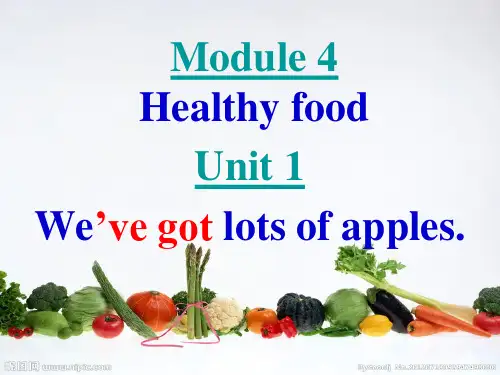
Work in groups (ABCD) A: Has he got any chocolate? B: Yes, he has. /No, he hasn’t.
√
√
×
×
Food Drink
Things Tony’s family has got at home
chocolate, apples
Let’s say说一说:
--Have you got any… ? -- Yes, I have.
-- Have you got any… ? -- No, I haven’t. -- So let’s get some.
(所以让我们去买一些)
-- Ok,good idea!
Tony and his dad are talking about going shopping. Let’s listen to the dialogue.
She has got a table.
2) 含有have / has got的肯定句变为否定 句时,在have或has后加not 即可。 have not 缩写 haven’t has not 缩写 hasn’t
e.g. They haven’t got a big television. 他们没有大电视。
food drink candy fruit meat
vegetables apples
beans
beef carrots
potatoes
chicken tomatoes
chocolate
coffee
cola
juice milk tea
water
Words and expressions
外研版七年级上册英语全书短语归纳

外研版七年级上册英语全书短语归纳Module 11. come from来自= be from 来自2. Nice to meet you. /Good to see you.很高兴见到你It’s nice to meet you.3.Welcome sb to somewhere 欢迎某人来到某地4. Class One Grade Seven 七年级一班5. the capital of …的首都.省会6. family name =last name 姓given name = first name 名7. 提问年龄How old be sb? What’s sb’s age?Module 21.on the left 在左边2. on the right 在右边On the left/right o f…3. next to 在…隔壁The woman next to her在她旁边的那个女人4. in front of 在…前面5. behind 在…后面6.at the same hospital 在同一家医院7.What a big family! 好大的家庭啊!你父亲的职业是什么?8.What’s your father’s job?= What does your father do?9. a photo of sb. 某人的照片10. a hotel manager/ a manager of a hotel宾馆经理A theatre manager / a manager of a theatre 剧院经理11. at a police station 在警察局12. a bus station 公共汽车站13. a farm worker 一位农场工人14. family doctor 家庭医生15. family (集合用法)①视为“整体”谓语动词用单数②视为“每个家庭成员”谓语动词用复数。
外研版七年级上册英语Module4讲义
1、food1)当food作“食物;粮食;食品”讲时,用作不可数名词。
例如:We like Chinese food very much .Let’s go to buy some food.2)当表示特定种类的食物时,用作可数名词,其复数形式是“food”。
A favourite food 最喜欢吃的一种食品Frozen foods 冷冻食品拓展:A、类似用法的单词还有:fruit,fish,表示物品的数量时,用作不可数名词;而表示物品的种类时,则可看作是可数名词。
例如:I want to buy some fishThere are different kinds of fishes in the lake.B、食物类的不可数名词有:beef牛肉,meat肉,pork猪肉,chicken鸡肉,fish鱼肉,rice 米饭。
2、drink的用法1)课文当中用作名词,意为“饮料”。
A、当drink作“饮料”讲时,一般为不可数名词。
Have you got any drink?你有饮料吗?B、指不同种类的饮料时,为可数名词。
Cola isn’t a healthy drink。
可乐不是健康的饮料。
C、Drink还可指“一杯(饮料)”或“一份(饮料)”。
Let’s have a drink.咱们喝一杯吧!拓展:喝的不可数名词有:juice果汁,milk牛奶,orange橘汁,water水,tea茶,coffee咖啡。
3、Candy即是可数又是不可数名词,意为“糖果”。
I like to eat candy very much。
我非常喜欢吃糖果。
4、meat不可数名词,意为“肉”。
与meet”遇见“为同音词。
注意:由于它是不可数名词,所以,不能用many,或few 修饰,而用some,any,much,lots of,a little等修饰。
5、Fruit 名词,意为水果,通常用作集合名词,无复数形式;但是表示不同种类的水果时加-s。
外研版英语七年级上册Module4 语法要点:some,any用法辨析
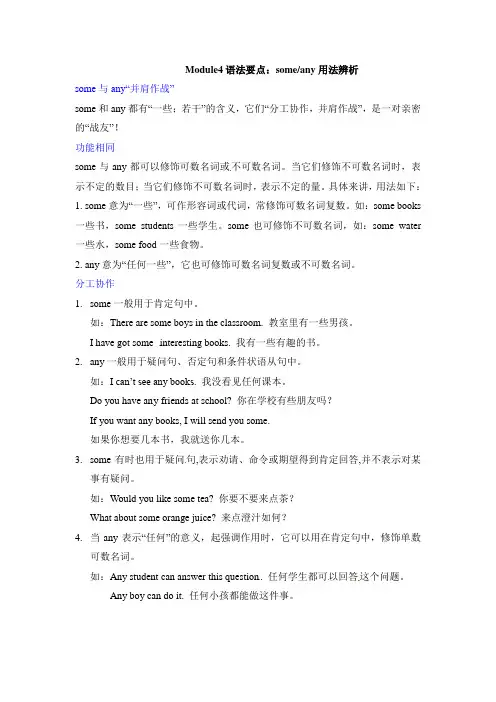
Module4语法要点:some/any用法辨析some与any“并肩作战”some和any都有“一些;若干”的含义,它们“分工协作,并肩作战”,是一对亲密的“战友”!功能相同some与any都可以修饰可数名词或不可数名词。
当它们修饰不可数名词时,表示不定的数目;当它们修饰不可数名词时,表示不定的量。
具体来讲,用法如下:1. some意为“一些”,可作形容词或代词,常修饰可数名词复数。
如:some books 一些书,some students一些学生。
some也可修饰不可数名词,如:some water 一些水,some food一些食物。
2. any意为“任何一些”,它也可修饰可数名词复数或不可数名词。
分工协作1.some一般用于肯定句中。
如:There are some boys in the classroom. 教室里有一些男孩。
I have got some interesting books. 我有一些有趣的书。
2.any一般用于疑问句、否定句和条件状语从句中。
如:I can’t see any books. 我没看见任何课本。
Do you have any friends at school? 你在学校有些朋友吗?If you want any books, I will send you some.如果你想要几本书,我就送你几本。
3.some有时也用于疑问句,表示劝请、命令或期望得到肯定回答,并不表示对某事有疑问。
如:Would you like some tea? 你要不要来点茶?What about some orange juice? 来点澄汁如何?4.当any表示“任何”的意义,起强调作用时,它可以用在肯定句中,修饰单数可数名词。
如:Any student can answer this question. 任何学生都可以回答这个问题。
Any boy can do it. 任何小孩都能做这件事。
2024外研版英语七年级上册复习知识点汇总
七年级上Revision of Starter 一、重点短语sit down坐下stand up站起来how old多大after school/class放学后/下课后listen to music听音乐welcome to+地点欢迎来某地in English用英语say that again再说一遍of course当然what color什么颜色eve,yday life每天的生活good idea好主意how many/how much多少thank you/thanks谢谢put up sb's hand举起某人的手telephone number电话号码write it on the blackboard把它写在黑板上play basketball/football打篮球/踢足球in Class Five Grade One在一年级五班see you tomorrow明天见go swimming去游泳m+国家/城市等在国家/城市等at+车站/学校/家等在车站/学校/家等sb's favorite sport/color某人最喜欢的运动/颜色good morning/afternoon/evening早上好/下午好/晚上好二、重点句型l---\邓at's your name, please? 请问你叫什么名字?---I'm/My mane's... 我叫.2.---How are you ? 你好吗?---F ine,thanks.很好,谢谢……..in spring/summer/autumn/winter在春/夏/秋/冬等3.---This is my friend/teacher, and his/her name is/he is...这是我的朋友/老师,他的名字是.4.---I t's time to go now. Goodbye.现在该走了,再见。
外研版七年级上册英语Starter Module 4重要知识点讲解
Starter Module 4重要知识点讲解Unit 1一、询问星期几的句型-What day is it today?今天是星期几?-It's Monday.[点拨]what day用来对星期提问,回答用“It,s +星期”。
二、询问最喜欢哪天的表达What day is your favourite day?你最喜欢星期几?[点拨]"What day is your favourite day?H用于提问最喜欢哪天。
favourite此处用作形容词,意为“最喜欢的”,其后跟名词。
如:Sunday is my favorite day.我最喜欢的是星期天。
Unit 2一、询问天气状况的表达What's the weather like in spring?春天天气怎么样?[点拨]“What's the weather like..?'用于询问天气状况。
同义表达:How is the weather...?该问句的回答:It's +表天气状况的形容词(如cool, cold, warm, hot等)”。
-What's the weather like today?今天的天气怎么样?-It's cold.很冷。
Unit 3一、以Let开头的祈使句Let's play football after school.我们放学后去踢足球吧。
[点拨]例句是一个以let开头的祈使句,用于提出建议或征求别人的意见。
肯定:“Good idea./OK./All right./YesJet's...”等;否定:"Sorry,I...”二、介词on的用法[点拨]on是介词,意为“在......的时候”,主要是用在星期几,具体的某一天或某一天的早、中、晚或节日之前。
on Sunday在星期天on a cold morning在一个寒冷的早晨。
外研版七年级英语上册Module 4模块知识点归纳
外研版七年级英语上册Module 4 Healthy foodWe've got lots of apples.必背单词1.candy (n.)糖果→candies (pl.)2.potato (n.)马铃薯,土豆→potatoes3.have (v.aux.)助动词(v.)有,吃、喝→has(第三人称单数形式) 4.kind (n.)种类→kinds (pl.)5.bad (adj.)坏的,不好的→good(反义词)好的6.food (n.)食物,食品7.drink (n.)饮料;(v.)喝8.fruit (n.)水果9.meat (n.)肉10.vegetable (n.)蔬菜11.apple (n.)苹果12.bean (n.)豆13.beef (n.)牛肉14.carrot (n.)胡萝卜15.chicken (n.)鸡肉16.chocolate (n.)巧克力17.coffee (n.)咖啡18.juice (n.)果汁19.milk (n.)牛奶20.tea (n.)茶21.water (n.)水22.shop (v.)逛商店;购物23.get (v.)得到24.some (adj.)若干,一些,少量的(pron.)一些,某些25.so (conj.)因此,所以必背短语26.go shopping去买东西,去购物27.have got有;拥有28.too much太多29.lots of大量;许多必背句子30.Let's get some chicken.我们买些鸡肉吧。
31.What kind of fruit?哪种水果?32.How about some orange juice?买些橘汁怎么样?33.Let's get some for your mum.我们给你妈妈买一些。
Is your food and drink healthy? 必背单词1.healthy (adj.)健康的→health (n.)健康2.child (n.)(14岁以下的)小孩;儿童→children (pl.)3.right (adj.)正确的,对的→wrong(反义词)4.tooth (n.)牙齿→teeth(pl.)5.tired (adj.)劳累的(主语为人)→tiring (adj.)令人劳累的(主语为物) 6.important (adj.)重要的→importance (n.)重要性7.well(adv.)好地→good (adj.)好的8.fat (adj.)肥胖的→thin(反义词)瘦的9.delicious (adj.)美味的10.bread (n.)面包11.fish (n.)鱼肉;鱼12.hamburger (n.)汉堡包13.noodle (n.)面条14.rice (n.) 米;米饭15.sugar (n.)糖16.eat (v.)吃17.sweet (adj.)甜的18.egg (n.)蛋,鸡蛋19.eye (n.)眼睛20.cheese (n.)奶酪21.soup (n.)汤22.remember (v.)记住;想起23.stay (v.)保持,停留24.or (conj.)或者25.breakfast (n.)早饭lunch(n.)午饭26.every (adj.)每个,每一27.home (n.)家,家庭必背短语28.ice cream冰激凌29.be good for对……有帮助30.be bad for对……有害31.a bit稍微,有点儿32.get fat发胖必背句子33.Is your food and drink healthy?你的饮食健康吗?34.It is important to remember:eat well, stay healthy, and don't get fat!记住这些很重要:吃得好,保持健康,不要太胖!35.Have a good breakfast every morning.每天早上吃一顿很好的早饭。
外研版 七年级上册Starter Module 4 知识点总结
Starter Module 4 知识点一.单词季节season 春spring 夏summer 秋autumn\fall 冬winter天气weather 暖和的warm 炎热的hot 凉爽的cool 寒冷的cold一天day 今天today 明天tomorrow 最喜欢的favourite 喜欢like生日birthday 星期一Monday 星期二Tuesday 星期三Wednesday星期四Thursday 星期五Friday 星期六Saturday 星期天Sunday运动sport 篮球basketball 足球football 乒乓球table tennis 游泳swimming 让let 我们(宾格) us 参加,玩耍play 想法,主意idea 中国Chinese 北京Peking 英国England 伦敦London二.词组在黑板上on the blackboard 在你的书上in your book放学后after school 在春天in spring 在夏天in summer 在秋天in autumn 在冬天in winter 打篮球play basketball 踢足球play football 打乒乓球play table tennis去游泳go swimming 我最喜欢的运动my favourite sport你最喜欢的运动your favourite sport 他最喜欢的运动his favourite sport她最喜欢的运动her favourite sport 好主意good idea 在周一on Monday 在周日on Sunday 今天早上this morning 今天下午this afternoon三.句子1.今天是星期几?今天是周二。
What day is it today? It’s Tuesday.2.明天是星期几?明天是周三。
What day is it tomorrow? Tomorrow is Wednesday.3.今天是星期四,明天是星期五。