
七年级英语下册《Unit10_I’d_like_some_noodles_Section_A》课件_(新版)人教新目标版
noodles
rice
Exercise:
What would you like ? I’d like What would you like ? I’d like
porridge
What would he like ? He’d like What would she like ? She’d like
A: What kind of noodles would you like? B: I’d like tomato and egg noodles.
A: What kind of noodles would you like?
B: I’d like beef and carrot noodles.
any的用法: any意为“任何一些”,它也
可修饰可数名词复数或不可数名词,常
用于疑问句和否定句。如:
I can’t see any tea. 我没看见茶叶。
Do you have any friends at school?
你在学校有些朋友吗?
当any表示“任何”的意义,起强调作用时, 它可以用在肯定句中; 如:Any student can answer this question. 任何学生都可以回答这个问题。
3
May I take your order?/Can I help you?
1) 这都是服务用语, 可根据不同的服务场合
翻译成不同的意思。如: 在餐馆, 都可以用,
翻译成: “你想吃点什么?” ,
在商店, 用后者,则是“你想买点什么?”
2) 类似的服务用语还有What can I do for
you? 此句的本义为: “我能为你做点什么?”
5. 否定句: would 后+not would not like n.
would not like to do
eg: I would not like the red tea.
They would not like to swim this afternoon
1.I would like some beef.
some的用法: some意为“一些”,可作形
容词和代词。常用在肯定句中,修饰可数名词
复数也可修饰不可数名词 如:some books 一些书 some boys 一些男孩,
some water 一些水,some tea 一些茶叶,
但在表示建议,反问,请求的疑问句中,或 期望得到肯定回答时,多用some而不用any。 如:Would you like some coffee? 你要不要来点咖啡? How about some fruit juice? 来点水果汁如何?
Language points
1
some和any的用法
some和any 既可以修饰可数名词又可以修 饰不可数名词, some常用在肯定句中, 而 any则常用在否定和疑问句中。所以, some 和 any 的区别在于: some和any 的用法主要 是考虑用在肯定句、疑问句还是否定句中, 与名词的可数与否无关。
否定句
: I would not like any beef. 一般疑问句及回答:Would you like any beef ? Yes, I would. / Yes, please. No, I wouldn’t. No, thanks. I’m full. / I don’t want it now
Practice
用 a, an或 some填空。
a 1. _______ potato 2. _______ beef some 3. ________ milk some 4. ________ strawberry a 5. ________ chicken some 6. ________ egg an 7. ________ mutton some 8. ________ apple an 9. ________ tomato a 10. ______ noodles some
--What would you like?
--I’d like some drinks.
=What do you want ? I want some drinks. 2) would like to do = want to do eg: --What would you like to do today? -- I would like to play basketball. =What do you want to do today? I want to play basketball. 3)would like sb.to do sth.=want sb.to do sth. --I would like you to go with me. = I want you to go with me.
单数名词做定语
What size bowl of noodles would you like?
I’d like…
a small bowl of noodles a medium bowl of noodles
a large bowl of noodles
What size bowl of noodles would he/she like? He/She’d like a…bowl of noodles. large
What would you like ?
What would they like ?
They’d like
I’d like
noodles
I’d like noodles.
He’d like noodles. She’d like noodles.
A: What kind of noodles would you like? B: I’d like mutton and potato noodles.
她想要羊肉和卷心菜面条。
She’d like mutton and cabbage noodles.
3. Would you like sth? 是提建议的一种句型,
如需用一些, 用some而不用any。 其否定回答是: No, thanks. --Would you like some bananas? -- Yes, please. / No, thanks.
写出下列可数名词的复数形式
1. dumpling __________ apple_______ dumplings apples boxes watches 2. box ______ watch _______ leaves thieves 3. leaf _____ thief _______ 4. country _________ countries strawberry ____________ strawberries 5. policeman __________ woman _______ policemen women 6. potato ________ tomato _________ potatoes tomatoes
肯定回答是: Yes, please. /All right. / Yes. / OK.
4. 一般疑问句: 情态动词 would 提前:
Would sb. like sth. / to do sth.?
eg: She would like to go shopping.
Would she like to go shopping?
2
可数名词和不可数名词
可数名词: 可以计数的名词称为可数名词。 一般有
单数与复数两种形式, 前面可加a, an或数词来修饰.
不可数名词: 不可计数的名词称为不可数名词。
没有复数形式, 前面不能用不定冠词a, an, 也不能
直接加数词, 但可以跟某些量词短语搭配,
表示数量。如: a glass of water, two cups of tea.
medium small
1
Grammar
would like “想要” (表示一种委婉的语气) 其用法相当于want。 would like an apple (want an apple) would like to play soccer (want to play soccer)
1. would 是情态动词, 没有人称和数的变化, 可与
bananas
strawberries
oranges apples
What kind of vegetables would you like? I’d like some… potatoes
onions
carrots
tomatoes
What kind of vegetables would he like? He’d like some…
A: What kind of noodles would you like? B: I’d like chicken and cabbage noodles.
A: What kind of noodles would you like?
B: I’d like pork and cabbage noodles.
人称代词缩写为’d, 与其它情态动词一样可帮助 完成疑问句和否定句。如: 我想要些牛肉。 I’d like some beef. 她想去打乒乓球。She would like to play ping-pang.
2. Would like 句型总结
1) would like + n. = want + n. e.g.
Countable nouns
Uncountable nouns
Countable and Uncountable nouns chicken, salad, ice-cream, cabbage ,fish, onion
七年级英语下册Unit10I’dlikesomenoodles短语、语法知识点汇总(新版)人教新目标版

Unit 10 I’d like some noodles基础归纳【教材内容解析】Section A1.What would you like? (P. 55)would like表示“想要”,相当于want,后接名词、代词或者动词不定式作宾语。
I would like a cup of tea now.2.I’m not sure yet. (P. 55)(1) sure的用法① be sure of/about sth. 对……确信Are you sure about the news?② be sure to do sth. 确保做某事Be sure to lock the door when you leave home.③ be sure that....确信……I am sure that he will come soon.④ make sure that...确保……Make sure that you can finish the job on time.(2)yet此处用作副词,表示“还、仍然”,常用于否定句和疑问句中。
Is everything ready yet?3. ---Are there any vegetables in the beef noodles?---Yes, there are some tomatoes. (P. 55)some一般用在肯定句中;any一般用在否定句、疑问句中。
例句:There are some birds in the tree. 例句:Do you have any questions?特殊情况:some可以用在疑问句中,表达“建议、请求、邀请” 并希望得到对方的肯定回答例句:Would you like some tea? 例句:Can I have some oranges?4.May I take your order? (P. 56)本句是服务员询问顾客是否点餐的常用交际语,order此处用作名词,表示“点菜”。
新目标英语七年级下册Unit 10 I'd like some noodles.知识点归纳
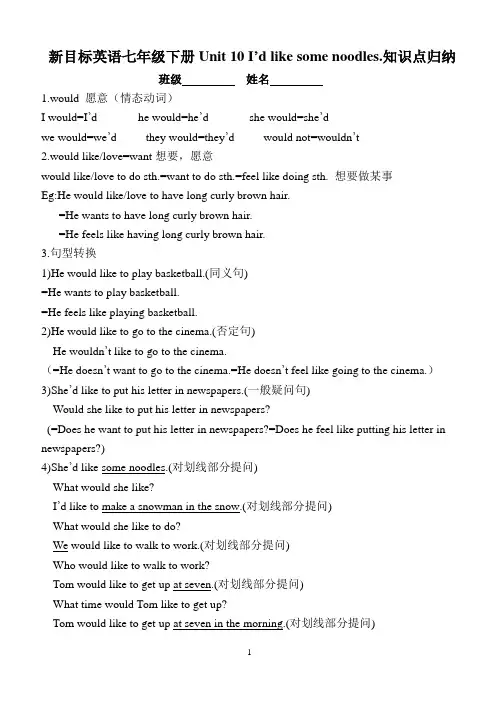
新目标英语七年级下册Unit 10 I’d like some noodles.知识点归纳班级姓名1.would 愿意(情态动词)I would=I’d he would=he’d she would=she’dwe would=we’d they would=they’d would not=wouldn’t2.would like/love=want想要,愿意would like/love to do sth.=want to do sth.=feel like doing sth. 想要做某事Eg:He would like/love to have long curly brown hair.=He wants to have long curly brown hair.=He feels like having long curly brown hair.3.句型转换1)He would like to play basketball.(同义句)=He wants to play basketball.=He feels like playing basketball.2)He would like to go to the cinema.(否定句)He wouldn’t like to go to the cinema.(=He doesn’t want to go to the cinema.=He doesn’t feel like going to the cinema.)3)She’d like to put his letter in newspapers.(一般疑问句)Would she like to put his letter in newspapers?(=Does he want to put his letter in newspapers?=Does he feel like putting his letter in newspapers?)4)She’d like some noodles.(对划线部分提问)What would she like?I’d like to make a snowman in the snow.(对划线部分提问)What would she like to do?We would like to walk to work.(对划线部分提问)Who would like to walk to work?Tom would like to get up at seven.(对划线部分提问)What time would Tom like to get up?Tom would like to get up at seven in the morning.(对划线部分提问)When would Tom like to get up?He’d like to play basketball at school.(对划线部分提问)Where would he like to play basketball?I’d like to see the giraffes. Because they are smart.(对划线部分提问)Why would you like to see the giraffes?I would like to go to school on foot.(对划线部分提问)How would you like to go to school?They’d like two potatoes.(对划线部分提问)How many potatoes would they like?They’d like a little milk.(对划线部分提问)How much milk would they like?I’d like a medium bowl of noodles.(对划线部分提问)What size bowl of noodles would you like?I’d like some beef and tomato noodles. (对划线部分提问)What kind of noodles would you like?5)I’d like some beef and potato noodles.(同义句)=I’d like some noodles with beef and potatoes.How old are you?(同义句)=What’s your age?6)Can you tell me? What does he want?(合并句子)Can you tell me what he wants?4.Would you like some noodles? 你想要一点面条吗?Yes,please. 是的。
Unit10-I’d-like-some-noodles教案精选全文完整版

可编辑修改精选全文完整版“聚焦教与学转型难点”的高效课堂教学设计课题名称:Unit10 I’d like some noodles(第一课时)姓名工作单位年级学科七年级教材版本一、教学难点内容分析(简要说明课题来源、学习内容、知识结构图以及学习内容的重要性)本堂课主要学习日常生活中有关的食物名称的单词noodles, mutton, beef, cabbage, potato,tomato, chicken等,掌握large, medium, small等描述分量大小的单词;学会would like句型的特殊疑问句及其回答。
难点:灵活应用新句型模拟生活场景进行点菜等对话。
二、教学目标(从学段课程标准中找到要求,并细化为本节课的具体要求,目标要明晰、具体、可操作,并说明本课题的重难点)英语新课程标准指出,基础教育阶段英语课程的总目标是培养学生的综合语言运用能力,而它又以学生语言知识、语言技能、学习策略、情感态度和文化意识五个方面的综合素养为基础。
根据总目标,结合本课教学内容及学生实际,我确定这节课的教学目标为:1、知识目标掌握新单词: noodles, beef, mutton, chicken, cabbage, potatoes, tomatoes, large.学会由would like构成的两个疑问句及回答,并能够使用该语言进行交际对话2、能力目标学生英语听说能力能够提高学生在角色扮演、自编对话的过程中锻炼表演能力和语言组织能力3、情感目标“从做中学”,在活动中学生能体会到学习英语的乐趣,树立学习英语的信心;模拟生活场景,在交流中增长生活经验,促进人际交往。
三、学习者特征分析(学生对预备知识的掌握了解情况,学生在新课的学习方法的掌握情况,如何设计预习)七年级学生有一定的语言基础,在小学英语学习和七年级上册英语学习中掌握了一定量的单词和句型,如hamburger, salad, ice-cream, egg,etc.What’s your favorite food ?What would you like ?他们充满好奇,有较强的求知欲、模仿能力和表现欲望。
七年级英语下册 Unit 10 I’d like some noodles单元教案 (新版)人教新目标版
元
教
学
目
标
1.知识目标:
学习、掌握本单元所出现的生词及短语,学习运用目标语言来订餐。
2.能力目标:
通过本单元的学生能够询运用所学词汇和句型模仿情景进行订餐对话练习。
3.教学方法 :通过学生的讨论、合作和探究的学习方法式。
4.情感态度价值观:通过对本单元的学习,帮助学 生养成不挑食、不偏食、均衡饮食的好习惯。
教学重点:
1.Would like to do sth.的含义及用法。
2.There be结构的用法
教学难点:1.可数名 词与不可数名词的用法。
2.And和or用法的辨析。
课时安排
Perio d 1SectionA1 a1c Period 2Section A2a-2d
Period 3 SectionA Grammar Focus-3cPeriod 4Section B1a1d
Period 5Section B2a3c
Period 6单元知识点归纳
Unit 10 I’d like som e noodles
单元
主题
Unit 10 I’d like som e noodles
教
材பைடு நூலகம்
分
析
本单元的核心话题是order food,通过本单元的学习学生能运 用所学词汇和句型模仿情景进行订餐对话练习,并尝试着自己写出食品宣传广 告。本单元有承上启下的作用由于前面已学过有关食物的词所以现在学起来 很感兴趣。本单元主要围绕面条的种类来学习如何订餐,让学生在创设的情境中模拟练习,极大地调动了学习的兴趣和激情。
七年级英语下册Unit10-I27d-like-some-noodles
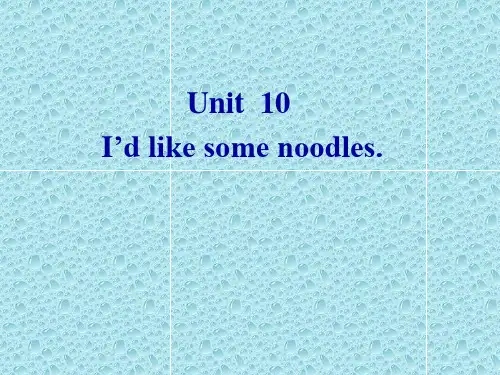
a large bowl of noodles
What size bowl of noodles would he/she like? He/She’d like a…bowl of noodles.
small
medium
large
2a. Listen and check the names of the foods you hear.
1. ___a____ potato 2. __s_o_m_e__ beef 3. __s_o_m_e___ milk 4. ____a____ strawberry 5. __s_o_m__e__ chicken 6. ___a_n____ egg 7. __s_o_m__e__ mutton 8. ___a_n____ apple 9. ____a____ tomato
1. __√____ noodles 5. _√____ tomatoes 2. __√____ beef 6. _√____ cabbage 3. ______ mutton 7. _√____ potatoes 4. __√____ chicken 8.__√___ vegetables
2b. Listen again . Complete the sentences.
I’d like chicken and cabbage noodles.
I’d like mutton and potato noodles.
I’d like pork and cabbage noodles.
I’d like egg and tomato noodles.
1a. Match the words with the foods. 1. mutton ___g__ 2. beef ___b__ 3. noodles ___c__
人教版七年级英语下册【词汇秒记】Unit10_I’d_like_some_noodles.
Unit 10 I’d like some noodles.➢描述与食物有关的词汇1.noodle n.(常用复数形式)面条2. beef n.牛肉3.special n.特色菜;特价品adj.特别的;特殊的4.meat n.(可食用的)肉5.dumpling n.饺子6.fish n.鱼;鱼肉7.pancake n.烙饼;薄饼8.cake n.蛋糕9. candy n.糖果10.potato n.土豆;马铃薯→ potatoes pl➢描述与点餐有关的词汇11.would modal v.(表示意愿)愿意12.yet adv.(常用于否定句或疑问句)还;仍然rge sdj.大号的;大的14.order n.&v.点菜;命令15.size n.大小;尺码16.bowl n.碗➢描述与人的生日有关的词汇17.candle n.蜡烛18.age n.年龄19.blow v.吹20.luck n.幸运→ lucky adj.幸运的→-luckily adv.幸运地➢其他万能词汇21.world n.世界22.answer n.答案v.回答23.if conj.如果24.will v.将要;会25.popular adj.受欢迎的;普遍的26.idea n.想法;主意27. different adj.不同的→ difference n.不同→ differently adv.不同地1.would like (表示意愿)愿意;喜欢2.two bowls of beef soup 两碗牛肉汤3.take one’s order 点菜4.beef noodles with carrot 有胡萝卜的牛肉面5.around the world 世界各地6.make a wish 许愿7.blow out 吹灭8.the number of…… ……的数量9.in one go 一口气e true 实现11.get popular 受欢迎;流行12.cut up 切碎13.bring good luck to 给……带来好运14.a symbol of….……的象征1.—What kind of noodles would you like? 你想要哪种面条?—I would like beef noodles, please. 我想要牛肉面。
Unit10-I'd-like-some-noodles-知识点1
I’d like some noodles一.重点词汇1.可数noodles:面条potatoes:土豆tomatoes:西红柿vegetables:蔬菜carrots:胡萝卜onions:洋葱dumplings:饺子pancakes:薄饼2.不可数mutton:羊肉beef:牛肉meat:肉porridge:稀饭Soup:汤milk:牛奶Water:水3.有时可数有时不可数chicken:鸡肉cabbage:卷心菜fish:鱼二.重点短语would like:情愿,喜爱a large bowl of :一大碗two bowls of :两碗what kind of :哪种?Blow out:吹灭Make a wish:许愿Bring good luck to : 给。
带来好运Cut up:切get popular:受欢迎三.重点句型1.-- What would you like-- I'd like beef noodles,please.2.--What kind of noodles would you like-- I'd like the beef noodles, please.3.May I take your order 我能拿走你的菜单吗?4.--What size would you like 你想要多大的?--I’d like a large bowl, please.5.--Is there any meet in the tomato and egg soupNo, there isn’t any.四.重点知识1、Would like的用法2.1would like 意为想要,情愿,相当于want,用于提出要求或建议;但语气比want委婉,一般有一下三种形式:①would like sth. 想要某物后接名词不加to如:我想要些冰淇淋I would like some ice cream.②would like to do sth. 想要干某事后跟动词,加to如:我想要和你一起去。
七年级下册英语unit10笔记
Unit10 I would like some noodles一、重点句型与语法归纳:1、would like 用法I'd like some noodles.我想要一些面条。
(1)①I’d like=I would likewould可和主语缩写为’d,would是情态动词,没有人称变化eg:I’d=I would;You’d=You would;He’d=He would等。
②would like sth.(更委婉)=want sth.=feel like sth.想要某物。
③would like to do sth.=want to sth.=feel like doing sth.想要做某事(2)would like sth 喜欢/想要某物would like to do sth 想要做某事would like sb(not)to do sth 想要做某事(3)句型①肯定句:主语+ would like(to do)sthI'd like a bowl of beef noodles. 我想要一碗牛肉面。
He'd like to be an actor. 他想成为一名演员。
②否定句:主语+ wouldn't like(to do)sth .I wouldn't like a bowl of beef noodles. 我不想要牛肉面。
He wouldn't like to be an actor. 他不想成为一名演员。
③一般疑问句:① Would + 主语+ like sth?肯定回答:Yes, please.否定回答:No, thanks.—Would you like some fruit?你想要吃点水果吗?②Would + 主语+ like to do sth?肯定回答:Yes, I'd like to……否定回答:Sorry, I'm afraid I can't..—Would you like to go there with me?你想和我一起去那吗?—Sorry, I'm afraid I can't. I have to do my homework. 对不起,恐怕不行。
七年级英语下册Unit10I'dlikesomenoodles必考知识点归纳(带答案)
七年级英语下册Unit10I'dlikesomenoodles必考知识点归纳单选题1、—I’m getting hungry. Do you know where we can get some good food?—Of course! There ________ a restaurant around the corner.A.will beB.wasC.is答案:C句意:——我饿了。
你知道我们在哪里可以买到好吃的吗?——当然!拐角处有一家餐馆。
考查there be句型。
根据问句可知答语的时态用一般现在时,而在there be结构中,be动词要与其后面相邻的主语保持数的一致,本句的主语“a restaurant”为单数,所以用is,故选C。
2、________ you like to go to school with me?A.CanB.AreC.WouldD.Does答案:C句意:你想要和我一起去学校吗?考查助动词和情态动词辨析。
Can可以;Are是;Would将会;Does无实义,do的三单形式。
根据“you like to go to school with me?”可知,would you like to do sth.“你想要/愿意做某事”,固定表达,符合题意。
故选C。
3、There are many kinds of ________ in the river. You can go _________ there.A.fishes; fishingB.fishes; fishC.fishs; fishingD.fish; to fish答案:A句意:河里有许多种类的鱼,你可以去那钓鱼。
考查名词的数和动词短语。
根据“ many kinds of ”可知这里表示很多种类的鱼,“fish”强调种类的时候可数,故这里用复数;根据“You can go”可知这里考查短语go fishing“去钓鱼”。
七年级下册英语unit10单词表
七年级下册英语unit10单词表在七年级英语的学习过程中,学生感到最难、最头痛的就是背单词。
七年级下册英语unit10的单词有什么呢》店铺为大家整理了七年级下册英语第10单元的单词表,欢迎大家阅读!七年级下册英语单词表:Unit10 I'd like some noodles.noodle n.面条mutton n.羊肉beef n.牛肉cabbage n.卷心菜;洋白菜potato n.土豆;马铃薯special n.特色菜;特价品;特别的;特殊的would v.(表示意愿)愿意would like愿意;喜欢yet adv(常用于否定句或疑问句)还;仍然large adj.大号的;大的order n.&v.点菜;命令take one's order点菜size n.大小;尺码bowl n.碗one(large)bowl of一(大)碗tofu n豆腐meat n.(可食用的)肉dumpling n.饺子porridge n.粥;面糊onion n.洋葱fish n.鱼;鱼肉pancake n.烙饼;薄饼world n.世界around the world世界各地answer n.答案v.回答different adj.不同的cake n.蛋糕candle n.蜡烛age n.年龄make a wish许愿blow v.吹blow out吹灭if conj.如果will v.会the UK n.英国candy n.糖果lucky adj.幸运的popular 受欢迎的;普遍的get popular受欢迎;流行cut up切碎idea n.想法;主意bring good luck to…给……带来好运七年级下册英语单词表(一)train n.火车bus n.公交车subway n.地铁take the subway 乘地铁ride v骑 n旅行bike n.自行车aride a bike 骑自行车sixty num.六十seventy num.七十eighty num.八十ninety num.九十hundred num.一百minute n.分钟far adv.&adj远;远的kilometer n.公里new adj.新的;刚出现的every adj.每一;每个every day 每天by prep.(表示方式)乘(交通工具) by bike 骑自行车drive v.开车car n.小汽车;轿车live v.居住;生活stop n.车站;停止think of 认为cross v.横过;越过river n.河;江many adj.&pron.许多village n.村庄;村镇between prep.介于…之间between…and… 在……和……之间bridge n.桥boat n.小船Ropeway n.索道year n.年;岁afraid adj.害怕;惧怕like prep.像;怎么样leave v.离开dream n.梦想;睡梦 v.做梦true adj.真的;符合事实的come true 实现;成为现实Dave 戴夫(男名)七年级下册英语单词表(二) guitar n.吉他sing v.唱;唱歌swim v.游泳dance v.跳舞;舞蹈draw v.画chess n.国际象棋play chess 下国际象棋speak v.说;说话speak English 说英语join v.参加;加入club n.俱乐部;社团be good at… 擅长于……tell v. n讲述;告诉story n故事;小说write v.写作,写字show n.演出;表演 v.展示;or conj.或者talk v. n说话;谈话talk to … 跟……说kungfu n.(中国)功夫drum n.鼓play the drums 敲鼓piano n.钢琴play the piano 弹钢琴violin n.小提琴play the violin 拉小提琴also adv也;而且people n人;人们home n 家,活动本部.adv到家;在家be good with… 善于应付……的;对……有办法make v.使成为;制造make friends 结交朋友today adv.在今天help (sb) with sth 在某方面帮助(某人) center n(=centre)中心,中央weekend. n.周末on the weekend. (在)周末teach v教,讲授musician n.音乐家Lisa 莉萨(女名)Jill 吉尔(女名)Peter 彼得(男名)。