
八年级英语下册 Unit 5 Good manners Grammar教案
学会用enough to来描述一个人的品质和能力。
学会用too…to来表达一个否定的结果。
难点
学会用enough to来描述一个人的品质和能力。
学会用too…to来表达一个否定的结果。
教学
准备
Multimedia;
教 学 设 计 详 案
二次备课内容
Step 呈现
o bef ore he mentions the good manners? (You are old eno ugh to learn about manners.) What’ll British people do if you are in their way? (If you are in their way, British people will be polite enoug h to wait till you move.)
Step 活 动
让学生用猜一猜描述的是谁。最后比一比谁描述得最准确、最形象。
Step IV呈现
1 What does Hobo sayto Eddiein the end?(You’re never too old to learn. )注意too…to的含义。
Step 操练
1 让学生齐声 朗读黑板上的两句话.然后呈现书本第70页的练习,指导 学生如何用the verb to be + adjective + enough + to–infinitive来连词成句。
2 让学生独立完成练习.然后展示学生的答案.全班进行核对,鼓励学生多提问。最后集体朗读这六句话.
(4)他们太慢了,赶不上这辆公交车了。
作业设计
l记忆词汇、词组和句型。
2用所学的两种句型各写五个句子。
3预习 Integrated skills。
教学反思
八年级英语下册 Unit 5 Good manners Grammar教案
编 辑:__________________
时 间:__________________
Unit 5 Good manners Grammar
教
学
目
标
学会用enough to来描述一个人的品质和能力。
学会用too…to来表达一个否定的结果。
Step V操练
1.指导学生完成课本第71页上的练习,指导学生如何用too…to 来连接两个句子。
2.让学生独立完成练习,并鼓励学生多提问,然后再展示学生的答案全班核对,最后集体亮度这五句话。
3 补充练习:将下列句子译成英文。
(1) 这男孩年龄太小.不能照顾自己。
(2)这双鞋太小了不能穿。
(3)这本书对于我们来说太难 了,读不下去。
3 the verb to be+ too +adje ctive +to-infinitive.What can we use this pattern to express? We use this pattern to express a negative result.
4 Sometimes we need to add for someone before the to-infinitive. For example,”The UK is too far away. Jenny can’t go there on her own.”We can also s ay“The UK is too far away for Jenny to go there on her own”
2 British people are very polite.They don’t shout loudly in public. They’re too polite to shout loudly in public. Also,British people won’t p ush past you. They’re too polite to push past you.
牛津译林版八年级下册Unit 5《Good manners》教学设计8
牛津译林版八年级下册Unit 5《Good manners》教学设计8一. 教材分析本课选自牛津译林版八年级下册Unit 5《Good manners》的主题为“礼貌”,本节课的教学内容主要是围绕礼貌用语的使用以及如何在不同的场景中表现出良好的礼仪。
教材通过听力、口语、阅读和写作等多种形式,帮助学生全面提高英语语言运用能力。
二. 学情分析学生在之前的学习中已经掌握了基本的英语语法和词汇,对于日常的英语交流已经没有太大的障碍。
但是对于一些特定的礼貌用语和礼仪规则还不够熟悉,需要通过本节课的学习来进一步提高。
三. 教学目标1.知识目标:学生能够掌握本节课的重点词汇和语法结构,理解礼貌用语的使用和重要性。
2.能力目标:学生能够在不同的场景中运用所学的礼貌用语,进行流畅的英语口语交流。
3.情感目标:培养学生具有良好的礼仪素养,提高他们的社会交际能力。
四. 教学重难点1.重点:学生能够掌握本节课的重点词汇和语法结构,能够运用所学的礼貌用语进行日常英语交流。
2.难点:学生能够理解在不同场景中使用不同的礼貌用语的重要性,以及如何运用礼貌用语来表现出良好的礼仪。
五. 教学方法本节课采用任务型教学法,通过听力、口语、阅读和写作等多种形式,让学生在实际的语言环境中学习和使用礼貌用语,提高他们的语言运用能力。
六. 教学准备1.教师准备:准备好本节课的教学PPT,包括听力材料、口语练习、阅读材料和写作任务等。
2.学生准备:学生需要提前预习本节课的内容,熟悉新的词汇和语法结构。
七. 教学过程1.导入(5分钟):教师通过播放一段关于礼貌用语的短片,引起学生对礼貌用语的兴趣,激发他们的学习动机。
2.呈现(10分钟):教师通过PPT展示本节课的重点词汇和语法结构,引导学生进行认读和理解。
3.操练(10分钟):教师学生进行小组活动,通过角色扮演、对话练习等形式,让学生在实际的语言环境中运用所学的礼貌用语。
4.巩固(10分钟):教师通过听力练习和口语交流,检查学生对礼貌用语的掌握情况,对学生的语言运用进行及时的反馈和指导。
八年级英语下册Unit5GoodmannersGrammar教案新版牛津版
Unit 5 Good mannersGrammarI. Teaching aims and learning objectivesBy the end of the lesson, students should be able to:1. use “to be + adjective + enough + to-infinitive” to describe a person’s personality and abilities;2. use “to be + too + adjective + to –infinitive” to express a negative result. II. Teaching contents1. New words and phrases: discussion, express, make everyone laugh, on her own, jointhe discussion, express himself clearly, all the mainpoints, be busy with2. New structures: You are old enough to learn about manners.British people are too polite to shout loudly in public.The UK is too far away for Jenny to go there on her own.III. Focus of the lesson and predicted area of difficultyLearn to use “to be + adjective + enough + to-infinitive”to describe a person’s personality and abilities.Learn to use “to be + too + adjective + to–infinitive” to express a negative result.IV. Teaching proceduresA Using enough toStep 1 Lead-inFree talkT: How do British people behave in public?S: They’re polite enough to obey traffic rules.They’re patient enough to wait till others move.In the underground they’re kind enough to give up their seats for pregnant women, elderly people or women with children.【设计意图:通过谈论英国人的礼貌行为,导入第一个语法点enough to的用法。
八年级英语下册Unit5 Good manners第一课时教案

1)D o you think Eddie really wants to teach Hobo?
2)What does Eddie teach Hobo?
2、Recite Comic strip and part B on page 65
3、Preview reading.
二次备课
教学反思
3、Check the answers.
Step 3、activities
1、Play the tape and get the students to repeat and then get the students to read it in different roles.
2、Design some scenes and get the students make new conversations according to part B
教师活动
Welcome to the unit
Step1.lead in
1、show some pictures with good manners and bad manners ,then ask: Are the people doing the right or wrong things?
2、Ask: Do you want to be good citizen? How can you be good citizens?
2、Get the students to work in pairs ,then ask them to act it out in front of the class.
8B Unit5 Good manners教案
课题
8B Unit5 Good manners
第4课时
教学
目标
1、通过听录音,了解不同公共标志的功能。
2、用从听力中获取的信息,完成一篇报告。
3、学会用英语劝导别人不要做某事。
教学
重点
1、通过听录音,了解不同公共标志的功能。
2、用从听力中获取的信息,完成一篇报告。
3、学会用英语劝导别人不要做某事。
This unit has mentioned some bad manners in public places.
What are they?
What should we do in these places?
Help them to review the points.
2.The teacher says: If some people don’t know how to behave properly in public, we have something to help them. What are they?
Listen to the first part of their conversation and help Shir;ley complete her notes in PartA1.
Play the tape.
Step3.Activities
Show some pictures and then ask and answer.
Read after the tape and finish PartB3.
Encourage them to read in class and then try to act them out.
Step3.Activities
八年级英语下册 Unit 5 Good manners grammar教案 (新版)牛津版
( )3. The bed is too small for the tall man_______.
A. to lieB. lyingC. to lie on D. lying on
( )4. The coat is big enough_______ me to wear.
②Li Lei is hard-working enough to do all kinds of things.
Li Lei is_______ hard-working_______ he_______ do all kinds of things,
Step5:Class Exercise
Exercise(一)5'
板书设计
Unit5 Good manners
grammar
作业布置
Review grammar and review integrated skills
课后反思
Guide Two 10'
Let students read part B and complete the exercises on page 71
Have a match ! Who can do it best ?
Step4:Show“Guide Three”to the students.
Guide Three 10'
二同义句转换。
1.I am too tired to walk on.
I am_______ tired_______ I _______walk on.
2. The man was kind enough to lend us his room.
_2020~2021学年牛津英语八年级下册Unit5 Good mannersGrammar教案
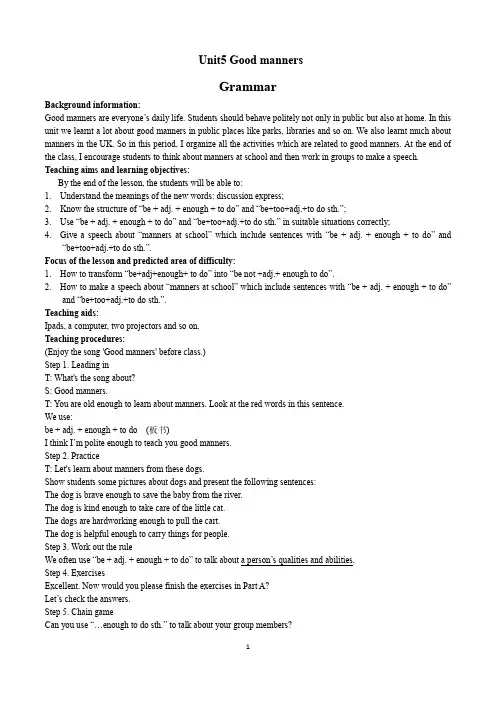
Unit5 Good mannersGrammarBackground information:Good manners are everyone’s daily life. Students should behave politely not only in public but also at home. In this unit we learnt a lot about good manners in public places like parks, libraries and so on. We also learnt much about manners in the UK. So in this period, I organize all the activities which are related to good manners. At the end of the class, I encourage students to think about manners at school and then work in groups to make a speech. Teaching aims and learning objectives:By the end of the lesson, the students will be able to:1. Understand the meanings of the new words: discussion express;2. Know the structure of “be + adj. + enough + to do” and “be+too+adj.+to do sth.”;3. Use “be + adj. + enough + to do” and “be+too+adj.+to do sth.” in suitable situations correctly;4. Give a speech about “manners at school” which include sentences with “be + adj. + enough + to do” and“be+too+adj.+to do sth.”.Focus of the lesson and predicted area of difficulty:1. How to transform “be+adj+enough+ to do” into “be not +adj.+ enough to do”.2. How to make a speech about “manners at school” which include sentences with “be + adj. + enough + to do”and “be+too+adj.+to do sth.”.Teaching aids:Ipads, a computer, two projectors and so on.Teaching procedures:(Enjoy the song 'Good manners' before class.)Step 1. Leading inT: What's the song about?S: Good manners.T: You are old enough to learn about manners. Look at the red words in this sentence.We use:be + adj. + enough + to do (板书)I think I’m polite enough to teach you good manners.Step 2. PracticeT: Let's learn about manners from these dogs.Show students some pictures about dogs and present the following sentences:The dog is brave enough to save the baby from the river.The dog is kind enough to take care of the little cat.The dogs are hardworking enough to pull the cart.The dog is helpful enough to carry things for people.Step 3. Work out the ruleWe often use “be + adj. + enough + to do” to talk about a person’s qualities and abilities.Step 4. ExercisesExcellent. Now would you please finish the exercises in Part A?Let’s check the answers.Step 5. Chain gameCan you use “…enough to do sth.” to talk about your group members?One student one sentence. Now work in groups.Step 6. Leading inYou’re all very good students. But nobody is perfect. So you should keep learning. Just as the saying goes: You’re never too old to learn.In this sentence, there is a “too…to…”We use this pattern to express a negative result.Step 7. Practice1. Look and sayLook at the picture and make sentences with the given words.carelesspay attention to detailsThe boy is too careless to pay attention to details.The boy is not careful enough to pay attention to details.2. Look and writeShow them five pictures and some words. Write down two sentences for each picture.Step 8. Work out the rule.We use “be + too + ______(adj./adv.) + to do” to express a negative(否定的) result.sth. be + too + adj. for sb. + to dosth. be not +adj. +enough for sb. +to doStep 9. Group workWe should mind our manners everywhere, including at school.Now let’s watch a video and then please make a speech about ‘manners at school’.Please work in groups and make a speech. Use “…enough to do sth.” and “…too…to …” if possible.Tips:Hello, boys and girls,Today, I’ll talk about manners at school.…patient… queue for our turn in thedinning hall…helpful…help people in need……careful…protect the books in thelibrary… impolite…keep quiet…That’s all. Thank you!Step 10. Exercises1. Finish some exercises on their ipads and hand them in online.2. Explain some difficulties according to the results.Homework1. Revise Grammar and finish the exercises.2. Preview Integrated skills.Blackboard design:Unit 5 Good mannersGrammarbe + adj. + enough + to dobe not+adj+enough to do(反义词)be+too+adj.+to doTeaching reflection:1. 本课紧紧围绕礼仪这一中心话题,从复习已学的礼仪方面的知识,到引入包含相关语法项目的句子,到学习礼仪知识自然导入训练情境。
八年级英语下册 8B Unit5《Good manners》Grammar1教学
Go to page 83 to finish exercises in Par t A, B and C in pairs.
Step 6 Doing an extension activity
How have your lives changed since you started secondary school?
I am used to taking the bus to schห้องสมุดไป่ตู้ol.
I am used to the larger classes at secondary school.
I am used to wearing the school uniform.
I am used to studying more than 10 subjects a week.
●To use ‘be used to’ to talk about what we have done regularly
Teaching procedures
Step 1 Having a revision
Do you still remember Dr. Ma? What is he? (A doctor.)
He is used to a vegetarian diet.
Scarf is used to taking a walk.(现在习惯于散步)
●used to的用法
否定式简写为usedn't,过去经常,以前常常。
We used to go there every year.(我每年都去那儿。)
He is not what he used to be.(他已不是旧日的他了。)
译林版八年级英语下册Unit5 Good manners-Grammar 学案
Unit 5 Good mannersGrammar一、教学目标1. 学会用enough to 来描述一个人的品质和能力。
2. 学会用too … to 来表达一个否定的结果。
二、教学重点、难点1. 掌握并熟练使用enough to 来描述一个人的品质和能力。
2. 掌握并熟练使用too … to 来表达一个否定的结果。
1. You are old enough to learn about manners.★ be + adj. + enough + to do sth.He is patient enough to wait for a long time without getting angry.2. British people are too polite to shout loudly in public.★ sb.+ be + too + adj. + to do sth.He is too short to reach the apple on the table.3. The UK is too far away for Jenny to go to on her own.★ sth. + be + too + adj. + for sb. + to do sth.五、课堂练习(一)词组翻译1.听广播___________________________ 2.参加讨论_________________________3.使大家大笑________________________ 4.依靠某人自己_____________________5.记下所有的要点____________________ 6.清楚地表达自己___________________7.她周围的细微变化__________________ 8.在公共场所大声喧哗_______________(二)单项填空( ) 1. -Do you want to keep goldfish?-No, it is_______ difficult_______ take care of them.A. so; thatB. not; enough toC. too; toD. such; that( ) 2. He ran and ran, but he couldn't run_______ to catch the bus.A. so fastB. enough fastC. too fastD. fast enough( ) 3. He is_______ apples with us.A. old enough pickingB. enough old to pickC. old enough to pickD. enough old picking( ) 4. The Chinese girl Han Meimei can speak good English_______. Her English is _______ that of Lucy.A. as well; as wellB. as well; as good asC. too; as goodD. as well as; as well as( ) 5. I find it_______ to work out this problem. You needn't go to the teacher.A. enough easyB. easily enoughC. easy enoughD. very easily( ) 6. The stone is _______ heavy for me to carry.A. tooB. veryC. soD. enough( ) 7. The room is_______ three desks.A. very big to holdB. big enough to holdC. enough big to holdD. too big to hold( ) 8. -Mum, can I ride your new motorbike to visit my friends?-Sorry, baby. I think you are_______ young_______ ride it.A. so; thatB. too; toC. enough; toD. too; that( ) 9. The workers are too busy_______, They have to keep working till they finish it.A. having a restB. not to have a restC. to have a restD. that they have a rest( )10. The old man was______ angry______ a word. He just stood there, looking at his son.A. enough; to sayB. so; sayingC. very; to sayD. too; to say(三)动词填空l. He was too excited_______ (say) a word.2. My brothers_______ (discuss) a maths problem with Cindy when I arrived home.3. I can't take a walk with you. I'm too busy_______ (clean) the house now.4. -Whose boat_______ (sail) over there on the sea far away?-The fisherman's.5. Amy, _______ (keep) your voice down in the library, please. Everyone is studyinghard now.6. -_______ you_______ (hear) the news about the princess?-Not yet.7. I hope he_______ (come) back in a week.8. I am so sorry to keep you_______ (wait) for such a long time.(四)完形填空Are you nervous when you stand in front of the public? Are you afraid to make a speech?Li Jun, a middle school boy, felt shy when he was making a speech the other day. Li had thought it would be quite easy to speak in front of __1__ classmates."I was wrong. It was very different and much__2__ than talking to my classmates during playtime," Li said. "I tried, but it was really difficult to speak. I felt like a mute (哑巴) and wanted to leave the classroom __3__ "Li is not alone. Many middle school students now have the same__4__ : they can talk about their ideas freely __5__ their best friends after class, but can't speak in public. According to Zhou Hong, a teacher from a university, the main reason is that schools in China pay more attention to writing instead of__6__ .Zhou hopes schools can give students more chances to open their __7__ , such as speech competitions, English corners and class discussions. Students can join in any one they want to__8__ he also gives some advice to students. "During your free time you should __9__ more. When you're speaking in public, take it easy. Just imagine you're talking to nobody and speak up your ideas clearly," Zhou said. "That __10__ a fine public speech and you'll feel confident. "( )1. A. her B. my C. your D. his( )2. A. harder B. easier C. better D. later( )3. A. slowly B. quickly C. sadly D. happily( )4. A. answer B. subject C. problem D. question( )5. A. except B. beside C. from D. with( )6. A. listening B. speaking C. reading D. singing( )7. A. mouths B. eyes C. minds D. hearts( )8. A. But B. So C. And D. Or( )9. A. play B. practice C. write D. watch( )10. A. reports B. keeps C. hears D. makes(五)阅读理解The Chinese mainland(大陆)and Taiwan started a travel program on June 28, 2011. Mainland individual (个人)tourists were allowed(允许)to visit Taiwan.Tourists of the cities of Beijing, Shanghai and Xiamen were first allowed to go to Taiwan. Later, the two sides also gave the green light to Fujian tourists if they wanted to travel to Taiwan's islands of Kinmen, Matsu and Penghu.In July, 2008, the two sides agreed that mainland tourists in groups could go to Taiwan. The number reached 930, 000 in 2009, and l, 630, 000 in 2010.In 2011, the two sides again agreed to have 558 flights a week. The mainland added four stops for flights in the eastern cities of Yancheng, Wenzhou and Huangshan and the northwestern city of Lanzhou. Taiwan also added its southern city of Tainan as a stop. There are now 50 stops for flights on both sides.( )1. First, individual tourists of_______ cities were allowed to visit Taiwan.A. twoB. threeC. fourD. five( )2. When did Chinese mainland tourists traveling to Taiwan start?A. In 2011.B. In 2010.C. In 2009.D. In 2008.( )3. What's the meaning of the underlined phrase "gave the green light"?A.提供方便B.设置障碍C.把绿灯打开D.给个绿灯( )4. How many flights a day were there between the mainland and Taiwan in 2011?A. About 50.B. About 60.C. About 80.D. About 550.( ) 5. Which of the following is right according to the passage?A. The passage talks about four islands in Taiwan.B. In 2011, the mainland added five stops for flights to Taiwan.C. People could take a direct flight to visit Taiwan from Guangdong on June 28, 2011.D. The number of mainland tourists to Taiwan is 700, 000 larger in 2010 than in 2009.(六)翻译句子1.我太兴奋了,都没法清楚地表达自己。
牛津译林版八年级下册Unit 5《Good manners》教学设计7
牛津译林版八年级下册Unit 5《Good manners》教学设计7一. 教材分析本课为牛津译林版八年级下册Unit 5《Good manners》的教学设计,本课主要围绕礼仪这一主题展开。
通过本课的学习,学生能够进一步了解日常生活中的礼仪知识,提高他们的文明素养。
教材内容丰富,包括听力、口语、阅读和写作等多个方面,有助于学生全面提高英语水平。
二. 学情分析八年级的学生已经具备了一定的英语基础,对日常生活中的基本礼仪有所了解。
但部分学生可能在实际运用中还存在一定的困难,如词汇量不足、语法掌握不牢固等。
因此,在教学过程中,需要关注学生的个体差异,因材施教,提高他们的英语实际运用能力。
三. 教学目标1.知识目标:学生能够掌握本课的生词、短语和句型,了解日常生活中的礼仪知识。
2.能力目标:学生能够运用所学知识进行日常交流,提高他们的英语口语表达能力。
3.情感目标:学生能够树立正确的礼仪观念,提高他们的文明素养。
四. 教学重难点1.重点:本课的生词、短语和句型。
2.难点:正确运用所学知识进行日常交流,特别是在实际场景中的运用。
五. 教学方法1.任务型教学法:通过设定各种真实的任务,让学生在完成任务的过程中运用所学知识,提高他们的实际运用能力。
2.情境教学法:创设各种日常生活中的情境,让学生在实际场景中学习礼仪知识,提高他们的交际能力。
3.合作学习法:引导学生进行小组讨论和合作,培养他们的团队精神和自主学习能力。
六. 教学准备1.教材、课件和教学资源。
2.教学设备:投影仪、电脑等。
3.教学辅助工具:挂图、卡片等。
七. 教学过程1.导入(5分钟)利用图片或视频展示不同场景下的礼仪行为,引导学生思考礼仪的重要性,激发他们的学习兴趣。
2.呈现(10分钟)通过课件或实物展示本课的生词、短语和句型,同时进行讲解和翻译,让学生初步掌握。
3.操练(10分钟)设计各种情境,让学生分组进行角色扮演,运用所学知识进行日常交流,教师进行指导和纠正。
牛津译林版八年级下册Unit 5《Good manners》教学设计1
牛津译林版八年级下册Unit 5《Good manners》教学设计1一. 教材分析《Good manners》是人教版牛津译林八年级下册第五单元的教学内容,本节课主要讨论日常生活中的礼仪和行为规范。
通过本节课的学习,学生能够掌握关于礼仪的词汇和表达方式,以及如何运用这些词汇和表达方式进行日常交流。
教材内容丰富,包括听、说、读、写等多种技能的训练,以及小组合作和讨论的活动。
二. 学情分析八年级的学生已经具备了一定的英语基础,能够听懂并运用简单的英语进行交流。
然而,对于一些关于礼仪的专业词汇和表达方式,学生可能比较陌生。
因此,在教学过程中,需要帮助学生熟悉并掌握这些词汇和表达方式,以便能够运用到日常交流中。
三. 教学目标1.知识目标:学生能够掌握关于礼仪的词汇和表达方式,如“excuseme”、“thank you”等;2.能力目标:学生能够运用所学的词汇和表达方式进行日常交流,如询问 permission、表达感谢等;3.情感目标:学生能够认识到礼仪的重要性,并在日常生活中积极实践。
四. 教学重难点1.重点:学生能够掌握关于礼仪的词汇和表达方式;2.难点:学生能够在实际情境中运用所学的词汇和表达方式进行日常交流。
五. 教学方法1.情境教学法:通过设置各种真实的场景,让学生在实践中学习和掌握礼仪知识;2.交际法:通过小组讨论和角色扮演等活动,让学生在实际交流中运用所学知识;3.任务型教学法:通过完成各种任务,激发学生的学习兴趣,提高学生的学习积极性。
六. 教学准备1.教师准备:准备好相关的教学材料,如PPT、图片、视频等;2.学生准备:学生提前预习本节课的内容,了解基本的礼仪知识。
七. 教学过程1.导入(5分钟)利用图片或视频展示一些日常生活中的礼仪场景,引导学生思考礼仪的重要性。
然后,简要介绍本节课的内容,激发学生的学习兴趣。
2.呈现(10分钟)通过PPT展示本节课的主要词汇和表达方式,如“excuse me”、“thank you”等。