
2020年春初中英语外研版七年级下册Module9Lifehistory 课件
【辨析】
Step 4【考点·练】 选词填空(become/turn/get) ①When he was 20, he _______ a teacher. ②It’s ______ colder andbeccoaldmeer, we need to wear warm clothes. ③Autugmetntinisgcoming, the leaves are _______ brown.
got work
4. ——他待在密苏里州吗? ——没有, 他去了纽约, 还有其他城市。 —____ he ____ in Missouri? —_D__id, he _s_t_a_y_ to New York, and other cities.
No went
5. 但是他没来中国。 But he ______ _____ to China.
_____,
意
为“写”。
作家
write
18. real是形容词, 意为“______________”; 其副词是
_____, 意为“真实地; 真正地”。
真实的; 真正的
really
1_9_._e_x_a_c, t意是为形“容准词确, 意地为; 确“准切__确地__的”__;。_确__切__的___”; 其副词是 2e0x.a也ctly______
in one’s life
Ⅱ. 根据汉语提示完成下列句子 1. 威廉·莎士比亚是一个著名的英国剧作家兼诗人。
William Shakespeare was __ _______ _______ ______
_2_. 莎pl士ay比s a亚nd的p父oe母ms没. 有学会a读fa书m写ou字s 。English writer Sohf akespeare’s parents ______ _____ to read __ _____.
“wo_r_k_s__”。
工作
1“2工.建b作筑uil物d 是, 大动楼词”, 意。为“建造”; 名词为 ________, 意为
building
1“3.奄d奄ie 一动息词的, 意; 为濒“临死_死_;_亡去__的世__”_”;;名现词在为分_词__是__d,y意in为g, “意死为”; 形容词为 _____, 意为“死的, 去世的”de。ath 14. 在某人一de生ad中 __________
real
( A )②(2019·山西中考)When we read a piece of news online, we’d better make sure it’s _____before
sending it to others. If not, we may spread something
*He became an actor. 他成了一位演员。
*He turned blue with cold. 他冻得脸色发青了。
*Spring is coming, the days are getting longer and longer. 春天来了, 白天变得越来越长了。
Step 3【知识·得】 become意为“变得”, 是系动词, 后面跟形容词或名词 作表语。其过去式是became。
___r_ich ________ ___l_a_n_guage
yo_u_n__g___________
around the world
9. play是名词, 意为“_____”,
意此为时“pl剧a_y_本e_r_;意_戏_为_剧_“___”_;_另__一__种”。词性是动词,
10. suc玩ces耍sful是形容词, 意为“成功运的动”员; 副词是
turning
要点4 in the 1860s在19世纪60年代 Step 1【难点·探】 如何用英语表示“在……世纪……年代”?
Step 2【语境·悟】
*But he took the name Mark Twain and became very
famous in the 1860s. 但是他在19世纪60年代使用了马克·吐温这个名字, 并 且变得非常出名。(P54)
*Father Christmas isn’t real. 圣诞老人并不是真有其人。
*Please believe me. The news is true. 请相信我, 这个消息是真的。
Step 3【知识·得】
Step 4【考点·练】 ①我在真正的冰上学滑冰。 I’m learning to skate on ____ ice.
__________, 意为“成功地”; 名词为 _______, 意为“成
功”; 动词为 _______, 意为“成功”。
successfully
success
succeed
1_1_._w__o_r。k:((21))不可可数数名名词词, 意, 意为为““_作____品____;__著_”_。作__(”3,)动其词复,数意为为
12. 成为v. dat_e______
13. 妇女节 14. 国庆节
bec_o_m__e_________ ____________
15. 儿童节 W_o_m_e_n_’_s_D_a_y_____
National Day
Children’s Day
16. 17.
在wr1it9e世r是纪名60词年, 代意为“i__n__t__h__e__”_1;_8_6其_0_s动_ 词是
*The three boys were born in the 1990s /1990’s. 这三个男孩出生于20世纪90年代。
Step 3【知识·得】 表示“在……世纪……年代”时用“in the+年代
复数”, 也可以用所有格形式, 但前面一定要加定冠词 the。 例如: This kind of music was popular in the 1980s. 这种音乐流行于20世纪80年代。
famous.
要点1 real adj. 真实的; 真正的 Step 1【难点·探】 real与true有什么区别?
Step 2【语境·悟】
*His real name was Samuel Clemens and he was born in 1835 in Missouri. 他的真名叫塞缪尔·克莱门斯, 1835 年出生于密苏里州。(P54)
as well
Ⅱ. 根据汉语提示完成下列句子 1. 我们可以在网上找到关于他的信息。 We can ____ ___ about him ___ ___ ________. 2. 他十二f岁in离d 开ou学t 校开始工作o。n the Internet He ___ ______ and ______ _____ at the age of twelve.
C. 1970s
D. the 1970s’
Module 9 Life history Unit 2
Ⅰ. 根据汉语提示写出下列单词或短语
1. 诗歌n.
_____
2. 结婚v.
___p_o_e_m
3. 4.
在火…; 火…灾上np. rep_.__m_a_r_ry
on
fire
5. 富有的adj. 6. 语言n. 7. 年轻的adj. 8. 世界各地
Step 4【考点·练】 ①李奶奶出生于19世纪20年代。 Grandma Li was born __ ___ _____. ②他们在17世纪30年代i建n 的th这e 1个82公0s园。 They built the park __ ___ ______.
in the 1630’s
( B )③This was a famous song in _____. 导学号 A. the 1970 B. the 1970s
didn’t come
Ⅲ. Read Activity 3 and answer the questions 1. Who wrote the book Tom Sawyer? _______________________________________ 2T. hWehfaenmaonuds AwmheerreicwanaswMriaterrk, TMwaarink bTowrani?n. ______________________________
___A_u_g_u_st __________
7. 10月n. ___S_e_p_t_ember
8. 11月n. 9. 12月n.
__O__c_to_b__er_ _________
November
December
10. 报纸n. 11. 日期n.
new__s_p_a_p_e_r___ ____
要点3 become v. 变得; 成为 Step 1【难点·探】 (1)become是系动词, 后面跟什么词作表语? (2)become, turn和get的区别是什么?
Step 2【语境·悟】
*But he took the name Mark Twain and became very famous in the 1860s. 但是他取了马克·吐温这个名字并 且在十九世纪六十年代变得很有名。(P54)
Step 2【语境·悟】
*He left school and began work at the age of twelve. 他12岁就离开学校开始工作了。(P54)
*Lily could ride a bike at the age of three. 莉莉三岁时就会骑自行车了。
* My grandmother was famous when she was twenty. 我的奶奶二十岁时就出名了。
Step 3【知识·得】 at the age of意为“在……岁时”, 后接基数词, 可以
2020春七年级英语下册Module9LifehistoryUnit1Heleftschooland

Unit 1He left school and beganwork at the age of twelve.Ⅰ. 根据句意及首字母或汉语提示完成句子中的单词1. April es after March but before May.2. Children's Day is on June 1.3. He often reads newspapers at breakfast.4. Please give me the exact(准确的) news about my favourite singer.5. You should remember the date(日期) of her birthday.Ⅱ. 用括号内所给单词的适当形式填空1. Lu Xun was a great writer(write).2. March 8 is Women's(woman) Day.3. The stories(story) in the book are very interesting.4. My father began(begin) to work at the age of seventeen.5. Jim became(bee) a rich man two years ago.Ⅲ. 用方框中所给单词的适当形式完成下列句子,使句子通顺、正确newspaper, know, listen, watch, start1. When did you start school in Beijing?2. Do you like watching movies?3. I listened to the radio last night.4. I knew Tom Sawyer twenty years ago.5. My father reads newspapers every morning to know the latest news.Ⅳ. 单项选择( D ) 1. The writer ________ his home town and worked for a newspaper.A. leaveB. leavesC. to leaveD. left(A) 2. I like the novels(小说) written by Mark Twain ________.A. as wellB. as well asC. eitherD. also(C) 3. We often plant trees in ________.A. SeptemberB. DecemberC. MarchD. August(C) 4. Can you help me ________ the truth?A. findB. look forC. find outD. look at(D) 5. Mark Twain b ecame very famous ________.A. in the 1860B. in 1860sC. in the 1860s'D. in the 1860sⅤ. 根据汉语意思完成下列句子,每空一词1. 我们必须查明他住在什么地方。
七年级英语下册 Module 9 Life history Unit 2课件 外研版

【探究总结】take part in/join /join in辨析
参加或参与会议、游行、战争 take part in 等群众性的活动
参加
join
参加某组织或团体,并成为其 中一员
join in
参加竞赛、游戏等活动,后面 一般接名词或动词-ing形式
【图解助记】
【学以致用】选词填空。 take part in,join,join in
Ⅱ. 句型展示 1. 像许多四百年前的人们一样,莎士比亚的父母没有学习读和 写。
_____ many people four hundred years ago, Shakespeare’s parents _____ learn to read _____ write. 2. 在学校里他喜欢戏剧,所以当他14岁毕业的时候他决定成为 演员。
5. 在老剧院里,发生了一场火灾,他们在1614年和1997年再次 修建了它。
_____ _____ a fire in the old theatre, and they _____ _____ _____ in 1614 and in 1997. 答案: There was; built it again
A. water B.ቤተ መጻሕፍቲ ባይዱplays
C. fire
D. theatre
5. There are lots of plays _____ English _____ the world.
A. with; around
B. in; around
C. by; over
D. use; all over
编后语
— Last year.
A. join
B. join in
外研新版英语-七年级下册Module9LifeHistory知识点及练习含答案.docx

外研新版MODULE 9 Life history知识点总结(重点难点:一般过去式时的不规则动词的构成规律;否定和疑问句形式)1、必记单词2、必记短语★用法荟萃3、经典句型4、语法重点(一般过去式m)(一)不规则动词的过去式(注:除去不规则变化动词,其他动词都是规则变化)swim -一swam 游泳fly -一flew 飞run — run 跑have --- had 有buy --- bought 买take --- took 拿eat --- ate 吃teach —taught 教go---went 去 sing — sang 唱 歌 sweep ---swept 打扫 make ・・-made 制作 get .― get 得 到,到 达 draw ..- drew 画画 ride — rode 骑 put — put 放 feel --- felt 感觉 think --- thought 想 wake ---woke 醒来 (二)一般过去时的否定句谓语动词为行为动词时,一般过去时的否定的构成为:主语+didn' t (didnot )+动词原形(+其他)We didn' t go to school yeaterday.昨天我们没有去上学。
They didn' t stop working.他们没有停止工作。
He didn' t eat breakfast this morning.今天早上他没有吃餐。
★注意do --- did 做 set ——set drink ■— drank 喝 tell ---told 告诉 meet — met 见面read ---read 读书sleep ― slept 睡觉write — wrote 写send — sent 发送fall —feU 落下第9模块Life Histoiy综合检测题(时间:60分钟满分:100分)一、找出一列各组单词画线部分读音不同的一个。
七年级英语下册 Module 9 Life history Unit 3课件 外研版
编后语
有的同学听课时容易走神,常常听着听着心思就不知道溜到哪里去了;有的学生,虽然留心听讲,却常常“跟不上步伐”,思维落后在老师的讲解后。这两种情况都 不能达到理想的听课效果。听课最重要的是紧跟老师的思路,否则,教师讲得再好,新知识也无法接受。如何跟上老师饭思路呢?以下的听课方法值得同学们学习:
4. —When _____ you begin to work here?
—Three years ago.
A. do B. did
C. are
D. were
5. I don’t like summer _____ winter.
A. as good as
B. as well as
C. and
D. with
老师没提了一个问题,同学们就应当立即主动地去思考,积极地寻找答案,然后和老师的解答进行比较。通过超前思考,可以把注意力集中在对这些“难点”的理解 上,保证“好钢用在刀刃上”,从而避免了没有重点的泛泛而听。通过将自己的思考跟老师的讲解做比较,还可以发现自己对新知识理解的不妥之处,及时消除知识 的“隐患”。
Ⅱ. 单项选择
1. When they _____ young, my parents didn’t use computers at school.
A. is B. are C. was D. were
2. — _____ you born in China?
— No. I _____ born in England.
尖子生好方法:听课时应该始终跟着老师的节奏,要善于抓住老师讲解中的关键词,构建自己的知识结构。利用老师讲课的间隙,猜想老师还会讲什么,会怎样讲, 怎样讲会更好,如果让我来讲,我会怎样讲。这种方法适合于听课容易分心的同学。
外研版英语七下第九模块《 Life history》重要知识点总结
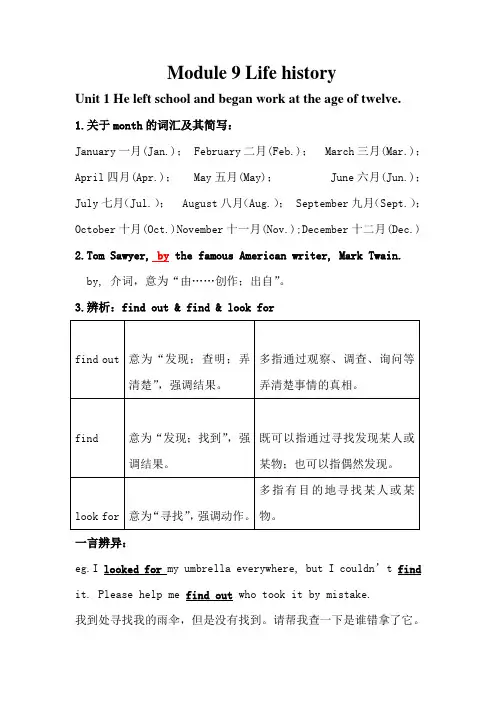
Module 9 Life historyUnit 1 He left school and began work at the age of twelve.1.关于month的词汇及其简写:January一月(Jan.); February二月(Feb.); March三月(Mar.);April四月(Apr.); May五月(May); June六月(Jun.);July七月(Jul.); August八月(Aug.); September九月(Sept.);October十月(Oct.)November十一月(Nov.);December十二月(Dec.)2.Tom Sawyer, by the famous American writer, Mark Twain. by, 介词,意为“由……创作;出自”。
3.辨析:find out & find & look for一言辨异:eg.I looked for my umbrella everywhere, but I couldn’t find it. Please help me find out who took it by mistake.我到处寻找我的雨伞,但是没有找到。
请帮我查一下是谁错拿了它。
4.“真实的”real(1)real,形容词,意为“真实的;真正的”。
real name,“真名”。
(2)really,副词,意为“确实;真正地”。
really happy,“确实很高兴”。
一言辨异:Tom really wants to make a real friend.汤姆真的很想结交一个真正的朋友。
5.age表达法at the age of +基数词 = at + 基数词,意为“在……岁时”相当于when sb. was... (years old)。
eg.At the age of 5/At 5,Jack could learn to read and write. =Jack could learn to read and write when he was 5 (years old). Jack 5岁时就学会了读书认字。
2020版七年级下册初一英语外研版全套课件Module9LifehistoryUnit3Languageinuse

Unit 3 Language in use
目录导航
01 语 法 探 究 02 巩 固 提 升 03 写 作 训 练 04 中 考 链 接
语法探究
一般过去时(3) 规则动词变过去式,通常是直接在动词原形后加-ed或 者-d,但有些动词并不遵循这一规则,我们称之为不规则动词。 由于不规则动词的变化无固定规律可循,因此我们需要不断 积累,加强记忆。
下面是一些常用的不规则动词及其过去式: be—was/were leave—left begin—began drink—drank give—gave ring—rang sing—sang sit—sat drive—drove ride—rode know—knew keep—kept sleep—slept break—broke speak—spoke tell—told stand—stood understand—understood buy—bought
11. 也,还______a_s_w__e_ll______ 12. 在19世纪60年代___in__t_h_e_1_8_6_0_s_____ 13. 世界各地__a_r_o_u_n_d_t_h_e__w_o_r_l_d_ 14. 结婚____g_e_t_m__a_r_r_ie_d____
二、单项填空。 ( D )1. —Do you like playing chess? —Yes, and I like playing computer games _____ . A. just B. also C. either D. as well ( A )2. I didn’t _____ to Shanghai last month. I went to Wuhan. A. go B. went C. goes D. will go
外研社七年级英语下册-模块9-Life-History知识点归纳
外研社七年级英语下册模块9 Life History知识点归纳知识点一:模块9的短语1. women’s Day妇女节2.National Day国庆节3.find out 发现,查明,弄清4.at the age of 在……岁时5.Children’s Day儿童节6.New Year’s Day元旦7.Teachers’ Day教师节8.Spring Festival春节9.on the Internet在网络上10.be born出生11.as well也,还12.in the 1860s在19世纪60年代13.around the world世界各地14.get married结婚知识点二:重点词语解释Unit one1.Hey,we can find out about him on the Internet.嘿,我们可以在网上查明有关他的资料。
find out意为“发现;查明;弄清”,后可接名词或从句。
如:Can you find out what time the plane takes of?你知道飞机几点起飞吗?The students found out that their teacher was ill.学生们发现老师病了。
[辨析]find,find out,look forfind,find out和look for都含有“寻找,找到”的意思,但其含义和用法却不同。
(1)find意为“找到,发现”,通常指找到或发现具体的东西,也可指偶然发现某物或某种情况,强调的是找的结果。
如:He didn’t find his bike.他没找到他的自行车。
(2)look for意为“寻找”,是有目的地找,强调“寻找”这一动作。
如:I can’t find my pen. I’m looking for it everywhere.我找不到我的钢笔,我正到处找。
(3)find out意为“找出;发现;查明”,多指通过调查、询问、打听、研究之后“搞清楚、弄明白”,通常含有“经过困难曲折”的含义,指找出较难找到的、无形的、抽象的东西。
2020-2021学年外研版英语七年级下册Module9 Life history 单词讲解课件
[meɪ]
3.June [dʒuːn]
n. 3月 n. 4月 n. 5月 n. 6月
节日首字母大写 on +具体某一天 4. Women's Day 妇女节 woman-women
5. National Day [ˈnæ ʃnəl] 国庆节
national 国家的 6. Children's Day 儿童节 child-children
I left school and began work at the age of twelve. =at twelve =when I was twelve (years old).
时间可以位于句首或句末
17. newspaper ['njuːzˌpeɪpə] n.报纸 可数名词 一名报社作者 a newspaper writer 他为报社写稿。 He writes for a newspaper. 看报纸 read newspapers news新闻;消息+paper报纸=newspaper
n. 作品;著作
26. work [wɜːk]
可数名词 复数:works 工作 不可数名词
v. 工作
我很喜欢他的作品。
I enjoy/like his works very much. 每天我都有许多工作要做。
I have a lot of work to do every day.
我们学习很努力。
在1583年,他结婚了。
He mrried in 1583.
约翰和玛丽结婚了。 John married Mary.
25.successful [səkˈsesfʊl] adj.成功的 他成为了一名成功的演员。 He became a successful actor.
2020年春初中英语外研版七年级下册Module9Lifehistory 课件
___r_ich ________ ___l_a_n_guage
yo_u_n__g___________
around the world
9. play是名词, 意为“_____”,
意此为时“pl剧a_y_本e_r_;意_戏_为_剧_“___”_;_另__一__种”。词性是动词,
10. suc玩ces耍sful是形容词, 意为“成功运的动”员; 副词是
“wo_r_k_s__”。
工作
1“2工.建b作筑uil物d 是, 大动楼词”, 意。为“建造”; 名词为 ________, 意为
building
1“3.奄d奄ie 一动息词的, 意; 为濒“临死_死_;_亡去__的世__”_”;;名现词在为分_词__是__d,y意in为g, “意死为”; 形容词为 _____, 意为“死的, 去世的”de。ath 14. 在某人一de生ad中 __________
got work
4. ——他待在密苏里州吗? ——没有, 他去了纽约, 还有其他城市。 —____ he ____ in Missouri? —_D__id, he _s_t_a_y_ to New York, and other cities.
No went
5. 但是他没来中国。 But he ______ _____ to China.
hewritenewspaperleftbeganwrotehetakenamemarktwainbecomeveryfamoushegoshakespearesparentswritetookbecamewentdidntcomedidntlearncompanybuildglobetheatreriverthameslondonbuilt知识详解记不规则动词的过去式1aa型即过去式与原形同形costcostcutcuthithithurthurtletletputputreadreadbeatbeat2ab型即过去式与原形不同形bewaswereleaveleftbuyboughtdodidmeetmetcomecameseesawgetgotsendsentgowentspendspenthavehadswimswamwritewrotetaketook不规则动词的过去式的句式除了变换形式不同不规则动词过去式的肯定句否定句一般疑问句和特殊疑问句都与规则动词相同
外研版英语七年级下册《module9lifehistoryunit1》说课稿
外研版英语七年级下册《module 9 life history unit 1》说课稿一. 教材分析外研版英语七年级下册《Module 9 Life History Unit 1》的主要内容包括两个部分:课文阅读和语法学习。
课文阅读部分主要介绍了达尔文和他的进化论,通过阅读这篇课文,学生可以了解到达尔文的生平、进化论的基本观点以及他在科学界的地位。
语法学习部分主要是对一般现在时和一般过去时的复习和运用。
二. 学情分析七年级的学生已经掌握了一定的英语基础,能够进行简单的英语交流和阅读。
但是,对于一些较复杂的句子结构和语法知识,学生可能还不太熟悉。
因此,在教学过程中,我将会引导学生通过阅读和讨论来理解课文内容,并通过练习来巩固语法知识。
三. 说教学目标1.知识目标:学生能够掌握课文中的关键词汇和短语,理解一般现在时和一般过去时的用法。
2.能力目标:学生能够流利地朗读课文,能够用英语简单介绍达尔文和进化论。
3.情感目标:学生能够培养对科学的兴趣,学习科学家严谨的治学态度。
四. 说教学重难点1.教学重点:课文的理解和语法知识的运用。
2.教学难点:一般过去时的用法和一些复杂句子结构的理解。
五. 说教学方法与手段在教学过程中,我将采用任务型教学法,通过引导学生进行阅读、讨论和练习,来提高他们的语言运用能力。
同时,我也会运用多媒体教学手段,如图片、视频等,来帮助学生更好地理解课文内容。
六. 说教学过程1.课前准备:让学生预习课文,了解达尔文和进化论的基本知识。
2.课堂导入:通过展示达尔文的图片,引导学生进入课文学习。
3.课文阅读:引导学生分段阅读课文,讨论并回答问题。
4.语法讲解:通过示例和练习,讲解一般现在时和一般过去时的用法。
5.课堂练习:让学生进行语法练习,巩固所学知识。
6.课堂总结:总结本节课的主要内容和知识点。
七. 说板书设计板书设计主要包括课文标题、主要人物和事件、语法知识点等。
通过板书,学生可以一目了然地了解本节课的主要内容。