
pep英语三年级下册unit3At_the_zoo第四课时教学设计
Unit3 At the zoo
第四课时
一.教学目标:
(1)知识目标:学生能够听、说、认、读单long, short, big, small;能够听懂会说单词children, tail; 能够认读句型It has..
(2)能力目标:能够在图片、实物或情景的帮助下运用句型It has...描述动物并听懂别人的描述。
(3)情感目标:培养学生具有热爱动物、保护动物的意识,能够做到不乱逗玩动物或乱喂动物等。
二.教学重点:
能够掌握单词long, short, big, small及句型It has... 三.教学难点:
能够在特定的语境中将单词运用于句型之中。
四.教学过程:
Step1 Preparation:
1.Greeting:Good morning.Nice to meet you!
2.A部分Let’s do.
3.自我介绍:老师先做示范,Hi! I’m Miss... Look at me.I’m tall. I have a nose.I have a mouth.I have two eyes and… I have…
T:Can you talk about yourself? S s: Yes.
4.然后同桌两人互相介绍,运用I have…
5.师让生到台前自我介绍,渗透:Come here,children.引出此句型。
Step2 Presentation:
1.T:Good ,boys and girls .You can talk about yourselves.Can you talk about the animals?Come here,children!Welcome to the zoo.
2.Look!An elephant and a monkey!
(1)Look at the elephant.It’s big.Look at the monkey.It’s small. The elephant has a nose .It’s so long. It has a tail. It’s short.It has a short tail.
(2)教授big small long short 这四个单词.
3.T:There are many animals in the zoo.Miss White ,John,Mike and Chen Jie are playing in the zoo,too.
4.Listen the talk and find the answer. Q1:What animals do they see?
A. elephant
B.bear
5.T:Oh ,they are looking at the elephant .Can you guess what they are talking about?
6.T:Listen again and answer the question:
Q2:Chen Jie:It has a ____ nose. A.long B.short
John :It has a ___ tail. A.long
B.short
7.师指板书,领读.It has ...
8.PPT图片机械操练,趣味操练。
9.T:Listen again and answer the question:
Q3:Mike:It has ___eyes and ___ears.(big\small)
板书,领读,机械操练,趣味操练。
10.Let’s chant.
T:A chant for you ,Clap your hands.
11.听读Let’s talk正音。
1)指听。
2)跟读。
12.朗读Let’s talk。
1)组内自读,分角色朗读。
2)Let’s play四人一小组,分角色展示。
Step3 Practice
1.T: Play a guessing game:出示动物一个身体部位,用所学举行描述,并猜测是什么动物。
2.Make a monster.It has... /OK.Here’s a...
Step4. Production
1.看动物图片,创设情景,选择小组成员喜欢的动物编成新对话,并展示。
Miss White:Come here, children.
Look at the ______.
(tiger,cat ,elephant,bird ,bear,dog,p anda,giraffe,monkey……
A,B&C: Wow! It’s so ______.(big,small,fat,thin……)
A: It has _____. a big\small\long nose
B: It has _____. a big\small mouth
C: It has _____. big\small eyes
big\small ears
a
long\short tail
a
big\small body
2.PPT图片情感渗透:清明节即将来到,同学们去动物园玩耍时切记:不乱逗玩动物或乱投喂动物,爱护我们的动物。
3.T: Say the sentences what we have learned.
Step5.Progress.
1. 跟读录音 Let’s talk.
2. Complete your exercise-book.
(完成你的练习册。
)
Blackboard:
Unit Three
Big small long short It has …。
新版PEP三年级下册英语Unit-3-At-the-zoo各课时教案
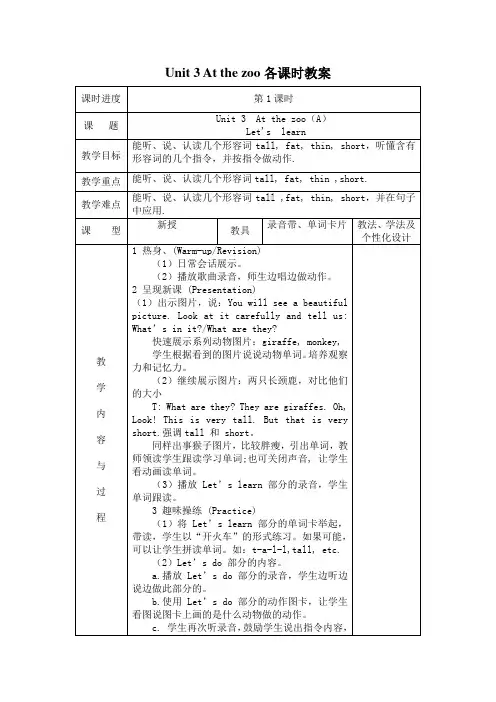
tall
fat
thin(图片和词卡)
short
课时进度
第2课时
课题
Unit3At the zoo(A)
Let's talk
教学目标
能够听、说、读句型It’s so……
并在情景中熟练应用
教学重点
句型It’s so……
教学难点
在情景中运用fat, short, tall。
课型
新授
教具
快速展示系列动物图片:giraffe, monkey,
学生根据看到的图片说说动物单词。培养观察力和记忆力。
(2)继续展示图片:两只长颈鹿,对比他们的大小
T: What are they? They are giraffes. Oh, Look! This is very tall. But that is very short.强调tall和short。
(2)了解so的用法。
so在句子中的意思是:“强调某种程度”。。
(3)根据学生对的记忆以及平日生活中的观察,让学生说说长颈鹿的眼睛、鼻子以及整体的样子。
S: The elephant has a long nose. It has big ears. It has a short tail. It is (so)big.引导学生将这些句子用and连接在一起,并带读:Look at the elephant, It’s so big. It has a long nose and a short tail. It has small eyes and big ears.
教学难点
能听、说、认读几个形容词tall,fat,thin,short,并在句子中应用.
Unit3 At the zoo B let’s talk (教案)人教PEP版英语三年级下册
Unit3 At the zoo B let’s talk (教案)
一、教材分析
1.1 单元主题
本单元主题为“在动物园”。
1.2 教学目标
1.能够听懂、认读并运用动物名称单词:tiger,panda,elephant,lion,kangaroo 等。
2.能够理解并表达“Is this a/an…?” “Yes, it is. / No, it isn’t.” 的基本用法。
3.能够利用所学知识进行简单的口语表达。
1.3 适用对象
三年级下册英语学习者
二、教学过程
2.1 预习
请学生预习课本 Unit3,浏览相关单词及例句。
2.2 启蒙
1.打开课件,并展示关于动物园的图片。
2.引导学生畅想自己在动物园观赏动物的场景。
2.3 学习
1.复习动物名称单词:tiger,panda,elephant,lion,kangaroo 等。
2.学习并掌握疑问句Is this a/an…?及其肯定否定回答形式 Yes, it is.
/ No, it isn’t.。
3.进行相关练习。
2.4 拓展
1.让学生自己动手制作简单的动物园,模拟观赏场景。
2.呈现英文版动物园资料,并引导学生进行简单的口语表达。
三、教学资源
1.课本 Unit3
2.PPT 图片
四、教学评价
1.通过课前预习及课堂讲解,学生逐渐掌握了动物名称和身份问句的基本用法。
2.课外扩展活动能够提高学生的语言表达能力。
3.教学评价通过听说读写四个方面来进行,学生在课堂上的表现良好,在语言学习上取得了进步。
小学三年级英语下册《Unit3Atthezoo》教案精选范文五篇

小学三年级英语下册《Unit 3 At the zoo》教案精选范文五篇新竹高于旧竹枝,全凭老干为扶持。
明年再有新生者,十万龙孙绕凤池。
,下面是小编给大家整理的小学三年级英语下册《Unit 3 At the zoo》教案精选范文,希望可以帮助到大家。
小学三年级英语下册《Unit 3 At the zoo》教案精选范文一教学目标1、能听、说、认读big\small\long\short四个形容词,了解short的另一含义,并知其反义词tall2、激发学生充分动用已学过的知识,进行发散性认识。
3、学习句型look at the ----,.it is ----,并能进行创编,成一个新的chant教学重难点重点1、听、说、认读几个形容词 small, big, long, short 。
2、运用所学过的知识,学说带有这些形容词的语句。
难点1、单词small 中[ l ] 的发音,舌头要上卷。
2、运用big\small\long\short四个形容词进行创编,成一个新的chant教学工具多媒体教学过程1、Warm uplet’s chantLook at the cat,it is fat.Look at the pig ,it isbig.Look at the monkey,it is funny.Look at the mouse ,in my house.ahhh!2、呈现新课 (presentation)(1)教学bigT(出示一只大盒子): Today, I prepare a gift for you . Look, what’s this? Ss: It’s a box. T: Yes, it’s a box, it’s a big box, this box is big.出示单词卡,学习big. B b b bigCAI(出示许多大的物品,让学生练说)a big _____Look at _______.It is big._______is big.(2)教学smallT: Look at the big box. There is something in it . Please, guess what’s in it? Ss:……. T: Look ,it’s a box, too. It’s a small box. The box is small.出示单词卡,学习small sm all small操练: a small _____Look at _______.It is small._______is small.(3)CAI: Can you say?_____________is big ,____________is small(4)教学long and shortT: What’s in the small box .Let me open it ad see. Oh,it’s a ruler. It’s a short ruler. The ruler is short.出示单词卡,学习short sh or t shortT: This ruler is a magic ruler. It can turn long, long, long. Let me say something to it” Long ,long, long, make yourself long. Long, long, long, make yourself long.”(边说边将尺子变长了) Look, the ruler is long, now.出示单词卡,学习long l ong long出示一对铅笔,两束头发让他们作出变化short——long long——short(5)描述短的钢笔,长的铅笔,并编成一个chantshort, short pen ,the pen is short, look at the pen ,it is short long, long pencil ,the pencil is long, look at the pencil ,it is long(6)单词操练听录音,跟读用动作表演: 看教师做———师生一起做——Let’s do (Big, big, big, make your eyes big. Small, small, small, make your eyes small. Long, long, long, make your arms long. Short ,short, short, short, make your arms long.) ———教师说,学生做找出反义词:教师向学生介绍这两对反义词(结合板书)———师生通过动作来表演反义词———CAI连线3、拓展与延伸(1) 教学单词tallCAI:以short的一封信引入,学习tall,并在班级中找出Who is short? Who is tall?———Let,s do (Tall, tall, tall, make yourself tall. Short, short, short, make yourself short.)(2)仿编chant4、Homework1、Read the dialogue 3 times.2、Share your picture to your friends.课后小结本堂课的教学内容选自PEP小学英语教材四年级上册Unit 6 Part A Let’s learn 和Let’s do。
小学英语_《Unit3Atthezoo》教学设计学情分析教材分析课后反思

Unit 3 At the zooPart A Let's Learn& Let’s do教学设计一、教材分析新人教版三年级英语下册Unit3 At The Zoo第二课时,包括Part A的Let’s learn 和Let’s do两个内容,是一节词汇课,主要教学几个形容动物体型的单词:thin、fat、tall、short,并能运用Look at....It’s....的句型来形容动物的体型。
本单元是另一个关于动物话题的单元,此话题特别能激起学生的兴趣,学生在三年级上册Unit4 W e love animals一单元已经认识了一些动物名称,而且在那一课的Let’s chant中Look at....It’s....的句型也以出现,教师巧妙的以旧引新,有效突破本节课的教学难点。
在学完本单元后,学生不仅能认识更多的动物,还能对动物的体型、器官等进行简单描述,乃至对人物进行描述。
对今后的学习起着至关重要的作用。
二、学情分析三年级这个年龄段的学生具有好奇、好活动、爱表现、善模仿等特点。
他们喜欢新鲜事物,对陌生语言的好奇心能激起他们对外语的兴趣。
学生之前已接触过动物名称的单词及一些简单句式,学生对此的学习兴趣很高,学习氛围浓厚,主要是让学生在“学中玩,玩中学”的环境中掌握知识。
三、教学目标1、知识与能力目标:能听懂、会说、会认读几个形容词tall, fat, thin, short,能够在图片、实物或情景的帮助下运用句型:Look at… It’s…;听懂含有形容词的几个指令,并按指令做动作2、过程与方法:创设情境,学生通过对比理解单词和句型,并在情景中运用句型进行描述。
通过TPR全身运动反应法增强对单词的记忆,在游戏中操练单词和句型。
3、情感目标:通过本节课的学习,让学生能够热爱动物,具有保护动物的意识;进一步激发学生学习英语的兴趣,享受学习过程带来的乐趣。
四、教学重难点重点:能听、说、认读几个形容词tall ,fat, thin ,short及句子:Look at that… It’s…;能够听懂Let’s do中的指令并做出正确的反应。
Unit3AtthezooBLet’stalk(教案)人教PEP版英语三年级下册
教案:Unit3 At the zoo B Let’s talk 教学内容:本节课的教学内容为人教PEP版英语三年级下册Unit3 At the zoo B部分Let’s talk。
本节课的主要内容是学习动物词汇,并通过Let’s talk部分进行简单的对话交流,让学生能够在动物园的场景中运用所学词汇和句型进行交流。
教学目标:1. 学生能够听懂、会说、会读本节课所学的动物词汇,如:tiger, elephant, monkey等。
2. 学生能够运用Let’s talk部分提供的句型进行简单的对话交流,如:What animal is it? It's a tiger. It's big and strong.3. 学生能够在动物园的场景中运用所学词汇和句型进行交流,并能够描述动物的特征。
教学难点:1. 动物词汇的发音和记忆。
2. Let’s talk部分句型的运用和对话交流。
教具学具准备:1. 多媒体教学设备。
2. 动物园场景图。
3. 动物词汇卡片。
4. 学生用书和练习册。
教学过程:1. 导入利用动物园场景图引导学生进入本节课的主题,让学生观察图中的动物,并引导学生用英语描述动物的特征。
2. 新课内容展示展示本节课所学的动物词汇,并通过多媒体教学设备展示相应的图片和发音,让学生跟读并模仿。
3. 句型学习利用Let’s talk部分提供的句型进行对话交流,让学生通过角色扮演的方式进行练习,并鼓励学生用所学词汇和句型进行自主对话。
4. 小组活动将学生分成小组,每组选择一个动物园场景图,利用所学的动物词汇和句型进行交流,并描述动物的特征。
每个小组进行展示,其他小组进行评价和反馈。
5. 巩固练习通过练习册上的相关练习,让学生进行巩固练习,检测学生对本节课所学内容的掌握程度。
板书设计:Unit3 At the zoo B Let’s talk1. 动物词汇:tiger, elephant, monkey等。
人教PEP版英语三下《Unit3Atthezoo》说课稿
人教PEP版英语三下《Unit 3 At the zoo》说课稿一. 教材分析《Unit 3 At the zoo》是人教PEP版英语三年级下的一个单元,本单元主要围绕动物园的主题展开,让学生在学习中掌握有关动物的词汇,如:tiger, panda, elephant, giraffe等,同时学习一般现在时的用法。
教材通过生动有趣的插图和贴近学生生活的场景,激发学生的学习兴趣,培养他们的观察能力和语言表达能力。
二. 学情分析学生在学习本单元前,已经掌握了基本的日常英语对话,具备一定的词汇量,如:cat, dog, bird等。
同时,他们对于动物园这一主题并不陌生,容易产生兴趣。
但部分学生可能在发音和单词拼写方面存在困难,需要在教学中重点关注。
三. 说教学目标1.知识目标:学生能够掌握本单元的生词和句型,正确运用一般现在时描述动物的特点。
2.能力目标:学生能够听懂、会说、会读本单元的生词和句型,提高观察能力和语言表达能力。
3.情感目标:培养学生热爱动物,关注生态环境的意识。
四. 说教学重难点1.重点:本单元的生词和句型,一般现在时的用法。
2.难点:单词的发音和拼写,一般现在时的运用。
五. 说教学方法与手段1.采用情境教学法,以动物园为背景,让学生在实际情境中学习单词和句型。
2.运用任务型教学法,引导学生参与各种活动,提高他们的实践能力。
3.利用多媒体教学手段,如图片、视频等,丰富教学内容,激发学生的学习兴趣。
4.采用分组合作学习,培养学生的团队精神和沟通能力。
六. 说教学过程1.导入:展示动物园的图片,引导学生谈论自己喜欢的动物,激发学生的学习兴趣。
2.新课呈现:通过展示动物园的动物图片,引导学生学习本单元的生词,如:tiger, panda等。
3.句型练习:运用一般现在时,让学生描述动物的特点,如:The tigeris big.4.小组活动:学生分组讨论,运用所学单词和句型介绍自己组的动物。
5.听力练习:播放听力材料,学生听后回答问题。
人教PEP版小学英语三年级下册 Unit 3 At the zoo 第四课时 教学课件PPT
Let's talk
Miss White, John, Mike and Chen Jie are looking at an elepahnt. Please describe this elephant.
Presentation
Listen and write
Now, listen to the dialogue. And then fill in the blanks. The elephant has a _l_o_ng__ nose. The elephant has a _s_h_o_r_t tail. The elephant has _s_m_a_l_l eyes and __b_i_g_ ears.
Unit 3 At the zoo
Part B Let's talk & Make a monster
Learning goals
Learning goals
✔ 能听、说单词:
children, tail, long, short, small, big
✔ 能够运用句型:
1. It has ... 2. It has ... and ... 3. Come here, children.
Wow! It has a big body.
It has small ears and short legs.
Presentation
Come here, children. Look at the tiger.
It has small eyes and a big mouth.
It has a long tail. It has short legs.
Presentation
新版PEP三年级英语下册第三单元教案
PEP小学英语三年级下册Unit 3 At the zoo教学设计(2012-2013学年度第二学期)赵晓燕第一课时一、教学内容A Let’s learn/Let’s do二、教学目标1. 能够听、说、认读thin, fat, tall, short四个形容词。
注意告知学生它们是两对反义词。
2. 能够在教师提供的语境中运用这四个词来描述动物外形特征。
3. 能够在图片的帮助下听懂指令并做出相应的动作。
三、教学重、难点分析1.重点是能够听、说、认读thin, fat, tall, short四个形容词;注意告知学生它们是两对反义词;能够在图片的帮助下听懂指令并做出相应的动作。
2.难点是能够在教师提供的语境中运用这四个词来描述动物外形特征。
四、教学准备单词卡片、PPT。
五、教学步骤Step 1 Warm ─up(热身)1、Let's chant课件显示,伴音吟唱2、Revise the numbers from 1 to 99 .并且以此来引出159、160等数字的读法。
3、出示几幅人物图,T:Who’s he/she? What’s he/she like ?引导学生用学过的形容词“tall,short, old, young, strong, thin, long, big, small”来描述人物。
(在描述中复习了旧知识,为将要学的的新知识做好铺垫。
)Step 2 Presentation(新课呈现)1、Let's start(1)、T: How old/ tall/heavy are you?教师提供量身高和体重的工具让学生量度自己的身高和体重,并将其结果和自己的年龄记录在小卡片上。
2、Let's learn(1) 让学生根据自己制作的小卡片学会用英语来表达自己的年龄、身高和体重。
如:I’m 11 years old. I’m 164 cm tall. I’m 48 kg. (注意cm和kg的读法)(2)Pair work:用句子How old/ tall/heavy are you? 来询问同桌的年龄、身高、重量并进行回答。
pep英语三年级下册unit3at-the-zoo第四课时教学设计
Unit3 At the zoo第四课时一.教学目标:(1)知识目标:学生能够听、说、认、读单long, short, big, small;能够听懂会说单词children, tail; 能够认读句型It has..(2)能力目标:能够在图片、实物或情景的帮助下运用句型It has...描述动物并听懂别人的描述。
(3)情感目标:培养学生具有热爱动物、保护动物的意识,能够做到不乱逗玩动物或乱喂动物等。
二.教学重点:能够掌握单词long, short, big, small及句型It has... 三.教学难点:能够在特定的语境中将单词运用于句型之中。
四.教学过程:Step1 Preparation:1.Greeting:Good morning.Nice to meet you!2.A部分Let’s do.3.自我介绍:老师先做示范,Hi! I’m Miss... Look at me.I’m tall. I have a nose.I have a mouth.I have two eyes and… I have…T:Can you talk about yourself? S s: Yes.4.然后同桌两人互相介绍,运用I have…5.师让生到台前自我介绍,渗透:Come here,children.引出此句型。
Step2 Presentation:1.T:Good ,boys and girls .You can talk about yourselves.Can you talk about the animals?Come here,children!Welcome to the zoo.2.Look!An elephant and a monkey!(1)Look at the elephant.It’s big.Look at the monkey.It’s small. The elephant has a nose .It’s so long. It has a tail. It’s short.It has a short tail.(2)教授big small long short 这四个单词.3.T:There are many animals in the zoo.Miss White ,John,Mike and Chen Jie are playing in the zoo,too.4.Listen the talk and find the answer. Q1:What animals do they see?A. elephantB.bear5.T:Oh ,they are looking at the elephant .Can you guess what they are talking about?6.T:Listen again and answer the question:Q2:Chen Jie:It has a ____ nose. A.long B.shortJohn :It has a ___ tail. A.longB.short7.师指板书,领读.It has ...8.PPT图片机械操练,趣味操练。
Unit 3 At the zoo A Let’s talk(教案)人教PEP版英语三年级下册
Unit 3 At the zoo A Let’s talk(教案)一、教学目标本节课的教学目标是:1.学生能够了解和掌握一些动物名称和基本特征;2.学生能够用简单的语言描述动物;3.学生能够正确使用“is”和“has”描述动物。
二、教学重点本堂课的教学重点是:1.学生能够正确说出和理解一些动物名称和基本特征;2.学生能够用简单的语言描述动物。
三、教学难点本堂课的教学难点是:1.学生能够正确使用“is”和“has”描述动物。
四、教学准备1.PPT课件;2.学生课本;3.小黑板或白板。
五、教学过程Step 1:热身(5分钟)1.让学生集体唱一遍歌曲《Let’s go to the zoo》;2.老师问一下学生:你们去过动物园吗?最喜欢哪个动物?Step 2:引入新课(20分钟)1.让学生口头说出通过动物造型可以表达出动物的名称。
例如,如果是老虎,可以模仿老虎的叫声、走动、喜好等;2.展示一些动物图片,问学生:“这是什么动物?它有什么特征?”;3.教师用PPT展示和解释一下,例如老虎:Tiger。
It has a big head and sharp claws. It is yellow and black. It can run very fast. It likes to eat meat.4.教师与学生一起描述一些其他的动物,例如各种动物的皮毛、眼睛、耳朵等特征。
Step 3:小练习(10分钟)1.让学生带好课本,找出书中有关动物的图片并用英语描述一下;2.如果学生表现得不错,可以组织一些小组间的竞赛,让学生更加积极投入学习。
Step 4:总结(5分钟)1.教师简要地总结一下本节课所学的内容和重点;2.教师强调学生需要通过实践来加深对动物的认识,并鼓励学生到动物园或者野外接触动物。
六、课后作业1.学生需要将本节课所学的内容记忆牢固,可以通过一些背诵、写字、绘画等方式完成。
2.学生还可以通过观看动物题材的动画片、电视剧等进行复习和加深理解。