
7年级上英语Unit10单元知识点
Unit 10 单元知识点1.定冠词(the definite article)定冠词主要用于以下几种情况:(1)读者或听者清楚所指为何人或何物。
如:The girls were not at home.(2)谈到前面提及过的人或物。
如:I saw a mouse. …We tried to catch the mouse.但一般只有在两次提及且间隔较远时才会重复名词,否则多用代词(如果上例中距离较近时用“it”代替the mouse)。
(3)名词后有修饰语。
如:to get back to the hotel where he was staying(有定语从句修饰)the interest paid on credit cards(有过去分词短语修饰)wrote a book with the title Gone with the Wind(有同位语修饰)the fear that no one would turn up(有同位语从句修饰)the price of copper(有介词短语修饰)不可数名词前通常不加定冠词,因为这类名词常表示泛指,但如果名词后有修饰语,则需要加定冠词。
如:Babies need the comfort of their mother’s arms.Even the honesty of the principal was in doubt.(4)在表示世界上独一无二之物的名词前常加定冠词。
如:the world,the sun,the stars,the moon,the north pole,the ground,the wind,the weather等。
但“earth”前常不用冠词,尤其是在“on”之后时。
如:the smallest nation on earth。
(5)定冠词与形容词最高级连用,如:the tallest,the best,the most beautiful等。
但系动词be后有时省去定冠词,如:Which work pattern is easiest ?(6)有些形容词与最高级形容词一样,也用来指明独一无二的事物,这时前面要用定冠词。
这类词有:following,last,main,next,only,opposite,present,principal,right,same,sole,ultimate,usual等。
如:My twin sister and I have got the same tastes in clothes.He was the only manager I knew.(7)定冠词与可数名词的单数形式连用,可以概括表示同一类别中所有成员。
如:Australia is the home of the kangaroo.不过应当注意,这是一种相当正式的用法,口语中一般不会使用。
更常见的用法是可数名词的复数形式或不可数名词不与任何冠词连用,直接对某一类别的情况进行概括。
如:Dogs need a regular balanced diet, not just meat.Passion, whether it’s love or hatred, can involve a lot of suffering.(8)定冠词与一些形容词(后面不再接名词)连用,可以表示所有具有那种特性的人。
这类形容词有:aged,blind,brave,dead,deaf,disabled,educated,homeless,living,old,poor,rich,sick,unemployed,weak,wealthy,wounded,young等。
这种形容词与定冠词的结合可当复数名词用,后面一般接动词复数形式。
如:It seems that the unemployed can be kept out of sight.The rich have not responded.(9)定冠词与表示国籍的形容词连用,表示这个国家的人民。
这种形容词与定冠词的结合可当复数名词用,后面一般接动词复数形式。
如:The Spanish claimed that the money had not been paid.The British are worried.还可以用相应的名词复数形式来表示一个国家的人民。
如:Germans,Americans等。
(10)谈论某人演奏某种乐器的能力时,在表示乐器的名词单数形式前加定冠词。
如:play the piano,play the violin,play the guitar等。
但表示球类运动的名词前不加任何冠词。
如:play football,play basketball,play golf 等。
(11)表示某些人类社会机构的名词,用来指特定建筑物或地点时,为可数名词,与冠词连用;但如果被笼统地视为机构,特指这些机构的既定目的(如在教堂中礼拜、在学校中学习、在医院中就医、在监狱中服刑、在法庭上诉讼等),则不用冠词。
这类词有:church,college,court,hospital,jail,prison,school,university等。
试比较:There is no playing field at the school.Mr Brown heard that the church had been bombed.They go to/attend church every Sunday.“bed”一词的用法与以上名词相近:不用冠词时表示人们睡觉或休息的地方,而不是特定的一张床。
试比较:He lived in a room with only two chairs, a bed and a table.I’m exhausted——I’m going to bed.(12)表示对人体部位的接触、打击和伤害等时,一般不用“sb. ’s+表示身体部位的名词”的形式,而是“sb. +介词+the+表示身体部位的名词”的形式。
如:Stein took Tony by the arm.He was wounded in the leg.Robert patted her on the shoulder.(13)在群岛、山脉和群山、地理区域、沙漠、江河、运河、海洋、海峡、海湾等名词前用定冠词。
如:the British Isles,the Hawaiian Islands;the Alps,the Himalayas,the Rocky Mountains/the Rockies;the Midlands(英格兰中部),the Middle East, the North of England; the Sahara; the Nile, the Mississippi, the River Rhine; the Suez Canal; the North Sea, the Indian Ocean, the Pacific (Ocean);the English Channel,the Straits of Dover,the Gulf of Mexico等。
但在大洲、国家(包含普通名词的国名、专有名词复数形式和国名的缩写形式除外)、村庄、城市、海湾(用of连接两个名词组成时,要用定冠词)、湖泊(包含普通名词或用of连接两个名词组成时,要用定冠词)、个别岛屿和个别山脉前不用定冠词。
如:Europe, Asia; Britain, China (the United Kingdom, the People’s Republic of China, the Netherlands, the USA); California, London; San Francisco Bay (the Bay of Bengal); Lake Michigan (Lake Geneva/the Lake of Geneva, the Great Salt Lake); Ireland, Bermuda; (Mount)Everest, Mount Fuji 等。
(14)学校校名以“university”“school”或“college”结尾的一般不用冠词,含of的要用定冠词,缩写形式不用。
如:Manchester Grammar School,Dartmouth College,Cambridge University;the University of California at Los Angles;UCLA等。
(15)比赛名称前通常有定冠词,如:the Olympic Games,the World Championship,the World Cup,the Cup Final,the Boat Race,the Grand National(越野障碍赛马),the British Open等。
表示一次这种类型的比赛时可以用定冠词或不定冠词,如:I’ve never been to a Cup Final.以比赛地点命名的比赛名称前不用定冠词,如:Wimbledon(温布尔敦网球赛)等。
(16)著名的组织名称前通常有定冠词,名称缩略时仍有定冠词。
如:the United Nations/the UN,the BBC,the Labour Party,the FBI等。
缩略字母如果读成一个词,则不用冠词。
如:OPEC/the Organization of Petroleum Exporting Countries,NATO,UNESCO/the United Nations Educational,Scientific and Cultural Organization等。
公司和连锁店的名称前通常不用冠词,但如果名称中含“company”,就要用定冠词。
如:General Electric/GEC(the General Electric Company),Nissan,Sony等。
英文报纸名称往往用定冠词,期刊名称则不定。
如:the Times(《泰晤士报》),the Daily Mirror,the Sun,the Star;Times(《时代周刊》),EST Journal,Newsweek,the Futurist,the Journal of American Psychology等。
(17)人名通常不用冠词,如:Mr Clinton,Clinton,Bill Clinton等。
定冠词加姓的复数形式,表示某某夫妇或某某一家人,如:the Smiths等。
七年级上册英语各单元知识点归纳
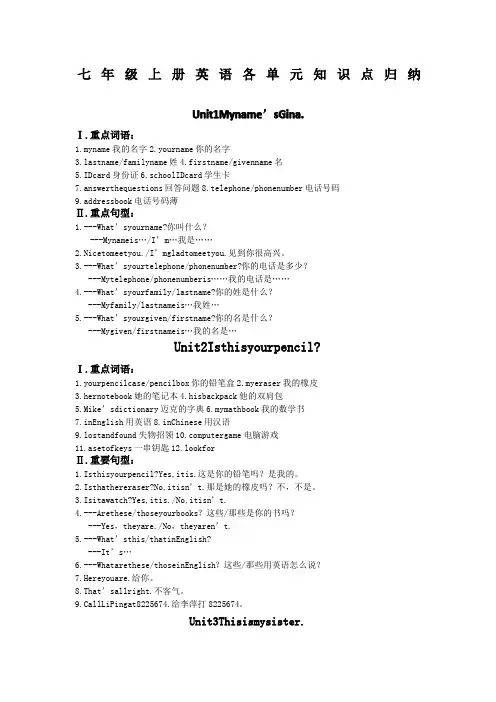
七年级上册英语各单元知识点归纳Unit1Myname’sGina.Ⅰ.重点词语:1.myname我的名字2.yourname你的名字stname/familyname姓4.firstname/givenname名5.IDcard身份证6.schoolIDcard学生卡7.answerthequestions回答问题8.telephone/phonenumber电话号码9.addressbook电话号码薄Ⅱ.重点句型:1.---What’syourname?你叫什么?---Mynameis…/I’m…我是……2.Nicetomeetyou./I’mgladtomeetyou.见到你很高兴。
3.---What’syourtelephone/phonenumber?你的电话是多少?---Mytelephone/phonenumberis……我的电话是……4.---What’syourfamily/lastname?你的姓是什么?---Myfamily/lastnameis…我姓…5.---What’syourgiven/firstname?你的名是什么?---Mygiven/firstnameis…我的名是…Unit2Isthisyourpencil?Ⅰ.重点词语:1.yourpencilcase/pencilbox你的铅笔盒2.myeraser我的橡皮3.hernotebook她的笔记本4.hisbackpack他的双肩包5.Mike’sdictionary迈克的字典6.mymathbook我的数学书7.inEnglish用英语8.inChinese用汉语9.lostandfound失物招领putergame电脑游戏11.asetofkeys一串钥匙12.lookforⅡ.重要句型:1.Isthisyourpencil?Yes,itis.这是你的铅笔吗?是我的。
2.Isthathereraser?No,itisn’t.那是她的橡皮吗?不,不是。
七年级上英语m10知识点
七年级上英语m10知识点七年级上英语M10知识点主要包括以下几个方面:Present Continuous Tense (现在进行时态)、Frequency Adverbs (频率副词)、Activities (活动)。
一、Present Continuous Tense (现在进行时态)现在进行时态用于表示现在正在发生的动作或者行为,其构成为:be动词(am, is, are) + 现在分词(-ing)。
例如:I am studying English right now. (我正在学习英语。
)不规则动词在构成现在分词时需要注意,例如:go → going、have → having、see → seeing。
否定句的构成为:主语+ am/is/are not + 现在分词(-ing)。
例如:I am not watching TV right now. (我现在没有看电视。
)疑问句的构成为:be动词(am/is/are) + 主语 + 现在分词(-ing)?例如:Are you playing soccer now? (你现在在打足球吗?)二、Frequency Adverbs (频率副词)频率副词用于表示某个动作或者行为发生的频率,例如:always (总是)、often (经常)、usually (通常)、sometimes (有时)、rarely (很少)、never (从不)。
Frequency Adverbs通常放在be动词之后,放在其他动词之前。
例如:I usually study English in the morning. (我通常在早上学习英语。
)三、Activities (活动)英语中有很多有关活动的动词,例如:swim (游泳)、run (跑步)、watch TV (看电视)、listen to music (听音乐)、dance (跳舞)等等。
由于活动是现在进行时态的重要内容,所以这里将活动列为知识点之一。
七年级上册英语m10知识点
七年级上册英语m10知识点在七年级上学期英语学习的第10个模块中,我们学习了很多新的知识点。
在这篇文章中,我将对这些知识点进行总结和介绍。
1. 过去式在这个模块中,我们学习了如何构成动词的过去式。
大多数情况下,我们只需要在动词的后面加上“-ed”,就能构成过去式。
例如,walk变成了walked,talk变成了talked。
然而,还有一些动词的过去式不是这样构成的。
例如,eat变成了ate,take变成了took。
因此,为了正确地使用过去式,我们需要将这些动词的过去式背熟。
2. 问句我们在这个模块中还学习了如何建立和回答问句。
在建立问句时,需要总是将助动词放在主语前面。
例如,你想问别人是否做过作业时,可以问,“Did you do your homework?”。
回答问句时,我们可以使用简短的回答,如“Yes, I did.”或者“No, I didn't.”。
这样的答案通常比较简短,但能很好地表达我们的意思。
3. 方位介词在这个模块中,我们还学习了方位介词。
这些介词用于描述物品的位置。
例如,above(在…上方)、below(在…下方)或between(在…之间)。
这些介词可以帮助我们更好地描述物品的位置,让我们更准确地表达自己。
4. 正确用词在英语中,很多单词的发音非常相似,但意思却有很大的差别。
在本模块中,我们学习了这些单词,以及如何在使用它们时避免出现意思混淆的情况。
例如,"there"(那里),"their"(他们的)以及"they're"(他们是)都有类似的发音,但在使用时,却意义大不相同。
因此,在使用这些词汇时,我们需要特别注意,避免出现错误。
总结在学习七年级上学期英语M10知识点时,我们学习了很多新的知识,包括如何使用过去式、建立和回答问句、方位介词、正确用词等等。
这些知识点不仅能够帮助我们更好地表达自己,而且能够为我们今后的学习打下坚实的基础。
人教版七(上)Unit 10知识归纳
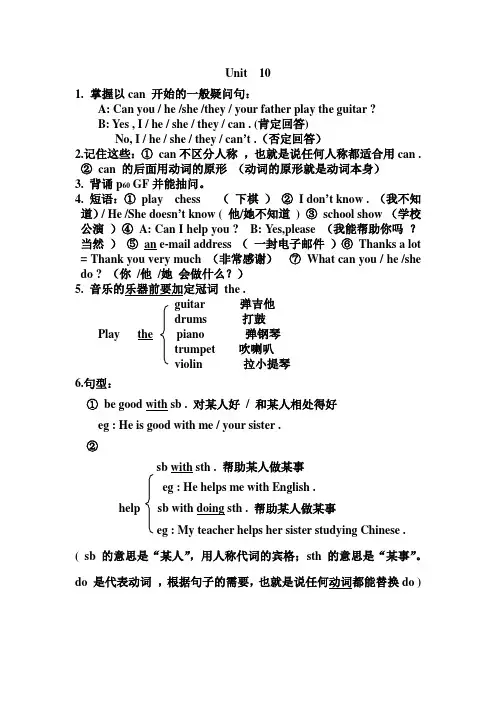
Unit 101.掌握以can 开始的一般疑问句:A: Can you / he /she /they / your father play the guitar ?B: Yes , I / he / she / they / can . (肯定回答)No, I / he / she / they / can’t .(否定回答)2.记住这些:①can不区分人称,也就是说任何人称都适合用can .②can 的后面用动词的原形(动词的原形就是动词本身)3. 背诵p60 GF并能抽问。
4. 短语:①play chess (下棋)②I don’t know . (我不知道)/ He /She doesn’t know ( 他/她不知道) ③school show (学校公演)④A: Can I help you ? B: Yes,please (我能帮助你吗?当然)⑤an e-mail address (一封电子邮件)⑥Thanks a lot = Thank you very much (非常感谢)⑦What can you / he /she do ? (你/他/她会做什么?)5. 音乐的乐器前要加定冠词the .guitar 弹吉他drums 打鼓Play the piano 弹钢琴trumpet 吹喇叭violin 拉小提琴6.句型:①be good with sb . 对某人好/ 和某人相处得好eg : He is good with me / your sister .②sb with sth . 帮助某人做某事eg : He helps me with English .help sb with doing sth . 帮助某人做某事eg : My teacher helps her sister studying Chinese . ( sb 的意思是“某人”,用人称代词的宾格;sth 的意思是“某事”。
七年级英语上册 UUnit10知识清单 人教新目标版

七年级上英语 Unit 10 Can you play the guitar?语法重点(同学们:情态动词贯穿我们学英语的始终,所以要重点把握)Can 是情态动词,所有情态动词都有以下共同的特点:1 没有人称和数的变化. Eg: She can play the violin2 情态动词后面接动词的原型Eg: She can swim . 不能说成:she can to swim (F)3 句型的变化都集中在情态动词的变化Eg: She can’t swim .Can she swim ? Yes, she can No, she can’t同学们马上检测一下对这个知识的把握是否到位!I can speak English.否定句:_____________________________________一般疑问:_________________________________肯定回答:__________________________________否定回答:________________________________________特殊疑问:__________________________________________________________________________________疑问句中对表示请求或允许的回答可以说 OK. 或 All right. 表示同意对方的要求。
-- Can I borrow (借)your pen ?-- OK/ All right. Here you are.-- Sorry. I only have one .在商场购物时,营业员通常说-- Can I help you ? (注意回答)-- Yes ,please. I’d like a sweater.-- No, thanks.重点单词短语1 play玩(和不同词搭配有不同的意思,)play the piano play the trumpet (和乐器搭配要用 the)play chess play soccerplay with the toy ( play with …和。
七年级英语第十单元知识点归纳
1. 一般过去时:使用一般过去时来谈论过去发生的事情,表示过去的状态或经验。
动词变为过去式,加上了-ed或者不规则过去式。
例句:I watched a movie last night.(我昨晚看了一场电影。
)They visited their grandparents yesterday.(他们昨天去看望了他们的祖父母。
)例句:He always goes to school by bike.(他总是骑自行车去上学。
)3. 特殊疑问句:特殊疑问句是用来询问特定的信息的句子,需要使用特殊疑问词来引导,如what(什么)、when(何时)、where(在哪里)、how(如何)、why(为什么)等。
特殊疑问句一般以问号结尾。
例句:What did you do last weekend?(你上个周末做了什么?)4. 过去式的疑问句和否定句:过去式的疑问句一般使用助动词did 加主语,并将动词原形用于谓语,否定句一般在谓语前面加上助动词did not或didn't。
例句:Did you visit the museum yesterday?(你昨天参观了博物馆吗?)They didn't go to the park last Sunday.(上个星期天他们没有去公园。
)5. 时间状语从句:时间状语从句是用来表示时间关系的从句,以when(当...时候)或while(当...的时候)引导。
时间状语从句一般放在主句之前。
6. 过去时的地点状语从句:地点状语从句是用来表示地点关系的从句,以where(在哪里)引导。
地点状语从句一般放在主句之后。
例句:She bought the book where she saw her favorite author.(她在看到她最喜欢的作家的地方买了这本书。
)7.过去时态与一般现在时态的区别:过去时态谈论过去的事情,一般现在时态谈论现在发生的事情。
七年级上册英语知识点m10
七年级上册英语知识点m10英语知识点:Unit 10Unit 10 in the 7th grade English textbook is focused on the topic of leisure time. Students will learn new vocabulary words related to leisure activities and how to ask and respond to questions about these activities. Here are the key areas covered in this unit.1. VocabularyIn this unit, students will learn new vocabulary words such as hobbies, interests, and leisure activities. Some of the common words they will learn include hiking, swimming, dancing, singing, drawing, and playing sports. Students will also learn how to ask questions about hobbies and how to respond.2. GrammarStudents will practice using the present continuous tense to describe what they are currently doing. They will also learn how to use adverbs of frequency to describe how often they do certain leisure activities.3. Reading and WritingStudents will read a short passage about a person's leisure activities, and answer questions about it. They will also practice writing about their own hobbies and interests.4. Listening and SpeakingIn this unit, students will practice speaking by asking and answering questions about leisure time activities. They will also listen to short conversations and answer questions about them.5. CultureStudents will learn about some of the common leisure activities in the United States and other English-speaking countries. They will also learn about different attitudes towards leisure time and how it is spent.Overall, Unit 10 in the 7th grade English textbook is an important unit that teaches students useful vocabulary and grammar related to leisure time. The unit helps students to develop their reading, writing,speaking, and listening skills while also learning about different cultures. By the end of the unit, students will be able to confidently talk about their own hobbies and interests in English.。
七年级英语10单元知识点
七年级英语10单元知识点七年级英语10单元是初中英语中的重要部分,其中包含了许多重要的知识点。
本篇文章将为您详细介绍七年级英语10单元的知识点,帮助您更好地掌握这一部分内容。
第一部分:词汇七年级英语10单元的词汇量相对较大,重点是一些动词和名词的用法。
以下是一些常见的词汇和用法:1. apologize:表示道歉,常用于以下场合:表示向他人道歉、承认错误等。
2. realize:表示意识到,意为“意识到/发现/认识到某事”的意思。
3. exhibition:意为“展览活动”,是指以某些事物或人物为主题,通过展示或表演的形式向他人展现出来。
4. energetic:意为“精力充沛的/积极的”,通常形容一个充满活力的人或物。
5. challenge:表示“挑战”,常用于以下场合:表示挑战自我;接受新的挑战等。
第二部分:语法语法是七年级英语10单元中比较重要的一部分,重点是一些基本的语法和句型。
以下是一些重要的语法点:1. 一般将来时:常用于以下场合:表示将来某个时间发生的行动或事件;表示计划/安排某个时间或行动。
2. 疑问句:通常以疑问副词或疑问代词开头,例如:What/When/Why/How等。
3. 宾语从句:常用于以下场合:表示自己对某些事情的看法或想法;表达感官、感受等内容时。
4. 比较级与最高级:表示两者之间的比较或多个人或物之间的比较。
第三部分:听力七年级英语10单元中的听力占比较大,主要是考察学生对于不同语音、口音的理解。
以下是一些听力知识点:1. 问候语:通常是听力考试中的开头部分,例如:Hello/Hi等。
2. 数字:通常出现在听力中的人名、地名、时间等,需要相当的听力功底。
3. 名词的发音:常用于以下场合:区分不同名词的发音;在英语中读准几个特殊的名词。
4. 知识点点拨:需要学生关注听到的语音内容,并在听力结束后对自己的答案进行反思和检查。
第四部分:阅读七年级英语10单元的阅读知识点比较多,主要是考察学生的阅读理解能力。
七年级上册英语Unit10《Canyouplaytheguitar》知识点
七年级上册英语Unit 10《Can you play the guitar》学问点【重点短语】1. play the guitar 弹吉彳也2. speak English 说英语3. join the art club参与艺术俱乐部4.play chess 下象棋5. be good with... 对…相处的好6.help sb. with sth,在某件事上帮助某人7.sing or dance唱歌或跳舞8. call sb. at... 用号码打给某人9. rock bank摇滚乐队10.school show 学校公演11. Chinese kung fu 中国功夫12. a little 一点13. E-mail address电子邮件地址【经典句型】1.Can you play the guitar? 你会弹吉他吗?Yes, I can. 是的,我会。
No, I不,我不会。
2.I want to join the music club. 我想参加音乐俱乐部。
3.What club do you want to join?你想参加什么俱乐部?4.What can you do? 你会做什么?5.Tom can play the guitar but he carTt play it very汤姆会弹吉他,但是well.6.Are you good with kids?你和孩子们相处得好吗?7.We need help for our Beidaihe School Trip.我们的北戴河之旅需要帮助。
8.Can you help with sports?你能在体育方面帮助吗?9.Musicians wanted for school music festival.学校音乐节招收音乐人。
10.Can you play the piano, the trumpet, the drums, or the guitar?你会弹电冈琴、吹喇叭、打鼓还是会弹吉他?11.Please call Zhang Heng at 622-6033. 请拨打622-6033 找张衡。
人教版七年级Unit10I’dlikesomenoodles.知识点及练习
⼈教版七年级Unit10I’dlikesomenoodles.知识点及练习⼈教版七年级Unit 10 I’d like some noodles、知识点及练习◆重点词汇:1、可数:noodles:⾯条 potatoes:⼟⾖ tomatoes:西红柿carrots :胡萝⼘ vegetables:蔬菜 onions:洋葱 dumplings:饺⼦ pancakes:薄饼2、不可数:mutton:⽺⾁ beef:⽜⾁meat:⾁porridge:稀饭Soup:汤 milk:⽜奶 water:⽔3、有时可数有时不可数:chicken:鸡⾁cabbage:卷⼼菜fish:鱼◆重点短语归纳:1、would like 想要2、take one’s order点菜3、beef soup ⽜⾁汤4、one (large)bowl of…⼀碗……5、what size 什么尺⼨6、Mapo tofu with rice带⽶饭得⿇婆⾖腐7、what kind 什么种类8、small / medium / large bowl ⼩/ 中/⼤碗9、green tea 绿茶 10、orange juice 橘汁;或orange11、around the world 世界各地 12、birthday cake ⽣⽇蛋糕13、the number of…得数量 14、make a wish 许个愿望15、blow out the candles吹灭蜡烛 16、in one go ⼀⼝⽓17、e true 实现 18、cut up 切碎19、get popular 受欢迎;流⾏ 20、bring good luck to 给……带来好运◆⽤法集萃:1、would like + sth、想要某物2、would like + to do sth、想要做某事3、Why don’t you + do sth?何不做某事?相当于Why not do……4、the number of + 名词复数……得数量,a number of+名词复数许多……1、would like得⽤法would like 意为想要,愿意,相当于want,⽤于提出要求或建议;但语⽓⽐want 委婉,⼀般有⼀下三种形式:①would like sth、想要某物,如:我想要些冰淇淋。