
人教版七年级下册英语知识点复习(完整版) - 副本
新目标英语七年级下册知识点总结Unit 1 Can you play the guita1 4个说的区别:say+内容speak+语言talk 谈论talk about sth talk with sb talk to sbtell 告诉,讲述tell sb (not)to do sth tell stories/ jokes22 be good at+ V-ing=do well in 擅长于be good for 对…有益(be bad for对…有害)be good to 对…友好(good 可用friendly,nice,kind替换)be good with 擅长和....打交道3,show sth to sb=show sb sth give sth to sb=give sb sthpass sth to sb = pass sb sthbuy \get sb sth= get\buy sth for sb4,help sb (to)do sth help sb with sth need to do sth decide to do5 be busy doing sth/ be busy with sth enjoy doing sth finish doing sthpractice doing sthUnit 2 What time do you go to school?1,问时间用what time或者whenAt+钟点at 7 o’clock at noon/ at night(during/ in the day)On+ 具体某天、星期、特指的一天on April 1st on Sunday on a cold winter morningIn +年、月、上午、下午、晚上2 3个穿的区别:wear 表状态,接服装、手套、眼镜、香水等put on 表动作,接服装dress 表动作,接sb/ oneself get dressed穿衣3 感叹句:How+adj+主谓!How+adj+a/an +n单+主谓!What+ a/an +adj+ n单+主谓!What+ adj+ n复/ 不可数+主谓!4 either…or5 it is +adj+for sb +to do sth (adj修饰to do sth)It is important for me to learn English.it is +adj+of sb +to do sth (adj修饰sb)It is kind/ friendly/ nice of you to help me.Unit 3 How do you get to school?1 how long 多长(时间)答语常用“(For/ about +)时间段”how far多远(距离)答语常用“(It’s +)数词 +miles/ meters/ kilometers”how often多久一次(频率)答语常用“Always/ often/ every day/…”或“次数+时间”等表频率的状语How soon多快,多久以后,常用在将来时中。
答语常用“in +时间段”how many多少(接可数名词) how much(接不可数名词)2 stop sb from doing sthStop to do 停下来去做其他事Stop doing 停止正在做的事3 what do you think of/ about…?= how do you like…?你认为…怎么样?4 be afraid of sth be afraid to do sth worry about be worried about 担心5 play with sb6 ,cross 是动词across是介词7,thanks for +n/ V-ingThanks for your help/ thanks for helping me.Thanks for your invitation/ thanks for inviting/ asking me.8 ,4个花费:人+spend/ spends/ spent+时间/钱+(in)doing sth/ on sth人+pay/ pays/ paid +钱+for sthIt takes/ took sb +时间+to do sth物+cost/ costs/ cost +sb +钱9 ,交通方式●用介词。
在句子中做方式状语。
①by +交通工具名词(中间无需任何修饰)By bus/ bike/ car/ taxi/ ship/ boat/ plane/ subway/ train……●用动词。
在句子中做谓语。
①take + a/ the +交通工具名词take a bus/ plane/ ship/ trainride a bike②walk/ drive/ ride/ fly to……(后面接here,there,home等地点副词时,省略介词to。
)如步行回家:walk home 10,名词所有格一般情况加’s Tom’s pen以s结尾加’ the teachers’ office ten days’ holiday表示几个人共同拥有,在最后一个名词后加’s Mike and John’s desk表示每个人各自拥有,在每个名词后加’s Mike’s and John’s desksUnit 4 Don’t eat in class.1,祈使句(变否定在句首+don’t)Be型(be +表语),否定形式:don’t + be +表语Be quiet,please. Don’t be late!Do型(实义动词+其他),否定形式:don’t +实义动词+其他Come here,please. Don’t play football here.Let型(let sb do sth),否定形式:don’t + let sb do sth或者let sb not do sthNo+n/ V-ing No photos /mobile;No parking/ smoking/ spitting/ talking/ picking of flowers2,in class在课堂上3,be on time准时3,listen to music4 on school days/ nights5 be strict with sb/ oneself be strict in sth对……严格。
6 ,too many“太多”修饰可数名词复数too much“太多”修饰不可数名词much too“实在太”修饰形容词或副词7 ,get to, arrive in/at, reach,到达(如果后面接地点的副词home,here或there ,就不用介词in ,at, to)8 ,remember/ forget+to do要做+doing做过9 ,have fun,enjoy oneself,have a good/ great/ wonderful time+V-ingUnit 5 Why do you like pandas?1,Kind of 相当于副词,修饰形容词或副词,意为“稍微,有点”,与a little/ bit 相近A kind of 意为“一种”,some kinds of 意为“几种”,all kinds of 意为“各种各样的”。
这里的kind 是“种,类,属”的意思。
2 ,Why not =Why don’t you+V原你为什么不…?3 ,be in great dangerUnit 6 I’m watching TV.1 other,another与the otherOther “其他的,另外的”,后接名词复数,有时other+n复数=othersAnother “又一(个),另一(个)”,泛指总数为三个或三个以上中的任意一个,后接名词单数。
The other“(两者中的)另一个”,常与one连用,“one…the other…”表示“一个…,另一个…”Unit 7 It’s raining!1 How’s it/ everything going?2 Take a message for sb 替人留言3 Leave a message to sb 给人留言4 right now,right away,at once,in a minute,in a moment,立刻,马上5 just now刚刚(用于一般过去式)6 ,the answer to the question,a key to the door,a ticket to the ball game7 ,反意疑问句(陈述句+附加疑问句)反意疑问句中,陈述句用的肯定,后面的附加疑问句就要用否定;相反,陈述句用的否定,附加疑问句就要用肯定。
Unit 8 Is there a post office near here?1,问路:①Is/ Are there……near here/ around here/ in the neighborhood?②Where is/ are……?③How can I get to……?④Could/Can you tell me the way to……⑤Which is the way to……2,Across,cross,through,overAcross是介词,“横过,在对面”表示从物体表面穿过Cross是动词,相当于go/ walk acrossThrough是介词,表示从物体中间或里面穿过go through the doorOver是介词,“横过,越过”表示从物体上空越过,跨过fly over3,ask for help/ advice4,in/ on the street5,在某条大街上习惯用介词on on Bridge Street6,across from,next to,between…and…,behind7,in front of在…(外部的)前面→behind在…后面in the front of在…(内部的)前面8,go/ walk along go straight9,turn left/right10,on one’s/ the left11,at the first crossing/ turning12,Time goes quickly.Unit 9 What does he look like?1,a little,little修饰不可数名词,a little表示一点点,little表示几乎没有a few,few修饰可数名词,a few表示一点点,few表示几乎没有2,Find 强调找到的结果,look for 强调寻找的过程.3,the same as→be different fromUnit 10 I’d like some noodles.1,名词可分为可数名词和不可数名词(不可数名词作主语,谓语动词用单数)。
(完整word版)新人教版七年级英语下册知识点全总结.docx
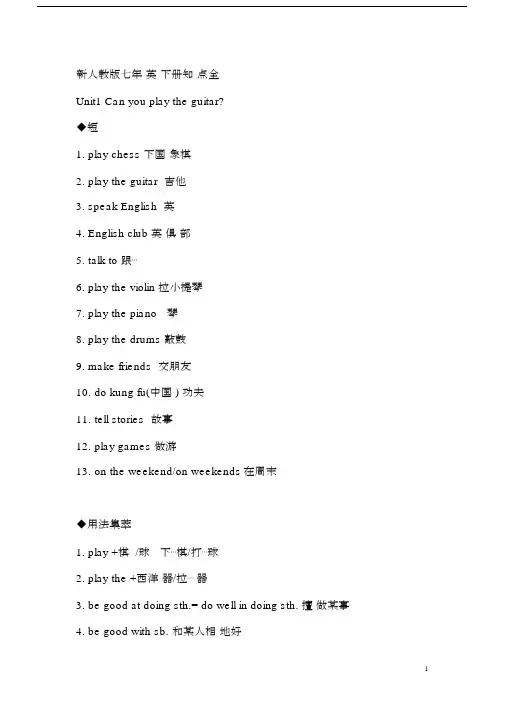
新人教版七年英下册知点全Unit1 Can you play the guitar?◆短1.play chess 下国象棋2.play the guitar 吉他3.speak English 英4.English club 英俱部5.talk to 跟⋯6.play the violin 拉小提琴7.play the piano 琴8.play the drums 敲鼓9.make friends 交朋友10.do kung fu(中国 ) 功夫11.tell stories 故事12.play games 做游13.on the weekend/on weekends在周末◆用法集萃1.play +棋 /球下⋯棋/打⋯球2.play the +西洋器/拉⋯器3.be good at doing sth.= do well in doing sth. 擅做某事4.be good with sb. 和某人相地好5.need sb. to do sth. 需要某人做某事6.can + 原形能/会做某事7. a little + 不可数名一点儿⋯8.join the⋯club加入⋯俱部9.like to do sth. =love to do sth. 喜 /喜做某事◆典句必背1. —Can you draw? 你会画画?— Yes, I can./No, I can 是的,’我t.会。
/不,我不会。
2.—What club do you want to join? 你想加入哪个俱部?—I want to join the chess club. 我想加入国象棋俱部。
3.You can join the English club. 你可以加入英俱部。
4.Sounds good./That sounds good.听上去很好。
5.I can speak English and I can also play soccer. 我会英也会踢足球。
(完整)最新人教版七年级下册英语各单元知识点复习,推荐文档
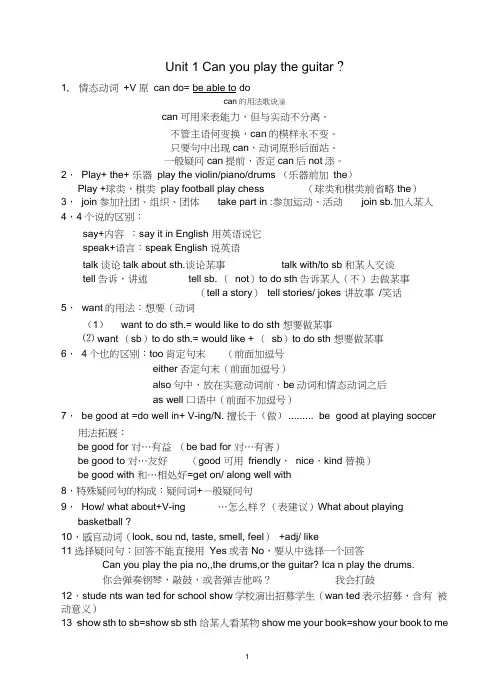
Unit 1 Can you play the guitar ?1, 情态动词+V 原can do= be able to docan的用法歌诀潼can可用来表能力,但与实动不分离。
不管主语何变换,can的模样永不变。
只要句中出现can,动词原形后面站。
一般疑问can提前,否定can后not添。
2,Play+ the+ 乐器play the violin/piano/drums (乐器前加the)Play +球类,棋类play football play chess (球类和棋类前省略the)3,join参加社团、组织、团体take part in :参加运动、活动join sb.加入某人4,4个说的区别:say+内容:say it in English 用英语说它speak+语言:speak English 说英语talk谈论talk about sth.谈论某事talk with/to sb 和某人交谈tell告诉,讲述tell sb. (not)to do sth告诉某人(不)去做某事(tell a story)tell stories/ jokes 讲故事/笑话5,want的用法:想要(动词(1)want to do sth.= would like to do sth 想要做某事⑵ want (sb)to do sth.= would like + (sb)to do sth 想要做某事6,4个也的区别:too肯定句末(前面加逗号either否定句末(前面加逗号)also句中,放在实意动词前,be动词和情态动词之后as well 口语中(前面不加逗号)7,be good at =do well in+ V-ing/N. 擅长于(做)......... be good at playing soccer用法拓展:be good for 对…有益(be bad for 对…有害)be good to 对…友好(good 可用friendly,nice,kind 替换)be good with 和…相处好=get on/ along well with8,特殊疑问句的构成:疑问词+—般疑问句9,How/ what about+V-ing …怎么样?(表建议)What about playing basketball ?10,感官动词(look, sou nd, taste, smell, feel)+adj/ like11选择疑问句:回答不能直接用Yes或者No,要从中选择一个回答Can you play the pia no,,the drums,or the guitar? Ica n play the drums.你会弹奏钢琴,敲鼓,或者弹吉他吗?我会打鼓12,stude nts wan ted for school show学校演出招募学生(wan ted表示招募,含有被动意义)13,show sth to sb=show sb sth 给某人看某物show me your book=show your book to meon show,意为在展出”give sth to sb=give sb sth 给某人某物give me a pen =give a pen to me 14,help sb (to)do sth 帮助某人做某事help sb with sth 帮助某人某事with sb 's help= with the help of sb 在某人的帮助下help oneself to 随便享用15,be busy doing sth= be busy with sth 忙于做某事,be busy doing his homework= be busy with his homework 忙于他的家庭作业16,sb. need to do sth 某人需要做某事need sb. to do sth 需要某人做某事17,be free= have time 有空的be busy 忙碌的18,make friends 交朋友make friends with sb. 与某人交朋友19,call sb at + 电话号码给某人打---电话20,on the weekend= on weekends 在周末21,English-speaking students 说英语的学生(带有连词符,有形容词性质)22,do kung fu 表演功夫23,in, on 和at 在表达时间方面的区别①in+年、月、季节;泛指在上午,下午,晚上,如:in the morning(afternoon, evening).in spring 在春季in September 在九月②on指在某一天或某一天的上午,下午,晚上,具体到某一天、节日如: on Monday, on Sunday afternoon, on July 1, 1999 on New Year's Day③ at,一般表示点时间,如at six o' clock, at three thirty. > 习惯用法: at night, at noon, 注意:在英语中,如果时间名词前用this, last, next 等修饰时,像这样的表示,“在某时”的时间短语前,并不需要任何介词。
人教版七年级下册英语知识点归纳

人教版七年级下册英语知识点归纳
一、词汇知识点
1. 名词:表示人、事物或物体的名称。
2. 动词:表示动作或状态的词语。
3. 形容词:描述人或事物的特征或性质。
4. 副词:修饰动词、形容词或其他副词,表示时间、地点、程
度等。
5. 介词:连接名词或代词与其他词性的词语,表示位置、时间、原因等。
6. 数词:表示数量或顺序的词语。
7. 代词:替代名词的词语,例如人称代词、指示代词等。
8. 冠词:放在名词前面,用来限定名词的词语。
二、语法知识点
1. 现在进行时:表示现在正在进行的动作或状态。
2. 一般现在时:表示经常、反复或总是发生的动作或状态。
3. 一般过去时:表示过去某个时间发生的动作或状态。
4. 一般将来时:表示将来要发生的动作或状态。
5. 祈使句:表示请求、命令、建议等的句子类型。
6. 疑问句:表示疑问的句子类型。
7. 定冠词与不定冠词的用法:表示特指或泛指的名词前需要使用不同的冠词。
三、阅读理解技巧
1. 细节理解:根据文章中的具体信息来回答问题。
2. 推理判断:根据已有信息进行推理,得出结论。
3. 主题概括:对文章的主要内容进行概括。
4. 上下文猜词:根据上下文的语境猜测单词的意思。
5. 标题选取:选择合适的标题来概括文章的内容。
以上是人教版七年级下册英语知识点的简要归纳,希望对你有所帮助!。
人教版七年级下册英语总复习
人教版七年级下册英语总复习
目标
本文档旨在提供人教版七年级下册英语的总复材料,帮助学生回顾和巩固所学内容。
复内容
1. 单元一:Lesson 1-2
- 研究日常问候语和自我介绍的表达方式
- 研究数字1-100及其应用
- 研究询问和回答年龄的方式
2. 单元二:Lesson 3-4
- 研究询问和表达家庭成员关系的方式
- 研究询问和回答职业的方式
- 研究指示方向和位置的表达方式
3. 单元三:Lesson 5-6
- 研究描述人物外貌和性格特征的表达方式
- 研究询问和回答时间的方式
- 研究表示频率的副词及其应用
4. 单元四:Lesson 7-8
- 研究描述人物喜好和日常活动的表达方式- 研究询问和回答能力和兴趣的方式
- 研究表达原因和结果的连词及其应用
5. 单元五:Lesson 9-10
- 研究描述家庭、房间和城市的表达方式- 研究询问和表达地点的方式
- 研究表示数量和价格的词汇及其应用
6. 单元六:Lesson 11-12
- 研究询问和回答日程安排的方式
- 研究表达喜怒和感受的形容词及其应用- 研究询问和表达能力和意愿的方式
复建议
- 复每个单元的重点词汇和常用句型
- 做相关单元的练题和听力练
- 跟读课文,注意语音和语调的准确性
- 制作复笔记,总结重点内容和常见问题- 参加口语练和模拟对话
祝愿同学们复习顺利,考试取得好成绩!。
人教版人教版七年级下册英语知识点复习(完整版)
人教版人教版七年级下册英语知识点复习(完整版)Unit 1 Can you play the guitar?1.Can do is equivalent to be able to do when used with a modal verb and a verb in its base form.e the definite article "the" when XXX.e "join" when XXX。
n。
or group.4.Say is used to express the content of a message。
while speak is used to express the language in which the message is XXX。
and tell is used to XXX.5."Want" can be replaced with "would like" when making a request for someone to do something.6."Too" is used in affirmative sentences with a comma before it。
while "either" is used in negative sentences with a comma before it。
"Also" is used after the verb "be," and "as well" is used in spoken language without a comma before it.7."Be good at" is used to XXX or activity。
七年级下册英语复习知识点归纳全册人教版
七年级下册英语复习知识点归纳全册人教版Unit 1 - My School- Vocabulary: school subjects, classroom objects, school facilities - Grammar: present simple tense, imperative sentencesUnit 2 - I Love History- Vocabulary: historical events, famous people, time expressions - Grammar: past simple tense, wh-questionsUnit 3 - At a Music Lesson- Vocabulary: musical instruments, musical terms, types of music - Grammar: present continuous tense, adverbs of frequencyUnit 4 - Our Neighborhood- Vocabulary: places in the neighborhood, directions, prepositions of place- Grammar: there is/are, prepositions of locationUnit 5 - Rules and Regulations- Vocabulary: school rules, traffic rules, safety rules- Grammar: should/shouldn't, must/mustn't, imperativesUnit 6 - Jobs- Vocabulary: different professions, job responsibilities, workplace - Grammar: be going to, future plans and predictionsUnit 7 - Food and Nutrition- Vocabulary: types of food, eating habits, health and nutrition- Grammar: present continuous for future, going to for future plansUnit 8 - Our Oldest Friends- Vocabulary: animals, animal characteristics, habitatsUnit 9 - Sports Day- Grammar: past continuous tense, time expressionsUnit 10 - Our Environment- Vocabulary: environmental issues, pollution, conservation - Grammar: present perfect tense, adverbs of frequencyUnit 11 - Shopping Fun- Vocabulary: clothing, accessories, shopping expressions - Grammar: countable and uncountable nouns, some/anyUnit 12 - Festivals and Celebrations- Vocabulary: festivals and celebrations, traditions, customs- Grammar: present perfect vs past simple, question tagsUnit 13 - Travel Time- Vocabulary: modes of transportation, travel destinations, vacation activities- Grammar: will, won't, going to for future plansUnit 14 - Let's Go Camping- Vocabulary: camping equipment, nature, outdoor activities- Grammar: could/may/might, polite requestsUnit 15 - Music and Movies- Vocabulary: music genres, film genres, entertainment- Grammar: so/such, too/enough以上是七年级下册英语复习的知识点全册归纳。
人教版七年级下册英语知识点复习(完整版)
人教版七年级下册英语知识点复习(完整版) Unit 1 Can you play the guitar?1,情态动词+V原can do= be able to do2,Play+ the+ 乐器+球类,棋类3,join 参加社团、组织、团体4,4个说的区别:say+内容Speak+语言Talk 谈论talk about sth talk with sb talk to sbTell 告诉,讲述tell sb (not)to do sthTell stories/ jokes5,want= would like +(sb)to do sth6,4个也的区别:too 肯定句末(前面加逗号)Either否定句末(前面加逗号)Also 行前be 后As well 口语中(前面不加逗号)7,be good at+ V-ing=do well in 擅长于be good for 对…有益(be bad for对…有害)be good to 对…友好(good 可用friendly,nice,kind替换)be good with和…相处好=get on/ along well with8,特殊疑问句的构成:疑问词+一般疑问句9,How/ what about+V-ing …怎么样?(表建议)10,感官动词(look, sound, taste, smell, feel)+adj/ like11,选择疑问句:回答不能直接用Yes或者No,要从中选择一个回答12,students wanted for school show(wanted表示招募,含有被动意义)13,show sth to sb=show sb sth give sth to sb=give sb sth14,help sb (to)do sthHelp sb with sthWith sb’s help= with the help of sbHelp oneself to 随便享用15,be busy doing sth/ be busy with sth16,need to do sth17,be free= have time18,have friends= make friends19,call sb at +电话号码20,on the weekend= on weekends21,English-speaking students 说英语的学生(带有连词符,有形容词性质)22,do kung fu表演功夫Unit 2 What time do you go to school?1,问时间用what time或者whenAt+钟点at 7 o’clock at noon/ at night(during/ in the day)On+ 具体某天、星期、特指的一天on April 1st on Sunday on a cold winter morningIn +年、月、上午、下午、晚上2,时间读法:顺读法逆读法:分钟≤30用past five past eight(8:05)half past eight(8:30)分钟>30用to a quarter to ten(9:45)整点用…o’clock 7 o’clock(7:00)3,3个穿的区别:wear 表状态,接服装、手套、眼镜、香水等Put on 表动作,接服装Dress 表动作,接sb/ oneself get dressed穿衣3,感叹句:How+adj+主谓!How+adj+a/an +n单+主谓!What+ a/an +adj+ n单+主谓!What+ adj+ n复/ 不可数+主谓!4,from…to…5,be/ arrive late for6,频度副词(行前be 后)Always usually often sometimes seldom hardly never7,一段时间前面要用介词for for half an hour for five minutes8,eat/ have…for breakfast/ lunch/ dinner/ supper9,either…or10,a lot of=lots of11,it is +adj+for sb +to do sth (adj修饰to do sth)It is important for me to learn English.it is +adj+of sb +to do sth (adj修饰sb)It is kind/ friendly/ nice of you to help me.Unit 3 How do you get to school?1,疑问词How 如何(方式)how long 多长(时间)答语常用“(For/ about +)时间段”how far多远(距离)答语常用“(It’s +)数词 +miles/ meters/ kilometers”how often多久一次(频率)答语常用“Always/ often/ every day/…”或“次数+时间”等表频率的状语How soon多快,多久以后,常用在将来时中。
七年级下册英语知识点总结归纳人教版
七年级下册英语知识点总结归纳人教版七年级下册英语知识点总结归纳(人教版)在七年级下册英语学习中,我们学习了许多重要的知识点。
这些知识点涵盖了语法、词汇、句子结构以及阅读理解等方面。
下面,我们将对这些知识点进行总结归纳,以帮助大家更好地复习和掌握。
一、语法知识点1. 一般现在时:表示经常性的动作或客观事实。
主语为第三人称单数时,动词要加-s或-es。
例句:He usually goes to school by bike.They often play football on weekends.2. 一般过去时:表示过去某个时间发生的动作或存在的状态。
动词要用其过去式形式。
例句:I watched a movie last night.She lived in China for two years.3. 现在进行时:表示说话时正在进行的动作。
构成:主语+be动词(am, is, are)+动词-ing。
例句:They are playing basketball in the park.We are learning English now.4. 一般将来时:表示将来要发生的动作或存在的状态。
构成:主语+will+动词原形。
例句:I will visit my grandparents next weekend.She will be a doctor in the future.5. 情态动词:can, may, must等,表示能力、许可、必须等。
例句:You can go to the park with us.Students must wear school uniforms.6. 宾语从句:用来充当主句中动词的宾语的从句。
例句:I think that he is a good student.She knows where the nearest supermarket is.二、词汇知识点1. 动词短语:由动词与副词/介词组成的短语。
人教版七年级下册英语知识点复习(完整版)
人教版七年级下册英语知识点复习(完整版)Unit 1 Can you play the guitar?1. be good at+ V-ing=do well in 擅长于be good for 对…有益( be bad for 对…有害)be good to 对…友好( good 可用 friendly , nice , kind 替换)be good with 和…相处好 =get on/ along well with2.情态动词 +V 原 can do= be able to do3.join 参加社团、组织、团体4. 4 个也的区别: too 肯定句末(前面加逗号)E ither 否定句末(前面加逗号)A lso 行前 be 后A s well 口语中(前面不加逗号)5. want= would like + ( sb ) to do sth6. P lay+ the+ 乐器+ 球类,棋类7.个说的区别: say+ 内容S peak+ 语言Talk 谈论 talk about sth talk with sb talk to sbTell 告诉,讲述 tell sb ( not ) to do sthT ell stories/ jokes8. H ow/ what about+V-ing …怎么样?(表建议)9.特殊疑问句的构成:疑问词 + 一般疑问句10 . 感官动词( look, sound, taste, smell, feel ) +adj/ like11 .选择疑问句:回答不能直接用 Yes 或者 No ,要从中选择一个回答12.students wanted for school show ( wanted 表示招募,含有被动意义)13.help sb ( to ) do sthH elp sb with sthWith sb ’ s help= with the help of sbHelp oneself to 随便享用14. show sth to sb=show sb sth give sth to sb=give sb sth15. need to do sth16.be free= have time17. be busy doing sth/ be busy with sth18. call sb at + 电话号码19 .English -speaking students 说英语的学生(带有连词符,有形容词性质)20. on the weekend= on weekends21.do kung fu 表演功夫22. have friends= make friendsUnit 2 What time do you go to school ?1.时间读法:顺读法逆读法:分钟≤ 30 用 past five past eight ( 8:05 ) half past eight ( 8:30 )分钟> 30 用 to a quarter to ten ( 9:45 )整点用… o ’ clock 7 o ’ clock ( 7:00 )2. 问时间用 what time 或者 whenA t+ 钟点at 7 o ’ clock at noon/ at night ( during/ in the day )O n+ 具体某天、星期、特指的一天 on April 1 st on S unday on a cold winter morningI n + 年、月、上午、下午、晚上3 . 感叹句: How+adj+ 主谓!How+adj+a/an +n 单 + 主谓!W hat+ a/an +adj+ n 单 + 主谓!W hat+ adj+ n 复 / 不可数 + 主谓!3. 3 个穿的区别: wear 表状态,接服装、手套、眼镜、香水等P ut on 表动作,接服装D ress 表动作,接 sb/ oneself get dressed 穿衣4.be/ arrive late for5. from … to …6. 频度副词(行前 be 后)Always usually often sometimes seldom hardly never7 . eat/ have … for breakfast/ lunch/ dinner/ supper8. 一段时间前面要用介词 for for half an hour for five minutes9. it is +adj+for sb +to do sth ( adj 修饰 to do sth ) It is important for me to learn English .it is +adj+of sb +to do sth ( adj 修饰 sb ) It is kind/ friendly/ nice of you to help me.10. a lot of=lots of11. either … orUnit 3 How do you get to school ?1.宾语从句要用陈述句语序2.疑问词H ow 如何(方式)how long 多长(时间)答语常用“(For/ about +)时间段”how far多远(距离)答语常用“(It ’ s +)数词 +miles/ meters/ kilometers”how often多久一次(频率)答语常用“A l ways/ often/ every day/…”或“ 次数+时间” 等表频率的状语H ow soon 多快,多久以后,常用在将来时中。
初中英语人教版七年级下册《知识点》归纳总结(直接打印每生一份学习)
七年级英语下册知识点归纳总结Unit 1 Can you play the guitar?1.情态动词(can,can't, must,mustn't) 助动词(do,does,don't,doesn't),let后面接的动词用原型2. play+ the/a/an/one's+ 乐器play the guitar 弹吉他play his guitar弹他的吉他pay +球类/棋类/游戏类play chess 下国际象棋play computer games玩电脑游戏play with sb./sth.和某人玩/ 玩某物改错题:1)Can you play the chess? 把the 去掉2)Tom always plays the computer games on weekends. 把the 去掉3)Lucy can play violin very well. 在play 与violin之间加the3.join 参加社团、组织、团体join the +社团、组织、团体be in 成为…成员4.4个说的区别:1)say+内容say it in English用英语说它2)speak+语言speak English说英语speak a little English说一点英语3)talk 谈论talk about sth 谈论某事talk with sb 与某人交谈talk to sb跟某人说4)tell 告诉,讲述tell sb(not)to do sth告诉某人(不要)做某事tell stories讲故事5. want(sb)to do sth想(让某人)做某事help sb. (to) do sth. 帮助某人做某事help sb. with (doing)sth.在某方面帮助某人like to do sth. 或者like doing sth. 喜欢做某事need to do sth.需要做某事help oneself to 随便享用with sb’s help= with the help of sb在某人的帮助下6.4个也的区别:1)too 肯定句末(前面加逗号)2)either否定句末(前面加逗号)3)also 1.放在行为动词之前; 2. be /助动词/情态动词之后4)as well 口语中(前面不加逗号)7. be good at+ V-ing=do well in+ V-ing擅长于be good for 对…有益(be bad for对…有害)be good to 对…友好(good 可用friendly,nice,kind替换)be good with和…相处好8.特殊疑问句的构成:疑问词+一般疑问句9.How/ what about+V-ing …怎么样?(表建议)10.感官动词(look, sound, taste, smell, feel)+adj/ like改错题:It tastes well. 把well 改为good.11.选择疑问句:回答不能直接用Yes或者No,要从中选择一个回答Can you play the guitar or the violin?I can play the guitar.不能用yes或者no来回答12.students wanted for school show(wanted表示招募,含有被动意义)13.把某物展示给某人看show sth to sb=show sb sth 给某人展示某物把某物给予某人give sth to sb=give sb sth给予某人某物买某物给某人buy sth for sb.=buy sb sth给某人买某物14.be busy doing sth/ be busy with sth忙着做某事15.be free= have time有时间,有空16.have friends= make friends交朋友17.call sb at +电话号码拨打…号码找某人18.on the weekend= on weekends在周末19.English-speaking students 说英语的学生(带有连词符,有形容词性质)20.do kung fu表演功夫Unit 2 What time do you go to school?1.问时间用what time几点?询问时刻,钟点when什么时候,几点……what time is it?=What is the time?几点了?at+钟点at 7 o’clockat noon/ at night(during/ in the day)on+ 具体某天、星期、特指的一天on April 1st on Sundayon schoolmornings/nightsin +年、月、上午、下午、晚上in 20202.时间读法:顺读法at eight five 在8:05分eight thirty 8:30eight fifteen 8:15逆读法:分钟≤30用pastfive past eight(8:05)half past eight(8:30)分钟>30用toa quarter to ten(9:45)整点用…o’clock7 o’clock(7:00)3.3个穿的区别:1)wear 表状态,接服装、手套、眼镜、香水等2)put on 表动作,接服装3)dress 表动作,接sb/ oneself 给某人穿衣服get dressed穿衣4.from…to…从.…到…between…and…在…和…之间either…or…要么…要么5.(be/ arrive) late for (school/class/work)6.频度副词(1.放在行为动词前2.放在be /助动词/情态动词后)always总是usually通常often经常sometimes有时never决不7.一段时间前面要用介词forfor half an hour持续半个小时wait for hours for the bus等公车等了数小时8.eat/ have+食物+for+breakfast/ lunch/ dinner/ suppereat/have+breakfast/ lunch/ dinner/ suppereat/have+a/an+形容词+breakfast/ lunch/ dinner/ supper吃一个有营养的早餐have a good/great breakfast8.either…or连接两个主语时,遵循就近原则(1) Either Tony or his sisters wash the dishes.此句与wash接近的主语是sisters,复数形式,用原型(2) Either Tony's sisters or Tony washes the dishes.此句与wash接近的主语是Tony,单数形式,所以动词用三单形式,以sh结尾的动词,加es.9.a lot of=lots of "许多,大量" 后面接可数名词的复数,或者不可数名词some 一些,后面接可数名词的复数,或者不可数名词many许多、大量,修饰可数名词复数too many太多,修饰可数名词复数much许多、大量,修饰不可数名词too much太多,修饰不可数名词much too“实在太”修饰形容词或副词10.It is +adj+for sb +to do sth (adj修饰to do sth)做某事对于某人来说……It is important for me to learn English.学英语对于我来说很重要。