
外研版(一起)英语三年级上册Module7 语法知识点
格子老师英语小课堂三年级上册英语语法知识点
Module 7
Unit 1 & Unit 2
1.have + 主语+ got + 名词?你有什么吗?------ 一般疑问句
Have you got a headache? ---- Yes, I have. / No, I haven’t. (肯定/否定回答)
Have you got a stomach ache?
Have you got a test today?
Have you got a picture of a panda?
Have you got a picture of a monkey?
Has Sara got a cough? ---- Yes, she has. / No, she hasn’t.
Has Daming got a cold? ---- Yes, he has. / No, he hasn’t.
Has he got a pen?
Has he got a book?
注:
①肯定/否定回答
Yes, 主格+ have(has).
No, 主格+ have n’t(has n’t).
- Yes, I have. / No, I haven’t.
- Yes, you have. / No, you haven’t.
- Yes, we have. / No, we haven’t.
- Yes, they have. / No, they haven’t.
- Yes, she has. / No, she hasn’t.
- Yes, he has. / No, he hasn’t.
- Yes, it has. / No, it hasn’t.
②肯定/否定回答
Yes, 主格+ have(has) got + 名词.
No, 主格+ have n’t(has n’t) got + 名词.
-Have you got a stomach ache? (可替换a headache, a test, a book)
-Yes, I have got a stomach ache. / No, I haven’t got a stomach ache.
2.主语+ have(has) got + 名词: 谁有什么。
She’s got a cold.
He’s got a cold.
He’s got a cough.
I’ve got a picture of panda.
注:she’s got= she has got, he’s got = he has got(区别she’s= she i s, he’s = he is)
3.Where + be + 主语?谁(什么)在哪里?
Where’s Jake? ---- He’s ill. (He’s at home.)
Where’s the cat?
Where’s the book?
Where’s the panda?
缩写:where‘s = where is。
外研版(三起)-英语-三年级上册-英语外研版三年级上 Module 7 Unit 1 教材同步讲解 教案(词汇)
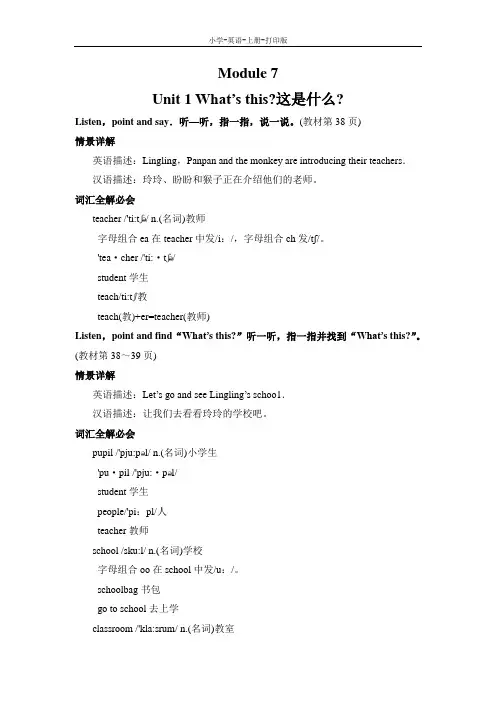
Module 7Unit 1 What’s this?这是什么?Listen,point and say.听—听,指一指,说一说。
(教材第38页)情景详解英语描述:Lingling,Panpan and the monkey are introducing their teachers.汉语描述:玲玲、盼盼和猴子正在介绍他们的老师。
词汇全解必会teacher /'ti:tʃə/ n.(名词)教师字母组合ea在teacher中发/i:/,字母组合ch发/tʃ/。
'tea·cher /'ti:·tʃə/student学生teach/ti:tʃ/教teach(教)+er=teacher(教师)Listen,point and find“What’s this?”听一听,指一指并找到“What’s this?”。
(教材第38~39页)情景详解英语描述:Let’s go and see Lingling’s schoo1.汉语描述:让我们去看看玲玲的学校吧。
词汇全解必会pupil /'pju:pəl/ n.(名词)小学生'pu·pil /'pju:·pəl/student学生people/'pi:pl/人teacher教师school /sku:l/ n.(名词)学校字母组合oo在school中发/u:/。
schoolbag书包go to school去上学classroom /'kla:srum/ n.(名词)教室字母组合oo在classroom中发/u/。
'class·room /'kla:s·rum/school学校,teacher教师,student学生Our classroom is clean.我们的教室很干净。
class(班级)+room(房间)=classroom(教室) English /'iŋgliʃ/ n.(名词)英语字母组合sh在English中发/ʃ/。
外研社三年级英语上册Module 7 知识清单

Module 7一、核心词汇1.名词:teacher教师pupil小学生school学校classroom教室English英语schoolbag书包ball球book书2.其他:that那个say说again再一次二、拓展词汇其他常见名词:student学生maths数学Chinese语文basketball篮球football足球badminton羽毛球notebook笔记本storybook故事书三、核心句型1.Thisismyteacher,MsSmart.这是我的老师,斯马特老师。
解读:这是介绍某人或某物的句型,其中this是指示代词,用来指代距离说话人较近的人或事物。
举一反三:Thisismyschool.这是我的学校。
Thisismybrother.这是我哥哥。
2.—What sthis?这是什么?—It sapencil.它是一支铅笔。
—What sthat?那是什么?—It saball.它是一个球。
解读:这是询问某物是什么的句型及回答。
回答时一般不用“Thisis…”和“Thatis…”,而是用it来代指this/that,以避免重复。
举一反三:—What sthis?这是什么?—It sacat.它是一只猫。
—What sthat?那是什么?—It sabook.它是一本书。
四、开拓眼界在美国怎样问候和打开话匣子对美国人而言,什么才是适当的问候语呢?可能你已经懂得怎么说“Howareyou?”,甚至也知道一般常用的回答是“Fine,thanks,andyou?”。
美国人的确常用这些老套的问候方式,而他们所期待的也只是一般的习惯性回答。
但是,多数美国人偶尔会喜欢有些变化。
在非正式的场合里,你可能听到美国人说“How sitgoing?”或“What sup?”;在正式的场合里所使用的问候语,则可能是“Goodmorning.”或“Hello,itisnicetoseeyou!”。
外研版新标准一起三上英语重点知识
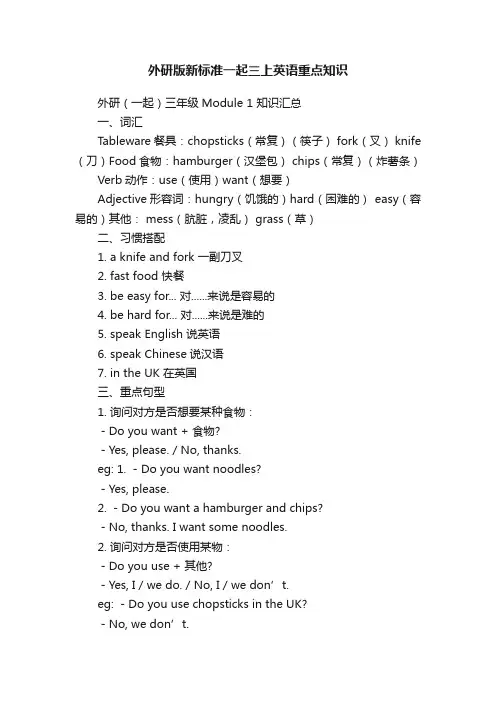
外研版新标准一起三上英语重点知识外研(一起)三年级Module 1 知识汇总一、词汇Tableware餐具:chopsticks(常复)(筷子) fork(叉) knife (刀)Food食物:hamburger(汉堡包) chips(常复)(炸薯条)Verb动作:use(使用)want(想要)Adjective形容词:hungry(饥饿的)hard(困难的) easy(容易的)其他: mess(肮脏,凌乱) grass(草)二、习惯搭配1. a knife and fork 一副刀叉2. fast food 快餐3. be easy for... 对......来说是容易的4. be hard for... 对......来说是难的5. speak English 说英语6. speak Chinese说汉语7. in the UK 在英国三、重点句型1. 询问对方是否想要某种食物:-Do you want + 食物?-Yes, please. / No, thanks.eg: 1. -Do you want noodles?-Yes, please.2. -Do you want a hamburger and chips?-No, thanks. I want some noodles.2. 询问对方是否使用某物:-Do you use + 其他?-Yes, I / we do. / No, I / we don’t.eg: -Do you use chopsticks in the UK?-No, we don’t.3. 询问对方正在吃什么:-What are you eating?-I’m eating + 食物.eg: -What are you eating?-I’m eating noodles and meat.外研(一起)三年级Module 2 知识汇总一、词汇1.Verb动作:make(制作)water(给(植物)浇水)2. Family members家庭成员: mum(妈妈) dad(爸爸)3. Adjective形容词:lovely(可爱的)quiet(安静的,不出声的)4. Food食物:cake(蛋糕)二、习惯搭配1. make a cake 制作蛋糕2. make a plane 制作飞机3. ride my bike 骑我的自行车4. water the flowers 浇花5. play the piano 弹钢琴6. watch TV 看电视7. play the drum(s) 打鼓8. Be quiet! 安静。
外研版(一起)英语三年级上册(全) 语法知识点

三年级上册英语语法知识点Module 1Unit 11.do+主语+动词……? (do要根据主语变换形式)---- 一般疑问句之一回答:Yes,主语do. / No, 主语don’t.例子:Do you use chopsticks in the UK? ---- 做出肯定/否定回答Do you want rice?Do you want noodles?Do you like rice?Do you use a knife and fork?Do they want rice?Does he use a knife and fork?Does she like rice?2.主语+be+形容词(adj.):什么怎么样例子:I am hungry. ---- 转换其他人称造句The noodles are good.It is easy for us.It is hard for us.3.缩写主语+be:I am = I’mYou are = you’reWe are = we’reThey are = they’reIt is = it’sHe is = he’sShe is = she’sWhat is = what’s否定形式:are not = aren’ti s not = isn’td o not = don’td oes not = doesn’t4.主语+动词+宾语例子:You like meat. ---- 替换各种宾语We use a knife and fork.5.词组:Look at + 名词Look at the mess! ---- 替换各种名词Look at me!Look !Unit 21.What + be + 主语+动词ing? 谁正在做什么?回答:主语+ be + doing…… 谁正在做什么。
What are you doing?What are you eating? ---- I am eating grass,(替换meat, rice, noodles, hamburgers and chips, apples. )2.现在进行时结构:be + 动词ing 正在……(四大时态之一)What are you eating? ---- 特殊疑问句---- 找出各自的be + doing What are you doing? ---- 特殊疑问句I’m eating grass. ---- 肯定句I’m eating meat.I’m eating hamburgers and chips.I’m using my hands.He’s using chopsticks.She’s using a knife and fork.3.be+主语+动词i ng……? (be要根据主语变换形式) ---- 一般疑问句之二回答:Yes,主语be. / No, 主语be not.Are you eating an apple? ---- 做出肯定/否定回答Are you eating a hamburger?Are they eating grass?Is he eating chips?Is she eating rice?Is your mother eating noodles?4.词组:Speak + 语言:说什么语言Speak EnglishSpeak ChineseSpeak JapaneseSpeak FrenchPlease 请Try them, please. (放最后的时候一般用逗号隔开)Please try them. (放前面不需要逗号隔开)Module 2Unit 15.现在进行时结构:be + 动词ing 正在……(四大时态之一)What are you doing? ---- 特殊疑问句---- 找出各自的be + doing We’re making a cake. ---- 肯定句We’re making a cake for you.We’re making a plane.I’m riding my bike.I’m making a cake.I’m reading.I’m working.Amy’s playing the piano.Sam’s playing the drums.(写出每个肯定句特殊疑问句)6.祈使句a)Let + 某人+ 动词原形+ 某事:让某人做某事Let’s make a cake for Mum and Dad.Let’s go to school.Let’s go home.Let me do it.缩写:l et’s = let us 让我们b)动词原形+ 宾格!or Be + 形容词!Be quiet!Please be quiet!Please go to your room!Please stop!7.词组:Good idea! 好主意!Thank you!谢谢你!Thanks!谢谢!Many thanks! 非常感谢!Yes!是的!Unit 21.现在进行时结构:be + 动词ing 正在……(四大时态之一)What are you doing? ---- 特殊疑问句---- 找出各自的be + doingWhat’s he doing?What’s she doing?What are they doing?I’m watching TV.I’m watering the flowers.He’s riding.She’s eating.He’s doing his homework.He is reading.He’s writing.She’s sleeping.They are drawing.She is getting up.We’re making ducks.We’re making planes.A cat is running.2.3.This is my bag.These are my books.Those are your books.缩写:that’s = that is4.词组:Here you are. 给你。
三年级上册英语知识总结Module7知识小结外研社(一起)
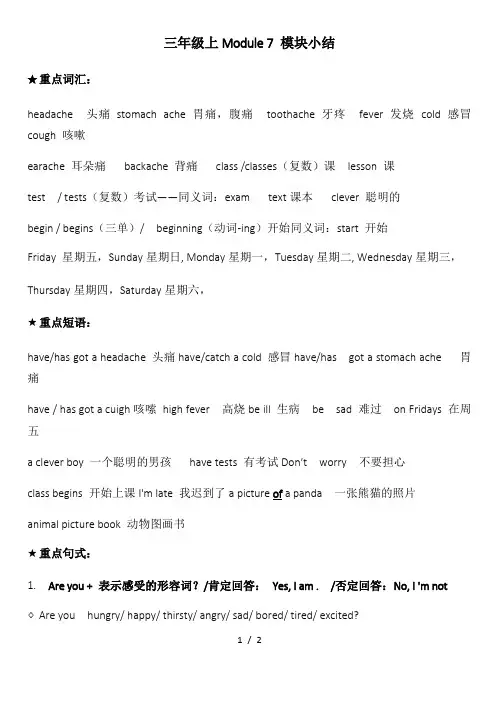
三年级上Module 7 模块小结★重点词汇:headache 头痛stomach ache 胃痛,腹痛toothache 牙疼fever发烧cold 感冒cough 咳嗽earache 耳朵痛backache 背痛class /classes(复数)课lesson 课test / tests(复数)考试——同义词:exam text课本clever 聪明的begin / begins(三单)/ beginning(动词-ing)开始同义词:start 开始Friday 星期五,Sunday星期日, Monday星期一,Tuesday星期二, Wednesday星期三,Thursday星期四,Saturday星期六,★重点短语:have/has got a headache 头痛have/catch a cold 感冒have/has got a stomach ache 胃痛have / has got a cuigh咳嗦high fever 高烧be ill 生病be sad 难过on Fridays 在周五a clever boy 一个聪明的男孩have tests 有考试Don’t worry 不要担心class begins 开始上课I'm late 我迟到了a picture of a panda 一张熊猫的照片animal picture book 动物图画书★重点句式:1. Are you + 表示感受的形容词?/肯定回答:Yes, I am . /否定回答:No, I 'm not◇Are you hungry/ happy/ thirsty/ angry/ sad/ bored/ tired/ excited?1 / 2(你饿吗?/你开心吗?/你口渴吗?/你生气了吗?/你兴奋吗?/ 你无聊吗?/你疲惫吗?/ 你难过吗?)回答:肯:Yes, I am .否:No, I 'm not .2. ◇Is she /he/it + 表示感受的形容词?肯:Yes, she/he /it is /否:No, she/he /it isn't . ◇Is(she /he/it)hungry/ thirsty? ((她/他/它)饿吗?/口渴吗?)回答:肯:Yes, she/he /it is. ; 否:No, she/he /it isn't .3. . Have you got a headache ?你头痛吗?No, I haven't (不,我不头痛。
Module7单元(教案)外研版(三起)英语三年级上册

教案:外研版(三起)英语三年级上册 Module 7 单元一、教学目标:1. 知识目标:(1)能够听懂、会说、会读本单元核心句型 "What's your mother's / father's job?" "She / He is a " "What does she /he do?" "She / He works in a " 以及词汇:teacher, doctor, farmer, police officer, worker, driver, student, postman。
(2)能够运用所学知识进行简单的日常交流,如询问和介绍家庭成员的职业。
2. 能力目标:培养学生运用英语进行交流的能力,提高他们的听说能力和语言运用能力。
3. 情感目标:培养学生对不同职业的尊重和理解,培养他们的感恩之心,教育他们要珍惜父母的辛勤付出。
二、教学内容:1. 核心句型:What's your mother's / father's job? She /He is a What does she / he do? She / He works in a .2. 词汇:teacher, doctor, farmer, police officer, worker, driver, student, postman。
三、教学重点与难点:1. 重点:掌握本单元核心句型和词汇,能够进行简单的日常交流。
2. 难点:正确运用核心句型和词汇进行交流,尤其是询问和介绍家庭成员的职业。
四、教具与学具准备:1. 教具:PPT、卡片、图片、录音机、磁带。
2. 学具:课本、练习册、铅笔、橡皮。
五、教学过程:1. 热身(5分钟)通过简单的英语歌曲或游戏,引导学生进入英语学习状态。
2. 引入(10分钟)利用PPT展示不同职业的图片,引导学生猜测这些职业是什么,并简单介绍这些职业的特点。
小学英语外研版(一年级起点)三年级上知识点总结(彩色完全版)
小学英语外研版(一年级起点)三年级上知识点总结(彩色完全版)e to download the essential study materials:For students studying English using the Foreign Language Teaching and Research Press (FLTRP) n。
starting from Year1.Grade 3.the following is a summary of key knowledge points and phrases:1."Be hard for。
" means something is difficult for XXX.2."A knife and fork" refers to a set of cutlery.3."Be easy for。
" means something is simple for XXX.4."Fast food" refers to quick and XXX.5."XXX.6."Make a cake (for。
)" XXX.7."Good idea" XXX favorable.8."XXX" means to not make any noise.9."Go to your room" means to go to one's own bedroom.10."Play the piano" means to perform on a piano.11."Water the flowers" means to give plants water.12."Here you are" means to give something to XXX.13."Watch TV" means to view n programs.14."Do the homework" XXX.15."Make planes" means to create paper airplanes.16."Dragon boats" XXX.17."Over there" means a n that is not nearby.18."Get out/go out" means to leave a place.19."Run fast" means to move XXX.20."Jump far" means to leap a great distance.21."Look at" means to observe something.22."Have a XXX" XXX.23."Have a cake" means to eat a slice of cake.24."Have an ice cream" means to enjoy a scoop of ice cream.25."Go to the shop" means to visit a store.26."Have some sweets" means to eat some candy.27."Come in" means to enter a room or building.28."Don't worry" means to not be XXX.29."Row a boat" means to use oars to XXX.30."Write a letter" means to compose a message on paper.31."Have got" means to possess something.32."Has got" means the third person singular form of "have got."33."Play with。
外研版英语三年级上册单元知识点
外研英语三年级第一单元Module1一、核心词汇1. 人称代词: I我you你;你们2. 感叹词: aah啊hello(hi)你好ooh嗬goodbye(bye-bye)再见3. be动词: am是are是4. 形容词: good好的fine健康的5. 表示时间的名词: morning早晨,上午6. 动词: thank谢谢二、拓展词汇1. 其他常见人称代词: he他she她it它we我们they他(她、它)们2. be动词: is是3. 其他表示时间的名词: noon中午,正午afternoon下午night晚上,夜晚三、核心句型1. Hello, I m Sam. 你好,我是萨姆。
解读:这是进行自我介绍时的一般用语,也可用来回答“What s your name?”这个询问对方姓名的问句。
句中的I m 是I am的缩写形式,其中am为be动词且只用在I后。
举一反三: I m Li Ming.=I am Li Ming. 我是李明。
2. — Goodbye, Lingling. 再见,玲玲。
— Goodbye, Daming. 再见,大明。
— Bye-bye, Amy. 再见,埃米。
— Bye-bye, Sam. 再见,萨姆。
解读:这是表示“再见”的常用句型。
“Goodbye!”是大家常用的且较为正式的告别语,多用于陌生人或年长的人。
“Bye-bye.”则较为口语化。
举一反三: — Goodbye, it s too late.再见,太晚了。
— Bye-bye. 再见。
3. Good morning, Daming!早上好,大明!解读:这是在一天的早上或上午向他人问好的句型。
举一反三: — Good morning, everyone. 大家早上好。
— Good morning, Mrs Green. 早上好,格林夫人。
4. — How are you, Sam? 你好么,萨姆?— I m fine, thank you. 我很好,谢谢。
新标准外研版三年级英语上册第七模块教案
Module 7 School本模块在学习单词的基础上,两课分别咨询同学们这是什么物件“ What’ s this”那是什么物件“ What’s that”指引学生用单元“ It ’s a bag.” “It’ s a pen.”进行回答。
就此解说this和教材剖析that的差别。
要点是在生活情境中对这两个功能句的灵巧应用。
所以课本中设计了听,说,画的练习,一方面培育学生学习的兴趣,另一方面,进一步稳固两个基本句型的应用。
一、知识与技术1. 学习单词 :school, pupil, classroom, English, teacher, that,bag, pencil, pen, book,again.的听闻读写。
2. 学习句型:介绍人物: This is my teacher, Ms Smart.单元教课咨询物件: What’s this It ’ s a bag.目标What’s thatIt ’s a pen.二、过程与方法 : 经过各样活动,培育学生的存心记忆和创建能力 , 培育学生用英语进行社交能力。
三、感情、态度、价值观:培育学生勇敢自信乐观的性格,从简单的平时社交口语中激发学生学习英语的兴趣。
单元训练重难点重点难点1.掌握本课单词。
2. 掌握功能句型能用英语向对方介绍自己的老师等,并This is my teacher, Ms Smart.讨论沟通咨询时什么物件。
What’s this \ thatIt’s a pen.单元Unit 1What’s this2课时课时Unit 2What’s that.2课时安排课题授班教课目教课要点教课点教课准教课一、复入二、新授Unit 1 What’s this(一)主人琴三年授人授一、知与技术1. 学 : teacher , pupil,school,classroom, English,, that, schoolbag, pencil, pen, book, again.的听写。
最新外研版小学英语三年级上册Module7 Unit1 Whats thi
外研版三年级上Module7 Unit1 What’s this?教学设计一、教材分析这是一个生活中经常用到的话题式内容:在教学中能使用实物来做教具比较好!本节课重点突出四个单词bag/pencil/pen/book.两个句式What’s this? It’s a…主要让学生通过主动探究,亲身经历和体验等过程,向学生渗透将生活中的具体问题转化为英语思维的思想, 激发学生的英语兴趣。
二、教学目标1、能听说认读单词:pen , pencil, book ,bag2、能听懂、会说句型:What’s this? It’s a…. 并能在实际情景中相互询问物品。
3、培养学生的注意力和语言综合运用能力,让学生们在日常生活中运用。
提升了运用语言的能力和语言交际能力,学会了倾听他人和肯定自己;学习英语更有信心!三、教学重、难点:本课时重点讲授关于物品名称的单词1、听说认读单词:pen , pencil, school bag, book ,ruler.2、运用句型What’s this ? It’s a …What’s that? It’s....进行相互询问。
教师在讲解时注意this和that的正确读音和表达。
3、激发学生的学习兴趣和积极思维,使他们在实际运用中体验学习英语的乐趣与意义。
四、课时安排五、教学过程:具体我从以下几个环节着手:1、Warming-up:GreetingsT: Good morning, boys and girls.Ss: Good morning, Mr fu.T: How are you?Ss: I’m fine, thank you. And how are you?T: I’m fine too, thank you.Ss: Very good. Sit down.2、PresentationChant (师生共同说唱颜色,教室物品单词和句型)red red red It’s a red door.yellow yellow yellow It’s a yellow desk.blue blue blue It’s blue chair.green green green It’s a green window.black black black It’s a black blackboard.此处我把单词书写在四线三格内,让学生区分大小写的占格,为后面的学习奠定良好的基础。