
仁爱版七下英语Unit6 Topic2 SectionD 教案
Unit6 Topic2 SectionD 教案
I. Teaching aims
1.Knowledge aims
引导学生复习Sections A~C的重点词汇并正确朗读和拼写下列词汇:
sleep, move, countryside, city, noisy, traffic, cost, miss, air, fresh
能够在活动中总结there be句型及本话题所学的谈论住房类型和邻里关
系的句子;
能正确使用方位介词和短语;
能结合话题,运用“谈论住房类型、谈论城乡区别”等交际功能意义的表达进行操练并加以总结。
2.Skill aims
能听懂有关邻里互助的话题;
能听懂简单的课堂用语并做出适当的反应;
能根据图文就居住环境和邻里关系等基本话题进行交流;
能根据图文理解相关话题,并根据要求进行学习活动;
能写出介绍自己喜欢的居住环境(农村还是城市)的短文。
3.Emotional aims
能够在游戏、小对话、小表演等活动中,培养学习英语的兴趣和积极主动的学习精神;
能够与同伴积极合作,参与课堂活动,大胆实践;
能在小组间进行良性竞争与合作,培养友好互助的精神;
能够学会和他人和谐相处,共创美好的生活氛围。
II. The key points and difficult points
在Sections A~C已学的基础上,能自行总结there be句型及本话题所学的谈论住房类型和邻里关系等的功能表达,并进行信息输出。
III. Learning strategies
1.能够养成运用图片、关键词、背景知识等帮助听说和阅读理解的学习策略;
2.能够清楚、大声地进行朗读,认真听录音和老师的发音,大胆开口,反复模仿;
3.能在学习过程中养成预习和复习的学习习惯。
IV. Teaching aids
录音机、教学挂图、闪卡和黑板V. Teaching procedures
VI. Blackboard design。
仁爱版七年级英语下册第六单元Topic2 SectionA学案
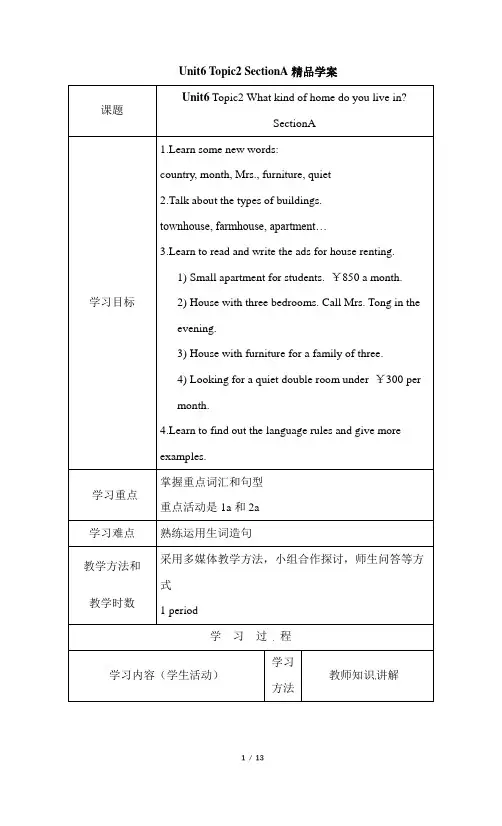
Unit6 Topic2 SectionA精品学案课题Unit6 Topic2 What kind of home do you live in?SectionA学习目标1.Learn some new words:country, month, Mrs., furniture, quiet2.Talk about the types of buildings.townhouse, farmhouse, apartment…3.Learn to read and write the ads for house renting.1) Small apartment for students. ¥850 a month.2) House with three bedrooms. Call Mrs. Tong in theevening.3) House with furniture for a family of three.4) Looking for a quiet double room under ¥300 permonth.4.Learn to find out the language rules and give more examples.学习重点掌握重点词汇和句型重点活动是1a和2a 学习难点熟练运用生词造句教学方法和教学时数采用多媒体教学方法,小组合作探讨,师生问答等方式1 period学习过程学习内容(学生活动)学习方法教师知识讲解一、学前准备1.阅读P33 1a(A)划出1a对话中谈论居民建筑的名称和特征的句子,然后写下意思并试着朗读该句(B)和你的同伴一起讨论翻译1a(做在书上)(C)你能试着用英语描述自己的居家情况吗?2.仔细观察P34 2a说说写租赁房广告需写清哪几个要素:3.写出预习所得和疑难点学生课前完成复习There be句型, 引入1a。
T: Boys and girls, pleasemake sentenceswith“Therebe”structure.S1: There is a pen on theteacher’s desk.S2: There are manyrulers in your hand.S3: …T: Good! You are great.T: Let’s chant.There are books on thetables.There are children on thechairs.There are pencils in ourhands.And there’s a teacher overthere.There are words on theblackboard.There are pictures on thewalls.But the cute animal in mypocket is the best thing of二.独立思考、解决问题1.呈现1a。
仁爱版七年级下册英语:Unit 6 Topic 1 Section ABCD学案(无答案)

Unit 6 Topic 1 Section A学习目标1. 学习本课中的新单词和词组。
2. 继续学习There be 句型并巩固运用。
3. 能够简单谈论自己的家。
自主学习一、预习Unit 6 Topic1 Section A 新单词(P127-128),然后根据所给中文写出对应的英文:1. 美丽的__________2. 花园____________3. 卧室____________4. 第二____________5. 楼层;地板_________6. 在(向)楼上_________7. 厨房___________ 8. 餐厅___________9. 客厅______________10. 浴室____________11. 第一_________ 12. 等等____________二、朗读1a,完成1b和1c。
根据所给中文,找出下列词组和短句,划线并翻译。
1.欢迎来到我的新家!_________________________2. 在二楼__________________________3. 挨着;在....旁边_________________4. 等等____________________________5. 上楼;到楼上去______________________6. 看一看________________________1a语法点拨1.--Where is your bedroom? --It’s on the second floor. There is a study next to my bedroom.你的卧室在哪儿?它在二楼,有一个书房紧挨着我的卧室。
(1)on the second floor “在二楼”,second 在此是序数词,意为“第二”,前面需要加定冠词the。
second 还可作名词,意为“秒”,表时间。
(2)study 在此是名词,意为“书房”,复数形式为studies。
Unit 1 Topic 2 Section D 示范教案(仁爱版七上)
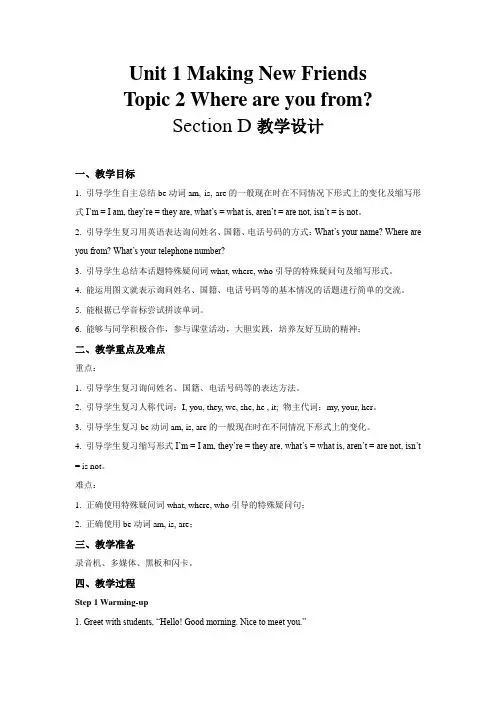
Unit 1 Making New FriendsTopic 2 Where are you from?Section D教学设计一、教学目标1. 引导学生自主总结be动词am, is, are的一般现在时在不同情况下形式上的变化及缩写形式I’m = I am, they’re = they are, what’s = what is, aren’t = are not, isn’t = is not。
2. 引导学生复习用英语表达询问姓名、国籍、电话号码的方式:What’s your name? Where are you from? What’s your telephone number?3. 引导学生总结本话题特殊疑问词what, where, who引导的特殊疑问句及缩写形式。
4. 能运用图文就表示询问姓名、国籍、电话号码等的基本情况的话题进行简单的交流。
5. 能根据已学音标尝试拼读单词。
6. 能够与同学积极合作,参与课堂活动,大胆实践,培养友好互助的精神;二、教学重点及难点重点:1. 引导学生复习询问姓名、国籍、电话号码等的表达方法。
2. 引导学生复习人称代词:I, you, they, we, she, he , it; 物主代词:my, your, her。
3. 引导学生复习be动词am, is, are的一般现在时在不同情况下形式上的变化。
4. 引导学生复习缩写形式I’m = I am, they’re = they are, what’s = what is, aren’t = are not, isn’t = is not。
难点:1. 正确使用特殊疑问词what, where, who引导的特殊疑问句;2. 正确使用be动词am, is, are;三、教学准备录音机、多媒体、黑板和闪卡。
四、教学过程Step 1 Warming-up1. Greet with students, “Hello! Good morning. Nice to meet you.”2. Let students introduce themselves using what we have learned.Hello. Nice to meet you. My name is… I am from… My telephone number is…设计意图:通过同伴对话介绍自己的情况,巩固前面所学的同时,也活跃了课堂气氛,为新课学习作铺垫。
仁爱版英语七年级下册Unit 6 topic 2 section D 说课稿

仁爱版英语七年级下册Unit 6 topic 2 section D 说课稿一. 教材分析仁爱版英语七年级下册Unit 6 topic 2 section D 主要讲述了一群学生在参加学校的春游活动。
通过本节课的学习,学生能够掌握一般过去时的被动语态,学会如何描述过去发生的事情。
教材内容丰富,插图清晰,练习多样,有助于提高学生的学习兴趣和积极性。
二. 学情分析七年级的学生已经掌握了基本的英语语法知识,对一般过去时有所了解。
但部分学生对被动语态的运用还不够熟练,需要在课堂上进行针对性的练习。
此外,学生的词汇量有待扩大,需要通过丰富的教学活动来提高他们的词汇水平。
三. 说教学目标1.知识目标:学生能够掌握一般过去时的被动语态,正确运用动词的过去分词形式。
2.能力目标:学生能够用英语描述过去发生的事情,提高口语表达能力。
3.情感目标:培养学生热爱生活,珍惜集体活动的情感。
四. 说教学重难点1.教学重点:一般过去时的被动语态的构成和运用。
2.教学难点:动词过去分词形式的正确运用,以及如何在实际语境中运用一般过去时的被动语态。
五. 说教学方法与手段1.采用任务型教学法,让学生在完成具体任务的过程中,自然而然地学会一般过去时的被动语态。
2.运用多媒体教学手段,如图片、视频等,激发学生的学习兴趣,提高课堂活力。
3.小组讨论,培养学生合作学习的能力。
4.进行互动式问答,引导学生主动思考,积极参与课堂活动。
六. 说教学过程1.导入:展示一组春游活动的图片,引导学生谈论自己参加过的春游活动,为新课学习做好铺垫。
2.呈现:通过展示故事插图,让学生感知一般过去时的被动语态,引出本节课的主题。
3.讲解:讲解一般过去时的被动语态的构成和用法,让学生举例练习。
4.练习:设计不同难度的练习题,让学生巩固所学知识。
5.运用:分组进行角色扮演,运用一般过去时的被动语态描述发生在过去的事情。
6.总结:对本节课所学内容进行总结,让学生复述一般过去时的被动语态的构成和用法。
仁爱初一Unit6Topic2详案(仁爱版七年级英语下册教案教学设计)
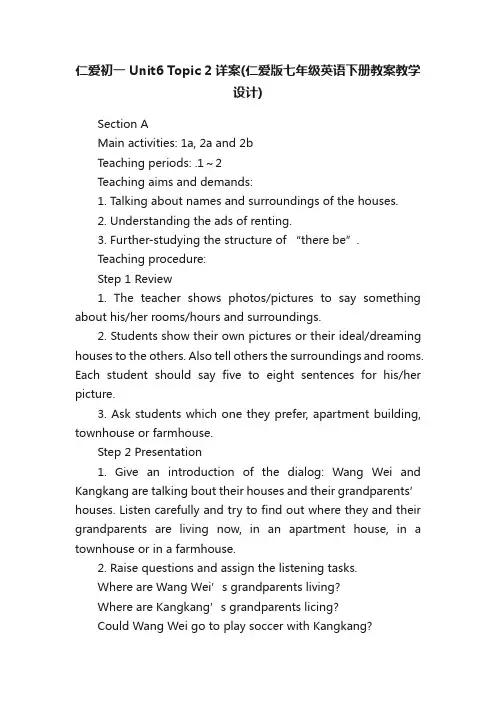
仁爱初一 Unit6 Topic 2 详案(仁爱版七年级英语下册教案教学设计)Section AMain activities: 1a, 2a and 2bTeaching periods: .1~2Teaching aims and demands:1. Talking about names and surroundings of the houses.2. Understanding the ads of renting.3. Further-studying the structure of “there be”.Teaching procedure:Step 1 Review1. The teacher shows photos/pictures to say something about his/her rooms/hours and surroundings.2. Students show their own pictures or their ideal/dreaming houses to the others. Also tell others the surroundings and rooms. Each student should say five to eight sentences for his/her picture.3. Ask students which one they prefer, apartment building, townhouse or farmhouse.Step 2 Presentation1. Give an introduction of the dialog: Wang Wei and Kangkang are talking bout their houses and their grandparents’ houses. Listen carefully and try to find out where they and their grandparents are living now, in an apartment house, in a townhouse or in a farmhouse.2. Raise questions and assign the listening tasks.Where are Wang Wei’s grandparents living?Where are Kangkang’s grandparents licing?Could Wang Wei go to play soccer with Kangkang?3. Complete the chare in 1b.4. Answer the following questions, and complete 1c.Who lives in apartment building?Who lives in townhouses?Who lives in farmhouses?Who lives in dormitories?Step 3 Consolidation1. Read the ads in 2a and make sure which ones are looking for or which ones are being let.2. Look at the ads and learn the new words: rent, furniture, quiet, single, per3. Finish 2b according to the ads.Step 4 PracticeStudents’ activities: Talk about how to write out “WANTED” or “TO LET”. The content of “WANTED” or “TO LET” includes: requirements, introduction and telephone numbers, etc.Step 5 Project1. The teacher reads out his/her own ads for renting and try to find out the suitable apartment or house among the students ads. And then write it out.2. First speak out the ads, and then write them down. Show them out on the wall. Ask each of them to find out his/her own dreaming house.Section BMain activities: 1a and 2aTeaching periods: 1~2Teaching aims and demands:1. Learning the names of facilities in the local area, such as a shop.2. Descr ibing one’s living environment.3. Making telephones for help.Teaching procedure:Step 1 Review1. Show a map of a community. Describe the facilities of the community and their functions.2. Get the students to talk about their own areas or villages.There is a small garden in front of my house.There are a lot of tall buildings in our area.Step 2 Presentation1. Hang the pictures in 1a on the wall. Introduce the pictures first in order to make the listening material easy.For example:Mike is Mary’s new neighbor. He is looking for a store. There is a store in front of their building. Also there is a bank on the street corner.2. Listen and imitate.3. Read the dialog and do pair work.4. Finish 1b and 1c.Step 3 Consolidation1. Listen to the dialog first, then read it out.2. Practice in pairs for some time.Step 4 Practice1. Finish 2b. Practice the conversation with partners, focusing on fluency.2. Students practice from mechanical exercise to meaningful exercise. Change the people, places, and things into the other ones.Step 5 ProjectMake a survey.Section CMain activities: 1 and 3aTeaching periods: 1Teaching aims and demands:1. Talking about neighbors and surroundings.2. Further-studying the structure of “there be”.3. Talk about how to get on well with neighbors.Teaching procedure:Step 1 Review1. Discuss your own area and try to answer the following questions:Is there a bank around you?Where can you buy fruits?Is there a community service centre in your area?2. Discussion:If something is broken or doesn’t work in your house, who can help you?3. Finish 1.Show posters (teaching pictures) to the students, using “there be” structure to retell the story as many as possible.Step 2 Presentation1. Present the dialog 3a with the picture. The teacher retells the story and raises questions according to the text. For example: Look! Dave is playing the piano. He is beautifully, but it is too loud. Mr. Smith is knocking at the door. Mr. Smith is talking about it to Dave. Dave is really sorry. He will try to play quietly.2. Listen and answer.Questions: what is Dave doing?Who is Dave’s neighbor?What is happening to them?3. Read the text. Ask and answer question with each other.Step 3 ConsolidationPractice 3b in pairs and then act it out.Step 4 Practice1. Discuss with your partner “How do you get on well with your neighbors? Are you a good neighbor?”2. Finish 4.First practice in pairs and then group work. At last arrange all the answers into an article.3. Song time: finish 5.Step 5 ProjectSay something about your neighbor’s family, their daily activities, then write it out. Subject: My Neighbor. Use the words in Section B as many as possible.Section DMain activities: 1and 4Teaching periods: 1Teaching aims and demands:Review the structure of “there be”.Teaching procedure:Step 1 Review1. Beginning songs Home on the Range.2. Say something about your house or building, then answer the following questions:Which type of home do you live?Where do you want to live?Do you have a good neighbor?3. Finish 1. Try to find out more words pronounced with.Step 2 Presentation1. Show the pictures and say something about them.2. Read the text and fill in the form with “suburbs” or“cities”.3. Answer the questions:Why do so many people dislike living in the cities?Why do they like living in the suburbs?Which one do you prefer, living in the cities or living in the suburbs?What’s the opinion of your classmates?4. Finish 4b.Step 3 Consolidation1. Further study 3a, 3b. Summarize the uses of the “there be” structure and useful expressions.2. Listen to the tape. Finish 4b.Step 4 Practice1. Answer the question in 5.2. Write out an article according to the answers.Step 5 Project1. Write a passage with about 50 words. The title is “I like living in the cities/suburbs”.2. Finish 6. Class activities: Let’s chant.Teaching assessment:Dictation。
仁爱版英语七年级下册Unit6topic1sectionD说课稿
仁爱版英语七年级下册Unit 6 topic 1 section D 说课稿一. 教材分析仁爱版英语七年级下册Unit 6 topic 1 section D 主要讲述了在业余时间,人们喜欢做什么以及不同人喜欢不同的业余活动。
本节课的主要语言点是:一般现在时态的肯定句和否定句以及一般疑问句,特殊疑问词what about和would like to的用法。
通过本节课的学习,学生能够掌握一般现在时态的肯定句和否定句以及一般疑问句的结构和用法,并能够运用特殊疑问词what about和would like to询问别人的业余活动并做出回答。
二. 学情分析面对七年级的学生,他们已经掌握了基本的英语语法知识,如一般现在时态的肯定句和否定句以及一般疑问句的结构和用法。
但是对于特殊疑问词what about和would like to的用法还不够熟悉。
因此,在教学过程中,需要引导学生理解和运用这两个特殊疑问词。
三. 说教学目标1.知识目标:学生能够掌握一般现在时态的肯定句和否定句以及一般疑问句的结构和用法,并能够运用特殊疑问词what about和would like to询问别人的业余活动并做出回答。
2.能力目标:学生能够在日常生活中运用所学知识进行简单的交流,如询问和介绍自己的业余活动。
3.情感目标:通过本节课的学习,学生能够培养对不同业余活动的兴趣,丰富自己的课余生活。
四. 说教学重难点1.教学重点:一般现在时态的肯定句和否定句以及一般疑问句的结构和用法。
2.教学难点:特殊疑问词what about和would like to的用法。
五. 说教学方法与手段在本节课的教学过程中,我将采用情境教学法、交际法以及任务型教学法。
通过创设情境,引导学生进行角色扮演和小组讨论,让学生在实际语境中感知和运用所学知识。
同时,利用多媒体教学手段,如图片、视频等,丰富教学内容,激发学生的学习兴趣。
六. 说教学过程1.导入:通过展示不同业余活动的图片,引导学生谈论自己喜欢的业余活动,为新课的学习营造轻松的氛围。
七年级英语下册 Unit6Topic2Section A教案 仁爱版
Unit 6 Our Local Area Topic 1 Is there a computer in your study?Section ASection A needs 1~2 periods. Section A 需用1~2课时。
The main activities are 1a, 2a and 3. 本课重点活动是1a,2a和3。
Ⅰ. Aims and demands目标要求1. (1)Learn the words of rooms in homes:bedroom, kitchen, dining room, living room, bathroom(2)Learn other new words and phrases:garden, second, floor, upstairs, come in, house, grandfather, door2. (1)Learn some prepositions of position:in, on, next to, in front of, behind(2)Learn how to use the structure of“There be”.Oh, there are so many books on the shelves.Is there a computer in your study? Yes, there is.Are there any books in the study? Yes, there are.3. Review the present continuous tense.Ⅱ. Teaching aids 教具录音机/挂图/单词卡片Ⅲ. Five-finger Teaching Plan 五指教学方案Step 1 Review 第一步 复习(时间:5分钟)复习现在进行时和一般现在时,引出1a中的新词汇。
2016年春仁爱英语七年级下Unit 6 Topic 2 My home is in an apartment building
Unit 6 Topic 2 My home is in an apartment building重点单词1、建筑名称:townhouse farmhouse apartment store bank bookstore parkinglot supermarket2、道路名词:street railway station road traffic area3、地区名词:Country city countryside community4、动词:rent post close sleep miss move5、名词:month end sport service cost air6、形容词:quiet close colorful noisy freshSection AI 重点短语1 What kind of 什么种类2 A townhouse with two floors一套两层的排房3.Live with 和…住在一起4.Live in 居住在…5.In the country在农村6.Like doing sth.7.Look for 寻找8.For rent 出租9.room wanted 求租房屋10. A quiet room. 一个安静的房间11. Call sb. At+电话号码打某人的电话。
II 重点知识点1.Wang Wei, what kind of home do you live in?It’s a townhouse with two floors.Kind名词“种类,类型”what kind of…?“哪种…?What kind of sports do you like?拓展:a kind of一种many kinds of许多种,all kinds of 各种各样的。
With two floors两层的。
这儿的介词with意为“带有,有,伴有”This is a table with three legs.这是一张三条腿的桌子。
仁爱版九年级英语下册第六单元topic2SectionD教案
Unit6 Topic2 SectionD 教学设计Ⅰ. Material analysis本课是第六单元第二话题的最后一课,主活动为1a。
通过讲述德拉和吉姆之间互送圣诞礼物的故事, 培养学生通过阅读快速找出文章大意的能力和理解有关细节并回答问题的能力。
同时该课对整个话题的功能进行了系统的总结。
通过本课的学习,学生在了解欧亨利这篇著名的短篇小说的同时,提高自己综合运用语言的技能,同时增加对爱的更深层的理解。
Ⅱ.Teaching aims1. Knowledge aims:Words and phrases:husband, wealth, sudden, all of a sudden, cut off, live through,long for, at present, couple2. Skill aims:1)能读懂英语的片断;2)能用英语续编并表演短剧。
1/ 233. Learning strategies1)积极参与课内外的英语表演活动;2)对所学内容主动复习并加以整理和归纳。
Ⅲ. The key points and difficult points1. Words and phrases:husband, wealth, sudden, all of a sudden, cut off, live through, long for, at present, couple2. Sentences:1) I sold my hair so that I could give you something for Christmas.2) I do understand.3) The fact that you have a different hair cut could not possibly make me love you less.4) Isn’t it lovely, Jim?Ⅳ. Teaching aids多媒体课件,《麦琪的礼物》配图。
仁爱英语七年级下册Unit6 topic2 Section C.D练习
Section C一. 单词和短语社区____________儿童____________ 靠近____________远的____________ 服务____________地区____________许多____________靠近____________做运动____________五彩缤纷的____________二. 翻译1、有许多老人住在这里。
2、许多有小孩的家庭也住在这里。
3、他们都对彼此很友好。
4、我们可以打电话向他们求助。
三. 按要求完成下列各句1. Some ________ (child) are playing soccer over there.2. There’re a lot of books on the desk. (改为同义句)There’re ______ books on the de sk.3. There’s a hospital near the bank.(改为同义句)A hospital is ______ ______ the bank.4. There’re many students on the playground. They’re playing football. (改为同义句)There’re ____ _________ ________ _________ on the playground.四. 选择适当的介词填空。
1. Tom sits ______ (on/at) the playground.2. There is a bridge(冰箱) _______(in front of/in the front of) the living room.3. My house is _______ (on/ next to) Jim’s house.4. There is a tall building _______ (behind/under) the restaurant.5. The girl is sitting ______ (on/in) the tree.6. I will go shopping _______ (and/with) my sister this afternoon.7. He has a glass of milk and some bread _______ (to/for) breakfast in the morning.8. There is a garage(车库) ________(near/to) the house.9. I put my sports shoes _______ (under/behind) the desk.10. _______ (At/In) the end of the street, you can see the cinema _____(on/in) the right.五. 用所给词的正确形式填空。