
2017年北京市丰台区中考二模英语试卷及答案
A. To Tokyo.
B.
To London.
C.
To New
York.
请听一段对话,完成第 7 至第 8 小题。
7. What ’s wrong with Dick?
A. He has a cold. B. He has a fever. C. He has
a toothache.
8. What does the doctor ask Dick to do?
B、C三个选项中选择最佳选项。 每段对话或独白你将听两遍。 ( 共
12 分,每小题 1 分)
请听一段对话,完成第 5 至第 6 小题。
5. What is Bill reading?
A. A letter.
B.
A book.
C.
A
newspaper.
6. Where does Bill want to go for his university study?
A. Do more exercise. B. Drink much water.
C.
Eat lots of fruits. 请听一段对话,完成第 9 至第 10 小题。
9. How does Larry feel about the party?
A. He is a little excited. B. He is a little nervous. C.
5.考试结束,请将本试卷和答题卡一并交回。
听力理解(共 26 分)
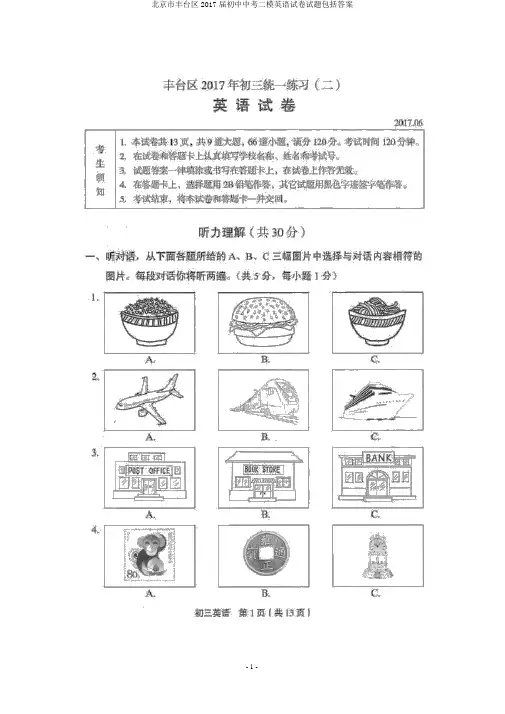
一、听对话,从下面各题所给的 A、B、C三幅图片中选择与对话内容 相符的图片。每段对话你将听两遍。 (共 4 分,每小题 1 分)
1.
A. 2.
B.
C.
A.
B.
C.
3.
A.
B.
C.
4.
A.
B.ห้องสมุดไป่ตู้
C.
二、听对话或独白,根据对话或独白的内容,从下面各题所给的 A、
He is a little surprised.
10. What does the woman advise Larry to do?
A. Wear a shirt and a tie for the party.
丰台区 2017 学年度第二学期统一练习 (二) 初三英语
1.本试卷共 12 页,满分 120 分,考试时间 120 分钟。 考 2.在试卷和答题卡上认真填写学校名称、姓名和准考证号。 生 3.试题答案一律填涂或书写在答题卡上, 在试卷上作答无效。 须 4.在答题卡上,选择题用 2B 铅笔作答,其它试题用黑色字 知 迹签字笔作答。
2017北京中考英语模拟试卷及答案(2)

2017北京中考英语模拟试卷及答案(2)2017北京中考英语模拟试题听力材料及答案一、听力测试(本大题满分25分,每小题1分)第一节下面你将听到5段短对话。
每段对话后有一个小题,从每小题A、B、C三个选项中选出一个最佳答案。
听完每段对话后,你有10秒钟的时间来回答有关小题和阅读下一小题。
每段对话只播一遍。
1.W:Today is windy.M:Yes. It’s terrible.W:Do you know if it is sunny tomorrow?M:The weather report says it will be rainy tomorrow.Question:What will the weather be like tomorrow?2.W:Dick, what subject did you use to like?M:Math. But now I prefer physics. Do you like physics?W:Yes. And I do well in it.M:Congratulations to you!Question:What subject does Dick like better now?3.W:Look at this photo, Jack. It was taken when I was five years old.M:Oh, Marry! At the age of five? It was taken eleven years ago. You’ve changed a lot.W:Yes. I used to have short hair.M:And you didn’t use to wear glasses.Question:How old is Mary now?4.W:Mr. White, you used to go to work by car, didn’t you?M:Yes, I did. But now I take the bus.W:Why did you go to work by bus?M:Because I think it’s good for our environment.Question:How did Mr. White use to go to work?5.W:I hear you were late for class this morning, Peter.M:Yes. I missed the first bus.W:What do you mean?M:I overslept. When I got to the bus stop, the bus had already left.Question:Why was Peter late for class?第二节下面你将听到6段对话或独白。
2017年北京市丰台区高考英语二模试卷(J)
2017年北京市丰台区高考英语二模试卷(J)副标题一、单选题(本大题共15小题,共15.0分)1.Hurry up!Mum and Dad us.()A. expectB. have expectedC. are expectingD. will expect【答案】C【解析】答案是C.本题考查现在进行时;现在进行时表示此刻或现阶段正在进行的动作;根据上文中的Hurry up判断,爸爸和妈妈"正在等"我们,可见句中需要现在进行时,故选C.快点!爸爸和妈妈正在等我们.对时态的选择,要在把握时态的基本用法的基础上,根据具体语境和题干中的时间推断时态,同时关注特殊的结构.2.Look up in the dictionary the words meanings you are not sure about.()A. thatB. whyC. whereD. whose【答案】D【解析】答案:D 考查限制性定语从句.分析句子结构可知这是一个定语从句,先行词the words在从句中作meanings的定语,用关系代词whose,故选D.that在从句中作主语、宾语或表语;why,where是关系副词.在字典里查一下你不确定它的意思的单词.引导定语从句的关系代词有who,whom,whose,which,that等和关系副词where,when,why等.关系代词和关系副词在定语从句中担任句子成分.在定语从句中,关系代词或关系副词都代替先行词在从句中充当一定的成分,如果该从句中缺少主语、表语、宾语或定语,就要用关系代词来连接从句;如果从句中缺少状语,就得用关系副词来连接从句.3.-I've heard that you have moved into a new house.-That's right.We in before Christmas.()A. movedB. have movedC. will moveD. had moved【答案】A【解析】答案是A.本题考查过去时;根据答句中的That's right 判断,搬家的动作过去发生,句中的before Christmas是过去的时间状语,故用过去时,答案是A.--我听说你已经搬进了新房子.--是的.我们圣诞节前搬进去的.对时态的选择,要在把握时态的基本用法的基础上,根据具体语境和题干中的时间推断时态,同时关注特殊的结构.4.-I prefer shutting myself in and surfing the Internet all day on Sundays.-That's I don't agree.You should have a more active life.()A. whyB. whereC. howD. when【答案】B【解析】答案是B.本题考查表语从句中的引导词;题干中is后面的表语从句;that's why 那就是…原因;that's where那就是…地方/方面;that's how 那就是如何…;that's when 那就是…时间;根据句意,那就是我不赞成的方面,故答案是B.--星期天我宁愿把自己关在家里整天上网;--那就是我不赞成的方面.你应该过更活跃的生活.名词性从句考查的关键是连接词的选用和语序,因此,我们首先要搞清从句的性质,掌握各连接词的用法,在此基础上判断.此外,关注名词性从句用陈述语序.5.My brother fell while he his bike and hurt himself.()A. was ridingB. rodeC. would rideD. had ridden【答案】A【解析】答案是A.本题考查过去进行时;过去进行时表示过去某一点时间或过去某一段时间内正在进行的动作;根据语境,摔倒是过去发生的事,弟弟"正骑自行车的时候"摔倒,可见句中需要过去进行时,故选A.我弟弟骑自行车的时候摔倒了,伤了自己.对时态的选择,要在把握时态的基本用法的基础上,根据具体语境和题干中的时间推断时态,同时关注特殊的结构.6.Mr.Smith,your son's performance at school still leaves a lot .()A. desiredB. to desireC. to be desiredD. being desired 【答案】C【解析】答案是C.本题考查非谓语动词;题干中考查短语 leave a lot to be desired尚有(许多)需要改进之处;有待(大幅)提高;该结构中用动词不定式表示"将来";且a lot 和desire之间是被动关系,故用动词不定式的被动语态,答案选C.史密斯先生,你儿子在学校的表现还有很多需要改进的地方.首先判断选项中的动词在句中是以谓语还是非谓语形式出现,然后根据选项在句中的功能结合非谓语的基本用法做出合理的判断.要关注常见非谓语动词的搭配.7.The task will not be fulfilled we get help from other teams.()A. ifB. unlessC. whenD. since【答案】B【解析】答案:B本题考查条件状语从句.根据句意可知,任务完成的条件是我们得到其他队的帮助,所以unless表示除非…否则引导条件状语从句符合题意.if假如;when当…时候;since 自从;除非我们得到其他队的帮助,否则任务完成不了.考生在答题时要弄清上下句之见的逻辑性,从而选择合适的连接词.8.In addition to the website in Chinese,there is an English version .()A. providingB. to provideC. provideD. provided【答案】D【解析】答案是D.本题考查分词做定语;题干中缺少的是version的定语,provide与version 之间的被动关系,故用过去分词表示被动,答案选D.除了汉语的网站,还提供了英语的版本.首先判断选项中的动词在句中是以谓语还是非谓语形式出现,然后根据选项在句中的功能结合非谓语的基本用法做出合理的判断.9.We promise attends the party a chance to have a photo taken with the moviestar.()A. whateverB. wheneverC. whoeverD. however【答案】C【解析】答案是C.本题考查动词后宾语从句中的引导词;动词promise后的宾语从句"______ attends the party"中缺少的是主语,表示"任何人";故答案是C.我们承诺任何参加聚会的人一个与这名电影明星拍照的机会.名词性从句考查的关键是连接词的选用和语序,因此,我们首先要搞清从句的性质,掌握各连接词的用法,在此基础上判断.此外,关注名词性从句用陈述语序.st year some measures to protect customers'personal information byWeChat.()A. tookB. were takenC. had been takenD. would take【答案】B【解析】答案是B.本题考查一般过去时的被动语态;题干中last year为过去的时间状语,必须与过去时连用;measures与take之间是被动关系,故用一般过去时的被动语态,答案是B.去年微信采取了一些措施保护顾客的私人信息.对时态的选择,要在把握时态的基本用法的基础上,根据具体语境和题干中的时间推断时态,同时关注特殊的结构.11.You return the book now.And you can keep it till next week.()A. needn'tB. can'tC. mustn'tD. won't【答案】A【解析】答案是A.本题考查情态动词辨析;needn't不必;can't不可能;mustn't禁止;won't不会;根据下文"你可以把它保存到下一周"推断你现在"不必"还书,所以答案选择A.你现在不必还这本书.你可以把它保存到下一周.要在正确理解情态动词的基本含义的基础上,整体理解语境中的情感态度,做出合理的判断.12. the entire annual report before,I couldn't give comments at the meeting.()A. Not readingB. Not to readC. Having not readD. Not having read【答案】D【解析】答案是D.本题考查分词做状语;动词不定式在句首做状语往往表示"目的";现在分词完成式的否定结构应该在分词前加not,所以C项形式错误;A项是现在分词一般式,表示分词的动作与谓语动词同时进行;D项是现在分词完成式,表示分词的动作在谓语动词前已经发生或完成;根据语境,没有看完整的年度报告"在前",不能发表意见"在后",故选用现在分词完成式,答案是D.句意:先前没有读完整的年度报告,在会议上我没有能够发表意见.首先判断选项中的动词在句中是以谓语还是非谓语形式出现,然后根据选项在句中的功能结合非谓语的基本用法做出合理的判断.要关注常见非谓语动词的搭配.13.Listening to loud music at rock concerts caused hearing loss in some teenagers.()A. isB. areC. hasD. have【答案】C【解析】答案C.这个句子已经有个谓语动词(caused),并且这个动词有自己的宾语(hearing loss in some teenagers),所以主语(listening to loud music at rock concerts)不是这个谓语动词的承受者,没有被动关系.故排除A、B.主语是动名词(listening to…),应用单数,故选C.在摇滚音乐会上听大声的音乐会造成一些青少年的听力损失.本题考查助动词的用法.在能分析句子成分的基础上与句子语境相结合,从而选出正确答案.14.If I had worn warmer clothes,I a cold.()A. won't catchB. won't have caughtC. wouldn't catchD. wouldn't have caught【答案】D【解析】答案是D.本题考查与过去事实相反的虚拟条件句;与过去事实相反的虚拟条件句中,从句中用过去完成时,相应的主句中用"would/should/could/might+have done",题干中从句中had worn为过去完成时,故判断是与过去事实相反的虚拟语气,由此判断答案是D.如果我当时穿暖和点衣服,我就不会感冒了.在掌握虚拟语气的规则的基础上,判断题干属于什么类型的虚拟,然后根据语境,选用恰当的动词形式表达虚拟.15.The days are gone physical strength was all you needed to make a living.()A. whoB. whichC. whenD. what【答案】C【解析】答案:C 考查限制性定语从句.本题是when引导的分隔性定语从句,先行词是The days,英语中为了句子的平衡,而采用了这种方式.who,which不能在定语从句中作状语,what不引导定语从句.故选C.本题先行词与定语从句隔开,构成了"分隔性定语从句",增加了试题难度.体力是谋生的唯一需求的日子一去不复返了.引导定语从句的关系代词有who,whom,whose,which,that等和关系副词where,when,why等.关系代词和关系副词在定语从句中担任句子成分.在定语从句中,关系代词或关系副词都代替先行词在从句中充当一定的成分,如果该从句中缺少主语、表语、宾语或定语,就要用关系代词来连接从句;如果从句中缺少状语,就得用关系副词来连接从句.二、阅读理解(本大题共15小题,共4.0分)A16.To search for information online from TEEN ZONE RESOURCES,you have to ______ .A. ask Ms.Frye for the passwordB. register at the Circulation DeskC. get permission from your parentD. bring your books and reading log17.If you are interested in making different shapes with paper,you can come to ______A. Poetry SessionB. Learn OrigamiC. Eco Crafts with JasleenD. Magazine and Book Art18.Teen Zone is a place where you can ______A. watch moviesB. meet many world-famous poetsC. exchange artworksD. have new experience with books.【答案】【小题1】C 【小题2】B 【小题3】D【解析】56.C 细节题.根据文章内容 Look to the Teen Zone's"Ready Reference"corner for all the help you need to locate information on the Internet…You must have a signed parent permission slip before using the computers.Access is limited to 30 minutes and is on afirst-come,first-served basis想要从TEEN ZONE RESOURCES上搜寻到信息,你必须首先得到父母的同意,要他们同意你使用电脑才可以.结合选项,故选C57.D 细节题.根据文章内容 Learn Origami…This class provides books and instruction in the ancient Japanese art of folding colourful squares of paper into shapes,such as birds,insects,or flowers.由此可知,Learn Origami提供给你使用纸折叠各种事物的课程,结合选项,故选D58.B 推理题.根据文章内容,主要讲述了在暑假期间,在新的公共图书馆,开办的活动.尤其是学生们可以参加,在活动过程中得到更多收获.结合选项,故选B本文主要讲述了在暑假期间,在新的公共图书馆,开办的活动.尤其是学生们可以参加,在活动过程中得到更多收获.本文是一个广告布告类阅读理解,题目涉及多道细节理解题,做题时结合原文和题目有针对性的找出相关语句进行仔细分析,结合选项选出正确答案.推理判断题也是要在抓住关键句子的基础上合理的分析才能得出正确答案,切忌胡乱猜测,一定要做到有理有据.BRiding DayAs I watch a single horse running across the field,I thinkback to when I saw my first horse.She was standing in afield."Hold out your hand.Gentle now,"my grandfathersaid.Nervously,I did.Stepping toward me,she turned herhead to inspect me with one coffee-colored eye.At thatmoment,I could have known she smiled.This was my firstchildhood memory,in which I realized that I would soonlearn to ride her,and in my heart I felt like a true Comanche.For days after our first meeting,I sat in the field with myhorse.I studied her as she studied me.I learned whichgrasses she preferred to eat;she would lift her head into the gentle spring wind that often blew across the field.Finally,the time came to ride her.It was a tribal(部落的)tradition for younger men to spend most of their days hunting.This left the teaching to the elders,like my grandfather.Theselessons were extremely important.Every boy was put on a horse before he could walk and was expected to be a skilled rider by age five.When the elders felt a boy was an expert,he was able to have his own horse.On riding day,I told my horse that we both had much to prove today,and I remembered nuzzling her and kissing her long face.When she nuzzled me back,I knew she understood.I felt the days spent in the field with her had given me a strange belief in her--in us.I encouraged her to move,and with her head held high,she carried me.She was as proud of me as I was of her.We succeeded.The elders of the tribe announced me a skilled horseman.I stood in a circle of men from my tribe.I could feel my heart beating quickly.Then the moment came when my father presented me with my first bow and arrow.I had never before seen so much pride in his eyes.Today my father leads the horse and his grandson--my son--climb upon his own horse in golden sunlight.My father insisted on teaching him to ride and doing it in the way of our people.Proudly,I stepped aside to let him do so.I smile,cherishing the details of this moment as much as I have always cherished the memories of my own riding day.19.The writer and the horse got to know each other when they ______ .A. ate their meals togetherB. went for short rides togetherC. received training from an elderD. spent time observing one another20.From the underlined sentence,we can learn that ______ .A. the writer and the horse developed a close bondB. both the writer and the horse were well-preparedC. the horse had formed a good habitD. it took courage to ride in public21.It is Comanche's tradition that ______ .A. skilled horsemen can get their bows and arrowsB. on riding day all tribe members hunt togetherC. the tribe leaders pass down the riding skillsD. each boy receives a horse at the age of five22.We can infer from the last paragraph that the writer ______A. takes pride in his son's talentB. values their family memoriesC. delights in the tradition passed downD. respects the way their people ride horses.【答案】【小题1】D 【小题2】A 【小题3】A 【小题4】C【解析】59.D,细节理解题,根据句子For days after our first meeting,I sat in the field with my horse.I studied her as she studied me可知,作者和马互相熟悉是通过观察彼此,故答案为D.60.A,推理判断题,根据句子I encouraged her to move,and with her head held high,she carried me可知这是作者和马之间在彼此磨合的过程,彼此都感到很骄傲,可以推测出作者和马发展了一种紧密的关系,故答案为A.61.A,细节理解题,根据句子Then the moment came when my father presented me with my first bow and arrow.可知,科曼奇族的传统就是会授予技术娴熟的骑手弓箭,故答案为A.62.C,推理判断题,最后一段主要讲了作者的父亲教作者的儿子骑马,从句子Proudly,I stepped aside to let him do so可知,作者是很欣慰这种传统的传递,故答案为C.短文主要描写了作者小时候爷爷教"我"学会骑马的过程,让父亲在整个部落中为"我"感到骄傲,这成为作者弥为珍贵的记忆.解答任务型阅读理解题,首先对原文材料迅速浏览,掌握全文的主旨大意.因为阅读理解题一般没有标题,所以,速读全文,抓住中心主旨很有必要,在速读的过程中,应尽可能多地捕获信息材料.其次,细读题材,各个击破.掌握全文的大意之后,细细阅读每篇材料后的问题,弄清每题要求后,带着问题,再回到原文中去寻找、捕获有关信息.最后,要善于抓住每段的主题句,阅读时,要有较强的针对性.对于捕获到的信息,要做认真分析,仔细推敲,理解透彻,只有这样,针对题目要求,才能做到稳、准.CReward methods are an everyday occurrence in our classrooms.More than ever,a great number of incentive(激励)programs have been created to help teachers manage behavior,and motivate learners.However,there is evidence that in the long run,reward systems don't work.Many people believe that rewards can help students develop a reason to do better.However,this approach fails to address why children are unable to be successful in the first place.When a student who dislikes math frequently behaves badly in class,a simple and easy way to deal with the behavior might be to offer him a reward for not misbehaving.Yet this would do nothing to solve his real problem-which is his attitude towards math.On the other hand,rewards can't last forever.So what happens when they stop?Many experiments suggest once the rewards stop,people go back to behaving as they did before.Some people might counter that.It may be true that students won't spontaneously(自发地)work once we stop rewarding them,but at least they will have worked more than they otherwise would have!Unfortunately,there is another more surprising consequence of rewards that we need to consider:Rather than create motivation,they can actually decrease motivation.In a classic study,some kinder garteners who enjoyed drawing with markers were observed in a classroom with different activities available.They were broken into two groups.Everyone in the first group was told that he or she could win an attractive certificate by drawing a picture with markers.Each was eager to get the certificate and drew a picture.Children in the second group were also encouraged to draw but didn't get a certificate.After a delay of about two weeks,when the markers again appeared in the classroom but no certificate was promised,the children in the first group used the markers about half as much as children in the second group.Apparently,rewards actually made them enjoy drawing less.What we really want is for students to take responsibility for their own learning.When much of the focus is on performance outcome,it can stop the development ofself-motivation.The‘self-determination theory'claims all human beings will succeed when our basic,inborn,and emotional needs are met.By providing appropriate support and opportunities,we can help to meet the needs of all students and therefore increase their motivation.23.The author mainly argues that ______ .A. students should be responsible for their learningB. incentive programs help to solve real problemsC. motivation plays an important role in learningD. reward methods for students are ineffective24.The underlined word"counter"in Paragraph 4 probably means ______ .A. suspectB. opposeC. detailD. confirm25.In Paragraph 5,the author uses the example to show that ______ .A. rewards keep interestB. children enjoy awardsC. children are changeableD. rewards reduce motivation26.The author persuades readers to accept his argument mainly by ______ .A. questioning the results of classic studiesB. comparing strengths with weaknessesC. pointing out the problems with reward systemsD. giving examples of badly-behaved students.【答案】【小题1】D 【小题2】B 【小题3】D 【小题4】C【解析】63.D,推理判断题,根据句子However,this approach fails to address why children are unable to be successful in the first place可知,作者认为奖励机制不能说明为什么孩子不能成功,可见作者认为奖励机制对于学生来说是没有作用的,故答案为D.64.B,词义猜测题,根据后一句It may be true that students won't spontaneously(自发地)work once we stop rewarding them,but at least they will have worked more than they otherwise would have!,虽然停止奖励后学生不会自发地做出正确的事,但至少比起他们没有奖励的时候要好得多,因此可以推测该词表示反对上文作者提出的观点,故答案为B.65.D,段落大意题,这一段的实验主要是为了验证上文的总结Rather than create motivation,they can actually decrease motivation,奖励会降低学生的动力,故答案为D.66.C,主旨大意题,作者在这篇短文主要指出现实生活中经常使用的奖励机制对于孩子的行为在长久看来是没有作用的,通过实验表明了奖励机制存在的问题等,故答案为C.短文主要指出现实生活中经常使用的奖励机制对于孩子的行为在长久看来是没有作用的,通过实验表明了奖励机制存在的问题.解答任务型阅读理解题,首先对原文材料迅速浏览,掌握全文的主旨大意.因为阅读理解题一般没有标题,所以,速读全文,抓住中心主旨很有必要,在速读的过程中,应尽可能多地捕获信息材料.其次,细读题材,各个击破.掌握全文的大意之后,细细阅读每篇材料后的问题,弄清每题要求后,带着问题,再回到原文中去寻找、捕获有关信息.最后,要善于抓住每段的主题句,阅读时,要有较强的针对性.对于捕获到的信息,要做认真分析,仔细推敲,理解透彻,只有这样,针对题目要求,才能做到稳、准.DNothing is more tiresome than being stuck in a boring class.Every second takes ages to tick by.A recent survey of American kids revealed that 91 percent experience boredom.In fact,adolescence is considered a peak period for the problem.One study showed that roughly one in three teenagers was bored at school.Peter Stromberg,professor at the University of Tulsa says,"Our brains adapt really quickly to certain levels of stimulation(刺激).We get used to the media providing levels of highly emotional stimulation,and when we're not getting them we feel bored.As our society develops various ways of keeping us entertained,we may discover that rather than getting rid of boredom,we're multiplying it."Luckily,new research is implying a way that we can battle the trend.Professor John D.Eastwood of the University of York developed a new theory of boredom,which links it to the brain's attention system-the part of the brain that we use to focus.Anything the attention system in your brain locks onto will be automatically sucked up into yourconscious awareness-it might be a bird outside the window,the pleasant smell of lunch,or even someone sleeping in the back of the class.The problem is that your attention system doesn't like being told what to do.It wants to focus on stuff that you find fun and interesting.For the parts of school that you enjoy,this isn't a problem.But for those classes that don't interest you,or present too much or too little challenge,the story is very different.In those situations,you're going to have to spend a lot of effort constantly redirecting your attention system to focus on things it would rather ignore.And the effort is going to wear you out.Eastwood describes it as"wanting,but being unable,to be involved in a satisfying activity."It's like a block in the system.And it's the awareness of that block combined with a sense that the environment is to blame that leads to feelings of boredom.When we're bored we blame the world around us,but Eastwood's theory challenges this assumption:Boredom doesn't exist out there;it exists inside your brain.What that means is-hard as it may be to hear-boring lessons aren't only the fault of your teacher or the subject,they're your fault too.27.According to Peter Stromberg,______ .A. teenagers are victims of boredomB. our brains demand much stimulationC. we've grown dependent on media for funD. the way we have fun makes us become bored28.According to Paragraph 4,the attention system ______ .A. doesn't like challengesB. enjoys interesting thingsC. does what you want it to doD. can make our efforts fruitless29.What might the author suggest about a boring class?______A. Focusing more attention on it.B. Changing the way we look at it.C. Employing various teaching methods.D. Challenging the disturbing environment.30.What might be the best title for the passage?______A. Escape Your BoredomB. Battle Your AttentionC. Fun or Boredom?D. Who Is to Blame?【答案】【小题1】D 【小题2】B 【小题3】B 【小题4】A【解析】67.D,细节理解题,根据句子As our society develops various ways of keeping us entertained,we may discover that rather than getting rid of boredom,we're multiplying it可知,Peter认为我们娱乐的方式让我们感到更无聊,故答案为D.68.B,细节理解题,根据句子It wants to focus on stuff that you find fun and interesting可知,注意系统会喜欢那些有趣的事物,故答案为B.69.B,推理判断题,根据句子boring lessons aren't only the fault of your teacher or the subject,they're your fault too可知,作者认为无聊的课不仅仅是老师和科目的原因,也是你自己的过错,从而可以推断作者建议我们改变自己的看法,故答案为B.70.A,标题归纳题,短文主要讲了我们日常生活中的无聊是如何构成的,并通过对注意系统的分析,最后作者对于如何赶走这种无聊给出建议,因此最好的题目是A选项.短文主要讲了我们日常生活中的无聊是如何构成的,并通过对注意系统的分析,最后作者对于如何赶走这种无聊给出建议.解答任务型阅读理解题,首先对原文材料迅速浏览,掌握全文的主旨大意.因为阅读理解题一般没有标题,所以,速读全文,抓住中心主旨很有必要,在速读的过程中,应尽可能多地捕获信息材料.其次,细读题材,各个击破.掌握全文的大意之后,细细阅读每篇材料后的问题,弄清每题要求后,带着问题,再回到原文中去寻找、捕获有关信息.最后,要善于抓住每段的主题句,阅读时,要有较强的针对性.对于捕获到的信息,要做认真分析,仔细推敲,理解透彻,只有这样,针对题目要求,才能做到稳、准.三、阅读七选五(本大题共5小题,共1.0分)Taking QuestionsWhen giving presentations,it is common practice to encourage audience involvement and this often takes the form of questions from the audience.A good deal has been written recently discussing the advantages and disadvanges of various approaches to handling these.(71)______One approach is to take questions as and when they arise.Usually there are only a few points from the audience but in the event of receiving too many,the presenter may move the presentation on by reminding the audience of the time,and offering to continue the discussion later.(72)______ Those who aren't will simply have to wait.(73)______ A danger here is that too much time may be wasted on questions and,as a consequence,important parts of other main points have to be edited out.The audience may also confuse the presenter by asking about points that he or she intends to cover later in the presentation.If this happens,it is important to make the audience aware that answering their questions now might weaken the structure of the talk.Alternatively,mid-point questions can be discouraged by signalling that you would prefer questions at the end.If you take this approach,however,it is important to bear in mind that when you get to the end,it may take a little time for people to reflect on what they have heard and to formulate a question.(74)______ To overcome this,it is useful to have a chairperson who is prepared to ask the first question.(75)______ In that case,the safest response is to tell the truth.Then the rest of the audience may appreciate your honesty.It may also be possible to move the attention away from the questioner by asking other audience if anyone else can provide an answer.A.Another potential problem is unfriendly questioners who ask the kind of questions they know will be difficult to answer.B.A statement such as"I will come back to this point at the end"should keep most people happy.C.Another approach is to ask for questions after each main point has been addressed.D.It is a good idea to be aware of the traps that this type of questioners try to set.E.However,my intention here is simply to present the most common approaches.F.There is even the possibility that an embarrassing silence may ensure.G.Seeking a question can be an effective way of moving the session on.31. A. A B. B C. C D. D E.E32. A. A B. B C. C D. D E.E33. A. A B. B C. C D. D E.E34. A. A B. B C. C D. D E.E35. A. A B. B C. C D. D E.E【答案】【小题1】E 【小题2】B 【小题3】C 【小题4】F 【小题5】A【解析】71.E 72.B 73.C 74.F 75.A71.E 细节题.根据前句A good deal has been written recently discussing the advantages and disadvanges of various approaches to handling these可知,近期写了很多关于讨论处理这种问题的方法的优缺点,所以下句对应也提到了approaches,故选E.72.B 上下文语境.根据该段的第一句话One approach is to take questions as and when they arise可知,其中之一的方法是当问题出现就认真对待并处理,所以选项B即使回到该问题的陈述最受大家欢迎,故选B.73.C 概括题.通过上一段的 One approach is to take…是介绍一种方法,自然下段会提到另外一种方法,即C.74.F 上下文语境.前句it is important to bear in mind that when you get to the end,it may take a little time for people to reflect on what they have heard and to formulate a question告诉我们要有心理准备,即到最后人们需要有时间去反思所听到的,所以会有沉默期,故选F.75.A 概括总结.通过最后一段的这句话In that case,the safest response is to tell the truth 得知,如果出现这种情况,最保险的方法就是说真相,可见前面应该是提到一种不好应付的情况,而选项A正好是遇到的一个棘手的问题,即提问者提出了一个不好回答的问题,故选A.在给出陈述的时候,通常的做法是鼓励观众参与,即鼓励观众以问题的形式.但这种做法有缺点也有优点.文章作者介绍了最通常的做法.本文是一篇选句填空阅读,题目主要考查上下文内容联系以及文章内容理解.做题时学生应仔细阅读原文,把握文章主要内容,联系文章上下文内容并结合所给选项含义,从中选出正确答案,一定要做到有理有据,切忌胡乱猜测.四、完形填空(本大题共20小题,共1.0分)From Disappointment to PurposeI'm known for my determination.If I want something,I (36)for it;I refuse to give up until I succeed.Over the years this attitude has worked well for me and helped me achieve my goals.(37),when I wanted to be on the dance team at school,I learned all the dances and practiced until I could hardly (38)And when I wanted money for a new computer,I washed cars,babysat,and walked dogs for all my neighbors.(39)this year everything changed.I had set my sights on a summer(40) that I was determined to get at the Water Zone,because the employees there could go on the water rides after their work and get free food at the snack bar.It was the (41) job to have on hot summer vacations.So just as I had achieved every goal in the past,I set out to (42)the job.I completed the application in my neatest handwriting,carefully prepared for my interview,and gathered a pack of recommendation letters.I was certain that nothing (43) keep me from my dream job.But after my (44),the manager of the Water Zone told me that he could hire only those with experience in water safety.I was (45)I felt like a failure.On the last weekend before school ended,my teacher,Mrs.Keller,asked me(46) I would be interested in the kids'summer day camp.I decided that I had nothing to (47),so I called the manager and (48) an interview.She was (49)by my babysitting experience and employed me.In less than a week,I had completely (50)about wanting to work at the water park.Each time I comforted a little boy who missed his mother or a little girl who needed to help tying her shoes,I felt I was doing something (51)I realized that I had discovered my life's。
北京市丰台区2017届初中中考二模英语试卷试题包括答案
丰台区 2021年初三统一练习〔二〕英语参考答案2021 年 6月听力理解〔共30 分〕一、听对话,选出与对话内容相符的图片。
〔共 5分,每题 1分〕1. B2. A3. C4. A5. B二、听对话或独白,选择最正确选项〔。
共 15 分,每题分〕6. C7. B8. B9. A10. C11. B12. A13. C14. B15. C三、听对话,记录关键信息。
〔共10 分,每题 2 分〕16. Bill17. 62918. Green19. Monday20. July知识运用〔共25分〕四、单项填空〔共10 分,每题 1 分〕21. A22. B23. A24. D25. C26. B27. C28. D29. C30. D五、完形填空〔共15 分,每题分〕31. D32. B33. A34. D35. C36. B37. C38. A39. D40. B阅读理解〔共50分〕六、阅读短文,选择最正确选项。
〔共 30 分,每题 2 分〕41. B42. D43. C44. A45. D46. C47. B48. D49. C50. A51. B52. D53. A54. B55. C七、阅读短文,复原句子。
〔共 10分,每题 2 分〕56. E57. C58. B59. A60. D八、阅读短文,答复下列问题。
〔共 10分,每题 2分〕61.Yes. / Yes, she did.62.More than 200.63.Two scientists.64.To test how smart Rico was.65.Understanding certain words and fast mapping.书面表达〔共 15 分〕九、文段表达〔15 分〕66.题目①Dear Peter , How is itgoing?Our school is going to hold an activity for students to experience non-material cultures.I ’m writing to invite you to take part in it.It will be held at the school hall from2:00 to 4:00 next Thursday afternoon. First, we are going to listen to a talk about it. Andthen we are going to learn paper-cutting. If you would like to come, you can takea notebook to take notes and some colour paper to make beautiful papercuts.I ’m looking forward to your early reply. Yours,Li Hua题目②I like reading very much and I often do some reading when I ’m free.I read about20 books last year. I mostly read books about famous people in history. I chose thesebooks to read because I am interested in history and I respect famous people in history.Their stories encourage me to be brave and smart. I think reading books is good for us.听力录音材料:1. W: What would you like to have, sir? M:Ahamburger, please.2.W: How will Uncle Tom come to visit us? M: Byplane.3. W: Where do you work, Frank? M: I workin the bank.4.W: Hi, Jason. Do you like collecting stamps? M:Yes. This monkey stamp is my favourite.5.W: What are you going to do this afternoon, Martin? M:I ’m going to watch TV at home.6. W: Hello,Joe. How are you? And how’s your family? M:Hi,Mary. Everybody’s fine except me.W: Oh? What’s wrong with you?M: Well, my family says I ’m too heavy.W: Have you done anything about it?M: No, not yet. Mary, you are fit. Tell me your secret.W:Nothing special. I do exercise every day.M: But I do exercise, too.W:It ’s not enough to walk from the car park to the office. You need real exercise. M:How long should I exercise?W:About 45 minutes.M: 45 minutes!It ’s hard for me but I ’ll try.7.M: Hi, Mum!W: Hello, David! How is everything going in China?M: Great! I ’m standing on the Great Wall of China and talking to you. W: Really?M: Yes. We are on a school trip.W:That ’s great. What about your Chinese friends? Are they with you? M: Yes.We are taking lots of photos together.W: Please take some photos of the Great Wall and send them to me by email. M:No problem.I ’ll send the photos to you tonight.W: Are you enjoying the school trip?M: Yes. We are having great fun. But I also miss you and Dad. W: We missyou, too.8.W: Hi, Bob. Do you want to go and watch a film? M: Hi, Mandy.Sure, what’s on?W: Well, there is an action film, War Games.M:But I don’t really want to see an action film. What else is on? W:There ’s a film called Forever Young. It’s a love story.M: Mmm, I ’m not sure.W: Then what about Midnight Moon?It ’s very scary.M: Sounds interesting.Let ’s go and watch Midnight Moon. What time is it on? W:It ’son at 4:30 in the afternoon and then 6:30 in the evening.M: How about watching it at 6:30?W: Perfect. When and where shall we meet? M:Shallwe meet at the cinema at 6o’clock?W: OK! I ’ll meet you at the cinema at 6o’clock.9.W: Happy birthday, Simon. Here is your gift.M: Oh, you remembered! What a surprise!Thank you, Sara. W: Don’tyou want to open it?M:I don’t think I should open it now. Back in China, we open a gift later.W:But here in America, we open a gift immediately.M: So what do I do?W: You needn’t wait! Open it.M:Wow, it ’s a dictionary! Oh, thank you. I really wanted one.W:I noticed another difference. You accept a gift with both hands. But in the West,we don’t pay much attention to that.M:Our traditions are sometimes different.W:That ’s interesting. Are there any other different traditions in China?M: Yes. There are a lot. For example, during the Spring Festival month, we don’t have our hair cut.W: You can’t be serious! M: Yes,I am.W: I really want to know more about your traditions.10. Morning,everyone. Quiet, please. OK, I ’m going to give you some advice to help you prepare for the exams next week.First,find a comfortable place with plenty of light when you study. But not ‘too ’comfortable or you’ll fall asleep!Don’t try to learn everything.There isn ’t time. Choose the ‘important ’things, the things that will get you most points in an exam. Review them first and don’t worry too much about less important things. If you have time, you can come back laterand go over them.Make notes of these key points and read them, then cover them up and try to remember all the points. It might be boring, but it helps you to remember.Use past exam papers to study. They will help you know what you need to improve.Take breaks while you are studying. A five-minute break every half hour is usuallyenough. Get some fresh air and exercise your arms and legs.It ’s important to relaxyour body and mind.And, last but not least, good luck!I ’m sure you will all do your best.11.W: Good morning. Gino ’s Restaurant. May I help you? M: Goodmorning. I would like to book a table for dinner. W: Can youtell me when you will be coming?M: On Monday evening.W:Do you mean next Monday, July the third? M: Yes.It ’s next Monday, July the third.W:What time will you come?M: Our first choice would be 7:00. Is that OK? W: Yes.How many guests will be in your party?M:Eight of us will be coming. Would you please set us in a private room? W:Let me see. Oh, the Green Light Room has not been booked yet.M: Great. I ’ll take the Green Light Room. W: MayI have your name, please?M: My name is Bill Foster. B-I-L-L,Bill.F-O-S-T-E-R, Foster. W: Andcould you give me your phone number, Mr Foster?W:6-3-5-4-6-2-9. OK. We will have a table for eight in the Green Light Room at 7 o’clock next Monday evening, July the third.M:I look forward to having dinner at your restaurant. Thank you for your help. W: Thanks for your calling, Mr Foster. See you next Monday.。
2017年北京市中学考试英语试卷含问题详解解析汇报(Word版)

2017年北京市中考英语试卷一、听对话,从下面各题所给的A、B、C 三幅图片中选择与对话内容相符的图片.每段对话你将听两遍.(共5 分,每小题1 分)1.2.3.4.5.二、听对话或独白,根据对话或独白的内容,从下面各题所给的A、B、C 三个选项中选择最佳选项.每段对话或独白你将听两遍.(共15 分,每小题1.5 分)6.请听一段对话,完成第6 至第7 小题.6.What does the woman want to drink?A.Tea.B.Milk.C.Juice.7.How much does the woman pay?A.﹩7.B.﹩8.C.﹩9.8.请听一段对话,完成第8 至第9 小题.8.Where are the speakers going to have a picnic?A.In the park.B.On the hill.C.At the seaside.9.Who will join the speakers for the picnic?A.The boy's dad.B.The boy's grandpa.C.The boy's grandma.10.请听一段对话,完成第10 至第11 小题.10.How did the boy go to the wild animal park?A.By train.B.By car.C.By bus.11.What did the boy do in the wild animal park?A.He drew a picture.B.He fed an elephant.C.He saw a bird show.12.请听一段对话,完成第12 至第13 小题.12.What are the speakers mainly talking about?A.Different reading skills.B.Some benefits of reading.C.The man's reading habits.13.What does the man think of reading?A.He believes it is enjoyable.B.He finds it a little difficult.C.He thinks it takes too much time.14.请听一段独白,完成第14 至第15 小题.14.What can we know about the speaker?A.She lives near her school.B.She likes traveling abroad.C.She wants to improve her English.15.Why does the speaker send this message?A.To describe her trip in London.B.To tell the way to her house.C.To introduce her hometown.16.听对话,记录关键信息.本段对话你将听两遍.请根据所听到的对话内容和提示词语,将所缺的关键信息填写在答题卡的相应位置上.四、单项选择(共10 分,每小题1 分)从下面各题所给的A、B、C、D 四个选项中,选择可以填入空白处的最佳选项.21.My father is a worker.is very kind.()A.He B.She C.His D.It22.More and more young people go skating winter.()A.at B.in C.on D.to23.﹣﹣﹣did you stop playing?﹣﹣﹣Because I was tired.()A.How B.Why C.When D.Where24.The hotel is very old.It's one of buildings in the city.()A.old B.older C.oldest D.the oldest25.﹣﹣﹣I hand in the report today?﹣﹣﹣No,you needn't.()A.Can B.Must C.Shall D.Could26.﹣﹣﹣How do you usually go to school?﹣﹣﹣I to school on foot.()A.go B.went C.was going D.will go27.My mother some washing when the telephone rang.()A.does B.did C.is doing D.was doing28.Lily is my classmate.We each other since she came to our school.()A.know B.knew C.have known D.will know29.The mobile phone in 1973.()A.invents B.is invented C.invented D.was invented30.﹣﹣﹣Judy,could you tell me_______the schoolbag?﹣﹣﹣Oh,yes.I bought it in a store on the Internet.()A.where did you buy B.where will you buyC.where you bought D.where you will buy五、完形填空(共15 分,每小题1.5 分)阅读下面的短文,掌握其大意,然后从短文后各题所给的A、B、C、D 四个选项中,选择最佳选项.31.A Meaningful GiftEmily was an eighth grader.To pass her Civics course(公民课程),she had to do some volunteer service in a nursing home for a week.One Monday,Emily went to the nursing home after school.When she arrived,she was told she would(31)an hour every weekday with an elderly lady,Mrs.Blair.She was then led into a room,where an old lady in a flowery dress was sitting on a sofa.Emily(32)awkwardly(别扭地)in front of the lady.She cleared her throat and said,"Good afternoon I'm Emily.""Good afternoon,Emily.Take a seat,please."Mrs.Blair replied.Then,(33)filled the space between them.Emily wondered what to say."Tell me about yourself,Emily,"Mrs.Blair said suddenly."Well,"Emily started,"I don't have any grandparents,so I can't relate to elderly people much.I love the performing arts.I'm here mainly because I have to(34)here to get a good grade for my Civics class."Mrs.Blair didn't seem to(35)."Many people,especially teens,don't seem to care about old people like me.Now you are here,and I'm going to change that about you.Ask me anything."Emily thought for a moment,and finally decided,"What was your job?""I was a Broadway star in the 1950s."Mrs.Blair answered."Cool!Can you tell me about it?"Emily asked,amazed.Mrs.Blair smiled."Back then,only the lead actress had the honor to wear a(36)bracelet.I was the lead in almost all of the plays,so I always wore the bracelet.Till this day,I still have it."Emily smiled along with Mts.Blair and listened to the other stories,attentively.She had become sointerested in Mrs.Blair's(37)that she decided to come earlier the next day.Tuesday,Wednesday,and Thursday passed by quickly.Then came Friday.As she was leaving,Emilywas really(38)to say goodbye."Don't be sad.You can still visit me,"Mrs.Blair comforted her.She then handed a small box to Emily,"It's my gift to you."Emily(39)opened the box and was surprised to see what was inside."It's the bracelet that youwore.Thank you!"Emily said,with tears in her eyes."I'm sure to visit you whenever I'm free."On the way home,Emily thought of her own love for the performing arts.She touched the bracelet andmade a (40)that she would keep her word to Mrs.Blair.31.A.waste B.spend C.plan D.exercise 32.A.asked B.sat C.stood D.danced 33.A.warmth B.sadness C.happiness D.silence34.A.study B.live C.volunteer D.play35.A.mind B.fear C.insist D.regret 36.A.strange B.special C.common D.private 37.A.dreams B.hobbies C.stories D.jokes38.A.upset B.confused C.surprised D.nervous 39.A.proudly B.secretly C.worriedly D.carefully 40.A.promise B.change C.judgment D.choice.六、阅读下列短文,根据短文内容,从短文后各题所给的A、B、C、D 四个选项中,选择最佳选项.(共30 分,每小题2 分)41.Summer Programs at Museums41.You can join in the programs at the Postal Museum any day.A.from July 17to 23B.from July 29﹣30C.from August 7﹣20D.from August 21to 2742.If you are interested in the program about video arts,you can phone.A.965﹣0400B.654﹣0930C.357﹣3030D.272﹣056043.A 15﹣year﹣old student can take part in the programs at.A.the Building MuseumB.the Postal MuseumC.the Air and Space MuseumD.the Science Museum44.In the Air and Space Museum,you can.A.create a stampB.build a houseC.make a paper airplaneD.explore a future city.45.The Sixth Time I Went to the Principal's OfficeWhen I was in the seventh grade,I had problems behaving.My heart was in the right place,but Icouldn't always follow the rules.I played many tricks on my schoolmates.Once,I even pulled a girl's hair on the school bus to get her attention.As a result,I was repeatedly sent to the office of the principal(校长).Although I hated going there,I did not hate the principal,Mr.Ratcliff.Mr.Ratcliff was a kind,elderly man.When he spanked(打屁股)me for putting some ants into aclassmate's pencil box,it didn't hurt at all,but it did hurt my feelings.I thought so much of him andmoments like that seemed to prove I was hopelessly bad.When I got called to Mr.Ratcliff's office for the sixth time,I had no idea what I had done.I feltdisappointed as I walked down there.I went into his office,sat down,and looked at the floor.Then he said the last thing I expected to hear:"Kevin,I've heard you've been behaving really well lately.I want you to know how proud I am of you,and I just called you down to my office to give you a peppermint.""Really?"I was surprised."Yes.Now you can take that peppermint and go back to class."I carried the peppermint with me as if it was a gold coin.When I got into myclassroom,I bragged (吹嘘)to my classmates about my turnaround,excitedly.I wasn't so bad after all.Mr.Ratcliff was really kind.He made me realize that I was just a kid who had problems with behavior.He bought some peppermints and took the time to notice me when I got something﹣anything﹣right.Mr.Ratcliff gave me some hope by giving me some love.I will just remember him for the rest of my life.45.In his seventh grade,the writer.A.hated the principalB.had problems behavingC.always followed the rulesD.often helped his classmates46.How did the writer feel when he went to the principal's office for the sixth time?A.Lonely.B.Excited.C.Confident.D.Disappointed.47.The sixth time the writer went to the principal's office,he got.A.a peppermintB.a model busC.a pencil boxD.a coin48.The writer will always remember Mr.Ratcliff,because the principal.A.talked with him in the officeB.played games with himC.expected him to be a teacherD.gave him some hope and love.49.Buying Is Doing?How important is shopping to you?How much time do you spend buying things?And how much timedo you spend organizing these things in your home?In the future,how much time will you spend in movietheaters,at amusement parks,at shopping malls,or at convenience stores?When you add it all up,you will probably see you spend a lot of your life consuming(消费)things.Consuming products is not necessarily bad.However,if we spend too much time doing it,we should look at it carefully.Imagine that you have a week off from school.You don't have to go to class.However,in this week,you cannot spend any money﹣﹣﹣﹣﹣no shopping,no movies,no eating out.How would you spend your time?What things would bring you happiness?Perhaps you would take a walk with your best friend.Perhaps you would help a child read.Or you might spend time with your family.When we look back,it is likely that non﹣consuming experiences like these will be our most importantmemories.Why?Non﹣consuming activities are active,not passive.They don't come in a package.You make the experience yourself.For example,each person who reads to a child will have a different experience.The experience changes with the reader,the child,and the book.Similarly,when you have a conversation with a friend,you are actively creating an experience.The conversation that you have with your friend cannot be experienced or recreated by anyone else.However,if you watch a movie with a friend,you will each have a package experience.It requires no action and little interaction between the two of you.The environment we live in encourages us to have packaged experiences.We feel that we must consume because we believe that buying is doing.However,we can start a personal revolution (变革)against consumerism.How?By consuming less.We can ask ourselves what experiences bring us the greatest satisfaction.Then we can organize our lives so that we have more of those kinds of experiences.49.If consuming products takes too much time,we should.A.spend less moneyB.think about it carefullyC.organize our thingsD.go to convenience stores50.According to the passage,the writer believes that.A.we can say no to consumerism by consuming lessB.buying things can bring us the greatest satisfactionC.the environment seldom influences our shopping choicesD.consuming experiences will be our most important memories51.What is the writer's main purpose in writing this passage?A.To introduce some ways of enjoying our spare time.B.To encourage people to have more active experiences.C.To explain reasons behind people's shopping behavior.D.To share his personal experience in consuming products.52.Say you're sitting around with some friends playing video games and someone mentions a game that happens to be one of your favorites."Oh,that game's easy.So not worth the time,"one of your friends says.The others agree.Although you enjoy the game quite a lot,not wanting to argue with them,you go along with the crowd.You have just experienced what is commonly referred to as peer pressure(同伴压力),also called peerinfluence.You will adopt a certain type of behavior,dress,or attitude in order to beaccepted as part of a group of your"peers".As a teen,you are likely to have experienced the effect of peer pressure in a number of different areas.We are all influenced by our peers at any age.For teens,as school and other activities take you awayfrom home,you may spend more time with your friends than with your family.As you become moreindependent,your peers naturally play a greater role in your life.According to Dr.Casey from Cornell University,teens are very quick and accurate in making decisionson their own and in situations where they have time to think.However,when they make decisions in theheat of the moment or in social situations,their decisions are often influenced by factors like peers.In arecent study,teen volunteers played a video driving game,either alone or with friends watching.Theresearchers discovered that the number of risks teens took more than doubled when their friends werewatching,compared with when they played alone.This shows that teens may find it more difficult to control risky behavior when their friends are around,or in situations where they are extremely angry.Just as people can influence us to make unwise choices,they can also influence us to make good ones.A teen might join in a volunteer project because his or her friends are doing it,or get good grades because his or her friends think getting good grades is important.In fact,friends often encourage each other to study,or try out for sports.While we are always influenced by those around us,the decision to act or not is up to us.So when itcomes to decision making,the choice is up to you.52.According to the passage,Dr.Casey probably agrees that teens.A.like to play driving games with their friendsB.prefer situations where they have time to thinkC.may take more risks when their friends are aroundD.are slow in making decisions when they are on their own53.The words"in the heat of the moment"in Paragraph 4probably mean"".A.when teens avoid possible risksB.when teens trust their judgmentC.when teens lose control over their angerD.when teens give consideration to situations54.What can we learn from the passage?A.Teens are eager to be different from their peers.B.Peer pressure has effects on both teens and adults.C.Peer pressure does more harm than good to teens.D.Tees think it challenging to get good grades at school.55.Which of the following would be the best title for the passage?A.Peer Pressure:Is It Necessary to Deal with It?B.Peer Pressure:Is It Possible to Get Away from It?C.Peer Pressure:Its Benefits to Teens and Friend MakingD.Peer Pressure:Its Influence on Teens and Decision Making.七、阅读短文,根据短文内容,从短文后的五个选项中选出能填入空白处的最佳选项.每个选项只能用一次.(共10 分,每小题2 分)56.From the Other SideLara and Tara are twins.(56)but they are very different in everything else.For example,hot food is Lara's favorite,and Tara has a sweet choice.However,this isn't the problem with the twin girls.They always argued that the opposite one was wrong.(57),while Tara insisted that mornings were fresh and it was difficult to stay up till midnight.(58).To put an end to their fights,their parents decided to create a smalldrama.They wanted the girls to understand that they were both correct from their own point of view.Their parents covered the girls'eyes with black ribbons,and brought them to the dining room.(59)Lara was asked to stand on one side of the board and Tara on the other.They couldn't see the other side of it.When the ribbons were taken away,they were surprised to see a huge board between them.Now,their father asked Lara,"What's the color of the board?"She replied,"It's black!"(60).She replied,"It's white!"The two girls began to argue again.While Lara was confident it was black,Tara was sure it was white.Then,they were asked to exchange(交换)their places.They couldn't believe their eyes.Tara,who insisted it was a white board,saw a black one.Similarly,Lara,who argued the board was black,was shocked to see a white one.They understood that each of them was right in her own view.Most of us are like Lara and Tara.We are right most times,but insist that others are wrong!A.They look like each otherB.For years,their arguments continuedC.Their mother asked Tara the same questionD.In the room,a big board was placed in the middleE.Lara thought it was terrible to get up early in the morning.八、阅读短文,根据短文内容回答问题.(共10 分,每小题2 分)61.What's in a Name?Many American names come from England.But where did most English names come from?Centuries ago,most people in England had only one name﹣﹣their first name.Inthe 11th century,five or six of the 50people in a village might be named William,and it was easy to get confused.But in the Middle Ages,people found a way to describe each person exactly.If there were four Williams in one village,one might be referred to as William the son of John.A second might be called William from the hill.A third,William the blacksmith(铁匠).And a fourth,William the brown haired.In conversation,people might refer to the four Williams as William John's son,William hill,William smith,and William brown.It was 300or 400years before the extra (附加的)names gradually developed into last names,orsurnames.They were passed on from generation to generation.By the 1300s,Robert,the son of Williamsmith,had the name Robert smith,even if he was not a blacksmith like his father.As the last name became widely accepted,the first letter was capitalized,as in Robert Smith.By the 15th century,most people of the upper and middle classes had surnames.Many surnames were based on father﹣son relations.The"son of"part was added to the father's firstname,like Johnson,meaning John's son.Sometimes it was shortened to just"s",as in Jones or Evans.Surnames like Hill described the place where a person lived.They are the most common type of surname.A third kind of surname was based on a person's job.Forester was someone who looked after the forest.In the Middle Ages,occupation names such as Baker,Carpenter,and Miller became common.The fourth kind of surname was nickname(绰号).A man whose surname was Bear might be as fierce as a bear.Have you ever wondered why some surnames are so common?The most common surname in the English language is Smith.Being able to make metals(金属)into tools was an important skill in the Middle Ages,and many people were trained as blacksmiths.The most common American surnames are Smith,Johnson,William andBrown.61.Where do many American names come from?62.When did people find a way to describe each person exactly?63.How long did it take for extra names to develop into last names?64.What is the fourth paragraph mainly about?65.Why were many people trained blacksmith in the Middle Ages?九、文段表达(15 分)66.从下面两个题目中任选一题,根据中文和英文提示,完成一篇不少于50 词的文段写作.文中已给出内容不计入总词数.所给提示词语仅供选用.请不要写出你的校名和姓名.题目①假如你是李华,正在美国参加一个交换生项目.今天下午你应邀和朋友Jim 一家外出,请用英语给接待家庭的妈妈Mrs.Smith 写一个留言条,告诉她你们要去哪里,去做什么,以及你回家的时间和方式.提示词语:park,movie theater,go boating,watch a movie提示问题:Where are you going?What are you going to do?When and how will you get home?Dear Mrs.Smith,My friend Jim asks me to go out with his family this afternoon.Li Hua.67.题目②宽容是一种美德.人与人之间难免会有磕磕绊绊.面对矛盾,多一份包容和谅解,生活就会多一缕阳光.某英文网站正在开展以"包容、谅解"为主题的征文活动.假如你是李华,请用英语写一篇短文投稿,谈谈生活中你原谅他人的一次经历,主要内容包括:你们之间发生了什么,你为什么原谅对方,以及原谅对方之后的感受.提示词语:hurt,realize,forgive(原谅),happy提示问题:What happened between you and him/her?Why did you decide to forgive him/her?How did you feel after forgiving him/her?I still remember what happened between2017年北京市中考英语试卷参考答案与试题解析一、听对话,从下面各题所给的A、B、C 三幅图片中选择与对话内容相符的图片.每段对话你将听两遍.(共5 分,每小题1 分)1.【考点】14:听录音选图.【分析】略【解答】略2.【考点】14:听录音选图.【分析】略【解答】略3.【考点】14:听录音选图.【分析】略【解答】略4.【考点】14:听录音选图.【分析】略【解答】略5.【考点】14:听录音选图.【分析】略【解答】略二、听对话或独白,根据对话或独白的内容,从下面各题所给的A、B、C 三个选项中选择最佳选项.每段对话或独白你将听两遍.(共15 分,每小题1.5 分)6.请听一段对话,完成第6 至第7 小题.6.What does the woman want to drink?A.Tea.B.Milk.C.Juice.7.How much does the woman pay?A.﹩7.B.﹩8.C.﹩9.【考点】17:长对话理解.【分析】略【解答】略8.请听一段对话,完成第8 至第9 小题.8.Where are the speakers going to have a picnic?A.In the park.B.On the hill.C.At the seaside.9.Who will join the speakers for the picnic?A.The boy's dad.B.The boy's grandpa.C.The boy's grandma.【考点】17:长对话理解.【分析】略【解答】略10.请听一段对话,完成第10 至第11 小题.10.How did the boy go to the wild animal park?A.By train.B.By car.C.By bus.11.What did the boy do in the wild animal park?A.He drew a picture.B.He fed an elephant.C.He saw a bird show.【考点】17:长对话理解.【分析】略【解答】略12.请听一段对话,完成第12 至第13 小题.12.What are the speakers mainly talking about?A.Different reading skills.B.Some benefits of reading.C.The man's reading habits.13.What does the man think of reading?A.He believes it is enjoyable.B.He finds it a little difficult.C.He thinks it takes too much time.【考点】17:长对话理解.【分析】略【解答】略14.请听一段独白,完成第14 至第15 小题.14.What can we know about the speaker?A.She lives near her school.B.She likes traveling abroad.C.She wants to improve her English.15.Why does the speaker send this message?A.To describe her trip in London.B.To tell the way to her house.C.To introduce her hometown.【考点】16:短文理解.【分析】略【解答】略16.听对话,记录关键信息.本段对话你将听两遍.请根据所听到的对话内容和提示词语,将所缺的关键信息填写在答题卡的相应位置上.【考点】17:长对话理解.【分析】略【解答】略四、单项选择(共10 分,每小题1 分)从下面各题所给的A、B、C、D 四个选项中,选择可以填入空白处的最佳选项.21.My father is a worker.is very kind.()A.He B.She C.His D.It【考点】61:人称代词.【分析】我爸爸是一名工人.他非常善良.【解答】答案:A.考查人称代词.句意:我爸爸是一名工人.他非常善良.根据题干My father is a worker.is very kind.可知My father是男性,空后有is,所以用he,即我爸爸是一名工人.他非常善良.故选A.22.More and more young people go skating winter.()A.at B.in C.on D.to【考点】7B:常用介词的辨析.【分析】越来越多的年轻人在冬天滑冰.【解答】答案:B当表示时间时,at用于具体的时刻前;in用于年、月、季节和泛指的早上、下午、晚上前;on用于日期、星期、具体的早上、下午、晚上前.to用于分钟数和整点间,表示差…分到…点.此处的winter是季节,选B.23.﹣﹣﹣did you stop playing?﹣﹣﹣Because I was tired.()A.How B.Why C.When D.Where【考点】97:疑问副词.【分析】﹣﹣你为什么不玩了?﹣﹣因为我累了.【解答】答案:B.考查疑问副词.句意:﹣﹣你为什么不玩了?﹣﹣因为我累了.how怎样,用于询问方式;why为什么,用于提问原因;when什么时候,提问时间;where哪里,提问地点.根据回答Because I was tired.因为我累了.可知问的是原因,所以说你为什么不玩了?用why.故选B.24.The hotel is very old.It's one of buildings in the city.()A.old B.older C.oldest D.the oldest【考点】81:形容词的比较级和最高级.【分析】这家旅馆很旧,是城里最古老的建筑物之一.【解答】答案:D.考查最高级.句意"这家旅馆很旧,是城里最古老的建筑物之一.".A旧的,形容词原级.B更旧的,比较级.C最高级前通常加the.D最旧的,最高级.结合语境one of…"…之一",由buildings in the city在城市里的建筑,可知三者以上比较,用最高级the oldest最旧的.选D.25.﹣﹣﹣I hand in the report today?﹣﹣﹣No,you needn't.()A.Can B.Must C.Shall D.Could【考点】DB:情态动词.【分析】﹣﹣﹣我必须今天交报告吗?﹣﹣﹣﹣不,没有必要.【解答】答案:B.结合下文No,you needn't和上下文语境可知上文是说我必须上交吗?故用must开头的一般疑问句,故答案是B.26.﹣﹣﹣How do you usually go to school?﹣﹣﹣I to school on foot.()A.go B.went C.was going D.will go【考点】F6:时态辨析.【分析】﹣﹣你通常怎样去上学?﹣﹣我步行去上学.【解答】答案:A.考查时态.句意"﹣﹣你通常怎样去上学?﹣﹣我步行去上学.".A动词原形.B过去时.C过去进行时态.D一般将来时态.由usually 通常,可知表示习惯性动作用一般现在时态主语是I我,第一人称,谓语动词用原形go.答案是A.27.My mother some washing when the telephone rang.()A.does B.did C.is doing D.was doing【考点】F6:时态辨析.【分析】电话铃响时,我妈妈正在洗衣服.【解答】答案:D.考查时态.句意"电话铃响时,我妈妈正在洗衣服.".A第三人称单数.B过去时.C现在进行时态.D过去进行时态.由rang过去式,可知表示过去某个时间正在进行的动作,这里指电话铃响时,我妈妈正在洗衣服,用过去进行时态,结构是was/were+动词的现在分词.主语是mother单数,用was.do的现在分词是doing.答案是D.28.Lily is my classmate.We each other since she came to our school.()A.know B.knew C.have known D.will know【考点】F5:现在完成时.【分析】莉莉是我的同学,自从她来我们学校我们就认识彼此了.【解答】答案:C.结合可知动作发生在过去,对现在造成一定的影响,故用现在完成时have/has+过去分词,主语we.故have,故答案是C.29.The mobile phone in 1973.()A.invents B.is invented C.invented D.was invented【考点】GA:语态的辨析.【分析】手机是1973发明的.【解答】答案:D.考查被动语态.句意"手机是1973发明的.".A第三人称单数.B一般现在时态的被动语态.C过去时.D一般过去时态的被动语态.结合语境1973年,可知应该是一般过去时态,因此A,B不正确.主语mobile phone 手机,是动词invent"发明"动作的承受者,因此用一般过去时态的被动语态,结构是was/were+动词的过去分词,C不正确.答案是D.30.﹣﹣﹣Judy,could you tell me_______the schoolbag?﹣﹣﹣Oh,yes.I bought it in a store on the Internet.()A.where did you buy B.where will you buyC.where you bought D.where you will buy【考点】K5:宾语从句.【分析】﹣﹣朱蒂,你能告诉我你在哪里买的书包吗?﹣﹣哦,是的.我在网上的一家商店买的.【解答】答案:C.根据Could you tell me ?再结合选项,可知could you tell me后面是跟一个宾语从句,宾语从句中应该用陈述语序,即主语+谓语,所以排除AB.再根据I bought it in a store on the Internet.是说我在网上的一家商店买的.可知是一般过去时,排除D,故选:C.五、完形填空(共15 分,每小题1.5 分)阅读下面的短文,掌握其大意,然后从短文后各题所给的A、B、C、D 四个选项中,选择最佳选项.31.A Meaningful GiftEmily was an eighth grader.To pass her Civics course(公民课程),she had to do some volunteer service in a nursing home for a week.One Monday,Emily went to the nursing home after school.When she arrived,she was told she would(31)B an hour every weekday with an elderly lady,Mrs.Blair.She was then led into a room,where an old lady in a flowery dress was sitting on a sofa.Emily(32)C awkwardly(别扭地)in front of the lady.She cleared her throat and said,"Good afternoon I'm Emily.""Good afternoon,Emily.Take a seat,please."Mrs.Blair replied.Then,(33)D filled the space between them.Emily wondered what to say."Tell me about yourself,Emily,"Mrs.Blair said suddenly."Well,"Emily started,"I don't have any grandparents,so I can't relate to elderly people much.I love the performing arts.I'm here mainly because I have to(34)C here to get a good grade for my Civics class."Mrs.Blair didn't seem to(35)A."Many people,especially teens,don't seem to care about old people like me.Now you are here,and I'm going to change that about you.Ask me anything."Emily thought for a moment,and finally decided,"What was your job?""I was a Broadway star in the 1950s."Mrs.Blair answered."Cool!Can you tell me about it?"Emily asked,amazed.Mrs.Blair smiled."Back then,only the lead actress had the honor to wear a(36)B bracelet.I was the lead in almost all of the plays,so I always wore the bracelet.Till this day,I still have it."Emily smiled along with Mts.Blair and listened to the other stories,attentively.She had become sointerested in Mrs.Blair's(37)C that she decided to come earlier the next day.Tuesday,Wednesday,and Thursday passed by quickly.Then came Friday.As she was leaving,Emilywas really(38)A to say goodbye."Don't be sad.You can still visit me,"Mrs.Blair comforted her.She then handed a small box to Emily,"It's my gift to you."Emily(39)D opened the box and was surprised to see what was inside."It's the bracelet that youwore.Thank you!"Emily said,with tears in her eyes."I'm sure to visit you whenever I'm free."On the way home,Emily thought of her own love for the performing arts.She touched the bracelet andmade a (40)A that she would keep her word to Mrs.Blair.31.A.waste B.spend C.plan D.exercise32.A.asked B.sat C.stood D.danced 33.A.warmth B.sadness C.happiness D.silence34.A.study B.live C.volunteer D.play35.A.mind B.fear C.insist D.regret36.A.strange B.special C.common D.private 37.A.dreams B.hobbies C.stories D.jokes38.A.upset B.confused C.surprised D.nervous 39.A.proudly B.secretly C.worriedly D.carefully 40.A.promise B.change C.judgment D.choice.【考点】N1:记叙文.【分析】文章讲述了Emily为了通过她的公民课程不得不去养老院照顾老人,于是她结识了Blair太太,一开始气氛很尴尬,因为Emily不擅于与老人相处,她只是为了完成这门课程,但与Blair太太的聊天改变了她.Blair让她介绍下自己,她说自己喜欢表演,Blair太太告诉她她年轻时是百老汇的明星,由此Emily开始对她感兴趣,经常来听她的故事.后来Blair太太将自己戴的手镯送给了Emily,Emily承诺说自己一有空就会去陪她.【解答】31.B 考查动词.A表示浪费;B表示花费;C表示计划;D表示运动.spend time with sb表示与某人一起度过时光,此处表示她被告知她在工作日每天要花一小时的时间与一个老年女士一起共度,选B.32.C 考查动词.A表示问;B表示坐;C表示站;D表示跳舞.由Blair太太说的Take a seat,please可知此处Emily是站着的,选C.33.D 考查名词.A表示温暖;B表示悲伤;C表示快乐;D表示沉默.由Emily wondered what to say可知此处表示她们间充斥着沉默,选D.34.C 考查动词.A表示学习;B表示生活;C表示志愿;D表示玩.由she had to do some volunteer service in a nursing home for a week可知此处表示我不得不志愿到此来为我的公民课程取得好成绩,选C.35.A 考查动词.A表示介意;B表示害怕;C表示坚持;D表示遗憾.由下文Blair太太说的话Many people,especially teens,don't seem to care about old people like me.Now you are here,and I'm going to change that about you.Ask me anything 可知此处表示Blair太太似乎并不介意,选A.36.B 考查形容词.A表示奇怪的;B表示特别的;C表示普通的;D表示私人的.结合语境可知此处表示只有主演才有资格戴特别的手镯,选B.37.C 考查名词.A表示梦想;B表示爱好;C表示故事;D表示玩笑.由Emily smiled along with Mts.Blair and listened to the other stories可知此处表示她变得对Blair太太的故事如此感兴趣,选C.38.A 考查形容词.A表示沮丧的;B表示迷惑的;C表示吃惊的;D表示紧张的.由Don't be sad可知此处表示Emily说再见很沮丧,选A.39.D 考查副词.A表示自豪地;B表示秘密地;C表示担心地;D表示小心地.结合语境可知此处表示Emily小心地打开了盒子,选D.40.A 考查名词.A表示承诺;B表示改变;C表示判断;D表示选择.由she would。
北京市丰台区中考英语二模试题 人教新目标版

北京市丰台区中考英语二模试题人教新目标版考生须知1.本试卷为闭卷考试,共12页,满分120分,考试时间为120分钟。
2.请在试卷和答题卡上准确填写学校名称、姓名和准考证号。
3.试题答案一律填涂或书写在答题卡上,在试卷上作答无效。
答题卡上的选择题用2B铅笔规范填涂,其他试题用黑色签字笔作答。
4.考试结束后,请将试卷、答题卡和草稿纸一并交回。
听力理解 (共26分)一、听对话,选择与对话内容相符的图片。
每段对话读两遍。
(共4分,每小题1分)1.A. B. C.2.A. B. C.3.4.二、听对话或独白,根据对话或独白的内容,选择正确答案。
每段对话或独白读两遍。
(共12分,每小题1分)请听下面的对话,完成第5至第6小题。
5. What does the boy need the money for? AA. For a book.B. For a ticket.C. For food.6. When will the boy return the money? CA. Next Saturday.B. Next Sunday.C. Next Monday.请听下面的对话,完成第7至第8小题。
7. Whose birthday is it today? AA. Jim’s.B. Tony’s.C. Betty’s.8. How many happy things have happened to the man? BA. Two.B. Three.C. Four.请听下面的对话,完成第9至第10小题。
9. What’s wrong with Rose now? -- She’s got ____. CA. a bad headache.B. a bad toothache.C. a fever.10. What advice does the boy give the girl? BA. To go home.B. To see the doctor.C. To have classes.请听下面的对话,完成第11至第13小题。
2017届中考英语二模试题含答案
2017届中考英语二模试题一、单项选择(共15小题;每小题l分,满分15分)1. —We raised a lot of money at the charity show.—Exactly! There is ▲ useful saying, “Many hands make light work.”A. aB. anC. theD. /2. Mum likes to buy ▲ lots of nice clothes. She wants to appear beautiful every day.A. sheB. herC. hersD. herself3. —Why stop walking, Michelle?—There are so many people standing there that we can’t go ▲ .A. acrossB. throughC. overD. on4. Getting a driver’s license▲ a lot of time, but many people think it’s worth it.A. costsB. paysC. takesD. spends5. —Will you fix up the broken robot according to the ▲ , Tommy?—No problem.A. inventionB. informationC. instructionD.introduction6. —Could you tell me how many books I can borrow at a time?—Sorry, ▲ at all. Our computer has broken down.A. NotB. NoneC. NothingD. No7. —Kitty is very good at musical instruments.—Yes, she is. She can play the guitar almost ▲ her guitar teacher.A. as better asB. as good asC. as well asD. so well as8. —May I go to the zoo with you next Sunday?—No, you can’t, ▲ you have a ticket. I have only one ticket.A. ifB. untilC. orD. unless9. My uncle regretted ▲ his house in Shanghai last year, because the house price keepsrising.A. sellB. to sellC. sellingD. sold10. It ▲ that she was the real princess. I thought she was a farmer.A. tu rned outB. turned downC. turned upD. turned on11. ▲ black clouds in the sky! I think it’s going to rain.A. WhatB. What aC. HowD. How a12. —Has Mr. Green travelled abroad yet?—Not only Mr. and Mrs. Green but also their daughter ▲ abroad twice.A. have goneB. have beenC. has goneD. has been13. —Mum, can I go to watch the movie Guardians of the Galaxy Vol. 2 tomorrow?—Sure, if your homework ▲ .A. finishB. is finishedC. will finishD. will be finished14. —Shall we go to the concert together at seven o’clock this evening?—▲ . Will half past seven be OK?A. Sorry, I can’t make itB. Certainly, no problemC. Sure, it’s up to youD. Sorry, I’m not free today15. —Could you please tell me ▲ ?—Yes. He came to study here just last month.A. that he is a new studentB. when did he come hereC. if she likes English bestD. whether he is a new student二、完形填空(共10小题;每小题l分,满分l0分)阅读下面短文,根据短文内容,从短文后各题所给的A、B、C、D 四个选项中,选择最佳选项。
2017年北京市丰台区高考英语二模试卷-教师用卷
2017年北京市丰台区高考英语二模试卷副标题一、单选题(本大题共15小题,共15.0分)1.Hurry up!Mum and Dad us.()A. expectB. have expectedC. are expectingD. will expect【答案】C【解析】答案是C.本题考查现在进行时;现在进行时表示此刻或现阶段正在进行的动作;根据上文中的Hurry up判断,爸爸和妈妈"正在等"我们,可见句中需要现在进行时,故选C.快点!爸爸和妈妈正在等我们.对时态的选择,要在把握时态的基本用法的基础上,根据具体语境和题干中的时间推断时态,同时关注特殊的结构.2.Look up in the dictionary the words meanings you are not sure about.()A. thatB. whyC. whereD. whose【答案】D【解析】答案:D 考查限制性定语从句.分析句子结构可知这是一个定语从句,先行词the words在从句中作meanings的定语,用关系代词whose,故选D.that在从句中作主语、宾语或表语;why,where是关系副词.在字典里查一下你不确定它的意思的单词.引导定语从句的关系代词有who,whom,whose,which,that等和关系副词where,when,why等.关系代词和关系副词在定语从句中担任句子成分.在定语从句中,关系代词或关系副词都代替先行词在从句中充当一定的成分,如果该从句中缺少主语、表语、宾语或定语,就要用关系代词来连接从句;如果从句中缺少状语,就得用关系副词来连接从句.3.-I've heard that you have moved into a new house.-That's right.We in before Christmas.()A. movedB. have movedC. will moveD. had moved【答案】A【解析】答案是A.本题考查过去时;根据答句中的That's right 判断,搬家的动作过去发生,句中的before Christmas是过去的时间状语,故用过去时,答案是A.--我听说你已经搬进了新房子.--是的.我们圣诞节前搬进去的.对时态的选择,要在把握时态的基本用法的基础上,根据具体语境和题干中的时间推断时态,同时关注特殊的结构.4.-I prefer shutting myself in and surfing the Internet all day on Sundays.-That's I don't agree.You should have a more active life.()A. whyB. whereC. howD. when【答案】B【解析】答案是B.本题考查表语从句中的引导词;题干中is后面的表语从句;that's why 那就是…原因;that's where那就是…地方/方面;that's how 那就是如何…;that's when 那就是…时间;根据句意,那就是我不赞成的方面,故答案是B.--星期天我宁愿把自己关在家里整天上网;--那就是我不赞成的方面.你应该过更活跃的生活.名词性从句考查的关键是连接词的选用和语序,因此,我们首先要搞清从句的性质,掌握各连接词的用法,在此基础上判断.此外,关注名词性从句用陈述语序.5.My brother fell while he his bike and hurt himself.()A. was ridingB. rodeC. would rideD. had ridden【答案】A【解析】答案是A.本题考查过去进行时;过去进行时表示过去某一点时间或过去某一段时间内正在进行的动作;根据语境,摔倒是过去发生的事,弟弟"正骑自行车的时候"摔倒,可见句中需要过去进行时,故选A.我弟弟骑自行车的时候摔倒了,伤了自己.对时态的选择,要在把握时态的基本用法的基础上,根据具体语境和题干中的时间推断时态,同时关注特殊的结构.6.Mr.Smith,your son's performance at school still leaves a lot .()A. desiredB. to desireC. to be desiredD. being desired 【答案】C【解析】答案是C.本题考查非谓语动词;题干中考查短语 leave a lot to be desired尚有(许多)需要改进之处;有待(大幅)提高;该结构中用动词不定式表示"将来";且a lot 和desire之间是被动关系,故用动词不定式的被动语态,答案选C.史密斯先生,你儿子在学校的表现还有很多需要改进的地方.首先判断选项中的动词在句中是以谓语还是非谓语形式出现,然后根据选项在句中的功能结合非谓语的基本用法做出合理的判断.要关注常见非谓语动词的搭配.7.The task will not be fulfilled we get help from other teams.()A. ifB. unlessC. whenD. since【答案】B【解析】答案:B本题考查条件状语从句.根据句意可知,任务完成的条件是我们得到其他队的帮助,所以unless表示除非…否则引导条件状语从句符合题意.if假如;when当…时候;since 自从;除非我们得到其他队的帮助,否则任务完成不了.考生在答题时要弄清上下句之见的逻辑性,从而选择合适的连接词.8.In addition to the website in Chinese,there is an English version .()A. providingB. to provideC. provideD. provided【答案】D【解析】答案是D.本题考查分词做定语;题干中缺少的是version的定语,provide与version 之间的被动关系,故用过去分词表示被动,答案选D.除了汉语的网站,还提供了英语的版本.首先判断选项中的动词在句中是以谓语还是非谓语形式出现,然后根据选项在句中的功能结合非谓语的基本用法做出合理的判断.9.We promise attends the party a chance to have a photo taken with the moviestar.()A. whateverB. wheneverC. whoeverD. however【答案】C【解析】答案是C.本题考查动词后宾语从句中的引导词;动词promise后的宾语从句"______ attends the party"中缺少的是主语,表示"任何人";故答案是C.我们承诺任何参加聚会的人一个与这名电影明星拍照的机会.名词性从句考查的关键是连接词的选用和语序,因此,我们首先要搞清从句的性质,掌握各连接词的用法,在此基础上判断.此外,关注名词性从句用陈述语序.st year some measures to protect customers'personal information byWeChat.()A. tookB. were takenC. had been takenD. would take【答案】B【解析】答案是B.本题考查一般过去时的被动语态;题干中last year为过去的时间状语,必须与过去时连用;measures与take之间是被动关系,故用一般过去时的被动语态,答案是B.去年微信采取了一些措施保护顾客的私人信息.对时态的选择,要在把握时态的基本用法的基础上,根据具体语境和题干中的时间推断时态,同时关注特殊的结构.11.You return the book now.And you can keep it till next week.()A. needn'tB. can'tC. mustn'tD. won't【答案】A【解析】答案是A.本题考查情态动词辨析;needn't不必;can't不可能;mustn't禁止;won't不会;根据下文"你可以把它保存到下一周"推断你现在"不必"还书,所以答案选择A.你现在不必还这本书.你可以把它保存到下一周.要在正确理解情态动词的基本含义的基础上,整体理解语境中的情感态度,做出合理的判断.12. the entire annual report before,I couldn't give comments at the meeting.()A. Not readingB. Not to readC. Having not readD. Not having read【答案】D【解析】答案是D.本题考查分词做状语;动词不定式在句首做状语往往表示"目的";现在分词完成式的否定结构应该在分词前加not,所以C项形式错误;A项是现在分词一般式,表示分词的动作与谓语动词同时进行;D项是现在分词完成式,表示分词的动作在谓语动词前已经发生或完成;根据语境,没有看完整的年度报告"在前",不能发表意见"在后",故选用现在分词完成式,答案是D.句意:先前没有读完整的年度报告,在会议上我没有能够发表意见.首先判断选项中的动词在句中是以谓语还是非谓语形式出现,然后根据选项在句中的功能结合非谓语的基本用法做出合理的判断.要关注常见非谓语动词的搭配.13.Listening to loud music at rock concerts caused hearing loss in some teenagers.()A. isB. areC. hasD. have【答案】C【解析】答案C.这个句子已经有个谓语动词(caused),并且这个动词有自己的宾语(hearing loss in some teenagers),所以主语(listening to loud music at rock concerts)不是这个谓语动词的承受者,没有被动关系.故排除A、B.主语是动名词(listening to…),应用单数,故选C.在摇滚音乐会上听大声的音乐会造成一些青少年的听力损失.本题考查助动词的用法.在能分析句子成分的基础上与句子语境相结合,从而选出正确答案.14.If I had worn warmer clothes,I a cold.()A. won't catchB. won't have caughtC. wouldn't catchD. wouldn't have caught【答案】D【解析】答案是D.本题考查与过去事实相反的虚拟条件句;与过去事实相反的虚拟条件句中,从句中用过去完成时,相应的主句中用"would/should/could/might+have done",题干中从句中had worn为过去完成时,故判断是与过去事实相反的虚拟语气,由此判断答案是D.如果我当时穿暖和点衣服,我就不会感冒了.在掌握虚拟语气的规则的基础上,判断题干属于什么类型的虚拟,然后根据语境,选用恰当的动词形式表达虚拟.15.The days are gone physical strength was all you needed to make a living.()A. whoB. whichC. whenD. what【答案】C【解析】答案:C 考查限制性定语从句.本题是when引导的分隔性定语从句,先行词是The days,英语中为了句子的平衡,而采用了这种方式.who,which不能在定语从句中作状语,what不引导定语从句.故选C.本题先行词与定语从句隔开,构成了"分隔性定语从句",增加了试题难度.体力是谋生的唯一需求的日子一去不复返了.引导定语从句的关系代词有who,whom,whose,which,that等和关系副词where,when,why等.关系代词和关系副词在定语从句中担任句子成分.在定语从句中,关系代词或关系副词都代替先行词在从句中充当一定的成分,如果该从句中缺少主语、表语、宾语或定语,就要用关系代词来连接从句;如果从句中缺少状语,就得用关系副词来连接从句.二、阅读理解(本大题共15小题,共30.0分)A16.To search for information online from TEEN ZONE RESOURCES,you have to ______ .A. ask Ms.Frye for the passwordB. register at the Circulation DeskC. get permission from your parentD. bring your books and reading log17.If you are interested in making different shapes with paper,you can come to ______A. Poetry SessionB. Learn OrigamiC. Eco Crafts with JasleenD. Magazine and Book Art18.Teen Zone is a place where you can ______A. watch moviesB. meet many world-famous poetsC. exchange artworksD. have new experience with books.【答案】【小题1】C 【小题2】B 【小题3】D【解析】56.C 细节题.根据文章内容 Look to the Teen Zone's"Ready Reference"corner for all the help you need to locate information on the Internet…You must have a signed parent permission slip before using the computers.Access is limited to 30 minutes and is on afirst-come,first-served basis想要从TEEN ZONE RESOURCES上搜寻到信息,你必须首先得到父母的同意,要他们同意你使用电脑才可以.结合选项,故选C57.D 细节题.根据文章内容 Learn Origami…This class provides books and instruction in the ancient Japanese art of folding colourful squares of paper into shapes,such as birds,insects,or flowers.由此可知,Learn Origami提供给你使用纸折叠各种事物的课程,结合选项,故选D58.B 推理题.根据文章内容,主要讲述了在暑假期间,在新的公共图书馆,开办的活动.尤其是学生们可以参加,在活动过程中得到更多收获.结合选项,故选B本文主要讲述了在暑假期间,在新的公共图书馆,开办的活动.尤其是学生们可以参加,在活动过程中得到更多收获.本文是一个广告布告类阅读理解,题目涉及多道细节理解题,做题时结合原文和题目有针对性的找出相关语句进行仔细分析,结合选项选出正确答案.推理判断题也是要在抓住关键句子的基础上合理的分析才能得出正确答案,切忌胡乱猜测,一定要做到有理有据.BRiding DayAs I watch a single horse running across the field,I thinkback to when I saw my first horse.She was standing in afield."Hold out your hand.Gentle now,"my grandfathersaid.Nervously,I did.Stepping toward me,she turned herhead to inspect me with one coffee-colored eye.At thatmoment,I could have known she smiled.This was my firstchildhood memory,in which I realized that I would soonlearn to ride her,and in my heart I felt like a true Comanche.For days after our first meeting,I sat in the field with myhorse.I studied her as she studied me.I learned whichgrasses she preferred to eat;she would lift her head into the gentle spring wind that often blew across the field.Finally,the time came to ride her.It was a tribal(部落的)tradition for younger men to spend most of their days hunting.This left the teaching to the elders,like my grandfather.Theselessons were extremely important.Every boy was put on a horse before he could walk and was expected to be a skilled rider by age five.When the elders felt a boy was an expert,he was able to have his own horse.On riding day,I told my horse that we both had much to prove today,and I remembered nuzzling her and kissing her long face.When she nuzzled me back,I knew she understood.I felt the days spent in the field with her had given me a strange belief in her--in us.I encouraged her to move,and with her head held high,she carried me.She was as proud of me as I was of her.We succeeded.The elders of the tribe announced me a skilled horseman.I stood in a circle of men from my tribe.I could feel my heart beating quickly.Then the moment came when my father presented me with my first bow and arrow.I had never before seen so much pride in his eyes.Today my father leads the horse and his grandson--my son--climb upon his own horse in golden sunlight.My father insisted on teaching him to ride and doing it in the way of our people.Proudly,I stepped aside to let him do so.I smile,cherishing the details of this moment as much as I have always cherished the memories of my own riding day.19.The writer and the horse got to know each other when they ______ .A. ate their meals togetherB. went for short rides togetherC. received training from an elderD. spent time observing one another20.From the underlined sentence,we can learn that ______ .A. the writer and the horse developed a close bondB. both the writer and the horse were well-preparedC. the horse had formed a good habitD. it took courage to ride in public21.It is Comanche's tradition that ______ .A. skilled horsemen can get their bows and arrowsB. on riding day all tribe members hunt togetherC. the tribe leaders pass down the riding skillsD. each boy receives a horse at the age of five22.We can infer from the last paragraph that the writer ______A. takes pride in his son's talentB. values their family memoriesC. delights in the tradition passed downD. respects the way their people ride horses.【答案】【小题1】D 【小题2】A 【小题3】A 【小题4】C【解析】59.D,细节理解题,根据句子For days after our first meeting,I sat in the field with my horse.I studied her as she studied me可知,作者和马互相熟悉是通过观察彼此,故答案为D.60.A,推理判断题,根据句子I encouraged her to move,and with her head held high,she carried me可知这是作者和马之间在彼此磨合的过程,彼此都感到很骄傲,可以推测出作者和马发展了一种紧密的关系,故答案为A.61.A,细节理解题,根据句子Then the moment came when my father presented me with my first bow and arrow.可知,科曼奇族的传统就是会授予技术娴熟的骑手弓箭,故答案为A.62.C,推理判断题,最后一段主要讲了作者的父亲教作者的儿子骑马,从句子Proudly,I stepped aside to let him do so可知,作者是很欣慰这种传统的传递,故答案为C.短文主要描写了作者小时候爷爷教"我"学会骑马的过程,让父亲在整个部落中为"我"感到骄傲,这成为作者弥为珍贵的记忆.解答任务型阅读理解题,首先对原文材料迅速浏览,掌握全文的主旨大意.因为阅读理解题一般没有标题,所以,速读全文,抓住中心主旨很有必要,在速读的过程中,应尽可能多地捕获信息材料.其次,细读题材,各个击破.掌握全文的大意之后,细细阅读每篇材料后的问题,弄清每题要求后,带着问题,再回到原文中去寻找、捕获有关信息.最后,要善于抓住每段的主题句,阅读时,要有较强的针对性.对于捕获到的信息,要做认真分析,仔细推敲,理解透彻,只有这样,针对题目要求,才能做到稳、准.CReward methods are an everyday occurrence in our classrooms.More than ever,a great number of incentive(激励)programs have been created to help teachers manage behavior,and motivate learners.However,there is evidence that in the long run,reward systems don't work.Many people believe that rewards can help students develop a reason to do better.However,this approach fails to address why children are unable to be successful in the first place.When a student who dislikes math frequently behaves badly in class,a simple and easy way to deal with the behavior might be to offer him a reward for not misbehaving.Yet this would do nothing to solve his real problem-which is his attitude towards math.On the other hand,rewards can't last forever.So what happens when they stop?Many experiments suggest once the rewards stop,people go back to behaving as they did before.Some people might counter that.It may be true that students won't spontaneously(自发地)work once we stop rewarding them,but at least they will have worked more than they otherwise would have!Unfortunately,there is another more surprising consequence of rewards that we need to consider:Rather than create motivation,they can actually decrease motivation.In a classic study,some kinder garteners who enjoyed drawing with markers were observed in a classroom with different activities available.They were broken into two groups.Everyone in the first group was told that he or she could win an attractive certificate by drawing a picture with markers.Each was eager to get the certificate and drew a picture.Children in the second group were also encouraged to draw but didn't get a certificate.After a delay of about two weeks,when the markers again appeared in the classroom but no certificate was promised,the children in the first group used the markers about half as much as children in the second group.Apparently,rewards actually made them enjoy drawing less.What we really want is for students to take responsibility for their own learning.When much of the focus is on performance outcome,it can stop the development ofself-motivation.The‘self-determination theory'claims all human beings will succeed when our basic,inborn,and emotional needs are met.By providing appropriate support and opportunities,we can help to meet the needs of all students and therefore increase their motivation.23.The author mainly argues that ______ .A. students should be responsible for their learningB. incentive programs help to solve real problemsC. motivation plays an important role in learningD. reward methods for students are ineffective24.The underlined word"counter"in Paragraph 4 probably means ______ .A. suspectB. opposeC. detailD. confirm25.In Paragraph 5,the author uses the example to show that ______ .A. rewards keep interestB. children enjoy awardsC. children are changeableD. rewards reduce motivation26.The author persuades readers to accept his argument mainly by ______ .A. questioning the results of classic studiesB. comparing strengths with weaknessesC. pointing out the problems with reward systemsD. giving examples of badly-behaved students.【答案】【小题1】D 【小题2】B 【小题3】D 【小题4】C【解析】63.D,推理判断题,根据句子However,this approach fails to address why children are unable to be successful in the first place可知,作者认为奖励机制不能说明为什么孩子不能成功,可见作者认为奖励机制对于学生来说是没有作用的,故答案为D.64.B,词义猜测题,根据后一句It may be true that students won't spontaneously(自发地)work once we stop rewarding them,but at least they will have worked more than they otherwise would have!,虽然停止奖励后学生不会自发地做出正确的事,但至少比起他们没有奖励的时候要好得多,因此可以推测该词表示反对上文作者提出的观点,故答案为B.65.D,段落大意题,这一段的实验主要是为了验证上文的总结Rather than create motivation,they can actually decrease motivation,奖励会降低学生的动力,故答案为D.66.C,主旨大意题,作者在这篇短文主要指出现实生活中经常使用的奖励机制对于孩子的行为在长久看来是没有作用的,通过实验表明了奖励机制存在的问题等,故答案为C.短文主要指出现实生活中经常使用的奖励机制对于孩子的行为在长久看来是没有作用的,通过实验表明了奖励机制存在的问题.解答任务型阅读理解题,首先对原文材料迅速浏览,掌握全文的主旨大意.因为阅读理解题一般没有标题,所以,速读全文,抓住中心主旨很有必要,在速读的过程中,应尽可能多地捕获信息材料.其次,细读题材,各个击破.掌握全文的大意之后,细细阅读每篇材料后的问题,弄清每题要求后,带着问题,再回到原文中去寻找、捕获有关信息.最后,要善于抓住每段的主题句,阅读时,要有较强的针对性.对于捕获到的信息,要做认真分析,仔细推敲,理解透彻,只有这样,针对题目要求,才能做到稳、准.DNothing is more tiresome than being stuck in a boring class.Every second takes ages to tick by.A recent survey of American kids revealed that 91 percent experience boredom.In fact,adolescence is considered a peak period for the problem.One study showed that roughly one in three teenagers was bored at school.Peter Stromberg,professor at the University of Tulsa says,"Our brains adapt really quickly to certain levels of stimulation(刺激).We get used to the media providing levels of highly emotional stimulation,and when we're not getting them we feel bored.As our society develops various ways of keeping us entertained,we may discover that rather than getting rid of boredom,we're multiplying it."Luckily,new research is implying a way that we can battle the trend.Professor John D.Eastwood of the University of York developed a new theory of boredom,which links it to the brain's attention system-the part of the brain that we use to focus.Anything the attention system in your brain locks onto will be automatically sucked up into yourconscious awareness-it might be a bird outside the window,the pleasant smell of lunch,or even someone sleeping in the back of the class.The problem is that your attention system doesn't like being told what to do.It wants to focus on stuff that you find fun and interesting.For the parts of school that you enjoy,this isn't a problem.But for those classes that don't interest you,or present too much or too little challenge,the story is very different.In those situations,you're going to have to spend a lot of effort constantly redirecting your attention system to focus on things it would rather ignore.And the effort is going to wear you out.Eastwood describes it as"wanting,but being unable,to be involved in a satisfying activity."It's like a block in the system.And it's the awareness of that block combined with a sense that the environment is to blame that leads to feelings of boredom.When we're bored we blame the world around us,but Eastwood's theory challenges this assumption:Boredom doesn't exist out there;it exists inside your brain.What that means is-hard as it may be to hear-boring lessons aren't only the fault of your teacher or the subject,they're your fault too.27.According to Peter Stromberg,______ .A. teenagers are victims of boredomB. our brains demand much stimulationC. we've grown dependent on media for funD. the way we have fun makes us become bored28.According to Paragraph 4,the attention system ______ .A. doesn't like challengesB. enjoys interesting thingsC. does what you want it to doD. can make our efforts fruitless29.What might the author suggest about a boring class?______A. Focusing more attention on it.B. Changing the way we look at it.C. Employing various teaching methods.D. Challenging the disturbing environment.30.What might be the best title for the passage?______A. Escape Your BoredomB. Battle Your AttentionC. Fun or Boredom?D. Who Is to Blame?【答案】【小题1】D 【小题2】B 【小题3】B 【小题4】A【解析】67.D,细节理解题,根据句子As our society develops various ways of keeping us entertained,we may discover that rather than getting rid of boredom,we're multiplying it可知,Peter认为我们娱乐的方式让我们感到更无聊,故答案为D.68.B,细节理解题,根据句子It wants to focus on stuff that you find fun and interesting可知,注意系统会喜欢那些有趣的事物,故答案为B.69.B,推理判断题,根据句子boring lessons aren't only the fault of your teacher or the subject,they're your fault too可知,作者认为无聊的课不仅仅是老师和科目的原因,也是你自己的过错,从而可以推断作者建议我们改变自己的看法,故答案为B.70.A,标题归纳题,短文主要讲了我们日常生活中的无聊是如何构成的,并通过对注意系统的分析,最后作者对于如何赶走这种无聊给出建议,因此最好的题目是A选项.短文主要讲了我们日常生活中的无聊是如何构成的,并通过对注意系统的分析,最后作者对于如何赶走这种无聊给出建议.解答任务型阅读理解题,首先对原文材料迅速浏览,掌握全文的主旨大意.因为阅读理解题一般没有标题,所以,速读全文,抓住中心主旨很有必要,在速读的过程中,应尽可能多地捕获信息材料.其次,细读题材,各个击破.掌握全文的大意之后,细细阅读每篇材料后的问题,弄清每题要求后,带着问题,再回到原文中去寻找、捕获有关信息.最后,要善于抓住每段的主题句,阅读时,要有较强的针对性.对于捕获到的信息,要做认真分析,仔细推敲,理解透彻,只有这样,针对题目要求,才能做到稳、准.三、阅读七选五(本大题共5小题,共10.0分)Taking QuestionsWhen giving presentations,it is common practice to encourage audience involvement and this often takes the form of questions from the audience.A good deal has been written recently discussing the advantages and disadvanges of various approaches to handling these.(1)______One approach is to take questions as and when they arise.Usually there are only a few points from the audience but in the event of receiving too many,the presenter may move the presentation on by reminding the audience of the time,and offering to continue the discussion later.(2)______ Those who aren't will simply have to wait.(3)______ A danger here is that too much time may be wasted on questions and,as a consequence,important parts of other main points have to be edited out.The audience may also confuse the presenter by asking about points that he or she intends to cover later in the presentation.If this happens,it is important to make the audience aware that answering their questions now might weaken the structure of the talk.Alternatively,mid-point questions can be discouraged by signalling that you would prefer questions at the end.If you take this approach,however,it is important to bear in mind that when you get to the end,it may take a little time for people to reflect on what they have heard and to formulate a question.(4)______ To overcome this,it is useful to have a chairperson who is prepared to ask the first question.(5)______ In that case,the safest response is to tell the truth.Then the rest of the audience may appreciate your honesty.It may also be possible to move the attention away from the questioner by asking other audience if anyone else can provide an answer.A. Another potential problem is unfriendly questioners who ask the kind of questions they know will be difficult to answer.B. A statement such as"I will come back to this point at the end"should keep most people happy.C. Another approach is to ask for questions after each main point has been addressed.D. It is a good idea to be aware of the traps that this type of questioners try to set.E. However,my intention here is simply to present the most common approaches.F. There is even the possibility that an embarrassing silence may ensure.G. Seeking a question can be an effective way of moving the session on.31. A. A B. B C. C D. D E.E F.F G. G32. A. A B. B C. C D. D E.E F.F G. G33. A. A B. B C. C D. D E.E F.F G. G34. A. A B. B C. C D. D E.E F.F G. G35. A. A B. B C. C D. D E.E F.F G. G【答案】【小题1】E 【小题2】B 【小题3】C 【小题4】F 【小题5】A【解析】1.E 细节题.根据前句A good deal has been written recently discussing the advantages and disadvanges of various approaches to handling these可知,近期写了很多关于讨论处理这种问题的方法的优缺点,所以下句对应也提到了approaches,故选E.2.B 上下文语境.根据该段的第一句话One approach is to take questions as and when they arise可知,其中之一的方法是当问题出现就认真对待并处理,所以选项B即使回到该问题的陈述最受大家欢迎,故选B.3.C 概括题.通过上一段的 One approach is to take…是介绍一种方法,自然下段会提到另外一种方法,即C.4.F 上下文语境.前句it is important to bear in mind that when you get to the end,it may take a little time for people to reflect on what they have heard and to formulate a question告诉我们要有心理准备,即到最后人们需要有时间去反思所听到的,所以会有沉默期,故选F.5.A 概括总结.通过最后一段的这句话In that case,the safest response is to tell the truth 得知,如果出现这种情况,最保险的方法就是说真相,可见前面应该是提到一种不好应付的情况,而选项A正好是遇到的一个棘手的问题,即提问者提出了一个不好回答的问题,故选A.在给出陈述的时候,通常的做法是鼓励观众参与,即鼓励观众以问题的形式.但这种做法有缺点也有优点.文章作者介绍了最通常的做法.本文是一篇选句填空阅读,题目主要考查上下文内容联系以及文章内容理解.做题时学生应仔细阅读原文,把握文章主要内容,联系文章上下文内容并结合所给选项含义,从中选出正确答案,一定要做到有理有据,切忌胡乱猜测.四、完形填空(本大题共20小题,共30.0分)From Disappointment to PurposeI'm known for my determination.If I want something,I (36)for it;I refuse to give up until I succeed.Over the years this attitude has worked well for me and helped me achieve my goals.(37),when I wanted to be on the dance team at school,I learned all the dances and practiced until I could hardly (38)And when I wanted money for a new computer,I washed cars,babysat,and walked dogs for all my neighbors.(39)this year everything changed.I had set my sights on a summer(40) that I was determined to get at the Water Zone,because the employees there could go on the water rides after their work and get free food at the snack bar.It was the (41) job to have on hot summer vacations.So just as I had achieved every goal in the past,I set out to (42)the job.I completed the application in my neatest handwriting,carefully prepared for my interview,and gathered a pack of recommendation letters.I was certain that nothing (43) keep me from my dream job.But after my (44),the manager of the Water Zone told me that he could hire only those with experience in water safety.I was (45)I felt like a failure.On the last weekend before school ended,my teacher,Mrs.Keller,asked me。
2017丰台二模英语试题
2016-2017北京市丰台区高三年级第二学期综合练习第一部分听力理解(共三节30分)第一节(共5小题;每小题1.5分,共7.5分)听下面5段对话。
每段对话后有一道小题,从每题所给的A、B、C三个选项中选出最佳选项。
听完每段对话后,你将有10秒钟的时间来回答有关小题和阅读下一小题。
每段对话你将听一遍。
1. What drink does the woman prefer?A.Green tea.B. Coffee.C. Orange juice.2. What’s the weather like this afternoon?A. Stormy.B. Sunny.C. Cloudy.3. Why does the man want to buy a bicycle?A. To get some exercise.B. To train for a bicycle race.C. To join a bicycle club.4.Which of the following has the same meaning as TTFN?A. BRB. B. BCNU.C. TYVM.5. Where are the two speakers?A. In the railway station.B. At the cinema.C. In the park.第二节(共10小题;每小题1.5分,共15分)听下面4段对话或独白。
每段对话或独白后有几道小题,从每题所给的A、B、C三个选项中选出最佳选项。
听每段对话或独白前,你将有5秒钟的时间阅读每小题。
听完后,每小题将给出5秒钟的作答时间。
每段对话或独白你将听两遍。
听下面一段对话,回答第6至7两道小题。
6. Why is Charlotte upset?A. She doesn’t feel well.B. She is too busy to have supper.C. She made mistakes during work.7. What is the man doing?A. Asking for help.B. Comforting Charlotte.C. Giving Charlotte suggestions.听下面一段对话,回答第8至9两道小题。
2017丰台二模英语
to cry, I tried really hard to ___33___ and be happy for my teammates who did get
one. When we got home I had a long talk with my mom and told her how I felt before
B. In China
C. In Canada.
9. What will the man send to the woman?
A. Some photos.
B. Some presents.
C. Some postcards.
请听一段对话,完成第 10 至第 11 小题。
10. Which film will the speakers watch?
3/17
28. Mike had a bad cold,
he had to stay at home.
A. or
B. but
C. because
D. so
29. Today Chinese
by more and more people around the world.
A. speak
B. spoke
Name
___16___ Foster
Phone
6354- ___17___
Reservation Time
a table for 8 in the ___18___ Light Room At 7:00 next ___19___ evening. ___20___ 3rd
知识运用(共 25 分) 四、单项填空(共 10 分,每小题 1 分)
a magazine when her father got home.
2017年北京市中考英语试卷含答案解析(Word版)
2017年北京市中考英语试卷一、听对话,从下面各题所给的A、B、C 三幅图片中选择与对话内容相符的图片.每段对话你将听两遍.(共5 分,每小题 1 分)1.2.3.4.5.二、听对话或独白,根据对话或独白的内容,从下面各题所给的A、B、C 三个选项中选择最佳选项.每段对话或独白你将听两遍.(共15 分,每小题1.5 分)6.请听一段对话,完成第 6 至第7 小题.6.What does the woman want to drink?A.Tea.B.Milk.C.Juice.7.How much does the woman pay?A.﹩7.B.﹩8.C.﹩9.8.请听一段对话,完成第8 至第9 小题.8.Where are the speakers going to have a picnic?A.In the park.B.On the hill.C.At the seaside.9.Who will join the speakers for the picnic?A.The boy's dad.B.The boy's grandpa.C.The boy's grandma.10.请听一段对话,完成第10 至第11 小题.10.How did the boy go to the wild animal park?A.By train.B.By car.C.By bus.11.What did the boy do in the wild animal park?A.He drew a picture.B.He fed an elephant.C.He saw a bird show.12.请听一段对话,完成第12 至第13 小题.12.What are the speakers mainly talking about?A.Different reading skills.B.Some benefits of reading.C.The man's reading habits.13.What does the man think of reading?A.He believes it is enjoyable.B.He finds it a little difficult.C.He thinks it takes too much time.14.请听一段独白,完成第14 至第15 小题.14.What can we know about the speaker?A.She lives near her school.B.She likes traveling abroad.C.She wants to improve her English.15.Why does the speaker send this message?A.To describe her trip in London.B.To tell the way to her house.C.To introduce her hometown.16.听对话,记录关键信息.本段对话你将听两遍.请根据所听到的对话内容和提示词语,将所缺的关键信息填写在答题卡的相应位置上.Service Request FormName(16)WhitePhone(17)Address56(18)RoadService Moving a double(19)Time On (20),July 31四、单项选择(共10 分,每小题 1 分)从下面各题所给的A、B、C、D 四个选项中,选择可以填入空白处的最佳选项.21.My father is a worker.is very kind.()A.He B.She C.His D.It22.More and more young people go skating winter.()A.at B.in C.on D.to23.﹣﹣﹣did you stop playing?﹣﹣﹣Because I was tired.()A.How B.Why C.When D.Where24.The hotel is very old.It's one of buildings in the city.()A.old B.older C.oldest D.the oldest25.﹣﹣﹣I hand in the report today?﹣﹣﹣No,you needn't.()A.Can B.Must C.Shall D.Could26.﹣﹣﹣How do you usually go to school?﹣﹣﹣I to school on foot.()A.go B.went C.was going D.will go27.My mother some washing when the telephone rang.()A.does B.did C.is doing D.was doing28.Lily is my classmate.We each other since she came to our school.()A.know B.knew C.have known D.will know29.The mobile phone in 1973.()A.invents B.is invented C.invented D.was invented30.﹣﹣﹣Judy,could you tell me_______the schoolbag?﹣﹣﹣Oh,yes.I bought it in a store on the Internet.()A.where did you buy B.where will you buyC.where you bought D.where you will buy五、完形填空(共15 分,每小题 1.5 分)阅读下面的短文,掌握其大意,然后从短文后各题所给的A、B、C、D 四个选项中,选择最佳选项.31.A Meaningful GiftEmily was an eighth grader.To pass her Civics course(公民课程),she had to do some volunteer service in a nursing home for a week.One Monday,Emily went to the nursing home after school.When she arrived,she was told she would(31)an hour every weekday with an elderly lady,Mrs.Blair.She was then led into a room,where an old lady in a flowery dress was sitting on a sofa.Emily(32)awkwardly(别扭地)in front of the lady.She cleared her throat and said,"Good afternoon I'm Emily.""Good afternoon,Emily.Take a seat,please."Mrs.Blair replied.Then,(33)filled the space between them.Emily wondered what to say."Tell me about yourself,Emily,"Mrs.Blair said suddenly."Well,"Emily started,"I don't have any grandparents,so I can't relate to elderly people much.I love the performing arts.I'm here mainly because I have to(34)here to get a good grade for my Civics class."Mrs.Blair didn't seem to(35)."Many people,especially teens,don't seem to care about old people like me.Now you are here,and I'm going to change that about you.Ask me anything."Emily thought for a moment,and finally decided,"What was your job?""I was a Broadway star in the 1950s."Mrs.Blair answered."Cool!Can you tell me about it"Emily asked,amazed.Mrs.Blair smiled."Back then,only the lead actress had the honor to wear a(36)bracelet.I was the lead in almost all of the plays,so I always wore the bracelet.Till this day,I still have it."Emily smiled along with Mts.Blair and listened to the other stories,attentively.She had become sointerested in Mrs.Blair's(37)that she decided to come earlier the next day.Tuesday,Wednesday,and Thursday passed by quickly.Then came Friday.As she was leaving,Emilywas really(38)to say goodbye."Don't be sad.You can still visit me,"Mrs.Blair comforted her.She then handed a small box to Emily,"It's my gift to you."Emily(39)opened the box and was surprised to see what was inside."It's the bracelet that youwore.Thank you!"Emily said,with tears in her eyes."I'm sure to visit you whenever I'm free."On the way home,Emily thought of her own love for the performing arts.She touched the bracelet andmade a (40)that she would keep her word to Mrs.Blair.31.A.waste B.spend C.plan D.exercise32.A.asked B.sat C.stood D.danced33.A.warmth B.sadness C.happiness D.silence34.A.study B.live C.volunteer D.play35.A.mind B.fear C.insist D.regret36.A.strange B.special C.common D.private37.A.dreams B.hobbies C.stories D.jokes38.A.upset B.confused C.surprised D.nervous39.A.proudly B.secretly C.worriedly D.carefully 40.A.promise B.change C.judgment D.choice.六、阅读下列短文,根据短文内容,从短文后各题所给的A、B、C、D 四个选项中,选择最佳选项.(共30 分,每小题 2 分)41.Summer Programs at Museums41.You can join in the programs at the Postal Museum any day.A.from July 17to 23B.from July 29﹣30C.from August 7﹣20D.from August 21to 2742.If you are interested in the program about video arts,you can phone.A.965﹣0400B.654﹣0930C.357﹣3030D.272﹣056043.A 15﹣year﹣old student can take part in the programs at.A.the Building MuseumB.the Postal MuseumC.the Air and Space MuseumD.the Science Museum44.In the Air and Space Museum,you can.A.create a stampB.build a houseC.make a paper airplaneD.explore a future city.45.The Sixth Time I Went to the Principal's OfficeWhen I was in the seventh grade,I had problems behaving.My heart was in the right place,but Icouldn't always follow the rules.I played many tricks on my schoolmates.Once,I even pulled a girl's hair on the school bus to get her attention.As a result,I was repeatedly sent to the office of the principal(校长).Although I hated going there,I did not hate the principal,Mr.Ratcliff.Mr.Ratcliff was a kind,elderly man.When he spanked(打屁股)me for putting some ants into aclassmate's pencil box,it didn't hurt at all,but it did hurt my feelings.I thought so much of him andmoments like that seemed to prove I was hopelessly bad.When I got called to Mr.Ratcliff's office for the sixth time,I had no idea what I had done.I feltdisappointed as I walked down there.I went into his office,sat down,and looked at the floor.Then he said the last thing I expected to hear:"Kevin,I've heard you've been behaving really well lately.I want you to know how proud I am of you,and I just called you down to my office to give you a peppermint.""Really?"I was surprised."Yes.Now you can take that peppermint and go back to class."I carried the peppermint with me as if it was a gold coin.When I got into myclassroom,I bragged (吹嘘)to my classmates about my turnaround,excitedly.I wasn't so bad after all.Mr.Ratcliff was really kind.He made me realize that I was just a kid who had problems with behavior.He bought some peppermints and took the time to notice me when I got something﹣anything﹣right.Mr.Ratcliff gave me some hope by giving me some love.I will just remember him for the rest of my life.45.In his seventh grade,the writer.A.hated the principalB.had problems behavingC.always followed the rulesD.often helped his classmates46.How did the writer feel when he went to the principal's office for the sixth time?A.Lonely.B.Excited.C.Confident.D.Disappointed.47.The sixth time the writer went to the principal's office,he got.A.a peppermintB.a model busC.a pencil boxD.a coin48.The writer will always remember Mr.Ratcliff,because the principal.A.talked with him in the officeB.played games with himC.expected him to be a teacherD.gave him some hope and love.49.Buying Is Doing?How important is shopping to you?How much time do you spend buying things?And how much timedo you spend organizing these things in your home In the future,how much time will you spend in movietheaters,at amusement parks,at shopping malls,or at convenience stores?When you add it all up,you will probably see you spend a lot of your life consuming(消费)things.Consuming products is not necessarily bad.However,if we spend too much time doing it,we should look at it carefully.Imagine that you have a week off from school.You don't have to go to class.However,in this week,you cannot spend any money﹣﹣﹣﹣﹣no shopping,no movies,no eating out.How would you spend your time?What things would bring you happiness?Perhaps you would take a walk with your best friend.Perhaps you would help a child read.Or you might spend time with your family.When we look back,it is likely that non﹣consuming experiences like these will be our most importantmemories.Why?Non﹣consuming activities are active,not passive.They don't come in a package.You make the experience yourself.For example,each person who reads to a child will have a different experience.The experience changes with the reader,the child,and the book.Similarly,when you have a conversation with a friend,you are actively creating an experience.The conversation that you have with your friend cannot be experienced or recreated by anyone else.However,if you watch a movie with a friend,you will each have a package experience.It requires no action and little interaction between the two of you.The environment we live in encourages us to have packaged experiences.We feel that we must consume because we believe that buying is doing.However,we can start a personal revolution (变革)against consumerism.How?By consuming less.We can ask ourselves what experiences bring us the greatest satisfaction.Then we can organize our lives so that we have more of those kinds of experiences.49.If consuming products takes too much time,we should.A.spend less moneyB.think about it carefullyC.organize our thingsD.go to convenience stores50.According to the passage,the writer believes that.A.we can say no to consumerism by consuming lessB.buying things can bring us the greatest satisfactionC.the environment seldom influences our shopping choicesD.consuming experiences will be our most important memories51.What is the writer's main purpose in writing this passage?A.To introduce some ways of enjoying our spare time.B.To encourage people to have more active experiences.C.To explain reasons behind people's shopping behavior.D.To share his personal experience in consuming products.52.Say you're sitting around with some friends playing video games and someone mentions a game that happens to be one of your favorites."Oh,that game's easy.So not worth the time,"one of your friends says.The others agree.Although you enjoy the game quite a lot,not wanting to argue with them,you go along with the crowd.You have just experienced what is commonly referred to as peer pressure(同伴压力),also called peerinfluence.You will adopt a certain type of behavior,dress,or attitude in order to beaccepted as part of a group of your"peers".As a teen,you are likely to have experienced the effect of peer pressure in a number of different areas.We are all influenced by our peers at any age.For teens,as school and other activities take you awayfrom home,you may spend more time with your friends than with your family.As you become moreindependent,your peers naturally play a greater role in your life.According to Dr.Casey from Cornell University,teens are very quick and accurate in making decisionson their own and in situations where they have time to think.However,when they make decisions in theheat of the moment or in social situations,their decisions are often influenced by factors like peers.In arecent study,teen volunteers played a video driving game,either alone or with friends watching.Theresearchers discovered that the number of risks teens took more than doubled when their friends werewatching,compared with when they played alone.This shows that teens may find it more difficult to control risky behavior when their friends are around,or in situations where they are extremely angry.Just as people can influence us to make unwise choices,they can also influence us to make good ones.A teen might join in a volunteer project because his or her friends are doing it,or get good grades because his or her friends think getting good grades is important.In fact,friends often encourage each other to study,or try out for sports.While we are always influenced by those around us,the decision to act or not is up to us.So when itcomes to decision making,the choice is up to you.52.According to the passage,Dr.Casey probably agrees that teens.A.like to play driving games with their friendsB.prefer situations where they have time to thinkC.may take more risks when their friends are aroundD.are slow in making decisions when they are on their own53.The words"in the heat of the moment"in Paragraph 4probably mean"".A.when teens avoid possible risksB.when teens trust their judgmentC.when teens lose control over their angerD.when teens give consideration to situations54.What can we learn from the passage?A.Teens are eager to be different from their peers.B.Peer pressure has effects on both teens and adults.C.Peer pressure does more harm than good to teens.D.Tees think it challenging to get good grades at school.55.Which of the following would be the best title for the passage?A.Peer Pressure:Is It Necessary to Deal with It?B.Peer Pressure:Is It Possible to Get Away from It?C.Peer Pressure:Its Benefits to Teens and Friend MakingD.Peer Pressure:Its Influence on Teens and Decision Making.七、阅读短文,根据短文内容,从短文后的五个选项中选出能填入空白处的最佳选项.每个选项只能用一次.(共10 分,每小题 2 分)56.From the Other SideLara and Tara are twins.(56)but they are very different in everything else.For example,hot food is Lara's favorite,and Tara has a sweet choice.However,this isn't the problem with the twin girls.They always argued that the opposite one was wrong.(57),while Tara insisted that mornings were fresh and it was difficult to stay up till midnight.(58).To put an end to their fights,their parents decided to create a smalldrama.They wanted the girls to understand that they were both correct from their own point of view.Their parents covered the girls'eyes with black ribbons,and brought them to the dining room.(59)Lara was asked to stand on one side of the board and Tara on the other.They couldn't see the other side of it.When the ribbons were taken away,they were surprised to see a huge board between them.Now,their father asked Lara,"What's the color of the board?"She replied,"It's black!"(60).She replied,"It's white!"The two girls began to argue again.While Lara was confident it was black,Tara was sure it was white.Then,they were asked to exchange(交换)their places.They couldn't believe their eyes.Tara,who insisted it was a white board,saw a black one.Similarly,Lara,who argued the board was black,was shocked to see a white one.They understood that each of them was right in her own view.Most of us are like Lara and Tara.We are right most times,but insist that others are wrong!A.They look like each otherB.For years,their arguments continuedC.Their mother asked Tara the same questionD.In the room,a big board was placed in the middleE.Lara thought it was terrible to get up early in the morning.八、阅读短文,根据短文内容回答问题.(共10 分,每小题 2 分)61.What's in a Name?Many American names come from England.But where did most English names come from?Centuries ago,most people in England had only one name﹣﹣their first name.Inthe 11th century,five or six of the 50people in a village might be named William,and it was easy to get confused.But in the Middle Ages,people found a way to describe each person exactly.If there were four Williams in one village,one might be referred to as William the son of John.A second might be called William from the hill.A third,William the blacksmith(铁匠).And a fourth,William the brown haired.In conversation,people might refer to the four Williams as William John's son,William hill,William smith,and William brown.It was 300or 400years before the extra (附加的)names gradually developed into last names,orsurnames.They were passed on from generation to generation.By the 1300s,Robert,the son of Williamsmith,had the name Robert smith,even if he was not a blacksmith like his father.As the last name became widely accepted,the first letter was capitalized,as in Robert Smith.By the 15th century,most people of the upper and middle classes had surnames.Many surnames were based on father﹣son relations.The"son of"part was added to the father's firstname,like Johnson,meaning John's son.Sometimes it was shortened to just"s",as in Jones or Evans.Surnames like Hill described the place where a person lived.They are the most common type of surname.A third kind of surname was based on a person's job.Forester was someone who looked after the forest.In the Middle Ages,occupation names such as Baker,Carpenter,and Miller became common.The fourth kind of surname was nickname(绰号).A man whose surname was Bear might be as fierce as a bear.Have you ever wondered why some surnames are so common The most common surname in the English language is Smith.Being able to make metals(金属)into tools was an important skill in the Middle Ages,and many people were trained as blacksmiths.The most common American surnames are Smith,Johnson,William andBrown.61.Where do many American names come from?62.When did people find a way to describe each person exactly?63.How long did it take for extra names to develop into last names?64.What is the fourth paragraph mainly about?65.Why were many people trained blacksmith in the Middle Ages?九、文段表达(15 分)66.从下面两个题目中任选一题,根据中文和英文提示,完成一篇不少于50 词的文段写作.文中已给出内容不计入总词数.所给提示词语仅供选用.请不要写出你的校名和姓名.题目①假如你是李华,正在美国参加一个交换生项目.今天下午你应邀和朋友Jim 一家外出,请用英语给接待家庭的妈妈Mrs.Smith 写一个留言条,告诉她你们要去哪里,去做什么,以及你回家的时间和方式.提示词语:park,movie theater,go boating,watch a movie提示问题:Where are you going?What are you going to do?When and how will you get home?Dear Mrs.Smith,My friend Jim asks me to go out with his family this afternoon.Li Hua.67.题目②宽容是一种美德.人与人之间难免会有磕磕绊绊.面对矛盾,多一份包容和谅解,生活就会多一缕阳光.某英文网站正在开展以"包容、谅解"为主题的征文活动.假如你是李华,请用英语写一篇短文投稿,谈谈生活中你原谅他人的一次经历,主要内容包括:你们之间发生了什么,你为什么原谅对方,以及原谅对方之后的感受.提示词语:hurt,realize,forgive(原谅),happy提示问题:What happened between you and him/her?Why did you decide to forgive him/her?How did you feel after forgiving him/her?I still remember what happened between2017年北京市中考英语试卷参考答案与试题解析一、听对话,从下面各题所给的A、B、C 三幅图片中选择与对话内容相符的图片.每段对话你将听两遍.(共5 分,每小题 1 分)1.【考点】14:听录音选图.【分析】略【解答】略2.【考点】14:听录音选图.【分析】略【解答】略3.【考点】14:听录音选图.【分析】略【解答】略4.【考点】14:听录音选图.【分析】略【解答】略5.【考点】14:听录音选图.【分析】略【解答】略二、听对话或独白,根据对话或独白的内容,从下面各题所给的A、B、C 三个选项中选择最佳选项.每段对话或独白你将听两遍.(共15 分,每小题1.5 分)6.请听一段对话,完成第 6 至第7 小题.6.What does the woman want to drink?A.Tea.B.Milk.C.Juice.7.How much does the woman pay?A.﹩7.B.﹩8.C.﹩9.【考点】17:长对话理解.【分析】略【解答】略8.请听一段对话,完成第8 至第9 小题.8.Where are the speakers going to have a picnic?A.In the park.B.On the hill.C.At the seaside.9.Who will join the speakers for the picnic?A.The boy's dad.B.The boy's grandpa.C.The boy's grandma.【考点】17:长对话理解.【分析】略【解答】略10.请听一段对话,完成第10 至第11 小题.10.How did the boy go to the wild animal park?A.By train.B.By car.C.By bus.11.What did the boy do in the wild animal park?A.He drew a picture.B.He fed an elephant.C.He saw a bird show.【考点】17:长对话理解.【分析】略【解答】略12.请听一段对话,完成第12 至第13 小题.12.What are the speakers mainly talking about?A.Different reading skills.B.Some benefits of reading.C.The man's reading habits.13.What does the man think of reading?A.He believes it is enjoyable.B.He finds it a little difficult.C.He thinks it takes too much time.【考点】17:长对话理解.【分析】略【解答】略14.请听一段独白,完成第14 至第15 小题.14.What can we know about the speaker?A.She lives near her school.B.She likes traveling abroad.C.She wants to improve her English.15.Why does the speaker send this message?A.To describe her trip in London.B.To tell the way to her house.C.To introduce her hometown.【考点】16:短文理解.【分析】略【解答】略16.听对话,记录关键信息.本段对话你将听两遍.请根据所听到的对话内容和提示词语,将所缺的关键信息填写在答题卡的相应位置上.Service Request FormName(16)略WhitePhone(17)略Address56(18)略RoadService Moving a double(19)略Time On (20)略,July 31【考点】17:长对话理解.【分析】略【解答】略四、单项选择(共10 分,每小题 1 分)从下面各题所给的A、B、C、D 四个选项中,选择可以填入空白处的最佳选项.21.My father is a worker.is very kind.()A.He B.She C.His D.It【考点】61:人称代词.【分析】我爸爸是一名工人.他非常善良.【解答】答案:A.考查人称代词.句意:我爸爸是一名工人.他非常善良.根据题干My father is a worker.is very kind.可知My father是男性,空后有is,所以用he,即我爸爸是一名工人.他非常善良.故选A.22.More and more young people go skating winter.()A.at B.in C.on D.to【考点】7B:常用介词的辨析.【分析】越来越多的年轻人在冬天滑冰.【解答】答案:B当表示时间时,at用于具体的时刻前;in用于年、月、季节和泛指的早上、下午、晚上前;on用于日期、星期、具体的早上、下午、晚上前.to用于分钟数和整点间,表示差…分到…点.此处的winter是季节,选B.23.﹣﹣﹣did you stop playing?﹣﹣﹣Because I was tired.()A.How B.Why C.When D.Where【考点】97:疑问副词.【分析】﹣﹣你为什么不玩了?﹣﹣因为我累了.【解答】答案:B.考查疑问副词.句意:﹣﹣你为什么不玩了?﹣﹣因为我累了.how怎样,用于询问方式;why为什么,用于提问原因;when什么时候,提问时间;where哪里,提问地点.根据回答Because I was tired.因为我累了.可知问的是原因,所以说你为什么不玩了?用why.故选B.24.The hotel is very old.It's one of buildings in the city.()A.old B.older C.oldest D.the oldest【考点】81:形容词的比较级和最高级.【分析】这家旅馆很旧,是城里最古老的建筑物之一.【解答】答案:D.考查最高级.句意"这家旅馆很旧,是城里最古老的建筑物之一.".A旧的,形容词原级.B更旧的,比较级.C最高级前通常加the.D最旧的,最高级.结合语境one of…"…之一",由buildings in the city在城市里的建筑,可知三者以上比较,用最高级the oldest最旧的.选D.25.﹣﹣﹣I hand in the report today?﹣﹣﹣No,you needn't.()A.Can B.Must C.Shall D.Could【考点】DB:情态动词.【分析】﹣﹣﹣我必须今天交报告吗?﹣﹣﹣﹣不,没有必要.【解答】答案:B.结合下文No,you needn't和上下文语境可知上文是说我必须上交吗?故用must开头的一般疑问句,故答案是B.26.﹣﹣﹣How do you usually go to school?﹣﹣﹣I to school on foot.()A.go B.went C.was going D.will go【考点】F6:时态辨析.【分析】﹣﹣你通常怎样去上学?﹣﹣我步行去上学.【解答】答案:A.考查时态.句意"﹣﹣你通常怎样去上学?﹣﹣我步行去上学.".A动词原形.B过去时.C过去进行时态.D一般将来时态.由usually 通常,可知表示习惯性动作用一般现在时态主语是I我,第一人称,谓语动词用原形go.答案是A.27.My mother some washing when the telephone rang.()A.does B.did C.is doing D.was doing【考点】F6:时态辨析.【分析】电话铃响时,我妈妈正在洗衣服.【解答】答案:D.考查时态.句意"电话铃响时,我妈妈正在洗衣服.".A第三人称单数.B过去时.C现在进行时态.D过去进行时态.由rang过去式,可知表示过去某个时间正在进行的动作,这里指电话铃响时,我妈妈正在洗衣服,用过去进行时态,结构是was/were+动词的现在分词.主语是mother单数,用was.do的现在分词是doing.答案是D.28.Lily is my classmate.We each other since she came to our school.()A.know B.knew C.have known D.will know【考点】F5:现在完成时.【分析】莉莉是我的同学,自从她来我们学校我们就认识彼此了.【解答】答案:C.结合可知动作发生在过去,对现在造成一定的影响,故用现在完成时have/has+过去分词,主语we.故have,故答案是C.29.The mobile phone in 1973.()A.invents B.is invented C.invented D.was invented【考点】GA:语态的辨析.【分析】手机是1973发明的.【解答】答案:D.考查被动语态.句意"手机是1973发明的.".A第三人称单数.B一般现在时态的被动语态.C过去时.D一般过去时态的被动语态.结合语境1973年,可知应该是一般过去时态,因此A,B不正确.主语mobile phone 手机,是动词invent"发明"动作的承受者,因此用一般过去时态的被动语态,结构是was/were+动词的过去分词,C不正确.答案是D.30.﹣﹣﹣Judy,could you tell me_______the schoolbag?﹣﹣﹣Oh,yes.I bought it in a store on the Internet.()A.where did you buy B.where will you buyC.where you bought D.where you will buy【考点】K5:宾语从句.【分析】﹣﹣朱蒂,你能告诉我你在哪里买的书包吗?﹣﹣哦,是的.我在网上的一家商店买的.【解答】答案:C.根据Could you tell me ?再结合选项,可知could you tell me后面是跟一个宾语从句,宾语从句中应该用陈述语序,即主语+谓语,所以排除AB.再根据I bought it in a store on the Internet.是说我在网上的一家商店买的.可知是一般过去时,排除D,故选:C.五、完形填空(共15 分,每小题 1.5 分)阅读下面的短文,掌握其大意,然后从短文后各题所给的A、B、C、D 四个选项中,选择最佳选项.31.A Meaningful GiftEmily was an eighth grader.To pass her Civics course(公民课程),she had to do some volunteer service in a nursing home for a week.One Monday,Emily went to the nursing home after school.When she arrived,she was told she would(31)B an hour every weekday with an elderly lady,Mrs.Blair.She was then led into a room,where an old lady in a flowery dress was sitting on a sofa.Emily(32)C awkwardly(别扭地)in front of the lady.She cleared her throat and said,"Good afternoon I'm Emily.""Good afternoon,Emily.Take a seat,please."Mrs.Blair replied.Then,(33)D filled the space between them.Emily wondered what to say."Tell me about yourself,Emily,"Mrs.Blair said suddenly."Well,"Emily started,"I don't have any grandparents,so I can't relate to elderly people much.I love the performing arts.I'm here mainly because I have to(34)C here to get a good grade for my Civics class."Mrs.Blair didn't seem to(35)A."Many people,especially teens,don't seem to care about old people like me.Now you are here,and I'm going to change that about you.Ask me anything."Emily thought for a moment,and finally decided,"What was your job?""I was a Broadway star in the 1950s."Mrs.Blair answered."Cool!Can you tell me about it"Emily asked,amazed.Mrs.Blair smiled."Back then,only the lead actress had the honor to wear a(36)B bracelet.I was the lead in almost all of the plays,so I always wore the bracelet.Till this day,I still have it."Emily smiled along with Mts.Blair and listened to the other stories,attentively.She had become sointerested in Mrs.Blair's(37)C that she decided to come earlier the next day.Tuesday,Wednesday,and Thursday passed by quickly.Then came Friday.As she was leaving,Emilywas really(38)A to say goodbye."Don't be sad.You can still visit me,"Mrs.Blair comforted her.She then handed a small box to Emily,"It's my gift to you."Emily(39)D opened the box and was surprised to see what was inside."It's the bracelet that youwore.Thank you!"Emily said,with tears in her eyes."I'm sure to visit you whenever I'm free."On the way home,Emily thought of her own love for the performing arts.She touched the bracelet andmade a (40)A that she would keep her word to Mrs.Blair.31.A.waste B.spend C.plan D.exercise32.A.asked B.sat C.stood D.danced33.A.warmth B.sadness C.happiness D.silence34.A.study B.live C.volunteer D.play35.A.mind B.fear C.insist D.regret36.A.strange B.special C.common D.private37.A.dreams B.hobbies C.stories D.jokes38.A.upset B.confused C.surprised D.nervous39.A.proudly B.secretly C.worriedly D.carefully 40.A.promise B.change C.judgment D.choice.【考点】N1:记叙文.【分析】文章讲述了Emily为了通过她的公民课程不得不去养老院照顾老人,于。