
新目标英语七年级下册Unit-2-What-time-do-you-go-to-school-教案
新目标英语七年级下册Unit-2-What-time-do-you-go-to-school-教案Unit 2 What time do you go to school?Section A 1 (1a-2d)一、教学目标:1. 语言知识目标:1) 能掌握以下单词:up, get up, dress, get dressed, brush, tooth (pl. teeth) brush teeth, shower, takea shower, usually, forty, fifty, wow, never, early, job, work, station, radiostation, o'clock, funny, exercise能掌握以下句型:①—What time do you usually get up? —I usually get up at six thirty.②—When do you go to work? —I usually go to work at eleven o'clock.③—He has an interesting job. —He works at a radio station.2) 用when和what time引导的特殊疑问句询问时间和时间的表达法;用所学的目标语言对生活和学习活动做计划,学会合理地安排作息时间。
2. 情感态度价值观目标:本部分的话题是“日常作息时间”,学习内容贴近学生的生活,因为学生的作息时间安排是非常有规律的。
通过互相询问或谈论自己或对方的作息时间安排和活动计划,可以培养学生良好的作息习惯和守时习惯。
二、教学重难点1. 教学重点:1) 掌握时间的简单表达方式。
2) 学习询问和谈论时间和制订作息时间表。
2. 教学难点:when和what time引导的特殊疑问句和时间的表达法。
三、教学过程Ⅰ. Warming-up1. Greet the Ss as usual.2. Present some sentences about time.Ⅱ. Presentation1. 出示一个可以转动时/分针的大钟,一边调整时间,一边询问学生时间“What time is it?”。
学生们在老师的帮助下回答时间:It's six o'clock. It's seven twenty. …(给学生们解释在英语中时间的简单的表达方式)2. 调整时钟到某个时间,然后说:I get up at 6:00.I go to school at 6:45.等;再询问学生:What time do you get up? 等,引导学生回答,从而引出本部分的重点目标句型。
学生们一边观看大钟,一边认真听老师的描述,然后回答老师的问题I get up at…,从而学习本部分的重点目标句型。
Ⅲ. Presentation1. 出示几幅反映日常事务(如:起床、上学、跑步等)的图画,引导学生谈论这些日常事务go to school,get up,run,take a shower,eat breakfast等,学习有关的动词短语。
2. 出示la部分的图片,引导学生将词语与图画进行搭配。
学生们观看1a部分的图片,将词语与图画进行搭配,完成la部分的学习任务。
Ⅳ. Listening1. 播放1b部分的录音让学生听,引导学生根据所听到的内容,将时间与活动进行搭配。
2. 学生们听1b部分的录音,根据所听到的内容,将时间与活动进行搭配,完成1b部分的学习任务。
3. Check the answers:Ⅴ. Pair work1. 引导学生完成1b部分的对话原文,并进行角色扮演2. 引导学生展开Pairwork活动,进行口语交际活动,学会运用what time引导的疑问句,用数词来询问和表达时间。
Ⅵ. Listening1. 让学生们先阅读2a部分的句子,理解大意。
然后播放2a部分的录音让学生听,引导学生根据对话内容进行填空。
(注意提醒学生们听对话填空的技巧:先听、记住应填的内容,做简单的(符号)记录,最后,在听第二遍的时候再进行单词的书写。
)2. 再播放2a部分的对话录音让学生听,引导学生写出Jim一家人的淋浴计划(时间)。
3. 学生们再听2a部分的对话录音,写出Jim一家人的淋浴计划,完成2b部分的教学任务。
4. Check the answers.Ⅶ. Pair work引导学生展开Pairwork活动,完成2c部分口语交际的教学任务。
提示学生们可以就1a部分的日常活动来进行问答。
e.g. S1: What time do you usually ….?S2: I usually … at ….S1: Wow! I never … so early.…Explanations:1. five fif + ty = fifty 五十four for + ty = forty 四十2. always意为“总是,一直”usually意为“通常地,一直地”never意为“从未,绝不”Ⅷ. Role-play1. Ask Ss to read the conversation in 2d. Then answer the questions below:①Where does Scott work?②What time is his radio show?③What time does he usually get up?④What time does he eat breakfast?⑤What time does he usually go to work?2. Play the recording for the Ss to listen and repeat. Then let Ss work in pairs to practice reading the conversation. Then try to act it out.3. Ask some pairs to come to the front and act out the conversation. See which group does best.IX. Language points1. Brush v.刷;刷净n.刷子e.g. He ________ his shoes before he goes out every day. brushesPlease pass us those _________. brushes2. tooth n.牙齿My sister’s _____ are white and pretty.teeth[拓展] tooth 的合成词:toothache 牙疼toothbrush 牙刷toothpaste 牙膏3. job与work辨析job是可数名词, 主要指有报酬的工作。
work是不可数名词, 主要指要付出努力的劳动。
e.g. Bob wants to find a good ____. jobI have much _____ to do today. workShe goes to _____ at six o’clock.work4. That’s a funny time for breakfast!time常和介词“for”搭配,表示“做……的时间”。
e.g. We don’t have too much time for sports.我们没有太多的时间开展体育活动。
Time for dinner, children. Go and wash your hands, please.孩子们,饭好了。
去洗手吧。
辨析funny与funfunny是形容词, 意为“有趣的, 滑稽的”; fun是名词, 意为“有趣的事”;也可以是形容词,意为“有趣的,逗乐的,使人快乐的”。
两者含义上的差别:funny 表示“有趣的, 滑稽的”, 它指的是一种滑稽可笑的“有趣”, 侧重点是让人觉得好玩或发笑。
而fun则主要指“有趣, 好玩”, 不像funny那样强调“滑稽”。
翻译下列句子。
That’s the funniest joke I’ve ever heard._____________________________________这是我听过的最滑稽可笑的笑话。
We had a lot of fun at Sarah’s party._____________________________________这里有许多供年轻人玩乐的东西。
There are lots of fun things for young people._____________________________________我们在萨拉的聚会上玩的很开心。
5. I usually exercise at about ten twenty.exercise 的用法小结:作动词,“锻炼”。
e.g. 他爷爷每天早晨锻炼。
His grandpa ________ in the morning. exercises作不可数名词,“锻炼;运动”。
e.g. 每天他都做大约十五分钟的运动。
H e does about fifteen minutes’ _______ every day. exercise作可数名词,“体操;(技能)练习”。
e.g. 我们每天做早操。
We do morning ________ every day. exercises6. …so I’m never late for work.be late for 意为“做……迟到”e.g. 汤姆经常上学迟到。
Tom is always ____ ___ school. late forX. ExercisesXI1. HomeworkInterview your friends. Ask and answer questions about their day.Section A 2 (Grammar Focus-3c)一、教学目标:1. 语言知识目标:1) 继续学习运用when和what time引导的特殊疑问句询问时间、运用数词表达不同的时间,通过对目标语言的学习使学生学会更合理地安排自己的学习和课活动时间。
能掌握以下句型:①—What time do you usually get up? —I usually get up at six thirty.②—When do you go to work?—I usually go to work at eleven o'clock. —He's never late for school.③—When does Rick eat breakfast? —He eats breakfast at seven o'clock.④—When do your friends exercise? —They usually exercise on weekends.2. 情感态度价值观目标:通过对该部分内容的学习,让学生们学会用频率副词谈论自己日常生活及日常作息习惯;学会更合理地安排自己的学习和课外活动时间;能够运用所学知识对某一活动进行合理安排,并培养学生良好的作息习惯和守时习惯。
新目标(人教)七年级下册英语单元复习课件 Unit 2复习课件

具体时刻,也可询问日期、月份、年份等。 ②when常用来提问年、月、日、上/下午等大概时间,此时
when不可与what time替换。
From twelve o'clock at night to six o'clock in the morning.从夜里十二点到早上六点。
on weekends
radio show
16.几点 ____w_h__a_t_t_i_m__e_______
1178..一半份小有时趣__的__工___作____a__n____i__n__t__e__r__e___s__ti_n_g__j_o_b__ 19.要么……要h么al…f …an;h或ou者r……或者…… ____________________ 20.做作业 _________________________
either...or...
do (one’s) homework
21.去睡觉 __g_o__t_o__b__e_d_________ 2223..到散家 步;__走g__e一_t__走h_o__m_____e_________________________ 24.快速地吃 _________ta__k_e__a__w_a__lk_ 25.做运动 ____________________
play computer games
go home
三、核心句型
1. 里克,你通常几点钟洗淋浴?
__W__h_a_t_ _t_im__e___ do you usually _t_a_k_e__ __a_ _s_h_o_w__e_r,Rick? 2. 我通常在六点半起床。 I _______ ____ _____ at six thirty. 3.u—su—a斯lly科g特et,u你p的广播节目在几点?——从夜里12点到早上6点。 —Scott,________ ________ is your radio show? —_______ wtwhealvte o'cltoimckeat night _______ six o'clock in the morning.
七年级新目标下Unit_2_What_time_do_you_go_to_school教案
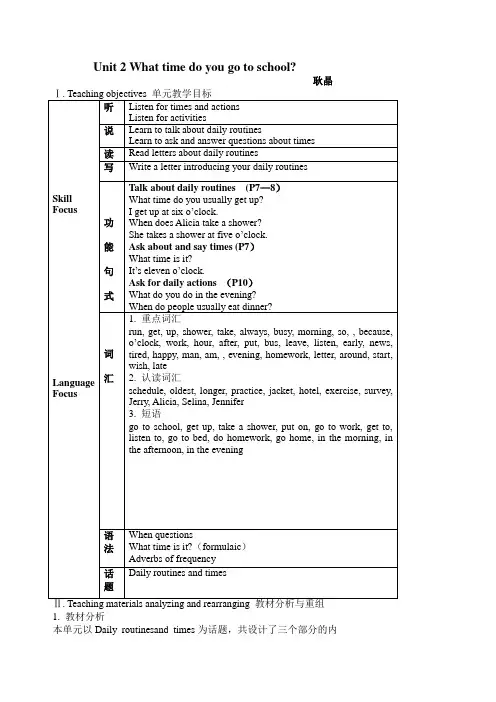
Unit 2 What time do you go to school?耿晶1. 教材分析本单元以Daily routinesand times为话题,共设计了三个部分的内容。
旨在通过单元教学使学生学会谈论日常行为、询问并答复有关时间的问题、询问并回答人们在特定时间所从事的活动。
Section A 学习谈论日常作息时间。
1a, 1b, 1c 重点学习和学生息息相关的几种日常行为的英文表示方法,学会询问和答复日常作息时间。
2a, 2b, 2c ,2d继续学习谈论自己或他人的日常作息时间。
重点学习如何询问,这也是本单元的语法重点。
3a, 3b, 3c 学会叙述他人的日常活动安排,同时学习询问时间和时间表达法,进一步巩固询问别人的日常作息时间的表达法。
Section B 继续学习询问和谈论别人的日常行为。
1a, 1b, 2a, 1c,1d,1e,学会谈论和询问一天内各个时间段的活动安排。
2a,2b,3a,3b学会通过两个人的对比介绍来判断并养成好的作息时间。
Self check 重点单词句型复习2. 课型设计与课时分配Period 1 Listening and speaking (I)(Section A: 1a, 1b, 1c)Period 2 Listening and speaking (II)(Section A:2a, 2b, 2c,2d)Period 3 Integrating skills(Section A:3a, 3b, 3cSection B: 1a, 1b,1c,1d,1e)Period 4 Reading and writing(Section B:2a, 2b, 2c,3a,3b)Period 5 Self checkⅢ. Teaching plans for each periodPeriod 1 Listening and speaking(Ⅰ) Target language目标语言1. Words && phrases生词和短语Up,get up,dress,get dressed,brush,tooth,shower,take a shower,usually,forty, what time,2. Key sentences重点句子When do people usually ...? People usually ...What time do you usually ...? I usually ...Ability goals能力目标Enable students to learn to talk about daily routines.Learning ability goals学能目标Help the students learn how to talk about daily routines.Teaching important / difficult points教学重难点How to talk about daily routines.Teaching aids教具准备A tape recorder and a model clock.Teaching procedures and ways教学过程与方式Step ⅠWarming upIn this procedure, motivate students to learn some words and phrases by singing the songs they’ve learned before.T: Good morning, everyone. (sing) “Good morning to you. Good morning to you. Good morning, dear children. Good morning to you.” This song is easy to learn. Who can sing it to us?Encourage students to sing the song.T: Well done. Thank you! We sing “Good morning to you” in the morning. Then what do we sing in the afternoon and in the evening? S: We sing Good afternoon to you in the afternoon and Good evening to you in the evening.T: That’s right. I know all of you are very good at singing. Does anyone want to sing Good afternoon to you or Good evening to you to us?Step ⅡTalking and reading (1a)In this procedure, ask students to finish the required task and learn some key phrases about daily actions.T: As we all know, time is very important and in English there is a famous saying "An hour in the morning is worth two in the evening." So what do you do in the morning?S1: I read English. S2: I do morning exercise.T: And what do you do in the afternoon and in the evening?S1: I play basketball in the afternoon. S2: I watch TV in the evening.T: I’m very glad to hear that. You use your time very well. And there’re many daily things we can do. Now let’s read these phrases in 1a and match these actions and the time of day.Step ⅢPracticeIn this procedure, students will learn how to talk about actions and the time of day.T: I know you’re very clever. Now I want you to tell if my statements are right or wrong. First, I usually eat dinner in the morning. S: Wrong.T: When do I usually eat dinner? S: In the evening.T: Second, she gets up at 19:00 in the morning. S: Wrong.T: What is the correct way of saying the sentence? S: She gets up at 7:00 in the morning.T: How clever you are! Now let’s read the conversation in groups and see which group reads better.Ask students to do pairwork.T: Please ask your partner when people usually do these things: do homework, eat dinner, eat breakfast and go to bed.(Write “When do people usually ...”on the blackboard)Sample dialogue:S1: When do people usually do homework?S2: People usually do homework in the afternoon.Interest the students in going on practicing the conversation using a new way of reading.T: Now let’s try a new way of reading. First I name one student to ask a question, and then ask all of you repeat this question together. After that, I name another student to answer this question, and all of you repeat the answer together.Sample dialogue:S1: When do people usually go to bed?S: When do people usually go to bed?S2: People usually go to bed in the evening.S: People usually go to bed in the evening.Step ⅣTalking about time (1c)In this procedure, students will learn how to ask about and say hour times and learn some key phrases about daily routines.T: Boys and girls, please listen to what I’m saying and guess what it is. 小小骏马不停蹄,日日夜夜不休息,蹄声哒哒似战鼓,提醒人们争朝夕。
2019-2020学年七年级英语下册 Unit 2 What time do you go to school知识点总结+导学案(新版)人教新目标版
2019-2020学年七年级英语下册 Unit 2 What time do you go to school知识点总结+导学案(新版)人教新目标版学习目标:1.熟练读出书写本节课的表示活动的单词。
2.学会询问时间的句型,熟练的谈论表示时间的话题。
重难点:what time/when 引导的特殊疑问句;频率副词的用法。
情感目标:通过询问和谈论彼此的作息习惯,培养良好的学习习惯。
学习过程:Ⅰ.【课前热身】预习效果检测: 默写下列短语。
去上学起床跑步吃早餐洗澡通常几点,什么时候穿上衣服刷牙Ⅱ.【自主学习】1.给图片找到对应的短语 1a2.听录音完成下列部分1b,2a,2bⅢ.【合作学习】与同伴练习1b中的对话Ⅳ.【拓展提升】根据1b,2b部分创编新对话, 完成1c,2c对话表演。
Ⅴ.【答疑解惑】针对本课提出困惑的知识点或问题。
Ⅵ.【课堂小结】总结本课所学知识点。
Ⅶ.【达标检测】一、翻译句子。
1.你通常几点钟起床?What _______ do you ________get ________?2.我通常在12:00吃午餐。
I ________ eat _______ ________12:00.3.你通常什么时候起床?______do you usually _____ ______?4.我通常6点钟起床。
I usually _____ _____at six______.5. 我从来不起这么早。
I _____get up so______.6. 他有一份有趣的工作。
He _____ an ______ job.备课人:7. 那是一个有趣的早餐时刻。
That’s a ____time ______ _______.8、It’s 7 o’clock.(对划线部分提问)______ ______ is it?9、Alicia takes a shower at 9:00 (对划线部分提问)______ _____ does Alicia ______ ___ ________?10、Jim gets up at 6:00 in the morning.(变成否定句)Jim _______ ____ ____ at 6:00 in the morning.11、他们总是在7:20穿衣服。
人教新目标七年级英语下册课堂笔记Unit 2 What time do you go to

Unit 2 What time do you go to school?2012版人教新目标七年级英语下册课堂笔记1. upadv. 向上n 反义词:down nget up起床nstand up起立Please lift your head up.2. dress v. 穿衣服n. 连衣裙n复数:dressesn get dressed穿上衣服My daughter is too young to dress herself.3. brush v. 刷;刷净n. 刷子n 复数:brushes n 单三: brushes nwipe擦nsweep扫nrub摩擦nscrape刮掉You have to brush your shoes now.4. toothn. 牙齿n 复:teeth nbrush teeth刷牙ntoothpick牙签ntoothpaste牙膏ntoothbrush牙刷The baby has two teeth.常见的可数名词单数变复数时不规则变化的名词有: man, woman, child, foot, mouse, tooth 等。
我们可以用这样一句话来记忆这些单词“男女孩子的脚踩住老鼠的牙”5. shower n. & v. 淋浴,(名)淋浴器n 近: bath 洗澡,沐浴ntake/have a shower洗澡nshower下阵雨,倾注;阵雨,大量倾泻nshow给……看You’d better take a shower.6. usually adv. 通常地,一般地Do you usually go to the park?n unusually异乎寻常地7. fortynum. 四十n 表示“几十”的数字都以-ty结尾。
n词形特殊的有:twenty, thirty, forty, fifty, eighty.nfour四nfourteen十四There are 40 students in Class One.8. never adv. 从不; 绝不n Better late than never.迟做总比不做好。
人教新目标七年级下册英语导学案Unit 2 What time do you go to school
承德四中年级学科导学案.主备人:审核人:审批人:编号:课题:Unit 2 What time do you go to school? 第一课时课型:听说课第一标:设置目标(5分钟)【学习目标】知识目标1:能掌握以下单词和短语:up, dress, brush, tooth (pl. teeth), shower, get up, get dressed, brush teeth,take a shower, go to school, eat breakfast2.能掌握以下句型:①—What time is it? —It’s ….②—What time do you usually get up? —I usually get up at six thirty.③—What time does Bob usually get up? —He usually gets up at five thirty. 第二标:达成目标(25分钟)学法指导1.Pairwork(要求学生两人一组练习。
): —What time is it? —It’s ….2. 听录音,完成活动1b,把时间与活动的匹配(组内检查)。
3.谈论日常生活:—What time do you usually get up? —I usually get up at six thirty.4.听录音,完成活动2a,2b(组内检查)。
小组内复述Jim一家的淋浴时间,第三标:反馈目标(15分钟)一. 根据汉语写单词、短语:起床_______________穿上衣服___________________洗淋浴_________________刷、刷净__________________牙齿(单、复数形式)________ __________二、翻译句子:Time is money. Time is life. Time flies. ______三. 单项选择:( )1. Tony usually gets up___5 o’clock. A. in B. at C. on D. about ( )2. —W hat’s the English for 8:10? —It’s ______.A. eight tenB. ten eightC. ten to eightD. eight past ten( )3. He_____up at 7:00 and_____the early morning news(新闻) on TV.A. gets, seesB. get, watchC. gets, watchesD.get, see( )4. What time _______she_______?A. do, go to schoolB. does, goes to schoolC. does, go to the schoolD. does, go to school( )5. _______does your father usually ____ a shower?A. What time, takesB. What’s time, takeC. What time, ta keD. What’s time, takes( ) 6.He gets up early. So he has ______ time for breakfast.A. manyB. a lotC. lots ofD. lot of四、句型转换。
人教版新目标七年级下册英语第二单元精选练习题及答案
人教版新目标七年级下册英语第二单元精选练习题及答案Unit 2 what time do you go to school?Section A (1a-2c)I.翻译词组(中英互译)1.去上学_______2.get dressed_______3.刷牙________4.eat breakfast_______5.上班迟到_______6.take a shower______7.一份有趣的工作_______ 8.at eight thirty______II.根据汉语提示完成句子Scott works very long hours.He usually _______﹙起床﹚at 17:00.He_______﹙刷牙﹚and_______﹙洗澡﹚Then he ______﹙吃早饭﹚.___________________ ﹙多么有趣的时间啊﹚to eat breakfast!After breakfast he __________﹙弹吉他﹚.Then he _______﹙去上班﹚.To get to work,he __________﹙乘17路车﹚to a hotel.Then bus usually ____________﹙带他去上班﹚at 19:15.He ________﹙整夜工作﹚.People love to__________﹙听他说话﹚!He________﹙到家﹚ at 7:00,and he ___________﹙看早间电视﹚.He ________(_睡觉﹚at 8:30.Can you think what his job is?III.单项选择。
()1._____ do you usually go to school?A .w hat time B. whoC. whichD. why()2.--____he get up early in the m orning?--Yes, he____ up very earlyA. Does , getB. Do , getsC. Does, getsD. do, get( 3.I usually ____ out to ____ with my friends.A. go ,eatB. go, eatsC. goes, eatsD. goes, eat()4.She ____up at seven every day.A getB getsC to getD getting( )5.We have_______b reakfast______morningA.the,inB./,in theC.the, in theD./, in()6.___he b rush teeth every day ?Yes ,he _____.A Do ,doesB Does ,doC Does ,doesD Do ,do.( )7.What time_____he usually ___a shower?A. do, take B do, takes C does ,takes D does,take( )8.I’m never late_____class.A toB fromC forD atUnit 2 Section A (grammar focus-3c)I.翻译词组(中英互译)1洗淋浴____________2 在周末_________3 在学习日__________4 吃早餐_________5去上班___________ 6去上学__________7回家__________ 8 起床_____________II.选择1. —_____ do you go to school ?— I often go to school ____ 7:30 pm .A、What time,onB、What time , atC、What , inD、When , in2.—What's the time ? (几点了?)—______ nine —fifteen.A、The time isB、It'sC、AtD、This is3.—It's seven o'clock .It's time to go ______.—OK. Let's go .A、to homeB、the homeC、my homeD、 home4. Mike often _________ a shower in the morning.A. makesB. haveC. takes D gets5. He __________ his homework _________ Sundays.A. doesn’t, onB. don’t do, inC. doesn’t do, onD. don’t do ,onIII. 翻译下列句子.1. Tom一般几点起床?他一般4点15起床。
人教新目标七年级下册 Unit 2 What time do you go to school课件
_7_. c_l_e_a_n_m__y_room
3. eat breakfast _7__:0_0__a._m__. __8_. e_a_t__d_in_n_e_r _7_:_1_5_p_._m__. _
4. go to school _7_:_4_5_a_._m__. _ 9. take a walk __________
Look at the pictures and then ask and answer. What time/ When do you usually …? I usually … at …?
When do you usually have the class? I usually have the class at eight o’clock.
6:30 a.m. half past six in the morning 3:15 p.m. a quarter past three in the afternoon 6:45 p.m. a quarter to seven in the evening 9:45 p.m. a quarter to ten in the evening
10:00 p.m.
1c Listen and circle the activities you hear.
1. get up 5:30 _2_. r_u_n______________
6. do my homework _________ 7. clean my room _________
3. eat breakfast
8. eat dinner _________
_4_. g_o__t_o_s_c_hool _________ 9. take a walk _________
人教版新目标go for it 七年级下册Unit 2单词拼写,课文填空和知识点梳理
人教版新目标七年级下册Unit 2What time do you go to school? 单词拼写1. I get up at a______ 6:00.2. School s______ at 7:40.3. Ice-cream usually t______ good, so students like to eat it after school.4. You need to b_______ your teeth after eating.5. Here are your clothes. Go and get d______ quickly!6. .My father goes to b_______at ten in the evening.7. Scott is n_______late for class.8. His b_______friend Alice is in Class Four.9. She can write f_______words in a minute.10. After dinner, my parents and I e_______at about half an hour every day.【答案】1.about 2.starts 3.tastes 4.brush 5.dressed 6.bed 7.never 8.best 9.five10.exercise七下Unit2课文填空Hi! I’m Tony. I don’t like ______get up early. In the morning, I get up at eight. Then I go to school at eight thirty. I don’t have_______ (many) time for breakfast, so I______ (usual) eat very quickly. For lunch, I usually eat hamburgers. After school, I _______ (sometime) play basketball for half an hour. When I get home, I always do my homework _______(one). In the evening, I_______ watch TV or play computer games. At ten thirty, I brush my______ (tooth) and then I go to bed. Mary is my sister. She usually gets up at six thirty. Then she always _______a shower and eats a good breakfast. After that, she goes to school at eight thirty. At twelve, she eats________(lot)of fruit and vegetables for lunch. After lunch, she sometimes plays volleyball. She always eats ice-cream after dinner. She knows it’s not good for her,but it tastes______ (well)! In the evening, she does her homework and usually swims or takes a walk. At nine thirty, she goes to bed.Keys: to; much; usually; sometimes; first; usually; teeth; takes; lots; goodSection A重点单词听,并跟读下列单词1. up adv.向上2. dress v.穿衣服n.连衣裙3. brush v.刷;刷净n.刷子4. tooth n. 牙齿5. shower n.&v.淋浴n.淋浴器(间)6. usually adv.通常地;一般地7. forty num.四十8. wow interj. (表示惊奇或敬佩)哇;呀9. never adv.从不;绝不10. early adv.&adj.早(的)11. fifty num.五十12. job n. 工作;职业13. work v.&n.工作14. station n.电(视)台;车站15. o’clock adv. (表示整点)…点钟16. night n. 晚上;夜晚17. funny adj.奇怪的;滑稽好笑的18. exercise v.&n. 锻炼;练习19. best adj.最好的adv.最好地;最20. group n.组;群听,并跟读下列单词变形l. dress--dresses(第三人称单数)- dresses(复数)2. brush--brushes(第三人称单数) brushes(复数)3. tooth- teeth(复数)4. usually-- usual(形容词)5. up-down(反义词)6. four-forty(四十)7. never-- always(反义词)8. funny—fun(名词)重点短语听,并跟读下列短语1. get up起床;站起2. go to school去上学3. get dressed穿上衣服4. brush teeth刷牙5. eat breakfast吃早餐6. take a shower 洗淋浴7. what time什么时间8. at six forty在六点四十9. radio show广播节目10. after that然后11. radio station广播电台12.on weekends(在)周末重点句型听,并跟读下列句子1.你通常什么时候洗淋浴?What time do you usually take/have a shower?2.我通常六点四十洗淋浴。
人教版七年级英语下册Unit2_知识点思维导图(可编辑版)
人教新目标版七年级下册Unit 2 What time do you go to school?1、get up起床go to bed 上床睡觉Rick is a students. he usually _____at eight o'clock in the morning.A. goes to bedB. goes to schoolC. goes to the bedD.goes to the school2、go to schoolgo to school 侧重功能go to the school 侧重地点in hospitalin the hospitalat tableat the table---Would you like to come to my party this afternoon?---I'd like to, but my mother is ill in ___hospital. I will go to ___ hospital to see herA./ ; aB. a; theC. the; theD./; the3、get dressedget dressed in +衣服或表示颜色的词dress sb. 给...穿衣服He gets____quickly,and then_____ his brother.A. dresses;dressedB. dressed; dressesC. dresses; dressesD. dressed; dressed4、brush teethteeth 是tooth 的复数形式Do you know how many____ you have?A. toothsB. toothesC. teeth5、at , in , onat 后接具体的时刻at five o'clockat noonin 在月、季、年、早、中、晚前面,(早、中、晚前加the)in Mayin springin the morningon 表示某一天,或某一天的早、中、晚on Mondayon Children's Dayon the afternoon of July 8th---When is the Art Festival party?---It's ___seven o'clock ___the evening of November 18th.A. at; inB. at; onC. on; inD. in; onWe usually have the first class ____ 8:00 in the morning.A. ofB. inC. onD. at6、... time for ... 做...的时间It's time for.../It's time to do... 到该做...的时候了It's time for sb. to do sth.7、go to work 去上班go to schoolgo to bed8、be late for.. ...迟到Don't be late______class! We must be on time.A. forB. toC. in9、what time 与whenwhat time 更具体---____is your birthday and ___ do you have a birthday party?---Next Friday and at 6:00 in the afternoon.A. When; what timeB. What time; whenC. What; whenD. When; what time10、时间表达整点法整点数+(o'clock)顺读法6:30为six thirty4:05为four o five逆读法8:10 为ten past eight1:30 为half past one5:56 为four to six10:15 为a quarter past ten(quarter 意为一刻钟、四分之一)5:45 为a quarter to six11、频度副词12、half复数为halveshalf past+one/two/three...half an hour 半个小时one hour and a half = one and a half hours13、take a walk 散步相当于take walksHis grandfather often______after dinner.A. take a walkB. takes a walkC. go a walkD. goes a walk14、sometimes用于How often 的提问He sometimes takes a walk with his mom.(对sometimes 提问)_____ ______ _______ he take a walk with his mom?He usually goes to school by bus, but ____ he rides a bike.A. sometimeB. some timeC. sometimesD. some times15、either...or...意为“非...即...”连接两个并列主语,谓语动词和最近的主语一致-“就近原则”Either she or I am right---Either you or she ____on duty today. Don't forget it.---OK.I won't.A. isB. amC. areD. beeither 常用于否定句,意为“也不”I don't like the green one either.either 用作代词,意为“两者中任何一个”---Would you like some orange juice or coffee?---______. I don't mindA. NeitherB. BothC. Either16、lots of= a lot of 大量修饰可数名词复数和不可数名词lots of peoplemany修饰可数名词复数Do you have many books?much修饰不可数名词I spend much time doing my homework every day.I have _____work to do every day.A. a lotB. lots ofC. a lots ofD. many。
人教版新目标版七年级英语下册 Unit 2 What time do you go to school教案
7. 3a: Use“always”,”usually”, or“never”to make sentences.
8. 3b :Let students write about something they do.
Step3 3c :1.make an interview 2. write a short passage
What time do you usually eat dinner?
What time do your parents go to work?
Step3 完成教材2a- 2d 的任务
1.观察听录音完成2a
2.再听一遍录音,完成2b中的表格。
3.让学生根据听力内容和图片信息进行回答。
4.完成2c
5.朗读2d中的内容
2. 重点词词组:get up get dressed take a shower radio station
3. 谈论时间的句型:
—Whattimedo youusuallytake a shower?? —When do you go to school?.
教学重点:
1.生词 2. what time 和when引导的特殊疑问句
1. 他也会中国功夫。
He__________do Chinese kung fu.
2. 我可以和你交朋友吗?
Can I__________with you?
3. 你周末做什么?
What do you usually do__________?
4. 你可以在老年人之家教英语。
You can teach English at____________________.