
牛津沪教版英语七年级下Module 1 Unit3 复习教案
Module 1 garden city and its neighborsU3 A visit to garden city教学过程:1. 基础知识梳理2. 重要句型及语法3. 课堂练习4. 家庭作业Part 1基础知识梳理:重要词汇和短语:1.the Li family 李的一家人2. design machines 设计机械3. quite a few 相当多,不少4.catch thieves 抓捕小偷5.help keep the city a safe place 保卫城市安全6.draw plans of buildings 画建筑物的平面图7.have been an engineer for several years 当工程师好几年了8.train someone in sport 在运动方面训练某人9.deliver letters 送信10.type letters and answer the phone 打字和接电话11.bring sb. sth.=bring sth. to sb. 给某人带来某物12.grow vegetables in the fields 在田野里种蔬菜13.be in charge of a school 管理一个学14.be used for doing sth. 被用来做某事15.tell the time 报时16.have a good time =enjoy oneself 玩得开心17.the top of ……的顶端词性转换:engine n.引擎engineer n. 工程师an engineer 一个工程师cook n. 厨师cooker n.厨具farm n. 农场farmer n.农民thief n. 小偷two thieves 两个小偷safe adj. 安全的safely adv.安全地safety n.安全save. v. 挽救、节省use v. 使用useful adj.有用的useless adj.无用的help v.帮助helpful adj.有帮助的helpless adj. 无助的fantasy n.幻想fantastic adj. 奇妙的wait v. 等待waiter n.男服务员waitress n.女服务员build v. 建筑building n.建筑物词汇详解1. visitn. 参观,拜访 a visit to Garden City 参观花园市这里的visit 是名词v. 参观,拜访to visit Garden City 参观花园市这里的visit 是动词They paid a visit to Shanghai Museum last week.They visited Shanghai Museum last week.2. the Li family 李家辨析:family、house和home1、family的意思是“家庭、家庭成员”,与居住的房子无关。
表示“家庭”或“家人”,是集合名词,若视为整体,具有单数意义,若逐个考虑其个体,当“家庭成员”讲时则具有复数意义。
如:His family are all tall. 他家的人都很高。
His family is very large [big]. 他家是个大家庭。
【注】侧重指家庭成员的 family 有时还可以用 all, some之类的词修饰。
如:All my family enjoy skiing. 我全家都喜欢滑雪。
I’m moving to London because I have some family there.我要搬到伦敦去住,因为我的一些家人住在那儿。
2、house的意思是“房屋、住宅”,一般对家人所居住的建筑物而言。
如:There are many new houses in our village.(我们村里有很多新房子。
)3、home的意思是“家”,主要指一个人出生或居住的地方,房屋是其中的一部分,因而也有“家乡、故乡”的意思,它具有house所没有的感情色彩(如“团聚”、“思念”等),如:East or West,home is best.(金窝银窝不如自己的草窝。
)3. teachTeach oneself English : 自学英语Teach sb. sth.:教某人某事teach sb to do sth: 教某人做某事teach maths in a school 在一个学校教数学Miss Guo teaches us maths in our school 郭小姐教我们数学。
4. be an architect(an engineer )= work as an architect (an engineer )担任(建筑师)工程师一职5. quite 相当,十分quite a few : 相当多,不少quite a lot: 大量,许多quite a few (years) 好几(年)跟可数名词He has made quite a few friends since he came here.自从他来到这里已经交了好几个朋友了。
quite a little (news )好些新闻跟不可数名词He has collected quite a little useful news since he surfed the net. 自从他上网以来,已经收集了好多有用的信息了。
6. design machines 设计机器designer: 设计师7. train v. 训练,培训train someone in sport 在体育方面训练某人train to be a doctor:接受医生培训trainer:训练员,教员trainee:受训练的人8. be in charge of:负责掌管be in charge of a school 负责主管一个学校take charge of : 接管He will take charge of the company. 他将接管这个公司。
in one’s charge/in the charge of sb. 在某人的掌管下Our class is in the charge of Mr Gu. 我们班级由谷老师负责管理。
9. tell the time 报时A watch is used for telling the time. 手表是用来报时的。
The child is old enough to tell the time. 这个小孩已经能认识钟了。
time 相关短语all the time:一直,始终At the same time: 同时,一起In time 及时On time 准时10. key:n. 钥匙;关键;答案adj. 关键的;主要的1)n. 关键,要诀The key to the whole thing was his book.2)n. 答案:Do you know the key to the question?3)n. (计算机或打字机的)键Press the key to enter the information.4) adj. 主要的,关键的the key information11. take the cable car 乘缆车Take off: (飞机等)起飞Take up:占据This table takes up too much room.12. on the top of the hill 在小山顶上n. 顶部,顶端We enjoy the nice views on the top of the hill. 我们从山顶欣赏美丽的景色。
At the top of one’s speed: 以最高的速度adj. 最高的,头等的:Top student: 优等生13. have a good time 玩得高兴= enjoy oneselfThe children had a good time at the beach last weekend. 上周末孩子们在海滩上玩得高兴。
Part 2重要句型和语法1. How long have you been a teacher?I have been a teacher for quite a few years.I have been a teacher since quite a few years ago.语法链接:现在完成时的"未完成用法"指的是动作开始于过去某一时刻,一直延续到现在,或可能还要继续下去。
这里的动词要用持续性动词。
常与for(+时间段),since(+时间点)连用.例如:a)He has lived here since 1978.自从1978年以来,他一直住在这儿。
(动作起始于1978年,一直住到现在,可能还要继续住下去。
)b)I have been in the army for more than 5 years.我在部队已经呆了五年多了。
(动作开始于5年前,一直延续至今,有可能还要继续下去。
)for 和sincefor + 一段时间(for a week, for many years, for a long time等等):(prep. 达(时间段)之久;)Eg. I have been here for 5 weeks.He’s studied English for 3 yearssince + (表示过去某一时间的)时间点:(prep. & conj. 自从(过去时间点)以来)(since +单词)(since+词组)(since+从句(一般过去时)Eg. I have been here since 2000.I have been here since 5 years ago.I have been here since I graduated in 2000.对for或since引导的时间状语提问必须用how long, 决不能用when.例:I have lived here for 10 years.How long have you lived here?She has stood here since 2 hour ago.How long has she stood here?含有For 和since时间状语的现在完成时和过去时的互相转换:1. My uncle has been in the Army for 3 years.= (My uncle joined the Army 3 years ago.)2. Peter has worked in this company since 2005.= (Peter started to work in this company in 2005.)= (Peter has worked in this company for 4 years.)3. I have had the digital camera for 2 years.= I bought the digital camera 2 years ago.2)但是有些短暂性动词不能和表示一段时间的状语连用。
七年级英语下册 总复习教案3 (新版)牛津版-(新版)牛津版初中七年级下册英语教案

To revise some useful sentences and do some exercises.
教法及教具
教
学
过
程
教 学 内 容
个案调整
教师主导活动
学生主体活动
一、四会单词
2.没有什么
3.等一会儿4.元
5.罐,听
7.交流学生8安静的
9.空气,大气
11.本地的12.慢跑锻炼
13地铁14.著名的
复习
教学目标
1.Torevise some useful phrases and language pints.
2.To revise some useful sentences and do some exercise.
重点
Torevise some useful phrases and language points.
13.艺术品
14.中ቤተ መጻሕፍቲ ባይዱ画
21.明信片
22.钥匙
23.环,圈,
24.你的;你们的
25.我们的
26他(她,它)们的
27她的
28到处,遍及
29笔盒,笔袋
30金銮宝座
31.作品,著作
32.艺术品
33.绘画,油画
34.划(船)
15.为你的家人买精美的礼物16.西餐馆
17.欣赏京剧18.参观我们当地的剧
19.更多地了解中国的艺术20.别错过戏剧表演
看那两支铅笔,红的是你的,蓝的是我的。
总结:名词性物主代词后面_______(能/不能)加名词。
注意:名词性物主代词=形容词性物主代词+名词
3.名词所有格,表示的是一种所属关系。一般是表示有生命的名词后加’s
【牛津上海版】七年级英语下Unit 1-11 全套单元教学设计

【牛津上海版】七年级英语下Unit 1-11全套单元教学设计目录Unit 1 Writing a travel guide (1)Unit 2 Going to see a film (3)Unit 3 A visit to Garden City (6)Unit 4 Let’s go shopping (9)Unit 5 What can we learn from others? (11)Unit 6 Hard work for a better life (14)Unit 7 In the future (15)Unit 8 A more enjoyable school life (17)Unit 9 The wind is blowing (19)Unit 10 Water Festival (20)Unit 11 Electricity (22)Unit 1 Writing a travel guide 1教学目标By the end of the lesson, the Sts will…be able to further practise describing a place and know more about Shanghai.be able to develop their speaking ability of fluency by describing a scenic spot.2学情分析The learners are the students form Class Twelve, Grade Seven of North Jincai Secondary School. They have been learning English for 7 years, so they are of different levels. Quite a few students are quite excellent. They do well in both speaking and writing. They are very active in class. But some students are at a lower English level. However, sometimes they can speak a little in class. What they need is a language environment. Therefore, group work in class is helpful for them to take an active part in the class.3重点难点This is ‘more practice’ part of Module One. The to pic is A One-day Tour Plan. We have talked about some famous places in the previous period, so the students have learned some expressions. There will be a language environment created for them so as to encourage more of them to talk about scenic spots and their tour plans.Key phrases and sentence structures are familiar to students. But it will be a little hard for them to organize language with much new information. So teacher can take fully advantage of group work. The students may have difficulty in listening to the French in the second part because of the accent. Teachers can give students a second chance to listen.Some students may also have difficulty in pronouncing some words. Teachers can guide them to use the dictionaries on their Pads.4教学过程第一学时教学目标By the end of the lesson, the Sts will…be able to further practise describing a place and know more about Shanghai.be able to develop their speaking ability of fluency by describing a scenic spot.学时重点This is ‘more practice’ part of Module One. Th e topic is A One-day Tour Plan. We have talked about some famous places in the previous period, so the students have learned some expressions. There will be a language environment created for them so as to encourage more of them to talk about scenic spots and their tour plans.学时难点Key phrases and sentence structures are familiar to students. But it will be a little hard for them to organize language with much new information. So teacher can take fully advantage of group work. The students may have difficulty in listening to the French in the second part because of the accent. Teachers can give students a second chance to listen.Some students may also have difficulty in pronouncing some words. Teachers can guide them to use the dictionaries on their Pads.教学活动活动1【导入】Lead inIt’s said that they really enjoyed the trip to Shanghai. Do you want to k now where they have been? I will show you some pictures of places they’ve been. Please take notes when you are watching.T gives the following instructions:1. I will show you some pictures of places they’ve been.2. Please take notes when you are watching.3. After that, please tell me how many places are there altogether and what they are.T shows four pictures of some places.S answers according to the picture.T corrects the mistakes and may show the pictures again if necessary.(Pudong International Airport, the bund, Yu garden, Shanghai zoo, Xintiandi, Shanghai Science and Technology Museum and Shanghai Museum) 活动2【活动】Input-listeningT: Among these pictures, do you know their favourite place?Students may give some answers or no answer.T: I’ve invited 4 French students to talk about their favourite places. Let’s listen to them. Please take notes while listening.T plays the recording one by one.T invites students to give answers and give reasons.T giv es feedback if the students’ answers are wrong.活动3【活动】Input-readingT: French students told me that they wanted to know more about Shanghai, about those they have been to, and also about those they haven’t. Would you please give them some introductions about more places? First, you need to read some instructions.T gives the instructions.1. Work in a group of 6.2. Each group needs to read 8 passages and find useful information as much as possible.3. Take notes and finish the table.4. Group A is responsible for sightseeing, Group B shopping and Group C eating.T provides individual drilling.活动4【活动】Output-an introduction about a scenic spotT invites some students to introduce some scenic spots according to the information they have taken down.T gives feedbacks about their presentations.活动5【活动】Output-a tour planT: I think they will enjoy those places. So why not make a tour plan for them? Please discuss with your group members and make a one-day tour plan for them. Each group needs to focus on your task. (Group A sightseeing Group B eating Group C shopping.)T provides individual drilling.T invites some students to give presentations about their tour plans.T gives feedbacks about their presentations.活动6【作业】AssignmentT: Write down your 3-day tour plan for French students. The school may use your plan next year.e.g.: On the first day, they are going to …Unit 2 Going to see a film1教学目标认知目标:课标词汇hardly, type, operate, railway, fly, judge, raise, instruction, program, mistake, hold, video, more importantly, have great understanding of…, make mistakes, for the time being拓展词汇unaware, be unaware of…, dependent, be dependent on…,diagram,essential, drive, CD-ROM, DVD-ROM2. 能力发展目标:1)通过多种形式的阅读活动与任务,培养一些阅读微技能,如:整体把握文章大意,快速搜索信息的能力2)设计小组合作,学会交流与合作3)情感目标:拓展学生视野,培养学生正确表达自己观点,学会对电影做出评价2学情分析1.这是一篇影评,比较枯燥,学生容易失去兴趣。
沪教牛津版七年级下册英语 Unit 1 3- Grammar 教案

课题:Unit 1 People around us(语法及运用课)课时:第3时,共 4 课时课型:Grammar教学目标:1.to grasp the usage of the definite word the and the preposition with2. to raise the students’ ability to sum up some language rules教学重点: Know when should use the in front of a noun and when we should not use it and the usage of the with phrases to describe a person教学难点: When we should not use the in front of a noun.教学准备:PPT, Blackboard教学步骤:Step1:Free talkTalk about the noun with an, a and the .Step2: WritingBefore writing: Give Ss the title of the article to talk about.1.Who are you going to write about?2.Think about the following ideas.1)a family member2)a good friend3)a teacher or a great personWhile writing:1.Write a short article about this person.Show some PPT to help them to write the article.2.介绍一些描述人常用的词汇.3. Ask Ss to read “My dad”as an example.Step3:More practiceAsk Ss to re ad the article about Mother’s Day quickly.Then answer the questions.1.When is Mother’s Day?2.What do people like to do this day?3.What do the author advise people to do on this day?Step4 Study skills1.Learn line graphs and bar charts to show the change in numbers.2.Fill in the blanks.3.Check their answers.Step 4:Culture corner1.Introduce middle names for Ss.2.Write some famous people’s middle names.Step5:Sum up1.Go over the rules of theStep6: HomeworkStep7 The blackboard design1.冠词“a\an”的用法。
牛津沪教版英语七年级下重点知识复习

牛津沪教版英语七年级下重点知识复习
本文将对牛津沪教版英语七年级下学期的重点知识进行复回顾。
Unit 1: My School Life
1. 介绍自己的学校、班级,以及相关的场景词汇;
2. 表达日常活动和课程安排;
3. 掌握一些谈论学校生活的简单句型。
Unit 2: I Love Learning English
1. 谈论个人研究英语的心得和方法;
2. 研究动词-ing形式的用法;
3. 研究询问及表达兴趣的句型。
Unit 3: My Weekend
1. 谈论自己和朋友的周末活动;
2. 掌握时间状语的用法;
3. 掌握一些听力技巧。
Unit 4: Jobs
1. 研究表示职业的词汇;
2. 表达及询问个人志愿和理想。
Unit 5: Food and Drink
1. 研究食物和饮品的词汇;
2. 掌握询问及表述食物喜好和不喜好的方法。
Unit 6: Sports and Hobbies
1. 研究表示不同体育项目和爱好的单词;
2. 表达及询问个人感受和喜好。
Unit 7: Travelling
1. 谈论旅游的相关话题;
2. 表达和询问喜欢或不喜欢旅游的理由和偏好。
Unit 8: Festivals and Celebrations
1. 研究表示节日和庆祝活动的单词;
2. 谈论家庭或朋友间的庆祝活动。
总结
以上是牛津沪教版英语七年级下学期的重点知识复习,希望对大家的英语学习有所帮助。
Module1 Unit 3 A visit to Garden City-牛津上海版七年级下册英语教案
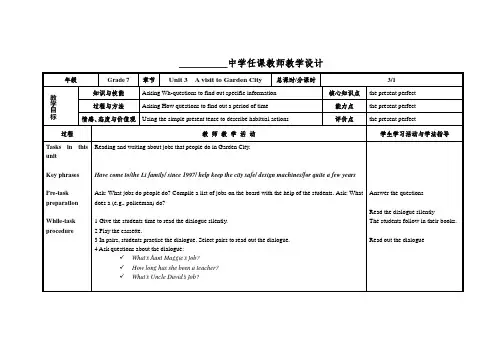
What’s Uncle Weiming’s job?
How long has he been an engineer?
5 Selectpairsto read out thedialogueagain.
Workbook 7B page 19
年级
Grade 7
章节
Unit 3 A visit to Garden City
总课时/分课时
3/3
教学目标
知识与技能
Asking Wh-questions to find out specific information
核心知识点
be used for /be used to
过程与方法
Using the simple past tense to refer to past events
The students follow in their books.
Read out the dialogue
过程
教师教学活动
学生学习活动与学法指导
Post-task activities
Consolidation
How long has he been a policeman?
What’s Aunt Betty’s job?
read out the dialogue
In pairs, students completeFind outandwrite.
Play the game
过程
教师教学活动
学生学习活动与学法指导
Consolidation
6 Give the students time to readA report.
牛津沪教版英语七年级下Unit 3 Lesson 1辅导教案
七年级下U3L1情景导入本课主要学习表达不同的职业及描述自己的理想等表达方式,例如:A: Hey , have you ever thought about what you want to be when you grow up?B: Yes, of course. I would like to be a doctor.A: That’s great.重点词汇wyer /'lɔjɚ/ n. 律师“law”是法律的意思,“-er ”是英语中表示人物的后缀,两者结合就成了律师。
e.g. My father used to be a lawyer. 我的爸爸曾经是个律师。
2.sociable /'səʊʃəb(ə)l/ a. 好交际的,合群的这是society的形容词形式,society是社会的意思,所以其形容词意思是“好交际的,社交能力强的”容人的性格品质。
e.g. Some children have mre sociable personalities than others. 一些孩子比其他孩子更善于社交。
social和sociable 的区别这一对形容词都有“社交”的意思,但含义和使用场合不同。
sociable 有“好交际的,社交性的,善交际的”意味。
social表示“社会的”“社会性的”“有关社会的”意味。
如social problem 社会问题social life 社会生活,social science 社会科学social welfare 社会福利social morality 社会道德e.g. Mr. Liang is a very sociable person. 梁先生是个很爱交际的人。
This is a sociable house party held by his father.这是他父亲举办的家庭聚会These are the social duties that you should perform.这是你们应尽的社会义务。
七年级英语下册Module3Unit1Changingourlives学案上海牛津版
Module 3 ChangeUnit 1 Changing our lives1st Period课型:新授教课目的Understand the connection between ideas by identifying linking words or phr ases. Skim a text to obtain a general impression and the main ideas.教课要点1. Using connectives to link contrasting ideas.e.g. I’m good at a lot of subjects, but I’m poor at Maths.2. Using connectives to express transition of meaning.e.g. Although we’re old, we still work in the fields every day.3. Expressions and phrases:1) What ’ s the matter? = What ’ s wrong (with you)?怎么了?2) pocket money 零花费3) be good at 善于于4) be poor at 不善于于5) long ago = long, long ago 好久好久从前6) live happily together 幸福地生活在一同7) in a tiny, old hut 在一个破旧的小茅草屋里8) one winter night 在一个冬季的夜晚9) the Luck Fairy 好运女神10)give sb. a wish 知足某人一个梦想11)smile at each other 相视而笑12)work in the fields 在田里干活13)earn very little money 挣不到钱14)gold coins 金币15)have enough food to eat 有足够的食品吃16)since I was born 自从我出生以来专心爱心专心-1-1 / 517)be different from与不一样18)Wish you happiness and health forever.祝你们永久幸福、健康。
word完整版牛津沪教版英语七年级下Unit1复习教案
牛津沪教版英语七年级下Unit1 复习教案U1 Writing a travel guide教学过程:1.词汇梳2.重要句型及语3.课堂练4.家庭作Part 词汇梳理1. guid nv.(1) guid作名词时,可以表示①导游The guide took us around the Palace Museum.导游带我们参观了故宫②导游手相当guidebookDo you need a guide?It tells you a lot about the Forbidden City.你需要一本导游手吗?它会告诉你很多关于紫禁城的信息③指南A Guide to English Grammar《英语语法指南(2) guid作动词时,可以表…领路,带的意思。
如Martin guided him to the reception room.马丁把他领到接待室批注:让学生注意分guid的两种词2. tour n旅行;旅Can you give us some tour suggestions?你能给我们一些旅行建议吗【联想touristn.游客,旅游3. reason n.原因,理The reason why she was late was that she forgot to set the clock.她迟到的原因是因为忘记了定闹钟【近义词causen.原因,起因,缘故;理【拓展reasonableadj.合理的,明智批注the reason wh的句可以让学生用在写作中3. take part in参加(活动如We'll take part in the sports meeting this Friday.本周五我们要参加运动会They have decided to take part in a competition.他们决定参加一个竞赛【比较take part ijoin都参的意思take part in表示参加某项活动joi示参加或加入某个团体或组织如He joined the Party ten years ago他十年前入党I'll join the Youth League next month.下个月我要入团【提示take part in = join in批注:注take part injoi的区4. sightseeingn观光;游Tourists usually go there for sightseeing and fun游客们通常会去那儿观光游玩【记忆go sightseein去观【联想go shoppin去购物go swimmin去游泳go fishin去钓鱼go travellin去旅游11/ 1复习教案牛津沪教版英语七年级下Unit1去徒步旅行go boating去划船;go hiking go camping去野营;go cycling去骑车;去打猎go windsurfing去风帆冲浪;go hunting go skating去溜冰;观光旅游 a sightseeing tour【拓展】a sightseeing bus观光旅游车的中部位于……5. in the centre ofin the middle of 强调与四周距离相等的中心位置,常用来指空间;【比较】in the centre of强调两端之间的位置,并不强调中心,既可用于指空间,也可用于指时间。
最新牛津上海版英语七年级下册module 1《unit 3 the international food festival》教案一.doc
Module 1 Food and drinksUnit 3 The international food festival1Language focusAsking ‘wh-’ and ‘How’ questions to find out various kinds of specific information[e.g. What/Why/Where/When/Who/How?Using modals to expression an obligatione.g. Let’s have it at our school …Using modals to express an obligatione.g. What should have an international food festival.Using formulaic expressions to show agreemente.g. This is a good idea.Language skillsListeningRecognize differences in the use of intonation in questions and statements, and respond appropriately. Identify main ideas of a new topic SpeakingUse appropriate intonation and stress, and vary volume, tone of voice and speed to convey intended meanings and feelingsReadingRead written language in meaningful chunksScan a text to lacate specific informationMaterialsStudent’s Book 7B page 14Cassette 7B and a cassette playerPreparationCue the cassette.Pre-task preparationLanguage learning activity(This section aims at providing students with opportunities to practise the language/vocabulary needed or bee familiar with the background for the task that follows.1. Explain to students the idea of raising money and its purpose. Ask students some ways if they know of raising money. Ask students if they have ever participated in any fund-raise activities. Invite some students to talk about their experiences by asking them when, where and how the activity was carried out.2. Tell students to plan an international food festival to raise money for the SPCA. Ask students to explain the term SPCA, which was introduced in Student’s Book 7A. Bring in photos or pictures of different kinds of ethnic food, such as sushi, hamburgers, sandwiches and so forth, together with pictures of national flags of the relevant countries. Show students the photos or pictures. Ask students to match the flags to the food. Ask them what kind of food they can make.3. Give students some time to read the passage on page 14.4. Play the recording Read. Students listen and follow in the books.5. Ask several of the more able students to role-play the characters and parctise the dialogue.6. Review the use of interrogatives in questions with students. Students read the passage again, and then in pairs ask and answer questions about what Kitty and her friends are going to do.ConsolidationGrammar Practice Book 7B page 11.2Language focusAsking ‘Wh-’ and ‘How’ questions to find out various kinds of specific information.e.g. What/Why/Where/When/Who/How?Using ‘going to’ describe events that will occur quite soon.e.g. Who is going to help us?Language skillsListeningRecognize differences in the use of intonation in questions and statements, and respond appropriately. Listen for specific information.SpeakingUse appropriate intonation and stress, and vary volume, tone of voice and speed to convey intended meanings and feeling.ReadingRecognize recurrent patterns in language structure, such as word structure, word order, sentence structure, organization pf text-typ es. Recognize the presentation of ideas through headings, paragraphing,spacing, italic, italics, bold print and punctuationWritingDevelop written texts by using appropriate format, conventions and language features when writing non-narrative texts.Revise and edit short written texts by making changes to incorrect spelling, punctuation and grammar, and adding details if necessary in response to suggestions from the teacherMaterialsStudent’s Book 7B page 15Workbook 7B page 9Photocopiable page 9 and 10PreparationMake a copy of Photocopiable page 9 and 10 for each student. ConsolidationWorkbook page 93Language focusUsing the future tense to talk about future eventse.g. The food will be different kinds of sushi.Using prepositions to indicate addition.e.g. scones with butter/tea with milkUsing connectives to add information.e.g. The food will be scones and the drink will be tea.Using adjectives to describe different kinds of ethnic food.e.g. Japanese food/English food and drink/ American food/ Indian food.Language skillsListeningListen for specific informationReadingRead written language in meaningful chunks.Scan a text to locate specific informationRecognize recurrent patterns in language structure, such as word structure, word order, sentence structure, organization of text-types. Use visual clues, context and knowledge of the world to work out the meaning of an unknown word and a plete expressionMaterialsStudent’s Book 7B page 16Cassette 7B and a cassette playerWorkbook 7B page 10Photocopiable page 11A world mapSticker of national flagsPictures or photos of different ethnic foodAn English dictionaryPreparationCue the cassette. Make a copy of Photocopiable page 11 for each student. Pre-task preparationLanguage learning activity(This section aims at providing students with opportunities to practise the language/vocabulary needed or bee familiar with the backg round for the task that follows.1. Use photos or pictures of different kinds of ethnic food, such as sushi, hamburgers, sandwiches and so forth, together with pictures of national flags of the relevant countries. Show students a world map. Ask students to point out country from where the food being referred to originates. Help students to distinguish the name of a country and adjective used to describe things about that country and the adjective used to describe things about that country, as in England and English; Japan and Japanese. List several countries and have students find out their corresponding adjectives with the help of an English dictionary.2. Ask students what kind of ethnic food they can make. Introduce new vocabulary, e.g. tuna, cucumber, scones, samosas, naan bread. Ask them if they know nay other ethnic food and the country and the country from which it originates.3. Play the recording Look and read. Students listen and follow in their books.4. Play a matching game Distribute a copy of Photocopiable page 11 to each student. Students may draw ethnic food of other countries, such as Thai food, Vietnamese food and Italian food. With the picture cards, students get into groups of four. Each student chooses a country and put them face down on the desk. Students in turns draw a card. If the food on the card matches the chosen country, the student shows the card and says I’ll sell food. The food will be ______. The student keeps the card until he/she has obtained the whole collection. If a wrong card is picked, the studentputs the card back on the desk and the next student takes a turn. The student who has the most cards wins the game.ConsolidationGrammar Practice Book 7B page 12Workbook page 104Language focusUsing ‘going to’ to describe events that will occur quite soon.e.g. We’re going to have an international food festival at our school. Using the future tense to make a request.e.g. Will you teach me how to make scones, please?Using imperatives to give instructions.e.g. sift, mix, add, pour, sprinkle, cookUsing adverbs to indicate time sequence and procedures.e.g. First,…/ Then …/Next,…/Finally,…Language skillsListeningListen for specific informationUse visual clues, context and knowledge of the world to work out the meaning of an unknown word and a plete expressionSpeakingUse appropriate intonation and stress, and vary volume, tone of voice and speed to convey intended meaning and feelingsReadingRecognize recurrent patterns in language structure, such as word structure, word order, sentence structure, organization of text-types. Predict the likely development of a topic by recognizing key words and making use of context and knowledge of the worldUnderstand the connection between ideas by identifying link ing words or phrases.Scan a text to locate specific informationWritingPlan and organize information and ideas by deciding on the sequence of content.Revise and edit short written texts by making changes to incorrect spelling, punctuation and grammar, and adding details if necessary in response to suggestions from the teacherMaterialsStudent’s Book 7B page 17Cassette 7B and a cassette playerWorkbook 7B page 11Photocopiable page 12PreparationCue the cassette. Make a copy of Photocopiable page 12 for each student.Pre-task preparation1. Ask students if they have ever made biscuits, cookies or bread and if they know the major ingredients for making such things. Ask What will Ineed to make biscuits? To elicit suggestions from students. Write students’ suggestions on the board. Introduce vocabulary, e.g. raising flour, butter, salt, sugar, milk. Explain to students the use of each ingredient.2. Give students some time to read the procedures for making sc ones in Look and read. Students pair up to discuss and decide on the correct order of the procedures. Play the recording for the part of making scones.ConsolidationGrammar Practice Book 7B page 135Language focusUsing modals to make an offere.g. Would you like to buy some food?Asking ‘Wh-’ questions to find out specific information about someone.e.g. What kind of food are you selling?Asking ‘How’ questions to find out pricese.g. How much do they coat?Using modals to make a polite request.e.g. May I have a hot dog, please?Language skillsListeningRecognize differences in the use of intonation in questions and statements, and respont appropriately. Understand the speaker’s intention, attitude and feelings through his/her choice and use of language, gesture andfacial expression.Listen for specific information.SpeakingUse appropriate registers when speaking to familiar interlocutors such as teachers and peers.Maintain an interaction by asking and responding to others’ opinions. ReadingUse visual clues, context and knowledge of the world to work out the meaning of an unknown word and a plete expression.Scan a text to locate specific informationMaterialsStudent’s Book 7B page 18Cassette 7B and a cassette playerWorkbook 7B page 12Photocopiable page 13 and 14PreparationCue the cassette. Make a copy of Photocopiable page 13 and 14 for each group.Pre-task preparation1. Review names of ethnic food particular to the countries introduced on page 16 of the Student’s Book. Write a country on the board, for example, Japan. Ask students to give name of food and to categorize them using an adjective, like this sushi, Japanese food.2. Give students some time to read the dialogue in Look and read. Playthe recording. Students listen and follow in their books.3. Invite pairs to say the conversations in Look and read.ConsolidationGrammar Practice Book 7B page 14Workbook page 126Language focusUsing formulaic expression s to begin and end a lettere.g. Dear Lucy,/Love, Kitty.Using simple past te nse to describe past actionse.g. Our school had an international food festival last week.Language skillsListeningRecognize the presentation of ideas through headings, paragraphing, spacing, italics, bold print and punctuation. Read written language in meaningful chunks.WritingPlan and organize information and ideas by identifying purpose and audience for a writing task.Develop written texts by presenting main and supporting ideas and by using paragraphs and conventional punctuation to frame ideas.Revise and edit short written texts by making changes to incorrect spelling, punctuation and grammar, and adding details if necessary inresponse to suggestions from the teacher.MaterialsStudent’s Book 7B page 19Informal English lettersPre-task preparation1. Ask students if they have ever written informal English letters to friends and relatives. If they have, invite them to explain to the class the format of an informal letter. Ask students to bring in English letters received from their friends or relatives or letters written to them. Ask students to show them to t he class.2. Review the format of an informal letter with students. Tell students that a letter should i nclude the date, receiver’s name and address, greeting, boby, plimentary closing and writer’s signature. Remind students that there are different letter formats and that it is acceptable to indent the paragraphs.ConsolidationGrammar Practice Book 7B page 20.。
word完整版牛津沪教版英语七年级下Unit1复习教案
牛津沪教版英语七年级下Un itl复习教案U1 Writ ing a travel guide教学过程:1. 词汇梳2. 重要句型及语3. 课堂练4. 家庭作Part词汇梳理1. guid nv.(1) guid作名词时,可以表示①导游The guide took us around the Palace Museum.导游带我们参观了故宫②导游手相当guidebookDo you need a guide?It tells you a lot about the Forbidden City. 你需要一本导游手吗?它会告诉你很多关于紫禁城的信息③指南 A Guide to English Grammar《英语语法指南⑵guid作动词时,可以表…领路,带的意思。
如Marti n guided him to the recepti on room. 马丁把他领到接待室批注:让学生注意分guid 的两种词2. tour n旅行;旅Can you give us some tour suggestions? 你能给我们一些旅行建议吗【联想touristn.游客,旅游3. reason n.原因,理The reason why she was late was that she forgot to set the clock. 她迟到的原因是因为忘记了定闹钟【近义词causen.原因,起因,缘故;理【拓展reasonableadj.合理的,明智批注the reason wh 的句可以让学生用在写作中3. take part in 参加(活动如We'll take part in the sports meeting this Friday.本周五我们要参加运动会They have decided to take part in a competition. 他们决定参加一个竞赛【比较take part ijoin都参的意思take part in表示参加某项活动joi示参加或加入某个团体或组织女口He joined the Party ten years ago 他十年前入党I'll join the Youth League n ext mon th.下个月我要入团【提示take part in = join in批注:注take part injoi 的区4. sightsee ingn 观光;游Tourists usually go there for sightseei ng and fun 游客们通常会去那儿观光游玩【记忆go sightsee in去观【联想go shoppin 去购物go swimmin 去游泳go fishin 去钓鱼go travellin 去旅游11/ 1复习教案牛津沪教版英语七年级下Unit1去徒步旅行go boating去划船;go hiking go camping 去野营;go cycling 去骑车;去打猎go windsurfing 去风帆冲浪;go hunting go skating 去溜冰;观光旅游 a sightseeing tour【拓展】a sightseeing bus观光旅游车的中部位于... 5. in the cen tre ofin the middle of强调与四周距离相等的中心位置,常用来指空间;【比较】in the centre of强调两端之间的位置,并不强调中心,既可用于指空间,也可用于指时间。