
高中情态动词和虚拟语气讲解与练习附答案
高中英语情态动词和虚拟语气情态动词:记住下面三个方面的用法,可以快速地掌握情态动词。
在遇到情态动词的题的时候,一定要先判断出题目考察的是下面3个的哪个方面。
1.常规(所有),2.判断/推测(5个 +1个),3.用于虚拟语气的情态动词(5个)1.常规:所有的情态动词都有常规的形式,大多12个。
Can: 表示“能力”,表示“请求或允许”。
Could : 用法同上,语气较can轻。
Must : “必须/一定,应当”;“偏要”。
May : 可能/可以,表示“征求对方意见或允许”,或“祝愿”Might : 用法同上,语气较may轻。
Should : 表示“应该,惊讶,委婉/客气”。
Ought to: 用法同上,语气较should重。
Will : “愿,要,会”表示“意愿,征求意见或提出请求,或执意/决心。
Would : 用法同上,语气较will轻。
Shall : 征求对方意见;警告/承诺(用于法律或规定中);应该/必须(语气比should重)need/dare:两个“半”情态动词,在肯定句中只能用need/dare + to do在否定/疑问句中可用need/dare + to do 或 need/dare + do2.推测/判断:在高中英语中能用作推测或判断的情态动词大多是:can > could (语气由重到轻,用于否定货疑问句中)must > may > might (语气由重到轻,用于肯定句中)should 可用于各种(肯定,否定,疑问)句式中,只能用should + do的形式对“现在”的事的判断的用法:can/could must/may/might + do/be+doing对“过去”的事的判断的用法:can/could must/may/might + have done当然其他的情态动词在特殊的情况下也可以用于推测/判断,但不常用所以不必记忆。
3.可以用于虚拟语气的情态动词有以下5个:Should(应该), would(将,愿,要,会) could(能), might(可能,可以)ought to(应该,语气比should强)。
八、虚拟语气:当事情不会发生或发生的可能性很小时,要用虚拟语气。
虚拟的事情可能发生在“现在”,“过去”或“将来”。
一定要先辨别出虚拟的情况发生在“什么时候”,记住下面的表格和后面的几个特殊单词你就会用虚拟语气了。
否使用情态动词取决于句义,如果需要用情态动词的词义时就用should, could, would, might, ought to 中的某一个。
在下面的12个及物动词后的宾语从句中要用虚拟语气:三个“建议”: advise, suggest, propose三个“要求”: ask, require/request, demand两个“命令”: order, command一个“希望”: wish一个“渴望”: desire一个“宁愿”: would rather一个“坚持”: insist注意:这12及物动词所衍生出的名词或形容词所引导的同位语从句、表语从句或主语从句中也要用虚拟语气。
下面的几个句式中也要用虚拟语气:It is requested/suggested/proposed/…+that从句(从句中要用虚拟语气)It is important/necessary/natural/strange/ a pity + that从句(从句中要用虚拟语气)It is ( high/about)time + that从句,从句中的动词要用were/did的虚拟形式。
If only + 从句,从句中也要用虚拟语气。
情态动词和虚拟语气1. I often see lights in that empty house. Do you think I ______ report it to the police?A. shouldB. mayC. willD. can2. ---- The room is so dirty. ______we clean it?---- OK.A. WillB. ShallC. WouldD. Can3. ---- Dare your little daughter stay at home alone at night?---- _________A. Yes, she doesB. No, she dare notC. No, she doesn’tD. Yes, she dares to4. It is suggested that a doctor _______ immediately.A. be sent forB. send forC. is send forD. should send for5. When he was there, he ______ go to that coffee shop at the corner after work every day.A. wouldB. shouldC. had betterD. might6. There is no light on; they ______ be at home.A. can’tB. mustn’tC. needn’tD. shouldn’t7. ---- Mr. Smith, ______ he have all these papers typed for you right away?---- He ______. They should be ready by 10 o’clock this morning.A. will; mustB. shall; has toC. need; willD. would; ought to8. Research findings show we spend about two hours dreaming every night, no matter what we ______ during the day.A. may have doneB. can have doneC. must have doneD. should have done9. ---- Don’t press the button, John.---- What if I _______A. didB. wouldC. willD. shall10. Their basketball team has lots of excellent players, so if there is no unexpectedthing to happen, their team ______ win the championship.A. wouldB. mayC. shouldD. need11. Jenny ______ her word. I wonder why she changed her mind.A. must have keptB. can have keptC. should have keptD. would have kept12. My mother stared at me as if she ________ me before.A. didn’t seeB. hasn’t seenC. hadn’t seenD. doesn’t see13. Peter ______ come with us tonight, but he isn’t sure.A. mustB. mayC. canD. will14. ---- Could I use your computer while you are out?---- Of course you _______A. couldB. shouldC. mustD. can15. I’ve changed to take the job and I ________ change my mind.A. mustn’tB. can’tC. won’tD. may not16. ---- Is John coming by bus?---- He should, but he ______ not. He likes riding his bike.A. mustB. canC. needD. may17. ---- I heard they went skating in the mountains last winter.---- It ______ be true because there was little snow there.A. may notB. won’tC. couldn’tD. mustn’t18. I was really anxious about you. You ______ home without a word.A. mustn’t leaveB. shouldn’t have leftC. couldn’t have leftD. needn’t leave19. ---- Mary, how did your Math test go?---- I had thought I ______, but in fact I came in the top 10 in my class.A. should have failedB. could have failedC. might have failedD. need have failed20. I wonder how he ______ that to the teacher.A. dare to sayB. dare sayingC. not dare sayD. dared say21. It’s high time that he settled down in the city and ______ a new life.A. startB. startedC. to startD. starting22. How I wish I ______ to learn Japanese when I was ten.A. would beginB. beganC. should beginD. had begun23. ---- ______ he have been chosen as captain of our school football team?---- Yes, he ______. Can’t you see he’s wearing an armband?A. Can; can’tB. Must; must haveC. Can; must haveD. Must; must24. ---- Isn’t that Ann’s mother over there?---- No, it ______ be her. I’m sure she is taller.A. can’tB. must notC. won’tD. may not25. ---- No wonder you caught a cold. You ______ out last night without a coat.---- I know how silly I was.A. shouldn’t have goneB. mustn’t have goneC. couldn’t have goneD. mightn’t have gone26. But for your timely help, the boy ______ his life.A. must have lostB. may loseC. might have lostD. should lose27. What would you say if I ______ you the truth?A. am going to tellB. were to tellC. have toldD. would tell28. ---- You really shouldn’t have shouted to them.---- Right. I ______ crazy then.A. must beB. must have beenC. would have beenD. should have been29. If I ______ you, I ______ a plane instead of a bus. It’s too far.A. were; would have takenB. had been; would have takenC. were; would takeD. had been; would take30. ---- Were you shown around Venice in a boat with those American tourists?---- No, but I wish I ______A. amB. wereC. hadD. should。
05 情态动词和虚拟语气-2021年新高考英语二轮复习语法及题型大全 (含答案)
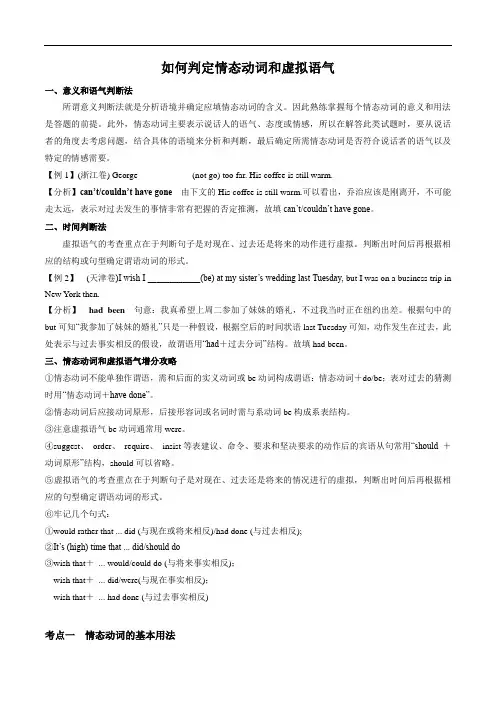
如何判定情态动词和虚拟语气一、意义和语气判断法所谓意义判断法就是分析语境并确定应填情态动词的含义。
因此熟练掌握每个情态动词的意义和用法是答题的前提。
此外,情态动词主要表示说话人的语气、态度或情感,所以在解答此类试题时,要从说话者的角度去考虑问题,结合具体的语境来分析和判断,最后确定所需情态动词是否符合说话者的语气以及特定的情感需要。
【例1】(浙江卷) George ____________(not go) too far. His coffee is still warm.【分析】can’t/couldn’t have gone由下文的His coffee is still warm.可以看出,乔治应该是刚离开,不可能走太远,表示对过去发生的事情非常有把握的否定推测,故填can’t/couldn’t have gone。
二、时间判断法虚拟语气的考查重点在于判断句子是对现在、过去还是将来的动作进行虚拟。
判断出时间后再根据相应的结构或句型确定谓语动词的形式。
【例2】(天津卷)I wish I ____________(be) at my sister’s wedding last Tuesday, but I was on a business trip in New York then.【分析】had been句意:我真希望上周二参加了妹妹的婚礼,不过我当时正在纽约出差。
根据句中的but可知“我参加了妹妹的婚礼”只是一种假设,根据空后的时间状语last Tuesday可知,动作发生在过去,此处表示与过去事实相反的假设,故谓语用“had+过去分词”结构。
故填had been。
三、情态动词和虚拟语气增分攻略①情态动词不能单独作谓语,需和后面的实义动词或be动词构成谓语:情态动词+do/be;表对过去的猜测时用“情态动词+have done”。
②情态动词后应接动词原形,后接形容词或名词时需与系动词be构成系表结构。
高三英语虚拟语气与情态动词试题答案及解析

高三英语虚拟语气与情态动词试题答案及解析1. They were abroad during the months when we were carrying out the investigation, or they_____ to our help.A.would have come B.could come C.have come D.had come【答案】A【解析】这里when引导的是定语从句,修饰前面的名词months;根据谓语动词were可知事情发生过去,or后是对过去的虚拟,所以应该用would have done,故选A。
句意:在我们进行调查期间他们在国外,要不然的话他们就来帮忙。
【考点】考查虚拟语气。
2. (2014·蜀光中学月考)The weather turned out to be fine yesterday.I________the trouble to carry the umbrella with me.A.couldn’t have taken B.mustn’t have takenC.needn’t have taken D.didn’t need to take【答案】C【解析】考查情态动词。
句意为:昨天天气很好,我本不必麻烦随身带伞的。
根据句意可知C项正确。
needn’t have done本没有必要做而做了。
答案:C3. ______ today, he would get there by Friday.A.Were he to leave B.If he had left C.Did he to leave D.Had he left【答案】A【解析】句意:要是他明天离开,在星期五之前就会到那里。
这里的were he to leave today="If" he were to leave today, 为虚拟语气,if条件句谓语中如果有系动词were,助动词should,had可将它提到主语前面,省去if.所以选A。
高二英语虚拟语气与情态动词试题答案及解析
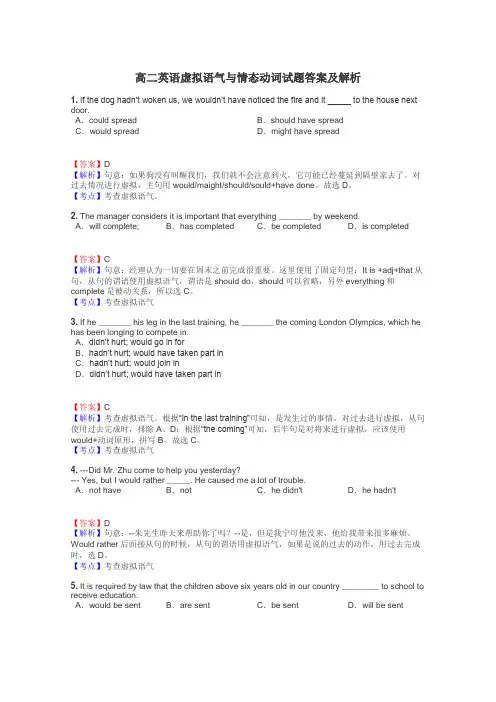
高二英语虚拟语气与情态动词试题答案及解析1.If the dog hadn’t woken us, we wouldn’t have noticed the fire and it _____ to the house next door.A.could spread B.should have spreadC.would spread D.might have spread【答案】D【解析】句意:如果狗没有叫醒我们,我们就不会注意到火,它可能已经蔓延到隔壁家去了。
对过去情况进行虚拟,主句用would/maight/should/sould+have done。
故选D。
【考点】考查虚拟语气。
2. The manager considers it is important that everything _______ by weekend.A.will complete;B.has completed C.be completed D.is completed【答案】C【解析】句意:经理认为一切要在周末之前完成很重要。
这里使用了固定句型:It is +adj+that从句,从句的谓语使用虚拟语气,谓语是should do,should可以省略,另外everything和complete是被动关系,所以选C。
【考点】考查虚拟语气3. If he _______ his leg in the last training, he _______ the coming London Olympics, which he has been longing to compete in.A.didn’t hurt; would go in forB.hadn’t hurt; would have taken part inC.hadn’t hurt; would join inD.didn’t hurt; would have taken part in【答案】C【解析】考查虚拟语气。
英语虚拟语气与情态动词试题答案及解析
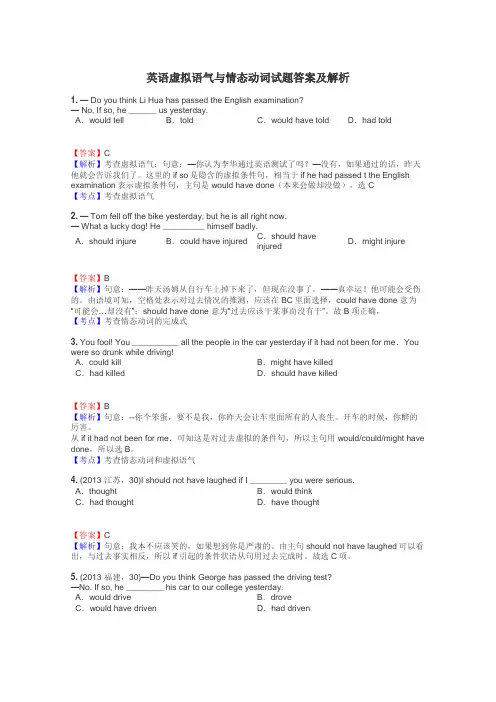
英语虚拟语气与情态动词试题答案及解析1.— Do you think Li Hua has passed the English examination?— No, If so, he ______ us yesterday.A.would tell B.told C.would have told D.had told【答案】C【解析】考查虚拟语气:句意:—你认为李华通过英语测试了吗?—没有,如果通过的话,昨天他就会告诉我们了。
这里的if so是隐含的虚拟条件句,相当于if he had passed t the English examination表示虚拟条件句,主句是would have done(本来会做却没做)。
选C【考点】考查虚拟语气2.— Tom fell off the bike yesterday, but he is all right now.— What a lucky dog! He _________ himself badly.A.should injure B.could have injured C.should haveinjuredD.might injure【答案】B【解析】句意:——昨天汤姆从自行车上掉下来了,但现在没事了。
——真幸运!他可能会受伤的。
由语境可知,空格处表示对过去情况的推测,应该在BC里面选择,could have done 意为“可能会…却没有”;should have done 意为“过去应该干某事而没有干”。
故B项正确,【考点】考查情态动词的完成式3. You fool! You __________ all the people in the car yesterday if it had not been for me.You were so drunk while driving!A.could kill B.might have killedC.had killed D.should have killed【答案】B【解析】句意:--你个笨蛋,要不是我,你昨天会让车里面所有的人丧生。
专题 15 情态动词和虚拟语气-2024年新高考英语一轮复习练小题刷大题提能力(含答案解析)

专题15 情态动词和虚拟语气1.I________ to return early but they just wouldn’t let me go.A.intended B.have intended C.was intending D.had intended【答案】D【详解】考查虚拟语气。
句意:我本打算早点回来,但他们就说不让我走。
结合句意表达“本打算做某事(而未做)”用had intended to do,是与过去事实相反的虚拟语气。
故选D。
2.He recommended she________ some research about what a healthy candy would contain.A.do B.did C.would do D.to do【答案】A【详解】考查虚拟语气。
句意:他建议她做一些关于健康糖果含有什么的研究。
分析句子可知,“recommended”后为宾语从句,空处为从句谓语;在英语中,recommend后接宾语从句时,从句要用虚拟语气,即谓语动词用should+动词原形,should可省略。
故选A。
3.The woman insisted that the lost child _____ to store’s information desk so his parents could be informed.A.be taken B.was taken C.taking D.must be taken【答案】A【详解】考查虚拟语气和语态。
句意:这位女士坚持要把走失的孩子带到商店的咨询台,以便通知他的父母。
insist作“坚持”讲时其后宾语从句要用虚拟语气,谓语部分为“should+动词原形”,should可省;主语child 和take之间是被动关系,应用被动语态;此处用be done构成含情态动词的被动语态。
综上,故选A。
4.It seemed as if the world________ to an end.A.is coming B.were coming C.was coming D.has come【答案】B【详解】考查动词时态和虚拟语气。
高中英语情态动词和虚拟语气练习题(带答案)
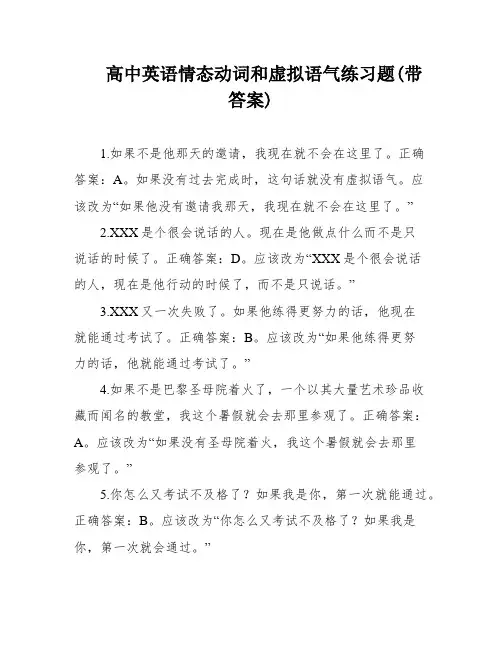
高中英语情态动词和虚拟语气练习题(带答案)1.如果不是他那天的邀请,我现在就不会在这里了。
正确答案:A。
如果没有过去完成时,这句话就没有虚拟语气。
应该改为“如果他没有邀请我那天,我现在就不会在这里了。
”2.XXX是个很会说话的人。
现在是他做点什么而不是只说话的时候了。
正确答案:D。
应该改为“XXX是个很会说话的人,现在是他行动的时候了,而不是只说话。
”3.XXX又一次失败了。
如果他练得更努力的话,他现在就能通过考试了。
正确答案:B。
应该改为“如果他练得更努力的话,他就能通过考试了。
”4.如果不是巴黎圣母院着火了,一个以其大量艺术珍品收藏而闻名的教堂,我这个暑假就会去那里参观了。
正确答案:A。
应该改为“如果没有圣母院着火,我这个暑假就会去那里参观了。
”5.你怎么又考试不及格了?如果我是你,第一次就能通过。
正确答案:B。
应该改为“你怎么又考试不及格了?如果我是你,第一次就会通过。
”11.I was stuck in a traffic jam for more than an hour。
otherwise I wouldn't have kept you waiting for such a long time。
(Changed "over" to "more than" for clarity and corrected "you" to "I".)12.Despite suffering from the blood disease。
the girl acted as if nothing had happened when facing her friends and family。
(Changed "XXX" to "nothing had XXX.)13.As the XXX approaching。
情态动词与虚拟语气讲解及练习题
情态动词与虚拟语气四川省达州市第一中学张国龙一. 含义和特征1. 含义: 情态动词是表示情态意义的动词, 它表示说话人的语气和情态, 它不能单独作谓语, 必须与实义动词一起构成谓语, 情态动词没有人称和数的变化。
2. 特征: ①有词义但不完整, 不能单独作谓语, 要跟实意动词或系动词的原形作谓语。
②除have to外, 可适用于各种人称和数。
③有些情态动词有过去式。
二. 基本用法1. can/ could和be able to ①can/ could表示能力, 这时could 为can 的过去时。
I can climb the cliff. He can drive a car. We could sing the song when I was young. ②表示许可。
You can sit here. The plane can take off now. 在疑问句中could比can委婉, 回答用can。
Can/ Could I come here tomorrow? Yes, you can. ③表示“有时候可能会”。
Even an experienced teacher can make a mistake. To stay here could be better. ④表示说话人的推测、怀疑、惊异、猜测、不肯定或不耐烦等,主要用于否定句, 疑问句或感叹句中。
The story can’t be true. How could you be so careless! Where can he go? ⑤cannot…too/ enough意为无论怎么…也不过分, 越…越好。
You cannot be too careful. You cannot remember enough English words.⑥can和be able to都表示能力, 意思上没多大区别。
can只有can和could两种形式, 而be able to则有am/ is/ are/ was/ were able to, will/ shall be able to, have/ has/ had been able to等形式。
高中英语虚拟语气讲解及练习附答案
高中英语虚拟语气讲解及练习虚拟条件句就是对现实条件的一种虚拟假设,所假设的条件一般不符合事实或与事实相反或在现实中发生的可能性极小。
根据时间的不同,虚拟条件句可分为三种,即与现在事实相反的虚拟条件句、与过去事实相反的虚拟条件句(1)表示与现在事实相反If I had enough money now, I would lend it to you.(2)表示与过去事实相反If he had taken your advice, he wouldn’t have made such a bad mistake.(3)表示与将来事实相反I would go shopping with you if it were to be Sunday tomorrow.1. 虚拟条件句的倒装在虚拟条件句中,为了强调所假设条件的虚拟性,或突出说话人的一种主观愿望,虚拟条件句可用倒装结构。
虚拟条件句的倒装是通过去掉if,把条件从句谓语中的助动词、情态动词或系动词放在句首实现的。
例如:Had I been(= If I had been ) in that situation, I would not have let the thief escape away with so much money.Should there be (= If there should be) a drought, what should we do at that time ?2. 错综时间条件句有时条件从句的动作和主句的动作发生的时间并不一致,这时谓语动词的形式应根据它所要表示的具体时间来确定。
例如:If we hadn’t been working hard in the past few years ,thing s wouldn’t be going so smoothly.3. 含蓄条件句有时假设的情况并不以条件从句的形式表现出来,而是通过某个介词或介词短语(如:with,otherwise,without,but for,in that position)、上下文或其它方式表现出来。
高二英语虚拟语气与情态动词试题答案及解析
高二英语虚拟语气与情态动词试题答案及解析1.––What a journey! We’ve finally arrived!––_____ an out-of-date train schedule, we would not have missed the train.A.Had we not used B.Did we useC.If we didn’t use D.If we had used【答案】A【解析】试题分析: 句意:真糟糕的旅行!我们终于到了。
如果我们没有用过期的列车时刻表,我们就不会错过火车了。
根据后句中的would not have missed可知句子使用了虚拟语气,是对过去发生的事情进行假设,主句应该用过去完成时,当句中有had ,should ,were时,可以省略if,把这些词提前,构成倒装结构,选A。
【考点】考查虚拟语气2.“You are too selfish. It’s high time you that you are not the most important person in the world.” Peter said to his boss angrily.A.realized B.realize C.will realize D.have realized]【答案】A【解析】句意:皮特生气的对老板说:“你太自私了。
正是你应该意识到你不是这个实际上最重要的人的时候了。
这里使用了句型:It is high time+从句,从句的谓语用should do或一般过去式,表示虚拟语气,所以选A。
【考点】考查虚拟语气3. --The mistake_____, I had been more careful.---But you weren’t at that time.A.might have avoided B.would avoidC.would be avoided D.might have been avoided【答案】 D【解析】句意:--如果我更加仔细一些,这个错误就会避免。
高中英语虚拟语气讲解及练习题(附答案)
高中英语虚拟语气讲解及练习虚拟条件句就是对现实条件的一种虚拟假设,所假设的条件一般不符合事实或与事实相反或在现实中发生的可能性极小。
根据时间的不同,虚拟条件句可分为三种,即与现在事实相反的虚拟条件句、与过去事实相反的虚拟条件句(1)表示与现在事实相反If I had enough money now, I would lend it to you.(2)表示与过去事实相反If he had taken your advice, he wouldn’t have made such a bad mistake.(3)表示与将来事实相反I would go shopping with you if it were to be Sunday tomorrow.1. 虚拟条件句的倒装在虚拟条件句中,为了强调所假设条件的虚拟性,或突出说话人的一种主观愿望,虚拟条件句可用倒装结构。
虚拟条件句的倒装是通过去掉if,把条件从句谓语中的助动词、情态动词或系动词放在句首实现的。
例如:Had I been(= If I had been ) in that situation, I would not have let the thief escape away with so much money.Should there be (= If there should be) a drought, what should we do at that time ?2. 错综时间条件句有时条件从句的动作和主句的动作发生的时间并不一致,这时谓语动词的形式应根据它所要表示的具体时间来确定。
例如:If we hadn’t been working hard in the past few years ,thing s wouldn’t be going so smoothly.3. 含蓄条件句有时假设的情况并不以条件从句的形式表现出来,而是通过某个介词或介词短语(如:with,otherwise,without,but for,in that position)、上下文或其它方式表现出来。