
外研版七年级英语上册教案Module 10 Unit 2
Module 10 Spring Festival Unit 2 My mother’s cleaning our house and sweeping away bad luck.
本模块话题是“节日”。
要求学生掌握描述节日的表达方式,同时加强学生对中外节日
的理解与认识。
通过使用现在进行时,对该话题展开听、说、读、写的语言实践活动。
使学
生加深能够谈论或写出对该节日的介绍,并了解英语国家中重要的节假日及其主要庆祝方式。
有助于学生了解世界,提高学习效率,形成自主学习的能力,为学生的终身学习奠定基础。
教学中教师应随时随地以课本为出发点,灵活利用各种素材组织教学过程和内容。
【知识目标】
1.能正确运用下列词汇:tradition, bad, luck, paint, mean, decorate, decoration, paper cut,
everyone, haircut, New Year, New Year’s Eve, dumpling, sweet pudding, fireworks, few, a few,
week, round, all the year round, bring, colour, something, cut, Christmas.
2. 能读懂对正在发生的事情的描述;
3. 能描述正在发生的事情。
【能力目标】
1. 正在发生的事情的描述;
2. 学会写明信片;
3. 学会描述自己或他人正在做的事情;
4. 学会用and 连接句子。
【情感目标】
通过对其他国家或地方人们生活的了解,培养对异国文化、生活习俗的兴趣,提高对本国文化的认识。
【教学重点】
能够通过阅读材料读懂描述春节的短文,并能与每一段落相对应的图片搭配,熟练运用现在进行时。
【教学难点】
区分现在进行时与一般现在时的用法,用所学的知识描述英国的圣诞节。
Tape recorder, Multimedia
Step 1. Warming-up
1.Talk about what you know about the Spring Festival.
2.Talk about the questions:
What traditions do you know? (food and decorations)
Do you know the paper cut?
Do you often have a haircut?
Step 2. Vocabulary
1. Show some pictures, ask the students to look at the pictures, then talk something about the
pictures.
3. Introduce the new words and expression and transform verb phrases into the gerunds.
4. Read the new words and expressions.
5. Look at the pictures and talk about what’s happening.
Step 3. Listening and reading
1.Listen to the text and answer the questions below.
1. When does the Spring Festival usually come?
2. What should mother do before Spring Festival?
3. How are the people celebrating on the Spring Festival evening?
2. Complete the passage with the correct words and expression from the box.
celebrate dumplings few luck mean
programme sweep away traditional
Step 4. Language points
1.with prep. 和,带有,用
2. It’s a few days before Spring Festival.
a few一些,表示肯定的概念,修饰可数名词复数。
few作形容词,表示否定的概念,为“几乎没有”,修饰可数名词复数。
few, a few, little, a little这四个词都有“一点儿”的意思,其用法既有相同之处,又有相异之处。
Step 5.Practice
请根据句意选用few, a few, little或a little填空。
Step 6.Writing
1.The notes about Christmas in Britain.
a) go shopping for presents
b) have a traditional family dinner
c) open presents on Christmas Day
d) put the presents next to the Christmas tree
e) get lots of food ready
f) sing Christmas songs
g) say Merry Christmas to family and friends
h) have a Christmas tree
2. Look at the notes about Christmas in Britain. Match the notes with the headings.
3.Write sentences
Join two notes and write one sentence with and.
4. Choose one of the headings in Activity 4 and write about Christmas in Britain. Step 6.Exercise
A. Translate these phrases into English.
B. Write down English words according to Chinese
C. Complete sentences according to Chinese.
D. Finish sentences as required.
Step 7. Speaking
看图说话
下图是一个德国人以图解析中西文化差异,请大家说说中西方人的不同之处。
Step 8. Homework
发挥想象,连词成文(50-100字)。
tradition, paint, decorate, paper cut,
dumpling, fireworks, all the year round
要求: 主要用现在进行时。
略。
外研版七年级英语上册教案Module 10 Unit 2
Module 10 Spring Festival Unit 2 My mother’s cleaning our house and sweeping away bad luck.本模块话题是“节日”。
要求学生掌握描述节日的表达方式,同时加强学生对中外节日的理解与认识。
通过使用现在进行时,对该话题展开听、说、读、写的语言实践活动。
使学生加深能够谈论或写出对该节日的介绍,并了解英语国家中重要的节假日及其主要庆祝方式。
有助于学生了解世界,提高学习效率,形成自主学习的能力,为学生的终身学习奠定基础。
教学中教师应随时随地以课本为出发点,灵活利用各种素材组织教学过程和内容。
【知识目标】1.能正确运用下列词汇:tradition, bad, luck, paint, mean, decorate, decoration, paper cut,everyone, haircut, New Year, New Year’s Eve, dumpling, sweet pudding, fireworks, few, a few,week, round, all the year round, bring, colour, something, cut, Christmas.2. 能读懂对正在发生的事情的描述;3. 能描述正在发生的事情。
【能力目标】1. 正在发生的事情的描述;2. 学会写明信片;3. 学会描述自己或他人正在做的事情;4. 学会用and 连接句子。
【情感目标】通过对其他国家或地方人们生活的了解,培养对异国文化、生活习俗的兴趣,提高对本国文化的认识。
【教学重点】能够通过阅读材料读懂描述春节的短文,并能与每一段落相对应的图片搭配,熟练运用现在进行时。
【教学难点】区分现在进行时与一般现在时的用法,用所学的知识描述英国的圣诞节。
Tape recorder, MultimediaStep 1. Warming-up1.Talk about what you know about the Spring Festival.2.Talk about the questions:What traditions do you know? (food and decorations)Do you know the paper cut?Do you often have a haircut?Step 2. Vocabulary1. Show some pictures, ask the students to look at the pictures, then talk something about thepictures.3. Introduce the new words and expression and transform verb phrases into the gerunds.4. Read the new words and expressions.5. Look at the pictures and talk about what’s happening.Step 3. Listening and reading1.Listen to the text and answer the questions below.1. When does the Spring Festival usually come?2. What should mother do before Spring Festival?3. How are the people celebrating on the Spring Festival evening?2. Complete the passage with the correct words and expression from the box.celebrate dumplings few luck meanprogramme sweep away traditionalStep 4. Language points1.with prep. 和,带有,用2. It’s a few days before Spring Festival.a few一些,表示肯定的概念,修饰可数名词复数。
外研版七年级英语上册:Module 10 Unit 2-教案

Module 10 Spring FestivalUnit 2 My mother’s cleaning our houses and sweeping away bad luckTeaching analysis Teachingaims1. To match photos with paragraphs and match questions withparagraphs2. To get information from the reading material about theSpring Festival3. To make notes and write sentences4. To learn to write paragraphsTeachingimportantand difficultpoints1.Key vocabulary:Christmas, February, January, before, sweep away, luck, mean, table, celebrate, traditional, dumpling, programmer, sweater, coat,lucky, tree, tell2. Key phrase:good luck, bad luck, decorate … with…, have a haircut, on New Year’s Day, a kind of at midnight, a few, at Lantern Festival,all the year round, on Spring Festival’s Eve, sweep away3. Key structures:1) My mother’s cleaning our house and sweeping away badluck.2) We are celebrating Spring Festival with a traditional familydinner on the evening before Spring Festival.3) I am eating jiaozi—a kind of dumpling.4) My parents and I are visiting my uncles and aunts.5) We are wearing new sweaters and coats.Teaching type Reading and writing.Teachingmeasure Interactive approachTeaching tools Recorder, OHP, videoTeaching proceduresChapter 1 Lead-in : Warming upStep 1 Warming-up1. Review the text of Unit 1.2. Show some pictures, ask the students to look at the pictures, then talk something about the pictures.3. Introduce the new words.4. Read the new words.Chapter 2 The students can learn by themselves, and ask some questions about the study.Step 2 Work in pairs.1. Read through the example sentences in Activity 1.—What’s Li Shan’s mother doing?—She’s cleaning the house.2. Look at the pictures and talk about what’s happening.Step 3 Group work1. Listen to the passage and answer the questions.1) Who is cleaning the house?2) Who gives Li Shan a Hongbao?Keys: Li Shan’s mother is cleaning the house.Li S han’s uncles and aunts.2. Read the passage and match the paragraphs with the pictures in Activity 1.3. Check with a partner.4. Call back the answers from the whole class.Keys: 1 2 3Chapter 3 The students can learn the main point with the help of the teacher, and solve the problems.Step 4 Reading.1. Play the recording.2. Ask the students to read through the passage.Read the passage and complete the sentences.1) People usually _____ houses and sweep away ___________ before Spring Festival.2) After the traditional family dinner, people usually watch a ________ on TV.3) In China, hongbao means _______ money.Keys: 1. clean; bad; luck 2. special programme 3. lucky3. Complete the passage with the correct words and expression from the box in Activity 3.celebrate dumpling few luck mean programme sweep away traditionalWe (1) ________ Spring Festival in January or February. A (2) ___ days before Spring Festival we clean our homes and (3) ___________ all the bad (4) ____.In the evening before Spring Festival we have a big family dinner. We eat lots of (5) _________ food, such as jiaozi –a kind of (6) _________. We usually watch a special (7) __________ on television, and parents usually give their children a hongbao. It (8) ______ lucky money.4. Check with a partner.5. Call back the answers from the whole class.Keys:1celebrate 2.few 3.sweep away 4.luck 5traditional6dumplings 7.programme 8. MeansRead the passage together.Step 5 Writing and speaking.1. Look at the notes about Christmas in Britain.The notes about Christmas in Britain.a) go shopping for presentsb) have a traditional family dinnerKeys:sweep it away sweep away the paper/ sweep the paper away2. We are celebrating Spring Festival with a traditional family dinner on the evening before Spring Festival.celebrate作动词,意为“庆祝”。
Module10Unit2阅读课第2课时学历案2023-2024学年外研版七年级英语上册

Step1 文中勾画重点句子,翻译短语,造句1. It means lucky money.mean 意为“意思是,意味着”,后面可跟名词、v.-ing, that从句。
询问“……是什么意思”有以下三种句型:(1) What do/does… mean ?(2)It means that从句(3) mean to do sth.打算做某事翻译:红灯意味着什么?__________________________________我打算去踢足球。
__________________________________2.There’s so much delicious food.so much 这么多【探究总结】so many 与so much的区别so many 意为“这么多”,后跟可数名词复数。
so much 意为“这么多”,后跟不可数名词。
翻译:这么多激动人心的电视节目____________________这么多美味的食物_________________3.My mother’s sweeping away bad luck.sweep away 打扫,扫除翻译:我妈妈要我把地上的米饭扫干净。
______________________请把垃圾打扫干净。
______________________4.It’s a few days before Spring Festival.a few 一些,几个,后跟可数名词复数,相当于severalfew 几乎没有,表否定,后跟可数名词复数翻译:我们学校有几个来自于澳大利亚的学生。
____________________________________________。
教室里没有几个学生。
____________________________________________。
5.观察并总结现在进行时的句式及用法My mother’s sweeping away bad luck.He is cleaning the house.I am celebrating Spring Festival.评价任务评价标准学习效Step2 根据思维导图,复述课文1. 展示自己画的思维导图,根据老师讲解完善思维导图。
新外研版七年级上册英语 Module 10 Unit 2 教案(教学设计)
Module 10 Spring FestivalUnit 2 My mother’s cleaning our house and sweeping away bad luck.单词 Christmas, February, January, before,1. To match photos with paragraphs and match questions with paragraphs2. To make notes and write sentences3. To learn to write paragraphsTo get information from the reading material about the Spring FestivalStep 1 Warming-up1. Review the text of Unit 1.2. Show some pictures, ask the students to look at the pictures, then talk something about the pictures.3. Introduce the new words.4. Read the new words.Step 2 Work in pairs.1. Read through the example sentences in Activity 1.—What’s Li Shan’s mother doing?—She’s cleaning the house.2. Look at the pictures and talk about what’s happening.Step 3 Group work1. Listen to the passage and answer the questions.2. Read the passage and match the paragraphs with the pictures in Activity 1. Step 4 Reading.1. Play the recording.2. Ask the students to read through the passage.Read the passage and complete the sentences.3. Complete the passage with the correct words and expression from the box in Activity 3.4. Check with a partner.5. Call back the answers from the whole class.6. Read the passage together.Step 5 Language points1. My mother’s cleaning our house and sweeping away bad luck.sweep away是动词短语,意为“扫去”。
七年级英语Module10Unit2教案

Module10 Life historyUnit 2 He decided to be an actor.课型:读写课【学习目标】1. 知识目标:单词:actor, writer, play, poem, age, marry, move, join, company, become, successful, rich, snow,短语:the life of ---, a writer of plays and poems, be born, decide to be an actor, at the age of---,at twenty-eight, become a successful actor, in many other languages, one of the most famous writers, in the world,2. 能力目标: 能够用一般过去时描述自己和他人过去的经历。
3. 情感目标: 通过对莎士比亚的了解,培养对文学家的崇敬之情以及对文学的兴趣。
【教学重点】1.the usages of the important words and phrases.2.一般过去时的用法(特殊疑问句)【教学难点】一般过去时的句式转换。
【教学过程】[课前朗读及背诵]:朗读重点词汇:actor, writer, play, poem, age, marry, move, join, company, become,successful, rich, snow,背诵第一单元单词及课文[检查词汇预习]:采取结对、小组互查等形式来检查学生对词汇的预习情况。
[检查课文背诵情况]:⏹I was born __November 1935.⏹Did you ___________________(骑自行车去上学)when you were a boy?(两种回答)⏹We had games ___chess.⏹__July and August, my brother and I visited my aunt near the sea.Did she have a house _______(在海边)一、导入新课老师通过对莎士比亚图片的展示,让学生猜Who was he? How much do you know about him? 让学生先就其对莎士比亚的了解做一下初步的介绍认识。
新外研版七年级英语上册Module 10 Unit 2 教案
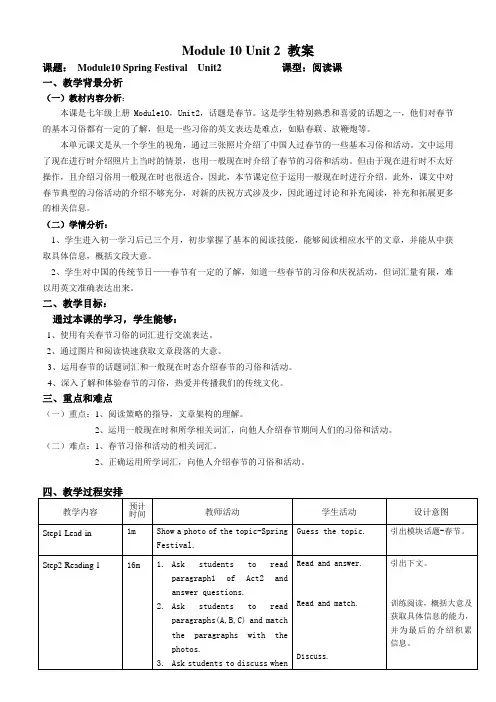
Module 10 Unit 2 教案课题:Module10 Spring Festival Unit2 课型:阅读课一、教学背景分析(一)教材内容分析:本课是七年级上册Module10,Unit2,话题是春节。
这是学生特别熟悉和喜爱的话题之一,他们对春节的基本习俗都有一定的了解,但是一些习俗的英文表达是难点,如贴春联、放鞭炮等。
本单元课文是从一个学生的视角,通过三张照片介绍了中国人过春节的一些基本习俗和活动。
文中运用了现在进行时介绍照片上当时的情景,也用一般现在时介绍了春节的习俗和活动。
但由于现在进行时不太好操作,且介绍习俗用一般现在时也很适合,因此,本节课定位于运用一般现在时进行介绍。
此外,课文中对春节典型的习俗活动的介绍不够充分,对新的庆祝方式涉及少,因此通过讨论和补充阅读,补充和拓展更多的相关信息。
(二)学情分析:1、学生进入初一学习后已三个月,初步掌握了基本的阅读技能,能够阅读相应水平的文章,并能从中获取具体信息,概括文段大意。
2、学生对中国的传统节日——春节有一定的了解,知道一些春节的习俗和庆祝活动,但词汇量有限,难以用英文准确表达出来。
二、教学目标:通过本课的学习,学生能够:1、使用有关春节习俗的词汇进行交流表达。
2、通过图片和阅读快速获取文章段落的大意。
3、运用春节的话题词汇和一般现在时态介绍春节的习俗和活动。
4、深入了解和体验春节的习俗,热爱并传播我们的传统文化。
三、重点和难点(一)重点:1、阅读策略的指导,文章架构的理解。
2、运用一般现在时和所学相关词汇,向他人介绍春节期间人们的习俗和活动。
(二)难点:1、春节习俗和活动的相关词汇。
2、正确运用所学词汇,向他人介绍春节的习俗和活动。
五、板书设计。
Module10 Unit 2 You shouldn't be late(教案)外研版(一起)英语
Module10 Unit 2 You shouldn’t be late(教案)教学目标1.能够听懂、会读并正确运用以下单词和句子:be early, be late, shouldn’t, apologize.2.能够在日常生活中应用所学语言。
3.通过师生互动,培养学生的语言表达和合作能力。
教学重点1.能够正确运用单词和句型。
2.能够在实际生活中应用所学语言。
教学难点1.运用所学语言进行日常应用。
2.通过师生互动,培养学生的语言表达和合作能力。
教学准备1.教师课件2.学生课本、练习册3.音乐、图片等辅助教学工具教学过程Part1: Warm-up1.师生互动,打招呼并温馨的问候学生。
2.引导学生练习日常用语,如问候、感谢、道歉等。
Part2: Presentation1.展示图片,引导学生讨论,What can we see in the picture?(图片上是两个人,一个时间急着赶路,一个在等待。
)2.引导学生描述图片中人物的状态,如hurry up, look at his watch, be late等。
3.教师带领学生一起学习be early, be late等相关单词。
4.学习单词shouldn’t,讲解其用法和意义。
5.教师再次展示图片,引导学生回忆图片中的内容,并学习句型You shouldn’t be late. 询问学生其含义并引导学生回答。
6.教师创造情景,让学生学习如何应用shouldn’t这个句型。
Part3: Practice1.引导学生分组完成分组活动:学生分成两组,一组为“迟到小组”,另一组为“遵守时间小组”;教师会跟迟到小组的学生搭话,引导他们回答为什么迟到并督促他们不要再次迟到,遵守时间小组则应当赞扬其它组并问为什么他们这么准时。
2.学生互相讨论如何表达不能迟到,如何向他人道歉等。
3.强化语言,引导学生再次掌握be late, be early, apologize等相关单词和句型。
初中英语外研版七年级上册《 Module 10 Unit 2 My mother's cleanin
I’m Li Shan from China. Spring Festival is very important in my country. Like Christmas, it happens every year, but not on the same day. It usually comes in February, but sometimes it comes in January. I’ve go some photos of it. Have a look at them. A Here’s the first one! It’s a few days before Spring Festival. My mother’s cleaning our house and sweeping away bad luck. Look at the food on the table! We always buys a lot of food before festival.
Christmas /ˈkrɪsməs/圣诞节
February /ˈfɛbrʊəri/二月
January /ˈdʒanjʊ(ə)ri/一月
table /ˈteɪbəl/桌子
sweater /ˈswɛdər/毛衣
dumpling /ˈdʌmplɪŋ/饺子
coat /kəʊt/外套
programme /ˈprəʊɡram/电视节目
C In this photo, my parents and I are visiting my uncles and aunts. We are wearing new sweaters and coats. I always get a hongbao. It means lucky money.
外研版-英语-七上外研版英语七上Module10:2单元教案
2011-2012外研版英语七上Module 10:Unit 2教案M10 U2 How often do you use a computer?教材分析The main topic of this unit is computer. Students can learn about how people in different places of the world use computer。
语言目标1.About knowledge: to understand questions and answers.2. About ability: to improve listening, speaking, reading and writing skills.3. About attitude: to be active to study and be confident.知识与能力1.Grammar: special questions and answers; affirmative and negative forms in Present Simple.2. Phrases: buy tickets, check train timetable, download music, get information, go online, maketravel plans, send email, use Internet, visit website3. Through reading, listening, speaking and writing exercises, be able to ask and answer questions with the new phrases in this unit and write a report in Present Simple.情感目标Be active to take part in the activities. Cooperate in a group. Be confident.过程与方法1.Guide the Ss to find out the answers by themselves.2. Set up different activities to reach the teaching goals.课堂检测题:一. 根据中文写出英文单词。
外研版初中英语七年级上册 Module 10 Unit 2 .(共24张PPT)
set off firecrackers
and fireworks
visit friends and relatives(亲戚)
On Spring Festival
wear new sweaters and coats
get a hongbao
from parents
1.Write a passage about Spring Festival . (Part of the Ss)
make dumplings make lanterns
clean the window sweep the floor
Studying aims(学习目标)
1.学习有关春节的词语及重点句子,能运用所学 知识描述春节活动。 2.掌握阅读技巧。 3.能写一篇关于春节的短文。 4.了解中国文化以及具有中国特色的物品,培养 民族自豪感,传承本族文化。
Before Spring Festival, We usually . . . to celebrate Spring Festival.
clean the house buy a lot of food put up(挂) red lanterns ['kʌplɪts] put up Chinese couplets
hongbao. It 8._m_e_a_n_s lucky money.
Exercises
A. 根据汉语或首字母填空。
1.Spring Festival is very im__p_or_t_a_n_t _in China. 2.F_eb_r_u_a_r_yis the second month in a year. 3.A year begin with Ja_n_u_a_r_y. 4.”No parking” me_a_n_s_ ”Don’t stop cars here”. 5.What pr_o_g_r_a_m_m_e_ (节目) do you like best? 6.They are ce_l_e_b_ra_t_in_g_ Spring Festival. 7.Before Spring Festival we often clean the house and s_w_ee_p_ away bad luck.