
人教新目标八年级英语上册期中复习
想让某人做某事 want sb. to do sth.
和某人一起度过时光spend time with sb.
向某人询问某事 ask sb. about sth.
通过做某事
by doing sth.
做某事的最好方式 the best way to do sth.
拓展: How often 多久一次 (提问频度,常用频度副词、频度 短语回答) How long 多长时间(提问时间段,常用“for+一段时间” 表示持续多久) How soon 多久以后(提问将来时,常用“in+ 一段时间” 表示多久以后) How many +复n. 多少; How many times 多少次 How much +不可n. 多少; How much be …? 多少钱 How old多大年龄 ; How far 多远
想要做某事 want to do sth.
与……一样
as+ adj./adv.的原级+as
不如
not as/so+adj./adv.的原级+as
be different from
关心
care about
像一面镜子
be like a mirror
最重要的
the most important
只要
as long as
取得更好的成绩 get better grades
事实上
in fact
交朋友
make friends
其他的
the other
感动某人
相当多
quite a few
为……而学习
study for
出去
go out
大部分时间
most of the time
尝起来很好吃
taste good
玩得高兴
have a good time
当然
of course
给……的感觉;感受到 feel like
想要做某事
feel like doing sth.
touch one’s heart
在音乐方面有天赋 be talented in music
擅长……
be good at
善于与……相处 be good with
事实上
in fact
愉快地做某事 have fun doing sth.
擅长做某事 be good at doing sth
★使某人做某事make sb. do sth.
决定去做某事 decide to do sth.
尝试做某事
try doing sth.
★尽力去做某事
try to do sth.
忘记做某事
forget to do sth.
喜欢做某事
enjoy doing sth.
开始做某事
start doing \to do sth.
停止做某事
stop doing sth.
上上下下 up and down
为某人买某物 buy sth. for sb. / buy sb. sth.
尝起来\看起来……
taste\look + adj.
除了……之外什么都没有 nothing…but+动词原形
★看起来…… seem+(to be)+ adj.
到达某地
arrive in+大地点 / arrive at+小地点
maybe adv.
可能,大概
(表示推测,通常用在句首)
may be 情态动词+ v. 可能是
(表示推测,通常用在句中,主语后)
I can’t find anywhere. __M__a_y_b_e___she is at home now. = I can’t find anywhere. She __m_a_y__b__e____ at home now.
maybe
may be
Unit3 I’m more outgoing than my sister?
更外向
more outgoing
与……一样…ing competition
与……相像的 be similar to
和……相同
(be)the same as
与……不同
打网球
play tennis
熬夜;睡得很晚 stay up late
至少
at least
上舞蹈课和钢琴课have dance and piano lessons
早点睡觉
go to bed early
进行体育活动 play sports
对……有好处 be good for
去野营
go camping
一点儿也不…… not…at all
unit1Where did you go on vacation?
大杜庄中学 何忠辉
去度假
go on vacation
待在家里
stay at home
去爬山
go to the mountains
去海滩
go to the beach
参观博物馆
visit museums
去参观夏令营
go to summer camp
在某人的空闲时间 in one’s free time
最受欢迎的
the most popular
★例如
such as
去看牙医
go to the dentist
★多于;超过
more than
少于
less than
在某方面帮助某人 help sb. with sth.
帮助某人做某事 help sb. ﹙ to ﹚do sth.
停下来去做某事
stop to do sth.
不喜欢做某事
dislike doing sth.
如此……以至于…… so+adj.+that+从句
告诉某人(不要)做某事 tell sb. (not) to do sth.
(年龄)足够大
old enough
Unit2How often do you exercise?
去购物
go shopping
在过去
in the past
四处走走
walk around
★因为
because of
一碗…… one bowl of…
第二天
the next day
喝茶
drink tea
★查明;弄清 find out
继续
go on
照相
take photos
★重要的事 something important
帮助做家务
help with housework
在周末
on weekends
多久一次
how often
几乎从不
hardly ever
每周一次
once a week
每月两次
twice a month
每天
every day
有空
be free
去看电影
go to the movies
用互联网
use the Internet
人教新目标(Go for it)版八年级上册英语期中复习—重要知识考点+练习过关(含答案)
重要知识考点总结归纳一、复合不定代词的用法 (1)二、一般过去时的用法 (2)三、反身代词的用法 (4)四、频度副词的用法 (5)五、形容词和副词的比较级 (7)六、形容词和副词的最高级的用法 (9)七、动词不定式作宾语的用法 (11)八、反意疑问句的用法 (13)重要知识考点总结归纳一、复合不定代词的用法1、复合不定代词只相当于名词,在句子中可作主语、宾语、表语,不能作定语(即不具有形容词的性质)。
❶ 含-body和-one的复合不定代词只用来代替人,在功能和意义上完全相同,可以互换。
eg:Someone/Somebody is crying in the next room.有人在隔壁房间里哭。
❶ 含-thing的复合不定代词只用来指事物。
eg:Are you going to buy anything? 你打算去买东西吗?2、复合不定代词都作单数看待,如果充当主语时,谓语动词用单数形式。
eg:Is everyone here today? 今天大家都到齐了吗?Nothing is difficult if you put your heart into it.世上无难事,只怕有心人。
3、形容词修饰复合不定代词时,要放在复合不定代词的后面。
eg:Can you tell something interesting? 你能讲一些有趣的事情吗?Did you go anywhere interesting last weekend?上周末你去什么有趣的地方了4、和some,any用法一样,含有-some的复合不定代词一般用于肯定句和请求语气的句子中,含有-any的复合不定代词一般用于否定句、疑问句。
eg:I have something important to tell you. 我有一些重要的事要告诉你。
Do you have anything to say? 你有话要说吗?5、在表示请求、邀请、提建议等的疑问句和希望得到对方肯定答复的疑问句中,也可用含-some的复合不定代词。
人教新目标初中英语八年级上册期中复习阅读理解专项练习
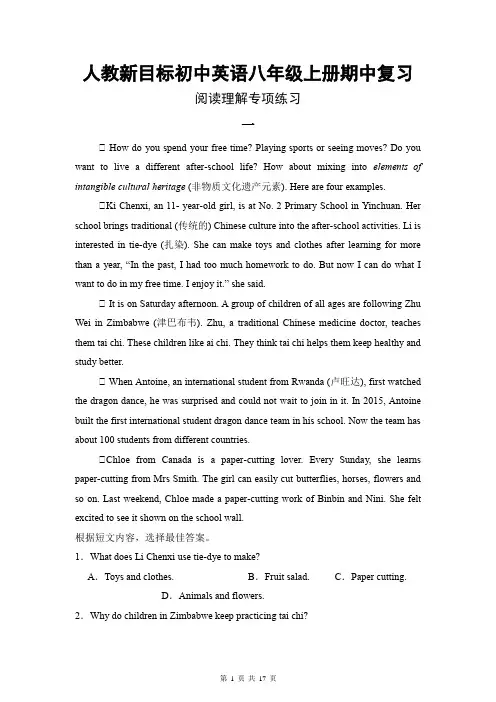
人教新目标初中英语八年级上册期中复习阅读理解专项练习一① How do you spend your free time? Playing sports or seeing moves? Do you want to live a different after-school life? How about mixing into elements of intangible cultural heritage (非物质文化遗产元素). Here are four examples.①Ki Chenxi, an 11- year-old girl, is at No. 2 Primary School in Yinchuan. Her school brings traditional (传统的) Chinese culture into the after-school activities. Li is interested in tie-dye (扎染). She can make toys and clothes after learning for more than a year, “In the past, I had too much homework to do. But now I can do what I want to do in my free time. I enjoy it.” she said.① It is on Saturday afternoon. A group of children of all ages are following Zhu Wei in Zimbabwe (津巴布韦). Zhu, a traditional Chinese medicine doctor, teaches them tai chi. These children like ai chi. They think tai chi helps them keep healthy and study better.① When Antoine, an international student from Rwanda (卢旺达), first watched the dragon dance, he was surprised and could not wait to join in it. In 2015, Antoine built the first international student dragon dance team in his school. Now the team has about 100 students from different countries.①Chloe from Canada is a paper-cutting lover. Every Sunday, she learns paper-cutting from Mrs Smith. The girl can easily cut butterflies, horses, flowers and so on. Last weekend, Chloe made a paper-cutting work of Binbin and Nini. She felt excited to see it shown on the school wall.根据短文内容,选择最佳答案。
2103人教新目标八年级英语上册期中复习课件
全世界
装扮
around the world all over the world dress up
one of the 最高级 复名
第几…最…
the 序数词 最高级 单名
Unit5 Do you want to watch a game show ?
“认为···怎么样?” ··· What … think of ...? /How ….like….? 你介意(某人)做…吗? Would/Do you mind (sb’s) doing sth.? 准备做某事 be/get ready to do sth. 为某事做准备 be/get ready for sth. 计划做…. plan to do sth. 希望做 hope to do sth 期待(某人)做某事expect (sb.)to do sth. 关于…进行讨论 have a discussion about 在二十世纪三十年代 in the 1930s learn …from… 从…中学到… 向某人学习 learn from sb. 发行; 出版 come out 查明,弄清 find out 作为(某身份)而出名 be famous as… 因为…而出名 be famous for… 尽某人的最大努力(做某事) try one’s best (to do sth.)
Unit2How often do you exercise?
帮助做家务 help with housework 在周末 on weekends 多久一次 how often 几乎从不 hardly ever 每周一次 once a week 每月两次 twice a month 每天 every day 有空 be free 去看电影 go to the movies 用互联网 use the Internet 打网球 play tennis 熬夜;睡得很晚 stay up late 至少 at least 上舞蹈课和钢琴课have dance and piano lessons go to bed early 早点睡觉 play sports 进行体育活动 be good for 对……有好处
人教新目标版八年级英语上册期中复习资料Unit1
人教新目标版八年级英语上册期中复习资料(一)Unit 1一.重点词组1. 有一些喝的东西have something to drink2. ……怎么样?What / How about ……?3. 再要一些食物have some more food4. 碗里的披萨the pizza in the bowl5. 一个诚实的孩子an honest child6. 保守秘密keep a secret7. 使你的朋友如此特别make your friend so special 8. 和我的朋友分享我的快乐share my joy with my friend9. 关心某人care about sb. 10. 相信他说的话believe what he says / believe his words11. 成为好朋友make good friends 12. 信任某人trust sb.13. 给某人讲风趣的笑话tell sb. funny jokes 14. 说谎tell a lie / tell lies 15. 我最好的朋友之一one of my best friends 16. 乐意做某事be willing / ready / happy / glad to do sth.17. 帮助我做作业help me with my homework 18. 有一个好嗓子have a good voice19. 在公共汽车上把座位让给需要的人give a seat on the bus to someone in need20. 戴着小圆眼镜wear small round glasses 21. 使他看上去很聪明make him look smart22. 很有幽默感have a good sense of humor 23. 感到无聊feel bored24. 经过我的课桌walk past my desk 25. 长着大而明亮的眼睛have big bright eyes26. 把我们的书和笔碰到地面上knock our books and pens onto the floor27. 留着长而直的头发have long straight hair 28. 一个真正的朋友 a true friend29. 说某人的坏话say a bad word about sb. / say bad things about sb.30. 使我担忧worry me 31. 任何时候any time / Any time32. 选May作为我最好的朋友choose May as my best friend33. 最昂贵的电脑the most expensive computer 34. 六个学生中of / among the six students35. 见不同的人meet different people 36. 和某人交朋友make friends with sb.37. 认真倾听人们的问题listen to people carefully 38. 帮助人们解决问题help people with their problems39. 环游世界travel around the world 40. 成为一名社会工作者be a social worker41. 在所有的中国艺术家中among all the Chinese artists 42. 漂亮的艺术品beautiful works of art43. 有一天some day 44. 左边的男孩the boy on the45. Peter隔壁的那个女孩the girl next to Peter 46. 扎着马尾辫的一个小女孩 a small girl with a ponytail47. 既……又……both……and……48. 长着一张圆脸have a round face49. 小鼻子 a small nose 50. 明亮微笑的眼睛bright smiling eyes51. 面带微笑have a smile on the face 52. 成为一名杰出的老师make an excellent teacher二. 重要句型1. Can I have something to drink? 我能喝点什么吗?这里have something to drink 表示“来点喝的东西”,动词不定式to drink 作定语,修饰不定代词something 。
人教版八年级英语上册期中考试复习知识点汇总精选全文完整版
可编辑修改精选全文完整版人教版八年级英语上册期中考试复习知识点汇总本页仅作为文档页封面,使用时可以删除This document is for reference only-rar21year.March人教版八年级英语上册期中考试复习知识点汇总Unit1Where did you go on vacation?【重点单词】anyone ['eniwʌn] pron.任何人anywhere ['eniweə(r)] adv.任何地方 n.任何(一个)地方wonderful ['wʌndəfl] adj.精彩的;极好的few [fjuː]adj.很少的;n.少量most [məʊst] adj.最多的;大多数的something ['sʌmθɪŋ] pron.某事物nothing(=not…anything) ['nʌθɪŋ] pron.没有什么n.没有myself [maɪ'self] pron.我自己everyone ['evriwʌn] pron.每人;人人yourself [jɔː'self] pron.你自己;你亲自hen [hen] n.母鸡;雌禽bored [bɔːd] adj.无聊的;厌烦的;郁闷的pig n.猪diary ['daɪəri] n.日记;日记簿(keep a diary)seem [siːm] vi.似乎;好像someone ['sʌmwʌn] pron.某人;有人quite a few 相当多;不少(后接可数名词)of course [əvkɔːs] 当然activity [æk'tɪvəti] n.活动;活跃decide [dɪ'saɪd] v.决定;选定(decide to do sth.)try [traɪ] v.尝试;设法;努力(try to do sth. /try doing sth.)bird [bɜːd] n.鸟;禽paragliding ['pærəɡlaɪdɪŋ] n.空中滑翔跳伞bicycle ['baɪsɪkl] n.自行车building ['bɪldɪŋ] n.建筑物trader ['treɪdə(r)] n.商人;商船wonder ['wʌndə(r)] v.惊奇;想知道;怀疑difference ['dɪfrəns] n.差异;不同top [tɒp] n.顶部;顶wait [weɪt] v.等;等待(wait for)umbrella [ʌm'brelə] n.伞;雨伞wet [wet] adj.湿的;雨天的below [bɪ'ləʊ] prep.低于;在...下面 adv.在下面as [əz] conj.如同;像...一样enough [ɪ'nʌf] adj.足够的 adv.足够地;充分地duck [dʌk] n.鸭肉;鸭hungry(反full) ['hʌŋɡri] adj.饥饿的;渴望的feel like(doing sth.) 想要dislike [dɪs'laɪk] v.不喜欢;厌恶 n.不喜爱;厌恶;反感【重点短语】1. go on vacation 去度假2. stay at home 呆在家3. go to the mountains 上山/进山4. go to the beach 到海边去5. visit museums 参观博物馆6. go to the summer camp 去夏令营7. quite a few 相当多8. study for为…… 学习,9. go out 出去10. most of the time 大部分时间/绝大多数时间11. taste good 尝起来味道好12. have a good time 玩的开心13. of course 当然可以14. feel like 感觉像……/想要15. go shopping 去购物16. in the past 在过去17. walk around 绕……走18. too many 太多(可数名词前面)19. because of 因为20. one bowl of 一碗……21. find out 查出来/发现22. go on 继续23. take photos 照相24. something important 重要的事情25. up and down 上上下下26. come up 出来【重点句型】1. ——Where did you go on vacation 你到哪里去度假了——I went to New York City. 我去了纽约城。
人教新目标初中八年级上册英语期中试题附答案及解析
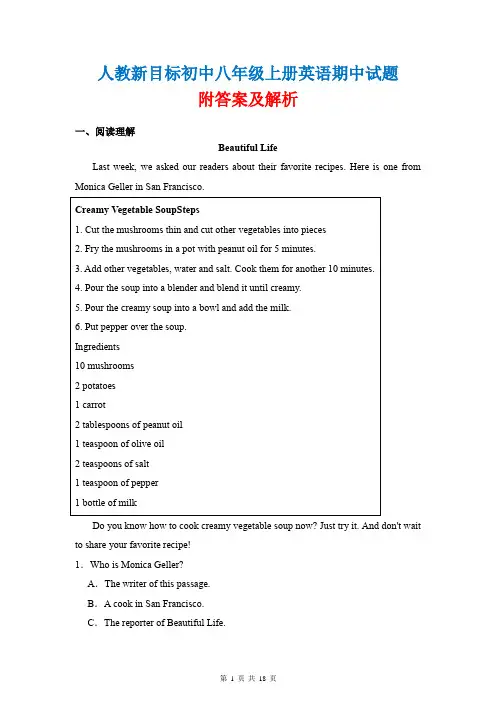
人教新目标初中八年级上册英语期中试题附答案及解析一、阅读理解Beautiful LifeLast week, we asked our readers about their favorite recipes. Here is one from Monica Geller in San Francisco.Do you know how to cook creamy vegetable soup now? Just try it. And don't wait to share your favorite recipe!1.Who is Monica Geller?A.The writer of this passage.B.A cook in San Francisco.C.The reporter of Beautiful Life.D.The reader of Beautiful Life.2.What do we use to fry the mushrooms according to this passage?A.Peanut oil.B.Water.C.Soup.D.Milk.3.What do we know from this passage?A.We should fry potatoes first.B.We pour the milk into the pot.C.We need a blender to cook creamy vegetable soup.D.It takes about 10 minutes to cook creamy vegetable soup.①When our taxi went on the streets, I looked with interest at everything around me. What could I see during my short stay in Milan? One answer came into my mind as our taxi went past Duomo di Milano, the largest cathedral (教堂) in Italy.①The next morning my family and I made our way to the cathedral. It was just a five-minute walk from our hotel. On the roof, there are many statues (雕像). They are all about characters from Bible (圣经). Although many look lovely, I felt kind of scared when I saw a scary one. We climbed to the roof. There, we had an amazing view of the city and took lots of photos. Inside, we enjoyed the beautiful glass windows.①We then walked to the La Scala, Milan’s world-famous opera house. It doesn’t look like much from the outside, but the inside is wonderful. Most of the greatest singers of the past 200 years sang there.①Between the Duomo di Milano and La Scala is the Galleria Vittorio Emanuele II hallway. We went there from the opera house. Some of the top fashion brands (品牌) have shops there. The only thing we could afford to buy was ice-cream. We waited in line, watching the server make it look like a rose. It tasted great, just like yogurt.①Milan’s other famous spots, such as da Vinci’s famous painting The Last Supper will have to wait. Milan is sure in my plan for another trip.4.Where can the visitors go if they want to buy things of top fashion brands?A.To La Scala.B.To opera house.C.To Duomo di Milano.D.To the Galleria Vittorio Emanuele II hallway.5.What does the underlined word “it” refer to in Paragraph 4?A.Rose.B.Line.C.Ice-cream.D.Yogurt. 6.What did the writer do in Milan?a. He visited a world-famous opera house.b. He climbed to the roof of the cathedral and took many photos.c. He tried the ice-cream with his family.d. He went to see the famous painting named The Last Supper.A.a-c-d B.b-c-d C.a-b-c D.a-b-d 7.What’s the passage mainly about?A.Buildings and food in Milan.B.The writer’s fantastic trip in Milan.C.The writer’s plans for travel in Milan.D.Some famous places of interests in Italy.①Do you have a talent for something that you couldn’t live without? If you lost it, what would you do to get it back? Liu Mengjie found his own answers to these questions.①Liu Mengjie was from Taiwan. He started to learn to play the piano at a very young age. He was such a talent that he was accepted into a music school at only 13. He left his home to study at the Curtis Institute of Music in Pennsylvania. Liu became one of the teachers after he graduated in 1993. That was the same year that he became famous in the music world.①When Liu was 23, just a few years after an outstanding performance, he came down with a serious illness. He had a difficult time walking and his heart even stopped beating. The worst part was that he couldn’t move his fingers. The doctor said, “I am sorry. I am afraid you have to say goodbye to your piano forever.”①However, Liu surprised everyone. He practiced his fingers very hard every day after he spent one month learning how to sit up. With strong will, he kept on with hiscareer as an excellent pianist. “I feel full and alive. Looking back on this journey, I want to say thanks and I have found the true meaning of life: be strong and stick to (坚持) your dream.”8.Why was Liu Mengjie accepted into a music school at only 13?A.Because he couldn’t live without playing the piano.B.Because he was pretty talented in playing the piano.C.Because he started to learn piano when he was very young.D.Because he had to leave his home to study in a new school.9.What can we infer (推断) from the doctor’s words in Paragraph.3?A.Even after Liu Mengjie got better, he couldn’t play the piano anymore.B.It will be good for Liu Mengjie’s health if he stops playing the piano.C.Liu Mengjie could keep on playing the piano after he got better.D.It will be impossible for Liu Mengjie to be well again.10.How did Liu Mengjie feel after he kept on as an excellent pianist?A.Thankful.B.Relaxed.C.Empty.D.Tired. 11.Which is the best title (标题) for this passage?A.A Serious IllnessB.A Man of Talent and StrengthC.A Talented PianistD.A Dream in Music①As a powerful chatting robot, ChatGPT becomes really popular. It is a large language model created by OpenAI and it is one of the most wonderful AI models now. It brings big changes to people’s life in many ways, especially education.①It helps students learn in lots of personal ways. With its excellent machine learning ability, ChatGPT can know very well about each student. So it can provide students with customized (定制的) learning materials (资料). Also, students can ask it for help with their homework. For example, a student may ask, “How to find information about the history of soccer?” ChatGPT will list the names of books,museums and key websites in a few seconds (秒). By searching (搜索) on these websites, students will have a clear understanding of soccer.①For teaching. ChatGPT is a window to a large number of teaching resources (资源). It makes teachers rethink the working ways. Many kinds of easy daily work, such as test papers, planning lessons and analyzing questionnaires (分析问卷), can be done more quickly. In this way, teachers can spend more time on more complex tasks, like designing classroom activities and making teaching plans.①However, every coin has two sides. Some teachers say that ChatGPT isn’t good for the development of students’ creative thinking. It may turn students into “mindless searching machines”. The teachers also worry that with the wide use of ChatGPT, the results of education may not be as good as before.①“ChatGPT can help our teachers and students understand the power of technology,” says Ellen Meier, an engineer in the ChatGPT research team. “However,” she adds, “it should not replace the roles of teachers or students in the classroom.”12.How many personal ways can ChatGPT help students with their study in?A.Two.B.Three.C.Four.D.Five. 13.Which of the following is TRUE according to the passage?A.ChatGPT is the most wonderful AI model now.B.Teachers can get few teaching resources from ChatGPT.C.Teachers think ChatGPT can make students' creative thinking better.D.Students will understand well of soccer after searching on the websites. 14.What does the underlined word “complex” in Paragraph 3 mean?A.Slow.B.Quick.C.Difficult.D.Easy. 15.Which of the following ideas may Ellen Meier agree with?A.It will be better for teachers to use ChatGPT more In the future.B.Students need to use ChatGPT as much as possible in the future.C.Technology should take the place of teachers in teaching in the future.D.Students can understand the importance of technology by using ChatGPT.阅读下文,请从A一F选项中选出符合第1-5题的最佳中心句。
人教版新目标英语八年级上学期期中考试分类复习训练题(Units 1-5语法基础知识篇)
人教版新目标英语八年级上学期期中考试分类复习训练题(Units 1-5)语法基础知识篇Unit 1:一、单项选择:( )1.My mother has umbrella. It`s useful tool for her to use it in both rainy and sunny weather.A.a , a B,an , an C. an ,a D.a, an( )2.Peter`s grandfather never speaks Chinese, but he knows Chinese characters.A.a littleB.quite a fewC.littleD.quite a lot( )3.—What would you like to buy for your mother on her birthday this year?-- special.I still make a nice card for her as before..A.SomethingB.AnythingC.EverythingD.Nothing( )4.—Look! The lights in the classroom are still on. Who is in it ?--- .Maybe forgot to turn them off.A.Nobody, somebodyB.None, someoneC.Someone. no oneD.No one, anybody( )5.—How many relatives did you visit during the Spring Festival of 2020?--- . All of us had to stay at our own homes because of the COVID-19.A.NobodyB.NoneC.No oneD.Nothing( )6.---Can you follow me, Tom ?—Yes, madam. You speak .A.enough clearB.clear enoughC.enough clearlyD.clearly enough( )7.--- fine weather it is today!---Yes. My sister and I can enjoy in the sun.A.What a, ourselvesB.What, ourselvesC.How , yourselvesD.What, yourselves( )8.-----Is here ?---Sorry, Miss Smith. Bob isn`t here.A.everyoneB.anyoneC.someoneD.no one( )9.Jack tried the door but the key didn`t work, so he tried into the room through the window and made it at last.A.opening,goingB.to open, goingC.opening, to goD.to open, to go( )10.---Come on! Jenny. Someone the school gate.A.is waiting forB.are waiting atC.is waiting atD.are waiting for二、句型转换:一空一词1.Mr. Black seemed to make a decision to visit the Palace Museum .(改为同义句)It that Mr. Black to visit the Palace Museum.2.Because the journey was very long, we all wanted to have a rest on halfway.(改为同义句)All of us a rest on halfway the long journey.3.The boy is too young to finish the work by himself.(改为同义句)The boy isn`t to finish the work by himself.(4.Mark did something special last Sunday.(改为否定句)Mark special last Sunday.Mark special last Sunday5.Shared bikes are very popular in big cities.(改为感叹句)shared bikes are in big cities !三、完成句子:(一空一词)1.无论做什么事,尽自己最大的努力吧!Whatever you do, .2.周六还是周日去野炊对我没什么影响。
人教版八年级上册英语期中复习重点难点汇总
人教版八年级上册英语期中复习重点难点汇总一、单词与词汇1. 重点单词- Unit 1:anyone(任何人),anywhere(在任何地方),wonderful(精彩的;绝妙的),few(不多;很少),most(最多;大多数),something(某事;某物),nothing(没有什么;没有一件东西),everyone(每人;人人;所有人),myself (我自己;我本人)等。
这些单词在一般疑问句、肯定句和否定句中的用法需重点掌握,同时要注意复合不定代词作主语时谓语动词的单复数形式。
- Unit 2:housework(家务劳动;家务事),hardly(几乎不;几乎没有),ever (在任何时候;从来;曾经),once(一次;曾经),twice(两次;两倍),Internet ((国际)互联网;因特网),program(节目),full(忙的;满的;充满的),swing (摆动;秋千;(使)摆动;摇摆)等。
重点掌握频率副词的位置和用法,以及与一般现在时的搭配。
- Unit 3:outgoing(爱交际的;友好的;外向的),both(两个;两个都),better(较好的(地);更好的(地)),loudly(喧闹地;大声地;响亮地),quietly (轻声地;轻柔地;安静地),hard - working(工作努力的;辛勤的),competition (比赛;竞赛;竞争),fantastic(极好的;了不起的)等。
要能正确使用形容词和副词的比较级和最高级形式,区分其用法。
2. 难点词汇-辨析:- few, a few, little, a little:few 和a few 修饰可数名词,few 表示“几乎没有”,a few 表示“有一些”;little 和a little 修饰不可数名词,little 表示“几乎没有”,a little 表示“有一点”。
例如:There are few apples on the tree.(树上几乎没有苹果。
人教版新目标英语八年级上期中阶段复习
新目标英语八年级阶段复习(一)【语法知识聚焦】1. It's easy to do... 做...容易,如:It's very easy to work out this math question.算出这道数学题很容易。
这个句型的easy可由其他的形容词替换,还表达做某事如何。
It's interesting to take photos of animals. 给动物照相很有趣。
2.how often, how long 这两个疑问词组用来提问时容易混淆。
how often 是用来针对频度的副词或状语来提问的;how long 是指多长时间,是就一段时间来提问的。
(1) --How often do you write to your friends?-- Once a week.(2) --How long do you watch TV yesterday?-- Two hours.3. 现在进行时态不表示“现在正在进行”的其他用法:(1)和频度副词always,constantly,continually和forever等连用时,表示一种感情色彩,并不强调动作在进行。
表示讨厌、不满,带有埋怨情绪,指责某人一贯的行径;或者是表示赞许、高兴。
带夸奖口吻,称赞对方的一贯表现。
如: He is forever boasting.他老爱说大话。
Strange! The weather here is constantly changing. 奇怪!这里的气候总是变化无常。
You are always doing well.你总是干得很不错。
(2)用hope,find,want,wonder等的进行时态是一种婉转的说话语气。
如:We are hoping you will get well soon.我们希望你很快康复。
(3)某些心态动词或情态动词的进行时表示“几乎”、“差一点”等含义。
人教新目标八年级 英语(上)期中复习
句型转换: 句型转换: 1. Ann’s mother shops once a month.
37.保持健康 保持健康
keep in good health = keep/stay healthy
38.少吃肉 eat less meat 少吃肉 39.提高英语 improve English 提高英语
1、你多久吃一次蔬菜?我每天都吃 How often do you eat vegetables ? I eat them every day . 2、她周末干什么? 她经常在家看电视。 What does she do on weekends ? She often watches TV at home . 3、至于家庭作业,大部分学生一周做3到4次作业 As for homework , most students do homework three or four times a week .
选用方框里的字, 选用方框里的字,用其适当形式填空
help, make, a lot of, want, early , exercise, try, and, give, take a lot of 1. I have ________ toy cars in my room. 2. I eat fruit ________ drink milk every day. and take 3. My parents often ________ me to the park on Sundays. 4. He usually comes to school_______. early give 5 Jim, ________ this book to Ann. 6. Mum wants _________ me to get up at 6:00 and run with her. 7. You must _________ to eat less meat. try make 8. Does it _______ a big difference if you eat fruit every