
八年级上册unit3英语
博文教育个性化辅导授课教案教师:学生:时间:2012 年 7月 6日 8时至10时辅导类型:一对一一、授课目的与考点分析:Unit3. 掌握一些重要的词汇和句型结构,学会一些词的进行时态表将来时二、授课内容:Unit3. What are you doing for vacation?单词和词组:Plan to do; how long; get back; send sb to do/send sb sth/send sth to sb; ride a bike; go fishing/shopping/swimming/hiking…; be famous in/for/as; something; forget/leave; how about/what about; ask扩展:get的短语; go的短语; 形容词修饰复合不定代词; Remember/forget/stop+ to do/doing;重要句子及句型结构1.--What are you doing for vacation this weekend, Li Chen?--I’m going camping.--That sounds nice. Who are you going with?①“What are you doing for…?”是一个现在进行时态的句子,用来询问将来的计划、打算等。
回答时也用进行时态表示计划、打算要做某事。
这种用法,通常需要一个表示将来时间的状语。
②现在进行时表示将来的用法:现在进行时的构成:主语 + be + v-ing表示位置移动的词,如go; come; leave; stay; arrive; move; take等动词的进行时表将来时。
Eg: He is going to Beijing next month.The famous player is taking a long vacation this winter.He is spending time with his best friend this Saturday.③go + doing表示“去做某事”,多指从事某种体育活动或业余娱乐活动,如:Go fishing/boating/swimming/bike riding/sightseeing/climbing/hiking④Who are you going with? 不用忘记with2.How about you, Tony?此句型常用来询问别人是否具有上文提到过的情况,可用what about替换how about,其中about是prep.Eg:I want some noodles. What about you?此句型还可用于表达建议或征求对方的意见,意为“…怎么样?”Eg: How/What about going for a walk after supper?3.Well, have a good time!其同意词组为have (great) fun和enjoy oneself, good可换成nice/great/wonderful等Eg: We have great fun learning English.4.Show me your photos when we get back to school.Show在句中为动词“出示,给…看”,show sb sth = show sth to sb类似的结构还有give sb sth = give sth to sb buy sb sth = buy sth for sb5.--How long are you staying?--About a week.How long“多久,多长时间”,询问动作持续的时间,谓语动词应为延续性动词,如work; live; study; play 等,可与多种时态连用,对“for + 一段时间”提问。
此外,还可用于询问物体的长度。
6.famouseg: He is a very famous actor in this country.The man is famous as a long novel writer.Shao Xing is famous for its yellow wine.7.He is leaving the first week in June and staying until September.Live sp for sp离开某地去某地 live for sp 到某地Live/forgetLeave表示“忘了带,丢下”,多指把某物忘在某处,后跟表示地点的词;forget表示“忘记做某事;忘记某物”,不强调地点。
Eg: The boy left this raincoat on the train.I forgot her name.Forget to do/forget doing前者表示忘记去做某事(还没做);后者表示忘记做过某事(已经做过),类似的词还有:remember/stop等Eg: I forget to post the letter.(信还没寄)I forgot posting the letter.(信已经寄出)8. How’s the weather…? = What’s the weather like…? …天气怎么样?Eg: --What’s the weather like today?--It’s sunny.9. He thought about going to Greece or Spain, but decided on Canada.Think about考虑 He was thinking about something else.Think的短语:Decide on决定,后接名词或v-ing形式,decide to do/decide that…句子含义相同Eg: I decide on the red dress.Dress/ wear/ put on/ have on/be in等表示“穿衣”的动词。
①从所接宾语来看dress 要接“人”作宾语(不接“衣”作宾语),而其余的则要接“衣”作宾语(而不接“人”作宾语)。
Eg: She dressed the baby. 她给婴儿穿衣服。
She was wearing her mother’s coat. 她穿她母亲的大衣。
Put your coat on when you go out. 出去时穿上外套。
She has a red jacket on. 她穿着一件红色的短上衣。
②从表示动作与状态来看wear和have on 通常指穿着衣服的状态,put on 通常指穿衣的动作,而 dress 既可指动作也可以指状态。
如:Eg: She wore [had on] a new dress. 她穿着一件新衣服。
Put on your clothes quickly. 赶快穿上衣服。
She is dressing hers elf. 她在穿衣服。
She always dresses in black. 她总是穿黑衣服。
注:dress 还通常用于被动语态。
如:The girl was poorly dressed. 这女孩衣着寒酸。
He was dressed as a woman. 他男扮女装。
③从所使用的时态和语态来看wear 和 have on 虽然都可表示穿衣的状态,但wear可用于进行时态和被动语态,而have on却既不可用于进行时态也不可用于被动语态。
如:Eg: He was wearing a new jacket. 他当时穿着一件新夹克。
Such clothes are not often worn nowadays. 现在那样的衣服很少有人穿了。
④其他用法上的区别wear 除可表示穿衣外,还可表示戴表(花、纪念章等)以及留头发或胡须等,而dress, put on 一般不这样用。
如:Eg: He seldom wears a wa tch. 他很少戴表。
He wears his hair long. 他留着长发。
注:have on 有时也这样用。
如:They all had dark glasses on. 他们都戴着墨镜。
Be in表示穿的状态,后接颜色词如:I’m in red today10. I heard that Canada is beautiful, and I know there are many people there who speak French. Hear of/about 听说Hear from sb = receive/get/have a letter from sb收到某人的来信Hear听见11. He plans to have a very relaxing vacation.(take a vacation/on vacation)Plan to do… = plan on doing…“计划去做…”Eg: Do you plan to stay overnight here? =12. tour/journey/trip/travel的辨析13. send sb to do sth; send for派人去请; send sb sth; send sth to sb练习:1. --Yesterday he broke his leg.--That sounds_____.A terribleB terriblyC terribllyD terriblely2. -- When will you_____ from school?--About 3 o’clock.A get inB get backC get upD get on3. All the new products were on_____ at the exhibition.A shownB showedC showD showing4. How long have you_____ your homework?A. been away from B left C arrived D come to5. -–When will you_____ New York?-- I_____ New York yesterday evening.A arrive at; arrivedB arrive in; reachC arrive at; arrived inD arrive in; reached6. Does Tom often_____ with his family?A taking a vacationB take a vacationC takes a vacationD taking a vacation7.—Which necklace have you lost?--The one you gave me_____ my birthday.A forB toC withD of8 Here are some Teachers’ Day cards_____ our teacher______ our best wishes.A to; withB for; withC for; onD on; for9. When the professor finishes his research, he will leave Beijing to Hong Kong.(改错)10. Today it is raining heavily outside, Tom has to_____ raincoat for school.A wearB put onC dressD dress in11. I didn’t buy the dictionary yesterday _________ my aunt would give me one.A. untilB. becauseC. ifD. before12. Please show me _________ to send an e-mail, John. It’s the first time for me to do it.A. howB. whatC. whenD. where三、本次作业四、学生对于本次课的评价:○特别满意○满意○一般○差学生签字:五、教师评定:1、学生上次作业评价:○好○较好○一般○差2、学生本次上课情况评价:○好○较好○一般○差教师签字:家长签字:博文教育教务处:。
人教版八年级上册英语Unit 3知识点梳理及语法讲义(教师版)
八年级上册英语Unit 3知识点与语法精讲精练词汇梳理(一)完成单词梳理:名词:1. competition比赛;竞赛 2. mirror 镜子 3. kid 小孩;年轻人4. grade 成绩等级5. hand 手6. saying 谚语;格言7. heart 内心;心脏8. fact 现实;事实9. information 信息;消息10. arm 手臂;上肢动词:1. win 获胜;赢 2. care 在意;关心 3. should 应该;应当4. reach 伸手;到达5. touch 感动;触摸6. break 损坏7. share 分享;共享;共用副词:1. loudly 喧闹地;大声地;响亮地 2. quietly 轻声地;轻柔地;安静地3. clearly 清楚地;清晰地;明白地4. truly 真正;确实形容词:1. outgoing 爱交际的;友好的;外向的 2. hard-working工作努力的;辛勤的3. fantastic 极好的;了不起的4. talented 有才能的;有才干的5. serious 严肃的;稳重的6. necessary 必需的;必要的7. loud 响亮的;大声的8. similar 相像的;类似的9. primary 最初的;最早的兼类词:1. both (adj/pron)两个;两个都2. better (adj/adv)较好的(地);更好的(地)3. which (pron/adj)哪一个;哪一些4. though (adv)不过;可是;然而(conj)虽然;尽管;不过5. laugh (v)笑;发笑(n)笑声(二) 词汇变形小结:1. good/well (adj/adv. 好的) — better (比较级) — best (最高级)2. loud (adj. 大声的) — loudly (adv.喧闹地)3. quiet (adj. 安静的) — quietly (adv. 安静地)4. competition (n. 竞争;比赛) — compete (v. 竞争;比赛)5. clearly (adv. 清楚地;清晰地) — clear (adj. 清楚的;清晰的)6. win (v. 赢;获胜) — won (过去式) — winner (n. 获胜者)7. talented (adj. 有才能的) — talent (n. 才能;天赋)8. truly(adv. 真正;确实) — true (adj. 真正的) — truth (n. 真实;真相)9. care(v. 在意;关心) — careful (adj. 认真的;细心的)10. serious(adj. 严肃的;稳重的) — seriously (adv. 严重地;严肃地)11. say(v. 说) — saying (n. 谚语;格言)12. touch(v. 感动;触摸) — touching (adj. 令人感动的) — touched (adj. 感动的)13. break(v. 破坏) — broke (过去式)【练一练】用所给词的适当形式填空1.Class Six won (win) the basketball game but our class lost the game.2.My friend likes telling jokes. He often makes us laugh (laugh)happily.3.Be quiet (quietly)! I have something important to tell you.4.I think Linda dances better (well) than Kate.5.Students can’t speak loudly (loud) in the library.6.Although he is only two years old, he can speak clearly (clear).7.The teacher told us to find out some information (information)about our country and share it next week.8.I’m truly (true) sorry that things had to end like this.st night we saw a movie and it made us touched (touch).10.I don't think differences (different) are important in a friendship.(三) 短语攻关:care about关心;在意be talented in 在……有天赋both...and...……和……都play the drums 敲鼓the singing competition 歌唱比赛be similar to 与……相像的bring out 使显现the same as 和……相同be different from与……不同as long as 只要in fact 事实上primary school 小学get good grades 取得好成绩have fun doing sth 做某事很开心make sb do sth 让某人做某事want to do sth 想要做某事make friends 交朋友be like 像……一样知识点梳理1.Both Sam and Tom can play the drums, but Sam plays them better than Tom. 萨姆和汤姆都会敲鼓,但是萨姆比汤姆敲得好。
新人教版八年级英语上册unit3知识点总结

Unit3I’mmoreoutgoingthanmysister基础单词SectionAadj.外向的adj.更好的;较好的adv.大声地;高声地;花俏地adv.安静地;悄悄地;平静地adj.勤勉的;努力工作的n.竞争;比赛adj.极好的;了不起的adj.哪一个;哪一些adv.清楚地;显然地v.赢;赢得;获胜;获得n.胜利SectionB1.betalentedin…在……方面有天赋2.thesameas与……相同3.(truly)careabout(真正)关心/留意/关注4.makesb.dosth.使某人笑5.bedifferentfrom与…不同6.makefriendswithsb.与某人交朋友7.aslongas只要;与…一样长8.bringout拿出;推出9.infact事实上;实际10.primaryschool小学12.getbettergrades取得好成绩,13.reachfor伸手达到/达到14.touchone’sheart感动,17.begoodat在某方面成绩好,18.theother另一个,19.besimilarto与…相似,20.begoodwith与…和睦相处21.belikeamirror像一面镜子22.befriendlywithsb.对某人很友好23.It’s+adj.+forsb.todosth.?对某人来说,做某事……的。
24.themostimportantthingisto……最重要的事是…….重点讲解SectionA形容词与副词的比较级大多数形容词(性质形容词)和副词有比较级和最高级的变化,即原级、比较级和最高级,用来表示事物的等级差别。
more/最高级在前加most:moreloudly,clearly,quietly/mostclearly,quietly,loudly.但是,friendly和healthy是形容词他们的比较是:friendlier和healthier.最高级是:friendliest,healthiesttalented,crowded的比较级都是在前加more。
八年级上册英语unit3-4知识点汇总
八年级上册英语unit3-4知识点汇总八年级上册英语unit3-4知识点汇总Unit3重点讲解1.“看起来”两不“像”:look like, look the sameAs you can see, in some ways we look the same, and in some ways we look different.就像你看到的那样,在某些方面我们看起来一样,在某些方面我们看上去不同。
look like, look the same都可以表示“看起来像”之意。
(1)look like是由“不及物动词look+介词like”构成的动词词组,后面需接一个宾语。
若表示“某人(物)十分相像”可用very much修饰。
Lily looks like your younger sister very much. 莉莉看上去很像你妹妹。
(2)look the same是一个固定词组,表示主语所包含的两个或两个以上的事物看起来一样,主语一定是复数,其动词look不可能出现looks形式。
Look the same后面不再接其他成分,也不能用very much修饰。
Are you twins? You look the same. 你们是双胞胎吗?你们看起来一样。
练习(1)Lucy looks _______her mother.A: same B: the same C: as D: like(2)Although they are sisters, they dont _______ ________ ________(看起来一样).2.all, both“都”不同We both have black eyes...我们都有黑色的眼睛......(P33)both 与all的用法相似。
both强调两者都,而all则强调三者或三者以上都。
both可用作形容词、代词和副词,其用法如下:词条区别例句代词“两者,双方,两人”,与of连用 Both of them are teachers.他们两都是老师。
八年级上册英语unit三知识点总结
八年级上册英语unit三知识点总结在八年级上册英语课程中,unit三是一个重要的单元。
本文将总结unit三的主要知识点,包括语法、词汇和阅读理解等方面。
一、语法1.现在进行时现在进行时表示现在正在进行的动作。
构成:be+现在分词(-ing)。
如:I am reading a book.(我正在看书。
)2.一般将来时一般将来时表示将来的动作或状态。
构成:will+动词原形。
如:I will go shopping tomorrow.(我明天去购物。
)约定时间或计划安排时用现在进行时+表示将来时间。
如:We are meeting at six tomorrow evening.(我们明天傍晚六点见面。
)3.被动语态被动语态表示动作的承受者,通常情况下使物体作主语,谓语动词用be+过去分词(-ed)。
如:The book was written by him.(这本书是他写的。
)二、词汇1.常见动词play(玩)、walk(散步)、jog(慢跑)、cycle(骑自行车)、swim(游泳)、dance(跳舞)、sing(唱歌)、listen(听)、draw(画画)、read(读)、write(写)、speak(说话)、learn (学习)、teach(教)、watch(看)等。
2.常见地点school(学校)、park(公园)、cinema(电影院)、library (图书馆)、supermarket(超市)、hospital(医院)、museum (博物馆)、post office(邮局)等。
3.常见习惯描述词汇always(总是)、usually(通常)、often(经常)、sometimes (有时)、not often(不经常)、hardly ever(很少)、never(从不)等。
三、阅读理解本单元阅读理解主要涉及四则运算和图表解释,详见教材P39和P40。
四、写作本单元写作主要涉及书信和短文。
八年级上册英语知识点总结unit3
八年级上册英语知识点总结unit3八年级上册英语知识点总结Unit 3Unit 3主要涉及关于语法、单词和短语方面的知识点。
以下是这个单元的详细内容。
句型1. 主语+be+形容词:这种句型用于表达人或事物的特征或状态。
例如:The weather is nice today. (天气今天很好。
)2. There be+名词单数/复数:这种句型用于表达某物或某人存在或发生。
例如:There are some books on the shelf. (书架上有一些书。
)3. 主语+动词(否定式)+其他。
例如:He doesn't like basketball. (他不喜欢篮球。
)4. 动词+宾语+间接宾语:这种句型用于表达给某人或某物做某事。
例如:I bought her a gift. (我给她买了一份礼物。
)时态1. 现在完成时:这种时态用于表达从过去某个时间点持续到现在的时间。
例如:I have read this book before. (我以前读过这本书。
)2. 现在完成进行时:这种时态用于表达从过去某个时间点开始持续到现在一直在进行的某个动作。
例如:I have been studying English for eight years. (我已经学了英语八年。
)单词和短语1. 词汇: 这个单元主要涉及关于天气和自然界的词汇,如:cloudy, sunny, rainy, windy (云,阳光,雨,有风). 另外,也包括其他主题的词汇如:wool, cotton, leather, clothes, bag (羊毛,棉花,皮革,衣服,袋子).2. 短语: 一些常用短语也在这个单元讨论,比如:take photos, go skiing, go fishing, go hiking, take a walk (拍照,滑雪,钓鱼,远足,散步).以上便是八年级上册英语知识点总结unit3的全部内容。
Unit3知识点 人教版英语八年级上册
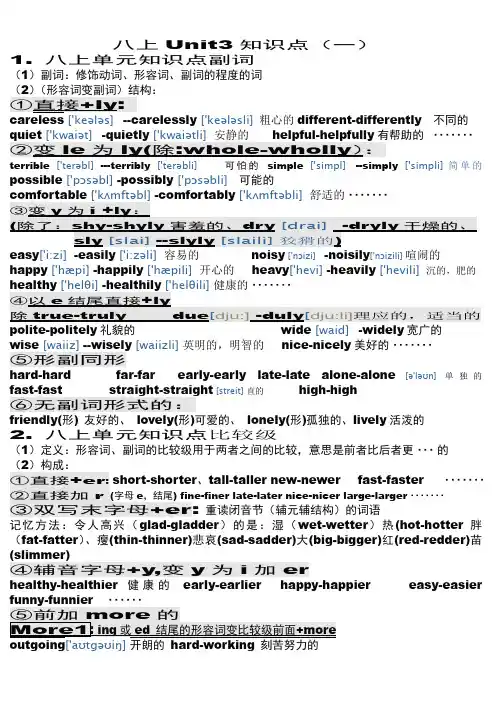
八上Unit3知识点(一)1.八上单元知识点副词(1)副词:修饰动词、形容词、副词的程度的词①直接+ly:careless ['keələs] --carelessly ['keələsli] 粗心的different-differently 不同的quiet ['kwaiət] -quietly ['kwaiətli] 安静的helpful-helpfully有帮助的·······:②变le为ly(除:whole-wholly)terrible['terəbl]---terribly ['terəbli]可怕的simple['simpl] --simply ['simpli] 简单的possible ['pɔsəbl] -possibly ['pɔsəbli]可能的comfortable ['kʌmftəbl] -comfortably ['kʌmftəbli] 舒适的·······③变y为i +ly:(除了:shy-shyly害羞的、dry [drai] -dryly干燥的、sly [slai] --slyly [slaili] 狡猾的)easy['i:zi] -easily ['i:zəli] 容易的noisy ['nɔizi] -noisily['nɔizili] 喧闹的happy ['hæpi] -happily ['hæpili] 开心的heavy['hevi] -heavily ['hevili]沉的,肥的healthy['helθi]-healthily['helθili]健康的·······④以e结尾直接+ly除true-truly due[dju:] -duly[dju:li]理应的,适当的polite-politely礼貌的wide [waid] -widely宽广的wise [waiiz] --wisely [waiizli] 英明的,明智的nice-nicely美好的·······⑤形副同形hard-hard far-far early-early late-late alone-alone[ə'ləʊn]单独的fast-fast straight-straight [streit] 直的high-high⑥无副词形式的:2.八上单元知识点比较级(1)定义:形容词、副词的比较级用于两者之间的比较,意思是前者比后者更···的(2)构成:①直接+er: short-shorter、tall-taller new-newer fast-faster ·······②直接加r (字母e,结尾) fine-finer late-later nice-nicer large-larger·······③双写末字母+er:重读闭音节(辅元辅结构)的词语记忆方法:令人高兴(glad-gladder)的是:湿(wet-wetter)热(hot-hotter胖(fat-fatter)、瘦(thin-thinner)悲哀(sad-sadder)大(big-bigger)红(red-redder)苗(slimmer)④辅音字母+y,变y为i加erhealthy-healthier健康的early-earlier happy-happier easy-easier ⑤前加more的More1: ing或ed 结尾的形容词变比较级前面+moreoutgoing['aʊtɡəʊiŋ]开朗的hard-working 刻苦努力的interesting ['intrəstiŋ]—interested ['intrəstid] (有趣的)surprising [sə'praiziŋ] --surprised [sə'praizd] (惊讶的)relaxing [ri'læksiŋ]—relaxed [ri'lækst] (放松的)boring-bored(枯燥的) tiring ['ta iər iŋ]—tired ['taiəd] (劳累的) exciting—excited(刺激的) talented ['tæləntid]有才能的·······More2:形容词后+ly 变成副词的前面+morequickly快的carefully 小心的quietly['kwaiətli] 安静的seriously ['sɪəriəsli]严肃的 happily 快乐的luckily 幸运的·······注意:friendly—friendlier lovely—lovelier lonely ['ləʊnli] --- lonelier ['ləʊnliə] More3:多音节词和部分双音节词(1)7个字母以及7个字母以下的词语:比较级加more的顺口溜:现代流行怕细心modern ['mɔdn]popular['pɔpjələ] afraid[ə'freid]careful['keəfl]严紧(紧张的)诚实用耐心serious ['siəriəs] nervous[ˈnɜ:vəs]honest ['ɔnist] useful(或useless) patient ['peiʃnt]经常(正常的)(常见的)积极有帮助often['ɔfn] normal[ˈnɔ:ml] common/kɔmən/ active ['æktiv]helpful(helpless)基本出名古得开自然无害地加fun和upset (沮丧的)basic ['beisik] 、famous、ancient[ˈe inʃənt]open ['əʊpən] natural[ˈnætʃrəl]harmless (harmful)fun upset (2)8个字母以及8个字母以上的词的比较级全部加more ⑥不规则的特殊记忆well -----better bad或badly--------worse ][wə:s] little—----less far---—farther或further['fə:ðə] 更远的八上单元知识点①“····比较级than····”:····比···“···数字times+比较级+than····”:···是···的几倍(一倍once两倍twice+times)···比较级than any other + 单数名词:比其他任何都··今早我起得比我妈早。
八年级上册英语单词表Unit3
八年级上册英语单词表Unit3八年级上册英语单词表Unit3(人教版)Unit3 Im more outgoing than my sister. outgoing [aʊtɡəʊɪŋ] adj.外向的better [betə(r)] adj.更好的;较好的 adv.更好地loudly [laʊdli] adv.大声地;高声地;花俏地quietly [kwaɪətli] adv.安静地;悄悄地;平静地hard-working [hɑːdwɜːkɪŋ] adj.勤勉的;努力工作的 competition [ˌkɒmpətɪʃn] n.竞争;比赛fantastic [fæntæstɪk] adj.极好的;了不起的which adj.哪一个;哪一些pron.哪一个;哪些clearly [klɪəli] adv.清楚地;显然地win [wɪn] v.赢;赢得;获胜;获得n.胜利though conj.虽然;尽管;adv.不过care about关心talented [tæləntɪd] adj.有才能的;有天赋的truly [truːli] adv.真实地;真诚地;正确地care [keə(r)] v.关心;担忧;照顾;在乎serious [sɪəriəs] adj.严肃的;严重的;庄重的mirror [mɪrə(r)] n.镜子;反映necessary [nesəsəri] adj.必要的;必然的both [bəʊθ] adj.两者都pron.两者should [ʃəd] aux.应该;可能;应当;将要touch [tʌtʃ] vt.触摸;感动reach [riːtʃ] v.到达;伸出;达成;取得联系;延伸;(伸手)去够 heart [hɑːt] n.心脏;内心fact [fækt] n.事实;真相;实际break [breɪk] v.打碎;折断;违背;解决;中断laugh [lɑːf] v.发笑;笑;嘲笑 n.笑声;笑;笑料similar [sɪmələ(r)] adj.类似的share [ʃeə(r)] vt.分享,共享;分配;共有loud [laʊd] adj.大声的;adv.大声地;响亮地primary [praɪməri] adj.最初的,最早的be different from和...不同information [ˌɪnfəmeɪʃn] n.信息;情报;资料;通知 as long as只要bring out拿出;推出the same as与...同样的in fact事实上;实际上;确切地说be similar to类似于;与...相似。
八年级上册英语unit3重点归纳
八年级上册英语Unit3重点归纳Embarking on our exploration of Unit 3 in Grade Eight English, we dive into a world brimming with exciting topics and essential language skills. This unit offers us not just vocabulary but also cultural insights and opportunities to hone our communication abilities. Let's delve right in!Key Vocabulary Spotlight: The cornerstone of any language learning journey is its vocabulary. In this unit, expect to encounter words that paint vivid pictures –adjectives like 'spectacular', verbs like 'wanderlust-inducing', and nouns such as 'historical landmarks'. Master these word gems and you'll find yourself weaving tales full of charm and depth.Grammar Gems for Enhancement: Grammar holds the key to unlocking the intricacies of English expressions. Here, we focus on present perfect tense and its wonders in narrating past experiences up until now ("I have visited five countries so far."). Embracing this tense enriches your storytelling capabilities, making each account come alive with precision and clarity.Cultural Insights Galore:Beyond mere linguistic pursuits, Unit 3 takes us on virtual tours across continents, immersing us in diverse cultures. From the bustling streets of Rome to the serene temples of Asia, every page whispers stories of heritage, customs, and traditions. Engage deeply with these narratives; let them broaden your horizons beyond textbooks.Reading Comprehension Skills Boost:Reading passages carefully crafted around our theme encourage critical thinking and deeper understanding. As you navigate through articles discussing famous monuments or biographical sketches, practice skimming for main ideas and scanning for details. Sharpen your comprehension skills by summarizing what you read aloud –it helps solidify knowledge within.Speaking & Writing Opportunities Abound:Practice makes perfect, especially when honing oral and written fluency. Group discussions centered around cultural differences or debates about conservation efforts foster confidence while enhancing vocabulary application. Don't shy away from penning essays exploring personal connections to historical sites; they are windows to your thoughts and emotions.In conclusion, Unit 3 presents a smorgasbord of treasures waiting to be uncovered. By mastering its core vocabulary, grasping essential grammar rules, soaking up cultural nuggets, boosting reading comprehension, and embracing speaking and writing challenges, you'll emerge stronger, more knowledgeable, and ready to embark on further adventures in English learning. So, gear up and embrace all that awaits you in this fascinating unit!。
八年级上册英语unit3单词表
八年级上册英语unit3单词表人教版八年级上册英语Unit 3单词表。
一、outgoing [ˈaʊtɡəʊɪŋ] adj. 外向的。
1. 例句:My sister is very outgoing.(我的姐姐非常外向。
)二、better [ˈbetə(r)] adj. & adv. (good和well的比较级)较好的(地);更好的(地)1. 例句:You can do better next time.(下次你能做得更好。
)三、loudly [ˈlaʊdli] adv. 喧闹地;大声地;响亮地。
1. 例句:Don't talk so loudly in the library.(不要在图书馆这么大声说话。
)四、quietly [ˈkwaɪətli] adv. 轻声地;轻柔地;安静地。
1. 例句:She left the room quietly.(她安静地离开了房间。
)五、hard - working [ˌhɑː d ˈwɜːkɪŋ] adj. 工作努力的;辛勤的。
1. 例句:My father is a hard - working man.(我的父亲是一个辛勤工作的人。
)六、competition [ˌkɒmpəˈtɪʃn] n. 比赛;竞赛;竞争。
1. 例句:There will be a singing competition next week.(下周将有一场歌唱比赛。
)七、fantastic [fænˈtæstɪk] adj. 极好的;了不起的。
1. 例句:The movie is fantastic.(这部电影棒极了。
)八、which [wɪtʃ] pron. & adj. 哪一个;哪一些。
1. 例句:Which book do you like?(你喜欢哪一本书?)九、clearly [ˈklɪəli] adv. 清楚地;清晰地;明白地。
人教版八年级上册英语Unit3重点单词与重点短语(附例句)-全
人教版八年级上册英语Unit3重点单词与重点短语(附例句)Unit 3 I'm more outgoing than my sister.【重点单词】outgoing ['aʊtɡəʊɪŋ] adj. 外向的The little girl is outgoing and lively.better ['betə(r)] adj. & adv. (good和well的比较级) 较好的(地);更好的(地)Tom is better at mathematics.loudly ['laʊdli] adv. 喧闹地;大声地①Xiao Ming is talking loudly in the classroom.②You should read English aloud in the morning声地;响亮地quietly ['kwaɪətli] adv. 轻声地;轻柔地;安静地He walked quietly into the bedroom.hard-working [ˌhɑː(r)d'wɜːkɪŋ] adj. 工作努力的;辛勤的He is a hard-working girl.Xiao Ming is a hard-working worker.competition [ˌkɒmpə'tɪʃn], [ˌkɑːmpə'tɪʃn] n. 比赛;竞赛;竞争There will be a math competition in our school tomorrow.I won the first prize in the painting competition.fantastic [fæn'tæstɪk] adj. 极好的;了不起的You look fantastic in that dress.你穿那件连衣裙真好看。