
八年级英语(下)第4单元第3课时
2)What are they doing?
3)Where are they?
4) Can you guess what’stheir problem?
III.Practice
操练
1.速读(Fast Reading)
—Well you should call him so that you can say you’re sorry.
—…
2) Role play the conversation.(2d)
2. Revision “复习检查”
通过检查上节课布置的作业落实作业完成情况,进而为新课的导入铺路搭桥。
通过检查“学案”中“新知预习”内容检查预习效果,
1.Free talk “自由交际”
1) Make conversations to talk about problems and give advice.
e.g.:
—What’swrongwith you?
—Ihad a fight with my best friend.What should I do?
II.Presentation
呈现
1. Learning tasks“示标定向”
(1)学习并掌握新词汇:
relation, communicate, communication, argue, cloud, elder, instead, whatever, nervous, offer, proper, secondly, explain, clear, copy, return, anymore
6. Compare the advice with your classmate’s and choose the best advice.
V.Examination
检测
1.引导学生小结梳理知识框架、规律、方法,并对合作小组当堂学习情况进行总结评价,巩固学生所获得的语言知识和经验,让学生在评价中反思,在反思中进步。
2.能正确使用以下常用表达:
get on with, elder brother, refuse to do sth, instead, feel lonely and nervous, mind sb doing sth, enough sleep, a big deal, so that, surprise sb, without doing sth, make sb angry, until the last minute, fight all the time, be afraid of doing, leave sth at home
(2)能正确使用以下常用表达:
get on with, elder brother, refuse to do sth, instead, feel lonely and nervous, mind sb doing sth, enough sleep, a big deal, so that, surprise sb, without doing sth, make sb angry, until the last minute, fight all the time, be afraid of doing, leave sth at home
Ask one of the students to say what they have learnt.
1)words 2)phrases 3) sentences
3. Read and recite the sente Fill in the blanks with “ although, so that or until”.(4a)
5. Give some advice about the problems. (4b)
Read quickly and find the answers to the questions:
(1) Who write the letter?
(2)What’s the writer’s problem?
(3)What’s the advice that Mr Hunt gave?
2.精读(Intensive Reading)
八年级英语(下)第4单元第3课时
Unit4Why don’t you talk to your parents?
Section AGrammar Focus—4c
一、【教材分析】
教
学
目
标
知识
目标
1.学习并掌握新词汇:
relation, communicate, communication, argue, cloud, elder, instead, whatever, nervous, offer, proper, secondly, explain, clear, copy, return, anymore
Robert Hunt
2.Read the words and expressions in3cthen find out which words or phrases in the letters have the same or similar meanings as them. Then write a sentence using each word or phrase.(3c)
A: Well, you could tell her that this makes you angry so that she will ask you next time.
2. Leading-in“导入新课”
(1) Look at the picture in3a, and answer the following questions:
IV.Consolidation
巩固
1. Close the books and try to fill in the blanks.
Dear Mr Hunt,
My problem is that I can’t _______ _______ ______my family. Relation between my parents have become difficult. They ________ ______ _______, and I really don’t like it. It’s the ______ _________________ they have. I don’t know is I should say anything to them about this. When they _______, it’s like a big, black cloud _________ ________ our home. Also, my ______ __________ is not very nice to me. He always refuses to let me watch my favorite TV show. ________ he watches _____________ _____ _______ until late at night. I don’t think this is fair. At home I always feel __________ _____ ______________. Is that normal?
What can I do?
Sad and Thirteen
Dear Sad and Thirteen,
It’s not easy ________ your age, and it’s normal to have these _________. ________ _______ _______talk about these feelings with your family? If your parents are having problems, you should ________ ________ ________. Maybe you could do more jobs around the house ______ _______ they have more time for ________ ________________.
Read the passage carefully andanswer the question:
What do you think of the advice?(3b)
Then talk about the advice. For example:
I agree / disagree with his advice because…
(3)学会使用以下句型:
1) A: What should he do?
B: He should talk to his friend so that he can say he’s sorry.
2) A: What’s wrong?
B: My sister borrows my clothes without asking. What should I do?
3.学会使用以下句型:
(1) A: What should he do?
B: He should talk to his friend so that he can say he’s sorry.
(2) A: What’s wrong?
B: My sister borrows my clothes without asking. What should I do?
A: Well, you could tell her that this makes you angry so that she will ask you next time.
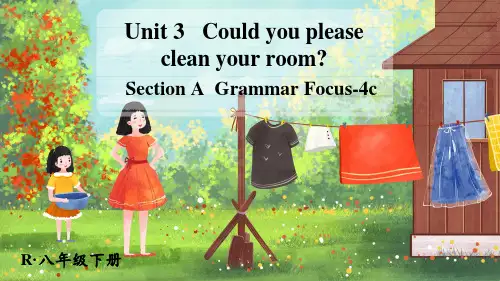
八年级英语下册《Unit 3 第3课时(A Grammar Focus-4c)》教学课件
talents at the very beginning.
—I agree. Even Einstein _______ read until he
was seven.
A. can’t
B. mustn’t
C. couldn’t
D. needn’t
根据对话内容,用情态动词 can, could 或 must 的适当形式填空,使对话完整、通顺。
注意
(1)无论是“Could you please... ?”还是
“Could I ...?”句型,问句中的 could 可用 can 来
代替,但是 could 更委婉。且答语中一般都避免使
用 could 来回答。
(2)句中 please 还可放在句尾,其前用逗号和前面的
内容隔开。
例:——请问我可以邀请朋友去聚会吗? ——当然可以。那听起来很有趣。 —Could I invite my friends to the party, please? —Of course you can. That sounds fun.
答语中的 can 不能换成 could
典例剖析 (酒泉中考)
—Can I borrow your new comic books?
—___________ Here they are.
A. What’s up?
B. What a pity!
C✔. Sure.
D. Thank you.
拓展
could 的其他用法如下:
Could you please fold your clothes, fold your clothes? Could you please make the bed, make the bed? If we are free, we all say “Yes, sure”. If we are busy, we can say “Sorry, I can’t”.
八年级下册unit4第3课时教案

学校:年级:八教师:课题:Unit Period 3日期:
备课项目
首备区域
复备区域
备课标与教材
分析课标目标要求与课
节语言知识、技能之间
的关系。
本节的知识点贯穿在本单元的听,说,读,写的环节中,使学生循序渐进地完成本单元学习。以讨论学习为情节展开教学,大量运用过去进行时态训练。进一步培养学生的跨文化意识和综合语言运用能力。
Steps:
1.answer the questions.
1. How was Alan’s grandpa?
2. Did he feel happy when he see envelope from school?
3. What did he think of science?
4. What did his science teacher say?
Steps:
1.进行单词的音形教学,让学生读写单词。
in good health
report card
nervous['nə:vəs]
envelope
semester
true
disappointing
lucky['lʌki]
copy['kɔpi]
own[əun]
get over
1. They had their o_______ house after they worked for five years in this city.
依据课标情感态度目
标描述,制定适合本
节课的情感态度目标
通过创设人文情景,学生身临其境感受和体验,使语言学以致用,激发学生的学习积极性。通过对文章的了解,让学生体会帮助别人的乐趣,学会互相帮助,培养学生乐于接触并了解异国文化。
Unit 7 第3课时 Grammar(被动语态)八年级英语下册(牛津译林版)

His eye problem was cured two months ago. the action is more important than the person who performs the action.
D.was finished
5.—All the students ________ to attend the art and science fair for free.
—What good news!
A.invite B.are invited C.were inviting D.will invite
adverbial
分别根据两个时 态的标志词判断
被动语态标志词by
I am supported by my parents.
They were supported by their teachers.
subject be
Past participle
by
object
强调执 行者
Judge the following sentences if it is passive voice
A.found
B.was found
C.founded
ቤተ መጻሕፍቲ ባይዱ
D.was founded
3.Frozen, a musical fantasy film, ________ by Walt Disney in 2013.
A.is produced
八年级英语下册《Unit 8 第3课时(A Grammar Focus-4c)》教学课件
C. yet; What a
D. already; What
2. —The book is popular. _____ you _____ it yet?
—Yes, I have.
A. Are; reading
B. Were; reading
C. Have; read
D. Will; read
3. —When will you give the novel back to me?
Have you decided in cYoems,mI ohna.ve. I’ve already
which book to write finished reading it. It was
about yet?
really good.
现在完成时(一)
一、现在完成时的用法 1. 表示过去发生或已经完成的动作对现在造成
二、单项选择。
1. —Have you seen the hot film Wandering Earth _____?
—Yes, I have. _________ wonderful science fiction
movie it is!
A. yet; How a
B. already; How
(未);尚(未)”。
例 句 Has your father eaten dinner yet?
五、现在完成时与一般过去时的区别 1. 现在完成时
用法:表示过去发生的动作对现在造成的影响, 侧重于现在的情况。
时间状语:常和already, yet, just, ever, never, before, since, for等连用。
Unit 8 Have you read Treasure Island yet?
八年级英语下册Unit4Reading优秀教案
教材分析1.教学内容本课是新目标英语八年级下册第4单元阅读部分,本单元的语言目标是“Report what someone said”(引述别人讲的话),学习直接引语和间接引语。
本课以“志愿者支教”为主要内容,通过志愿者杨蕾的支教事迹和想法而引出助人为乐,扶危济困这一中心话题,本文篇幅长,生词多,读前、读中、读后的任务多。
鉴于学生的实际情况及教材的特点,考虑到学生对长篇阅读的畏难情绪以及他们在课堂上可能出现的一些反应,我大胆构思了整个教学过程,构建“以生为本”的互动式阅读课堂,想办法尽可能降低文章难度,将难点分散,并根据需要整合了运用多种教学方法,让学生在互动中享受阅读。
2.教学目标A. Knowledge objectives:To master the words and expressions.To get familiar with the topic and use the sentences about helping others.To use “Direct Speech and Reported Speech”.B. Ability objectives:To find out the information and get the general idea of the text.To infer the meaning of the word they don’t know from the context.C. Affective objectives:Students are to realize the importance of helping others and they are encouraged to help others.By understanding the life in rural areas, students are to realize how happy they are.3.教学策略:(1)兴趣激发策略。
人教版初中八年级英语下册第四单元Unit 4 教案含教学反思
Section A 单词allow v.允许;准许wrong adj.有毛病;错误的guess v.猜测;估计deal n.协议;交易relation n.关系;联系;交往communication n.交流;沟通argue v.争吵;争论cloud n.云;云朵elder n.年纪较长的instead adv.代替;反而;却whatever pron.任何;每一nervous adj.焦虑的;担忧的offer v.主动提出;自愿给予proper adj.正确的;恰当的secondly adv.第二;其次communicate v.交流;沟通explain v.解释;说明clear adj.清楚易懂的;晴朗的copy v.抄袭;模仿;复制;复印return v.归还;回来;返回anymore adv.(常用于否定句和疑问句句末)再也(不);(不)再短语look through快速查看;浏览big deal重要的事work out成功地发展;解决get on with和睦相处;关系良好句型1.Many of them are learning exam skills so that they can get into a good high school and later a good university.他们中很多人正在学习应试技巧以便能考入一所好高中,进而升入一所好大学。
2.The Taylors are a typical American family.泰勒家就是一个典型的美国家庭。
3.And they are always comparing them with other children.而且她们总是将自己的孩子和别的孩子相比较。
语法although, so that及until引导的状语从句知识目标掌握课文中的重点词汇及相关短语,并灵活运用。
能力目标学会谈论问题和给出建议情感目标遇到问题要主动地去和家人、朋友或亲近的人交流;如果身边的人遇到问题,能主动提供帮助;要学会放松、缓解压力。
八年级英语上册 Unit 9 Can you come to my party(第3课时)说课稿
八年级英语上册 Unit 9 Can you come to my party(第3课时)说课稿一. 教材分析《八年级英语上册》Unit 9 “Can you come to my party?” 是人教版新目标英语的重要单元,主要围绕邀请和聚会主题展开。
本节课为该单元的第三课时,主要教学内容为对话和任务型活动。
通过本节课的学习,学生将能够运用所学知识进行日常邀请交流,提高英语口语表达能力。
二. 学情分析八年级的学生已经掌握了基本的英语语法和词汇,具备一定的听说读写能力。
但是,对于某些交际用语和表达方式还不够熟练,需要通过课堂学习和实践来提高。
此外,学生的学习兴趣和积极性也是影响教学效果的重要因素。
三. 说教学目标1.知识目标:学生能够掌握并运用日常邀请和聚会相关的词汇和表达方式。
2.能力目标:学生能够听懂、会说、会读、会写关于邀请和聚会的句子。
3.情感目标:学生能够积极参与课堂活动,提高团队合作和交际能力。
四. 说教学重难点1.重点:学生能够掌握并运用日常邀请和聚会相关的词汇和表达方式。
2.难点:学生能够正确使用情态动词“can” 来表达邀请和回答。
五. 说教学方法与手段本节课采用任务型教学法,结合情境教学法和分组合作学习法。
通过设定各种真实的交际情境,引导学生积极参与课堂活动,提高口语表达能力。
同时,利用多媒体教学手段,如PPT、视频等,增加课堂趣味性和互动性。
六. 说教学过程1.热身活动(5分钟):通过播放一段关于聚会的视频,引导学生谈论自己参加过的聚会,激发学生的学习兴趣。
2.呈现新课(10分钟):教师通过展示一组关于邀请和聚会的图片,引导学生猜测图片中的人物在说什么,引出本节课的主题。
接着,教师呈现本节课的主要词汇和句型,如“Can you come to my party?” 和“I can’t comebecause…” 等。
3.操练活动(10分钟):学生两人一组,进行角色扮演,模拟邀请和回答的场景,巩固所学知识。
新目标英语八年级下册Unit4单元配套课时练习题 含答案
Section A (1a—2d)Ⅰ. 根据语境及所给首字母提示,补全所缺单词。
1. —Jim, the cat is lovely. I want to have it as a pet.—But Mom doesn’t a us to keep animals at home.2. There’s something w with my watch. Can you help to repair it?3. —Where’s our En glish teacher now?—Hmm, I g she’s in the sports club but I’m not sure.4. —Mom, my little sister made my room in a mess.—It’s not a big d . After all (毕竟), she is only three years old. Ⅱ. 根据汉语意思完成英语句子,每空词数不限。
1. 吉米,不要浏览我的东西。
Ji mmy, don’t _________________ my things.2. 你不应该和别的孩子打架。
You shouldn’t _________________ with other children.3. 我们乘出租车吧,以便我们能准时到达那里。
Let’s take a taxi _________________ we can get there on time.4. 对于简来说最终事情的结果很不错。
Things _________________ well for Jane in the end.5. 你将何时还我自行车?When will you _________________ the bicycle to me?Ⅲ. 根据对话内容,从方框中选择恰当的选项补全对话。
A: Linda, your sister Rose is crying in her room. (1)_______B: Oh, just now I quarreled (吵架) with her.A: Why? (2)_______B: Yes. She gave my model plane to Jerry.A: Did she tell you about it before she did it?B: (3)_______A: Although she’s not right, she is just a little girl and she is your sister. B: You’re right. (4)_______A: Go to her room and say sorry to her.B: (5)_______ Rose, Rose ...答案Section A (1a—2d)Ⅰ. 1. allow 2. wrong 3. guess 4. dealⅡ. 1. look through 2. have a fight / fight 3. so that4. worked out5. give backⅢ. 1-5 CEABDSection A 3a—Grammar FocusⅠ. 根据语境,从方框中选择恰当的单词填空,有的需要变换形式。
最新人教版八年级下册英语第四单元导学案
Unit 4 W hat’s the best movie theat e r?第一课时Sectio n A1a-2d一、学习目标知识目标:学会使用下列单词和短语:theate r, comfor table, seat, screen, close, ticket, worst, cheapl y, song, choose, carefu lly, report er, fresh, comfor tably, so far 。
句子:What’sthebestc lothe s storein town? I thinkMiller’sisthebest.能力目标:初步理解并运用最高级,掌握最高级的构成规则。
情感目标:学会通过比较确定自己最喜欢的事物;身动、心动、神动,做课堂的主人。
激情投入,体会成功的快乐。
教学重点:词汇及最高级的构成规则。
教学难点:最高级在语言环境中的运用。
二、预习展示1.单词theate r____________ 使人舒服的___________seat____________ close_____________ 票__________ worst___________便宜地_____________小心地______________ report er_____________ comfor tably________________ 2.短语so far_________ be closeto______________看电影______________欢迎来……_________________三、合作探究(一)合作学习Task 1 小组合作完成1a discuss。
Task 2 完成1b, 2a, 2b听力。
八年级英语下册教学课件《Unit 5 第3课时(B 1a-1d)》
3. Which team won at the event? _J_o_h_n_’_s_t_e_a_m__w_o_n_._______________________
1b Listen and write short answers to the questions.
1. What event happened at the school yesterday? _T_h_e_r_e__w_a_s_a__b_a_s_k_e_tb_a_l_l_c_o_m__p_e_ti_ti_o_n_.________
realize
意识到; 我没有意识到天有多么晚。
理解
I didn’t realize how late it was.
认出; recognize 辨别出
我听出了他的声音。 I recognized his voice.
know
知道; 我知道她反对我们。 了解 I know she was against us.
a party
STohme ereeavseonntswyhoyu Imwaaysblaetleatfeorfoorr couldn’t go to an event is…
Last …, I was late for/ couldn’t go to… I was late/ couldn’t go because…
While she was running back home…
While she was running back home, she saw a dog _b_y__th_e__s_id_e__o_f _th__e_r_o_a_d_ and it _w__a_s_h_u_r_t__.